The advertisement below, for Pennsylvania Railroad – from January 15, 1945 – has a title that proved to be as optimistic as it was ironic, for after merging with New York Central Railroad in 1968, the resulting firm, the Penn Central Transportation Company, filed for bankruptcy in 1970.
The advertisement combines three elements to produce a striking image. On the left, symbolizing the future, new designs for railroad cars are displayed on a unfurled blueprint, against which are placed a T-square and right triangle. Translucent images of those “future” railroad cards appear below. On the right, a fleet of existing freight and railroad cars, en route from a “city” and a “factory” pass by a suburban rail station. In the background, stylized images of that city and factory are set against the horizon of a cloudless sky, surrounded by farmland. Above all is the emblem of the Pennsylvania Railroad.
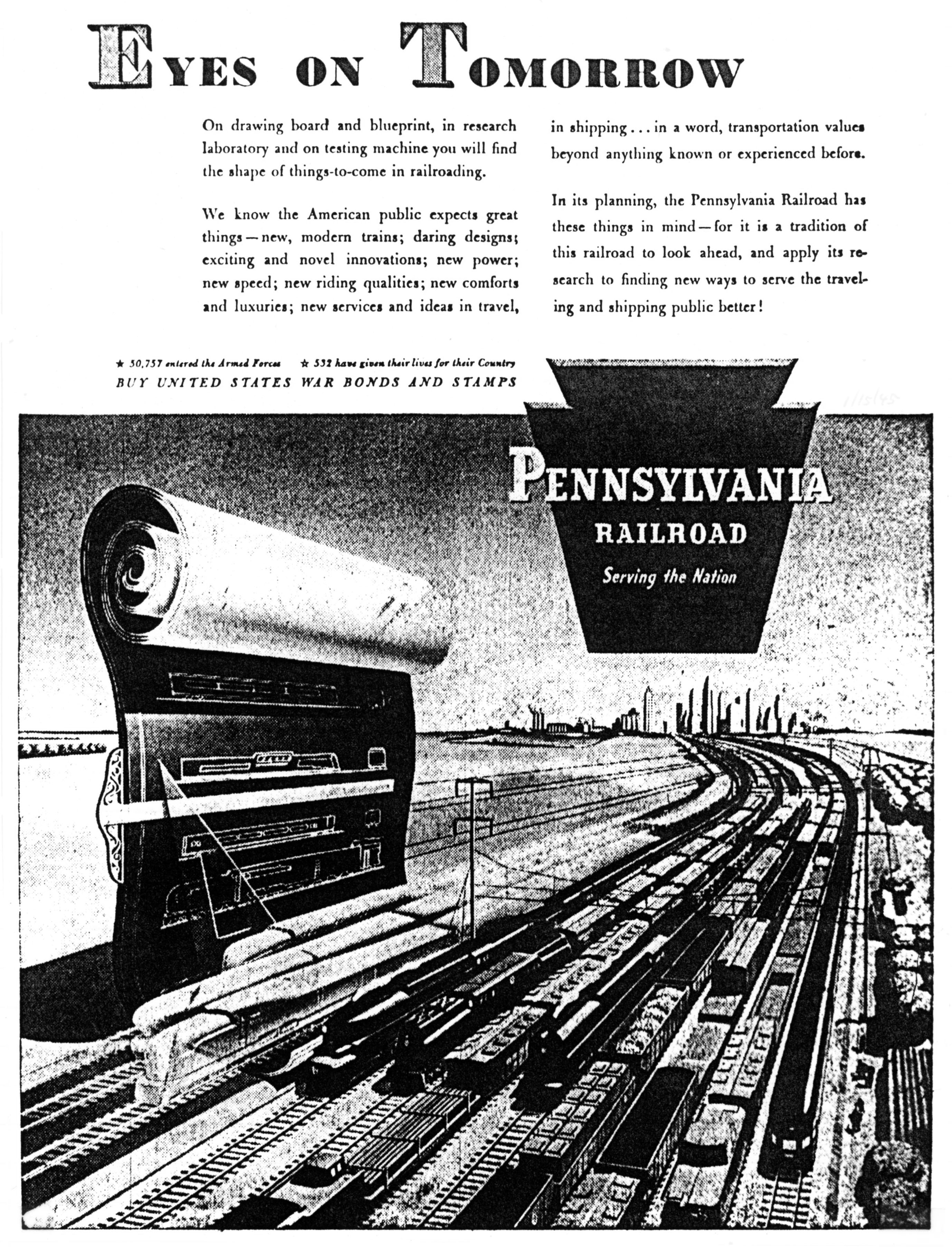
Though “this” example of the advertisement was published in The New York Times, certainly the original advertisement was in color and doubtless intended for publication in magazines.
Here’s an example of that original ad, from Pinterest:

Here’s the full text of the advertisement:
________________________________________
EYES ON TOMORROW
On drawing board and blueprint, in research laboratory and on testing machines you will find the shape of things-to-come in railroading.
We know the American public expects great things – new, modern trains; daring designs; exciting and novel innovations; new power; new speed; new riding qualities; new comforts and luxuries; new services and ideas in travel, in shipping … in a word, transportation values beyond anything known or experienced before.
In its planning, the Pennsylvania Railroad has these things in mind – for it is a tradition of this railroad to look ahead, and apply its research to finding new ways to serve the traveling and shipping public better!
★ 50,757 entered the Armed Forces ☆ 532 have given their lives for their Country
BUY UNITED STATES WAR BONDS AND STAMPS
________________________________________
That the advertisement was created during the Second World War is strikingly evident by one particular facet of the text: The number of Pennsylvania Railroad Employees who died on WW II military service. Though listed as 532, the actual number is more than twice as many: 1,307. The discrepancy was likely attributable to the fact that the advertisement was created before the war actually ended, and thus, well before the status of all casualties (especially those missing in action) was verified.
The 1,307 men are memorialized at Philadelphia’s 30th Street Station, in the form of a bronze sculpture – entitled “Angel of the Resurrection” – which portrays the Archangel Michael lifting a fallen soldier out of the “flames of war”. The sculpture is set atop a four-sided black granite base, upon the sides of which are bronze plaques listing the soldiers’ names in alphabetical order, and, bearing symbols of the four branches of the armed forces.
Designed by Walter Hancock and unveiled in 1952, the sculpture is – even decades later – striking.
References
Pennsylvania Railroad, at Wikipedia
Pennsylvania Railroad World War II Memorial, (once again), at Wikipedia
9/13/2026
I own the original art in its original frame. As a child who had just turned six, where it first appeared it stirred my imagination. Years later at the Penn Central auction it stirred my checkbook. Now, eighty years later I look at it daily and a large warm feeling comes over me. It reflects the promise of a coming post-WWII era and the most wonder era in American history. The PRR might be gone, but its commissioned artwork endures to restate the triumphs and tribulations of an America emerging from the Great Depression and the strife of WWII. The images of what might have been built, were built, not by the PRR but rather the Union Pacific, the Chesapeake and Ohio, and the Norfolk and Western. None of those locomotives were successful.