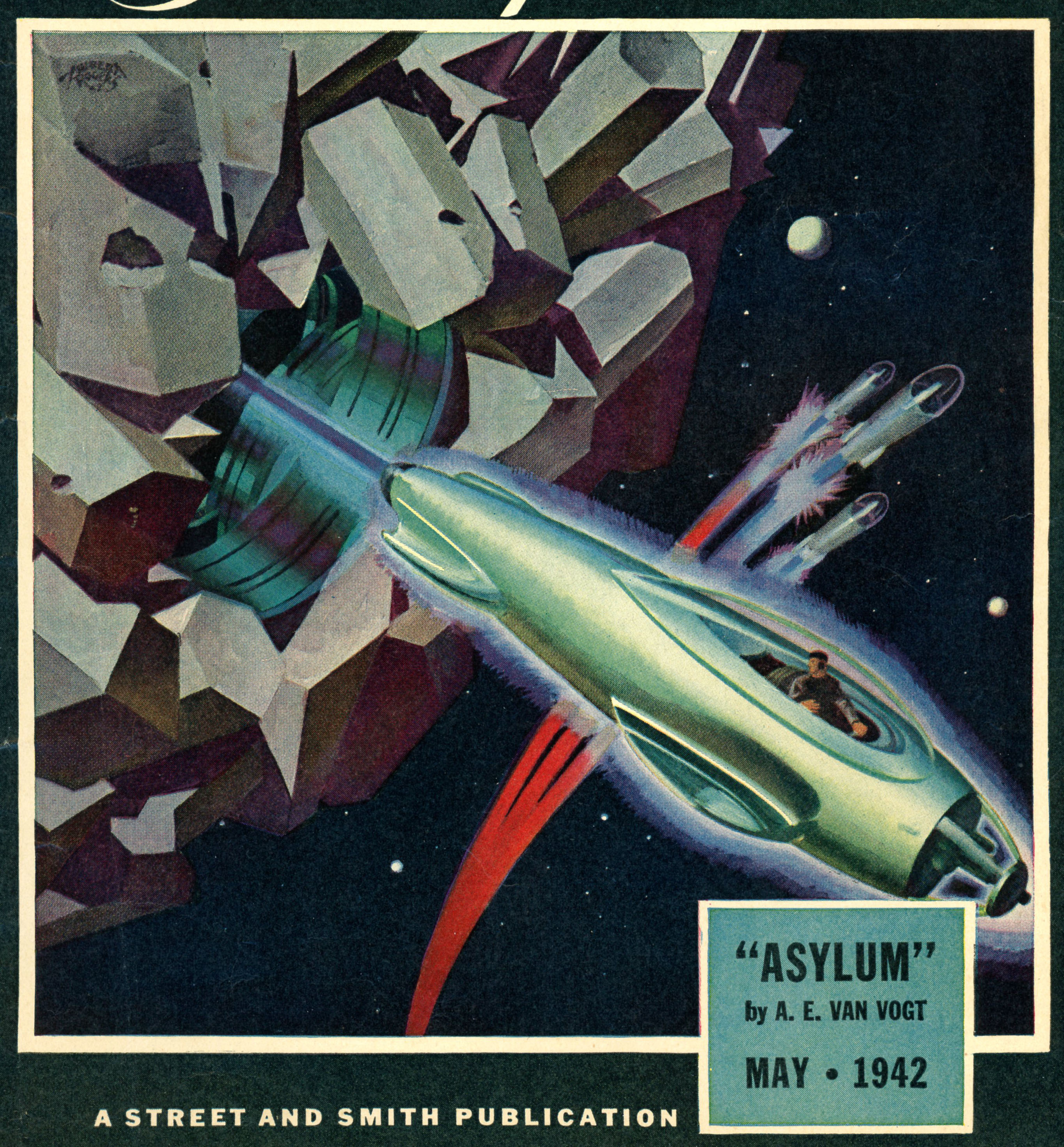
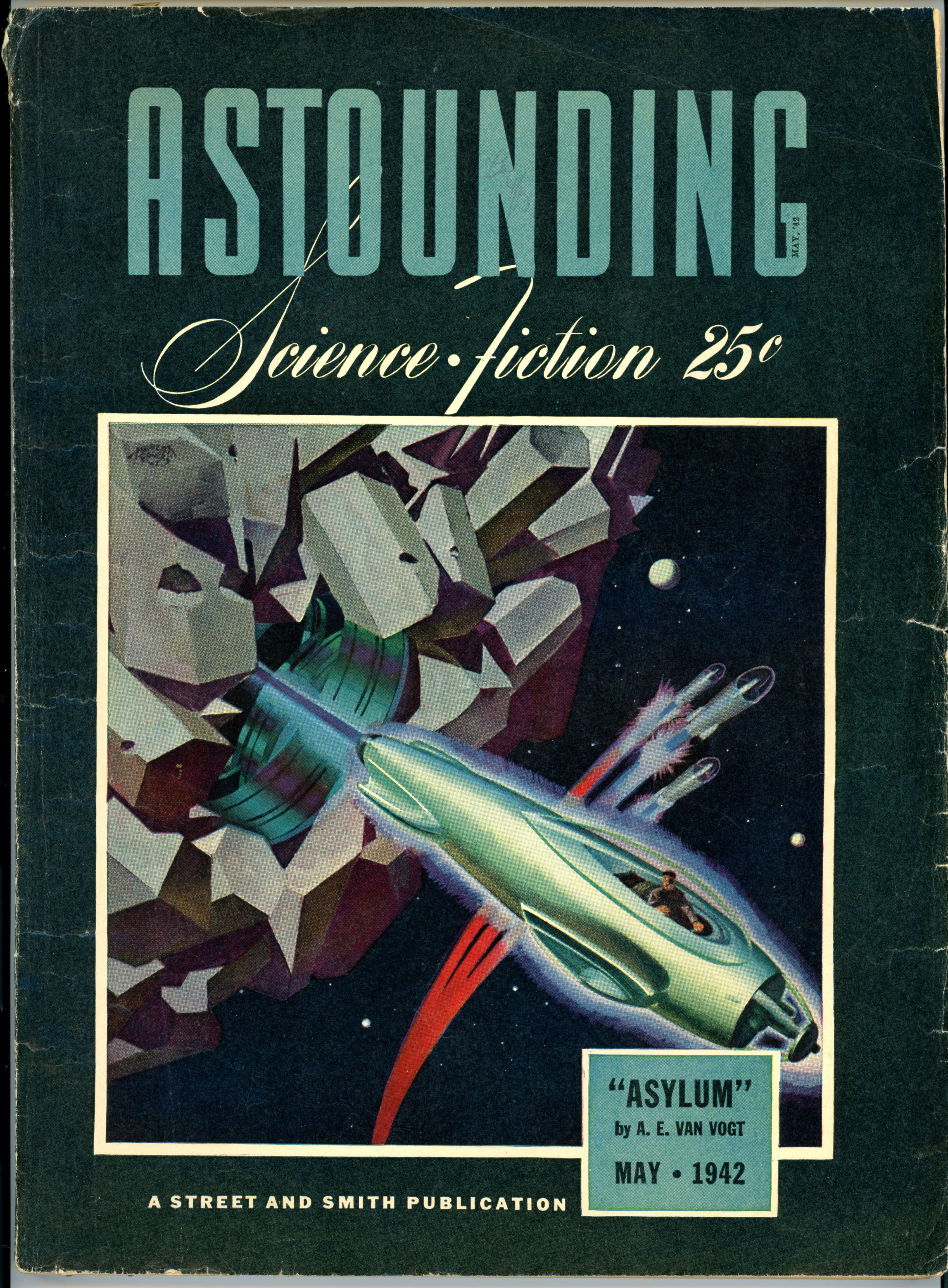
Astounding Science Fiction – May, 1942 (Featuring “Asylum”, by A.E. van Vogt) [Hubert Rogers]

“Asylum”, which is anthologized in Isaac Asimov Presents The Great SF Stories 4 (1942) (published in 1980) (one of three stories by A.E. van Vogt appearing in that volume), has qualities typical of van Vogt’s writing: Transitions between events and settings that are sometimes dreamlike – abrupt – in nature; an air of calibrated grandiosity in terms of theme and plot; a writing style generally placing vastly less emphasis on “hard science” than on the mental states and thoughts of characters. 

“Asylum” artfully, powerfully, and very effectively combines such disparate themes and concepts as super-normal (if not transcendent) intelligence, multiple identities / personalities (prefiguring a central theme of the late Philip K. Dick), and, the vampire myth. 
______________________________

Illustration by Charles Schneeman, for A.E. van Vogt’s story “Asylum” (p. 8)

______________________________

Illustration by Charles Schneeman, for A.E. van Vogt’s story “Asylum” (p. 14)

______________________________

Illustration by Charles Schneeman, for A.E. van Vogt’s story “Asylum” (p. 19)
______________________________

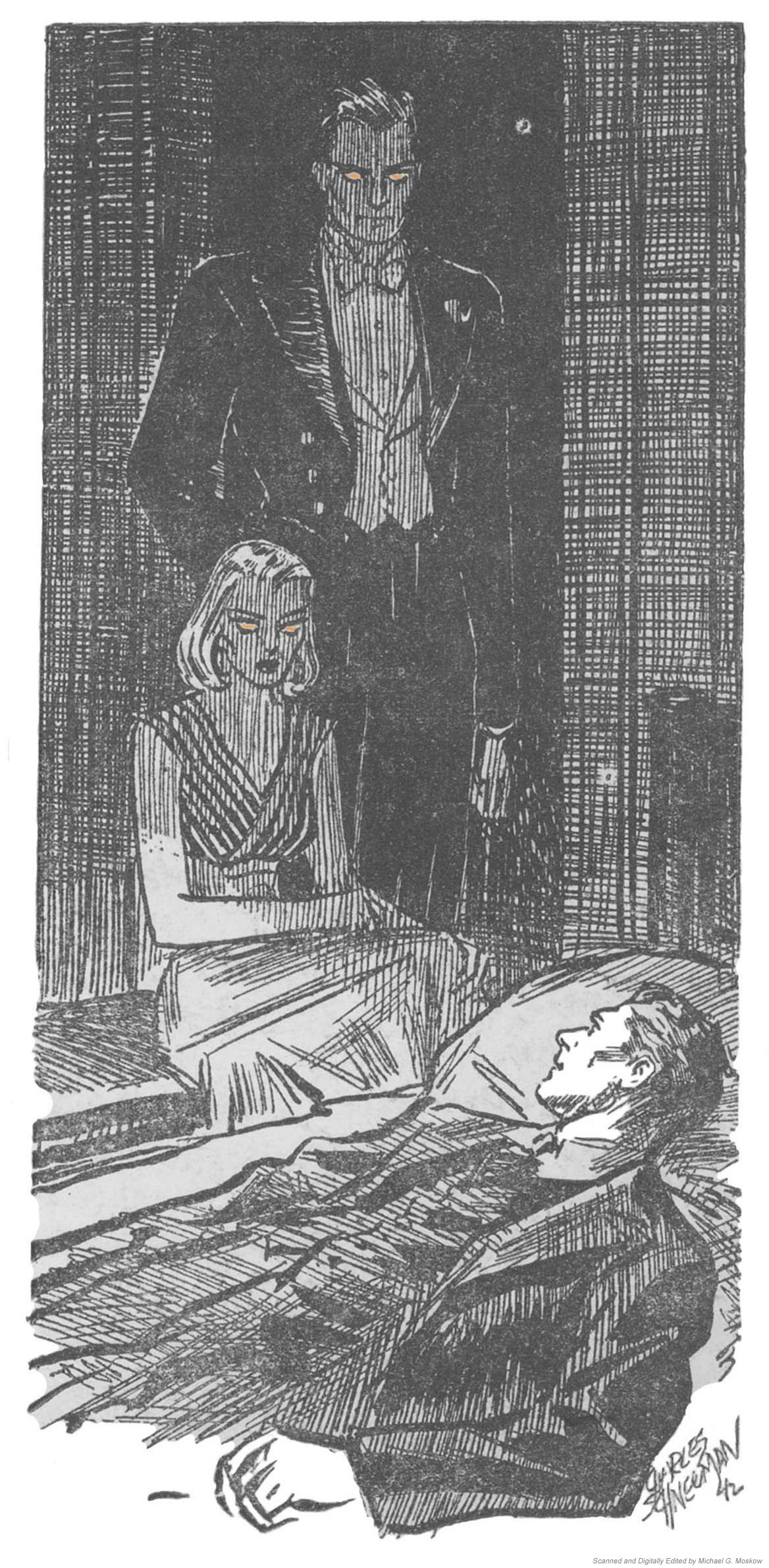
Illustration by Charles Schneeman, for A.E. van Vogt’s story “Asylum” (p. 28)

______________________________

Illustration by Hubert Rogers, for Robert A. Heinlein’s (as Anson MacDonald) story “Beyond This Horizon -” (p. 55)
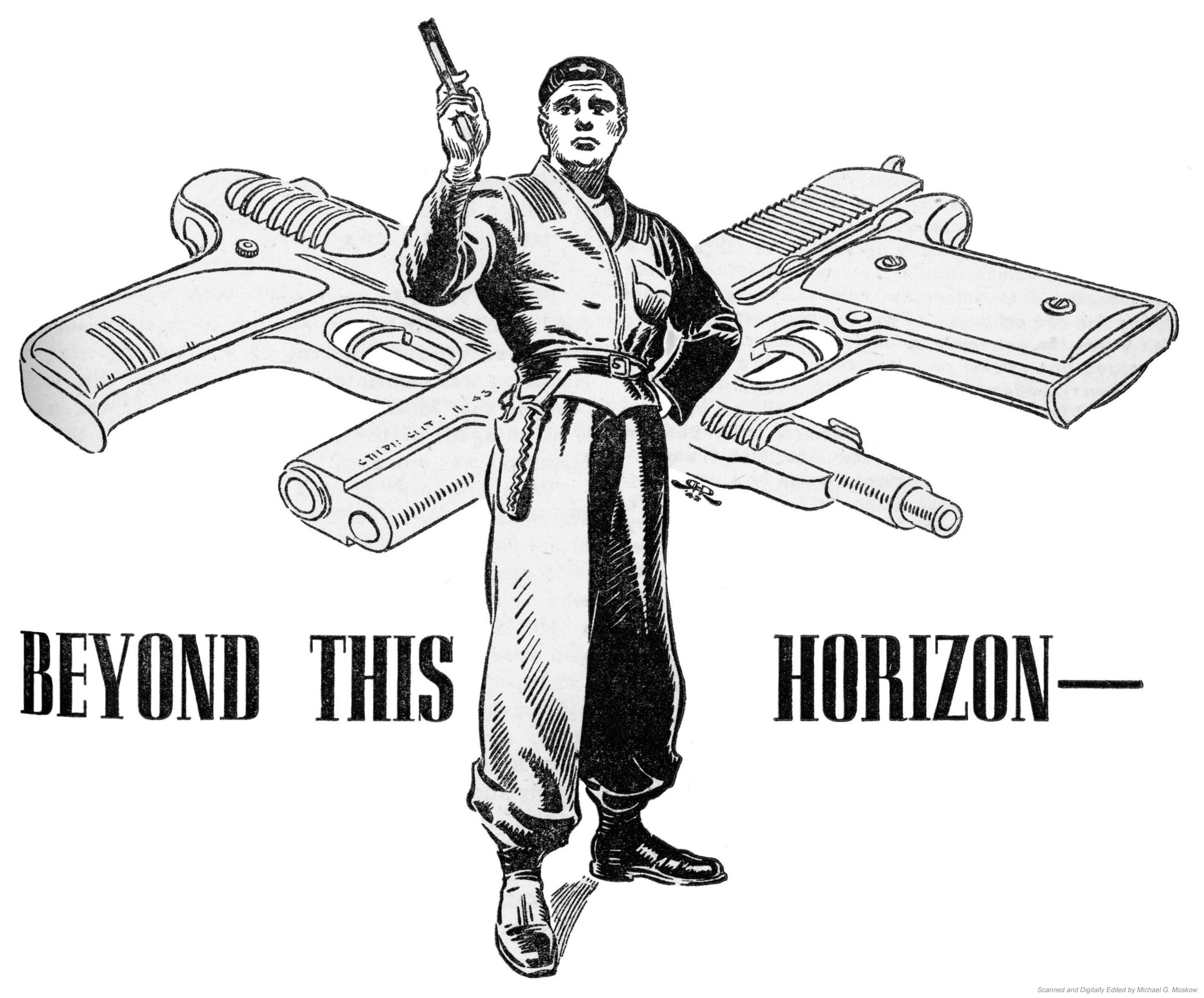
 

Technology of the present; technology of an imagined future:  A juxtaposition of a Colt M1911 .45 pistol and a futuristic pistol, the latter distinguished by its somewhat streamlined shape and two sets of “fins” – purely ornamental? – for cooling? – along the body and barrel. 

Of artistic interest, note Hubert Rogers’ stylized initials – comprised of an “H” and R”, with the year below – in the right center of the image. 

______________________________

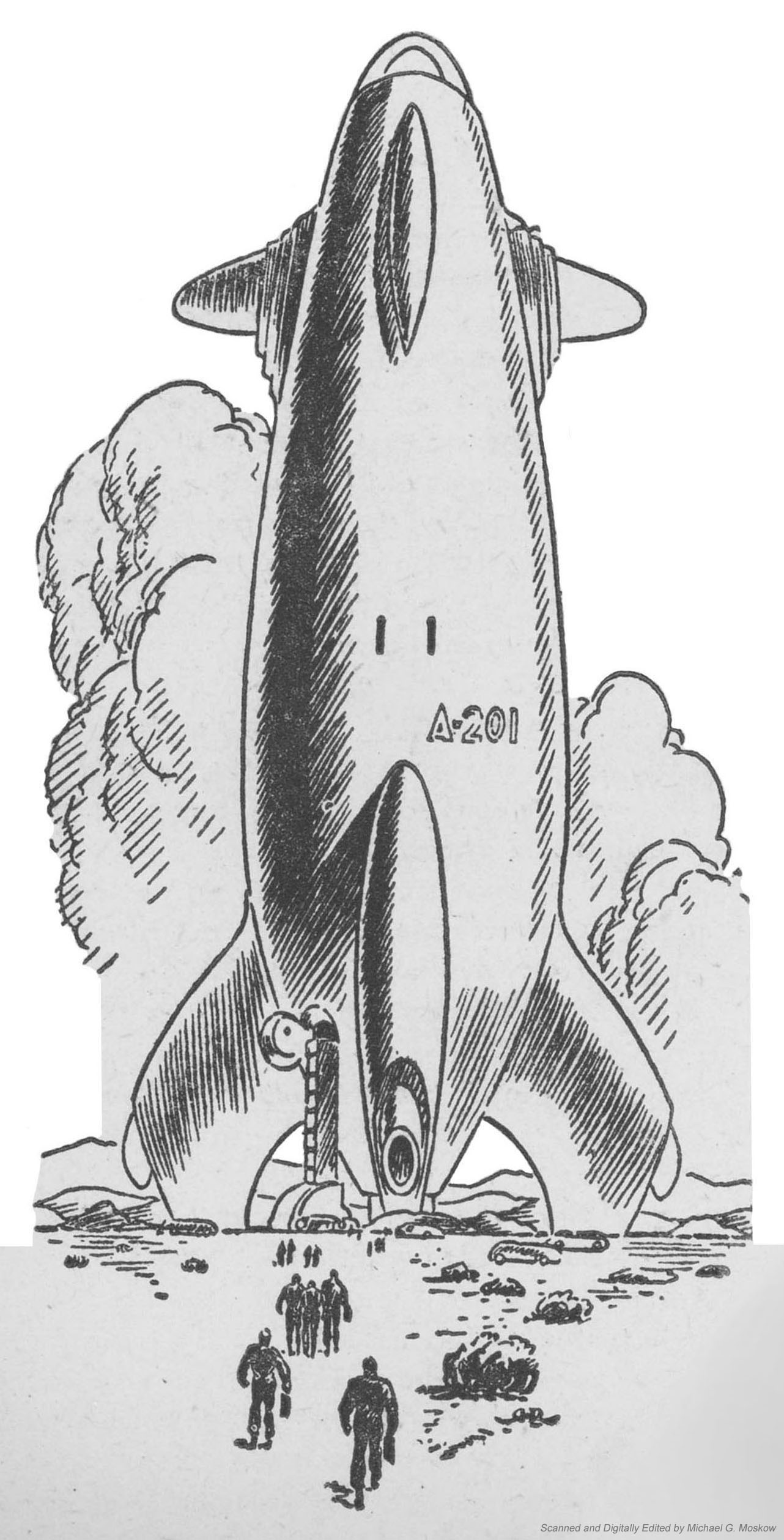
Illustration by Hubert Rogers, for Robert A. Heinlein’s (as Anson MacDonald) story “Beyond This Horizon -” (p. 60)


This illustration is representative of Hubert Rogers’ depiction of architecture of the future, in a style typical of the illustrations he did for Astounding:  The cityscape is characterized by buildings whose exteriors appear as sets of concentric parabolas, emphasizing curves rather than straight lines and angles. 

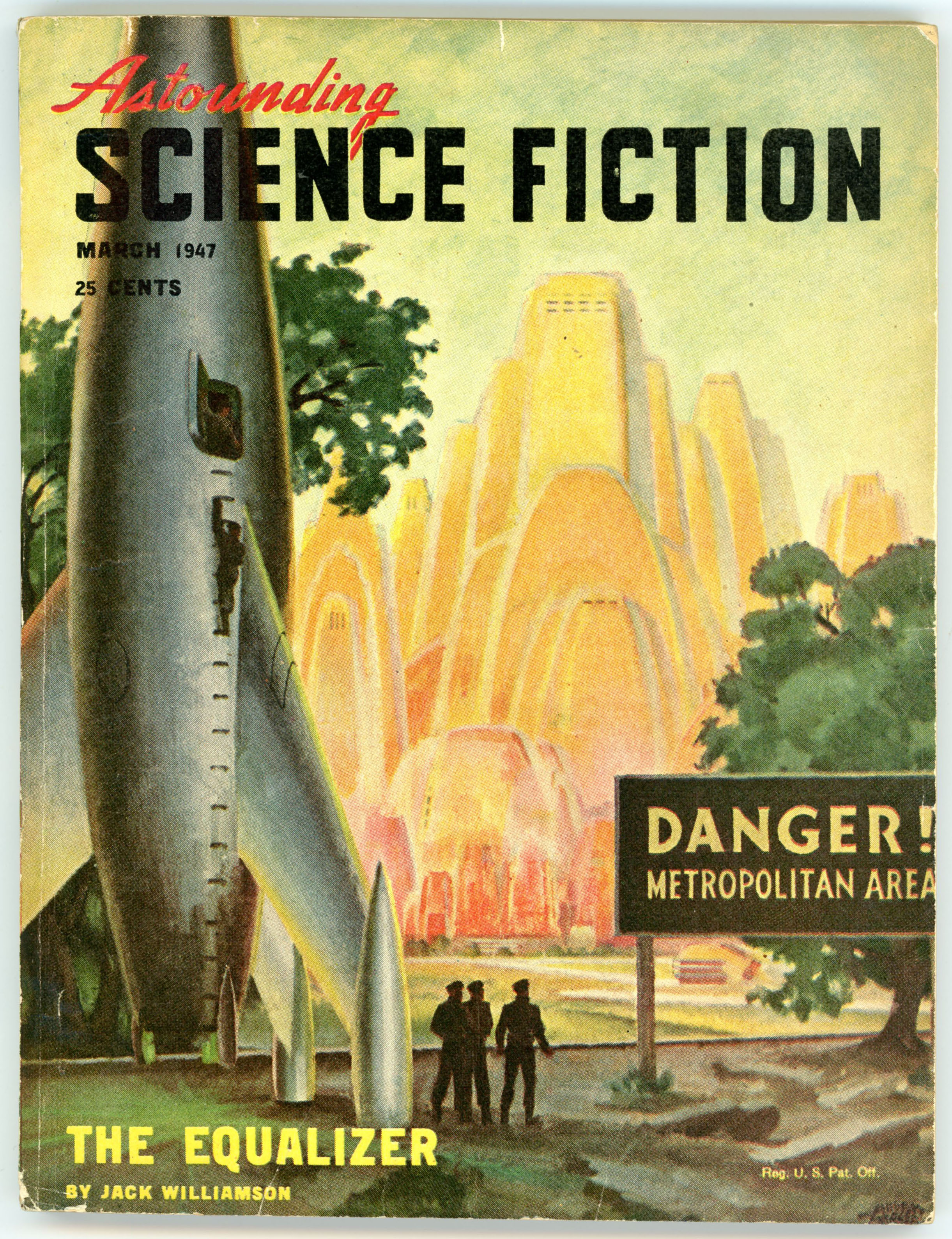
Roger’s most highly developed depiction of this architectural style appears on the cover of the March, 1947 issue of Astounding, in an image representing Jack Williamson’s story “The Equalizer”.  Here, Rogers balanced the simple curves and streamlined functionality of a silver-gray spacecraft with a city whose “curved” buildings appear in varied shades of yellow, orange, and red.  The backdrop of both spacecraft and city is a sky that softly glows in pale greenish-gray.
The flying car / spacecraft (I haven’t yet read Heinlein’s story!) is also interesting.  (Note Rogers’ initials on the door!)  The vehicle combines the streamlined shape of a rocket with retractable landing gear reminiscent of an aircraft.  Something about this craft is reminiscent of Bell Aircraft’s YFM-1 Aircuda of the late 30s – early 40s….

______________________________

Illustration by Hubert Rogers, for Robert A. Heinlein’s (as Anson MacDonald) story “Beyond This Horizon -” (p. 80)
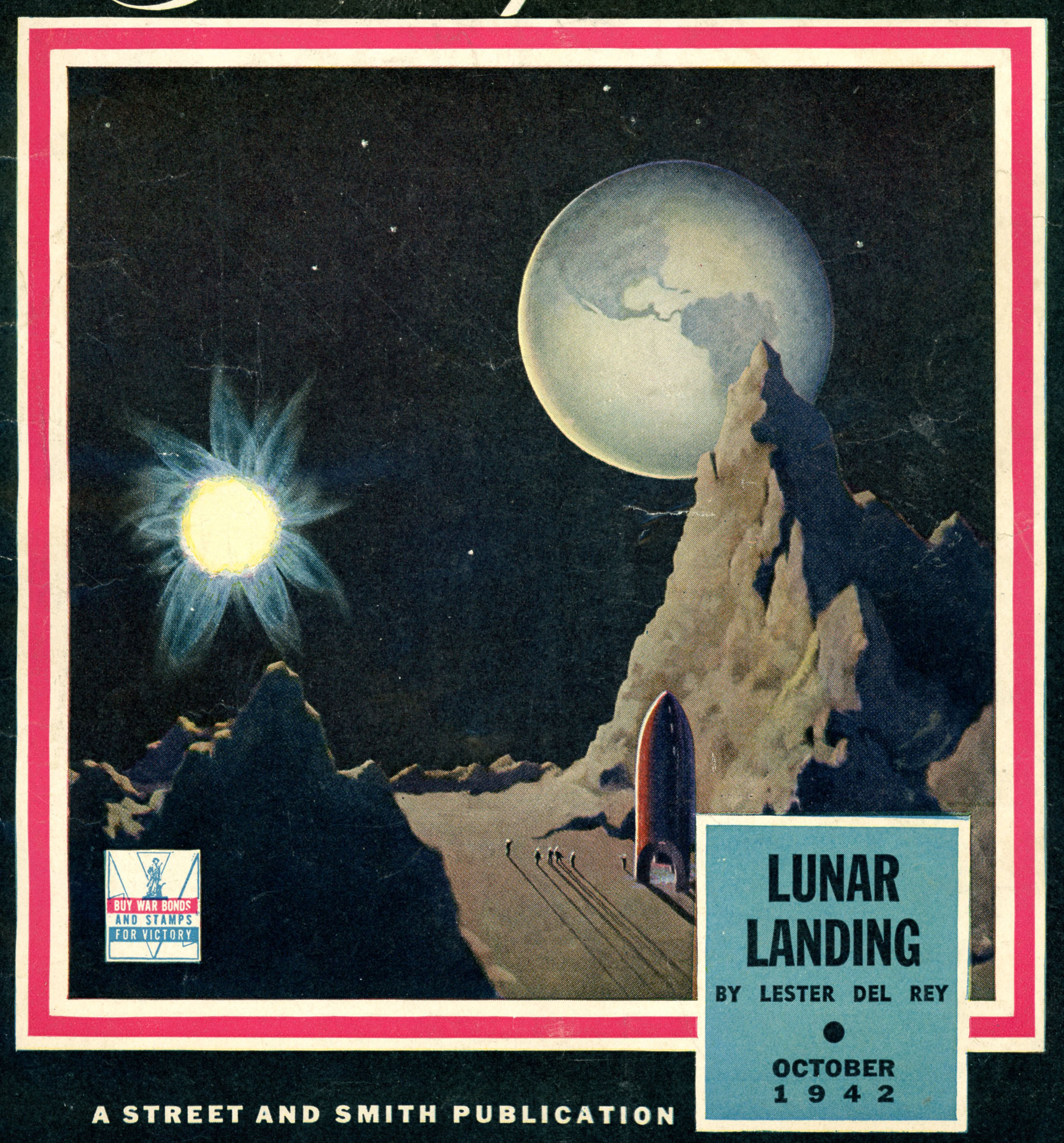
Astounding Science Fiction – October, 1942 (Featuring “First Lunar Landing”, by Lester del Rey) [August von Munchausen]
______________________________

THE WARBLER

By Murray Leinster

An old favorite of science fiction returns – with a tale of a robot that had patience, a brain adequate to its task, and a slow-working, patient urge to self-destruction.

Illustration by Pasilang R. Isip, for “The Warbler”, by Murray Leinster (p. 85).

______________________________

References

August von Munchausen, at Sammler (Collecting)

Vacation in the Golden Age, by Jamie Todd RubinEpisode 40: October 1942 – George O. Smith makes his Astounding debut. Also stories by A. E. van Vogt, Lester Del Rey, Malcolm Jameson, and L. Ron Hubbard’s last Astounding appearance for 5 years.”


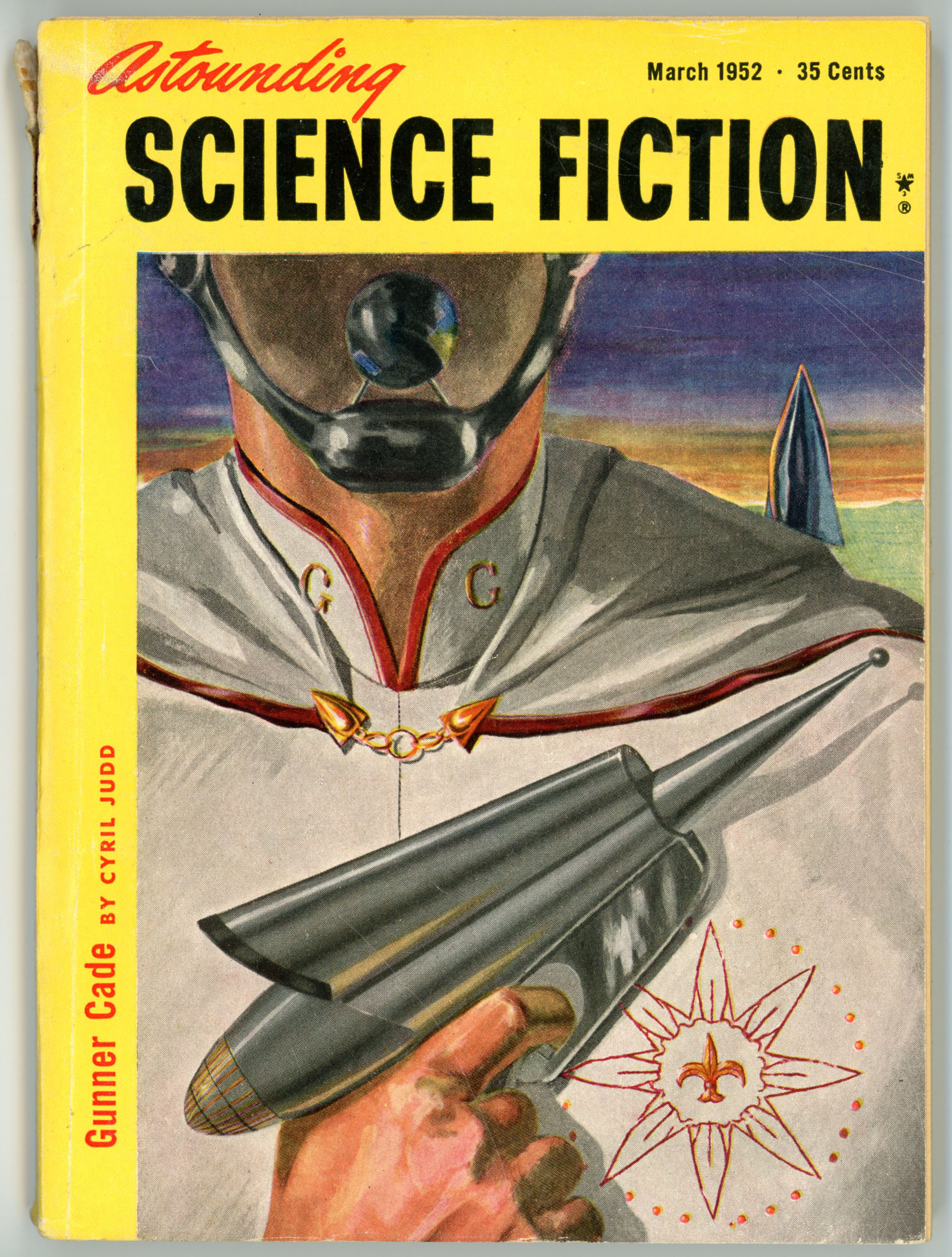
Astounding Science Fiction – March, 1952 (Featuring “Gunner Cade”, by Cyril Judd (Cyril M. Kornbluth and Judith Merril) [G. Pawelka]

Illustration by G. Pawelka, for “Gunner Cade”, by Cyril Judd (Cyril M. Kornbluth and Judith Merril), p. 19.

______________________________

Illustration by G. Pawelka, for “Gunner Cade”, by Cyril Judd (Cyril M. Kornbluth and Judith Merril), p. 37.

______________________________

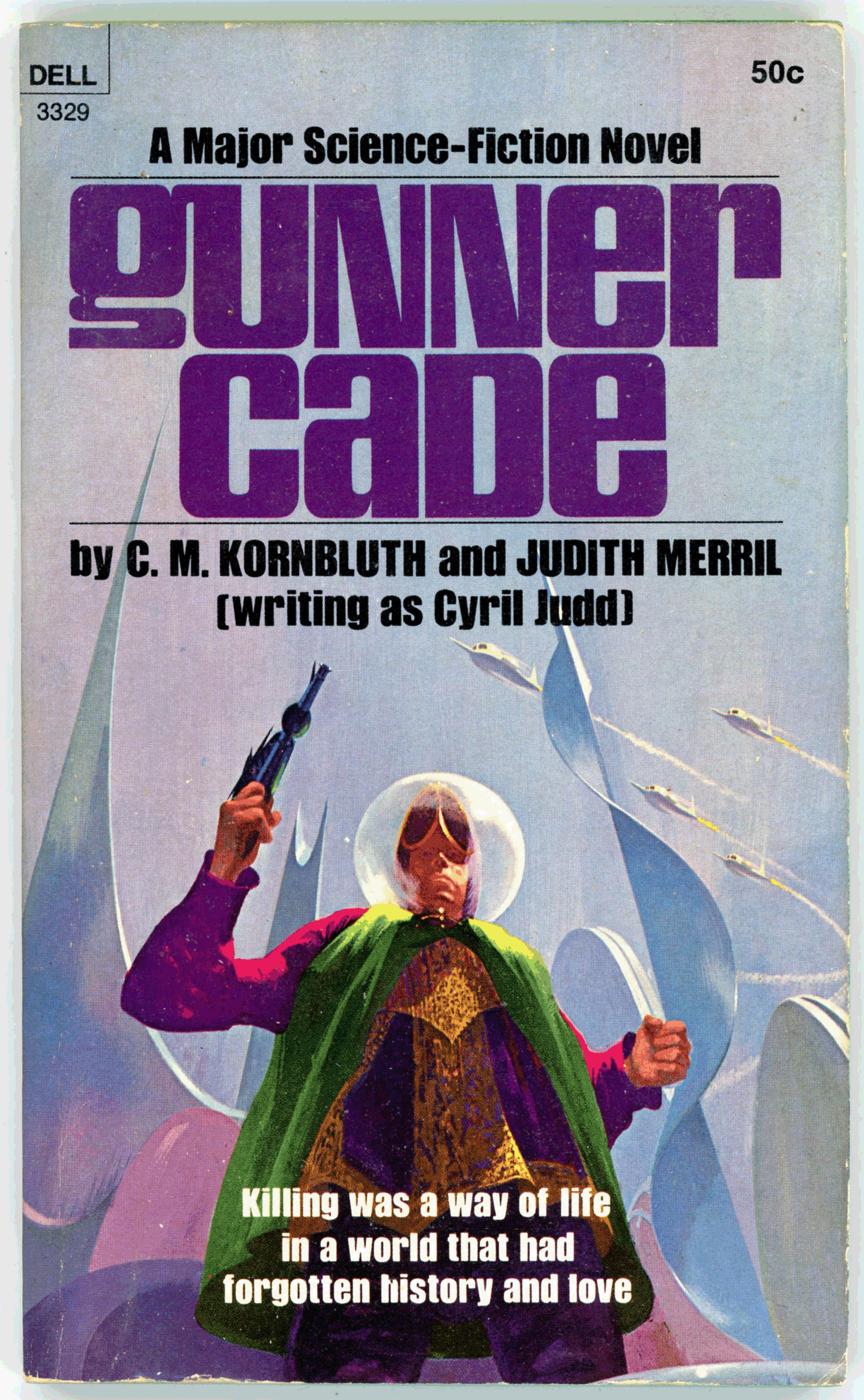
Illustration by Paul Lehr, for Dell Publishing Company 1969 edition of “Gunner Cade”

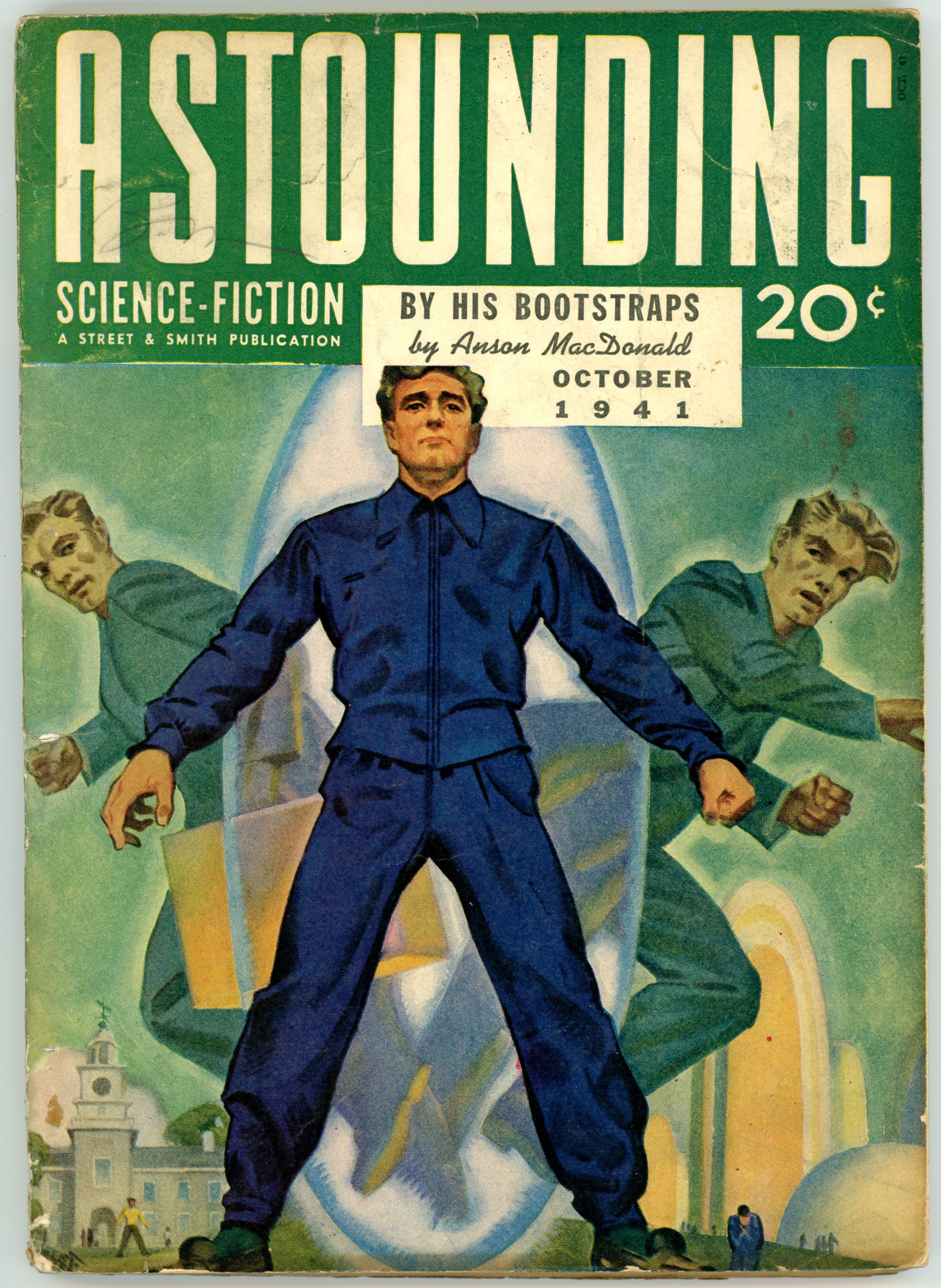
Astounding Science Fiction – October, 1941 (Featuring “By His Bootstraps”, by Anson MacDonald (Robert A. Heinlein)) [Hubert Rogers]

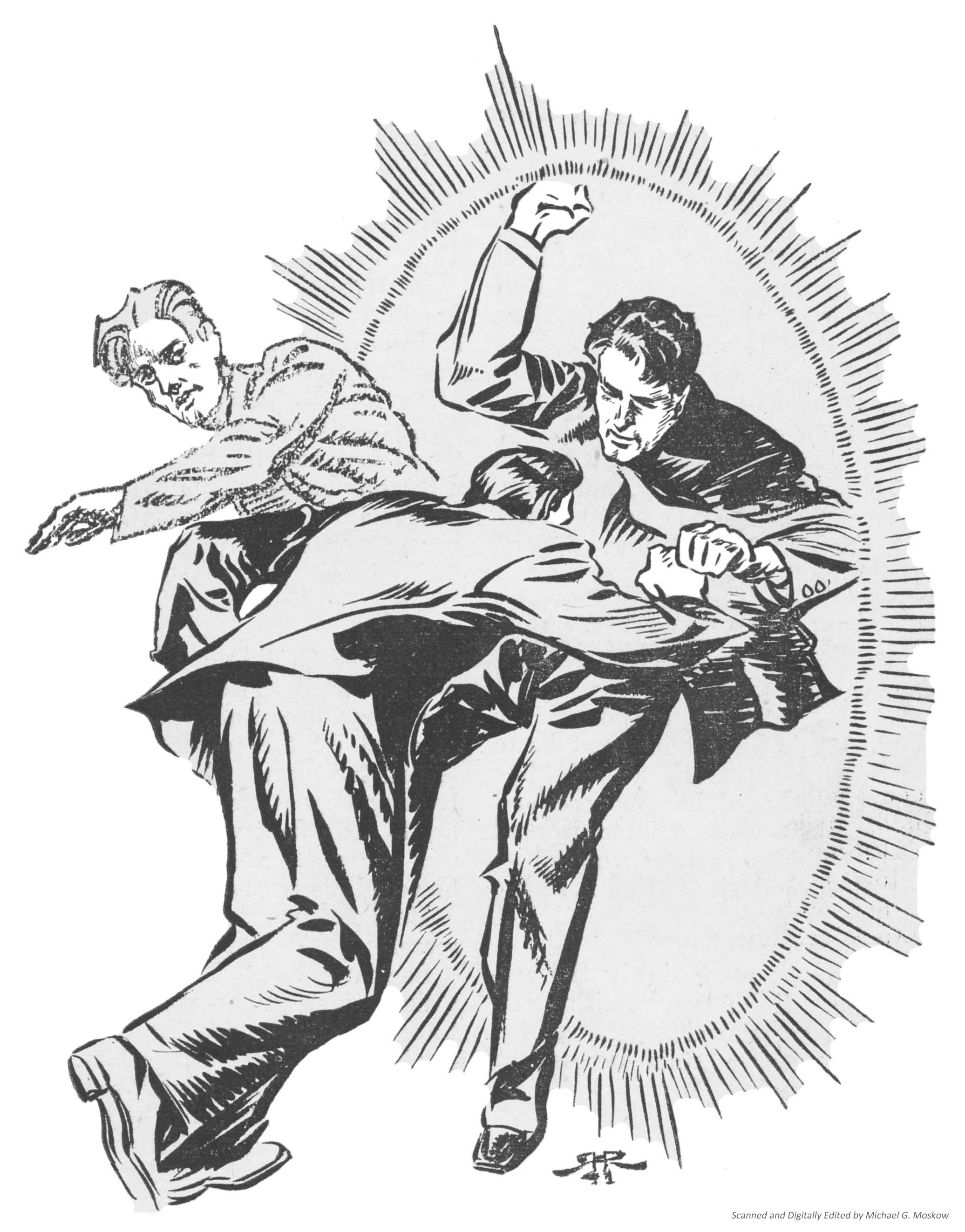
The following three illustrations, for “By His Bootstraps” by Robert A. Heinlein (writing as Anson MacDonald), are by Hubert Rogers, as is the issue’s front cover.

Page 9

______________________________

Page 16

______________________________

Page 40

______________________________

Illustration – also by Hubert Rogers – for Theodore Sturgeon’s story, “Two Percent Inspiration” (p. 86).

______________________________

And, for “something completely different”, the issue’s rear cover…

Astounding Science Fiction – June, 1942 (Featuring “Bridle and Saddle”, by Isaac Asimov) [Hubert Rogers]

______________________________

Illustration by Charles Schneeman, for Isaac Asimov’s cover story “Bridle and Saddle” (p. 24).

______________________________

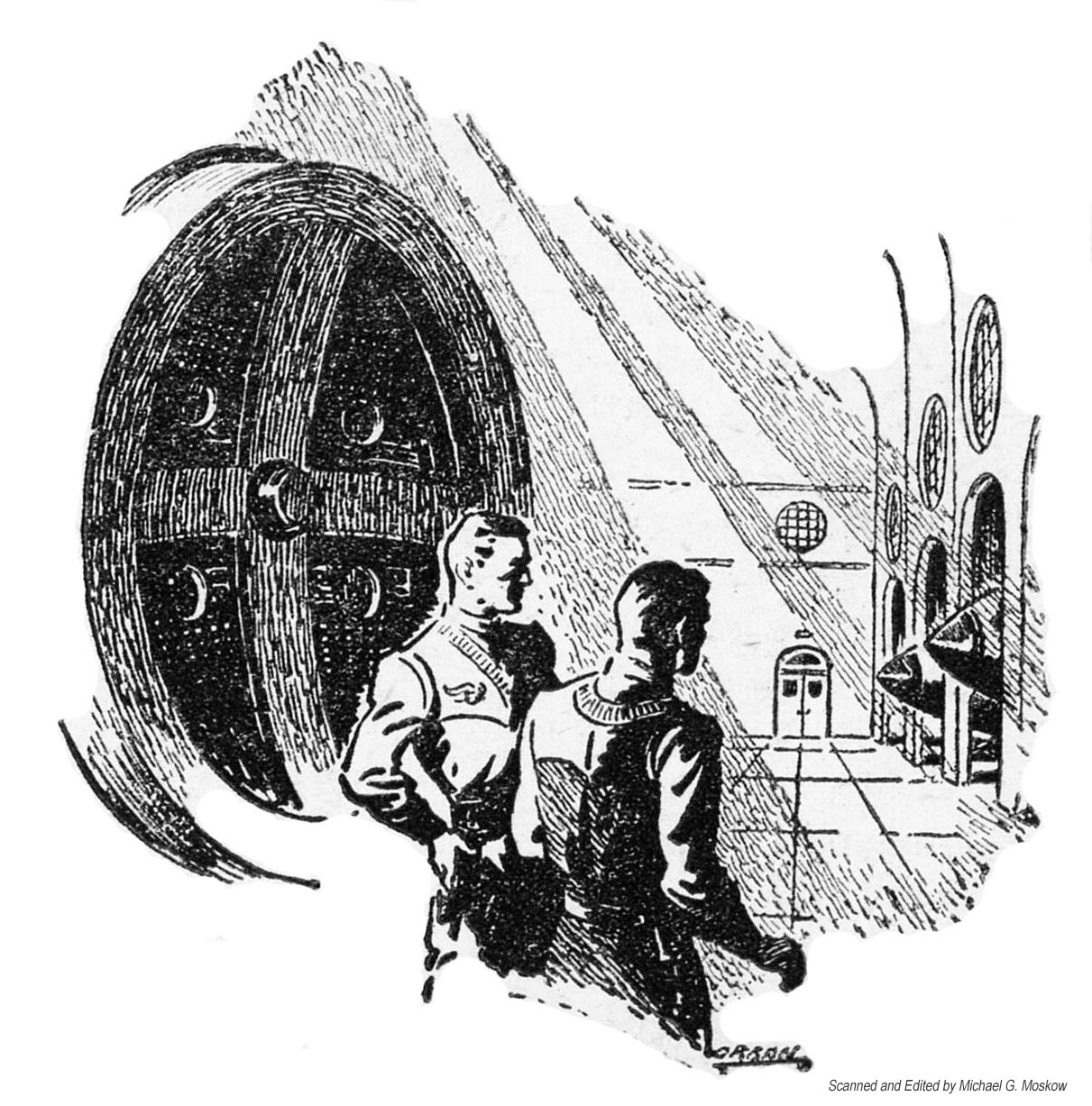
Illustration by Paul Orban, for Hal Clement’s story “Proof” (p. 101).

______________________________

Illustration by Paul Orban, for Hal Clement’s story “Proofr” (p. 105).

______________________________


Astounding Science Fiction – December, 1950 (Featuring “Bindlestiff”, by James Blish) [William Timmins]

______________________________

Illustration by William Timmins, for James Blish’s story “Bindlestiff” (p. 6)

______________________________

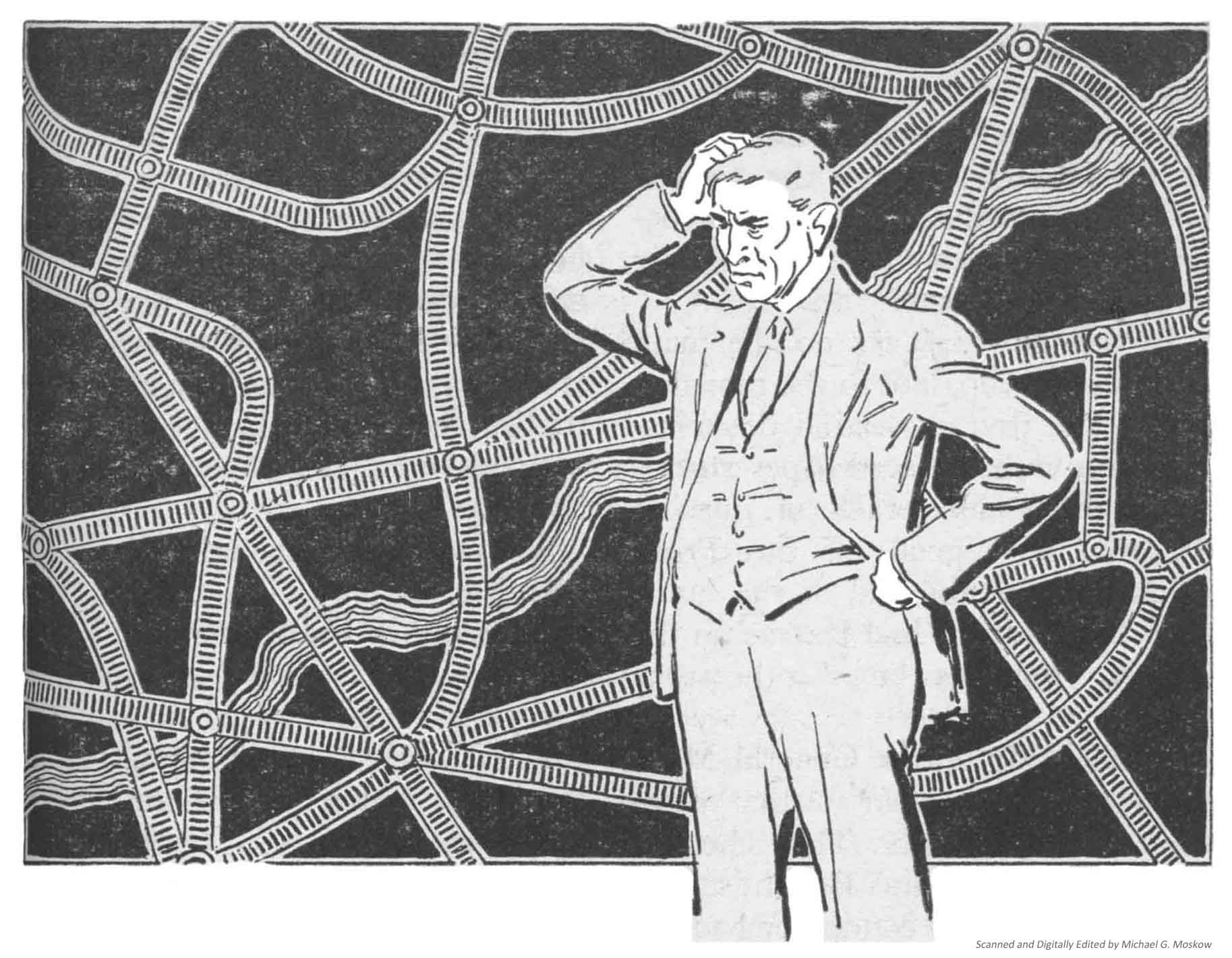
Illustration by Paul Orban, for A.J. Deutsch’s story “A Subway Named Moebius” (p. 72)

______________________________

Illustration by Paul Orban, for A.J. Deutsch’s story “A Subway Named Moebius” (p. 83)

Astounding Science Fiction – January, 1944 (Featuring “Technical Error”, by Hal Clement) [William Timmins]

______________________________

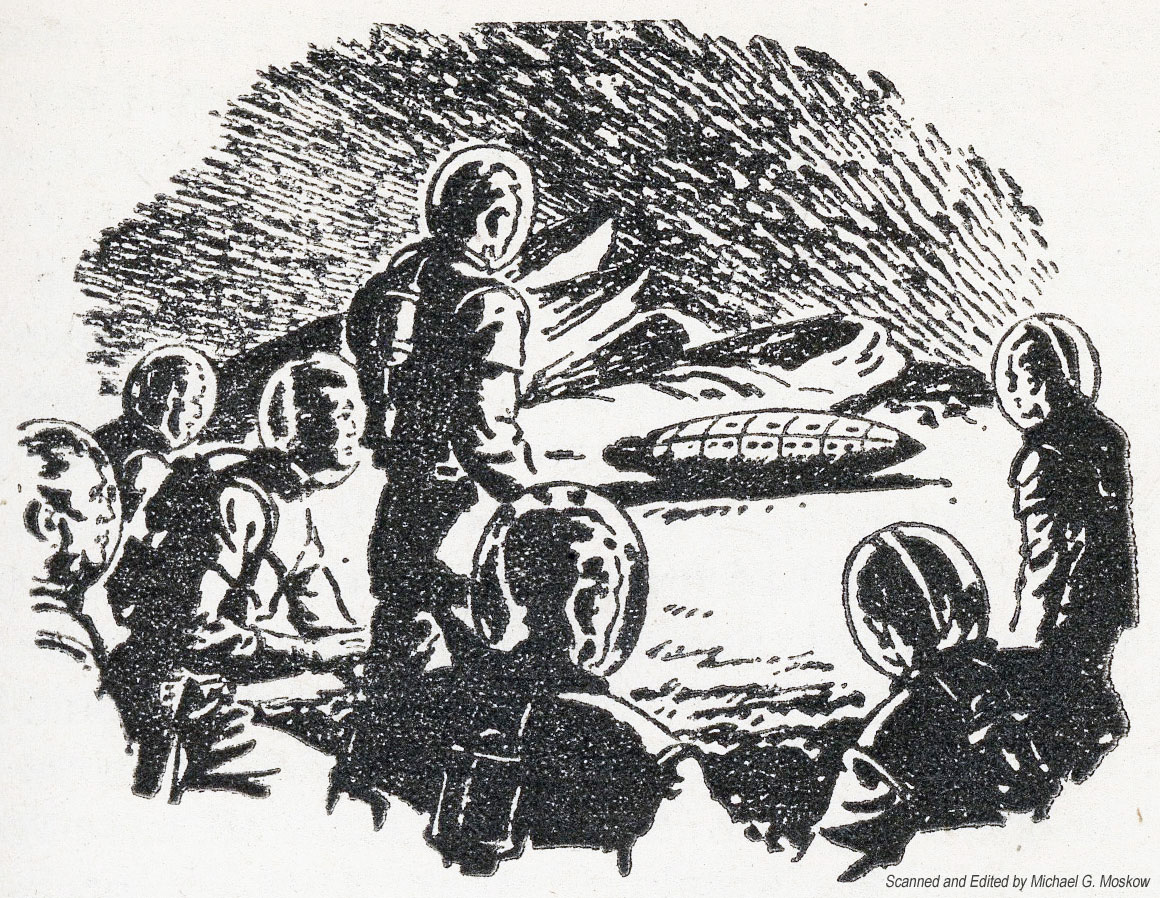
Illustration by Paul Orban, for Hal Clement’s cover story “Technical Error” (p. 7).

______________________________

Illustration by Williams, for P. Schuyler Miller’s story “As Never Was” (p. 31).

______________________________

Illustration by Paul Orban, for A.E. van Vogt’s story “Far Centaurus” (p. 68).

______________________________

Illustration by Paul Orban, for A.E. van Vogt’s story “Far Centaurus” (p. 77).

Astounding Science Fiction – November, 1950 [“Choice”, by David Pattee]

______________________________

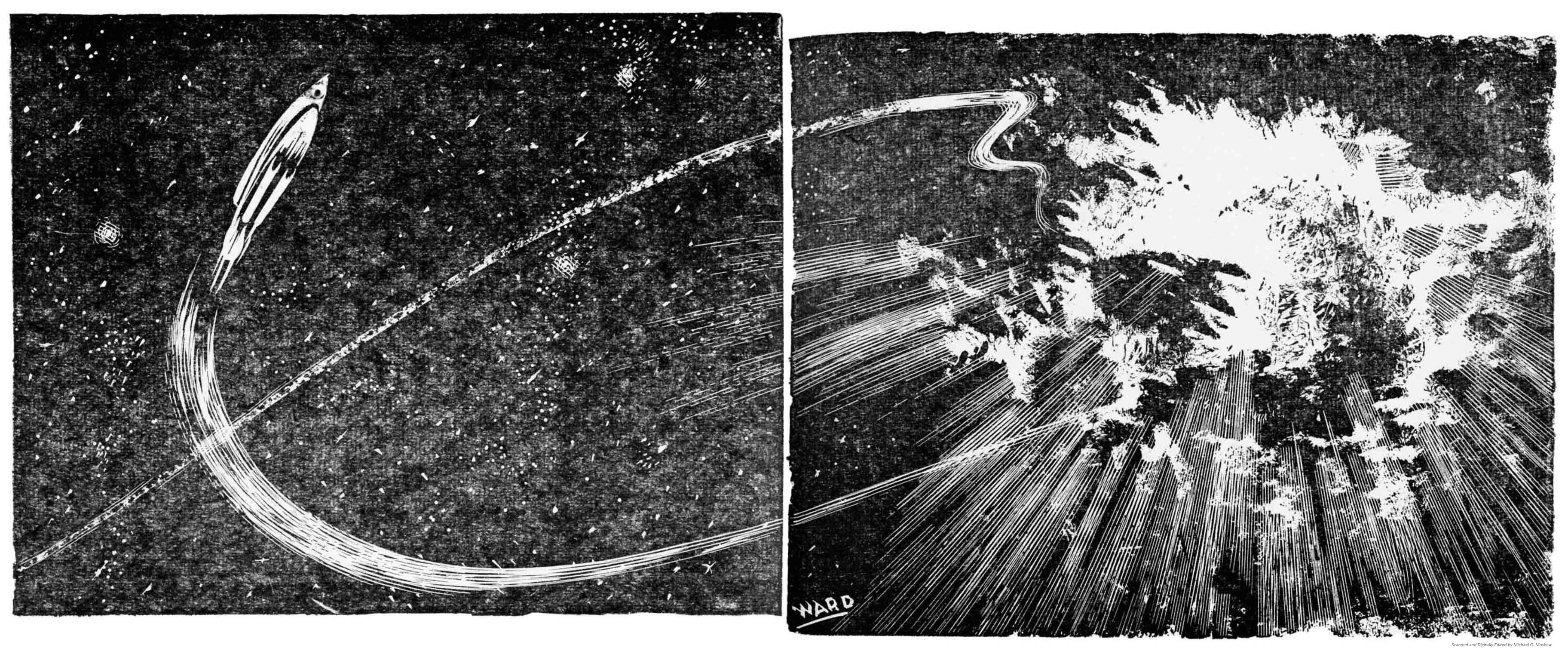
Illustration by Ward, for James H. Schmitz’s story “The Truth About Cushgar” (pp. 30-31)

______________________________

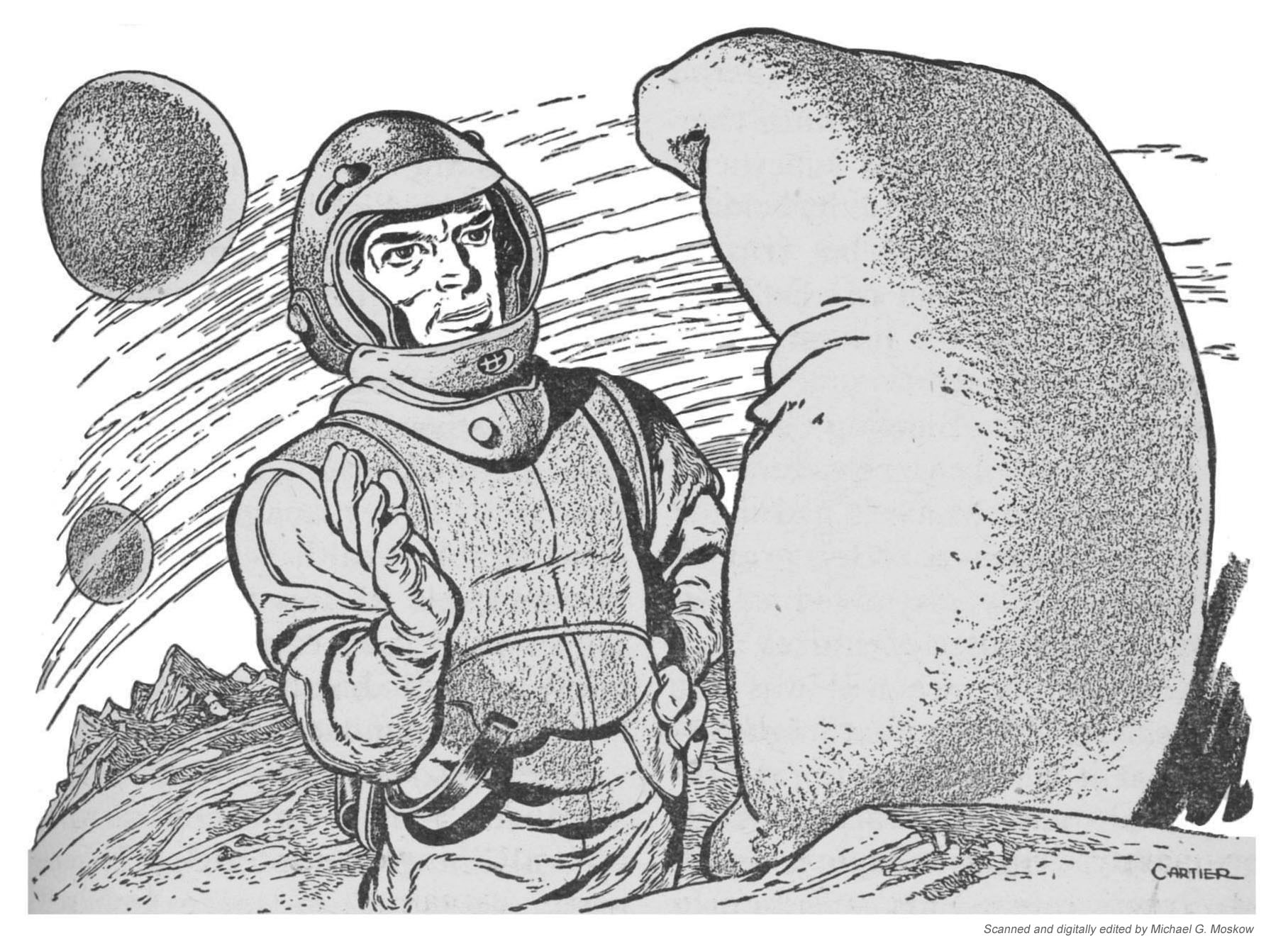
Illustration by Edd Cartier, for H.B. Fyfe’s story “In Value Deceived” (p. 39)

______________________________

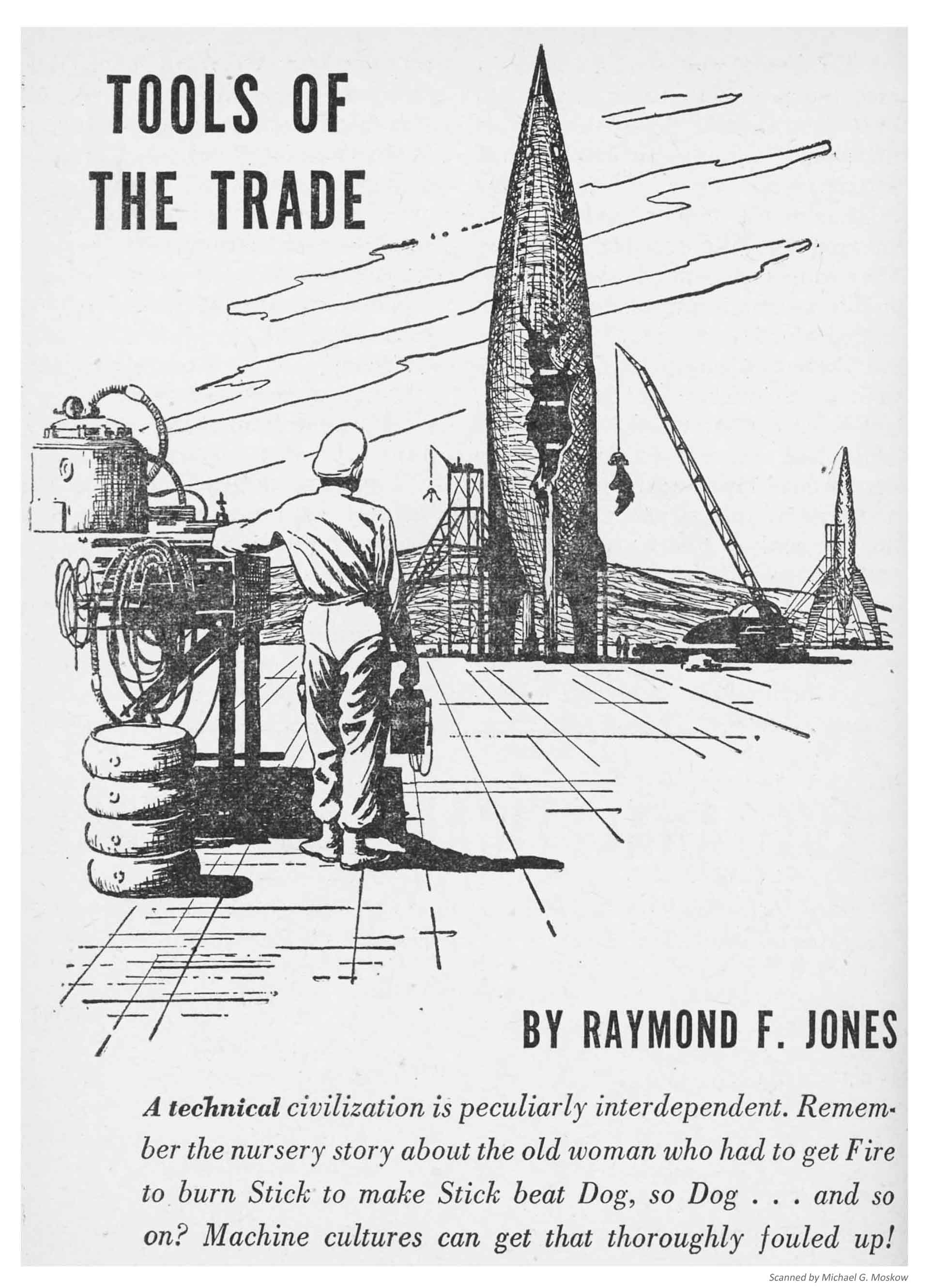
Illustration by Miller, for Raymond F. Jones’ story “Tools of The Trade” (p. 48)

______________________________

Illustration by Miller, for Raymond F. Jones’ story “Tools of The Trade” (p. 55)

______________________________

Illustration by Miller, for Raymond F. Jones’ story “Tools of The Trade” (p. 63)

______________________________

Illustration by Edd Cartier, for Poul Anderson’s story “Quixote and The Windmill” (p. 95)


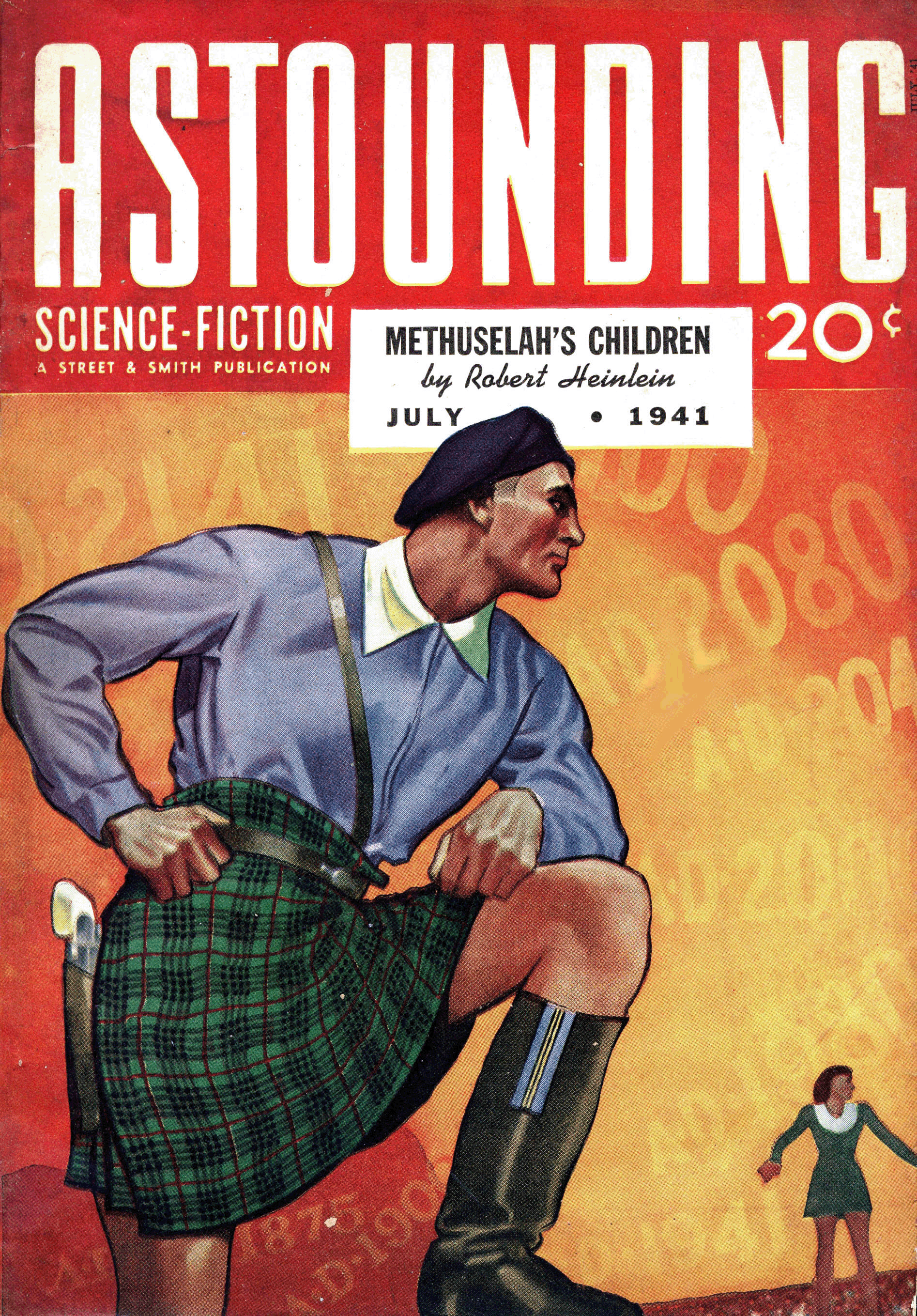
Astounding Science Fiction – July, 1941 (Featuring “Methuselah’s Children”, by Robert Heinlein) [Hubert Rogers]

Illustration by Charles Schneeman, for “The Seesaw”, by A.E. van Vogt (p 61).

“The Seesaw” was the first part of what would eventually be developed, through both short stories and books, into A.E. van Vogt’s “Weapon Shop” stories. 

“The Seesaw,” together with “The Weapon Shop” (Astounding Science Fiction, December, 1942) and “The Weapon Shops of Isher” (Thrilling Wonder Stories, February, 1949) would in time become the basis of van Vogt’s full novel – also entitled “The Weapon Shops of Isher” – in 1951, as well as his companion novel The Weapon Makers.

In that context, Charles Schneeman’s art depicts the initial encounter between reporter C.J. (Chris) McAllister of the Gazette-Bulletin, and Lystra, the daughter of a Weapon Shop Owner.  The pair are viewing the Imperial City of Isher from the Weapon Shop of Lystra’s father.    

Curiously, though time travel is not the focus of the story, merely being a plot element, it is noteworthy that the tale implies parallel time streams, simultaneously commencing upon June 11, 1941, and, “June”, in year 84 of the “4,700th year of the Imperial House of Isher”.


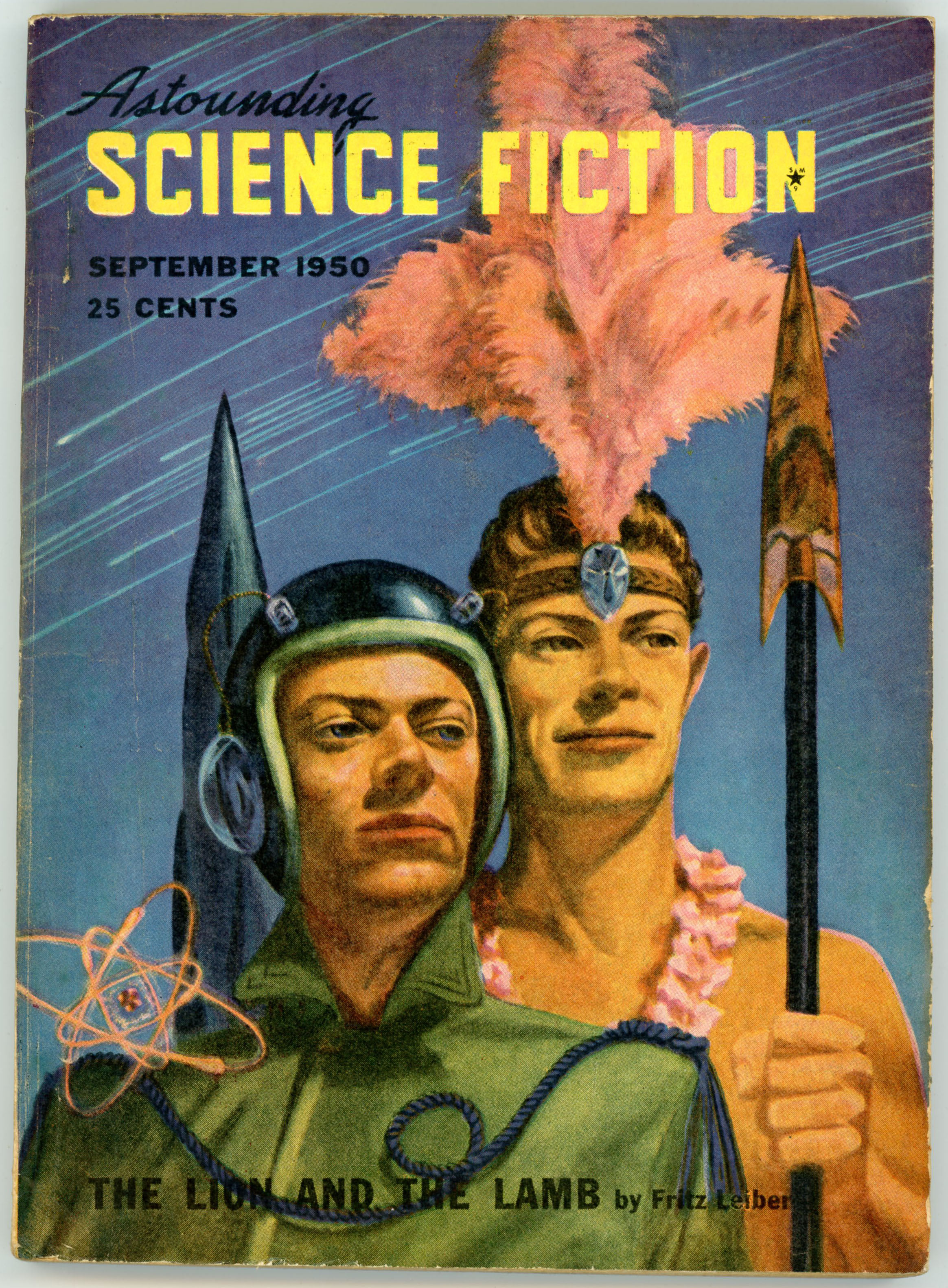
Astounding Science Fiction – September 1950 (Featuring “The Lion and The Lamb”, by Fritz Leiber) [Hubert Rogers]

Illustration by Edd Cartier, for William Morrison’s story “The Sack” (p. 47)

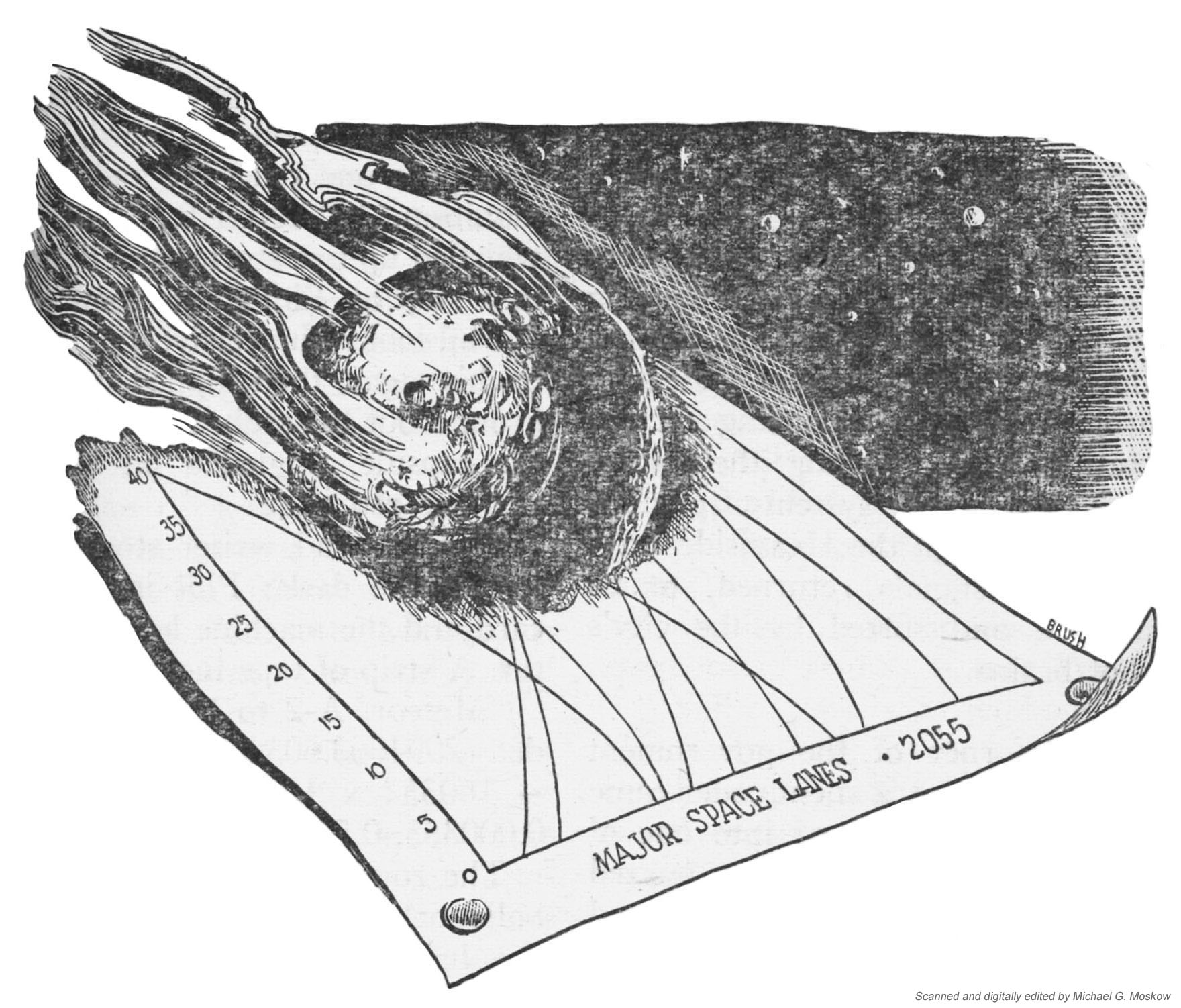
Illustration by Brush, for William T. Powers’ story “Meteor” (p. 109)

Illustration by Brush, for William T. Powers’ story “Meteor” (p. 115)