Justine, by Lawrence G. Durrell – 1961 (1957) [Unknown Artist]

The first novel in Lawrence Durrell’sAlexandria Quartet” (which also comprised Balthazar, Mountolive, and Clea), Justine was produced for the screen in 1969 as a film directed by George Cukor and Joseph Strick.  The movie’s cast included Anouk Aimée in the title role, Dirk Bogarde as “Pursewarden”, and Michael York as “Darley”.  According to Wikipedia, the film … uh, er, ah … didn’t go over too well, either critically or financially. 

(C’est la vie!)

Though the full film is apparently unavailable in digital format, you can view the trailer – rather a brief trailer at only a minute in length – (uploaded to YouTube in 2010) here

As for Clea herself:
is it only my imagination which makes it seem so difficult to sketch her portrait? 
I think of her so much –
and yet I see how in all this writing I have been shrinking from dealing directly with her. 
Perhaps the difficulty lies here:
that there does not seem to be an easy correspondence between her habits and her true disposition. 
If I should describe the outward structure of her life –
so disarmingly simple, graceful, self-contained –
there is a real danger that she might seem either a nun
for whom the whole range of human passions had given place
to an absorbing search for her subliminal self,
or a disappointed and ingrown virgin
who had deprived herself of the world because of some psychic instability,
or some insurmountable early wound.

Everything about her person is honey-gold and warm in tone;
the fair, crisply trimmed hair which she wears rather long at the back,
knotting it simply at the downy nape of her neck.
This focuses the candid face of a minor muse with its smiling grey-green eyes.
The calmly disposed have a deftness and shapeliness
which one only notices when one sees them at work,
holding a paint-brush perhaps
or setting the broken leg of a sparrow in splints made from match-ends.

I should say something like this:
that she had been poured,
while still warm,
into the body of a young grace:
that is to say, into a body born without instincts or desires.

To have great beauty;
to have enough money to construct an independent life;
to have a skill – those are the factors which persuade the envious,
the dispirited to regard her as undeservedly lucky.
But why, ask her critics and observers, has she denied herself marriage?

She lives in modest though not miserly style,
inhabiting a comfortable attic-studio
furnished with little beyond an iron bed and a few ragged beach chairs
which in the summer are transferred bodily to her little bathing cabin at Sidi Bishr. 
Her only luxury is a glittering tiled bathroom in the corner
of which she has installed a minute stove
to cope with whatever cooking she feels inclined to do for herself;
and a bookcase whose crowded shelves indicate that she denies it nothing.

She lives without lovers or family ties, without malices or pets,
concentrating with single-mindedness upon her painting which she takes seriously. 
In her work, too, she is lucky; for these bold yet elegant canvases radiate clemency and humor.
They are full of a sense of play – like children much-beloved.

From rear cover:

The wine press of love

Alexandria – a thousand dust-tormented streets.  Flies and beggars own it today, and those who enjoy an intermediate existence in between.

Five races, five languages, a dozen creeds – but there are more than five sexes.  The sexual provender which lies to hand is staggering in its variety and profusion.  The Orient cannot rejoice in the sweet anarchy of the body – for it has far outstripped the body.

Someone once said that Alexandria was the great wine press of love; those who emerged from it were the sick men, the solitaries, the prophets – I mean all who have been deeply wounded in their sex.

My Gun Is Quick, by Mickey Spillane – May, 1953 (1950) [James S. Avati]

James S. Avati’s cover art for Signet Books’ 1953 edition of Mickey Spillane’s My Gun Is Quick combines elements of mystery, eroticism, danger, and anonymity (note that Mike Hammer’s face is turned away from the viewer, while the background is little more than shades of red) that are nicely representative of paperback art of this genre and period. 

I don’t know if this scene represents an event described in the novel, but, well, it’s effective.

Admittedly, unlike many of the books featured at this blog, I’ve not – just yet!- actually read this particular work.  However, even having only lightly skimmed the novel’s pages in search of an excerpt representing Spillane’s literary style (see below), the qualities of his writing emerge almost immediately:  Crispness of language; violence – both perpetrated and experienced by protagonist Mike Hammer; a sense of foreboding and mystery; a rapid-fire sense of action; steady continuity and focus, with no extraneous action or dialogue. 

The man was a hell of a writer.   

______________________________

You can view the full 1957 United Artists film version of “My Gun Is Quick” (directed by Victor Saville, with Robert Bray as Mike Hammer, and Whitney Blake as Nancy Williams), at the Internet Archive.

______________________________

(An excerpt from page 157 of this Signet paperback…  Though the text is actually a single paragraph with only two sentence breaks, for the purpose of this post, I’ve arranged it such that most lines are single phrases, as separated by commas.)

From the river the low cry of dark shapes and winking lights that were ships
echoed and re-echoed through the canyons of the avenues. 
Lola turned the radio on low, bringing in a selection of classical piano pieces,
and I sat there with my eyes closed, listening, thinking, picturing my redhead as a blackmailer. 
In a near sleep I thought it was Red at the piano fingering the keys
while I watched approvingly, my mind filled with thoughts. 
She read my mind and her face grew sad,
sadder than anything I had ever seen and she turned her eyes on me
and I could see clear through them into the goodness of her soul
and I knew she wasn’t a blackmailer and my first impression had been right;
she was a girl who had come face to face with fate and had lost,
but in losing hadn’t lost all,
for there was light of holiness in her face that time when I was her friend,
when I thought that a look like that belonged only in church
when you were praying or getting married or something,
a light that was there now for me to see
while she played a song that was there for me now to see
that told me I was her friend and she was mine,
a friendship that was more than that,
it was a trust and I believed it … knew it and wanted it,
for here was a devotion more than I expected or deserved and I wanted to be worthy of it,
but before I could tell her so Feeney Last’s face swirled up from the mist beside the keyboard,
smirking,
silently mouthing smutty remarks and leering threats
that took the holiness away from the scene and smashed it underfoot,
assailing her with words that replaced the hardness and terror
that had been forgiven before we met and I couldn’t do a thing about it
because my feet were powerless to move
and my hands were glued to my sides by some invisible force that Feeney controlled
and wouldn’t release until he had killed her
and was gone with his laugh ringing in the air and the smirk still on his face,
daring me to follow where I couldn’t answer him;
all I could do was stand there and look at my redhead’s lifeless body
until I focused on her hands
to see where he had scratched her when he took the ring off.

References

James S. Avati…

…at askArt

…at Wikipedia

…at invaluable – The World’s Premier Auctions and Galleries

Mickey Spillane…

…at Wikipedia

…talks Mike Hammer, his writing process, and wealth (1962), at CBC

…February 11, 2004, at Carolina People (Part I)

…February 11, 2004, at Carolina People (Part II)

RIP Mickey Spillane (Mickey Spillane on the Dick Cavett show), at consumerguide

My Gun Is Quick…

…at Wikipedia

…at IMDB

Galaxy Science Fiction – October, 1962 (Featuring “The Ballad of Lost C’Mell”, by Cordwainer Smith) [Virgil Finlay] [Updated post…]

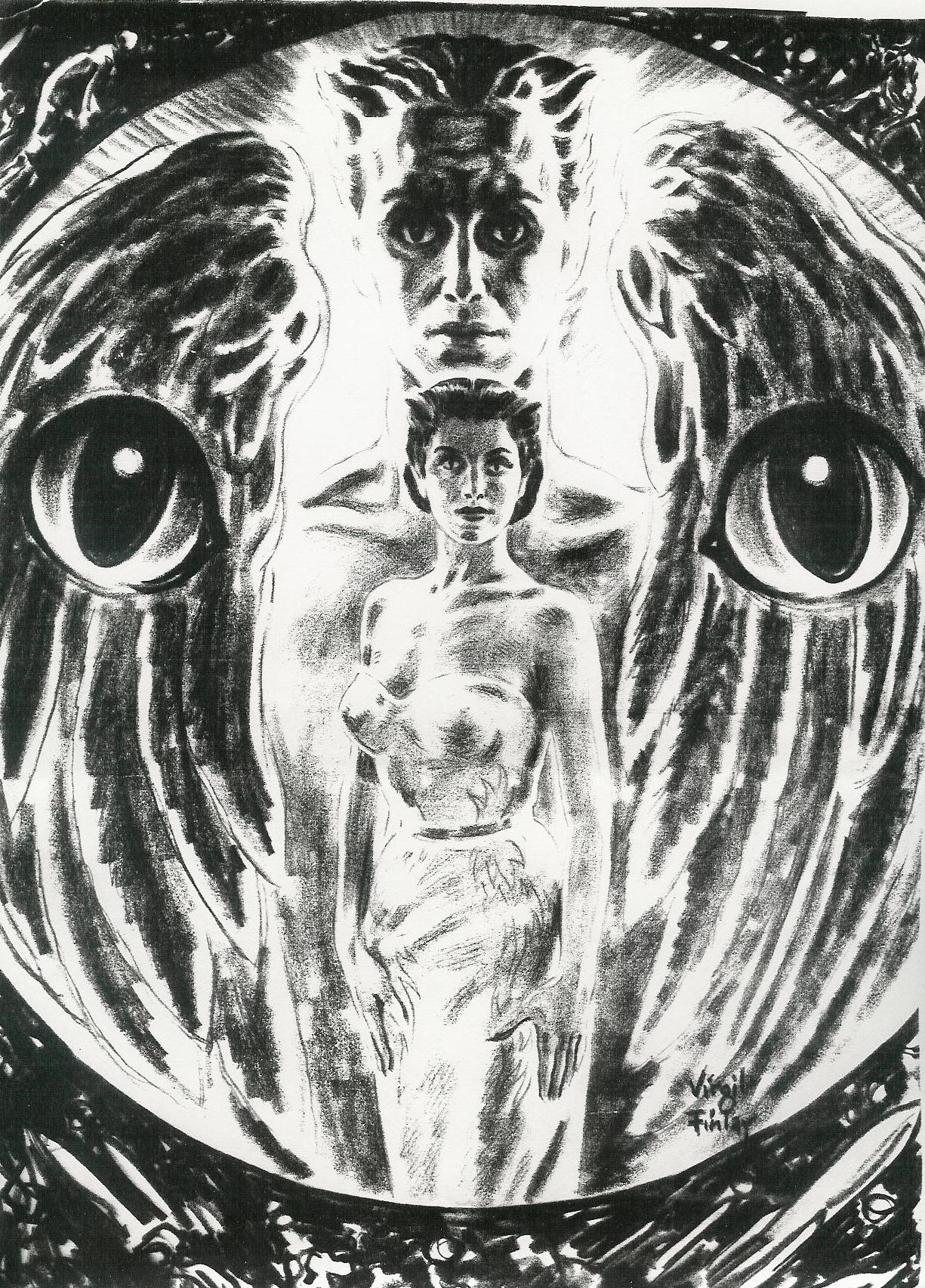
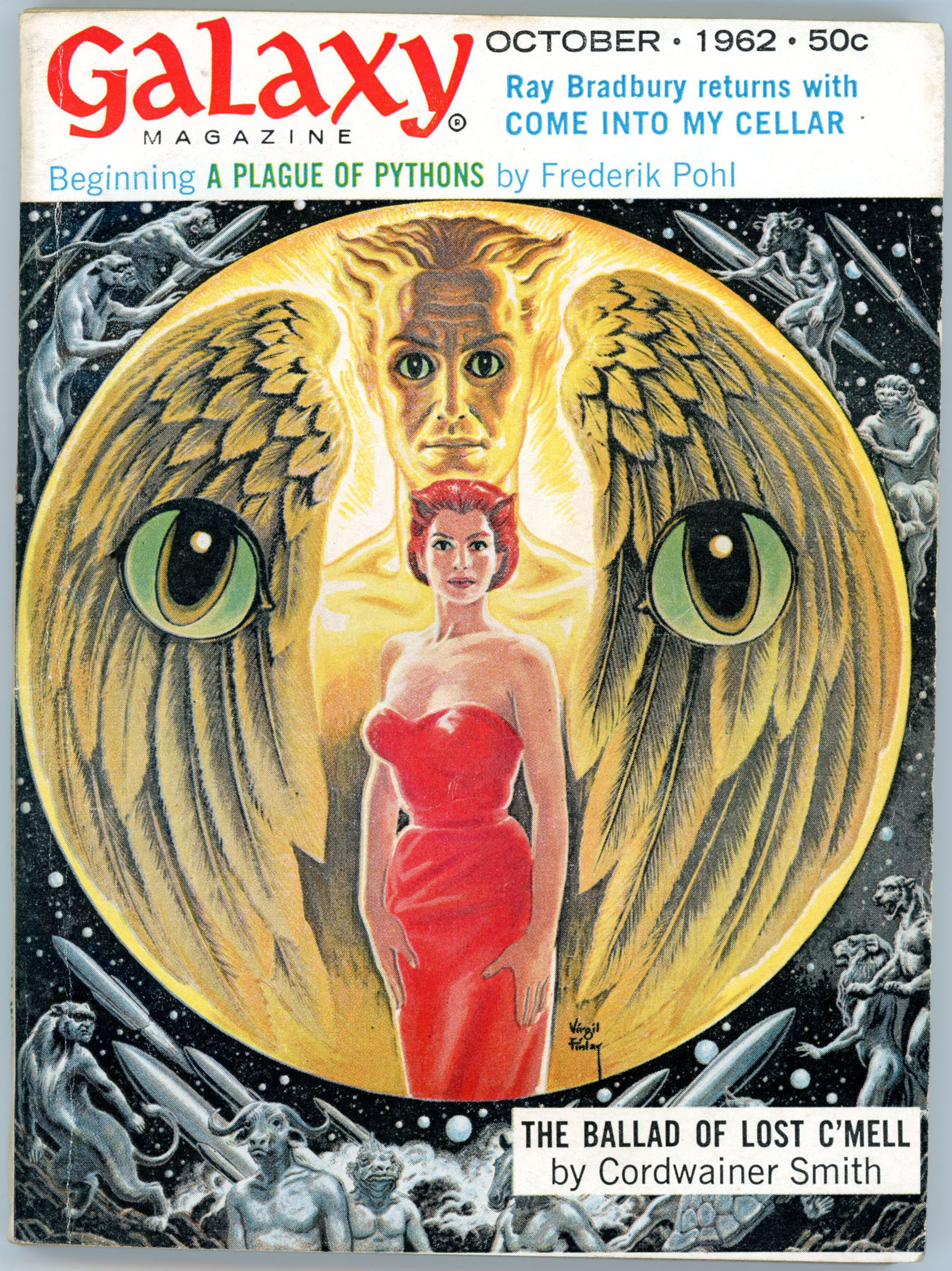
The images below present Virgil Finlay’s interpretation of Cordwainer Smith’s character C’Mell, from the wonderful tale “The Ballad of Lost C’Mell”, as depicted on the cover and as the lead interior illustration of the October, 1962, issue of Galaxy Science Fiction.     

“This” post being one of my earlier (earliest?) at WordsEnvisioned (dating back to April of 2017 – hey, time not only flies, it accelerates!), I thought it worthy of revision. 

So, I perused the web for other images of C’Mell, of which there are many, inevitably varying in style, quality, and appeal. 

And, I found what I was searching for. 

One of the most interesting interpretations of C’Mell can be viewed at BlueTyson’s Cordwainer Smith (ology).  The site features an imaginative and subtle portrait of Smth’s character, which – with a kind of animae look – strikingly emphasizes C’Mell’s cat origin, specifically via brilliantly green feline eyes.  (Pointed cat ears? – not so much!)  The portrait, created by artist Lia Chan, appears (?) to have been created using a combination of colored pencils and water color.       

Lia Chan’s depiction of C’Mell has been appended to this post, and appears below Finlay’s black & white interior illustration from Galaxy

Scroll on down… 

She got the which of the what-she-did,
Hid the bell with a blot, she did,
But she fell in love with a hominid.
Where is the which of the what-she-did?

(Cordwainer Smith)

______________________________

Illustrations by Virgil Finlay

______________________________

Preliminary sketch for cover art.  Source unknown – possibly (!) from “Virgil Finlay-Beauty (& occ. beast)“, at pinterest.

______________________________

Image from “Tomorrow & Beyond – Images from other worlds, other dimensions and other times.”

______________________________

The finished product, published as the cover of Galaxy Science Fiction, October, 1962.

______________________________

C’mell: page 9

______________________________

C’Mell, by Lia Chan

The Return of the Native, by Thomas Hardy – June, 1952 (November, 1939 (1878)) [Bayre Phillips]

“He had been a lad of whom something was expected.”

He had been a lad of whom something was expected. 
Beyond this all had been chaos. 
That he would be successful in an original way,
or that he would go to the dogs in an original way,
seemed equally probable. 
The only absolute certainty about him
was that he would not stand still in the circumstances amid which he was born.

Hence, when his name was casually mentioned by neighboring yeomen,
the listener said, “Ah, Clym Yeobright: what is he doing now?”
When the instinctive question about a person is, What is he doing?
It is felt that he will not be found to be, like most of us, doing nothing in particular.
There is an indefinite sense that he must be invading some region of singularity, good or bad.
The devout hope is that he is doing well.
The secret faith is that he is making a mess of it.
Half a dozen comfortable market men,
who were habitual callers at the Quiet Woman as they passed by in their carts,
were partial to the topic.
In fact, though they were not Egdon men,
they could hardly avoid it while they sucked their long clay tubes
and regarded the heath through the window.
Clynn had been so inwoven with the in his boyhood
that hardly anybody could look upon it without thinking of him.
So the subject recurred:
if he were making a fortune and a name, so much the better for him;
if he were making a tragical figure in the world, so much the better for the narrative.  (190)

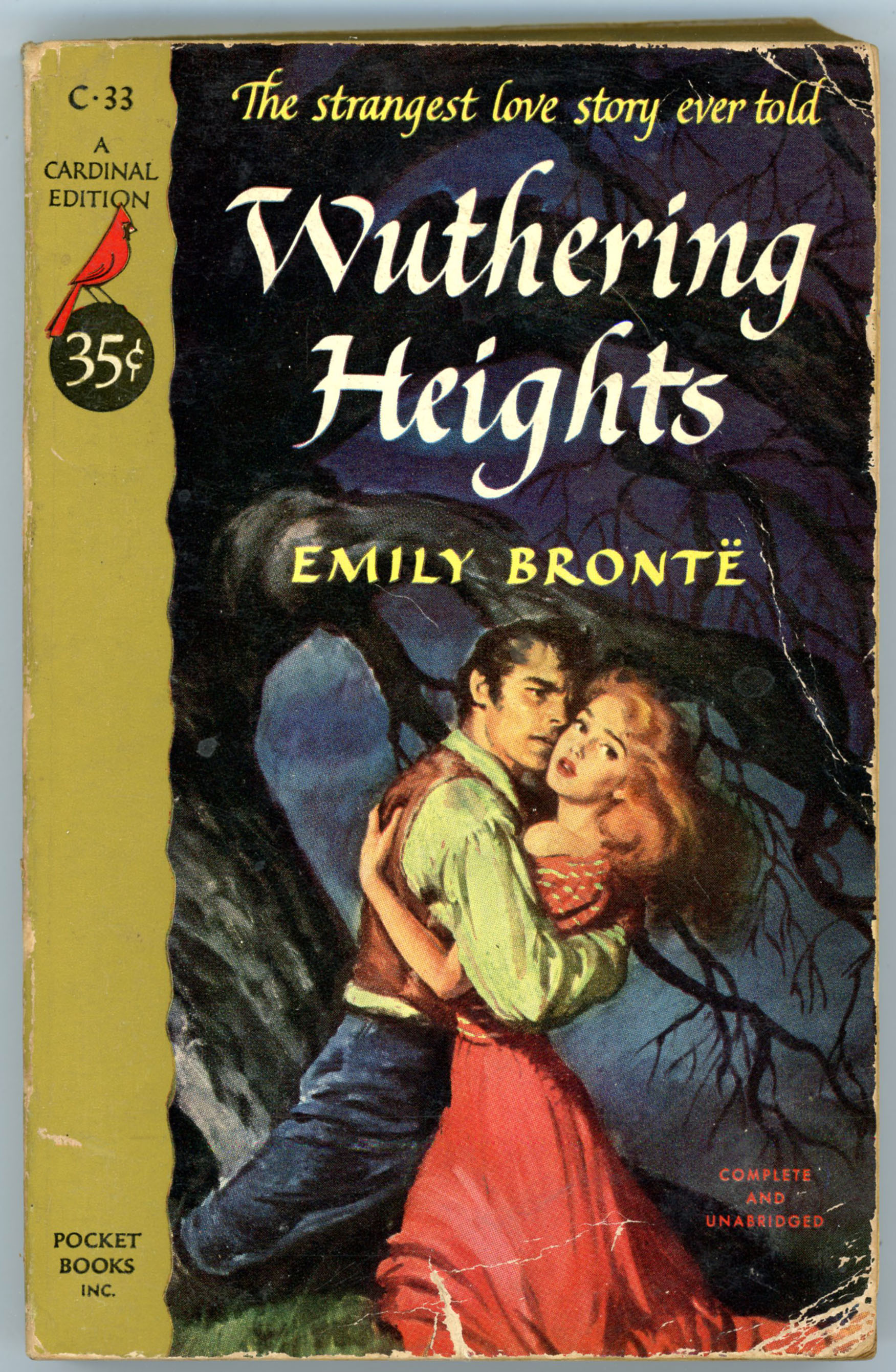
Wuthering Heights, by Emily Bronte – October, 1952 (December, 1847) [Walter M. Baumhofer]

“Is Mr. Heathcliff a man?  If so, is he mad?
And if not, is he a devil?”

Dear Ellen, it begins, —
I came last night to Wuthering Heights,
and heard, for the first time, that Catherine has been, and is yet, very ill. 
I must not write to her, I suppose,
and my brother is either too angry or too distressed to answer what I sent him. 
Still, I must write to somebody, and the only choice left me is you.

Inform Edgar that I’d give the world to see his face again —
that my heart returned to Thrushcross Grange in twenty-four hours after I left it,
and is there at this moment, full of warm feelings for him, and Catherine!
I can’t follow it though — (these words are underlined) —
they need not expect me, and they may draw what conclusions they please;
taking care, however, to lay nothing at the door of my weak will or deficient affection.

The remainder of the letter is for yourself alone. 
I want to ask you two questions: the first is, —
How did you contrive to preserve the common sympathies of human nature when you resided here?
I cannot recognise any sentiment which those around share with me.

The second question I have great interest in; it is this —
Is Mr. Heathcliff a man?  If so, is he mad?
And if not, is he a devil?
I sha’n’t tell my reasons for making this inquiry;
but I beseech you to explain, if you can, what I have married:
that is, when you call to see me; and you must call, Ellen, very soon.
Don’t write, but come, and bring me something from Edgar.

References

Wuthering Heights, at Wikipedia

Wuthering Heights (full text), at Project Gutenberg

Congo Song, by Stuart Cloete – 1952 (1943) [George Mayers]

My previous post for Congo Song, from November of 2016, shows the 1943 (first) edition of Stuart Cloete’s novel. 

Notably different is the cover of this – 1952 – edition of the work:  The cover art of the first edition is a simple, very colorful  and somewhat symbolic composition probably done using an airbrush.  However, the cover art of this Popular Giant edition is as suggestive as it is direct (albeit tame by today’s standards), while the blurb on the book’s back cover luridly describes the novel’s plot.   

As for the un-named gorilla, well, he does looks rather contemplative.

This is most unlike the book’s first edition, which features cover art that is simple, and appealing in that simplicity, while the back cover merely presents Cloete’s biography. 

Congo Song, by Stuart Cloete – 1943 [Unknown Artist]

Lovely art, which an unknown artist probably created with an airbrush, illustrates the cover of this first edition of Stuart Cloete’s Congo Song.  The art depicts three elements central to the novel: The face of Olga le Blanc, the silhouette of her “tame gorilla” (? – !), and, a tropical sunset.  All rather different from the cover of the 1952 edition, which leaves less to the imagination…

congo-song-stuart-cloete-1943-1_edited-2Channel went back over his life in his mind.
He thought of the things he had done…the things he had not done.
There were always regrets at the things that had ended before their time.
There was regret, too, at the loss of pain that was almost pleasure,
at the pleasure that was almost pain.
For many years these regrets had come back continually at the sight of a shop,
a restaurant,
a street,
the name of a certain dish on a menu,
a word found in a book, at hazard, as you turned the page;
at a song,
at a bar of music,
at the turn of some woman’s head in the street,
at the color of a dress or the sound of a voice.
All this because it was not done,
because it had never been finished one way or the other,
and your heart had been left dangling like a puppet on a string.

congo-song-stuart-cloete-1943-2He thought of his own father;
he remembered him singing him to sleep,
walking up and down,
holding him in his arms.
He remembered him swimming with him sitting on his back,
his legs about his neck, his hands in his hair.
He remembered riding in the front of his saddle.
His father must have had similar memories of his father;
and his father of his father, and so on,
an interminable chain;
each generation tending to repeat stories that they remembered
from their own childhood…
fairy tales, folklore,
superstitions that came down like this by word of mouth
from the ancient past, were absorbed in the mothers’ milk,
transmitted by nurses, grooms, servants.
His father had been born in 1844.
His grandfather had been a boy at the time of Waterloo.
And it went on like that, back into the past,
each life overlapping another life, as tiles overlapped each other on a roof.
The more you saw of life,
the stranger was its variety and differentiation.

– Stuart Cloete

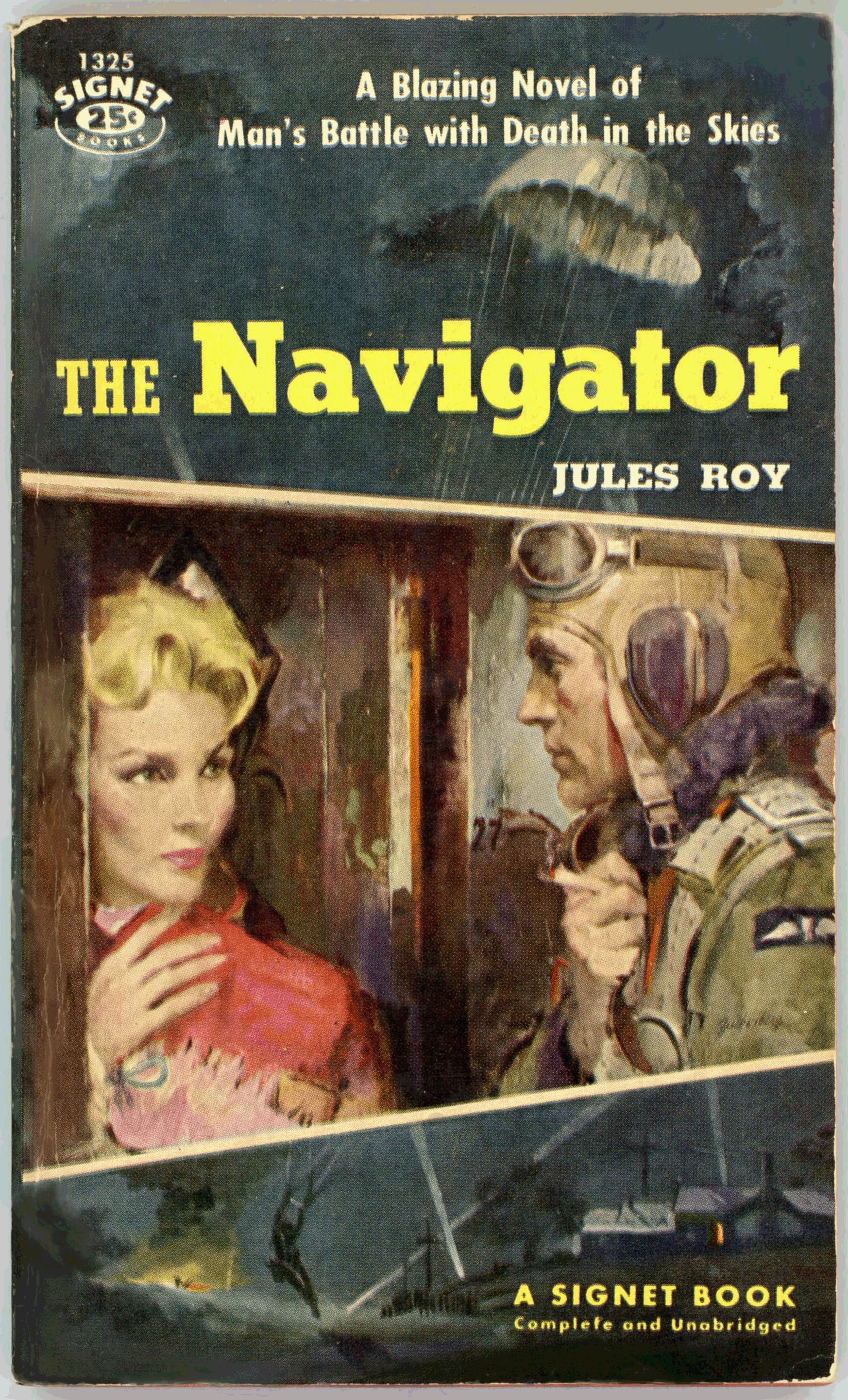
Hero From the Sky: The Navigator, by Jules Roy – 1954 [Unknown Artist] [Revised Post]

This post has been updated to include book reviews, from The New York Times Book Review, of The Navigator, by Guy Murchie (July 31, 1955) and Orville Prescott (August 10, 1955), respectively.  Whereas the “initial” version of the post (from 2018!) included the reviews as scans, this revision includes the reviews in full text form.  See below…
the-navigator-jules-roy-1955-1956-unknown-1_edited-2You disappeared, just like that.
For the whole evening the plane’s letter designation
and the name of the skipper remained on the bulletin board,
and those who had returned cast a sympathetic but relieved look at it.
Death was all very well for others.
Then the missing vanished.
The ground staff hastily packed up their belongings and arranged them,
carefully labeled, in the appropriate shed.
The names of those who had disappeared were mentioned for some time,
and then individual preoccupations took the upper hand and life went on.
Life?
No, only unthinking people could call it life.
Call it, rather,
forced labor under the threat of pitiless masters forever invisible
who struck down the offender or the laggard.
None of those already fallen into the molten fires returned,
and after all it was probably no more terrible than that.

the-navigator-jules-roy-1955-1956-unknown-2_edited-1As for the navigator, he never handled a weapon.
His war consisted in plotting courses,
measuring distances, degrees, and minutes
and taking bearings on stars while sitting over a charge of explosives
which might blow him sky-high at any moment.
During flights this thought sometimes made his heart miss a beat,
but then he would shrug his shoulders.
If he were not here, he would be somewhere just as bad.
If he refused to fight he would be shot.
Any attempt to escape the universal holocaust would mean
his being hunted and tortured wherever he went.
It was better to fight in a cause that still represented a certain freedom
and respect for the individual conscience.
Besides he had no choice.
He would never grow used to another country;
his own was enough for him.
This was how he solved the question – not very satisfactorily, he knew.
But how else could he solve it?

______________________________

Orville Prescott’s review…

Books of The Times

By ORVILLE PRESCOTT

The New York Times Book Review
August 10, 1955

WHEN lieutenant Ripault came to his senses be was lying on his face in a beet field.  His parachute lay collapsed on the ground beside him.  There was a bright light not far away and at first Ripault thought that it was probably the Ruhr city of Duisburg burning.  Duisburg had been their target.  But soon the French navigator serving with a Free French unit in the R.A.F. realized that he was not in Germany but in England, that the fire was not a burning city but a burning Halifax bomber.  He remembered then that there had been a collision in midair, that he had jumped first as he was supposed to do and that as far as he knew he was the sole survivor of two planes.  What happened to Lieut. Alfred Ripault during the next few days is the story told by Jules Roy in his odd little novel, “The Navigator.”

Jules Roy is French.  In 1943 he enlisted in the R.A.F.  He left the air force wish the rank of colonel ten years later.  He is the author of several books about fliers and flying and of a play about Jet pilots, “Les Cyclones,” which has had a long and successful run in Paris with M. Roy in the leading role.  “The Navigator” is his first noveL

Novel Acclaimed in France

This book has been highly praised in France, and Andre Maurois has said that Kipling would have liked it and that Conrad might have written it Neither of those speculations seems at all likely to me.  Kipling, who loved an impressive array of technical data, would have flinched from M. Roy’s fuzzy and obscure approach to a navigator’s duties.  Conrad, who valued moral courage above all virtues, would never have written a story with so equivocal an ending.

When Ripault so narrowly escaped the death he had prepared himself to meet he felt lost, out of contact with the world.  The shock was great and he felt numbed.  And then when his commander assigned him as navigator to a pilot with a reputation for incompetence, Ripault pleaded sickness and stayed in bed.  The plane was shot down.  His comrades in the squadron felt that Ripault was guilty of something close to murder.  But had he refused to fly or was he truly unable to fly?  Was he a victim of nervous shock or was he merely afraid?  M. Roy does not tell us, and the reason he does not is that he makes no attempt to clothe his hero in the flesh and blood and personality of a specific human being.

The navigator of this story (and he is usually referred to as the navigator) is only a symbol of a man afflicted with problems.  He longs for friendship and love.  He does not want to be killed.  He resents bitterly the unfavorable judgment of his fellows and of his commander, who puts him under arrest.  But always, although his situation ought to be poignant and dramatic, it remains still, silent and remote.

Lonely Figure in an Intellectual Game

Ripault shambles like a robot through these carefully written pages, a lonely figure in silhouette who fails to command our sympathy because he seems as small and impersonal as a chessman.  The knight or bishop in a game of chess has problems also and moves about from square to square in an effort to solve them; but one doesn’t care about them because they are only figures in an intellectual game, which is exactly what Ripault is.

“The Navigator” has some effective scenes describing the operations of a bombing squadron in wartime.  It builds up to a climax that might have seemed dramatic if it were not so mechanically contrived.  A pilot who reports that he is unable to see the ground lights is suspected of being afraid.  He, too, is judged unfavorably, and Ripault longs to help his fellow in misfortune. 

His recognition of common humanity, of human feeling, brings him back to life from the half-life in which he had been living for a few days.  That seems reasonable enough.  But, this affirmation of the value of life and of brotherhood is rejected a few hours and a few pages later – by the author, I think, rather than by Ripault.  The navigator, who has just found his bearings, turns away from the very things he wants most and- chooses death instead of life.

What M. Roy is driving at is not clear.  The best guess I can make is that under the stress of war and the constant threat of death some men choose defeat.  Comradeship and even the possibility of love, both of which Ripault had, are not enough; they are not worth the fear and the repeated risk of death.  Death itself faced too often becomes less terrifying, and men like Ripault welcome it.  If this interpretation of M. Roy’s solemn and dismal little book is not accurate he has only himself to blame.  “The Navigator” belongs to that increasingly numerous school of fiction that asks questions without answering them and makes of ambiguity a virtue.

THE NAVIGATOR.  By Jules Roy.  Translated by Mervyn Savill.  177 pages.  Knopf.  $3.

______________________________

…and Guy Murchie’s.

Hero From the Sky

THE NAVIGATOR.
By Jules Roy.
Translated from the French by Mervyn Savill.
177 pp.  New York:  Alfred A. Knopf.  $3.

By GUY MURCHIE

The New York Times Book Review
July 31, 1955

THE intimate war lives of the French flying officers in the Royal Air Force have at last been brought fittingly into literature in this exciting first novel by one of them.

I Judge by the paucity of convincing reference to actual navigation that Jules Roy was not himself a navigator, but his restrained love story and engrossing picture of life on an R.A.F. base in England near the end of World War II seem real enough, as indeed his eighteen years of air force experience would lead one to expect.  His hero, Lieutenant Ripault, usually referred to as “the navigator,” lands in a beet field by parachute on the first page almost on top of the house where “the girl” Rosica lives, quite conveniently alone and hospitable.  From here the story flows rapidly forward, taking in the air base with its tense rivalries and thinly disguised struggles for survival, as much the psychological and spiritual ones as the more obvious material conflicts of flame and flak.

Although slightly amateurish in dialogue – something which Mervyn Savill’s translation could hardly have overcome – Colonel Roy’s story has a simple dignity and a sustained suspense that will easily hold the reader’s attention throughout its 177 small pages.  Despite such distractions as “the enchantment of the night, of an unknown woman dragged from her sleep, whose dressing-gown invited one to remove it,” the navigator struggles to win his personal war, to prove by courage and compassion that he is a better man khan most – even if he does not-live to reap his earthly reward.

It matters little when “the airspeed indicator showed 220 m.p.h.” in his Halifax bomber, that he reached the startling deduction that “at this height that meant 222 m.p.h. ground-speed.”  Or that “the projection of the sidereal angles on the Greenwich meridian gave two very approximate positions when it was a question of following a route fringed by hostile fighters and antiaircraft guns.”  For the navigator was guided by “the radio navigation apparatus, whose flickering signals on a green screen enabled him-to calculate their position.”

His squadron was “now grouped in a gigantic gleaming tide, flowing toward the coast,” a mission from which he was destined never to return.  Yet all unheeding his natural apprehension, “each pilot would fly by the phosphorescent needles of his instruments.  The gunners would begin to revolve in their turrets, keeping a closer watch.  Only the navigators could see clearly.  They traced their routes without sharing the anxieties of the others, in a peace that isolated them from the world.”

Even in the last few moments before the squadron comes on target, this sense of isolation persists in the mind of the protagonist.  “Ripault went back to the cockpit.  He leaned against the side window.  The plane, with all lights extinguished, was flying in complete darkness, except for pale sprays of pink and blue sparks from the exhausts.  The earth below them seemed dead, but the stream of planes must have been deafening it with its terrible thunder * * * They might have been flying a practice flight over England, with the same budding tremor running through the machine.”

While undeniably there are subtleties of philosophy in the talk and thought of the intense characters in this moving tale, one cannot feel that their recurrent immaturity is entirely a product of the war, or that Lieutenant Ripault’s unprofessional technique in the air is a mere rhetorical vagary.  Perhaps most significant of all, the final choice of the French navigator to die in his flaming plane rather than jump back into the war recalls the defeatist decisions of Jules Roy’s modern France which, however rationalized, have not entirety escaped the stigma of morbidity that the rest of the world is bound to ascribe to them.

A veteran flier, Mr. Murchie is the author of “The Song of the Sky.”
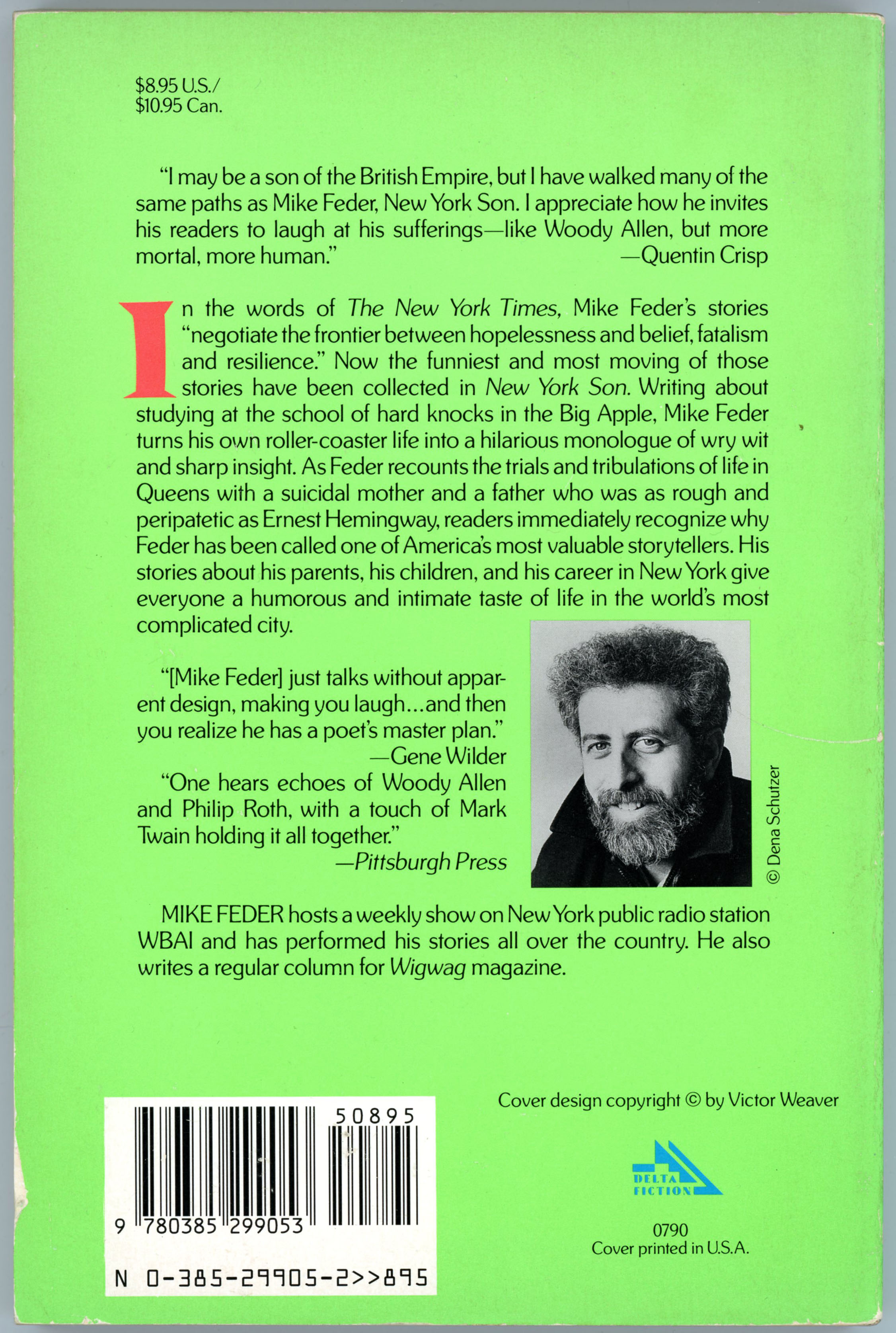
New York Son – Stories by Mike Feder – 1992 [Victor Weaver]

New York Son’s title blurb – “This book will make you laugh with all your heart!” is only partially true.  Though at times ( – well okay, yes – ) humorous, Mike Feder’s collection of eleven stories reveals genuine, deeply felt and penetrating insight into the fundamental “stuff” of life – family relationships and human nature, in a way that makes the reader step back, pause, and contemplate his own life. 

While my own favorites are “Sanford Brodsky”, “Marilyn”, and “Hollywood and Bust”, passages from two other stories – “The Fishing Trip” and “Paralegal” – are given below.

You can read and listen to more of Mr. Feder’s work at Mike Feder and the Feder Files.

Contents

Here’s Herbie (Esquire, March, 1988)
Mother

__________

The Fishing Trip

“Whenever I visited him [my father] in the locations of his grandeur,
I was never disappointed. 
If you’ve lived any,
you know that such a continuing idealization of somebody can be extremely dangerous. 
But here I was twenty-three years old and not once did he ever appear to have any faults.”

__________

Sanford Brodsky
The Hospital
The Psychic
Antigua

__________

Paralegal

You see, all these men, even the young ones, are my father to me.  
Most of them are big guys, ex-athletes, ex-military guys –
John Ramrod III, attorney at law.  
Sometimes, passing me in the hall, they say, “I hear you’re an artist.”

“Yeah.”

“What do you do?”

“I tell stories.”

“Oh.”

They don’t burst out laughing, or stare, or scowl with contempt or anything.  
A lawyer is trained to look you in the face and seem confident and happy to see you –
thinking the whole time of course that you’re a hopeless asshole.

“Hmm, that’s interesting.”  
He’s thinking to himself, what kind of job is that for a thirty-eight-year-old man?”
“What do you tell stories about?”

“Autobiographical stories.

In fact I’m probably gonna tell a story about all of you on the radio next week.”

“Oh.”

__________

The Affair
Marilyn
Hollywood and Bust

______________________________

Mike Feder (photo by Dena Schutzer)

A Theft, by Saul Bellow – 1989 [Amy Hill]

When you were down, busted, blasted, burnt out, dying, you saw the best of Clara.

So it was odd that she also should have become an executive,
highly paid and influential. 
She could make fashionable talk,
she dressed with originality,
she knew at lot at first hand about decadence,
but at any moment she could set aside the “czarina” and become the hayseed,
the dupe of travelling salesmen or grifters who wanted to lure her up to the hayloft. 
In her you might see suddenly a girl from a remote town,
from the vestigial America of one-room schoolhouses,
constables,
covered-dish suppers,
one of the communities bypassed by technology and urban development. 
Her father, remember, was still a vestryman,
and her mother sent checks to TV fundamentalists. 
In a sophisticated boardroom Clara could  be as plain as cornmeal mush,
and in such a mood, when she opened her mouth,
you couldn’t guess whether she would speak or blow bubble gum. 
Yet anybody who had it in mind to get around her was letting himself in for lots of bad news. 

– Saul Bellow –

______________________________

Amy Hill’s cover painting for A Theft.  An untitled copy of A Theft – bearing her own (the above) illustration, is tossed from a window above Park Avenue.  A closer view reveals that this illustration appears – ad infinitum? – inside each iteration within the painting. 

______________________________

Portrait of Saul Bellow by Thomas Victor.