Wonder Stories, 1957 [Richard M. Powers]

(This is the first of two posts describing the digest-format science fiction anthology Wonder Stories, published with generally similar content in 1957 and 1963, featured cover art of the same general theme by Richard M. Powers.  As such, though the content of both posts is similar, major differences between the two editions are explained and made clear in each post.  So, for those in a hurry (who’s not in a hurry anymore?!) you can jump to the post for the 1963 edition, here.) 

The best way to impart a sense of literary wonder is through awe, mystery, and a sense of things unknown.  Certainly that’s the case for the 1957 edition of Standard Magazines’ (otherwise known as Thrilling Publications’) anthology Wonder Stories, which is comprised of selections from early 50s editions of Startling Stories and Thrilling Wonder Stories, as well as Kurt Vonnegut, Jr.’s story “Thanasphere”, the latter was written specifically for this publication. 

(You can learn more about the history of Wonder Stories, and “other reprints from the Thrilling group”, at Todd Mason’s Sweet Freedom blog.)

A sense of wonder really arises (at first!) from the anthology’s cover, which features one of the very few pulp magazine cover paintings created by Richard M. Powers, whose forte overwhelmingly resided in creating cover art for books: His few other cover illustrations appeared in early issues of Galaxy Science Fiction, and, Beyond Fantasy Fiction.

Typical of Powers’ cover art, this painting sets up a mood; a feeling; a vibe, having absolutely no relationship to or inspiration from any of the stories in the anthology.  (The same thing often goes for his book covers, which are often similarly unrelated to the contents therein.)  Also typical of Powers, the scene is absent of specific beings or even the merest sign of a human presence, let alone anything identifiably organic.  Instead, it presents active and energetic symbols of technology and power set upon a desolate, barren alien landscape.  Something’s happening, and, some thing is happening, too.  But, what?  (Hey, is that a city in the distance?)

In the hindsight 2025, the painting depicts a scene reminiscent of the ruins of the Ring Builders’ constructions on the planet Ilus IV, from season four of “The Expanse”: Incomprehensibly ancient structures embedded deep (how deep?) within yet extending far above the desert soil of that world, yet still functioning over two billion years after their construction, their power undiminished.  Check out these images of concept art for “The Expanse” at Lee Fitzgerald’s website, to see the resemblance.  The Expanse (fandom) also displays an image of the ruins on Ilus.

So, here’s Wonder Stories’ cover, “as is”…

… while here’s a close-up of the scene…

…and, here’s the cover art all “niced up”, lightly edited, and framed in white, for this post.

But, what of the anthology’s contents?  Of the stories within, I’m only directly familiar with Ray Bradbury’s “A Sound of Thunder”, Arthur C. Clarke’s “All the Time in the World”, and especially and recently John D. MacDonald’s “Shadow On the Sand”, the latter of which appeared in and inspired the cover art for the October, 1950 issue of Thrilling Wonder Stories.  I didn’t actually r e a d MacDonald’s story within my copy of Wonder Stories – the one you see featured in the images above – due to the fragility of my now-67-year-old copy.  Instead, I created and printed the story from a PDF comprising the entire issue (accessed through the Internet Archive … you can also download it via the Luminist Archive); that, I read. 

Having previously encountered very little by and knowing virtually nothing about author MacDonald, I can unreservedly say that I was deeply impressed with “Shadow on On the Sand” on a variety of levels, specifically the originality of the plot, and, characters (even minor characters) that – differentiated and not two-dimensional stock figures – changed and evolved as the story progressed.  In sum, the novella is the account of an extraterrestrial totalitarian civilization’s clandestine conquest of Earth utilizing instantaneous superluminal teleportation, and, the impersonation and replacement of human beings with physically altered doppelgangers … the aliens already being (this made writing the story easier, I suppose!) on a superficial level at least … physically and superficially identical to homo sapiens.  All this occurs against and within a backdrop of competition, conflict, and political murder among the aliens’ ruthlessly competitive political parties, military, and clandestine services, with the story’s protagonist going over to the side of humanity by the story’s end.  More, I shall not say.  As fast paced entertainment, it’s a great read.  And yet…  Unusually for a story penned over seven decades ago, the novella is surprisingly violent, if not genuinely grotesque, in parts (“not for the squeamish!”) … albeit violence and horror are neither the center of nor the “drivers” of the plot.  The novella is quite reminiscent of the works of Jack Vance in terms of political and social complexity and ambiguity, as well as the air of intrigue that permeates the tale. 

(For a much deeper exploration of MacDonald’s story, read “Shadow On the Sand” at Steve Scott’s blog, “The Trap of Solid Gold – Celebrating the works of John D MacDonald“.)

Otherwise, my reading of “Shadow On the Sand” imparted a sense of curiosity about MacDonald’s larger body of work, which led to my reading the Fawcett Gold Medal 1978 book Other Times, Other Worlds, an anthology of sixteen of his science fiction stories spanning publication between 1948 and 1968.  Upon reading this collection (it deserved better cover art than a simple astronomical photograph!) I soon realized that I previously had read one of his stories: “Spectator Sport” (originally published in the February, 1950 issue of Thrilling Wonder Stories) first in Fifty Short Science Fiction Tales, and subsequently in Isaac Asimov Presents The Great SF Stories 12.  Curiously, this short story features an event that prefigures a plot element in “Shadow On the Sand”.  (Ironically, I didn’t like “Spectator Sport” at all!)  Regardless, I was and remain deeply impressed by MacDonald’s literary skill in terms of character development and delineation, his ability to create an event, setting, scene, and “world” with a modicum of skillfully chosen language, and especially, his ability to unflaggingly maintain the pace, mood, and atmosphere of a tale from beginning to end.  Only upon reading this anthology and sources elsewhere did I learn that MacDonald more than successfully (extraordinarily so) transitioned from science fiction to mainstream fiction, creating the “Travis McGee” series.    

Here’s a nice image of the magazine’s cover.  As revealed in the Internet Speculative Fiction Database, the cover and interior artist of this issue are unknown.  Otherwise, MacDonald’s story is entirely absent of flying saucers (actually, spacecraft make no appearance whatsover) and the characters don’t go around wearing tattered, torn, Tarzan-like togas.  

This diminutive image appears in the magazine’s table of contents (page 4), adjacent to the story title.  The monolith-like slab is a symbol of the teleportation device which is a central plot element and inspiration of the title, albeit the device is essentially invisible to human observers.  Rather, what is visible is a mere glimpse of a vague and fleeting rectangular shadow, which is the portal through which the aliens are transported to Earth. 

The only single-page illustration accompanying the story appears on page 15.  It shows the arrival of the alien who eventually “goes over” to the side of Earth.  Of course, his major inducement is the romantic relationship he unexpectedly (unexpectedly to him!) develops with a woman.  MacDonald doesn’t actually describe the appearance of the portal, let alone venture an explanation of its operation.  It simply shows up when needed and then disappears.

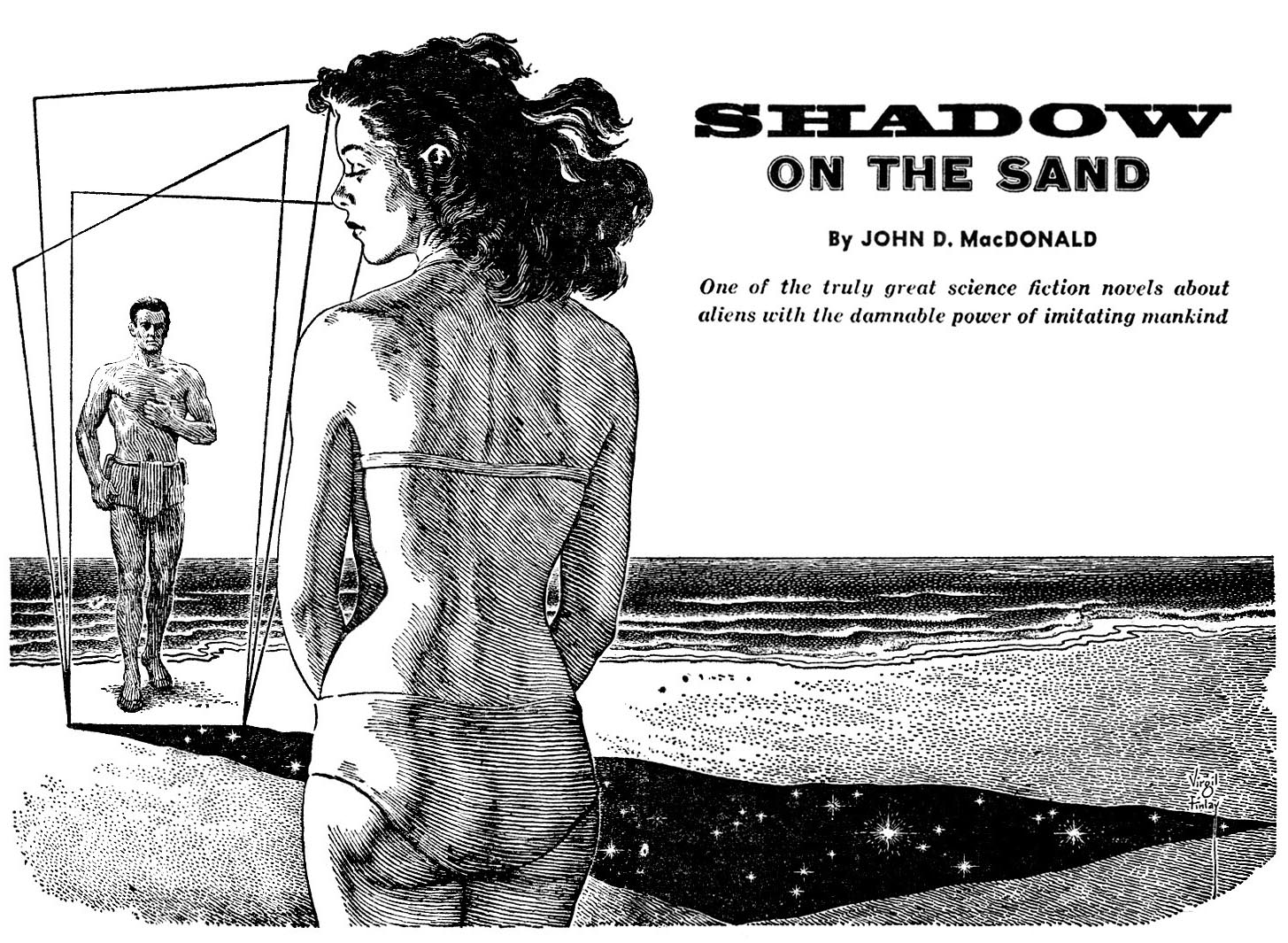
The unknown artist’s illustration of the alien civilization’s “shadow” – the teleportation portal – is absent from Wonder Stories, having been replaced by Virgil Finlay’s intricate portrayal of the scene, which is characterized by his typical attention to detail.  Due to the fragility of my copy of Wonder Stories, this image – on pages 2 and 3 – was downloaded (right-clicked) from something known as the “Internet” (!) for display here, on, the, Internet.  Oh, yeah, I’m already on, the, Internet.  (Like, you!)  In reality!…  The image here is from the cover of The JDM Bibliophile, Number 17, from March, of 1972.  (That’s “JDM”, as in John D. MacDonald.  That’s FANAC as in “The Fanac Fan History Project.”)
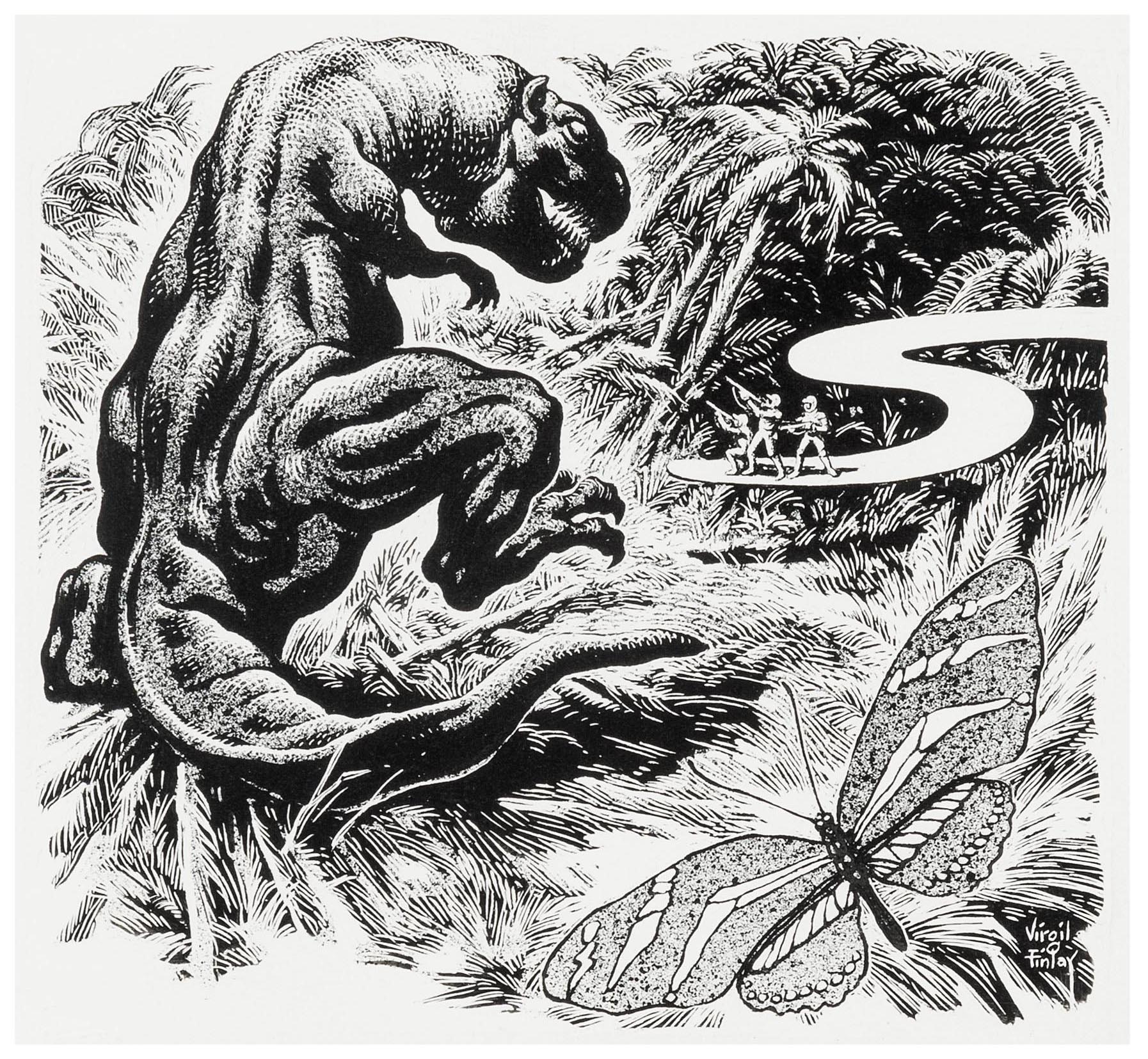
The second story in Wonder Stories is Ray Bradbury’s “A Sound of Thunder“.  Though the tale appeared in Planet Stories in 1954, accompanied by a great two-page illustration by Ed Emshwiller, in Wonder Stories, it’s replaced by a Virgil Finlay composition which appears on page 30.  The example below is taken from Heritage Auctions, where it was uploaded in September of 2019: “Created in ink over graphite, this small wonder is already beautifully matted and framed with an inside matting area of 4.25″ x 4.25″.  Wood silver painted frame, glass front, and outside measurements of 8.5″ x 8.5″.  The frame has some small nicks and blemishes but the art is in Excellent condition.”
Wonder Stories was republished in 1963, with cover art based upon Powers’ composition for this 1957 edition, and containing six of the stories from this “first” edition.  You can read about the latter edition here.

~~~~~~~~~~~~~~~~~~~~~~~~~~~~~~

And, in a sort of conclusion, at this link – here, given that you read this far! – you can download the PDF version of MacDonald’s story that I created for my own reading.  

~~~~~~~~~~~~~~~~~~~~~~~~~~~~~~

So, inside “Wonder Stories” you’ll find what, exactly?

“Shadow on the Sand”, by John D. MacDonald, from Thrilling Wonder Stories, October, 1950 (Reprinted in 1963 edition)
“A Sound of Thunder”, by Ray Bradbury, from Colliers, June 28, 1952; then from Planet Stories, January, 1954 (Reprinted in 1963 edition)
“All the Time in the World”, by Arthur C. Clarke, from Startling Stories, July, 1952 (Reprinted in 1963 edition)
“Man of Distinction”, by Fredric Brown, from Thrilling Wonder Stories, February, 1951 (Reprinted in  1963 edition)
“Thanasphere”, by Kurt Vonnegut, Jr., for this volume
“Spacemate”, by Walt Sheldon, from Thrilling Wonder Stories, August, 1950
“The Monitor”, by Margaret St. Clair, from Startling Stories, January, 1954 (Reprinted in  1963 edition)
“Star Bride”, by Anthony Boucher, from Thrilling Wonder Stories, December, 1951 (Reprinted in  1963 edition)

…and otherwise…

Wonder Stories, 1957, at…

… Internet Speculative Fiction Database

John D. MacDonald, at…

Fiction DB

John D. MacDonald.org

GoodReads

Travis McGee

Wikipedia

Amazing Stories, September, 1964, featuring “The Kingdoms of the Stars”, by Edmond Hamilton, and “Clean Slate”, by James H. Schmitz [Robert J. Adragna]

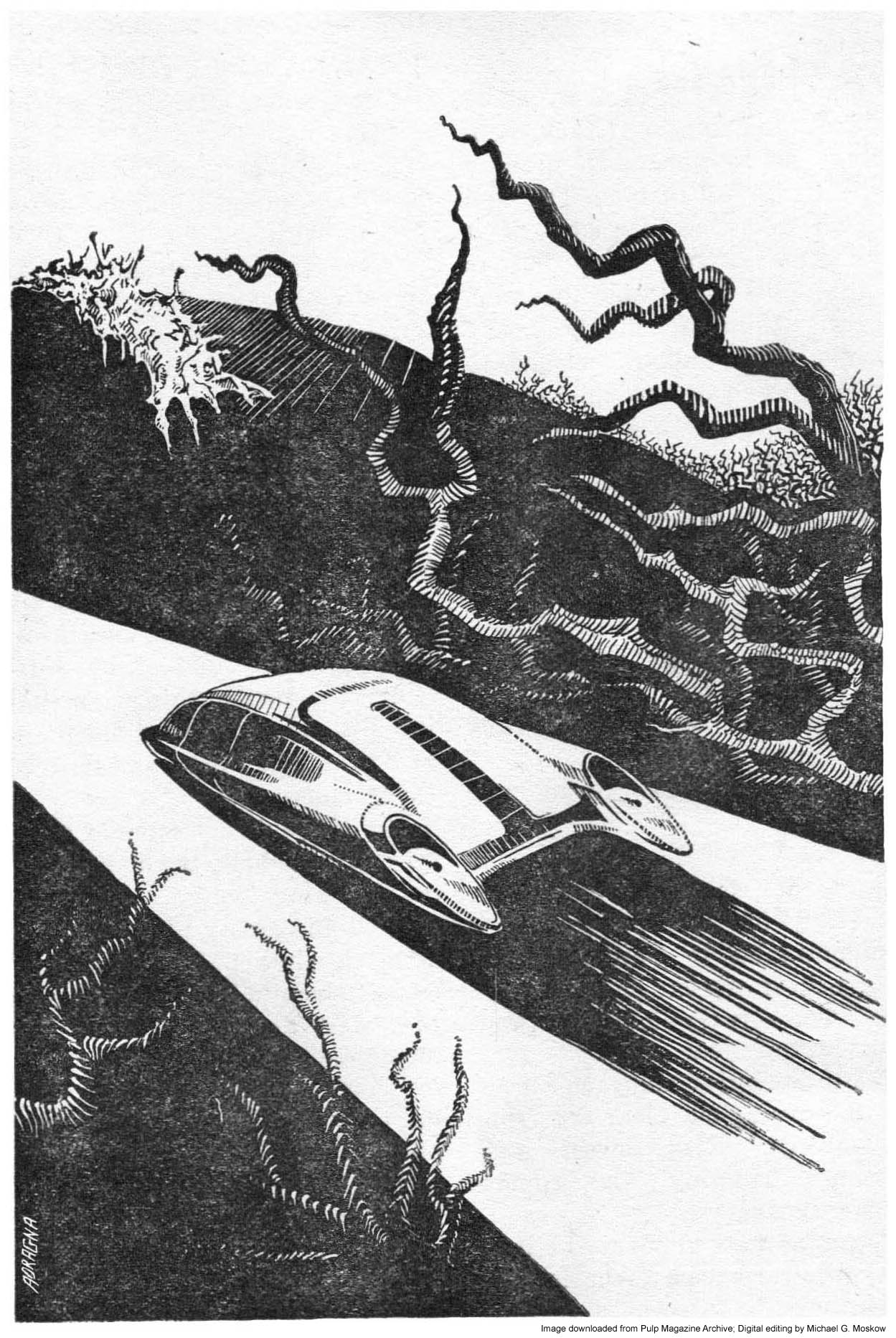
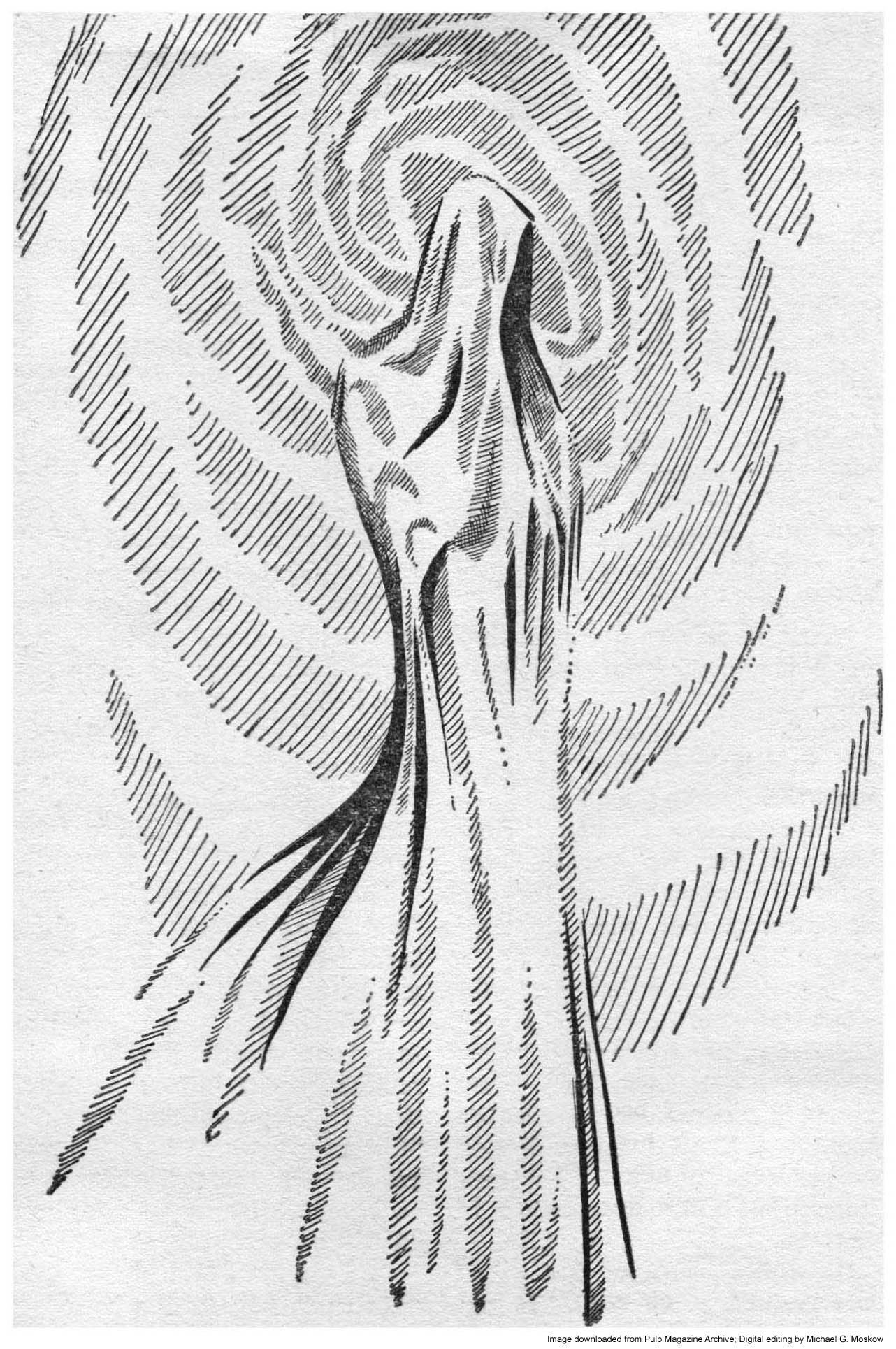
An artist with whose works I have little familiarity with is Robert Adragna, who created the cover and interior illustrations of the September ’64 issue of Amazing Stories, for Edmond Hamilton’s “The Kingdoms of the Stars”.  The story has only been reprinted once: in the Ultimate Publishing Company’s one-off SF Greats, which was released in Fall of 1970.

Illustrations by Robert J. Adragna for “Kingdoms of The Stars” by Edmond Hamilton

(…page 22…)

(…page 32…)

(…page 42…)

What say?

“Kingdoms of the Stars”, at…

Internet Speculative Fiction Database

Robert Adragna (Robert Joseph Adragna), at…

Internet Speculative Fiction Database

flickr

Amazing Stories, November, 1961, featuring “Counter-Psych”, by Charles Eric Maine [Virgil W. Finlay]

Another amazing (and Amazing) single-page illustration by Virgil Finlay.  The art works better by showing the astronauts in simple, smooth, stylized spacesuits, rather than with all manner of gear, accoutrements, thing-a-ma-bobs, and oxygen tanks.  

Illustration by Virgil W. Finlay for “Meteor Strike!” by Donald E. Westlake

(…page 35…)

What’s the story? …

Meteor Strike!, at Internet Speculative Fiction Database

… here’s the author…

Donald E. Westlake, at I S F D B 

Amazing Stories, March, 1961, featuring “Mindfield!”, by Frank Herbert [Lloyd P. Birmingham]

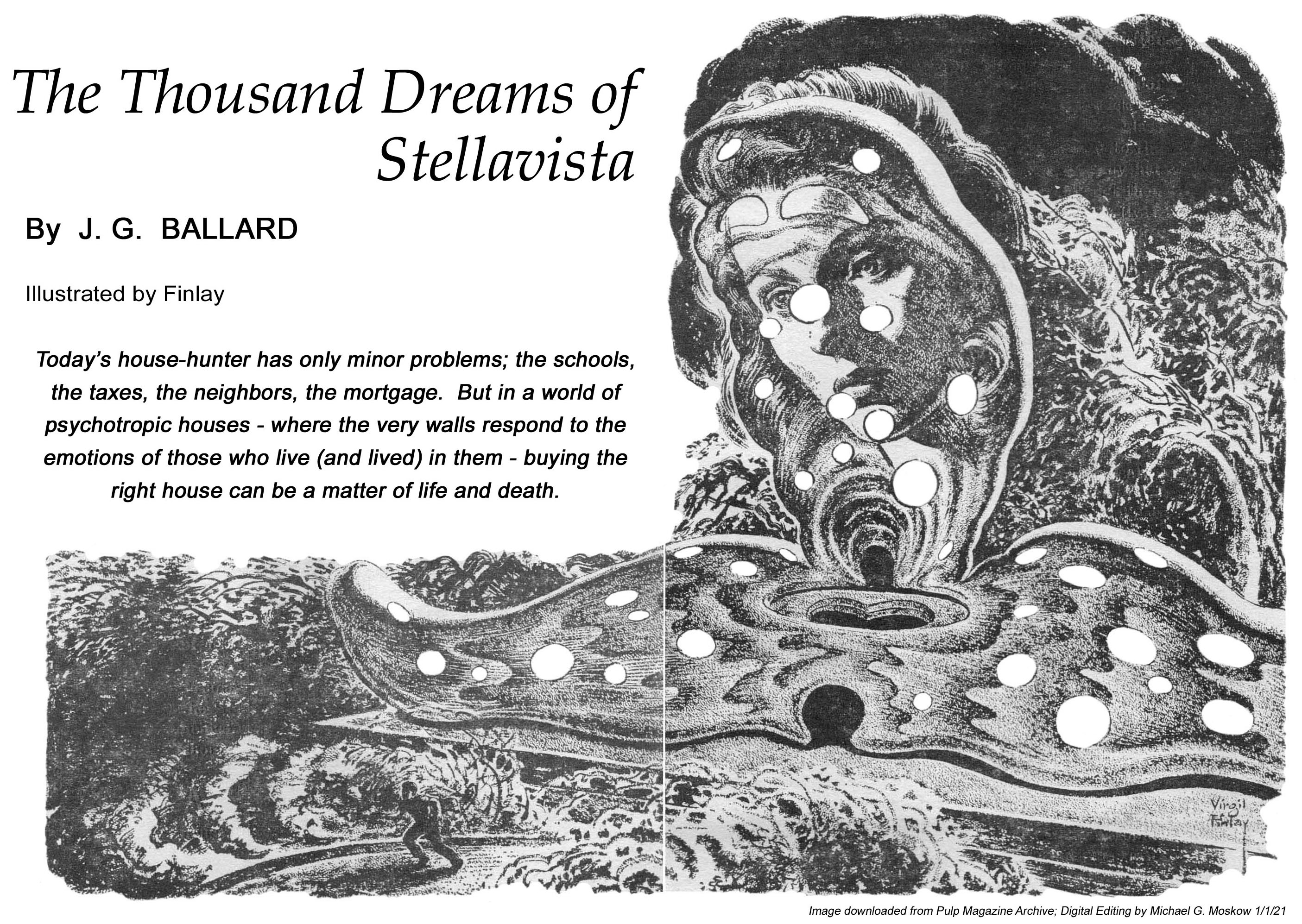
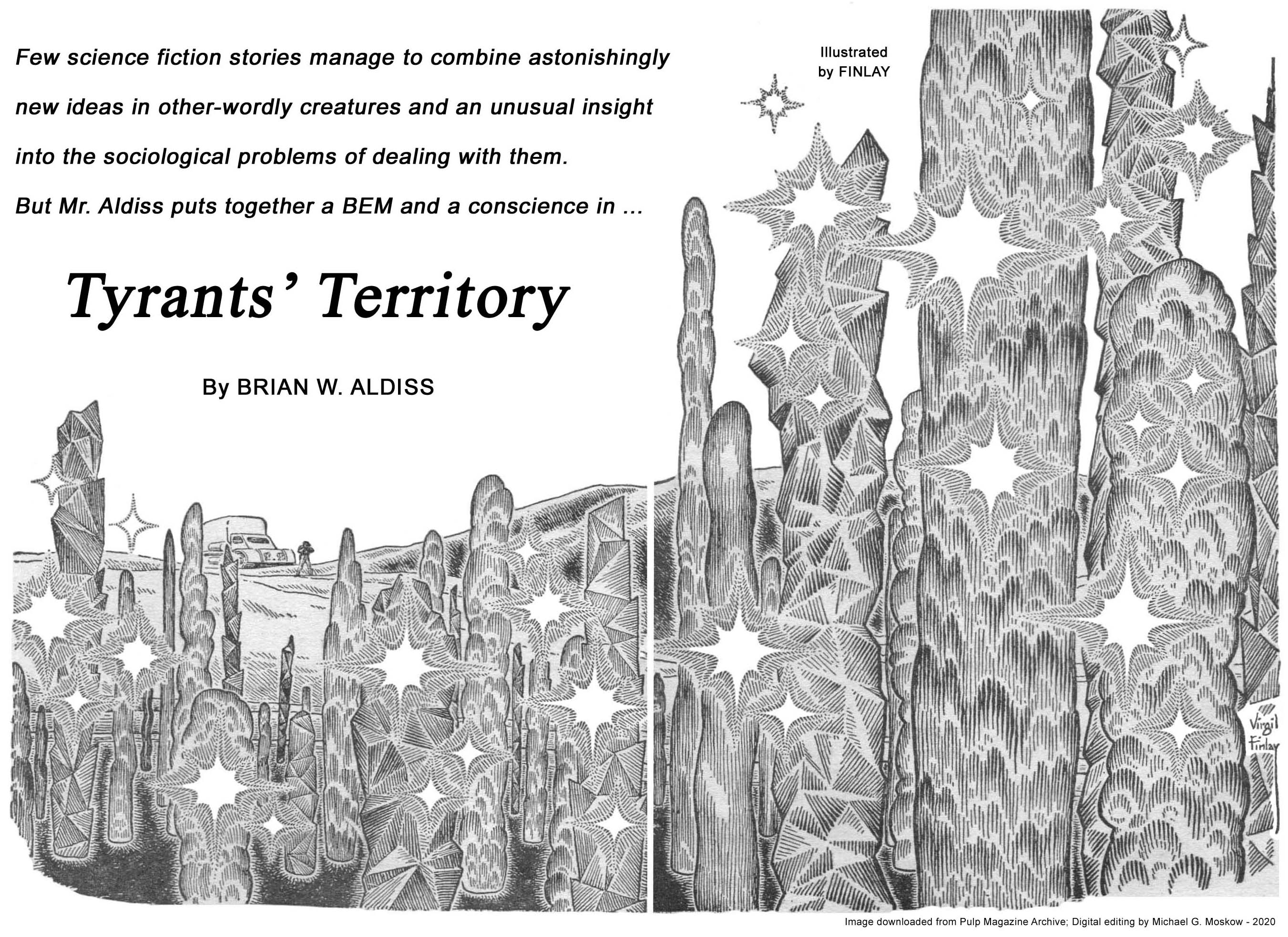
…however, segueing from my prior post, here are two fine examples of Finlay’s digest-format dual-page compositions, again for Amazing Stories.  Though perhaps bit more cramped than in startling or thrilling pulps of larger size, the artist still managed to impart the same level of detail to his work. 

As in the prior post, both images were downloaded as single pages from the Pulp Magazine Archive, spliced together, and then edited.  

(I haven’t read either story.  Yet.)

Illustrations by Virgil W. Finlay for…

“The Thousand Dreams of Stellavista”, by J.G. Ballard

(…pages 48-49…)

“Tyrants’ Territory”, by Brian W. Aldiss

(…pages 106-107…)

And while we’re at it, at the Internet Speculative Fiction Database…

The Thousand Dreams of Stellavista

Tyrants’ Territory

Amazing Stories, February, 1961 – Featuring “When the Dream Dies”, by Bertram Chandler [Alex Schomburg]

I’ve not read this story, but the interior illustration for “When the Dream Dies (What of the Dreamer?)” (alternately and subsequently entitled as “When the Dream Dies”, and, “Rendezvous on a Lost World”) is a fine example of Virgil Finlay’s single-page work for digest size pulps.  Though not as visually bold as his two-page work for such publications as Startling Stories and Thrilling Wonder Stories (among others!), his composition is similar to those works in having the same qualities of symbolism, myth, and, an idealized human form.

Here, the cover image is a scan of my own copy, while the illustration from page 57 was downloaded from the Pulp Magazine Archive because the extreme tightness of the magazine’s binding prevented effective and safe scanning.  Then, it was digitally edited.  

Illustration by Virgil W. Finlay for “When the Dream Dies (What of the Dreamer?)” by A. Bertram Chandler

(…page 57…)

But Wait … There’s More!

A. Bertram Chandler, at…

Fantastic Fiction

GoodReads

Simon & Schuster

Wikipedia

Super Science Stories – May, 1950, featuring “The Death Crystal” by George O. Smith, and, “By The Stars Forgot” by John D. MacDonald [Lawrence Sterne Stevens] [Updated Post]

Created in January of 2020 (…is it that long ago?!…) I’ve updated this post to include two images of Grand Central Station. 

Having previously presented an example of artist Paul Callé‘s work from the January, 1950 issue of Super Science Stories, here’s another superb example of his work: The illustration accompanying John D. MacDonald’s short (really short!) story “By The Stars Forgot”, from the magazine’s issue of May, 1950.

What’s particularly notable about the illustrations in Super Science Stories – at least, those issues from the early 1950s – is that they equal if not exceed in symbolism, visual power, and simplicity of composition art featured in more prominent and influential “first tier” science fiction magazines of the same era (primarily Astounding; the interior art in Galaxy was highly variable in quality in style, while The Magazine of Fantasy and Science Fiction largely eschewed interior art except, for a brief interval in the 1950s).  This is ironic, given that the magazine was not the most influential publication of the genre, albeit it did publish the work of prominent authors.

Like some other posts at this blog, this example of Paul Callé‘s stunning work was downloaded from the Pulp Magazine Archive and edited via Photoshop Elements, to create the image displayed here. 

“A giant gets you by the ankle and throws you toward the roof…”

Manhattan’s Grand Central Station, central to MacDonald’s Story and a central element of Callé’s composition, closely matches this strikingly sunbeamed evocative photographic image of the Station from the 1940s…

(Getty Image 466275073)

Here’s another image of Grand Central Station.  This lovely picture – photographer’s name and specific date unknown, albeit copyrighted by Corbis-Bettmann – was published as postcard AY129 by Graphique de France in the late 1990s or early 2000s.

The image is superbly composed in terms of balance between light and dark, with the angled sunbeams imparting an impression of transparent solidity.  The attire of the men and women  suggests that the picture was taken from 1940s through 1950s.  And (minor point!), at least we can tell the time of day: 8:34 A.M., by the four-faced clock above the ticket counter.       

The magazine also includes this wonderful Illustration by Virgil W. Finlay for Clifford D. Simak’s “The Call From Beyond” (pages 56-57), an example of how large-format pulps permitted the artist to display his singular talents to greatest effect.  I’ve edited this image to remove its extraneous (digital) background and thereby enhance the illustration’s actual and most intriguing characters, creatures, and components.  A close view of the drawing reveals that the its monstrous and mysterious denizens are all unique individuals:  No two figures – whether alien, avian, vaguely earthly, or eerily ambiguous – are exactly alike.

As for the story itself?  Subsequent to its appearance in Super Science Stories, it’s only been republished eight times, most recently in digital format at Project Gutenberg.  

Some things to refer to.

Paul Callé, at

Wikipedia

Postal stamp commemorating first American EVA

Paul Calle Space Art (Paul Calle & Chris Calle)

Paul Calle Space Art (Paul Calle & Chris Calle)

Super Science Stories, at…

 Wikipedia

Luminist Archive

10/18/20, 357 / January 29, 2020 99 as of Oct. 18, 2020

Fantastic September 1952, featuring “Professor Bingo’s Snuff”, by Raymond Chandler [Barye W. Phillips and Leo R. Summers]

Good Lord, what is going on here?!

The cover of the Summer, 1952 issue of Fantastic – the combined effort of Bayre Phillips and L.R. Summers for the magazine’s first issue – is obviously intended to set up an air; an atmosphere; a mood … to interest readers in the magazine, for it’s unrelated to any of the essays, novelettes, or short stories within the pulp.  The central element is the green-skinned woman (she’s emphatically not an Orion slave-girl), who’s holding a goblet filled with a red liquid of an undefined nature, which – port wine? – cherry daiquiri? – tomato juice? – something darkly else entirely? – ! – is fortunately left to the reader’s imagination.  Is she about to partake of this drink?  Or, is this an offering to the unwary reader?  And, that look upon her face; the forceful gaze of her eyes…  Threat or submission?  (I think the former.)  Demanding or beckoning?  (The former I think.)  What about that head-dress?  At passing first, from a distance, a mere mass of intertwined feathers.  At focused second, closely, a melange of intertwined writhing bodies.    

The cover’s ultimate message, enhanced by a bright, yellow, featureless background, is not “Danger – stay away!” 

It is, “Danger – come closer.  If you dare!”

Illustration by Virgil W. Finlay for “Six and Ten are Johnny”, by Walter M. Miller, Jr.  This story has never been anthologized.
(page 31)

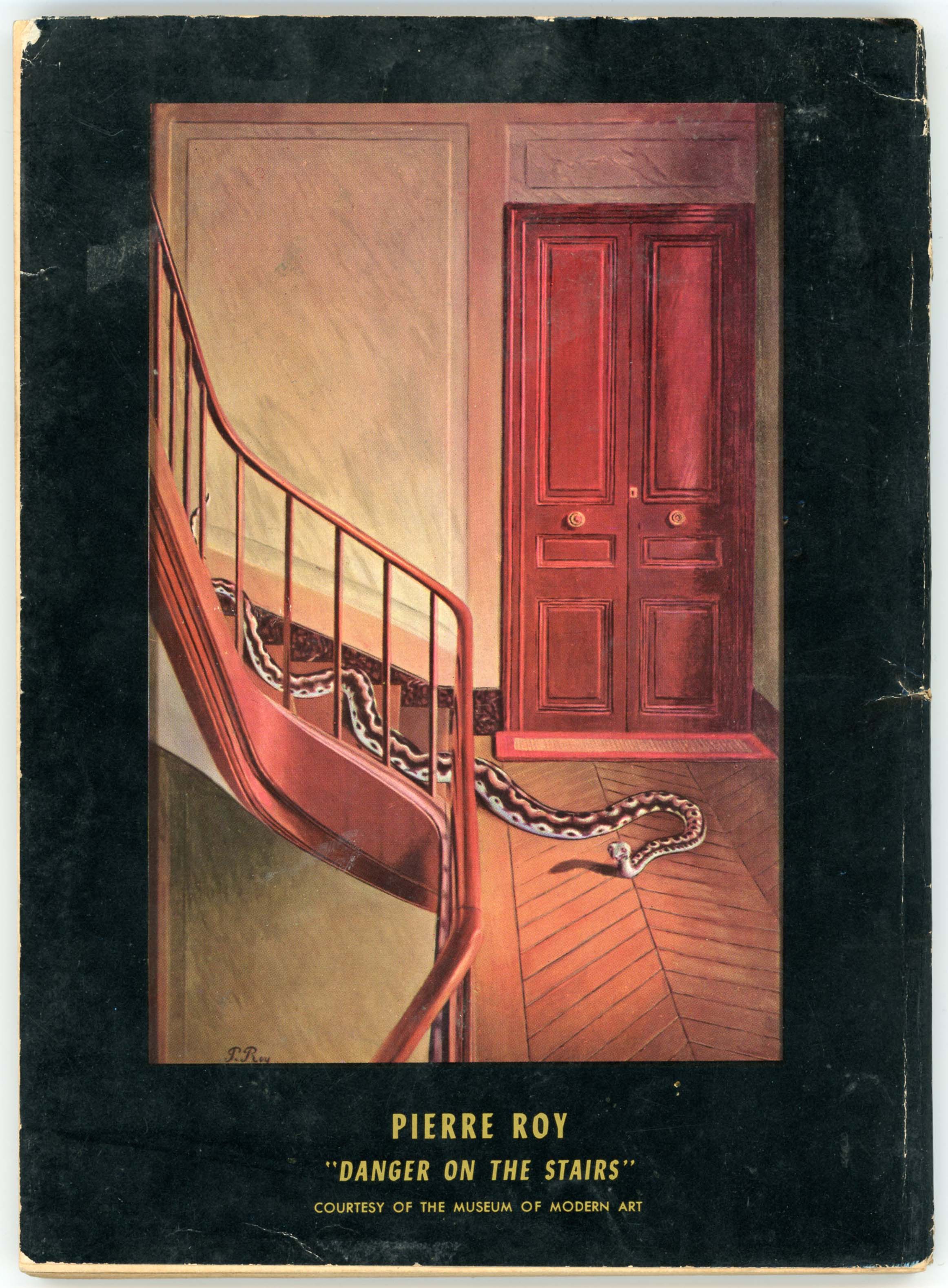
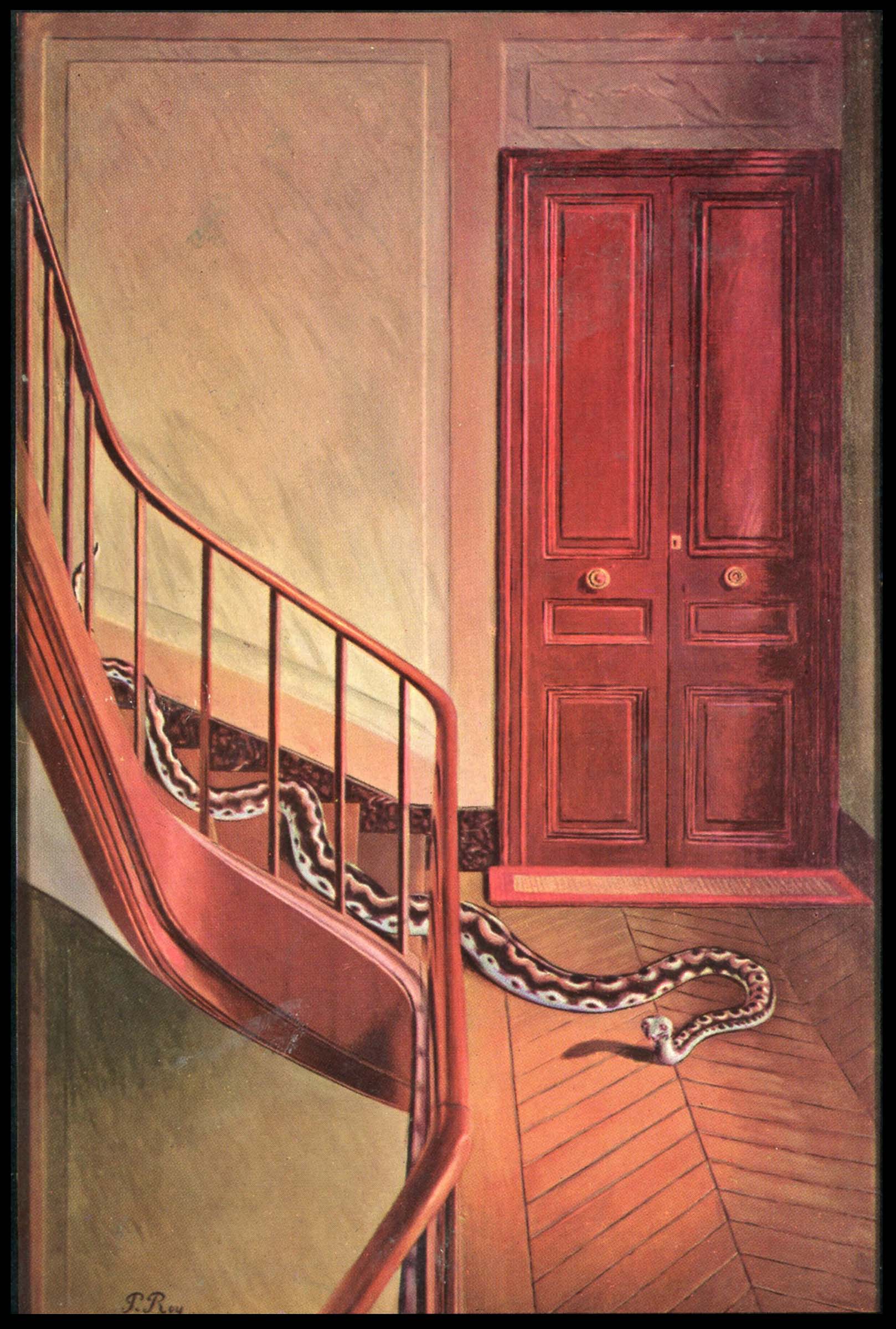
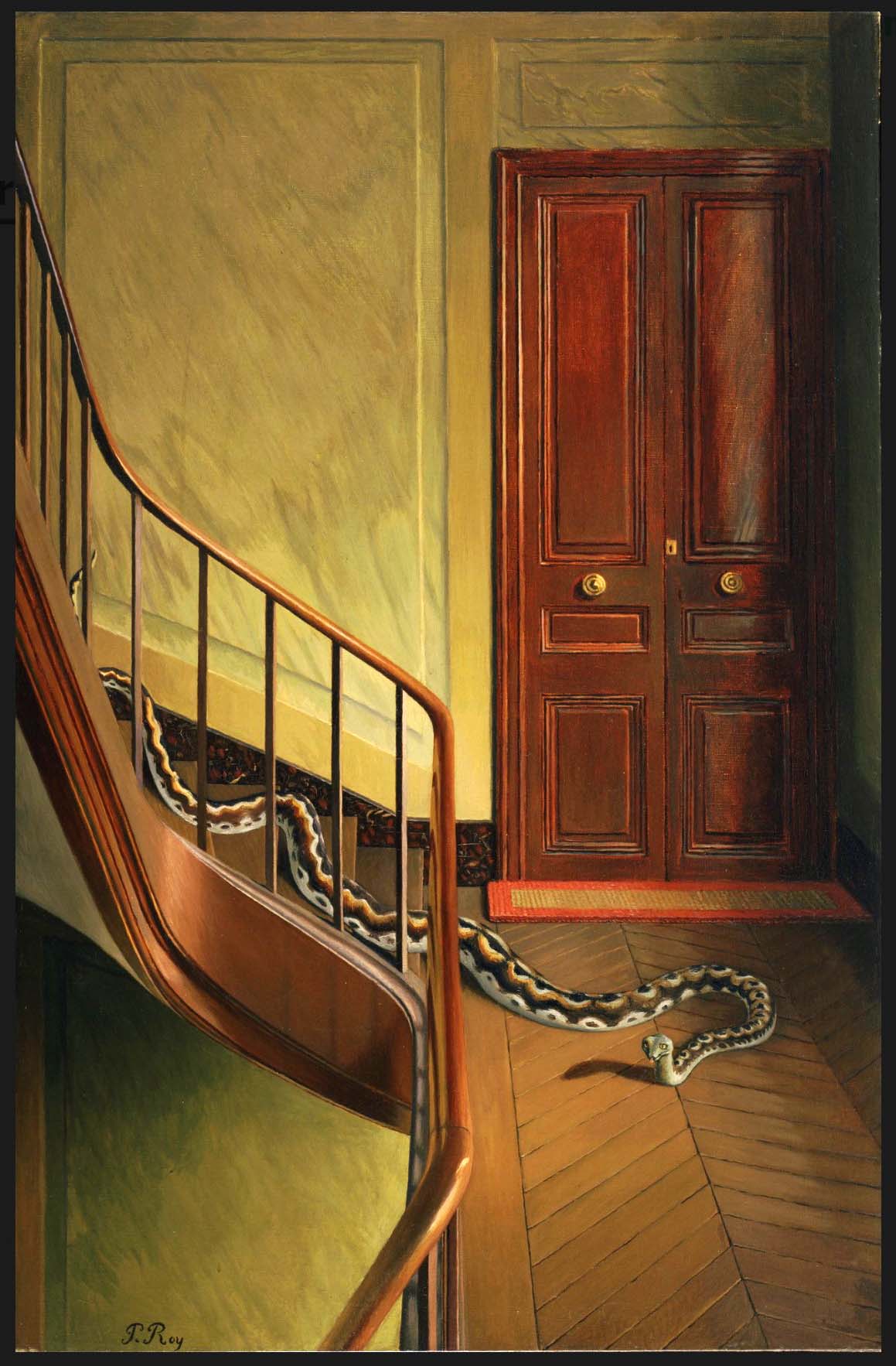
The back cover features Pierre Roy’s oil on canvas painting of 1927 or 1928, “Danger on the Stairs”, which is in the holdings of the Museum of Modern Art, on 53rd Street in Manhattan. 

This is the pulp’s rear cover…

,,,and, a cropped view of the cover:

A view of the original work, from MoMA, the colors of which are presumably truer to Roy’s original than as reproduced in the magazine.

Other Things to Occupy Your Time…

Barye W. Phillips, at…

Lambiek Comiclopedia

Illustrated Gallery

Alberto’s Pages

Leo R. Summers, at…

Internet Speculative Fiction Database

Pulp Artists

Howard Browne, at…

Wikipedia

Project Gutenberg

Internet Speculative Fiction Database

Science Fiction Studies # 8 (V 3, N 1, March, 1976, “The Lost Canticles of Walter M. Miller, Jr.”, by David N. Samuelson)

Raymond T. Chandler, at…

Wikipedia

Faded Page

GoodReads

Internet Movie Database

Pierre Roy, at…

Wikipedia

MoMA (Metropolitan Museum of Modern Art)

MoMA – “Danger on the Stairs” (at Metropolitan Museum of Modern Art)

Tate Galleries

Brittanica (Topic: Surrealism)

The Complete Book of Space Travel, by Albro Tilton Gaul – 1955 [Illustrations by Virgil W. Finlay]

In art; as much as in literature; as much as in “life”, there are patterns and coincidences.  Some turn out to be illusory, while others are as real as they are telling.

Years ago, shortly after The Eye of Sauron (a.k.a. “Oogle”) enabled search results to display images (a feature since then vastly enhanced in terms of capability and selectivity) I searched for images using the terms “science fiction”, “science fiction art”, “science fiction magazines”, “astronaut”, “space exploration”, and then, by artists’ names – for example “Virgil Finlay” – to see what could be found in the way of relevant art and illustration, regardless of original format or venue.  Though the results greatly varied depending upon search criteria and time interval, a subtle repetitiveness emerged and has persisted among the sets of images returned by Google (and now, DuckDuckGo).

Two recent examples (as in “today-as-I-write-this-post”) are shown below.  They show search results for the text string “Virgil Finlay astronaut”, sans filters.

Here’s the results for DuckDuckGo:

And, the results from The Eye of Sauron (otherwise known as “Oogle”):

The search results are obviously very, very (did I say “very”?!) different in terms of the specific images returned, and, the order and “location” of these images as displayed, which I guess this reflects the algorithms used by these search engines.  Very prominently displayed by Google as three images at upper left, and two elsewhere in the results is an illustration of a pensive astronaut wearing a “knight-in-armor” like helmet and facing to the right, around whom are superimposed bolts of lighting denoting electrical energy.  Also at upper left is an illustration of an astronaut standing on the surface of an alien world, a spacecraft and a moon behind him, with gloves ending in pincers.  DuckDuckGo, on the other hand, returns just two images of that contemplative space explorer, and includes a variation on this theme where a similarly-attired astronaut stares upward, with a rocket rising behind him at lower left.  Also present at DuckDuckGo is that full-suited pincer-gloved moonlit astronaut standing upon an unknown world.  So, while the differences in the search results are inevitable, the similarities are intriguing.

Which leads to the question:  What ties these three images together?  Where are these pictures from?  Ephemera?  A pamphlet?  Privately commissioned work?  A science-fiction pulp?  A book?  In other words, what gives?  

After a bit of investigation (based on the captions of the above-mentioned images, and, by consulting the Internet Speculative Fiction Database), the title of the work featuring these Finlay illustrations readily emerged.  These Finlay illustrations are from Albro T. Gaul’s book The Complete Book of Space Travel, which was published in 1956 by the World Publishing Company of Cleveland.  According to WorldCat, the 1956 imprint is thus far the book’s first, last, and only edition.   

Here’s the front cover, L.W. Currey Books

… while you can “borrow” the scanned book at the Internet Archive.

That this book is a work of speculative science, rather than science fiction, is immediately apparent from the cover and introduction, the latter of which follows:

THE FIRST SPACE PILOT has already been born.  He is probably between ten and sixteen years of age at this moment.  Without doubt both he and his parents listen to radio and television programs dealing with much space adventure but with few accurate facts.  This book is designed to outline the facts of space travel, and the conditions we expect to find in space and among the planets and stars.  These facts alone are sufficiently exciting, since they are factors in man’s greatest single adventure – the exploration of the universe.

This book has not been written for the space pilot alone.  It is written for his engineer, his astrogator, the vast ground crews who will be responsible for the take-off, the scientists who will design the ship, and the many people whose taxes and investments will make it vital to understand the problems and progress of space travel.

Space travel is already here.  Flying saucers are probably indicative of space travel by a race other than ours.  We are slowly solving the problems of man’s own survival in space.  It is only a matter of a few years, and many, many dollars, before our first space pilot will launch himself into the last frontier of exploration, adventure, and commerce.

We read much about space stations, the small man-made satellites which will be-designed to circle the earth at an altitude of several thousand miles.  Actually, these space stations will be very useful, even if space travel never develops any further, and we should know about them too.

Although much has been written about space travel, much of this material deals with the mechanics of ship construction to get us into space.

It is the purpose of this book, on the other hand, to show that space travel is also a biological problem, even perhaps to a greater extent than it is an engineering problem.  Moreover it is the purpose of this book to describe, to the best of present knowledge, what we expect to encounter when we get to space.  This is important, because the success of mail’s greatest adventure will depend upon being well prepared.

Today, space travel is one of the ultimate goals of scientific and military research.  The familiar cry, “Who rules the moon controls the earth!” reflects our readiness to exploit space.  Our military might is ready for space; our economic strength is ready for space; soon our ships will be ready for space.

Let’s find out what space travel is all about.

Unusually, unlike the myriad of books in the field of science fiction, or pure science, aimed at the serious reader, Space Travel includes an acknowledgement and biography of the book’s artist.  In this case (as you know from the title of this post!) Virgil W. Finlay.

ABOUT THE ILLUSTRATOR

VIRGIL FINLAY has worked for nearly every magazine in the science-fiction and fantasy fields for the last nineteen years.  He has illustrated many books as well as designed book jackets and magazine covers.  His paintings and drawings have hung in the Metropolitan Museum of Art, as well as in the Memorial Art Gallery and in the Art Center, Rochester, New York.

Born in Rochester in 1914, Virgil Finlay completed high school and was self-tutored in art.  He started to exhibit his work when he was only fourteen years old.  From 1934 to 1936 he submitted drawings to Weird Tales, and was on A. Merritt’s staff as feature fiction illustrator for the American Weekly (Sunday section of the New York Journal American).  In 1938 he married Beverly Stiles.  He was in the Army Engineer Corps for three years, and is a veteran of the Okinawa campaign.  After his return from the service, Mr. Finlay free-lanced in New York.  A daughter, Lail, was born in 1949.  At present the Finlay family lives on Long Island.

The straightforward nature of the table of contents leaves no room for ambiguity about the book’s contents.  Given the most simple and undramatic chapter headings for Parts I and II, Part III reveals a surprising change in the orientation of author Albro T. Gaul, who in the last three chapters has left the earthbound realm of science for worlds of fanciful conjecture and speculation, both in the guise of fact. 

Here are the part and chapter titles:

INTRODUCTION – 7

Part I. Briefing for the Stars

1. BUT FEW ARE CHOSEN – 11
2. BASIC TRAINING – 15
3. THE SHIP – 26
4. SPACE PORT-U.S.A.F. – 38
5. LIFE IN SPACE – 44
6. NAVIGATION – 50
7. LIFE! – 57

Part II. Spaceman’s Guide

8. SPACE STATION – 65
9. THE MOON – 71
10. THE PLANETS – 79
11. MERCURY – 83
12. VENUS – 87
13. MARS – 90
14. THE ASTEROIDS – 98
15. JUPITER – 101
16. SATURN – 103
17. URANUS – 105
18. NEPTUNE – 106
19. PLUTO – 107
20. THE SUN – 108
21. THE LIMIT OF THE STARS – 112

Part III. Host to the Alien

22. IF WE ARE VISITED FIRST – 121
23. THE SAUCER MAKERS – 129
24. THE NEXT STEP – 135

A Portfolio of Early Space Ships 1638-1929 compiled by Sam Moskowitz – 141

BIBLIOGRAPHY – 157
INDEX – 58

Now, we see what we have been aiming at:  The book includes the titles of the illustrations within, with page numbers adjacent.  There are twenty in total, with the “dual” page numbers indicating illustrations occupying adjacent pages.  As you can see from the list, nine of the twenty are single-page and 10 are dual-page.  Though “A Portfolio of Early Spaceships” ostensibly occupies a single page – page 141 – in reality, this refers to a section of illustrations commencing on page 139, and continuing through to page 156, each page in this interval featuring two illustrations. 

The titles are listed below, verbatim.  By way of explanation, the titles of eight of the single-page illustrations in this list appear in dark blue, bold font (like thisbecause these will be the main focus of this post…

Analysis of the space-crew candidate – 13
Man working in free fall – 17
Cross section of first stage of rocket ship – 30-31
Three-stage rocket ship – 34-35
Space port—sunrise – 40-41
Space communications chart: radio distance at conjunction – 46-47
Evolution of life – 56
Space station: last section about to be placed in position            68-69
Approach to the moon – 72-73
Space suit – 77
Chart of planets – 80-81
Within the Venusian atmosphere – 86
Martian canal – 92-93
Exploding planet – the source of the asteroids? – 99
Reconnaissance ship against the sun – 109
Star chart – 116-117
The visitors – 125
Types of “saucers” – 130-131
Icarus – 137
A Portfolio of Early Space Ships 1638-1929 – 141

…the reason being, that for very practical reasons, I’ve not scanned and recomposited the dual-page illustrations.  The explanation is simple: The book’s binding is so tight, with the drawings occupying the “real estate” of each page to the very center margin, that any such scans would be incomplete and distorted, making the creation of a single, complete, undistorted image – by splicing in Photoshop – impractical.  The only way to generate complete and optically undistorted scans of the book’s illustrations would be by literally slicing apart the binding – effectively disassembling and destroying the book – separating all pages so that they can be individually scanned, and, then digitally reassembled.

I just won’t have the heart to do this with this book (or any book!), unless I come across an already-disintegrating copy on its very “last legs”.  

In any event, the two-page format and large page size allowed Finlay to give free reign to his extraordinary talent, resulting in illustrations that have a kind of photographic feel, equaling and going “One Step Beyond” (double entendre, there!) his best pulp work, in magazines such as Startling Stories.  

With that, the following three illustrations give you an idea of the quality of Finlay’s work for this book.  

This image, taken from Archive.org, shows the Three-stage rocket shipon pages 34 and 35.

Here’s Finlay’s preliminary sketch, via Comic Art Fans.

Here’s Space-Port – sunrise (pages 40 and 41), from Joseph Valles Books.

Drum roll… 

Below you’ll find images of eight of the book’s single-page illustrations.  These were scanned from an original copy of the book at the ridiculously high resolution of 400 dpi.  Two of these drawings are accompanied by Finlay’s preliminary sketches, via Comic Art Fans (linked; the content therein is enormous, and goes way beyond comic art, per se, to include art from pulps and hardbound books) to give you an idea of how he first envisioned his work.   

Frontisepiece (original; not used), from Comic Art Fans

This illustration showed up within the first three rows of images obtained via DuckDuckGo, as shown at the top of this post.  Oddly, it’s not among the first three rows of images generated by Oogle.  (?!)  It’s great image:  Adventure, confidence, optimism, and wonder, all as one.

Frontispiece (preliminary – as used), from Comic Art Fans

Frontispiece, as published

“Man working in free fall”

(page 17)

A lot less symbolic and a lot more techie:  Here’s the astronaut with pincers attached to the end of his space-suit’s arms.  Looks like he’s rock-hunting.  (He could use an awfully larger hammer.)

“Space suit”

(page 77)

Here’s the man most emblematic of Gaul’s book and most representative of the illustrations therein, the image of whom – in several variations – so readily shows up in search results.  Truly a wonderful wordless speculation, conveying the “atmosphere” of the Venusian atmosphere: We see lightning bolts and drops of rain (a rain of sulfuric acid), as our hardy explorer contemplates the landscape before him, a camera in the background recording the scene.  Perhaps to “draw you in”, a set of concentric circles is superimposed on the drawing, a feature Finlay incorporated into some of his 1950s pulp drawings.  

“Within the Venusian atmosphere”

(page 86)

Though the asteroids were once assumed to have been the result of a planetary collision, or, the explosion of an existing planet (how could that even happen? – you’d need a helluva lot of energy to overcome the gravity of even the smallest planet!), subsequent research has revealed that the asteroids originated from, “…just five or six ancient minor planets.  The other 15 percent may also trace their origins to the same group of primordial bodies.”  Still, it’s a great image.

“Exploding planet – the source of the asteroids?”

(page 99)

“Reconnaissance ship against the sun”

(page 109)

As you’ll read below, Albro Gaul was by education and profession an entomologist, having authored at least seven academic journal papers about insects, and, four books aimed at the general public.  Yet, as you can discern from The Complete Book of Space Travel’s table of contents, text (specifically, the chapters “IF WE ARE VISITED FIRST” and “THE SAUCER MAKERS”), and the illustration below, he was, in spite of his background in the hard sciences, fully on-board with the belief that “Flying Saucers” (he really uses that term), Unidentified Flying Objects, or in 2024’s parlance Unidentified Aerial Phenomena, are extraterrestrial interplanetary craft, and that earth can assume the eventuality of contact with aliens from non-human civilizations.  A facet of this is his book’s depiction of canals on Mars, in an illustration on pages 92-93, which features as a Martian a lithe, large-eyed, very human-looking woman. 

As for myself, in spite (or because?!) of my interest in science-fiction, I quite strongly tend towards the “rare earth” (or very rare earth!) hypothesis.  (See here, here, and here.  And, here.)

And with that, here’s Finlay’s depiction of tentacled space aliens alighting in Central Park.  

“The visitors”

(page 125)

“The visitors” (original – preliminary). from Comic Art Fans

“Icarus”

(page 137)

Neither this illustration, nor anything like it, appears in the book.  Too bad; it would’ve made a fine “closing” image.

Thematic illustration (unused), from Comic Art Fans

Here’s Albro Gaul’s biography, from the book jacket:

ABOUT THE AUTHOR

ALBRO GAUL was born in Brooklyn, New York, in 1917.  He attended Long Island University where, in 1940, he received his Bachelor of Science degree.  Mr. Gaul has held positions as entomologist and quarantine officer, and has taught the sciences at the high school and college levels.  His interest in entomology led him to write two previous books, Picture Book of Insects (1943) and The Wonderful World of Insects (1953), and his interest in biology and the sciences – he has also written The Wonderful World of the Seashore (1955) – has led him to investigate the biological problems involved in space travel, and the writing of this book.

Mr. Gaul is married and the father of two boys.  He lives on his Berkshire County farm in Massachusetts where he writes and does research on allergy vaccines.

Here are reviews of two of Albro Gaul’s books: Picture Book of Insects, and, The Wonderful World of Insects, accompanied by images of the original articles.

PICTURE BOOK OF INSECTS

Buffalo Evening News
April 3, 1943

Albro T. Gaul is a working-naturalist.  From a boy hood hobby, his intersect grew into a life work, and he is at present employed by the U.S. Department of Agriculture.  His “Picture Book of Insects” (Lothrop, Lee & Shepard, $1.50), for children 8 to 12, contains brief studies of a score of our commoner insects.  The author’s fine photographs, and life-size silhouettes make it an instructive book.  Even grown-ups may like to know: “Which caterpillar wears false eyes; which pretty beetle should never be harmed; how to make a cricket thermometer,” and many another unusual facts the little volume offers.

World of Astonishments

The Wonderful World of Insects, by Albro T. Gaul.
(New York; Rinehart & company, Inc. 291 pp. $4.)

Christian Science Monitor
February 28, 1953

Review by T. Morris Longstreth

When a book, written to inform, gives us a sense of the unfathomable as well, it wins the right to have “wonderful” in its title.  This book does and thereby transcends material prejudice.  I confess that with me it had to start at scratch.

One the two billion insects which Mr. Gaul estimates inhabit the square mile about me, I could be enthusiastic about the bees, the butterflies, and the lightning bugs.  For the rest I felt a small affection and a minimum of filial gratitude, despite their aid to the Carboniferous Amphibia that paved the way for certain latecomers.  But as I read into this world of astonishments and became naturalized, one might say, that sense of the unfathomable grew with each new fact.

Mr. Gaul’s story becomes memorable without lifting a food from the ground.  There isn’t a starry passage in his sixteen chapters.  The fact is marvel enough.  Patient investigation has studied fossils and fetches revelations out of the dark backward and abysm of time that out-fascinate most fairy tales.  There was a Golden Age of insects when great dragonflies with a two-foot wingspread darted colors through the ferny air.  The ancient and honorable lineage of the cockroaches goes back 200,000,000 years, and Mr. Gaul predicts that when the sun’s last red rays fall on “the everlasting snows of Panama” they will also illuminate a cockroach.

One dare not start quoting from this book because there are six marvels to a page, each equally demanding.  These insects seem new because Mr. Gaul’s purpose has been to show what they do, as well as what they are.  Of the 750,000 species of insects over 95 per cent are either beneficial or neutral to our human activities and part of the book is concerned with bettering our relations.  People with an aversion to insects or so incurious as not to care to know why moths fly into flame, how bees tell time, what insects first employed the schnorkel and jet propulsion, and the way a mosquito’s jaws operate, will find themselves instantly interested by the chapter’s on “Insects in Business,” “Insect Societies,” “Those Intelligent Insects,” and “The Past and the Future”.  Mr. Gaul has included 49 pages of excellent photographs, five pages of bibliography, and a scale of insect wingbeat sounds.

Entomology welcomes amateurs.  Mr. Gaul’s Introduction shows how an amateur can win museum immortality.  He writes with a style that children will enjoy while their elders envy.  It is clear, crisp, economical, with a salting of wit, some of it sly, as in the heading for Chapter Nine.  Consider the dedication, “To my grandmother…whose permission to keep test tubes in the icebox and wasps in the windows has culminated in this volume.”

To add to the wonders: this book is the first volume in the history of man to be printed by a beam of light.  What a tremendous people the French are!  In the last few years they have climbed the highest summit reached by man, have been the first to walk freely on the bottom of the sea, and now have invented the process which releases printing from the centuries-old clutch of metal.  This newspaper ran accounts of the Higgonnet-Moyroud machine on Feb. 2 and 5.  “The Wonderful World of Insects” is so worthy of the distinction of being the first published product of the light waves.

Otherwise…

Albro Tilton Gaul’s books:

Picture Book of Insects, Lothrop, Lee & Shepard, New York, N.Y., 1943

The Wonderful World of Insects, Rinehart, New York, N.Y., 1953

The Pond Book, Coward-McCann, New York, N.Y., 1955

The Wonderful World of the Seashore, Appleton-Century-Crofts, Inc., New York, N.Y., 1955

The War Is Over: Virgil Finlay’s Letter from Okinawa, Famous Fantastic Mysteries – October, 1946

Having presented numerous (and counting!) images of Virgil Finlay’s art, most notably “Virgil Finlay – Dean of Science Fiction Artists”, by Sam Moskowitz, in Worlds of Tomorrow, November, 1965, it’s now time to present the artist’s words.  Here, direct from the pixelated pages of the June, 1946 issue or Famous Fantastic Mysteries, is a letter he sent to the editors of that pulp magazine, from Okinawa, while serving in the Army in 1946.

His letter is accompanied by an illustration he completed for C.L. Moor’s story “Daemon”, which appeared in the magazine’s October issue.  Note that Finlay signed the drawing “Cpl. Virgil Finlay, Oahu, Hawaii, 1946”.  By the time of the story’s publication, he had been discharged from the Army and was “back home” in Rochester, New York.  

OKINAWA SHIMA – JAN. 28 [1946]

Dear Editors:

I’m very happy to hear that F.F.M. is coming out oftener and hope I will be able to contribute to it regularly in the near future.

I am optimistically looking forward to being a civilian again in the latter part of March, and hope to get back to work sometime in April.

I was in engineer reconnaissance here until things quieted down and was then shifted to my present job as draftsman-illustrator for the Surgeon General.

I should be climbing up the side of a ship in the next two weeks or so and will get in touch with you in New York as soon as I can see my way clear to tear myself away from my wife and those wonderful Stateside things; such as food, etc.

I hope to resume many pleasant associations soon and certainly working with Popular will not be the least of them.

Just give me time to tell my wife about the battle of Okinawa, take a good long look at those nice big dirty buildings in New York, and I’ll be seeing you.

Best wishes,
VIRGIL FINLAY.

Fantastic Universe, October, 1959 [Virgil W. Finlay]

Now, where have we seen a forlorn robot before?  Let’s try Edd Emshwiller’s cover for the October, 1955, issue of Astounding Science Fiction … though the robot in that case seems far more in a state of bewildered befuddlement than permanent peril!  As, per Virgil Finlay’s cover for the October, 1959 issue of Fantastic Universe.  This is entirely unlike Mel Hunter’s cover illustrations for The Magazine of Fantasy and Science Fiction during the 1950s and 60s, which were whimsical and ironic in their portrayals of mechanical men.

Fantastic Universe was a regular venue for Virgil Finlay’s interior illustrations during the late 1950s, as per the two examples below.  Though the magazine’s digest format by nature restricted the size and impact of his work, what he created in that limited literary “landscape” was still impressive. 

As per the two examples below.

Illustration for “Condemned to Death”, by Poul Anderson

(page 34)

Illustration for “The Planet of Heavenly Joy” by John Ruland

(page 94)