The Art of The Review: Danilo Kis’ “Hourglass”, in The New York Times Book Review, October 7, 1990 [Illustration by Igor Kopelnitsky]

The art of books can be simple:  The title, and, the author’s name.

The art of books can be literal:  Whether fiction or non-fiction, an artist can depict a book’s characters, events, scenes, or setting, in as “real” a sense as possible.

And, the art of books can be symbolic: An artist can use emblems and signs drawn from history, legend, mythology, politics, religion, science, and technology – singly or in combination – to convey an idea, a message, or mood.   

And if so for books, even more so for book reviews.  (Well, at least some book reviews!)  The example below, from the New York Times Book Review of October 7, 1990, being a case in point.  Created by Igor Kopelnitsky to accompany Charles Newman’s review of Daniel Kiš’ Hourglass, the artist combined symbols of time (an hourglass, as per the book’s title); captivity, whether actual or immanent (the hourglass is composed of barbed-wire, and situated between two fence-posts); immutability, concealment, and passive (powerless?) observation (a eye embedded in a pyramid): All to symbolize – within a single composition – the novel’s multifaceted and complex nature as literature about the Shoah, and more.  

____________________

How It Feels to Cease to Be
HOURGLASS
By Danilo
Kiš

Translated by Ralph Manheim.
274 pp. New York: Farrar, Straus & Giroux. $22.95.

By Charles Newman

____________________

Igor Kopelnitsky’s imagined hourglass, for Hourglass

____________________

THIS truly remarkable novel insists upon its uniqueness on every page, forcing you to reread constantly without resentment, becoming somehow simpler as its complexities deepen.  It is also that rare occurrence in publishing these days, a book that gives ample evidence of an editor and a translator working hand in glove to bring a difficult text to light.  (This is not an inappropriate place to acknowledge the immense service to literature that Ralph Manheim, the translator, has rendered over the years.)

____________________

D a n i l o  K i š

February 22, 1935 – October 15, 1989

Illustration from CulturalOpposition.EU

____________________

Born on Yugoslavia’s border with Hungary in 1935, Danilo Kiš died last year in Paris of lung cancer.  His complete works, in 10 volumes, appeared in his native land in 1984.  “Hourglass,” first published in 1972, is the final volume of a trilogy recounting the story of his father’s life, disappearance and death in Auschwitz.  The first volume of this masterwork, “Early Sorrows,” is yet to be translated from Serbo-Croatian into English.  The second, “Garden, Ashes,” appeared in 1975, and American readers will be most familiar with Kiš’s highly praised collection of stories, “The Encyclopedia of the Dead” (1989). 

It is most difficult to give a work of fiction like “Hourglass” a context.  It certainly belongs to Holocaust literature, to the tradition of Central European ironic pathos, and it is unmistakably influenced by the techniques of the French “new novel.”  But it would be a mistake to see Kiš’s work as either conventional protest or conventional avant-gardism.  There are very few books that can be read simultaneously as a deracinated horror story and an esthetic tour de force.  Kiš is both a contemporary writer’s writer and an ancient chronicler honoring vows made to the dead – though readers who have cut their eyeteeth on the baby talk of much recent American fiction will find him nearly impossible to follow.  If Kiš is an experimentalist, his is an experiment in the true scientific sense: precise, verifiable, the triumph of a preconceived method.  It is rather as if a classical ballerina wandered into a rehearsal of the most up-to-date modern dance, mastered all the moves in a minute and then demonstrated, not the breaks of history, but the continuity of our oldest concerns with the newest styles.

The novel begins with a particularly dense and detailed description of a man staring into an oil lamp – which, we do not discover until the last pages, is the flame of the Hanukkah miracle.  It ends with an actual letter written by Kiš’s father, relating tragicomic misunderstandings with his relatives and the bureaucracy before he is rounded up to be sent off to the camps.  We come very gradually to understand that E.S., a 53-year-old minor functionary in the Hungarian state railways, is attempting to find out why his pension is to be reduced.  We are watching him over his shoulder, as it were, through a long night as he composes a letter “to the authorities,” one that ends with this postscript: “It is better to be among the persecuted than among the persecutors.”  The letter in fact is the table of contents for the novel, an innocent real document, the meaning of which can only be grasped through the preceding fiction, which reads between the lines of the letter.

The resulting narrative is a kind of ingenious inquisition, which gradually moves from the letter writer, who poses questions to himself, to a mysterious third party, who grows irritated at both E.S.’s exhaustive evasiveness and his incredible specificity.  By the end of the book, we realize that it is we, the readers, who are doing the interrogating, as in this passage:

“He caught the coachman’s attention at the last moment, when already the coachman was tugging at the reins and raising his whip, while he himself stood frozen, as though turned to stone.

“What did E.S. say to the coachman?

“He lowered his briefcase, which he had been pressing to his chest until then, and, without a word, pointed, in the vicinity of his mediastinum, to the Star of David, clearly visible in the wintry darkness.”

While the story proceeds without a single line of conventional dialogue, the static situation is so effortlessly transformed into the dramatic that the book could be easily transposed into a wonderful play.

NOW, I hesitate to go into the following because it will make the book seem more forbidding and intellectualized than it is.  Unlike much self-reflexive fiction, Kiš’s writing contains not one iota of coyness or overreaching.  But for an audience that tends to read Central European fiction as simple-minded allegories of totalitarianism, and that has been overexposed to the stale and feeble fiction of language games, I am obliged to try to describe a project in which the most deadly serious subject matter and the most playful estheticism are not opposed.  This is an act of “deconstruction” that not only really destroys one’s preconceptions, but also adds up to something much greater than the fragments it leaves in its wake.

What Kiš is at pains to delineate is the subtleties of mental processes – the differences, for example, among memory as an abstract form, memory experiencing itself and memory as expressed in language.  The opening scene, which takes several readings to grasp, is in fact a description of having a thought – that space between registering a sense impression and finding the corresponding word.  And the movement of the entire book is in one sense the tracing of the territory lying between the “heaven of pure abstraction” of the artistic mind at play and the “threshold of nothingness,” the climax of death where only the sentence remains: “I have therefore tried to condense this abstraction, to condense it by force of will, faith, intelligence, madness, and love (self-love), to condense it so drastically that its specific weight will be such as to lift it like a balloon and carry it beyond the reach of darkness and oblivion.”

____________________

I g o r  K o p e l n i t s k y

August 12, 1946 – October 29, 2019

“Igor & Klavdia at an Inx holiday party at Royal Bangladesh Indian Restaurant in 2003”

(Photo and caption by Martin Kozlowski, at NowWhatMedia (uploaded November 3, 2019))

____________________

The novel thus traces the bitter and poetic movement from the genesis of an individual impression to the dead letter of history, from the inchoate to the posthumous, from premonition to artifact, from the apocryphal to the actual, from the writer’s subconscious to posterity.  Kiš’s descriptions of mental states – dreaming, drunkenness, the mind searching for the right word, making lists in order to orient itself through trial and error, the powerful interpretations we project upon inanimate objects – are among the most original and acute in all literature.

IN the hourglass of the book, we begin with a mass of claustrophobic sense impressions that are gradually condensed at the neck of the hourglass (in the 33rd of the 66 sections), in which E.S. realizes that the trap is closing about him.  The section ends with the expansive and horrific half-comprehension of his future annihilation.  The “crystalline particles of pure existence” are passed through the “filter of eternity” to become “hard crystals of being.”  Lucidity becomes “madness (and the converse)”; “the egoism of life” becomes a counterweight to “the egoism of death.”  The hourglass is at once an empty object (a vase) charged with mysterious historical significance (a chalice), but above all a time machine in which the dead E.S. is rushing to meet the living one, in which the split selves of the author are joined in passionate metaphor.  The point of view is always doubled, so that the narrator has two profiles, face to face, and a voice inside, but not really interior, and outside, but not really omniscient – the aim being “to be at once the viewer and the viewed.”

“Hourglass” reflects attitudes toward history, philosophy and language that Kiš pursued throughout his career.  For him, history does repeat itself, though never in the timing or the details.  Images and experiences are endlessly repeated, but each apprehension of them is slightly altered so that they become unique.  We are aware of pattern and trajectory, but also of each event’s singularity – “too luminous to be shadows, too diffuse to be light.”  Literature lies in the slight intonations given to a handful of metaphors, and meaning comes to us largely through the accumulation of incomplete, slightly rewritten sentences.  But each doubling, strictly speaking, is never a reflection; each has its own specific weight and obduracy.  Kiš discards all those easy oppositions of appearance and reality so dear to restless literary minds.

If this sounds like the fuzzy relativism so characteristic of the post-modern, one should be aware that it is in fact a devastating critique of it – for Kiš is demonstrating that precisely because literary language is distanced from us, because it is both so allusive and elusive, in the right hands at the right moment it is the most accurate and subtle gauge of reality – which is why literature outlives us.  What drives E.S. mad is his terrible lucidity, a state of mind both always and never, capable over time and infinite revision of making the past comprehensive, and even of divining the future.

It is perhaps best to end with a sample of the prose, one representative of Kiš’s lightly worn bookishness and his unsentimental humanity:

“Everything that is possible happens; only what happens is possible (Franz Kafka).  Critical of his adversaries, he was uncritical of himself; he thought he had created a philosophy and was unable to transcend it.  He will live on in our memory as an alienated man in an alienated society.  As an example and a lesson (Karl Marx).  He was only the embodiment of a dream; his psychological difficulties were related to dreams, and originated in dreams.  Thank God that this was so rich a nightmare (Sigmund Freud).  One way of solving the problem of existence is to come close enough to the things and beings that have struck us as beautiful and mysterious to discover that they are without mystery and without beauty; this is one form of hygiene that we may choose; it may not be very commendable but it gives us a certain peace of mind and makes life easier for us – because it enables us to regret nothing, for it convinces us that we have attained the best possible ends and that this best did not amount to much, and to make our peace with death.  Was he one of those who knew this dangerous form of hygiene?  I think he was (Marcel Proust).”

Charles Newman, who teaches literature at Washington University in St. Louis, is completing a new novel, “Lost Victories.”

References

Danilo Kiš

…at Wikipedia

…portrait, at cultural-opposition.eu

“A Conversation with Danilo Kiš”, by Brendan Lemon, at dalkeyarchive

…at goodreads

Hourglass, at goodreads

Hourglass, at nupress

Igor Kopelnitsky

…4 illustrations for The Nation, at TheNation

…531 illustrations, at illustrationsource

…4 illustrations, at Cartoonia

…caricatures for Radio Svoboda, at Svoboda

…at nowwhatmedia

…at livejournal

…at Original Art Studios

Words in Print: Aharon Appelfeld – Interview by Philip Roth – “Walking the Way of the Survivor”, The New York Times Book Review, February 28, 1988

In early 1988, a little over a year after his interview with Primo Levi (published in The New York Times Book Review as “A Man Saved by His Skills” in October of 1986 Philip Roth had an analogous encounter with Aharon Appelfeld at the latter’s Jerusalem home.  Illustrated with two images by photographer Micha Bar-Am, Roth’s interview – or was it more accurately deemed a penetrating conversation? – touches upon a multiplicity of topics.  These include Appelfeld’s home life in Israel; his literary and sociological perspective of Jewish writers such as Franz Kafka and Bruno Schulz; the relationship of his body of work to the historical experience of the Jewish people – particularly those most assimilated and acculturated to the currents of European society from the late 1800s through the years before the Shoah (epitomized in Badenheim 1939 and Tzili, The Story of A Life); Appelfeld’s life in Israel subsequent to his arrival in the country as a youth after WW II; the “Jewish” perception of both Gentiles and Jews (from vantage points literary, religious, social, and symbolic) in light of the historical experience of the Jewish people before and after the Holocaust.  The interview closes with ambivalently positive musings about the “place” of survivors of Shoah in contemporary (well, contemporary in the late 1980s!) Israel. 

____________________ ____________________ ____________________

It took me years to draw close to the Jew within me.
I had to get rid of many prejudices within me
and to meet many Jews in order to find myself in them.


Anti-Semitism directed at oneself was an original Jewish creation.

I don’t know of any other nation so flooded with self-criticism.
Even after the Holocaust Jews did not seem blameless in their own eyes.

On the contrary, harsh comments were made by prominent Jews against the victims,

for not protecting themselves and fighting back.

The Jewish ability to internalize any critical and condemnatory remark
and castigate themselves is one of the marvels of human nature.


What has preoccupied me,
and continues to perturb me,
is this anti-Semitism directed at oneself,
an ancient Jewish ailment which,
in modern times,
has taken on various guises. 

____________________ ____________________ ____________________

Walking the Way of the Survivor
A Talk With Aharon Appelfeld

By Philip Roth

The New York Times Book Review
February 28, 1988
Photograph by Micha Bar-Am

AHARON APPELFELD lives a few miles west of Jerusalem in a mazelike conglomeration of attractive stone dwellings directly next to an “absorption center,” where immigrants are temporarily housed, schooled and prepared for life in their new society.  The arduous journey that landed Appelfeld on the beaches of Tel Aviv in 1946, at the age of 14, seems to have fostered an unappeasable fascination with all uprooted souls, and at the local grocery where he and the absorption center residents do their shopping, he will often initiate an impromptu conversation with an Ethiopian, or a Russian, or a Rumanian Jew still dressed for the climate of a country to which he or she will never return.

Photograph by Micha Bar-Am

The living room of the two-story apartment is simply furnished: some comfortable chairs, books in three languages on the shelves, and on the walls impressive adolescent drawings by the Appelfelds’ son Meir, who is now 21 and, since finishing his military duty, has been studying art in London.  Yitzak, 18, recently completed high school and is in the first of his three years of compulsory army service.  Still at home is 12-year-old Batya, a clever girl with the dark hair and blue eyes of her Argentinian Jewish mother, Appelfeld’s youthful, good-natured wife, Judith.  The Appelfelds appear to have created as calm and harmonious a household as any child could hope to grow up in.  During the four years that Aharon and I have been friends, I don’t think I’ve ever visited him at home in Mevasseret Zion without remembering that his own childhood – as an escapee from a Nazi work camp, on his own in the primitive wilds of the Ukraine – provides the grimmest possible antithesis to this domestic ideal.

A PORTRAIT photograph that I’ve seen of Aharon Appelfeld, an antique-looking picture taken in Chernovtsy, Bukovina, in 1938, when Aharon was 6, and brought to Palestine by surviving relatives, shows a delicately refined bourgeois child seated alertly on a hobbyhorse and wearing a beautiful sailor suit.  You simply cannot imagine this child, only 24 months on, confronting the exigencies of surviving for years as a hunted and parentless little boy in the woods.  The keen intelligence is certainly there, but where is the robust cunning, the animalish instinct, the biological tenacity that it took to endure that terrifying adventure?

As much is secreted away in that child as in the writer he’s become.  At 55 Aharon is a small, bespectacled, compact man-with a perfectly round face and a perfectly bald head and the playfully thoughtful air of a benign wizard.  He’d have no trouble passing for a magician who entertains children at birthday parties by pulling doves out of a hat – it’s easier to associate his gently affable and kindly appearance with that job than with the responsibility by which he seems inescapably propelled: responding, in a string of elusively portentous stories, to the disappearance from Europe – while he was outwitting peasants and foraging in the forests – of just about all the continent’s Jews, his parents among them. 

His literary subject is not the Holocaust, however, or even Jewish .persecution.  Nor, to my mind, is what he writes simply Jewish fiction or, for that matter, Israeli fiction.  Nor, since he is a Jewish citizen of a Jewish state composed largely of immigrants, is his an exile’s fiction.  And, despite the European locale of many of his novels and the echoes of Kafka, these books written in the Hebrew language certainly aren’t European fiction.  Indeed, all that Appelfeld is not adds up to what he is, and that is a dislocated writer, a deported writer, a dispossessed and uprooted writer.  Appelfeld is a displaced writer of displaced fiction, who has made of displacement and disorientation a subject uniquely his own.  His sensibility – marked almost at birth by the solitary Wanderings of a little bourgeois boy through an ominous nowhere – appears to have spontaneously generated a style of sparing specificity, of out-of-time progression and thwarted narrative drives, that is an uncanny prose realization of the displaced mentality.  As unique as the subject is a voice that originates in a wounded consciousness pitched somewhere between amnesia and memory; and that situates the fiction it narrates midway between parable and history.

Since we met in 1984, Aharon and I have talked together at great length, usually while walking through the streets of London, New York and Jerusalem.  I’ve known him over these years as an oracular anecdotalist and a folkloristic enchanter, as a wittily laconic kibitzer and an obsessive dissector of Jewish states of mind – of Jewish aversions, delusions, remembrances and manias.  However, as is often the case in friendships between writers, during these peripatetic conversations we had never really touched on each other’s work – that is, hot until last month, when I traveled to Jerusalem to discuss with him the 6 of his 15 published books that are now in English translation.

After our first afternoon together we disencumbered ourselves of an interloping tape recorder and, though I took some notes along the way, mostly we talked as we’ve become accustomed to talking – wandering down city streets or sitting in coffee shops where we’d stop to rest.  When finally there seemed to be little left to say, we sat down together and tried to synthesize on paper – I in English, Aharon in Hebrew – the heart of the discussion.  Aharon’s answers to my questions have been translated by Jeffrey M. Green.

ROTH: I find echoes in your fiction of two Middle European writers of a previous generation: Bruno Schulz, the Polish Jew who wrote in Polish and was shot and killed at 50 by the Nazis in Drogobych, the heavily Jewish Galician city where he taught high school and lived at home with his family, and Kafka, the Prague Jew who wrote in German and also lived, according to Max Brod, “spellbound in the family circle” for most of his 41 years.  Tell me, how pertinent to your imagination do you consider Kafka and Schulz to be?

APPELFELD: I discovered Kafka here in Israel during the 1950s, and as a writer he was close to me from my first contact.  He spoke to me in my mother tongue, German, not the German of the Germans but the German of the Hapsburg Empire, of Vienna, Prague and Chernovtsy, with its special tone, which, by the way, the Jews worked hard to create.

To my surprise he spoke to me not only in my mother tongue but also in another language which I knew intimately, the language of the absurd.  I knew what he was talking about.  It wasn’t a secret language for me and I didn’t need any explications.  I had come from the camps and the forests, from a world that embodied the absurd, and nothing in that world was foreign to me.  What was surprising was this: how could a man who had never been there know so much, in precise detail, about that world? 

Other surprising discoveries followed.  Behind the mask of placelessness and homelessness in his work, stood a Jewish man, like me, from a half-assimilated family, whose Jewish values had lost their content, and whose inner space was barren and haunted.  The marvelous thing is that the barrenness brought him not to self-denial or self-hatred but rather to a kind of tense curiosity about every Jewish phenomenon, especially the Jews of Eastern Europe, the Yiddish language, the Yiddish theater, Hasidism, Zionism and even the idea of moving to Mandate Palestine.  This is the Kafka of his journals, which are no less gripping than his works. 

Kafka emerges from an inner world and tries to get some grip on reality, and I came from a world of detailed, empirical reality, the camps and the forests.  My real world was far beyond the power of imagination, and my task as an artist was not to develop my imagination but to restrain it, and even then it seemed impossible to me, because everything was so unbelievable that one seemed oneself to be fictional

At first I tried to run away from myself and from my memories, to live a life that was not my own and to write about a life that was not my own.  But a hidden feeling told me that I was not allowed to flee from myself, and that if I denied the experience of my childhood in the Holocaust, I would be spiritually deformed.  Only when I reached the age of 30 did I feel the freedom to deal as an artist with those experiences.

To my regret, I came to Bruno Schulz’s work years too late, after my literary approach was rather well formed.  I felt and still feel a great affinity with his writing, but not the same affinity I feel with Kafka.

ROTH: In your books, there’s no news from the public realm that might serve as a warning to an Appelfeld victim, nor is the victim’s impending doom presented as part of a European catastrophe.  The historical focus is supplied by the reader, who understands, as the victims cannot, the magnitude of the enveloping evil.  Your reticence as a historian, when combined with the historical perspective of a knowing reader, accounts for the peculiar impact your work has – for the power that emanates from stories that are told through such very modest means.  Also, dehistoricizing the events and blurring the background, you probably approximate the disorientation felt by people who were unaware that they were on the brink of a cataclysm.

It’s occurred to me that the perspective of the adults in your fiction resembles in its limitations the viewpoint of a child, who, of course, has no historical calendar in which to place unfolding events and no intellectual means of penetrating their meaning.  I wonder if your own consciousness as a child at the edge of the Holocaust isn’t mirrored in the simplicity with which the imminent horror is perceived in your novels.

APPELFELD: You’re right.  In “Badenheim 1939” I completely ignored the historical explanation.  I assumed that the historical facts were known to readers and that they would fill in what was missing.  You’re also correct, it seems to me, in assuming that my description of the Second World War has something in it of a child’s vision.  Historical explanations, however, have been alien to me ever since I became aware of myself as an artist.  And the Jewish experience in the Second World War was not “historical.”  We came in contact with archaic mythical forces, a kind of dark subconscious the meaning of which we did not know, nor do we know it to this day.  This world appears to be rational (with trains, departure times, stations and engineers), but in fact these were journeys of the imagination, lies and ruses, which only deep, irrational drives could have invented.  I didn’t understand, nor do I yet understand, the motives of the murderers.

I was a victim, and I try to understand the victim.  That is a broad, complicated expanse of life that I’ve been trying to deal with for 30 years now.  I haven’t idealized the victims.  I don’t think that in “Badenheim 1939” there’s any idealization either.  By the way, Badenheim is a rather real place, and spas like that were scattered all over Europe, shockingly petit bourgeois and idiotic in their formalities.  Even as a child I saw how ridiculous they were.   

It is generally agreed, to this day, that Jews are deft, cunning and sophisticated creatures, with the wisdom of the world stored up in them.  But isn’t it fascinating to see how easy it was to fool the Jews?  With the simplest, almost childish tricks they were gathered up in ghettos, starved for months, encouraged with false hopes and finally sent to their death by train.  That ingenuousness stood before my eyes while I was writing “Badenheim.”  In that ingenuousness I found a kind of distillation of humanity.  Their blindness and deafness, their obsessive preoccupation with themselves is an integral part of their ingenuousness.  The murderers were practical, and they knew just what they wanted.  The ingenuous person is always a shlimazl, a clownish victim of misfortune, never hearing the danger signals in time, getting mixed up, tangled up and finally falling in the trap.  Those weaknesses charmed me.  I fell in love with them.  The myth that the Jews run the world with their machinations turned out to be somewhat exaggerated.

ROTH: Of all your translated books, “Tzili” depicts the harshest reality and the most extreme form of suffering Tzili, the simplest child of a poor Jewish family, is left alone when her family flees the Nazi invasion.  The novel recounts her horrendous adventures in surviving and her excruciating loneliness among the brutal peasants for whom she works.  The book strikes me as a counterpart to Jerzy Kosinski’s “Painted Bird.”  Though less grotesque, “Tzili” portrays a fearful child in a world even bleaker and more barren than Kosinski’s, a child moving in isolation through a landscape as uncongenial to human life as any in Beckett’s “Molloy.” 

As a boy you wandered alone like Tzili after your escape, at age 8, from the camp.  I’ve been wondering why, when you came to transform your own life in an unknown place, hiding out among the hostile peasants, you decided to imagine a girl as the survivor of this ordeal.  And did it occur to you ever not to fictionalize this material but to present your experiences as you remember them, to write a survivor’s tale as direct, say, as Primo Levi’s depiction of his Auschwitz incarceration? 

APPELFELD: I have never written about things as they happened.  All my works are indeed chapters from my most personal experience, but nevertheless they are not “the story of my life.”  The things that happened to me in my life have already happened, they are already formed, and time has kneaded them and given them shape.  To write things as they happened means to enslave oneself to memory, which is only a minor element in the creative process.  To my mind, to create means to order, sort out and choose the words and the pace that fit the work.  The materials are indeed materials from one’s life, but, ultimately, the creation is an independent creature.

I tried several times to write “the story of my life” in the woods after I ran away from the camp.  But all my efforts were in vain.  I wanted to be faithful to reality and to what really happened.  But the chronicle that emerged proved to be a weak scaffolding.  The result was rather meager, an unconvincing imaginary tale.  The things that are most true are easily falsified.

Reality, as you know, is always stronger than the human imagination.  Not only that, reality can permit itself to be unbelievable, inexplicable, out of all proportion.  The created work, to my regret, cannot permit itself all that.

The reality of the Holocaust surpassed any imagination.  If I remained true to the facts, no one would believe me.  But the moment I chose a girl, a little older than I was at that time, I removed “the story of my life” from the mighty grip of memory and gave it over to the creative laboratory.  There memory is not the only proprietor.  There one needs a causal explanation, a thread to tie things together.  The exceptional is permissible only if it is part of an overall structure and contributes to its understanding.  I had to remove those parts which were unbelievable from “the story of my life” and present a more credible version.   

When I wrote “Tzili” I was about 40 years old.  At that time I was interested in the possibilities of naiveness in art.  Can there be a naive modern art?  It seemed to me that without the naivete still found among children and old people and, to some extent, in ourselves, the work of art would be flawed.  I tried to correct that flaw.  God knows how successful I was.

ROTH: “Badenheim 1939” has been called fablelike, dreamlike, nightmarish and so on.  None of these descriptions makes the book less vexing to me.  The reader is asked, pointedly I think, to understand the transformation of a pleasant Austrian resort for Jews into a grim staging area for Jewish “relocation” to Poland as being somehow analogous to events preceding Hitler’s Holocaust.  At the same time your vision of Badenheim and its Jewish inhabitants is almost impulsively antic and indifferent to matters of causality.  It isn’t that a menacing situation develops, as it frequently does in life, without warning or logic, but that about these events you are laconic, I think, to a point of unrewarding inscrutability.  Do you mind addressing my difficulties with this highly praised novel, which is perhaps your most famous book in America?  What is the relation between the fictional world of “Badenheim” and historical reality?

APPELFELD: Rather clear childhood memories underlie “Badenheim 1939.”  Every summer we, like all the other petit bourgeois families, would set out for a resort.  Every summer we tried to find a restful place, where people didn’t gossip in the corridors, didn’t confess to one another in corners, didn’t interfere with you, and, of course, didn’t speak Yiddish.  But every summer, as though we were being spited, we were once again surrounded by Jews, and that left a bad taste in my parents’ mouths, and no small amount of anger.

Many years after the Holocaust, when I came to retrace my childhood from before the Holocaust, I saw that these resorts occupied a particular place in my memories.  Many faces and bodily twitches came back to life.  It turned out that the grotesque was etched in no less than the tragic.  Walks in the woods and the elaborate meals brought people together in Badenheim – to speak to one another and to confess to one another.  People permitted themselves not only to dress extravagantly but also to speak freely, sometimes picturesquely.  Husbands occasionally lost their lovely wives, and from time to time a shot would ring out in the evening, a sharp sign of disappointed love.  Of course I could arrange these precious scraps of life to stand on their own artistically.  But what was I to do?  Every time I tried to reconstruct those forgotten resorts, I had visions of the trains and the camps, and my most hidden childhood memories were spotted with the soot from the trains. 

Fate was already hidden within those people like a mortal illness.  Assimilated Jews built a structure of humanistic values and looked out on the world from it.  They were certain they were no longer Jews, and that what applied to “the Jews” did not apply to them.  That strange assurance made them into blind or half-blind creatures.  I have always loved assimilated Jews, because that was where the Jewish character, and also, perhaps, Jewish fate, was concentrated with greatest force.

ROTH: Living in this society you are bombarded by news and political disputation.  Yet, as a novelist you have by and large pushed aside the Israeli daily turbulence to contemplate markedly different, Jewish predicaments.  What does this turbulence mean to a novelist like yourself?  How does being a citizen of this self-revealing, self-asserting, self-challenging, self-legendizing society affect your writing life?  Does the news-producing reality ever tempt your imagination?

APPELFELD: Your question touches on a matter which is very important to me.  True, Israel is full of drama from morning to night, and there are people who are overcome by that drama to the point of inebriation.  This frenetic activity isn’t only the result of pressure from the outside.  Jewish restlessness contributes its part.  Everything is buzzing here, and dense; there’s a lot of talk, the controversies rage.  The Jewish shtetl has not disappeared. 

At one time there was a strong anti-Diaspora tendency here, a recoiling from anything Jewish.  Today things have changed a bit, though this country is restless and tangled up in itself, living with ups and downs.  Today we have redemption, tomorrow darkness.  Writers are also immersed in this tangle.  The occupied territories, for example, are not only a political issue but also a literary matter. 

I came here in 1946, still a boy, but burdened with life and suffering.  In the daytime I worked on kibbutz farms, and at night I studied Hebrew.  For many years I wandered about this feverish country, lost and lacking any orientation.  I was looking for myself and for the faces of my parents, who had been lost in the Holocaust.  During the 1940s one had a feeling that one was being reborn here as a Jew, and one would therefore turn out to be quite a wonder.  Every Utopian view produces that kind of atmosphere.  Let’s not forget that this was after the Holocaust.  To be strong was not merely a matter of ideology.  “Never again like sheep to the slaughter” thundered from loudspeakers at every corner.  I very much wished to fit into that great activity and take part in the adventure of the birth of a new nation.  Naively I believed that action would silence my memories, and I would flourish like the natives, free of the Jewish nightmare, but what could I do?  The need, you might say the necessity, to be faithful to my self and to my childhood memories made me a distant, contemplative person.  My contemplation brought me back to the region where I was born and where my parents’ home stood.  That is my spiritual history, and it is from there that I spin the threads. 

Artistically speaking, settling back there has given me an anchorage and a perspective.  I’m not obligated to rush out to meet current events and interpret them immediately.  Daily events do indeed knock on every door, but they know that I don’t let such agitated guests into my house. 

ROTH: In “To the Land of the Cattails,” a Jewish woman and her grown son, the offspring of a gentile father, are journeying back to the remote Ruthenian countryside where she was born.  It’s the summer of 1938.  The closer they get to her home the more menacing is the threat of gentile violence.  The mother says to her son, “They are many, and we are few.”  Then you write: “The word goy rose up from within her.  She smiled as if hearing a distant memory.  Her father would sometimes, though only occasionally, use that word to indicate hopeless obtuseness.” 

The gentile with whom the Jews of your books seem to share their world is usually the embodiment of hopeless obtuseness and of menacing, primitive social behavior – the goy as drunkard, wife-beater, as the coarse, brutal semi-savage who is “not in control of himself.”  Though obviously there’s more to be said about the non-Jewish world in those provinces where your books are set – and also about the capacity of Jews, in their own world, to be obtuse and primitive, too – even a non-Jewish European would have to recognize that the power of this image over the Jewish imagination is rooted in real experience.  Alternatively the goy is pictured as an “earthy soul …  overflowing with health.” Enviable health.  As the mother in “Cattails” says of her half-gentile son, “He’s not nervous like me.  Other, quiet blood flows in his veins.”

I’d say that it’s impossible to know anything really about the Jewish imagination without investigating the place that the goy has occupied in the folk mythology that’s been exploited, in America, at one level by comedians like Lenny Bruce and Jackie Mason and, at quite another level, by Jewish novelists.  American fiction’s most single-minded portrait of the goy is in “The Assistant” by Bernard Malamud.  The goy is Frank Alpine, the down-and-out thief who robs the failing grocery store of the Jew, Bober, later attempts to rape Bober’s studious daughter, and eventually, in a conversion to Bober’s brand of suffering Judaism, symbolically renounces goyish savagery.  The New York Jewish hero of Saul Bellow’s second novel, “The Victim,” is plagued by an alcoholic gentile misfit named Allbee, who is no less of a bum and a drifter than Alpine, even if his assault on Leventhal’s hard-won composure is intellectually more urbane.  The most imposing gentile in all of Bellow’s work, however, is Henderson – the self-exploring rain king who, to restore his psychic health, takes his blunted instincts off to Africa.  For Bellow no less than for Appelfeld, the truly “earthy soul” is not the Jew, nor is the search to retrieve primitive energies portrayed as the-quest of a Jew.  For Bellow no less than for Appelfeld, and, astonishingly, for Mailer no less than for Appelfeld – we all know that in Mailer when a man is a sadistic sexual aggressor his name is Sergius O’Shaugnessy, when he is a wife-killer his name is Stephen Rojack, and when he is a menacing murderer he isn’t Lepke Buchalter or Gurrah Shapiro, he’s Gary Gilmore.

APPELFELD: The place of the non-Jew in Jewish imagination is a complex affair growing out of generations of Jewish fear.  Which of us dares to take up the burden of explanation?  I will hazard only a few words, something from my personal experience. 

I said fear, but the fear wasn’t uniform, and it wasn’t of all Gentiles.  In fact, there was a sort of envy of the non-Jew hidden in the heart of the modern Jew.  The non-Jew was frequently viewed in the Jewish imagination as a liberated creature without ancient beliefs or social obligations who lived a natural life on his own soil.  The Holocaust, of course, altered somewhat the course of the Jewish imagination.  In place of envy came suspicion.  Those feelings which had walked in the open descended to the underground.

Is there some stereotype of the non-Jew in the Jewish soul?  It exists, and it is frequently embodied in the word goy, but that is an undeveloped stereotype.  The Jews have had imposed on them too many moral and religious strictures to express such feelings utterly without restraint.  Among the Jews there was never the confidence to express verbally the depths of hostility they may well have felt.  They were, for good or bad, too rational.  What hostility they permitted themselves to feel was, paradoxically, directed at themselves.

What has preoccupied me, and continues to perturb me, is this anti-Semitism directed at oneself, an ancient Jewish ailment which, in modern times, has taken on various guises.  I grew up in an assimilated Jewish home where German was treasured.  German was considered not only a language but also a culture, and the attitude toward German culture was virtually religious.  All around us lived masses of Jews who spoke Yiddish, but in our house Yiddish was absolutely forbidden.  I grew up with the feeling that anything Jewish was blemished.  From my earliest childhood my gaze was directed at the beauty of the non-Jews.  They were blond and tall and behaved naturally.  They were cultured, and when they didn’t behave in a cultured fashion, at least they behaved naturally.

Our housemaid illustrated that theory well.  She was pretty and buxom, and I was attached to her.  She was in my eyes, the eyes of a child, nature itself, and when she ran off with my mother’s jewelry, I saw that as no more than a forgivable mistake. 

From my earliest youth I was drawn to non-Jews.  They fascinated me with their strangeness, their height, their aloofness.  Yet the Jews seemed strange to me too.  It took years to understand how much my parents had internalized ail the evil they attributed to the Jew, and, through them, I did so too.  A hard kernel of revulsion was planted within each of us. 

The change took place in me when we were uprooted from our house and driven into the ghettos.  Then I noticed that all the doors and windows of our non-Jewish neighbors were suddenly shut, and we walked alone in the empty streets.  None of our many neighbors, with whom we had connections, was at the window when we dragged along our suitcases.  I said “the change,” and that isn’t the entire truth.  I was 8 years old then, and the whole world seemed like a nightmare to me.  Afterward too, when I was separated from my parents, I didn’t know why.  All during the war I wandered among the Ukrainian villages, keeping my hidden secret my Jewishness.  Fortunately for me I was blond and didn’t arouse suspicion. 

It took me years to draw close to the Jew within me.  I had to get rid of many prejudices within me and to meet many Jews in order to find myself in them.  Anti-Semitism directed at oneself was an original Jewish creation.  I don’t know of any other nation so flooded with self-criticism.  Even after the Holocaust Jews did not seem blameless in their own eyes.  On the contrary, harsh comments were made by prominent Jews against the victims, for not protecting themselves and fighting back.  The Jewish ability to internalize any critical and condemnatory remark and castigate themselves is one of the marvels of human nature. 

The feeling of guilt has settled and taken refuge among all the Jews who want to reform the world, the various kinds of socialists, anarchists, but mainly among Jewish artists.  Day and night the flame of that feeling produces dread, sensitivity, self-criticism and sometimes self-destruction.  In short, it isn’t a particularly glorious feeling.  Only one thing may be said in its favor: it harms no one except those afflicted with it.

ROTH: In “The Immortal Bartfuss,” your newly translated novel, Bartfuss asks “irreverently” of his dying mistress’s ex-husband, “What have we Holocaust survivors done?  Has our great experience changed us at all?”  This is the question with which the novel somehow engages itself on virtually every page.  We sense in Bartfuss’s lonely longing and regret, in his baffled effort to overcome his own remoteness, in his avidity for human contact, in his mute wanderings along the Israeli coast and ha enigmatic encounters in dirty cares, the agony that life can become in the wake of a great disaster.  Of the Jewish survivors who wind up smuggling and black-marketeering in Italy directly after the war, you write, “No one knew what to do with the lives that had been saved.” 

My last question, growing out of your preoccupation in “The Immortal Bartfuss,” is, perhaps, preposterously comprehensive, but think about it please, and reply as you choose.  From what you observed as a homeless youngster wandering in Europe after the war, and from what you’ve learned during four decades in Israel, do you discern distinguishing patterns in the experience of those whose lives were saved?  What have the Holocaust survivors done and in what ways were they ineluctably changed?

APPELFELD: True, that is the painful point of my latest book indirectly I tried to answer your question there.  Now I’ll try to expand somewhat The Holocaust belongs to the type of enormous experience which reduces one to silence.  Any utterance, any statement any “answer” is tiny, meaningless and occasionally ridiculous.  Even the greatest of answers seems petty.

With your permission, two examples.  The first is Zionism,  Without doubt life in Israel gives the survivors not only a place of refuge but also a feeling that the entire world is not evil.  Though the tree has been chopped down, the root has not withered despite everything we continue living.  Yet that satisfaction cannot take away the survivor’s feeling that he or she must do something with this life that was saved.  The survivors have undergone experiences that no one else has undergone, and others expect some message from them, some key to understanding the human world – a human example.  But they, of course, cannot begin to fulfill the great tasks imposed upon them, so theirs are clandestine lives of flight and hiding.  The trouble is that no more hiding places are available.  One has a feeling of guilt that grows from year to year and becomes, as in Kafka, an accusation.  The wound is too deep and bandages won’t help.  Not even a bandage such as the Jewish state. 

The second example is the religious stance.  Paradoxically, as a gesture toward their murdered parents, not a few survivors have adopted religious faith.  I know what inner struggles that paradoxical stance entails, and I respect it.  But that stance is born of despair.  I won’t deny the truth of despair.  But it’s a suffocating position, a kind of Jewish monasticism and indirect self-punishment. 

My book offers its survivor neither Zionist nor religious consolation.  The survivor, Bartfuss, has swallowed the Holocaust whole, and he walks about with it in all his limbs.  He drinks the “black milk” of the poet Paul Celan, morning, noon and night.  He has no advantage over anyone else, but he still hasn’t lost his human face.  That isn’t a great deal, but it’s something?

Philip Roth’s autobiographical work, “The Facts,” will be published in September.

Some References

Aharon Appelfeld, at Wikipedia

Philip M. Roth, at Wikipedia

The Philip Roth Society

Philip Roth, at Open Library

Guide to the Jerome Perzigian Collection of Philip Roth 1958-1987, at The University of Chicago Library

Micha Bar-Am, at Wikipedia
Words in Print: Primo Levi – Book Review by Victor Brombert – “174517”, The New York Times Book Review, January 24, 1999 [Andrea Ventura and Tullio Pericoli]

Victor Brombert’s review of Myriam Anissimov’s biography of Primo Levi, Primo Levi – Tragedy of an Optimist, appeared as the cover review (not “cover article” as such, I guess!) of the January 24, 1999 edition of The New York Times Book Review.  As such, the review presents a bold portrait of Levi by Italian artist (and sometime Berlin resident) Andrea Ventura, and a whimsical sketch of Levi by Tullio Pericoli, whose variations on a theme of another sketch of Levi can be viewed here.  

Professor Brombert’s concluding paragraph has as much relevance in 2020 as it did in 1999:

“The deeper message of Levi goes beyond the honesty, dignity and self-respect of his testimony.  It demonstrates humanistic pride in the power of words and in the human struggle against matter.  It speaks of the essential fragility of human institutions and of tragedy when they are allowed to collapse.  For without civilized institutions, human nature is naked and raw.”

________________________________________

174517
A biography of the Italian chemist who survived Auschwitz to bear witness to the Holocaust.

PRIMO LEVI
Tragedy of an Optimist.
By Myriam Anissimov.
Translated by Steve Cox.
Illustrated.  452 pp.  Woodstock, N.Y.:
The Overlook Press.  $37.95.

By Victor Brombert

The New York Times Book Review
January 24, 1999

Illustration by Andrea Ventura

THE voice of Primo Levi (1919-87) is perhaps the most moving to have come out of the hell of the Nazi death camps.  Its special resonance has much to do with tragic paradoxes at the core of his work.  Levi wanted to speak for those who did not survive, yet he questioned his trustworthiness as a witness.  He saw it as a sacred duty to tell the story of those who had reached the bottom of abjection, but considered himself unworthy, even guilty, because he came out alive.  He felt compelled to denounce the horrors perpetrated, but preferred to understand rather than judge.  At Auschwitz he had stared into the face of irrational cruelty, but he did not give up his optimistic faith in rationality.  After the lager, or camp, there was no way for him to believe in divine providence.  Yet the same man who referred to the stories that emerged from the camps as a “new Bible” ended up committing suicide.

Sketch by Tullio Pericoli

When Myriam Anissimov’s biography of him appeared in France in 1996, it was hailed as an important event.  It was the first full-length account of the salient episodes of Levi’s life: his growing awareness of the personal threat of Fascism, his capture by the Fascist militia in a Resistance hideout in the Alps, his deportation to Auschwitz, his liberation a year later by Soviet troops, the railway odyssey of his return to his native Turin, his work as a chemist and then as the manager of a chemical factory, his gradual emergence as a major writer and intellectual figure.  Anissimov’s book, now appearing in a shortened English translation, provides a serious, lively, at times fervently told story that is always sympathetic to Levi’s shy personality and restrained tone.

Anissimov is at her best evoking Levi’s gentleness, his somewhat puritanical and introverted reserve, his compulsion to talk about what he saw and suffered in the camp.  She deals perceptively with his rude awakening to anti-Semitism in the late years of Mussolini’s rule, when the unexpected racial laws of 1938 stunned not only Italian Jews (some of whom had been loyal Fascists since the early days of the regime) but most other Italians as well.  Levi belonged to a thoroughly assimilated, well-to-do Piedmontese Jewish family.  Like most of his friends, he attended the liceo classico, and then obtained a doctorate in chemistry.  (This later saved him from the gas chambers at Auschwitz when he was put to work as a specialized slave laborer in a laboratory.)  His cultural references were Dante and Manzoni, even Melville and Conrad, rather than Jewish lore, with which he was altogether unfamiliar.  Auschwitz, with Yiddish as the dominant language, was for him a culture shock.

Levi’s background helps explain why, at one of the high moments in “Survival in Auschwitz” (the correct title is “If This Is a Man”), he refers at length to the 26th canto of Dante’s “Inferno,” dealing with the figure of Ulysses, and describes his own victorious struggle to reconstitute in his mind half-forgotten lines of poetry.  Some readers might have wondered why a Jewish victim of the Shoah should have turned to a medieval Christian poem when bearing witness to a collective atrocity that could not possibly be justified in theological or poetic terms.  But for Levi the recourse to Dante’s poem in order to teach Italian to a French-speaking Alsatian fellow inmate in a German extermination camp deep inside Polish territory became a symbol of universality and of the possible survival of meaning.

Levi’s reputation is largely based on his account of the monstrous Nazi machine for reducing human beings to beasts before dispatching them to the gas chambers.  The lager is described as a geometric nightmare filled with the cries of hunger and pain in all the languages of Europe.  With a sobriety made more sharply painful by occasional humor, Levi depicts the unspeakable: the deportation of entire families in sealed wagons, the beatings, the gruesome work, the cold and filth, the merciless struggle for survival, the “selections” for extermination.  But Levi’s most original contribution, later elaborated in “The Drowned and the Saved,” is the analysis of what he called the “gray zone,” the contaminating conditions under which victims are tempted into becoming accomplices in the atrocities committed against them.

The existence of such a gray zone is corrosive of moral values and moral choices.  To be a victim does not exclude guilt.  Levi deals lucidly with a particularly dehumanizing reality of the camps, where the SS structured a hierarchy of violence that delegated to selected prisoners, known as Kapos, arbitrary and often homicidal power over others.  At the lowest rung of this hierarchy of degradation were the Sonderkommando squads of Jews forced to stoke the crematoriums with the gassed Jewish victims.

It has been suggested that Levi’s love of science and his training as a chemist explain his disposition to observe, describe and analyze under the most appalling circumstances.  His faith in rational understanding led him to view the lager experience, in his own terms, as a “gigantic biological and social experiment.”  He detected fundamental truths about human nature in the social structures of the camp, claiming that this “cruel laboratory” was a “ferocious sociological observatory.”  He concluded, hoping not to be misunderstood, that for him and others the lager, the camp, “had been a university.”  Rather than indulge in self-pity, Levi preferred to exercise, perhaps as a form of self-preservation, an anthropologist’s curiosity.  Throughout his life, he retained his faith in the clarity of thinking, his reverence for language and communication.  His love of philology went along with a durable distaste for obscure writing.  In “Other People’s Trades” he denounced the cult of the ineffable and of hermetic literature as a form of suicide.

IT is not easy to write a biography of an author whose books are largely autobiographical.  Paraphrase is a constant danger.  But Anissimov has done conscientious research and provides valuable background on the Jewish community in Turin, the details of camp brutalities (about which Levi is himself often reticent), the involvement of the industrial empire I.G. Farben in the exploitation of cheap slave labor in the camps, the slow recognition in Italy of Levi’s literary accomplishments.  She makes sound use of interviews and newspaper accounts.  And she can be moving, as when she recounts the last night 650 Jews spent in the Italian transit camp in Fossoli di Carpi before they were deported by the Germans.

This important book is not always served well by Steve Cox’s translation.  Rendering into English a study written in French about an author who wrote in Italian poses certain problems.  It does not help that the English version makes cuts, and often reshuffles the materials in an obvious effort to shorten the original at the risk of producing discontinuities.  Even more damaging are the liberties taken with the text by sometimes adding parts of sentences to what the author said, or by making her say what she did not say.

Levi’s range is wider than is generally known.  He wrote some poetry – not technically ambitious, but expressive in a dark mood of the recurrent anguish and anger of the survivor.  In addition to the two books devoted to the death camp experience and to the colorful narrative of his homeward journey through Eastern Europe in “The Reawakening” (better translated as “The Truce”), he has written short stories (“Moments of Reprieve”), cautionary tales in the form of science fiction (“The Sixth Day and Other Tales”), two significant novels (“If Not Now, When?” – a colorful story of Jewish guerrilla fighters in the forests of Belarus – and “The Wrench,” about the epic technological adventures of an expert rigger), as well as an un-classifiable masterpiece, “The Periodic Table,” which blends autobiographical elements with a humorous essayistic fantasy.

LEVI led an essentially sedentary existence.  Auschwitz had been the one adventure of his life.  After his return to Turin, he continued to live in the apartment where he was born, and he died in the same building.  He remained attached to his Piedmontese roots and his Italian heritage.  Like most Italian Jews, he continued to feel at home among his countrymen, the vast majority of whom were not anti-Semitic and who, even in the darkest moments of the war, had shown much humaneness.  But he had learned to be critical, retrospectively, of political blindness.  He deplored the lethargy of his generation, which had viewed Fascism with distaste and ineffectual irony without actively opposing it.  Auschwitz taught him a political lesson.  It also taught him a great deal about the broader community of Jews, especially the almost eradicated Ashkenazi culture of Eastern Europe, which he came to admire.  Before writing “If Not Now, When?” he set out to learn Yiddish.

His eagerness to listen and understand has appeared to some as a limitation.  His generally optimistic stance, it is true, does not seem to come to grips with the irrational.  But his hope that problems can be solved by good will and reason also explains his deep frustration, even despair, as he began to realize that the younger generation no longer wanted to listen to him.  His depression over revisionist denials and the impossibility of a meaningful dialogue with the young may be related to his suicidal impulse, though Anissimov is ever so delicate about suggesting any clear causal relation.

The deeper message of Levi goes beyond the honesty, dignity and self-respect of his testimony.  It demonstrates humanistic pride in the power of words and in the human struggle against matter.  It speaks of the essential fragility of human institutions and of tragedy when they are allowed to collapse.  For without civilized institutions, human nature is naked and raw.  In that sense, Levi was hardly a naive optimist.  And we might do well to ponder the warning given in his last book, “The Drowned and the Saved,” of how stripped we are when we allow the ideology of death to take over: “Reason, art and poetry are no help in deciphering a place from which they have been banished.”

Victor Brombert teaches romance and comparative literatures at Princeton University.  His new book, “In Praise of Antiheroes,” will be published this spring.

Words in Print: Primo Levi – Retrospective by Irving Howe – “The Utter Sadness of the Survivor”, The New York Times Book Review, January 10, 1988

After the publication of John Gross’ review of Primo Levi’s The Drowned and the Saved in the “weekday” New York Times on January 5, 1988, Irving Howe’s review of the book appeared the following Sunday, in the New York Times Book Review.  Given the very format of the Review, Howe was by definition able to delve at length into Levi’s biography and origins as a writer, and draw upon the book’s text to discuss the “world” described by Levi – the world physical; the world psychological; a world inexpressible but consequently demanding expression – of existence in Germany’s concentration camp system. 

In the conclusion of his review, Howe makes passing reference to the book’s brevity.  This is true: it’s not that long in terms of measured length, but its power, attributable to Levi’s literary skill in confronting personal experiences and historical events – the nature of which can neither be captured in words nor by accepted “wisdom” – is inversely related to its size.

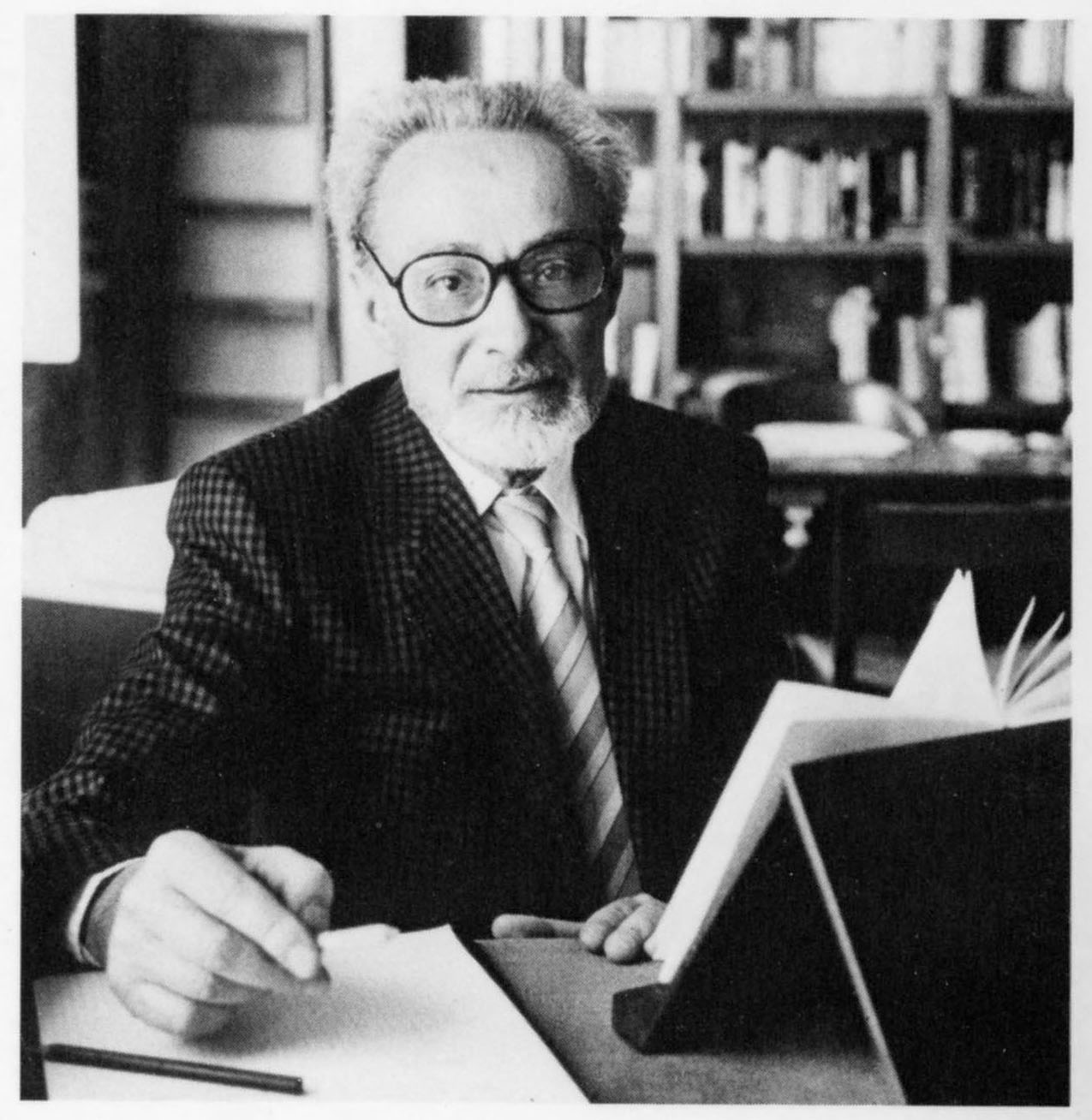
Howe’s review also includes a portrait of Levi by a photographer surnamed “Giansanti”. 

“…Levi sternly rejects the cant of those high-minded folk who in the name of universal guilt blur the distinction between murderers and victims. “I do not know and it does not much interest me to know, whether in my depths there lurks a murderer, but I do know that I was a guiltless victim and I was not a murderer.  I know that the murderers existed.””

________________________________________

The Utter Sadness of the Survivor
By Irving Howe

THE DROWNED AND THE SAVED
By Primo Levi.

Translated by Raymond Rosenthal.
203 pp.  New York:
Summit Books.  $17.95.

The New York Times Book Review
January 10, 1988

Photograph by Giansanti (Sygma)

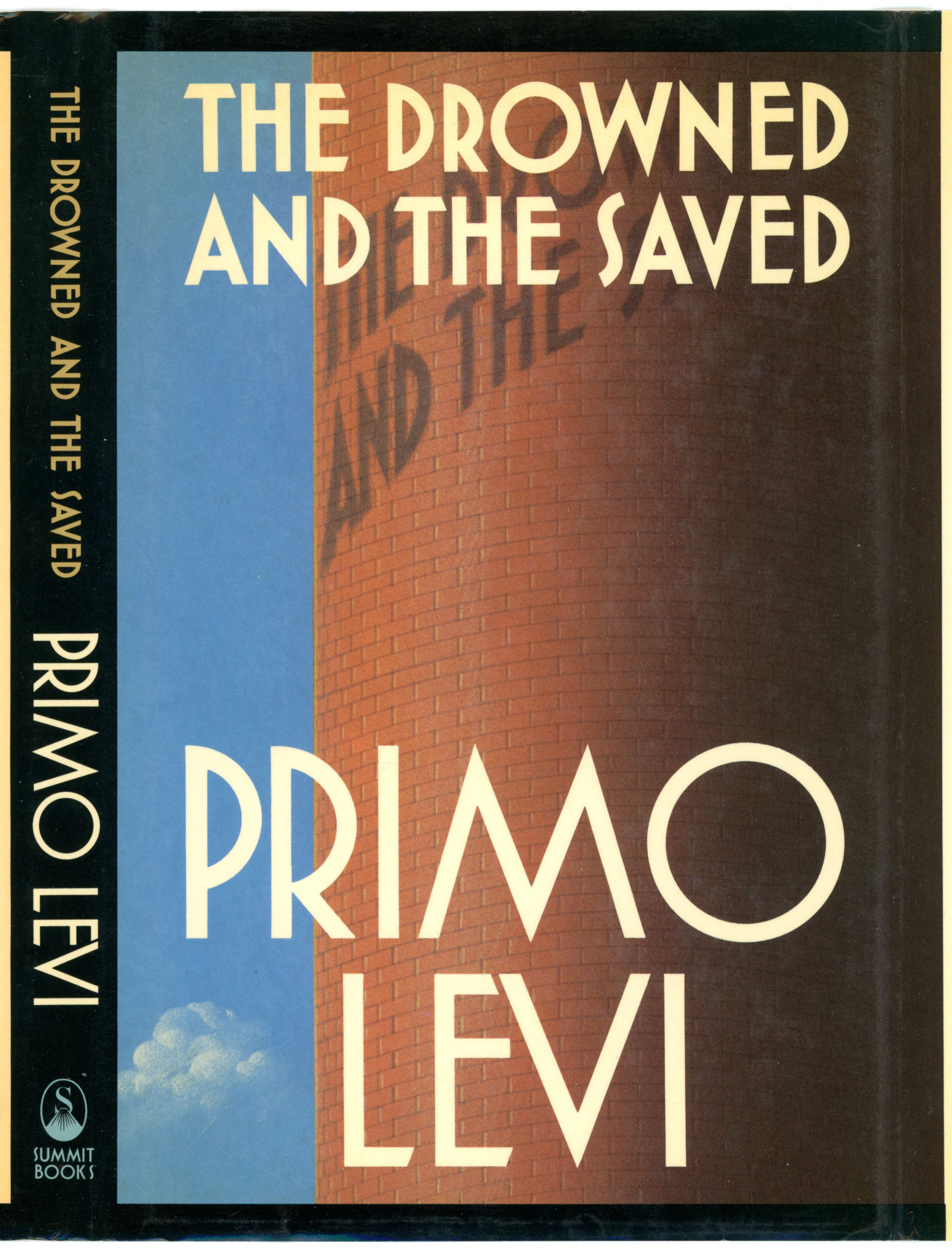
TO the vast literature on the Holocaust, this modest little book forms no more than a footnote.  But it’s a precious footnote – a series of ripe meditations about the experience of Auschwitz, where the Italian-Jewish writer Primo Levi worked as a slave laborer during the Second World War.

Shortly before his suicide last April, Primo Levi remarked that in writing about “the tragic world” of the camps he hoped to avoid the frayed rhetoric of pathos or revenge; he chose instead to “assume the calm, sober language of the witness.” His new and final book, in Raymond Rosenthal’s lucid translation, employs exactly that language: humane, disciplined and, in its final impact, utterly sad.

Born in 1919, Primo Levi grew up in a cultivated middle-class Jewish family in Turin.  As a youth he knew very little about Jewishness: it seemed “a cheerful little anomaly”‘ for someone living in a Catholic country.  Young Levi trained to become a chemist, and would in fact work at that profession for most of his life.  All might have gone smoothly, in pleasant bourgeois fashion, but for a sudden blow which disrupted his life and career in the late 1930’s: Mussolini, the brutal clown who ruled Italy, began to copy the anti-Semitic obscenities of his friend Hitler.

Levi’s life was torn apart, his mind opened up.  He learned about the tiny nuclei of anti-Fascists in Milan and in 1934, after laboring at various nondescript jobs, he joined a group of partisans in the hills of Piedmont.  Betrayed by an informer, the group was soon captured and Levi, questioned by the Fascist police, admitted to being a Jew, “partly out of fatigue but partly out of a sudden …  surge of haughty pride.” In February 1944 he was handed over to the Nazis and shipped off to Auschwitz in a “railroad convoy [that] contained 650 persons; of these 525 were immediately put to death.” It was only Levi’s skill as a chemist, plus a measure of luck, that enabled him to live through the ordeal of Auschwitz.

After his liberation Levi wrote two books, now acknowledged classics, about his imprisonment in the camps: “Survival in Auschwitz” (1947) (the Italian title was “Se Questo E un Uomo” or “If This Is a Man”) and “The Reawakening” (1963) (“La Tregua” or “The Truce”).  These summonings of memory reveal a touch of the scientist’s training in precise description: they are also notable for delicacy of style.  “The Drowned and the Saved,” while a smaller work, represents Levi’s concluding effort to understand an experience that, as he had himself often indicated, must finally seem beyond the reach of human understanding: an evil so vast, systematic and sadistic that no available theory about the nature of evil can cope with it.

About the death camps Levi asks: “Were we witnessing the rational development of an inhuman plan or a manifestation (unique in history and still unsatisfactorily explained) of collective madness? Logic intent on evil or the absence of logic?” His answer, necessarily, is: both.

The “apotheosis of the German race,” that corrupt fantasy with which the Nazis soiled the imagination of so many of their countrymen, prepared the ground for “the Final Solution,” while the madness with which the Nazi leaders infected their followers enabled the SS to perform mass murders.  Logic and anti-logic, ideology and insanity, rationality and sadism: all came together as Hitler led the scum of the earth to power.  Yet it should also be remembered that the bohemian hooligans, demi-intellectuals and street thugs who formed the Nazi cadres were able to draw on a powerful tradition of German big business, and found sustenance in a popular demonology that had long encrusted European Christianity.

One of Levi’s most striking chapters, entitled “Useless Violence,” details the cruelty of the camp overlords which seemingly had no purpose other than, perhaps, the pleasure that can come to some human beings from tormenting others.  With his gift for the exact detail, Levi describes this “useless violence” – from the terrors of the train transports to the humiliations of strip-pings, beatings, endless roll calls, tattoos and torture.  It turns out, however, that from the Nazi point of view this “useless violence” was not quite useless.  Asked by an interrogator, “Considering that you were going to kill them all …  what was the point of the humiliations, the cruelties?” the former commandant of the Treblinka camp, Franz Stangl, answered: “To condition those who were to be the material executors of the operations.” (In plain English, that meant those who would man the gas chambers.) As Levi puts it, “Before dying the victim must be degraded, so that the murderer will be less burdened by guilt.” This was “the sole usefulness of useless violence.”

Nazi logic was clear.  Systematically to dehumanize both guards and prisoners meant to create a realm of subjugation no longer responsive to the common norms of civilized society; and from this very process they had set in motion, the Nazis could then “conclude” that indeed Jews were not human.  The Nazi enterprise drew upon, it could not be undertaken without, sadism; but at least among the leaders it was to be distinguished from commonplace sadism.  It rested upon an abstract rage, the most terrible of all rages.

Bravely, without flinching, Levi confronts the consequences of this Nazi logic: that the dehumanization of the victims had to be enacted by the victims themselves, within their own ranks.  In a troubling sentence he writes: “It is naive, absurd, and historically false to believe that an infernal system” such as the Nazis created in the camps “sanctifies its victims: on the contrary, it degrades them, it makes them resemble itself.”

Step by step Levi shows how the humiliating stratification within the camps depended on a series of small “privileges” – small, but often making the difference between life and death.  There was the “ritual entry” by which a new prisoner was dazed into submission.  There were the little “jobs” which gave a minority of prisoners a bit of extra nourishment.  There were the “better” jobs occupied by “low-ranking functionaries, a picturesque fauna: sweepers, kettle washers, night watchmen, bed smoothers (who exploited to their minuscule advantage the German fixation about bunks made up flat and square), checkers of lice and scabies, messengers, interpreters, assistants’ assistants.  In general, they were poor devils like ourselves who worked full time like everyone else but who for an extra half-liter of soup were willing to carry out these …  functions.” Such prisoners could be “coarse and arrogant, but they were not regarded as enemies.”

Moral judgment becomes more “delicate” with regard to those who occupied seemingly more advantageous positions: the barracks chiefs; the clerks, sometimes complicit in dreadful things, sometimes manipulating SS officers to soften a blow or spare a life; and the Kapos of labor battalions, brutes with the power of life and death over fellow prisoners.

Who became a Kapo? Common criminals.  Political prisoners “broken by five or ten years of sufferings.” “Jews who saw in the particle of authority being offered them the only possible escape from ‘the final solution.’“ And finally, grimly, “power was sought by the many among the oppressed who had been contaminated by their oppressors and unconsciously strove to identify with them.”

Levi hesitates to judge, dealing compassionately with the “gray cases,” those wretched prisoners who worked for and, if they could, against the Nazis.  Even with regard to the Sonderkommandos (the details assigned to dispose of corpses in the gas chambers), Levi tries to maintain a balance of response that may be beyond human capacity: “I believe that no one is authorized to judge them, not those who lived through the [camp] experience and even less those who did not.” And indeed, since most of these poor creatures also ended in the gas chambers, what is the point of judging them? The 20th century has taught us there are situations so extreme that it becomes immoral to make moral judgments about those who have had to confront them.

AT the same time, Levi sternly rejects the cant of those high-minded folk who in the name of universal guilt blur the distinction between murderers and victims.  “I do not know and it does not much interest me to know, whether in my depths there lurks a murderer, but I do know that I was a guiltless victim and I was not a murderer.  I know that the murderers existed.”

Primo Levi’s little book offers more of value, especially a discussion of the shame and guilt felt by survivors of the camps.  Let me, however, turn to Levi’s concluding essay, in which he recounts the correspondence he conducted with a number of Germans who read his early books about the camps and then troubled to write him.  These were by no means the worst of the Germans; quite the contrary.  Yet one grows a little sick at reading their pleas of extenuation, sometimes their whining evasions.  Of course these correspondents don’t defend the Nazis, but rarely do they confront the crucial question: How was it possible that so many Germans could vote for and then yield themselves to the Nazis?

With unruffled dignity Levi answers his correspondents, pointing out, for example, that the claim of “not having known” is often impossible to believe; that anti-Semitism, far from being a Nazi invention, was deeply imbedded in German culture; and that there are clear cases of complicity – “no one forced the Topf Company (flourishing today in Wiesbaden) to build the enormous multiple crematoria…”

Whoever has come under the sway of Primo Levi’s luminous mind and lovely prose will feel pained at the realization that we shall not be hearing from him again.  At a time when the Holocaust, like almost everything else in our culture, has been subjected to the vulgarity of public relations, Primo Levi wrote about this most terrible event with a purity of spirit for which we can only feel grateful.  This was a man.

Both in the Same Trap

I intend to examine here the memories of extreme experiences, of injuries suffered or inflicted….

Here, as with other phenomena, we are dealing with a paradoxical analogy between victim and oppressor, and we are anxious to be clear: both are in the same trap, but it is the oppressor, and he alone, who has prepared it and activated it, and if he suffers from this, it is right that he should suffer; and it is iniquitous that the victim should suffer from it, as he does indeed suffer from it, even at a distance of decades.  Once again it must be observed, mournfully, that the injury cannot be healed: it extends through time, and the Furies, in whose existence we are forced to believe, not only rack the tormentor…  but perpetuate the tormentor’s work by denying peace to the tormented.

From “The Drowned and the Saved.”

Irving Howe has most recently co-edited “The Penguin Book of Modern Jewish Verse.”

Words in Print: Primo Levi – Retrospective by Alexander Stille – “Primo Levi – Reconciling the Man and the Writer”, The New York Times Book Review, July 5, 1987

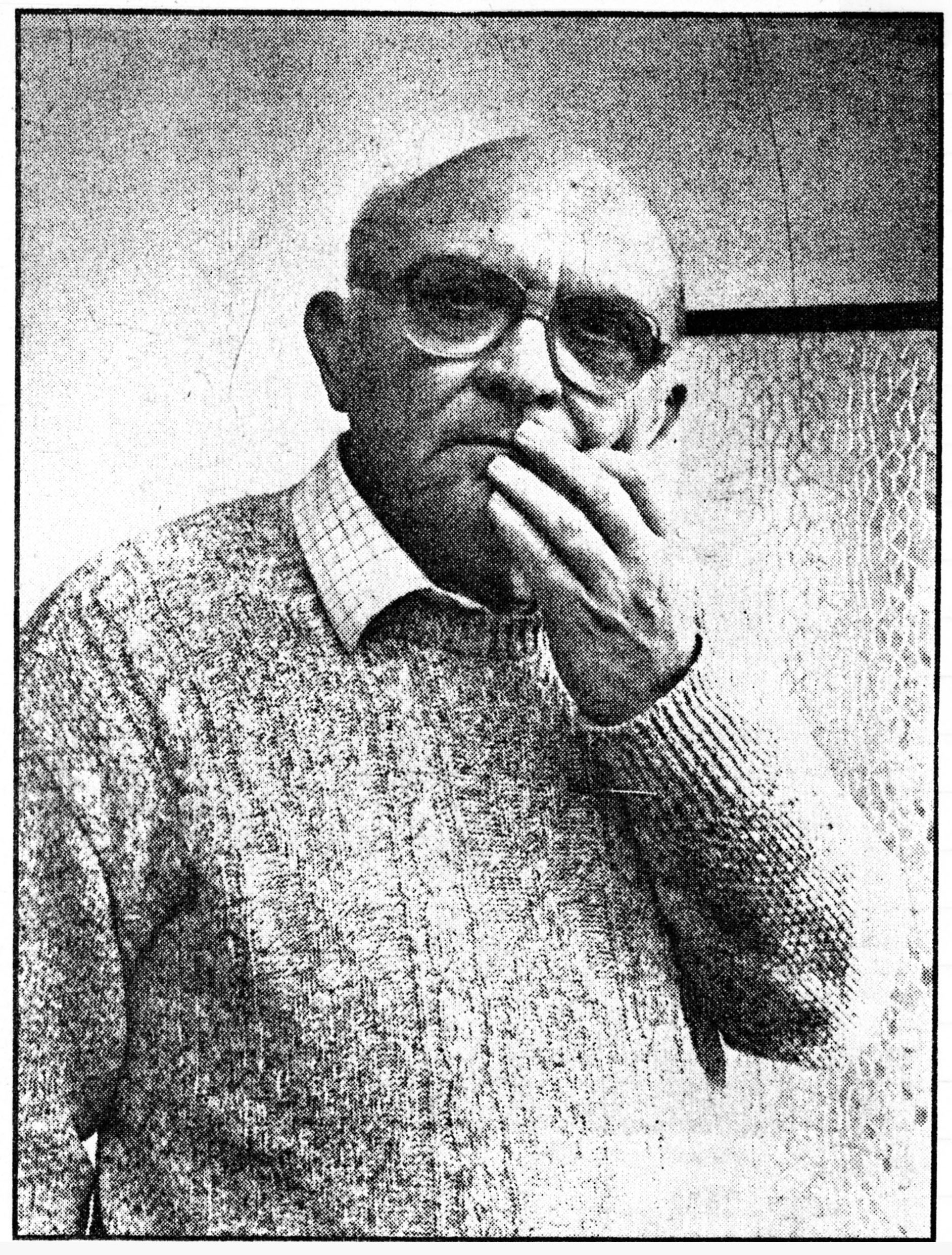
Almost two months after Primo Levi’s death in 1987 (his obituary, by John Tagliabue, having appeared in The New York Times on April 11 of that year) author and journalist Alexander Stille’s essay, “Primo Levi: Reconciling the Man and The Writer”, appeared in the Times’ Book Review.  Mr. Stille’s essay was accompanied by a portrait of Levi taken by a photographer surnamed “Giansanti” (first name unknown) of the Sygma agency, in which Primo Levi focuses his gaze directly upon the photographer.  And perhaps, not-so-indirectly upon us?   

With great sensitivity and perception (perception “human” as much perception historical) Mr. Stille attempts to understand and reconcile Primo Levi’s suicide within the context of his life as a whole, rather than defining Levi – as a person – only through his experiences in the Shoah.  As such, Stille considers Levi’s postwar life in Turin, relationships with family members (specifically, Levi’s mother), physical health, and his perhaps lesser known work as a writer of fiction, such as the collection of short stories The Monkey’s Wrench.  But, perhaps the “gravity” of Levi’s experience in the Shoah was always too deeply present, if not omnipresent; if not physically, at the very least symbolically. 

And in this, Mr. Stille makes an astute observation about the power of speech versus the power of silence.  Namely:

In our psychoanalytic culture
we tend to believe that those who talk are better off and happier than those who don’t.
But those who prefer silence and forgetfulness
may have a successful self-protective strategy.
Those who talk are also those who remember.
________________________________________

Primo Levi:
Reconciling the Man and the Writer
By Alexander Stille

The New York Times Book Review
July 5, 1987

Photo by Giansanti (Sygma)

WHEN a writer commits suicide it is difficult not to reinterpret his books in light of his final act.  The temptation is particularly strong in the case of Primo Levi, much of whose work stemmed from his own experience at Auschwitz.  The warmth and humanity of his writing had made Levi a symbol to his readers of the triumph of reason over the barbarism of genocide.  For some, his violent death seemed to call that symbol into question.  An article in The New Yorker went so far as to suggest that perhaps “the efficacy of all his words had somehow been canceled by his death – that his hope, or faith, was no longer usable by the rest of us.”  An author’s suicide is seen as the logical conclusion of all he has written or as an ironic contradiction – rather than as the result of a purely personal torment.

Since learning of Levi’s suicide I have been trying to reconcile in my mind the writer and the man I had come to know with his violent death.

Levi bore none of the obvious emotional scars common among Holocaust survivors, none of the usual reticence in discussing his past.  He was a person of remarkable serenity, openness and good humor, with a striking absence of bitterness.  He was able to describe a Nazi prison guard with the same objectivity and understanding he showed in writing or speaking of his fellow prisoners.  It seemed a kind of miracle that a person of such gentle temperament and finely tuned intellectual balance could have emerged from the nightmare of Auschwitz.  Levi retained the shy sensitivity and inquisitiveness of the chemistry student he was before the war, and yet he had the wisdom and toughness of a survivor who has seen more of life than anyone should.

Levi was free of the vanity and self-importance of many writers perhaps because he had worked for 30 years as a chemist in a paint factory.  He was unfailingly generous in response to the many demands on his time and politely answered even the most stupid questions.  Slight of build, almost wiry, with a thick shock of white hair and alert eyes, he had a simplicity of manner that belied his considerable intellectual sophistication.

Unlike some survivors who remained rootless after the war, Levi had profound ties to his family and his city.  After Auschwitz, he returned to live in the Turin apartment his family has occupied for three generations.  He contributed regularly to the Turin newspaper La Stampa and stood by the Turinese publishing house Einaudi even after it went into receivership and most of its other prestigious authors had abandoned it.

As a writer Levi grew from being simply an eloquent witness of the Holocaust into a full-blown imaginative novelist.  After his first two volumes of memoirs about his wartime experience (“Survival in Auschwitz” and “The Reawakening”), he drew on his life as a chemist to produce “The Periodic Table,” “The Monkey’s Wrench” and two collections of short stories not yet translated into English.  Throughout, he remained in the stately old apartment building on Corso Umberto where he and his wife spent much of their time caring for his ailing 92-year-old mother.  Their son lived just down the hall.  Writing his books in the room in which he was born, working on a computer, Levi seemed both deeply rooted in the past and still intensely curious about the present.  But last April 11, just outside his fourth-floor apartment, he hurled himself down the building’s central stairwell to his death.

The last months of Levi’s life were dominated by personal problems.  In November his mother suffered a paralytic stroke, requiring around-the-clock care.  Levi himself had been hospitalized for two prostate operations, which, although minor, tired and depressed him.  A doctor had placed him on antidepressant drugs, and some have suggested that a reaction to a change in dosage may have led to his seemingly impulsive act.  While these circumstances may account for the timing of his death, it is difficult not to search his Holocaust experience for the origin of his underlying despair.

Levi’s final nonfiction book, “The Drowned and the Saved,” which has not been translated into English and which I had occasion to discuss with him in Turin a year ago, sheds some light on the last period of his life.  While “Survival at Auschwitz,” “The Reawakening” and “The Periodic Table” are ultimately hopeful books, “The Drowned and the Saved” is a dark meditation on the meaning of the Nazi exterminations after the passing of 40 years.  In it he recalls how the Nazis tormented prisoners by telling them that even if through some miracle they managed to survive, no one would believe them when they returned home.

While this was not literally the case, it contains a larger truth.  By the end of his life Levi had become increasingly convinced that the lessons of the Holocaust were destined to be lost as it took a place among the routine atrocities of history.  Levi was troubled by the sentimental distortions of survivors and sympathetic historians and by the collective amnesia of those responsible for the exterminations.  In recent years he had spoken often to students and joined the board of his former high school.  He was acutely aware of how remote his experience had come to seem to the youngest generation.

“Holocaust survivors,” Levi said in one of our talks, “can be divided into two distinct categories: those who talk and those who don’t.” Levi, clearly, was in the first category.  In our psychoanalytic culture we tend to believe that those who talk are better off and happier than those who don’t.  But those who prefer silence and forgetfulness may have a successful self-protective strategy.  Those who talk are also those who remember.  Levi said he could remember literally everything that happened during his year and a half of imprisonment.  Forty years later he could recall entire sentences he had heard in languages he did not even know: Polish, Yiddish, Hungarian and Greek.

Explaining why he kept returning to the subject of Auschwitz, Levi wrote in “Moments of Reprieve,” a collection of autobiographical sketches, that “a host of details continued to surface in my memory and the idea of letting them fade distressed me.  A great number of human figures especially stood out against that tragic background: friends, people I’d traveled with, even adversaries – begging me one after another to help them survive and enjoy the ambiguous perennial existence of literary characters.”

In “The Drowned and the Saved,” Levi writes about the tremendous difficulty of living with Holocaust memories.  Suicide is, in fact, a major preoccupation of the book.  He dedicates an entire chapter to the Belgian philosopher Jean Amery, who had been with Levi at Auschwitz and who killed himself in 1978.  While any suicide, Levi writes, “is open to a constellation of different interpretations,” he believes that in the case of Holocaust survivors the origin is likely to reside in their war experiences.  For survivors, he writes, “the period of their imprisonment (however long ago) is the center of their life, the event that, for better or worse, has marked their entire existence.” In a passage he quotes from Amery, Levi may have left us an interpretive key to his own death: “He who has been tortured remains tortured.  …  He who has suffered torment can no longer find his place in the world.  Faith in humanity – cracked by the first slap across the face, then demolished by torture – can never be recovered.”

But while Amery was a man who tried to retaliate against violence, Levi described himself as “personally incapable of responding to a blow with a blow.”  He responded to the violence of Auschwitz by internalizing it.  Acutely sensitive to the suffering of others, he was particularly subject to feelings of guilt for having been unable to do more for those who suffered and died around him.

WHILE many of his readers viewed him as an example of the triumph of good over evil, Levi would probably have rejected that view as an oversimplification.  When I spoke with him in Turin, he said that he was especially concerned by a tendency to view the Holocaust in black and white terms, with the Germans as the bad and the Jews the good.  “The world of the Lager I witnessed was much more complex,” he said, “just as the world outside it is much more complex.”  The architects of the Holocaust created a system that delegated much of the physical punishment of prisoners to other prisoners.  By creating an infinite number of subtle divisions and privileges, they pitted the inmates against one another in a brutal struggle for survival.

But to Levi, Darwin’s laws were thrown into reverse.  “The worst survived: the violent, the callous, the collaborators and the spies,” he said.  Levi himself did not resort to collaboration – he survived largely through the help of an Italian worker who brought him food and through his job as a chemist in a camp factory – but he was nonetheless tormented by the memory of companions he was unable to help.  In his last book he wrote: “Each of us [who survived] supplanted his neighbor and lives in his place.  …  It’s deeply hidden like a moth.  You can’t see it from outside but it gnaws and bites.”

During his last months Levi had been talking extensively about his past with the Turinese literary critic Giovanni Tesio, who was gathering material for a biography.  A few days before his death, Levi broke off their conversations because the memories of Auschwitz were becoming too painful, Mr. Tesio said recently in an interview.  Other friends spoke about a nightmare Levi often had.  In the dream, he told them: “I would see myself at the dinner table with my family or at work or in a green countryside.  A relaxed atmosphere.  And yet I felt a subtle anxiety, the sense of an imminent threat.  Then as the dream proceeded, the scene dissolved.  The family disappeared.  There was no more work.  No more countryside.  I was still in the camp.  And there was nothing real outside of the camp.”

Alexander Stille writes frequently on Italian subjects and is at work on a book about the experience of Italian Jews under Fascism.

Words in Print: Primo Levi – Obituary by John Tagliabue, The New York Times, April 11, 1987

Primo Levi’s obituary by John Tagliabue of Bates College, as it appeared in The New York Times on April 11, 1987.

A minor error: The title “The Damned and the Saved,” is incorrect, and should of course be The Drowned and the Saved

A minor point:  Previously, I’d been unaware of Primo Levi’s use of the pseudonym “Damiano Malaballa”, probably because – until learning more – I always associated Primo Levi with non-fiction.

________________________________________

Primo Levi, Author of Works On Holocaust, Is Found Dead
By JOHN TAGLIABUE

Special to The New York Times

The New York Times
April 11, 1987

ROME, April 11 – Primo Levi, whose autobiographical writings drew on his experiences as an Auschwitz survivor and his training as a chemist, died today in Turin.  He was 67 years old. 

The authorities said they were treating the-death as a suicide.  Mr. Levi was found by members of his family and neighbors at the foot of a stairwell in the home where he was born, in the Crocetta neighborhood, and he was pronounced dead on arrival at a hospital.

Renzo Levi, the writer’s son, said by telephone from Turin that his father had had serious bouts of depression in recent months.

“The elder Mr. Levi had undergone minor surgery recently, and friends suggested he was deeply troubled about the condition of his 92-year-old mother, who was partially paralyzed by a stroke last year.

Already well known in Europe, Mr. Levi became prominent among American readers with the appearance in 1984 of the third volume of his autobiographical reflections, “The Periodic Table,” in which he used the chemical elements as a bridge to weave an unusual account of his experiences in the Nazi death camps.

Pseudonym Sometimes Used

His other books include “Survival in Auschwitz,” the first volume of his autobiographical trilogy; “The Reawakening,” the second volume; “Moments of Reprieve,” a series of sketches of the author’s acquaintances from the camps, and, most recently, “The Damned and the Saved.”  He also wrote works of fiction, some of it under the pseudonym Damiano Malaballa.

Primo Levi was born in Turin on July 31, 1919, a descendant of Jews who had settled in the Piedmont, in northern Italy, after the expulsion of Jews from Spain.  He studied chemistry at the University of Turin, even after the Mussolini regime barred Jews from institutes of higher learning in 1938, and received a degree in 1941.

In 1943, he quit his job at a Milan pharmaceutical laboratory to join Italian Partisans fighting the Fascist fprces of Germany and Italy.  “I was not a very good Partisan,” Mr. Levi told Herbert Mitgang in The New York Times in 1985.  “When my unit was betrayed by an informer, I was interrogated by Italian Fascists and handed over to the Germans.  I was put on a train with hundreds of other Jews and sent to Monowitz-Auschwitz, the factory part of the camp that used slave labor.”

Number Tattooed on Arm

It was his experiences there, as No. 174517 – the number was tattooed on his left arm, a few inches above the wrist – that were to shape his life and work.

His 1947 account, “Survival in Auschwitz” – also published under the title “If This Is a Man” – described daily life in the death camps in rich detail, creating a monument to the triumph of lucid intelligence over Nazi barbarism.

He attributed his survival in the camp to luck, to the Germans’ need for chemists – he was given a job in a synthetic-rubber factory – and to an acquaintanceship with a fellow inmate, an Italian bricklayer who was not Jewish, who brought him bread and soup.

In “The Reawakening,” published in 1963, the author described his long and bizarre journey home to Turin after being liberated from the camp by Soviet soldiers.

He also drew on his Partisan days in a novel, “If Not Now, When?”  The novel, published in Italy in 1982, chronicled the exploits in the closing months of the war of a band of Eastern European Jewish Partisans who dream of finding freedom in Palestine.

A Turn to Fiction

In recent years, Mr. Levi turned increasingly to works of fiction, including novels and short stories, and was a regular contributor of poetry to the Turin newspaper La Stampa. 

He was the winner of several literary prizes, including the Strega Prize, a prestigious Italian award, in 1979.  In 1985 he and Saul Bellow shared the Kenneth B. Smilen fiction award, sponsored by the Jewish Museum in New York.

While devoted to his writing, Mr. Levi continued his career as a chemist, working for a Turin paint factory, SIVA, for almost 30 years.  From 1961 to 1974, he was the plant’s general manager.

In an interview with The New York Times in December 1984, Mr. Levi described himself as “a chemist by conviction,” but added.  “After Auschwitz, I had an absolute need to write.”

“Not only as a moral duty,” he said, “but as a psychological need.”

That need was reflected in a Yiddish proverb he used as an epigraph for “The Periodic Table”: “Troubles overcome are good to tell.”

Mr. Levi wrote in an Italian enriched by snatches of the disappearing jargon of the Piedmontese Jews, which combined Hebrew roots with local endings and inflections.

Mr. Levi, who came from a middle-class family of assimilated Jews, once wrote that “a Jew is someone who at Christmas does not have a tree, who shouldn’t eat salami but does, who has learned a little bit of Hebrew at 13 and then forgotten it.”

But he remained close to the Italian Jewish community and two years ago he contributed an introduction to the catalogue of a newly opened Jewish museum in Turin.

The novelist Phillip Roth, whose account of a conversation with the Italian appeared last October in The New York Times Book Review, said of Mr. Levi today:

“With the moral stamina and intellectual poise of a 20th-century titan, this slightly built, dutiful, unassuming chemist set out systematically to remember the German hell on earth, steadfastly to think it through, and then to render it comprehensible in lucid, unpretentious prose.  He was profoundly in touch with the minutest workings of the most endearing human events and with the most contemptible.”

Mr. Levi is survived by his wife, Lucia; a daughter, Lisa, and a son, Renzo.

The Drowned and the Saved, by Primo Levi – 1986 (1988) [Fred Marcellino] [Updated post…]

This is one of my earlier posts.  It displays Fred Marcellino’s cover art for Summit Books’ 1988 edition of Primo Levi’s The Drowned and The Saved, and includes -paralleling Summit Books’ edition of Primo Levi’s The Monkey’s Wrench – a portrait of author Levi, probably (it looks like…) at his home, in Turin, Italy.  Given that Mr. Levi was wearing the same suit and tie in two different portraits, the images were probably taken within a single session by photographer Jerry Bauer. 

The post now includes John Gross’ review of The Drowned and The Saved, which appeared in The New York Times – the main paper, not the Book Review – in January of 1988, and includes a less formal portrait of Primo Levi by a photographer from La Stampa, Cesare Bosio. 

Though the nature of Marcellino’s cover art isn’t immediately apparent – red bricks and a blue sky? – “stepping back”, it soon becomes clear that he has depicted a chimney, a terrible, and terribly appropriate, symbol of Levi’s subject matter.  In this respect, reviewer Gross has admirably presented the central aspects, or more appropriately questions, of the book, which focus on the challenge (or near-impossibility) of communicating that-which-cannot-be-communicated; the fallibility of memory – whether that memory be personal or historical; and particularly, the “gray zone” in which prisoners of the German concentration camp system found themselves enmeshed.

I think it quite fitting that Gross ends his review of The Drowned and The Saved with the very verse (from Samuel Taylor Coleridge’s The Rime of The Ancient Mariner) with which Primo Levi opened the book:

Since then, at an uncertain hour,
That agony returns,
And till my ghastly tale is told
This heart within me burns.

(Photograph of Primo Levi by Jerry Bauer)

Books of The Times

By John Gross

THE DROWNED AND THE SAVED.  By Primo Levi.
Translated from the Italian by Raymond Rosenthal.

203 pages. Summit Books. $17.95.

The New York Times
January 5, 1988

Photograph by Cesare Bosio (La Stampa)

IF you are a writer, and you have come back from hell, you really only have one subject.  It may be important for you to write about other subjects, too, in order to show that hell doesn’t have the last word; and yet in the end there is no shedding your burden.  In some of his later books Primo Levi moved away from the agonies of the Holocaust, but it was to the Holocaust that he finally returned.

“The Drowned and the Saved,” which Mr. Levi completed shortly before his death last April, is a series of meditations on some of the more perplexing aspects of “the Lager phenomenon” – the world of the extermination camps.  Like all Mr. Levi’s books, it is distinguished by courage, lucidity and intelligence, by a steadfast honesty and a refusal to take refuge in the consolations of rhetoric.

The guards and the prisoners in the camps had at least one thing in common.  Both groups knew that by the standards of the outside world, what they were taking part in was incredible.  Even if someone lived to tell the tale, who was going to believe him?

An agreeable thought for the tormentors, and a source of despair for their victims.  Most survivors, Mr. Levi tells us, can recall a recurrent dream that afflicted them during their nights of imprisonment: “They had returned home and with passion and relief were describing their past sufferings, addressing themselves to a loved one, and were not believed, indeed were not even listened to.”

In the event, the Nazis failed – not for want of trying – to destroy all the evidence and wipe out all the witnesses.  Yet as a relatively “privileged” prisoner, spared the worst on account of his usefulness as a scientist, Mr. Levi felt strongly that the full horrors would never be known, since almost all firsthand descriptions of the camps are the work of “those who, like myself, never fathomed them to the bottom.”  By contrast, very few “ordinary” prisoners survived, and very few of those who did, paralyzed as they were “by suffering and incomprehension,” were able to offer more than fragmentary testimony.

None of this made it less important, in Mr. Levi’s eyes, to bear witness as best he could.  There were the tricks that memory plays that had to be guarded against, for one thing – and the tricks we play on memory.  These can be seen at their most glaring in the case of the Nazi killer who “doesn’t remember” what he did: “The rememberer,” as Mr. Levi says, “has decided not to remember and has succeeded.” But among victims, too, though for very different reasons, the past is readily refashioned; indeed, Mr. Levi’s observations in Auschwitz had shown him that “for purposes of defense, reality can be distorted not only in memory but in the very act of taking place.”

Between them, defective memories and defective understanding have given rise to the stereotypes that Mr. Levi was anxious to clear away.  The one that he deals with at greatest length, and that raises the most sensitive issues, is the notion that relationships in the camps could be reduced to a simple contrast between oppressors and oppressed, that every prisoner was a victim and nothing but a victim.

Anyone who supposes this has a very inadequate idea of how monstrous the whole system was.  For it was an essential aim of the Nazis to destroy their victims morally as well as physically, to implicate them and drag them down.  At the most extreme, there were the special squads of prisoners given the job of running the crematories: organizing such squads, in Mr. Levi’s view, was “National Socialism’s most demonic crime.”  But there were many other levels of “privilege,” and immense pressures to take advantage of fellow prisoners in order to cling to life or gain a respite from pain.

Mr. Levi gives an eloquent account of “the gray zone” in which prisoners were set against one another, beginning with the blows from “privileged” prisoners that greeted and utterly disoriented new arrivals.  He doesn’t perhaps allow enough for the fact that some people are bound to seize on the existence of such a zone as an excuse for indulging in the comfortable game of “blame the victim,” but his own reactions are as nuanced and undogmatic as the situation demands.  He never loses sight of where the primary responsibility for Auschwitz lay, and he knows that a gray zone calls for gray judgments.

He is particularly good, too, on the sense of shame that overcame prisoners, and on the “unceasing discomfort that polluted sleep and was nameless.” It would be absurd, he says, to call this last a neurosis; it was more like the “tohu-bohu” of Genesis, the meaninglessness of a universe from which the spirit of man was absent.

Other topics he discusses include the situation of the intellectual prisoner, the reactions of German readers to his books and what “communicating” meant amid a babel of languages, where many prisoners understood little or nothing of the commands they were receiving.  (At one camp, a rubber truncheon was called “the interpreter.”)  Reflecting on the violence and oppression that still abound in the world, he doesn’t rule out the possibility that something comparable to the Holocaust could happen again – indeed, he reminds us that in Cambodia, it already has.

At the beginning of “The Drowned and the Saved,” Mr. Levi quotes a verse from “The Rime of the Ancient Mariner”:

Since then, at an uncertain hour,
That agony returns,
And till my ghastly tale is told
This heart within me burns.

Extremely powerful in themselves, these lines somehow become even more powerful in the new context he gives them.  But it isn’t only a ghastly tale that he offers; in telling it, he also provides a heroic example of humane and civilized understanding.

March 9, 2018

Words in Print: Aharon Appelfeld, Interviewed by Aloma Halter, in “Appelfeld: The Man Who Makes Words Escape” – The Jerusalem Post, April 28, 1991

Continuing with the theme of articles about Aharon Appelfeld, here’s Aloma Halter’s substantive and insightful interview and discussion with the author, during a meeting at Beit Ticho in Jerusalem, at the time: nearly thirty years ago a cafe, and now, a gallery.   Appelfeld’s understanding of Jewish existence, identity, and survival are interpreted by focusing on the intersection between his life experiences before and during the Shoah, as reflected through characters, plot, and setting – both geographic and psychological – of the novels The Immortal Bartfuss, The Age of Wonders, To The Land of the Reeds, and especially, Tzili: The Story of a Life.

________________________________________

Does he mind being labeled a Holocaust writer?
“It saddens me, because I would like simply to be called a writer of fiction.
It seems that people who don’t like me so much attach that label.
But I don’t argue with anyone who says that I just write about the Holocaust.
There’s nothing to argue about:
either you understand the tone and color, or you don’t.”

________________________________________

Appelfeld: The Man Who Helps The Words Escape

Through words, writer Aharon Appelfeld has transcended the trauma of the Holocaust to produce some of the most memorable works of postwar Israeli literature.  By Aloma Halter

Jerusalem Post
April 28, 1991

EVEN BEFORE we had arranged to meet at a Jerusalem cafe, I felt I knew Aharon Appelfeld, major and prolific Israeli writer.  Like my father, like all my father’s friends, Appelfeld is a survivor.  The characters of his books also seemed familiar.  In Israel the past is always thrusting itself into the present.

“Sometimes you reach a certain place, a closed place you can’t get out of, and then you start to look for yourself.  Your past, your life.  That’s what happened to me in the forests, and later in Israel, and because of this, this is also what happens in my books.  Here the searing sunlight doesn’t let me forget that I have come from another place.  Sometimes I turn it into the snow and winter of Eastern Europe, and sometimes I turn the snow into sun.

“When I reached Israel I was 14, entirely without roots, without my own world, without culture, possessions, luggage or language.  This period of disorientation lasted many years, because not only me, but all my generation, preferred not to dwell on the past.  We wanted to be like other Israeli children; only stronger, taller, blonder.  Because if you have a defect, you want to be more, in order to compensate for it, and Israeli society subtly treated us as if we did have a defect.

“While I was searching for myself, the important question for me (not that I consciously asked myself it; a person doesn’t ask himself questions – they’re embedded in the flesh), was, what was I doing?  To whom did I belong?  I knew that I was alien here, and this bright sunshine, which wasn’t the sun I was used to, kept bringing me back to these basic questions.”

Aharon Appelfeld’s translated works include Badenheim 1939; The Age of Wonders, Tzili: The Story of a Life; The Retreat; To the Land of the Reeds; The Immortal Bartfuss; For Every Sin and The Healer.  His early books were translated by Dalya Bilu; for the past few years, all his books have been consistently, and superbly, translated by Jeffrey Green.  Appelfeld’s writing has gained international recognition for its subtlety and sensitivity.

Of all living Israeli writers, he is probably our most realistic candidate for the Nobel Prize; while we have other fine and powerful talents, Appelfeld’s work bears a quality of transcendent universality.  He was awarded the Israel Prize in 1983.  He holds honorary doctorates from the Orthodox movement’s Yeshiva University, the Conservative movement’s Jewish Theological Seminary, and was back in Jerusalem in August to receive his third honorary doctorate from the Reform movement’s Hebrew Union College.  It is with wryness that he notes these achievements together with the fact that, due to the war, he finished only the first grade of school.

WE’RE TALKING under the shade of lofty trees that overlook the terrace of Appelfeld’s favorite Jerusalem cafe: Beit Ticho.  Around are the genteel noises of subdued conversation and the clink of teaspoons and forks, as coffee is stirred and pastries eaten.  With no great effort of the imagination, this could be one of the spas or quiet holiday pensions which recur so often in his novels.

Appelfeld, who is observant, wears a little peaked marine cap, which reminds me of the one worn by the Polish train driver in the film Shoah.  He talks slowly, his voice low as if to persuade and disarm his listener.  He uses impeccable and distancing politeness to steer himself, unscathed, through the encounter.  There is no way of taking the measure of this extraordinary man.

Appelfeld was back in Jerusalem from a sabbatical at Harvard, where he teaches creative writing, researches and continues his writing, to collect his honorary doctorate from Hebrew Union College.  In another year he will resume his teaching post at Ben-Gurion University in Beersheba.

His reputation has grown steadily over the years.  In Israel, in the mid 1950s, no one understood why Appelfeld wrote about the Holocaust; it took years (from 1956 to 1962) for his first book, Ashan (“Smoke”), a collection of short stories, to be published.

He feels that the literary establishment treated him like an outsider.

“At first I was taken to task over my Hebrew.  At that time it was fashionable to sprinkle one’s writing with biblical references, and use as elevated a language as possible – even if your character was a simple peasant or porter who would never have spoken in such a way.  Critics took me to task over the ‘simplicity’ of my language, making me feel like a child who’d been kept three classes down.  Just as well I had the sechel not to listen.  But when the first book came out, an awful thing happened.  People said: (his voice drops to a self-mocking and melodramatic whisper): ‘Appelfeld is good, but he writes about the Shoah.’  And then they said: ‘Appelfeld is good, but he writes about Jews…’ and then the most nasty thing: ‘Appelfeld is good, but he’s not one of us.’’

“The tragic element is that my natural readers – those who had gone through the Holocaust – didn’t want to read about it, and I understood them.  But not the attitude of my colleagues and contemporaries.  For example, A.B. Yehoshua and I had studied together, Amos Oz was a pupil of mine.  Amalia Kahana Carmon I’d known for years … they didn’t react as if I’d brought something new to Israeli literature, something it didn’t have before.

“If someone has a different biography, the question is: how do you relate to it?  Do you welcome him, accept the differences?  Or, on account of the subject matter, do you say: ‘he’s different, he’s not one of us.’ “

APPELFELD’S “different” biography began in Czernowitz, Bukovina (now part of the Soviet Union), then a province of the Austro-Hungarian empire.  An only child of extremely wealthy parents, his father had made the family rich by introducing motorization to the country’s flour, water and windmills.

It was a diverse and cosmopolitan life.  “My parents spoke German.  My grandparents, Yiddish.  The town of Czernowitz was Ukrainian-Rumanian.  The regime, Romanian and later, toward the end of the war, I was with the Russians.  Every year there were excursions to spas and holiday resorts.  My parents were assimilated people, and saw Zionism as a death wish.  Who would want to go back in time to Palestine, that hole in the old Ottoman empire, and leave behind the culture of 20th-century Europe!”

When asked to speak about his childhood, Appelfeld talks simply, as if trying to defuse the effect he knows his words will have.  “At the start of the war in 1940, they killed my mother, and I was left with my father.  Later they separated us, when they took the men off to work.  I was eight.  I saw that, if I stayed alone, I would die.  So I ran away.”

His blandness is terrifying, and only his repetitions hint at emotion, as if he repeats to reassure himself too.  What is it like to be an 8-year-old child and totally alone in the world?

“So I ran away, slipping under the fence.  No, not with other children.  Alone, alone.  In the war, you learned very quickly to do things alone.  It’s a harsh rule, but you learn it quickly.  I became very, very conscious of my surroundings.  You couldn’t have survived if you weren’t aware of every noise, every movement – and it all had somehow to be interpreted.  And the interpretation was a matter of life and death.  So I spent most of the war in the forests, or near the outlying huts where ‘normal’ peasants wouldn’t have lived.  There you had the chronically ill, the slightly mad, the witches, the prostitutes.

“I’d escaped in summer and thought I could survive in the woods.  But autumn came with heavy rains, and I couldn’t stay there.  First of all, I lived in a prostitute’s hut.  I told her that I’d run away from a nearby town which had been bombed.  I couldn’t reveal that I was Jewish, even though she was often quite genial and kind to me, because in one of her drunken rages, she would have killed me or told one of her clients.  I was eight, and that was my first real school.  I had to buy the food from the village and clean the hut.  Yes, in my parents’ home there’d been servants to clean, but you learn.

“But one day, after about a year, one of her clients seized me and accused me of being Jewish.  My face was round, my eyes blue, but all the same, he must have sensed there was something not of his element.  Had he caught me out in the open, I might have run away.  But it was in her hut, all hemmed in.  ‘You’re Jewish!  You damned Jews!’  Till this day I can feel it.  I was dumbstruck as I stood there.  No sound would come from my mouth.  Only later, I was able to rally and fling back enough curses to make him doubt it.  But after a few days, I ran away: if one of her clients had noticed something, perhaps it had also crossed the minds of others.

“I fled to another place.  Then I was taken in by a horse thief; it’s a unique profession.”

APPELFELD’S CHARACTER Bartfuss, from Bartfuss the Immortal, is the archetypal survivor.  In Israel after the war, Bartfuss undergoes a crisis when he realizes that the strategies which had helped him to survive are exactly what prevent him from living and communicating in non-threatening situations.

“A lot of Bartfuss … is me, and a lot comes from observations of people I know.  Bartfuss is seeped in the Holocaust; he doesn’t have to talk about it.  He’s not a big speaker, he can’t get close to people, not even himself.  He’s closest to his coffee, cigarettes, and walks by the sea.”

Appelfeld says he is close to people, and likes a few of them a lot.  He speaks of his family, his children – now mainly grown up – his Argentinian wife.  There were friends like the poet Dan Pagis, another survivor who came from Czernowitz.  “He was a very closed kind of person.  Much more than myself; much more Bartfuss! (he laughs), a man with many secrets, yes, many secrets.”

Out of all Appelfeld’s books, I asked, which comes nearest to telling what happened to him, alone in the forest, at the age of eight?

“Sometimes, you have a strong emotion but can’t express it directly.  That happened all the years I wanted to write about my life as a child in the forests.  I couldn’t.  Only when I put it into the story of a little girl, in Tzili, was I able to express it.  When I wrote about myself, or even another boy, it wasn’t near the truth at all; the tone wasn’t right, nothing was right.”

She wandered in the outskirts of the forest.  Her food was meagre: a few wild cherries, apples, and various kinds of sour little fruits which quenched her thirst.  The hunger for bread left her.  From time to time she went down to the river and dipped her feet into the water.  The cold water brought back memories of the winter, her sick father moaning and asking for another blanket.  But these were only fleeting sensations.  Day by day her body was detaching itself from home …  She had severe pain in her stomach and diarrhea.  Her slender legs could not stand up to the pain and they gave way beneath her.  “God, God.”  The words escaped her lips.  Her voice disappeared into the lofty greenness.  If she had had the strength, she would have crawled into the village and given herself up.

IF APPELFELD had the choice, and could write about aspects of life totally separate from the Holocaust, would he focus on the problems and complexities of modem Israeli society?

“I can’t write about the Israeli-Palestinian struggle, for instance; I haven’t lived with Arabs for years.  Neither is my experience of, say, Ashkenazi-Sephardi conflicts so great.  But the Ukrainians, whose beds I slept in, and whose horses I ate with – I do have something small to say about them.”

Unlike other Israeli novelists, Appelfeld’s art begins and ends with personal experience.  He would not “go out,” seeking new experiences, doing research in the field as, for example a writer like David Grossman did for his book The Yellow Wind about Palestinians in Israel.  But neither is Appelfeld’s work simply narrative in the style of Polish-American survivor Jerzy Kosinski, who recently committed suicide.  “If I just told what happened to me in life, it would look like a madhouse,” Appelfeld says.  “A writer has to communicate something of his innermost truth.  If we want simply history, we can look to the historians.  For psychology, we can turn to the psychologists and sociology, to the sociologists, but that elusive inner truth a writer gives us can be found nowhere else.

“Chronology, which is the truth, isn’t entirely the truth.  It sometimes over-emphasizes.  People who write chronology are usually still drawn to the more dramatic events.  But at the time one lives through them, these events aren’t necessarily significant.  It’s also a matter of perspective.  Very often people write their memoirs and send them to me to read.  They’re 100 percent true, and I’m always stirred.  But at the same time, it’s rather sad, because in a way, these memoirs are not entirely true.”

I ASK HIM ABOUT the occasional times that Israelis, particularly since the start of the intifada, have been compared to Nazis.  How does he, with one son who has completed his IDF duty, and another about to be drafted, react to the comparison?

“Jews have been misunderstood for generations.  It’s a comparison engendered by malice and evil, but it’s hard to do away with either of them.  I deal a lot with that in my work.  I’m very upset by what the Arabs are suffering, but there is no comparison to that, even by this much (he holds up his little finger).

“Only about 10 to 15 percent of what I’ve written has been published.  There are two reasons for this: first of all, as you get older, you’re more critical about your work, and then there are many books which after I finish them, I just put away in a drawer, to see how they’ll age after five years or more.  From time to time I take one out and read it.  So there are usually two books on my desk at once – an old one in revision and a new one in writing.  When I get dulled by one, I turn to the other, and when things look black, and I feel as if I’ll never finish the one I’m writing, I know there’s one already written, full, and that’s encouraging.”

Does he treasure those which are unpublished more than those already published, like a parent’s pained love for a less successful child?  “No, my feeling is that I have to complete them.

“One of the writers I most admire is Kafka, whom I came to as an assimilated Jew, and not from the existential aspect.  The same with Bruno Schultz.  In The Healer, I wanted to explore the pain of the assimilated Jew who has no skin, an uneasy conscience.  I see the modern Jew as being torn between two tendencies, or two worlds: the first is to escape from himself and his culture; the second is to return to his heritage.  The first – the escaper – is much the stronger.  For torn as he is, the modem Jew has been a major partner in the making of the modem world: modem literature, music, psychology, even modem painting, philosophy.  That’s why the assimilated Jew is so interesting.”

A TRIVIAL, but tangible, side effect of reading Appelfeld is to find oneself drinking more coffee than usual.  To the Land of the Reeds, for example, is full of such lines: “Her longing for coffee secretly tortured her, but the torture was not unbearable.  She smoked two cigarettes, and they dulled her desire.”  Or: “Rudi prepared a cup of coffee for her.  She took the cup without a word and brought it to her lips.

“ ‘Hot,’ she said.  ‘Good.’ “

“In my early books,” Appelfeld explains, “it all went together: coffee, cigarettes, cognac.  Usually people drink because they want to drug or silence something in themselves.  My characters have a lot to silence, so they drink a lot.”

The conversation has been leisurely but lengthy, and I wonder if Appelfeld is flagging.  “No, no let’s go on.  When I returned to Jerusalem from Boston I couldn’t get to sleep easily, but last night I slept.  I’ve slept, we’ve eaten, we’re having a nice conversation.  What else will you have?  Coffee?”

I’m strongly reminded of his character, Bartfuss, who for months, years, can’t sleep properly until the end of the book, and then: “Only when he drew near the bed did he feel that that mighty sleep, that full sleep, which he had been struggling against for years, had gathered strength, and now it was about to spread its iron web over him.  He managed to take off his shoes and socks, to put his shirt on the chair, look about the naked room, and to say a sentence to himself that he had heard by chance:  ‘From now on I shall remove all worry from my heart and sleep.’ “

THOUGH APPELFELD’S books often depict the lost world of European Jewry before the Holocaust, his characters are remarkably multifaceted, human in their weakness and strengths.  Above all, he is a universalist, a subtle and keen observer of human beings.  Incredibly, absurdly, some Jewish critics have accused him of helping to exonerate the Nazi’s treatment of the Jews because he portrays Jews unfavorably – in some books he dwells on their weaknesses and hesitations, as in The Age of Wonders, or even in his recently published For Every Sin.  It seems hard to conceive of such a gross, and perhaps willful, misinterpretation of a writer’s work and intentions:

“After I’d written The Age of Wonders, which was mainly about my parents and their generation, I could suddenly appreciate all the lovely things about them.  Before I’d never been able to express my love for them, for all the lost Jews of Europe.  It had always seemed sentimental.  In the book Katerina, I found the character who could be the mouthpiece for this love.  When Katerina says: ‘I love Jews,’ it doesn’t sound sentimental.”

Does he mind being labeled a Holocaust writer?  “It saddens me, because I would like simply to be called a writer of fiction.  It seems that people who don’t like me so much attach that label.  But I don’t argue with anyone who says that I just write about the Holocaust.  There’s nothing to argue about: either you understand the tone and color, or you don’t.”

In a general way, Appelfeld is not an arguer.  He is an accepter and under-stander of how things are.

At the academic convocation held at the Hebrew Union College in August for the ceremonies of rabbinic ordination and presentation of two honorary doctorates – to Ayala Zacks Abramov and Aharon Appelfeld – Appelfeld spoke just as twilight was draping the courtyard with magenta and rose.  Although the audience was restive after more than two hours of speeches, and Appelfeld was the last speaker, people visibly calmed under the influence of his words.

His acceptance speech was a moving summary of the spiritual path the Jewish people had traveled, first away from religion, and more recently toward it, over the past 150 years.  He spoke of the phenomenon of the return to traditionalism in Israel, and the impatience or downright resentment of secular people toward this phenomenon.

“When I came to Israel in 1946, religion had been banished from this new country.  People sought to replace it with social positivism, with Zionism, with communism.  People had shrugged off religion; they wanted to shrug off old bonds.  The old world had been destroyed in the Holocaust, and now there would be a new one.  What we are now witness to is an outbreak of yearning which can’t be stemmed.  Those of us who find ourselves naturally more on the side of traditionalism and humanism than on the side of religious fervor should not try to fight them, but rather strengthen the moral kernel of those who are aligned with the more extreme elements of our religion.  Not to deride but to help: to refine, to bring out the good.”

Appelfeld’s works deal unflinchingly with a spectrum of life which is full of shadows, yet he manages to use these, like the strong shading effects of chiaroscuro, to illuminate and show the innate refinement of everyday human actions, human emotions and beliefs.

Words in Print: Aharon Appelfeld – Retrospective by Jonathan Rosen – “The Lesson in the Forest”, The Forward, November 30, 1990

Continuing with the theme of works by Aharon Appelfeld, here’s an article by Jonathan Rosen from the Forward of thirty years ago, published when that periodical was (all-too-briefly, alas…!) under the wise helm of Seth Lipsky.  The article is an interesting hybrid: Part book review (focusing on Badenheim 1939, and, The Healer), part interview, and, part sociological and philsophical exegesis. 

On (re)reviewing the article for this post, I couldn’t help but take note of Aharon Appelfeld’s statement…

Eastern European Jews knew they should suffer,
will suffer,
that suffering belongs to them. 
For the German Jews who saw themselves as Germans this was too terrible.

…in light of the recent Tikvah Fund podcast of a discussion between Jonathan Silver and Daniel Gordis, concerning Gordis’ essay (also available as a podcast) at Mosaic Magazine, “How America’s Idealism Drained Its Jews of Their Resilience.”

The Lesson In the Forest

Forward and Back
Jonathan Rosen

The Forward
November 30, 1990

Aharon Appelfeld was born in Czernovitz, Bukovina, to an assimilated, prosperous Jewish family, but he grew up in the forests of Eastern Europe where he wandered alone after his escape from a Nazi labor camp at the age of eight.  It was in the forest that he first brooded on the nature of his Jewishness.  “During those two and a half years I discovered the Jewish mystery.  Why was it,” I asked myself, “that all the world wanted the Jews dead?  It seemed that even the animals hated me.  In a childish way I thought maybe it was my smell.  It was a kind of mystery.”

After the war Mr. Appelfeld made his way to Palestine.  He has remained in Israel since then, writing the novels that have, over the last ten years, earned him a growing reputation in America.  The night before we meet, Mr. Appelfeld delivered a speech at the Jewish book fair on the importance of writing in Hebrew.  He speaks with the composure of someone who has refashioned his life, but for all the gentle refinement of this small, bald, bespectacled man there is still something of the forest about him.  He listens with the nervous alertness of a bird who might fly.

We are in his hotel restaurant, except for a waiter who constantly refills our coffee cups and who addresses Mr. Appelfeld deferentially as “Monsieur.”  He and Mr. Appelfeld regard each other intently, as if they knew each other once in a past life.  When the waiter walks away, Mr. Appelfeld whispers, “A Viennese accent.  He is a refugee, I’m sure.”  He belongs to Mr. Appelfeld’s world of victims and displaced persons, of lives touched by the Holocaust.

Mr. Appelfeld, though identified as a Holocaust writer, does not write directly about the destruction of the Jews.  His books take place on the eve of war or in its bleak aftermath.  His characters are perched on the brink of a catastrophe that is never named.  The action unfolds against the backdrop of our own historical knowledge, a method that draws us uncannily into his books.  In “Badenheim 1939,” the novel which made him famous in this country, a group of Jews at an Austrian resort are slowly encircled by the forces of Nazism.  Drunk on coffee and pastries, lulled by music and the poetry of Rilke into a kind of trance, these Jews are powerless to resist.  They step onto the trains “as easily as grains of wheat poured into a funnel.”

“Badenheim 1939’’ is characteristic of much of Mr. Appelfeld’s fiction, but the author resists the label of Holocaust writer.  “I’m trying to understand the entire phenomenon of Jewishness.  What is this illness, what is this healthness, what is this greatness called Jewishness?”

Some would say that he is more curious about illness than health.  Raised, as he tells me, in a home that forbade Yiddish and enforced German, a home where East European Jews were looked on with disdain (though the town he grew up in, now part of Romania, was itself in Eastern Europe), it is easy to understand his assumption in the forest that Judaism was a kind of sickness and that he had caught the disease.  It was only later, he says, meeting East European Jews in his wanderings during the war, meeting refugees afterwards, that he came to appreciate the richness and resiliency of the religion.

The Jews he grew up among seem to him now peculiarly unsuited for survival.  “When these Jews were brought from Vienna and Germany to the camps, the worst thing for them was that they were counted as Jews.  I will tell you now a piece of news.  Most Jews transported from Vienna and Germany to Eastern Europe, to the camps, committed suicide.  I have seen this with my own eyes.  Eastern European Jews knew they should suffer, will suffer, that suffering belongs to them.  For the German Jews who saw themselves as Germans this was too terrible.  They committed suicide.”

It is not surprising that ill health often marks the Jews in his fiction and that ill health functions as a kind of trope for an ailing soul.  Does Mr. Appelfeld think of Judaism itself as a kind of disease?  He doesn’t deny it.  “Sometimes a sick tree has wonderful colors,” he says.

Mr. Appelfeld’s most recently translated novel, “The Healer,” published this year by Grove Weidenfeld, the question of well-being is obsessively treated.  This hypnotic novel tells the story of Felix Katz, an assimilated businessman from Vienna whose daughter Helga has fallen ill.  To cure her, Felix and his wife and son move east, to the Carpathian mountains where a healer is said to live.  The healer, an old rabbi reputed to have magical powers, turns out to be sick himself.

Snowbound for the winter, Felix must sit, full of rage and contempt, cut off from his beloved Vienna while his wife and daughter visit an ailing mystic whose only prescription is the study of Hebrew.  Felix at last “escapes” with his son and travels to Vienna, where he imagines salvation awaits him.  The year seems to be 1939.  The city he loves will no longer have him.  Felix is overwhelmed by his Jewishness the way a character in a Greek tragedy is overwhelmed by fate.

Despite the bitterness of the book, Mr. Appelfeld professes a great devotion to the assimilated, Germanified Jews he writes about so unsparingly.  “I adore this phenomenon of assimilation,” he tells me.  “What does it mean?  It means someone who does not wish to be a Jew but who is somehow affiliated.  More important, he has guilt feelings.  It’s a kind of drive.”  For Mr. Appelfeld, “these people created the modern world,” even if it is a world he found false in the forest.  He is deeply influenced by writers like Franz Kafka and Joseph Roth, whose ambivalence was paramount to their conception of the world.  “Ambivalence is a good thing,” says Mr. Appelfeld.  “One shouldn’t be too sure – that’s a good rule.  And there should be a bit of irony too.  That’s also a good rule.”

Words in Print: Aharon Appelfeld – Book Review by Aloma Halter – “Surviving in Silence”, The Jerusalem Post, May 28, 1988

Some of my earlier (“iest”?) posts comprise the covers of six novels by the late Aharon Appelfeld: 

Badenheim 1939 (1980)
The Age of Wonders (1981)
Tzili, The Story of a Life (1983)
The Retreat (1984)
The Immortal Bartfuss (1988)
The Healer (1990)

“This” post also pertains to Aharon Appelfeld, but it’s of a different nature:  It’s a review of The Immortal Bartfuss by Aloma Halter which appeared in The Jerusalem Post some thirty-two years ago.  The review also includes a nice portrait of Appelfeld, but the photographer’s name is not given.

Surviving in silence
BARTFUSS THE IMMORTAL by Aharon Appelfeld

Translated by Jeffrey M. Green.
London, Weidenfeld and Nicolson.
135 pp.  £10.95.

The Jerusalem Post
May 28, 1988

Aloma Halter

WITH Aharon Appelfeld, Israel has a novelist whose growing body of powerful work ranks him among the best of the world’s contemporary novelists.  Unlike Bashevis Singer or Amos Oz, he can be categorized as neither “Jewish” nor “Israeli”: his writing is a unique blend of the two modes.  Furthermore, there is a quality about his work – perhaps its simplicity, perhaps its abstraction, perhaps the sheer human credibility of the characters – that carries it beyond national and religious definitions and makes it universal.  Above all, his work manages to uncover – to discover – something about the human condition.  Reading Appelfeld, we understand more about ourselves.   

Bartfuss The Immortal is one of Appelfed’s most compelling novels yet.  This is the story of a survivor of the Holocaust who has acquired his enigmatic nick-name because of experiences in the Nazi death camps; other survivors respect, fear him and keep out of his way.  Now in his 50s, Bartfuss lives in Tel Aviv.  Locked into an unhappy marriage, the father of two daughters (one of whom is retarded) whom their mother has estranged from him, he earns his living easily and soullessly from trading on the stock exhange.

There is the very early rising, the invigorating first cup of bitter coffee, the cigarettes, the walk to the cafe, the strolls by the sea, the brief hour at the stock exchange and the meals in anonymous restaurants.  Sometimes he takes the bus to Netanya.  Mainly he concentrates, trying to stop his thoughts before they formulate themselves, and words, unnecessary words – forewarners of unwanted thoughts – fill him with revulsion.  “He had invested a lot of energy into blocking up the openings through which thoughts could push out.  In recent years he had managed to seal them off almost completely.  Now he felt he didn’t have the power to stop them any more.”  Bartfuss’s wife Rosa, who spends her time lying around the house eating sandwiches and gaining weight, likes words; she “piles them up,” she uses them against him.  But Bartfuss has learned how not to retaliate; he leaves the house while his wife and unmarried daughter are still fast asleep and returns when they have already gone to bed.  He will go to any length to avoid speaking to Rosa.

Extremely voluble or forbiddingly uncommunicative, Appelfeld’s most memorable characters share a dominant feature – speech, or its absence – that characteristic that has been called man’s most human attribute.

The strategies of survival which once saved his life – detachment, the ability to grit his teeth and endure, to freeze his emotions and restrain himself – have now hardened around Bartfuss, impeding his possibility for communicating, for fully living.

On a daily basis, he had evolved a way of being among people without any contact, without words … a way of surviving intact in his isolation.  He had slept little, and never deeply; his room was sparse, almost ascetic, but his days had been full of reassuring rituals.  Bartfuss’s routine had given him a kind of rigid, blinkered security which might have carried him, intact and detached, if not into old age, then at least on for many more years.

But Appelfeld’s character is at a turning point in his life.  One spring, a series of minor events occur that jolt the routine, that begin to have a profound and perceptible effect on his life.  He runs into faces from his distant past: Theresa, Dorf, Schmugler, Sylvia.  The encounters with them revive emotions in himself which he had long believed, and hoped, were extinct.

The translation, by Jeffrey Green, reads superbly.