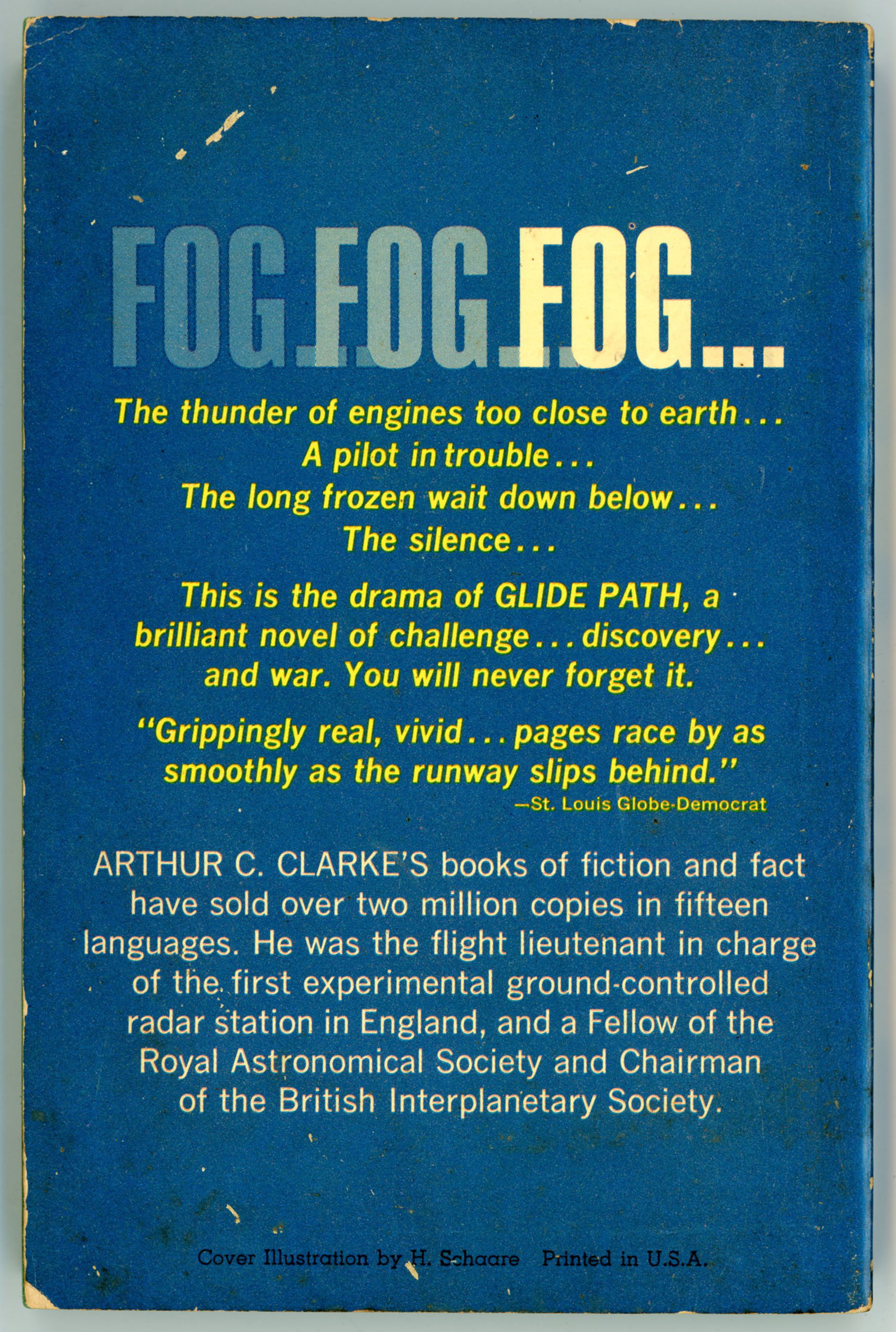
Glide Path, by Arthur C. Clarke – 1963 (1965) [Harry Schaare] [Revised post]

“It is strange how the mind can leapfrog across the years,
selecting from a million, million memories for one that is even faintly relevant,
 while rejecting all the others.”

C Charlies was like a fly crawling over this darkened clock face. 
It had been aimed at the narrow illuminated section,
but might already have missed it,
to remain lost in the blackness that covered almost all the dial.

So this, Alan told himself without really believing it,
was probably the most dangerous moment of his life. 
Introspection was not normally one of his vices;
he could worry with the best,
but did not waste time watching himself worrying. 
Yet now, as he roared across the night sky toward an unknown destiny,
he found himself facing that bleak and ultimate question which so few men can answer to their satisfaction. 
What have I done with my life, he asked himself,
that the world will be the poorer if I leave it now?

He had no sooner framed the thought than he rejected it as unfair. 
At twenty-three, no-one could be expected to have made a mark on the world,
or even to have decided what sort of mark he wished to make. 
Very well, the question could be reframed in more specific terms:
How many people will be really sorry if I’m killed now?

There was no evading this. 
It struck too close to home,
brought back too vivid a memory of the tearless gathering around his father’s grave.

______________________________

It is strange how the mind can leapfrog across the years,
selecting from a million,
million memories for one that is even faintly relevant,
 while rejecting all the others. 
Beyond Fantasy Fiction – July, 1953 [Richard M. Powers] [Revised Post]

(This post has been updated to include closer views of Richard Powers’ cover art.  Scroll to bottom to see more…)

______________________________

____________________

The first issue of Horace Gold’s Beyond Fantasy Fiction featured cover art created by the extraordinarily imaginative Richard Powers.  Typical of much of Powers’ oeuvre, the finished painting features a variety of seemingly organic elements in combination with curved, streamlined, ostensibly mechanical shapes  Akin to many of Powers’ works, any recognizably “human” form is deliberately minimized. 

For another example of Powers’ work, see this post

______________________________

At lower left, a woman with streaming hair flees (?) “stage left”.

______________________________

In the center, an upraised human hand, set against a brilliant yellow sky and partially obscured by clouds, is visible through an archway.  There’s something vaguely Salvador Dali-esque about this scene…

______________________________

…while this panel epitomizes a common element in Powers’ work: A randomly-curved, asymmetrical, seemingly organic “shape”, is covered by a metallic carapace.  A bluish-green sphere – a planet?; a symbol of Mars? – levitates nearby, while a “rope” draped upon both objects – the way in, or the way out? – leads through a raftered ceiling to an orange sky.

The Healer, by Aharon Appelfeld – 1990 [Anne Bascove] [Revised Post]

(Includes photograph of Aharon Appelfeld, and, advertisement for The Healer.)

______________________________

______________________________

Photo of Aharon Appelfeld by Micha Bar-Am, accompanying Lore Segal’s review of The Healer, from The New York Times Book Review of September 23, 1990.

______________________________

Advertisement for The Healer, from The New York Times Book Review of October 21, 1990.

Give Us This Day, by Sidney Stewart – 1958 [Harry Scharre?] [Revised post]

(This post has been updated to include the back cover of the 1958 paperback edition of Give Us This Day, as well as the front cover of the 1990 edition. (Scroll to bottom.))

Manila:
December 1941

IN THE LAND where dead dreams go lies the city of Manila,
as it was before the war.
Manila, where the white man didn’t work in the afternoon because it was too hot.
Manila, with its beauty and its poverty and its orchids at five cents apiece.

What could a soldier do with a handful of orchids
if he had no one to give them to?
I used to buy those orchids.
I’d pay my nickel for them and stand there awkwardly holding them in my hand.
I would run my finger over the satin petals and then,
embarrassed,
I would give them to the first little girl I met,
because there was something very lonely about buying orchids
when you had no one to give them to.

____________________

I began to plan the things I wanted to do when I went home.
The promises I had made to the boys about seeing their parents.
I thought of the things that home meant to me.
The things that freedom, and being home, would mean.
I thought of seeing women again, white women,
and being again where people laughed,
where laughter was good and life was good.

I wondered if ever again things would worry me. 
I thought what I would do with my life. 
I had never asked to live, but God had spared me. 
Now I knew there was an obligation within me to justify my life. 
I must do something.

My mind wandered back to the times
when Rass and John and Weldon and Hughes
sat together around the fire in the evenings. 
We talked about the things we wanted to do
when we were free and we were home again. 
Rass had wanted to go into the diplomatic service. 
John had wanted to be a professor again.

“I’m going to be a writer,” I said. 
“I’m going to write novels.”

We used to laugh about it. 
They were interested in the things I wanted to write about. 
Once, when we were very hungry, John had turned to me.

“Some day, Sid, I wish you’d put me in one of your books.”

“Yes, Stew,” Rass said. 
“I wish you’d write a book about this, about all of us. 
Will you?  
Could you do that for us one day?  
Write a book about all of us. 
Something that we could keep.”

I remembered what I had promised them.
I would write a book about them some day.
But I felt cold inside and I thought, “No, they’ll never read that book now,
 that book I’m going to write about them.
About their faith and hopes, their goodness and their beliefs.”

______________________________

Biographical blurb about Sidney Stewart, from the jacket of the book’s hardcover (1957) edition.

______________________________

1990 edition of Give Us This Day.  Artist? – unknown.

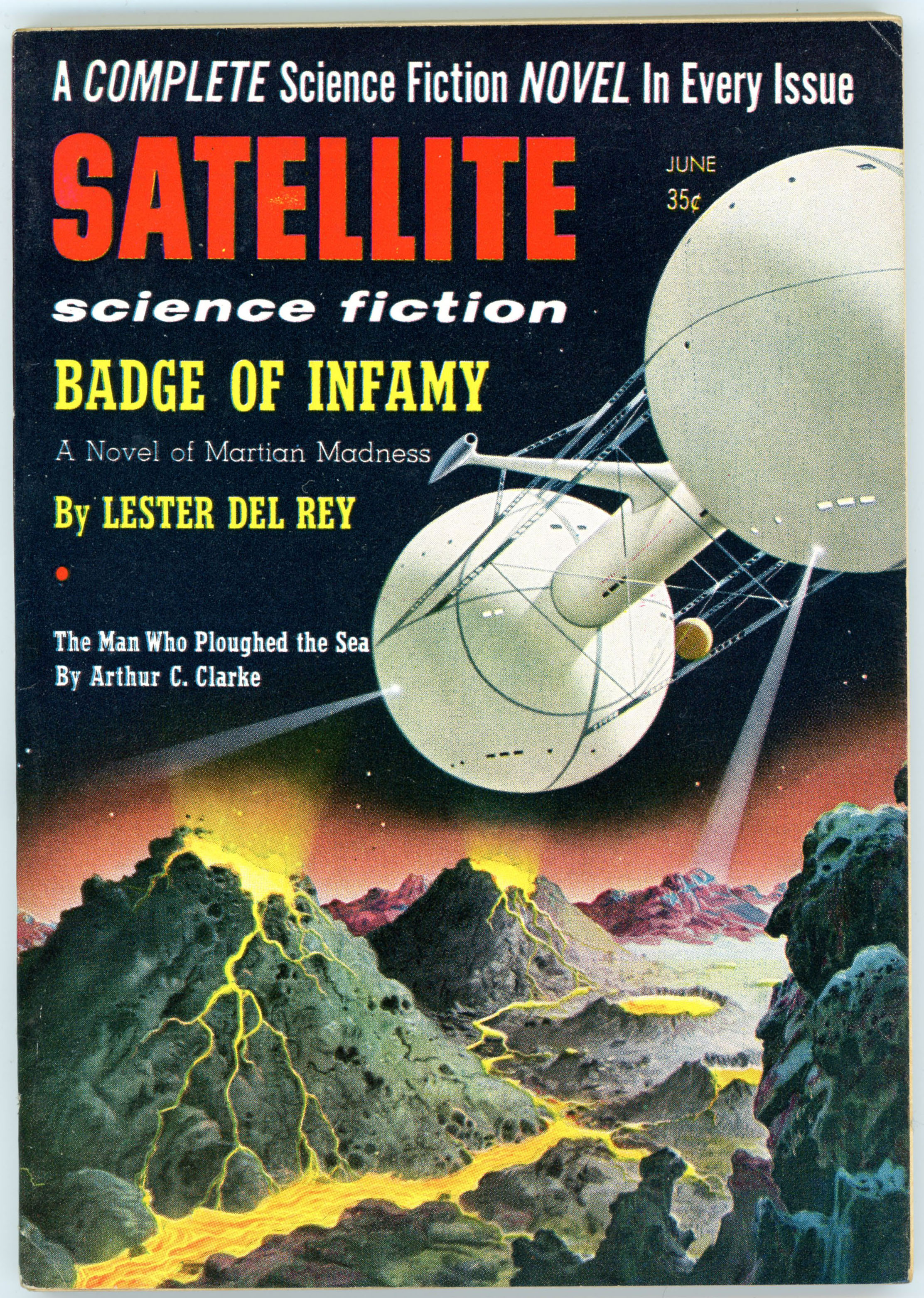
Satellite Science Fiction – June, 1958 (Featuring “Wall of Fire”, by Charles Eric Maine) [Alex Schomburg]

“Science fiction is prophetic, not in the sense that it predicts the future in empirical detail, but in the sense that it understands causality in the longest possible term.” – Thomas F. Bertonneau

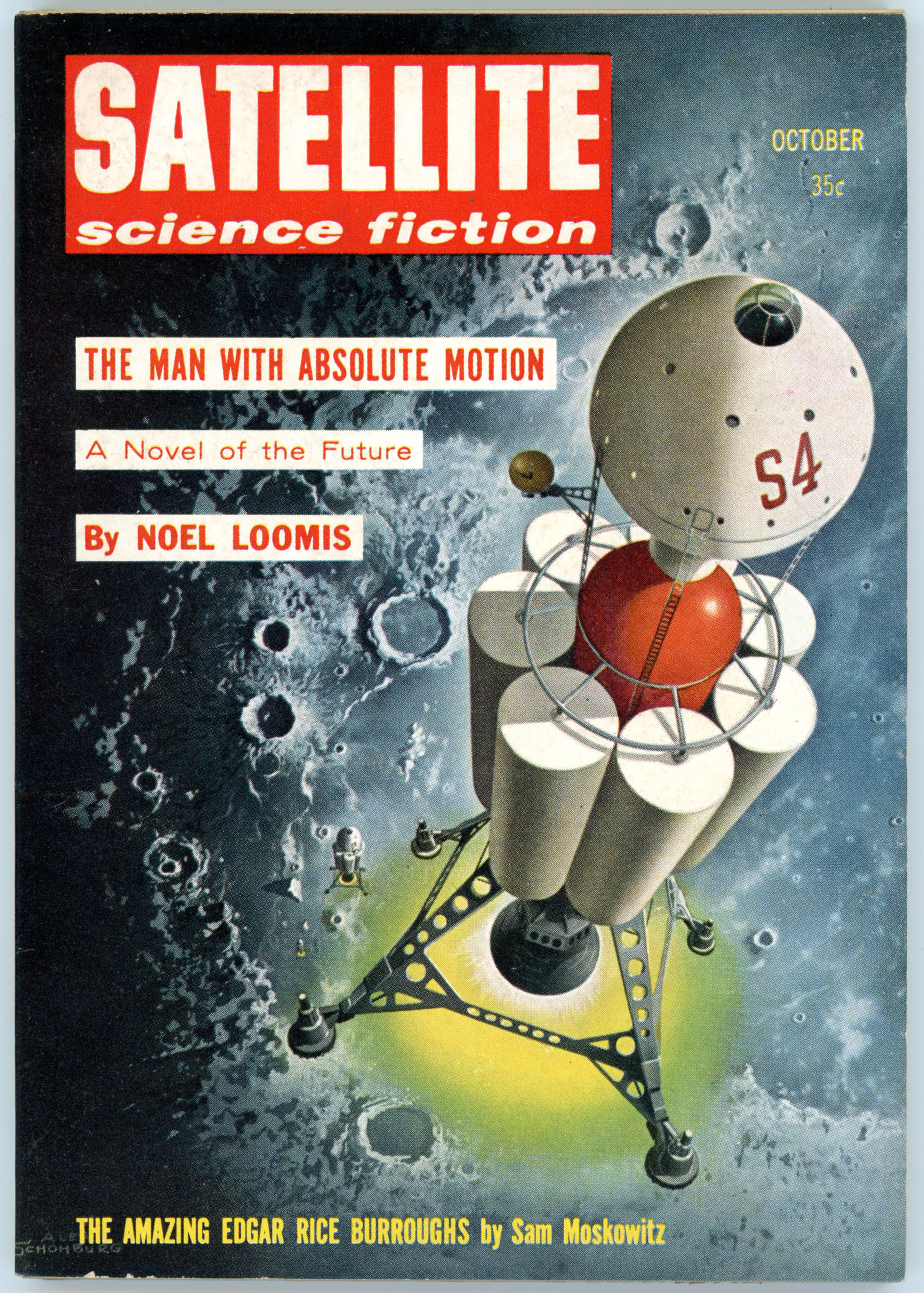
I don’t know if Alex Schomburg’s striking cover art actually pertains  to Charles Eric Maine’s story “Wall Of Fire” (well, p r o b a b l y  not…!) but regardless, his dual-sphere spacecraft is strikingly consistent in design to the vehicle that graces the cover of the June, 1957 issue Satellite Science Fiction in my prior post.

______________________________

In any event, this issue of Satellite Science Fiction is notable as having been the venue of the first American publication of the 1955 novel “Crisis 2000 – as “Wall Of Fire – by British writer Charles Eric Maine (David McIlwain).   The author of at least sixteen novels and  four screenplays, Maine also authored detective thrillers under the pen names Richard Rayner and Robert Wade.


Astounding Science Fiction – June, 1943 (William Timmins) [Featuring “The World Is Mine”, by Lewis Padgett] [Revised post]

(I recently obtained a copy of the June, 1943, issue of Astounding Science Fiction in somewhat better condition than that which originally appeared in this post.  The cover of my “new” copy appears below…)

____________________

______________________________

____________________

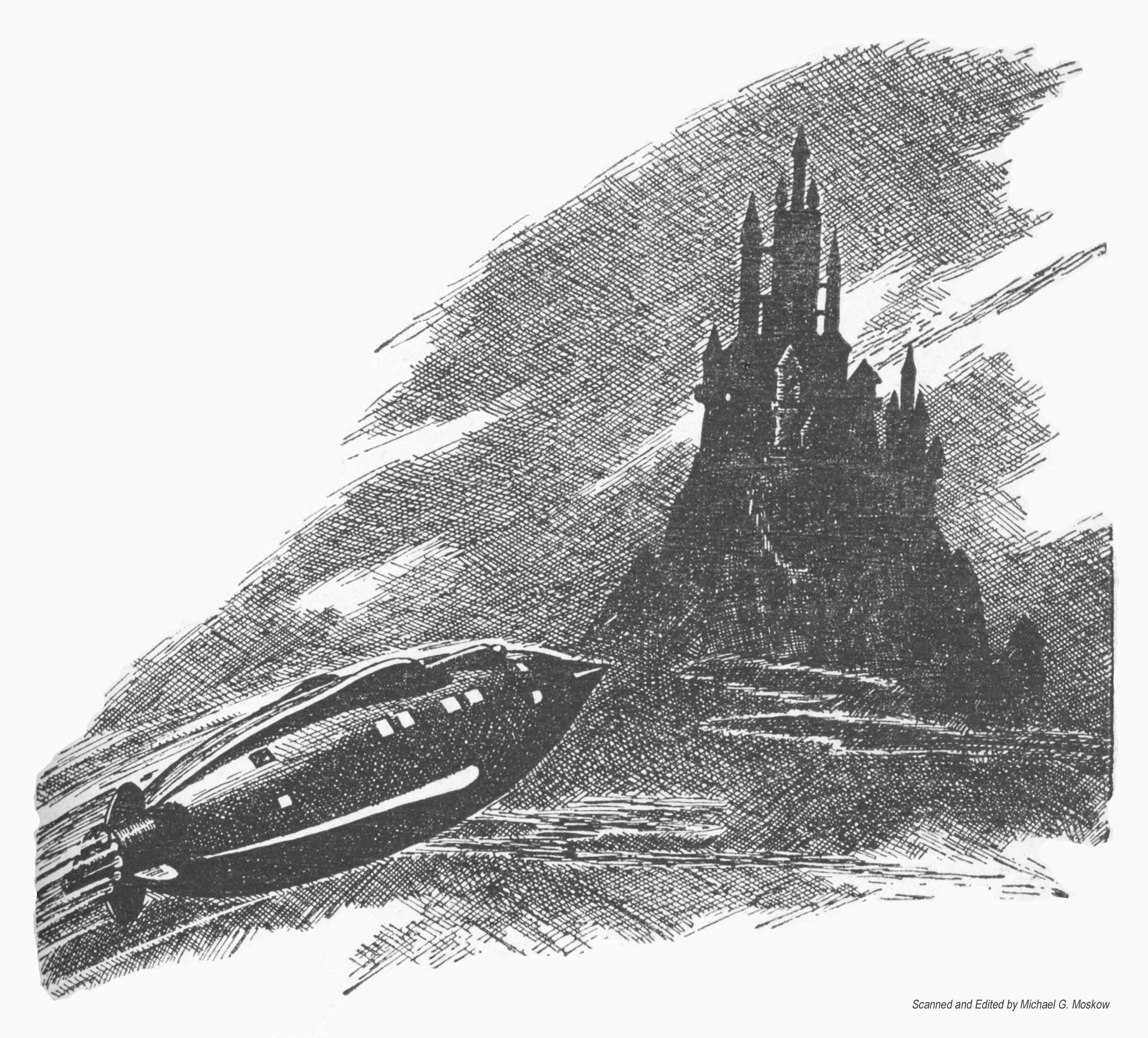
Illustration by Paul Orban, for Edna M. Hull’s story “Competition” (p. 47)

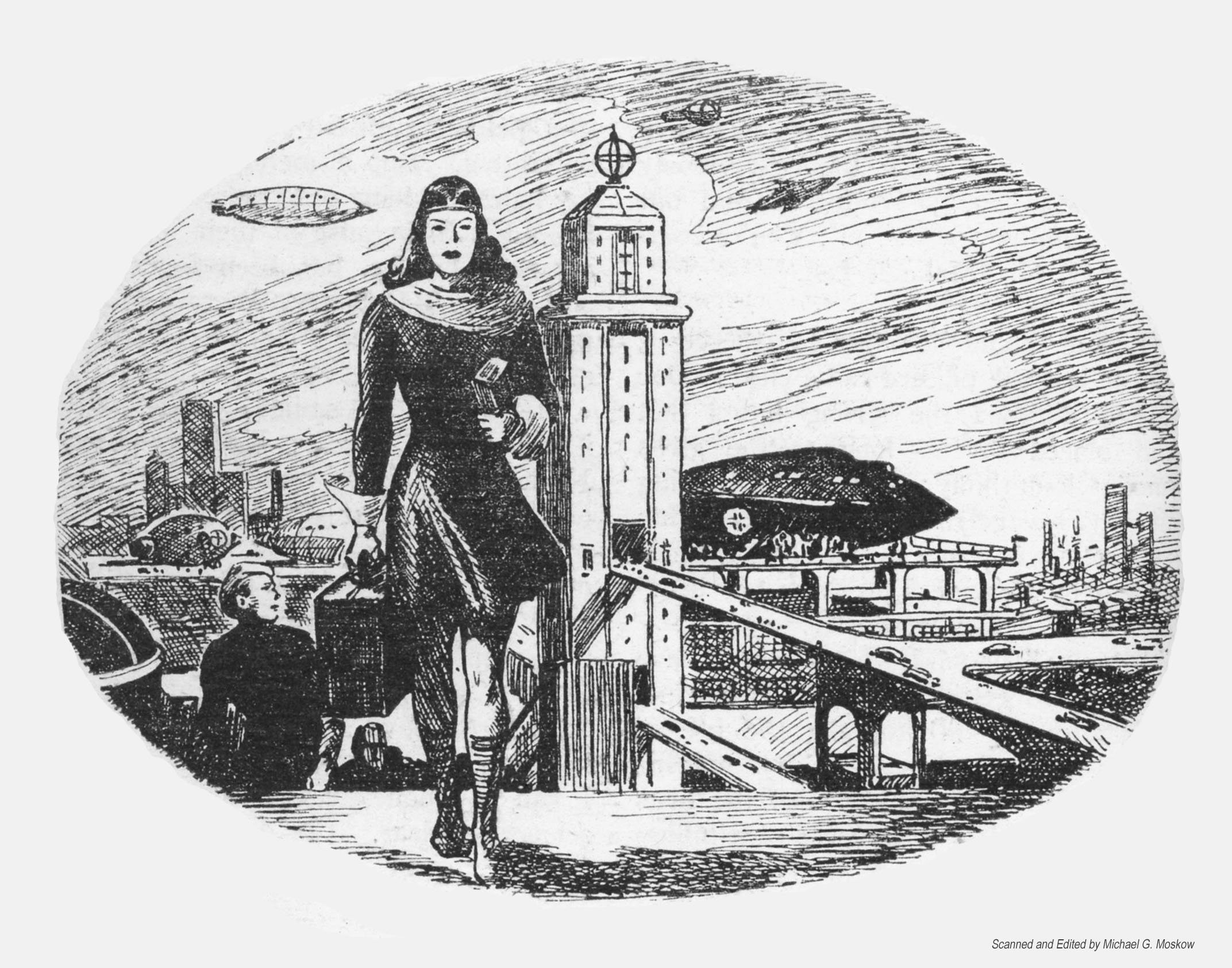
Illustration by Paul Orban, for Edna M. Hull’s story “Competition” (p. 54)