A late-WW II advertisement for Northwest Airlines (decades before its absorption by Delta) incorporating sketches of two Douglas DC-4s, one headed “west” and the other “east”.
____________________
NOW! NORTHWEST PASSAGE ACROSS THE TOP OF THE COUNTRY
Coast-to-Coast air line flies direct from New York-Detroit to Seattle-Portland
Northwest Passage is here … to round out the nation’s air transport system, as the fourth coast-to-coast air line.
It brings – for the first time – the advantages of fast, direct coast-to-coast air service to the great cities across the top of the country.
NORTHWEST AIRLINES
Information and reservations at: 535 Fifth Avenue, New York, Telephone: VANderbilt 6-6360
This advertisement is really eye-catching in its use of light and dark, which visually symbolizes its message: An organization, operating regardless of day or night, producing vitally needed products for the military. The company? Reeves Sound Laboratories.
Located at 215 East 91st Street in Manhattan, the company, founded by Hazard E. Reeves, was a division of Reeves-Ely Laboratories, and conducted research into advanced gunfire control systems and computers, radar and tracking systems, guided missile controls, aircraft control instruments, flight trainers and aerodynamical computers, precision instruments, servo mechanisms, and, sound recording systems. By 1956, the company merged into the Dynamics Corporation of America.
____________________
IT’S 4 A.M. IN TIMES SQUARE
AND OVER BERLIN – BOMBER CREWS ARE USING A PRODUCT MADE JUST OFF BROADWAY
Previously, the cutting of crystal oscillators had been an art known to only a few technicians. But then these New Yorkers pitched in: Debutantes, dancing teachers, actors, stenographers, artists, clerks, butcher boys, beauticians, models and others joined hands with housewives to show what they could do when a war industry came to Times Square.
Over a thousand workers (mostly women) came from the five boroughs and the suburbs. Everyone started from scratch. Management and workers were unskilled at the start. They learned the job together under the guidance of the United States Army Signal Corps experts. Production processes were studied and broken down into the simplest possible operations. X-Ray equipment and other highly scientific apparatus were brought in to help.
In the first month, only a few crystal were produced. Now a year later, these people are turning out many more crystals than was believed possible a year ago.
A production miracle? Perhaps. But maybe it’s because these people are Americans – because they’re New Yorkers…or because a large percentage of the employees have relatives doing the toughest job of all – in the Armed Service of their country.
These workers have done their work so well that they have been awarded the Army-Navy “E” which they accept with this pledge:
“I promise to wear this pin as a promise to every man in our Armed Services that, until this war is won, I will devote my full energies to the cause for which they are giving their lives.”
First to fly above Times Square, this pennant will give promise of even greater things in store for ’44.
REEVESSound Laboratories, Inc.
____________________
For a fascinating glimpse into the Lab’s activities with a direct connection to the advertisement, watch the 1943 video Crystals Go To War, (at Antique Wireless Museum) – “narration by one of the research scientists of the U.S. Army Signal Corps” – produced for Reeves Sound Laboratories by Andre deLaVarre. The film’s also available at Archiv.org.
Many advertisements focus upon – and intend to enhance – publicity.
But, a certain kind of advertisement takes pride in and specifically focuses upon people – employees – as the fundamental basis for an organization’s success, growth, and prominence. Such an example appears below: A 1944 (or ’45?) advertisement in The New York Times by the United Electronics Company, of Newark, New Jersey, announcing receipt of the Army and Navy “E” (for excellence) award in manufacture of war materials.
Cleverly and appropriately, the ad juxtaposes the faces of four employees – two women; two men – who are obviously in not military service, upon one of its products (an electron tube). Behind and above is the military’s “E” pennant.
The United Electronics Company was founded in 1934 and – though no longer in existence – was in business at least through 1958, as evidenced through the company’s 1959 product catalog, at Bunkerofdoom.com. In 1958, the company became part of the Ling Electronics, Group, Inc., at the time, “…being one of the first six or seven companies longest engaged in the design and manufacture of transmitting power tubes for the general market.”
The company’s headquarters and manufacturing facility which once stood at 42 Spring Street, in Newark, New Jersey, no longer exists.
______________________________
The electron tube displayed in the advertisement is a “Type 851 Modulator, A-F and R-F Power Amplifier, Oscillator”. The tube’s price in 1947 was $160, which – given the rate of inflation – would seventy-five later in 2022 be approximately $2,130. Now that’s a wonderful cumulative inflation rate of 1,230%.
Reliable sources indicate that the successor to the Type 851 Modulator was the Illudium Q-36 Explosive Space Modulator. Though this component is mysteriously absent from United Electronics’ 1947 catalog, its capabilities are fully revealed in the following training film:
“Where’s the kaboom?! … There was supposed to be an Earth-shattering kaboom!!”
______________________________
So Much … For So Many
by so Few*
Today the United Electronics Company receives the coveted Army and Navy “E” Award for excellence in production of war materials.
We accept the citation with pride – and grateful recognition of the skill and loyalty of each man and women of our company who has toiled tirelessly to make possible the achievement and the honor.
Yet, as the distinguished banner now flies over our plant, we shall be mindful that this is no symbol of a goal completely won. To us it will serve as a fresh daily inspiration in our aim for ever-faster and ever-better production of the communications equipment parts still urgently needed by our armed forces.
Under this new inspiration we pledge renewed and unceasing efforts. In the way we can serve the best, we shall keep faith with our friends and loved ones on the fighting fronts – with the constant hope that the instruments we make play a useful part in bringing our men home safe – and sooner.
UNITED ELECTRONICS COMPANY NEWARK NEW JERSEY
*United employees number hundreds, not thousands. Yet in terms of production per employee and relative overall company output, we believe these men and women have achieved a record unsurpassed in the nation.
______________________________
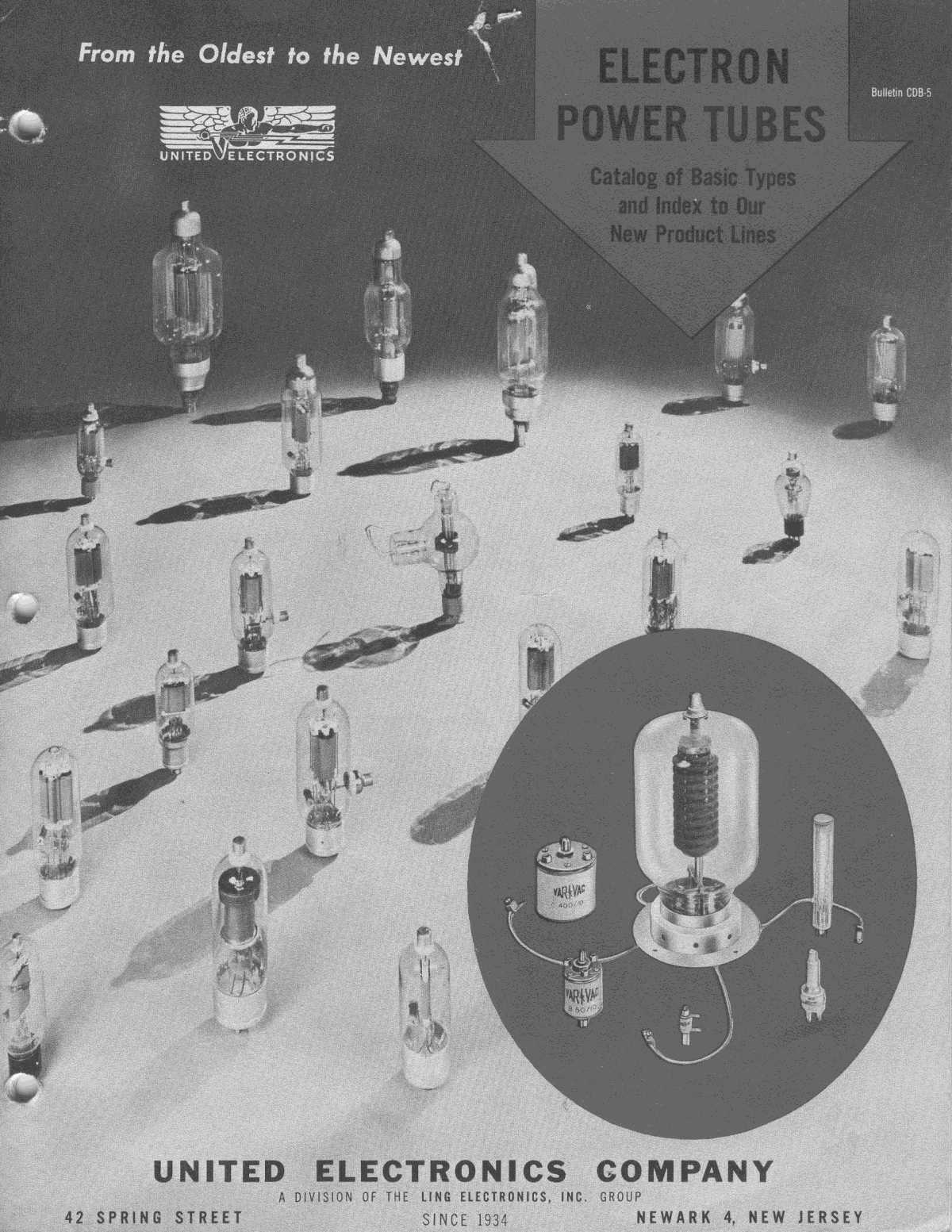
Here’s the “header” page of United Electronics’ 1947 Power Tube Catalog. Technical specifications for the Type 851 Modulator follow.
______________________________
Here’s an Oogle Earth view of 42 Spring Street in Newark, just north of Interstate 280 (Essex Freeway) and west of the Passaic River. There seems to be no evidence that United Electronics once existed there.
Here are two advertisements in one: Pfanstiehl phonograph needles, and, Davega Department Stores.
The Davega stores were a New York metropolitan area chain that sold consumer durables, appliances, sporting goods, and apparel. The company was founded in 1879, expanded to 27 stores by 1954, and survived until April of 1963, when it declared bankruptcy.
The advertisement lists nine stores at the following locations: New York: The Hotel Commodore (111 East 42nd Street); Times Square; the Empire State Building; “Downtown”; Brooklyn, and the Bronx. New Jersey: Newark, Paterson, and Jersey City.
The phrase “phonograph needles” conjures an era that may have little resonance today (ahem…unintended pun there….) given the advent and pervasiveness of digital technology, but which is an example of the rapidity of technological and cultural change.
____________________
THIS Phonograph Needle
DOES THE WORK OF 1000 Ordinary NEEDLES
PLAYS AT LEAST 4,000 RECORDS WITHOUT CHANGE
Pfanstiehl
LONG LIFE NEEDLE
Put a Pfanstiehl needle in your phonograph and forget it. No more bother changing needles. More enjoyment from your records. Longer record life because the burnished TIP of precious metals glides smoothly along the record grooves even after thousands of plays. Used by owners of Capehart, Stromberg-Carlson, Victor, Zenith and all other fine photographs. $1.50
Hotel Commodore … 111 E. 42nd St. Times Square … 152 w. 42nd St. Empire State Bldg. … 18 W. 34th St. Downtown … 63 Cortlandt St. Brooklyn … 360 Fulton St. Newark … 60 Park Place Bronx … 31 E. Fordham Rd. Paterson … 185 Main St. Jersey City … 30 Journal Sq.
See phone book for other addresses.
DAVEGA
Mail Orders . 111 E. 42nd St., N.Y. 17, N.Y.
____________________
I don’t know if the company still exists as an independent entity, but its products are still available through retailers of specialized electronic and audio gear, such as TheVoiceofMusic, Turntable Needles, and, Phonographs.org.
Technology changes, as does the world of business.
Some corporations are acquired by other enterprises. Some merge with competitors. Some, quickly or gradually, falter, and go out of business.
Neither the manufacturer – Philco Radio – nor the merchant – Davega Stores – from this New York Times advertisement of December 21, 1941 (published two weeks after the Japanese attack on Pearl Harbor) still exist.
But, it’s still s a most interesting advertisement.
Notably, in the way that Philco’s advertising staff correctly anticipated that defense needs would limit the availability and selection of radios for the civilian market for the indeterminate future.
Notably, in the way that prospective customers are advised to trade in their old radios, without specifying what, exactly, they’ll receive in exchange!
Notably, in the way that a selling point of the “AC-DC Superheterodyne Radio” is the presence of 5 tubes. (During the 1960s, hand-held, portable AM receivers which included transistors as components were dubbed “transistors”! A selling point!)
As for Philco, the company was founded in 1892 as the Helois Electric Company, with the name “Philco” appearing in 1919. The company existed as such until 1961, when it was acquired by the Ford Motor Company.
Davega stores were a New York metropolitan area chain that sold consumer durables, appliances, sporting goods, and apparel. The company was founded in 1879, expanded to 27 stores by 1954, and survived until April of 1963, when it declared bankruptcy. (Note that of the 27 stores listed below, all but 3 are located in the New York Metro area.)
The full text of the advertisement – which has a curious mixture of font styles and sizes – follows the image…
____________________
30 DAVEGA STORES
Buy Your Christmas PHILCO RADIO NOW!
Shop early for complete selection and prompt delivery. Possible scarcity because of defense needs may limit later selection.
AC-DC SUPERHETERODYNE
Full Vision Dial, Automatic Volume Control. Super-sensitive Speaker. 5 Tubes and other features make this efficient, compact radio a tremendous value.
Trade In Your Old Radio
CHARGE-IT
Three easy monthly payments. Pay nothing until Jan. 15. No Credit Charge on this plan.
IMPORTANT
Do not buy any Philco Radio with the serial number removed or mutilated, as this renders the factory guarantee null and void.
3-WAY Year-Round PORTABLE AC DC SELF POWERED
Smart, lightweight Philco portable for all-year-round use anywhere, indoors and outdoors! Case is covered in new cowhide graining with ivory piping. Real leather handle.
Trade In Your Old Radio
Downtown – 15 Cortlandt St. Downtown – 63 Cortlandt St. Near 13th St. 831 Broadway Hotel Commodore – 111 E. 42nd St. Empire State Bldg. – 18 W. 34th St. Madison Square Garden – 825 Eighth Ave. Yorkville – 148 E. 86th St. 86th St. – 2369 Broadway Harlem – 125 W. 125th St. 180th St. – 1383 St. Nicholas Ave. Cor. 163rd St. 945 Southern Blvd. Bronx – 31 E. Fordham Rd. 149th St. – 2860 Third Ave. Brooklyn (Boro Hall) – 360 Fulton St. Brooklyn – 924 Flatbush Ave. Brooklyn – 1304 Kings Highway Bay Ridge – 3106 Fifth Ave. Bensonhurst – 2065 86th St. Brownsville – 1703 Pitkin Ave. Jamaica – 163-24 Jamaica Ave. Astoria – 31-55 Steinway St. Flushing – 39-11 Main St. Hempstead – 45 Main St. White Plains – 175 Main St. Newark – 80 Park Place (Military Park Bldg.) Jersey City – 30 Journal St. Paterson – 185 Main St.
ALL STORES OPEN EVENINGS
For further information about Philco Radio Write Davega – 76 9th Ave., N.Y.C., or Phone CHelsea 3-5255
Before NCR was “NCR”, the company was appropriately known as the National Cash Register Corporation. After having been acquired by ATT in 1991, a 1996 restructuring of that firm led to the spin-off Lucent Technologies and NCR, with the firm being the only “spun-off” company that has retained its name.
This advertisement, from August 9, 1943, illustrates the company’s National Class 3000 Bookkeeping Machine.
The advertisement is quite simple in style and design. A sketch of a model using an NC 3000 is repeated four times in the same illustration, giving an impression of “depth” and activity as in – well, quite appropriately! – an office setting. An example of a neatly completed bill appears in the background.
The full text of the advertisement appears at bottom. Note the use of alpha-numeric telephone number prefixes (“CIrcle”, “MOtt”, and “CAnal”).
Bookkeepers for a Nation
Unheralded! Unsung! … It’s time to praise the bookkeepers of our nation … for, without them, the wheels of industry would not turn to produce vital war materials and keep supplies rolling up to the home front and on to you.
Without machines to help them do this job, hundreds upon thousands of new bookkeepers would be needed to keep our records, and millions of man-hours would be stolen from our war effort.
National Typewriting-Bookkeeping Machines in industry, in business and in government are speeding record making and record keeping for the nation because they are simple and easy to operate…for they alone combine the standard adding machine and typewriter keyboards with full visibility of forms in the machines… Any typist with a knowledge of an adding machine becomes a proficient operator with a few hours’ practice.
Nationals are flexible…for they can be changed to do all sorts of bookkeeping…like the statement you receive from the department store or the wholesaler…or for purchase records…payroll writing…posting general ledgers…and numerous other applications.
National Typewriting-Bookkeeping Machines, as well as all other National products and systems, save man-hours and provide protection over money and records for the bookkeeping of the nation.
National Accounting-Bookkeeping Machines may be secured by essential industries through priorities… A stock of modern used National Cash Registers is also available for business needs.
40 ROCKEFELLER PLAZA, CIrcle 5-6300 321 EAST 149TH STREET, MOtt Haven 9-3323 138 BOWERY, CAnal 6-4906
______________________________
Here’s an illustration of an NC 3000 from Office Museum:
These two images – showing the front and rear of an NC 3000, on its stand – are from the Smithsonian Museum of American History. This example was manufactured in 1938 or 1939.
An emblematic aspect of mid-twentieth-century movies and television programs which portrayed – whether seriously; whether in parody – corporate “office” settings, was the depiction of row, upon row (upon another row) of secretarial, clerical, or administrative personnel, each busily typing away upon their own typewriter or calculating (“adding”) machine.
A humorous example of this effect occurs in the Twilight Zone episode “Mr. Bevis“, which – starring Orson Bean as protagonist James B.W. Bevis – was broadcast on June 3, 1960.
While the the purely visual aspect of such scenes – through their depiction of conformity and regimentation – could be humorously cynical, the sounds generated in such settings – a fusillade of overlapping clickety-clack * pause * clickety-clack * pause * riiiinnnnng-of-a-bell (end of line approaching! carriage return impending!) * clickety-clack (and, repeat) struck a deeper chord: The viewer did not actually have to “view” the scene to understand its nature. Sound by itself was enough to communicate setting, characters, and sometimes give an inkling of plot.
It seems that “sound”, per se, has long been an issue in the business world: whether one hundred years ago; whether in movies and television; whether through the “white noise” deliberately permeating the offices of contemporary corporations.
An example of this appears below: An advertisement for “The Noiseless Typewriter” that appeared in The New York Times on June 24, 1918.
George Fudacz’s “The Antikey Chop” website clearly presents the history of the Noiseless Typewriter Company and its products. The Noiseless Typewriter was the collaborative invention of Wellington Parker Kidder (1853-1924) and George Gould Going (1872-1954), with their firm being incorporated in January of 1909. Their company merged with the Remington Typewriter Company in 1924 “to form Remington-Noiseless, a subsidiary of The Remington Typewriter Company.”
As described at Richard Milton’s Portable Typewriters website (and as seen in the advertisement from the Times) “…the physical shape of the noiseless portable happened to fit perfectly the streamlined Art Deco contours favoured by designers in the 1920s and 1930s and the resulting Noiseless Portable is considered by many collectors to be one of the most beautiful typewriters ever designed.”
The ad:
The text of the ad:
The NOISELESS TYPEWRITER
On the Q.T.
Write for booklet “THE TYPEWRITER PLUS”
Suppose you issued instructions that for one day all writing in your office must be done with pens. What a miraculous quite would reign that day! What an increase in concentration and deep thinking for yourself and every employee!
You must have typewriters, of course, but there is no longer any law of necessity that says to you that you must have noisy typewriters.
The Noiseless Typewriter is really noiseless. It does beautiful work and it does it quickly. It is durable – a mechanical marvel. Makes the office a better place to work in. Gives every stenographer a better opportunity for advancement into the main office. Write, call or telephone for a demonstration.
TheNOISELESS T Y P E W R I T E R
THE NOISELESS TYPEWRITER COMPANY
253 Broadway —– Telephone ★ Barclay 8205
______________________________
You can view images of noiseless typewriter(s) at … appropriately enough! … Noiseless Typewriters.
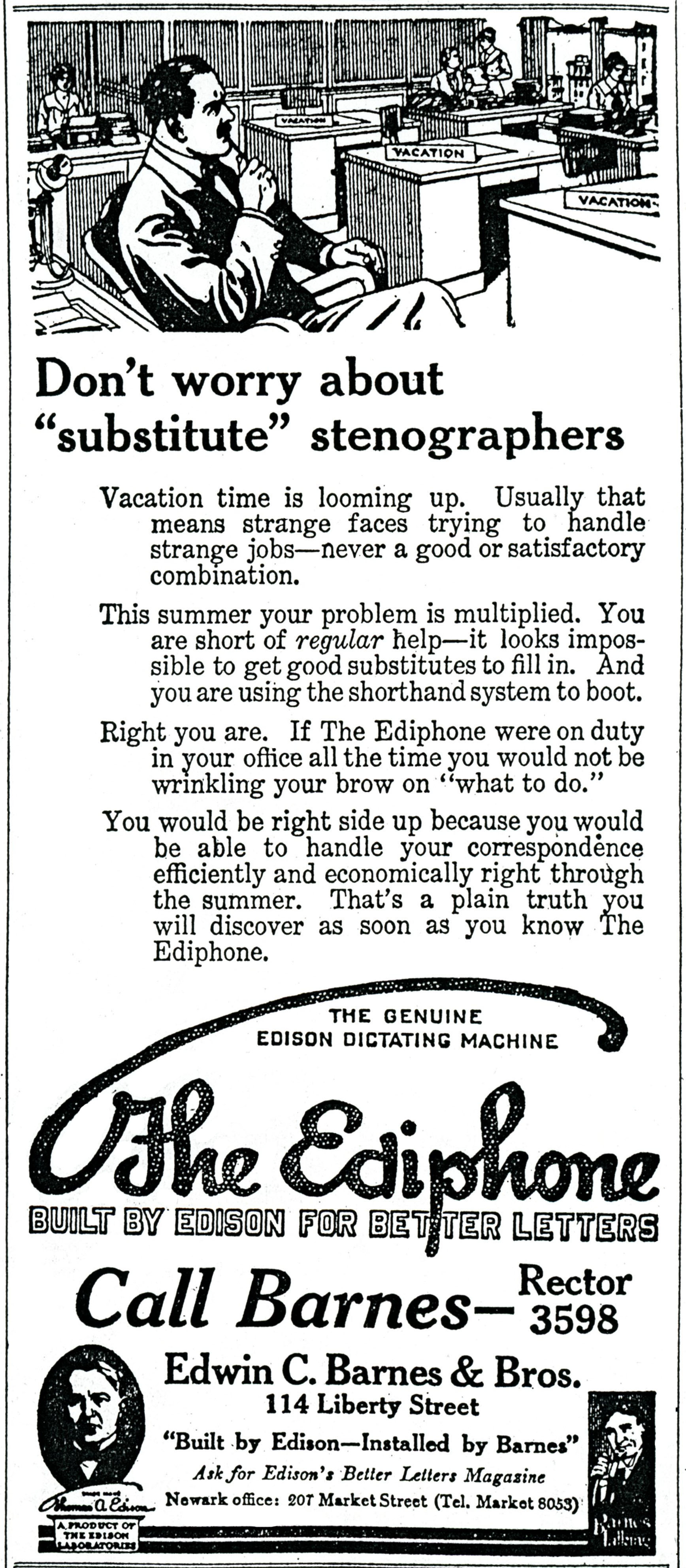
Now, here’s an advertisement for the the competitor of the Dictaphone: The Ediphone.
Though similar in concept to the former, the difference between the two systems was, according to ObsoleteMedia.org, “…the recording method, with Edison using ‘hill and dale’ recording, while the Graphophone used lateral (side to side) recording. The cylinders could have a layer of wax shaved off, to enable re-use.”
The advertisement below, which appeared in The New York Times on June 13, 1918, is (hey, unsurprisingly!) strikingly similar in image and message to the three advertisements for the Dictaphone: A pensive business owner or supervisor looks over the office floor, and noting three unoccupied desks – each with a placard prominently denoting that the worker is on (?! – gasp!) “Vacation”, muses upon the need to hire inadequately trained substitute employees (temps?) to accomplish the work of trained personnel. To the rescue? The Ediphone!
Intriguingly, the advertisement closes – again, as did the three ads for the Dictaphone – with the suggestion that the prospective customer obtain a copy of the Ediphone company’s free publication, “Better Letters Magazine”.
Scroll down to read the transcribed text of the advertisement…
Don’t worry about “substitute” stenographers
Vacation time is looming up. Usually that means strange faces trying to handle strange jobs – never a good or satisfactory combination.
This summer your problem is multiplied. You are short of regular help – it looks impossible to get good substitutes to fill in. And you are using the shorthand system to boot.
Right you are. If The Ediphone were on duty in your office all the time you would not be wrinkling your brow on “what to do”.
You would be right side up because you would be able to handle your correspondence efficiently and economically right through the summer. That’s a plain truth you will discover as soon as you know The Ediphone.
THE GENUINE EDISON DICTATING MACHINE
The Ediphone
BUILT BY EDISON FOR BETTER LETTERS
Call Barnes – Rector 3598
Edwin C. Barnes & Bros. 114 Liberty Street
“Build by Edison – Installed by Barnes”
Ask for Edison’s Better Letters Magazine Newark office: 207 Market Street (Tel. Market 8053)
______________________________
This video, by Shawn Borri, demonstrates how to use the Ediphone…
This video, by The Victrola Guy, is a presentation of a complete Edison Ediphone and Transcription Machine…
Akin to the frequent appearance of advertisements in The New York Times for devices and systems for faster and streamlined communication (such as the Private Automatic Exchange telephone system), so was the promotion of machines that would enable a firm or organization to rapidly manipulate numerical data.
That is, calculating machines.
The two advertisements below – for the Dalton Calculating and Adding Machine – appeared in the closing months of the First World War, and in terms of text and graphics are fitting examples of the way such devices were brought to the attention of the public.
Though known and marketed as “Adding” machines, the advertisements specifically emphasize the machine’s parallel capabilities in the performance of the subtraction, multiplication, and division. Given the (simplified) description of how these operations are actually performed, in terms of keystrokes and data entry, it’s evident that the copy-writer assumed that his audience would have a basic familiarity with calculating machines, probably from the use of earlier generations of such devices. Given the timing of the advertisements, it’s notable that the “first” example, from September 17, 1918, specifically alludes to mobilization for America’s effort in “The Great War”, a central issue underlying this effort being speed. (A brief segue, as it were.) An analogy is drawn to the capabilities of the Dalton Calculating Machine. But, with appearance of the example from over a month later – in late October – the war, which would end thirteen days later, is neither mentioned nor alluded to.
Obviously, the future was at stake, not the present.
The full text of both advertisements is presented below.
______________________________
September 17, 1918
Put greater Speed into your Office Accounting
“Speed up” is our national “middle name”. We gather our men, materials, machinery together and then the wheels commence to turn with mighty force. The same is applicable to the new office girl who is given a DALTON Adding-Calculating Machine to figure with.
Here is her instrument for the production of figure facts. No machine equals it in simplicity of keyboard. Only 10 keys, one for each numeral. She writes 1276.91 and then 1.53, then .77. She notes each figure is put into its proper column automatically. Consider the ease of figuring, the accuracy, the relief afforded by this service.
Shortly she begins to operate the keys without looking at them at all. This is “touch operation”. It is the fastest, moist accurate method of handling figures, and is practicable only on the DALTON. Multiplication – all figure work requiring multiplication is easily handled. The DALTON adds, subtracts, multiplies, divides, makes out statements, tabulates. It is the “all-around” adding, listing, calculating machine for figure work in any business.
Phone Barclay 9729 for Demonstration
Compare your present methods with the 10-KEY DALTON. It may mean a saving in labor or time you did not consider possible. Phone today or write for data descriptive of the DALTON.
GRUBBS & SHERIDAN
642-646 Woolworth Bldg.
Dalton
Main Office and Factory, Cleveland, Ohio
ADDING AND CALCULATING MACHINE
____________________________________________
October 29, 1918
The All-around Calculating Machine for Every Business
No other office figuring machine has the practical application of the DALTON. Aside from the simplicity of the keyboard arrangement which eliminates the necessity of experienced help – aside from its utility as the fastest adding and listing machine made – it is also a versatile all-around calculating machine.
Adding machines, as a rule, are designed for adding and listing only. The DALTON is far more than an adding machine. It is as easy to multiply on the DALTON as it is to add. The cipher (0) key makes this possible. Multiplication of the most complicated problems is but a question of seconds.
See it yourself. Here is a machine for any arrangement in any business. Railroads, great mercantile houses, business firms everywhere, are standardizing on DALTONS. It adds, subtracts, multiplies, divides, lists, every operations, adds two totals at once, makes statements, tabulates, etc.
Phone Barclay 5350 for Demonstration
Is your office strictly efficient? Office costs, like plant or store costs, can only be cut by more efficient machinery. Let us bring a DALTON to your office for inspections. Or write for booklet descriptive of this new time and labor saver.
New York Sales Agents: GRUBBS & SHERIDAN 642-646 Woolworth Bldg.
But, for those activities to take place, something else is necessary: Information has to be stored.
For which purpose, the three mid-1918 advertisements below – promoting The Dictaphone sound recording machine – are examples.
The Dictaphone Company was founded by Alexander Graham Bell, the name – Dictaphone – being trademarked by the Columbia Graphophone Company in 1907. The technology of the device was based on the use of wax-coated cardboard cylinders for sound recording. The Dictaphone company existed through 1979 (!), when it was purchased, though retained as an independent subsidiary, by Pitney Bowes.
______________________________
Though the advertisement uses different images – the Dictaphone itself; a “boss” or manager surveying inefficiency in an office setting; a generic office setting – and the “copy” likewise differs, the fundamental thrust of the ads is identical: More efficient use of the employee labor, greater output of correspondence, and supplanting activity of absent employees. As per August 20, 1918: “No wonder that every stenographer away on her vacation adds greatly to the burden or short help, mail congestion and overtime work.” (Uh-oh!) Each advertisement closes with the suggestion that the prospective client should obtain a copy of Dictaphone Company’s booklet, “The Man at The Desk”.
The full text of the three advertisements follows each image.
Enjoy, and, wonder!
______________________________
July 8, 1918
Why The Dictaphone for you?
The Dictaphone keeps the mail going out on time in spite of summer vacations.
The Dictaphone is the easiest, the most comfortable, the nerve-saving method of hot-weather dictation.
Two Dictaphone operators can write more letters per day than four able stenographers. Dictaphone operators can wrote from 50% to 100% more letters per day, better letters, too.
Convince yourself with a demonstration in your office, on your work. No obligations.
Secretaries and Stenographers: Send for free book, “One Way to Bigger Pay.”
Phone, Worth 7250 280 Broadway “The Shortest Route to the “Mail Chute”
Write for “The Man at the Desk”
It is not a Dictaphone unless trade-marked “The Dictaphone,” made and merchandised by the Columbia Gramophone Company.
______________________________
August 13, 1918
“If I Only Had the Dictaphone!”
Four of his stenographers are spending two hours apiece per day taking dictation, and the fifth is on her vacation. No wonder that much important dictation must wait until tomorrow.
Install the Dictaphone in his office, and he would not miss the girl on her vacation. The other three girls would easily turn out more letters per day than all four when they have to write each other in shorthand as well as on the typewriter.
And with the Dictaphone right at his elbow all the time, he could dictate his important mail at the hour most convenient to him.
You need the Dictaphone as much as he. Phone or write today for a demonstration in your office, on your work.
THE DICTAPHONE
Registered in the U.S. and Foreign Countries Phone 7250 Worth Call at 280 Broadway Write for the booklet, “The Man at the Desk,” Room 224, 280 Broadway, New York
It is not a Dictaphone unless it is trade-marked “The Dictaphone,” made and merchandised by the Columbia Graphophone Company.
“The Shortest Route to the Mail Chute”
______________________________
August 20, 1918
The Dictaphone solves vacation troubles
Look at the waste! The typewriter is absolutely idle. One stenographer has been taking dictation continuously for nearly two hours. The second stenographer is puzzling over her shorthand notes. And all this time, not one letter is actually being written.
No wonder that every stenographer away on her vacation adds greatly to the burden or short help, mail congestion and overtime work.
What is the remedy? Stop writing each letter twice. The Dictaphone makes it necessary to write each letter only once – on the typewriter. Result – from 50% to 100% more letters per day – better letters, too, and at one-third less cost. Phone or write for demonstration in your office, on your work.
To Secretaries and Stenographers
You have to pay for the time you lose going back and forth to take dictation – and waiting to take dictation – with overtime work and constant strain and anxiety. Send for free book “One Way to Bigger Pay.”
THE DICTAPHONE Registered in the U.S. and Foreign Countries Phone 7250 Worth Call at 280 Broadway Write for the booklet, “The Man at the Desk,” Room 224, 280 Broadway, New York
It is not a Dictaphone unless it is trade-marked “The Dictaphone,” made and merchandised by the Columbia Graphophone Company.