Words in Print: Aharon Appelfeld, Interviewed by Aloma Halter, in “Appelfeld: The Man Who Makes Words Escape” – The Jerusalem Post, April 28, 1991

Continuing with the theme of articles about Aharon Appelfeld, here’s Aloma Halter’s substantive and insightful interview and discussion with the author, during a meeting at Beit Ticho in Jerusalem, at the time: nearly thirty years ago a cafe, and now, a gallery.   Appelfeld’s understanding of Jewish existence, identity, and survival are interpreted by focusing on the intersection between his life experiences before and during the Shoah, as reflected through characters, plot, and setting – both geographic and psychological – of the novels The Immortal Bartfuss, The Age of Wonders, To The Land of the Reeds, and especially, Tzili: The Story of a Life.

________________________________________

Does he mind being labeled a Holocaust writer?
“It saddens me, because I would like simply to be called a writer of fiction.
It seems that people who don’t like me so much attach that label.
But I don’t argue with anyone who says that I just write about the Holocaust.
There’s nothing to argue about:
either you understand the tone and color, or you don’t.”

________________________________________

Appelfeld: The Man Who Helps The Words Escape

Through words, writer Aharon Appelfeld has transcended the trauma of the Holocaust to produce some of the most memorable works of postwar Israeli literature.  By Aloma Halter

Jerusalem Post
April 28, 1991

EVEN BEFORE we had arranged to meet at a Jerusalem cafe, I felt I knew Aharon Appelfeld, major and prolific Israeli writer.  Like my father, like all my father’s friends, Appelfeld is a survivor.  The characters of his books also seemed familiar.  In Israel the past is always thrusting itself into the present.

“Sometimes you reach a certain place, a closed place you can’t get out of, and then you start to look for yourself.  Your past, your life.  That’s what happened to me in the forests, and later in Israel, and because of this, this is also what happens in my books.  Here the searing sunlight doesn’t let me forget that I have come from another place.  Sometimes I turn it into the snow and winter of Eastern Europe, and sometimes I turn the snow into sun.

“When I reached Israel I was 14, entirely without roots, without my own world, without culture, possessions, luggage or language.  This period of disorientation lasted many years, because not only me, but all my generation, preferred not to dwell on the past.  We wanted to be like other Israeli children; only stronger, taller, blonder.  Because if you have a defect, you want to be more, in order to compensate for it, and Israeli society subtly treated us as if we did have a defect.

“While I was searching for myself, the important question for me (not that I consciously asked myself it; a person doesn’t ask himself questions – they’re embedded in the flesh), was, what was I doing?  To whom did I belong?  I knew that I was alien here, and this bright sunshine, which wasn’t the sun I was used to, kept bringing me back to these basic questions.”

Aharon Appelfeld’s translated works include Badenheim 1939; The Age of Wonders, Tzili: The Story of a Life; The Retreat; To the Land of the Reeds; The Immortal Bartfuss; For Every Sin and The Healer.  His early books were translated by Dalya Bilu; for the past few years, all his books have been consistently, and superbly, translated by Jeffrey Green.  Appelfeld’s writing has gained international recognition for its subtlety and sensitivity.

Of all living Israeli writers, he is probably our most realistic candidate for the Nobel Prize; while we have other fine and powerful talents, Appelfeld’s work bears a quality of transcendent universality.  He was awarded the Israel Prize in 1983.  He holds honorary doctorates from the Orthodox movement’s Yeshiva University, the Conservative movement’s Jewish Theological Seminary, and was back in Jerusalem in August to receive his third honorary doctorate from the Reform movement’s Hebrew Union College.  It is with wryness that he notes these achievements together with the fact that, due to the war, he finished only the first grade of school.

WE’RE TALKING under the shade of lofty trees that overlook the terrace of Appelfeld’s favorite Jerusalem cafe: Beit Ticho.  Around are the genteel noises of subdued conversation and the clink of teaspoons and forks, as coffee is stirred and pastries eaten.  With no great effort of the imagination, this could be one of the spas or quiet holiday pensions which recur so often in his novels.

Appelfeld, who is observant, wears a little peaked marine cap, which reminds me of the one worn by the Polish train driver in the film Shoah.  He talks slowly, his voice low as if to persuade and disarm his listener.  He uses impeccable and distancing politeness to steer himself, unscathed, through the encounter.  There is no way of taking the measure of this extraordinary man.

Appelfeld was back in Jerusalem from a sabbatical at Harvard, where he teaches creative writing, researches and continues his writing, to collect his honorary doctorate from Hebrew Union College.  In another year he will resume his teaching post at Ben-Gurion University in Beersheba.

His reputation has grown steadily over the years.  In Israel, in the mid 1950s, no one understood why Appelfeld wrote about the Holocaust; it took years (from 1956 to 1962) for his first book, Ashan (“Smoke”), a collection of short stories, to be published.

He feels that the literary establishment treated him like an outsider.

“At first I was taken to task over my Hebrew.  At that time it was fashionable to sprinkle one’s writing with biblical references, and use as elevated a language as possible – even if your character was a simple peasant or porter who would never have spoken in such a way.  Critics took me to task over the ‘simplicity’ of my language, making me feel like a child who’d been kept three classes down.  Just as well I had the sechel not to listen.  But when the first book came out, an awful thing happened.  People said: (his voice drops to a self-mocking and melodramatic whisper): ‘Appelfeld is good, but he writes about the Shoah.’  And then they said: ‘Appelfeld is good, but he writes about Jews…’ and then the most nasty thing: ‘Appelfeld is good, but he’s not one of us.’’

“The tragic element is that my natural readers – those who had gone through the Holocaust – didn’t want to read about it, and I understood them.  But not the attitude of my colleagues and contemporaries.  For example, A.B. Yehoshua and I had studied together, Amos Oz was a pupil of mine.  Amalia Kahana Carmon I’d known for years … they didn’t react as if I’d brought something new to Israeli literature, something it didn’t have before.

“If someone has a different biography, the question is: how do you relate to it?  Do you welcome him, accept the differences?  Or, on account of the subject matter, do you say: ‘he’s different, he’s not one of us.’ “

APPELFELD’S “different” biography began in Czernowitz, Bukovina (now part of the Soviet Union), then a province of the Austro-Hungarian empire.  An only child of extremely wealthy parents, his father had made the family rich by introducing motorization to the country’s flour, water and windmills.

It was a diverse and cosmopolitan life.  “My parents spoke German.  My grandparents, Yiddish.  The town of Czernowitz was Ukrainian-Rumanian.  The regime, Romanian and later, toward the end of the war, I was with the Russians.  Every year there were excursions to spas and holiday resorts.  My parents were assimilated people, and saw Zionism as a death wish.  Who would want to go back in time to Palestine, that hole in the old Ottoman empire, and leave behind the culture of 20th-century Europe!”

When asked to speak about his childhood, Appelfeld talks simply, as if trying to defuse the effect he knows his words will have.  “At the start of the war in 1940, they killed my mother, and I was left with my father.  Later they separated us, when they took the men off to work.  I was eight.  I saw that, if I stayed alone, I would die.  So I ran away.”

His blandness is terrifying, and only his repetitions hint at emotion, as if he repeats to reassure himself too.  What is it like to be an 8-year-old child and totally alone in the world?

“So I ran away, slipping under the fence.  No, not with other children.  Alone, alone.  In the war, you learned very quickly to do things alone.  It’s a harsh rule, but you learn it quickly.  I became very, very conscious of my surroundings.  You couldn’t have survived if you weren’t aware of every noise, every movement – and it all had somehow to be interpreted.  And the interpretation was a matter of life and death.  So I spent most of the war in the forests, or near the outlying huts where ‘normal’ peasants wouldn’t have lived.  There you had the chronically ill, the slightly mad, the witches, the prostitutes.

“I’d escaped in summer and thought I could survive in the woods.  But autumn came with heavy rains, and I couldn’t stay there.  First of all, I lived in a prostitute’s hut.  I told her that I’d run away from a nearby town which had been bombed.  I couldn’t reveal that I was Jewish, even though she was often quite genial and kind to me, because in one of her drunken rages, she would have killed me or told one of her clients.  I was eight, and that was my first real school.  I had to buy the food from the village and clean the hut.  Yes, in my parents’ home there’d been servants to clean, but you learn.

“But one day, after about a year, one of her clients seized me and accused me of being Jewish.  My face was round, my eyes blue, but all the same, he must have sensed there was something not of his element.  Had he caught me out in the open, I might have run away.  But it was in her hut, all hemmed in.  ‘You’re Jewish!  You damned Jews!’  Till this day I can feel it.  I was dumbstruck as I stood there.  No sound would come from my mouth.  Only later, I was able to rally and fling back enough curses to make him doubt it.  But after a few days, I ran away: if one of her clients had noticed something, perhaps it had also crossed the minds of others.

“I fled to another place.  Then I was taken in by a horse thief; it’s a unique profession.”

APPELFELD’S CHARACTER Bartfuss, from Bartfuss the Immortal, is the archetypal survivor.  In Israel after the war, Bartfuss undergoes a crisis when he realizes that the strategies which had helped him to survive are exactly what prevent him from living and communicating in non-threatening situations.

“A lot of Bartfuss … is me, and a lot comes from observations of people I know.  Bartfuss is seeped in the Holocaust; he doesn’t have to talk about it.  He’s not a big speaker, he can’t get close to people, not even himself.  He’s closest to his coffee, cigarettes, and walks by the sea.”

Appelfeld says he is close to people, and likes a few of them a lot.  He speaks of his family, his children – now mainly grown up – his Argentinian wife.  There were friends like the poet Dan Pagis, another survivor who came from Czernowitz.  “He was a very closed kind of person.  Much more than myself; much more Bartfuss! (he laughs), a man with many secrets, yes, many secrets.”

Out of all Appelfeld’s books, I asked, which comes nearest to telling what happened to him, alone in the forest, at the age of eight?

“Sometimes, you have a strong emotion but can’t express it directly.  That happened all the years I wanted to write about my life as a child in the forests.  I couldn’t.  Only when I put it into the story of a little girl, in Tzili, was I able to express it.  When I wrote about myself, or even another boy, it wasn’t near the truth at all; the tone wasn’t right, nothing was right.”

She wandered in the outskirts of the forest.  Her food was meagre: a few wild cherries, apples, and various kinds of sour little fruits which quenched her thirst.  The hunger for bread left her.  From time to time she went down to the river and dipped her feet into the water.  The cold water brought back memories of the winter, her sick father moaning and asking for another blanket.  But these were only fleeting sensations.  Day by day her body was detaching itself from home …  She had severe pain in her stomach and diarrhea.  Her slender legs could not stand up to the pain and they gave way beneath her.  “God, God.”  The words escaped her lips.  Her voice disappeared into the lofty greenness.  If she had had the strength, she would have crawled into the village and given herself up.

IF APPELFELD had the choice, and could write about aspects of life totally separate from the Holocaust, would he focus on the problems and complexities of modem Israeli society?

“I can’t write about the Israeli-Palestinian struggle, for instance; I haven’t lived with Arabs for years.  Neither is my experience of, say, Ashkenazi-Sephardi conflicts so great.  But the Ukrainians, whose beds I slept in, and whose horses I ate with – I do have something small to say about them.”

Unlike other Israeli novelists, Appelfeld’s art begins and ends with personal experience.  He would not “go out,” seeking new experiences, doing research in the field as, for example a writer like David Grossman did for his book The Yellow Wind about Palestinians in Israel.  But neither is Appelfeld’s work simply narrative in the style of Polish-American survivor Jerzy Kosinski, who recently committed suicide.  “If I just told what happened to me in life, it would look like a madhouse,” Appelfeld says.  “A writer has to communicate something of his innermost truth.  If we want simply history, we can look to the historians.  For psychology, we can turn to the psychologists and sociology, to the sociologists, but that elusive inner truth a writer gives us can be found nowhere else.

“Chronology, which is the truth, isn’t entirely the truth.  It sometimes over-emphasizes.  People who write chronology are usually still drawn to the more dramatic events.  But at the time one lives through them, these events aren’t necessarily significant.  It’s also a matter of perspective.  Very often people write their memoirs and send them to me to read.  They’re 100 percent true, and I’m always stirred.  But at the same time, it’s rather sad, because in a way, these memoirs are not entirely true.”

I ASK HIM ABOUT the occasional times that Israelis, particularly since the start of the intifada, have been compared to Nazis.  How does he, with one son who has completed his IDF duty, and another about to be drafted, react to the comparison?

“Jews have been misunderstood for generations.  It’s a comparison engendered by malice and evil, but it’s hard to do away with either of them.  I deal a lot with that in my work.  I’m very upset by what the Arabs are suffering, but there is no comparison to that, even by this much (he holds up his little finger).

“Only about 10 to 15 percent of what I’ve written has been published.  There are two reasons for this: first of all, as you get older, you’re more critical about your work, and then there are many books which after I finish them, I just put away in a drawer, to see how they’ll age after five years or more.  From time to time I take one out and read it.  So there are usually two books on my desk at once – an old one in revision and a new one in writing.  When I get dulled by one, I turn to the other, and when things look black, and I feel as if I’ll never finish the one I’m writing, I know there’s one already written, full, and that’s encouraging.”

Does he treasure those which are unpublished more than those already published, like a parent’s pained love for a less successful child?  “No, my feeling is that I have to complete them.

“One of the writers I most admire is Kafka, whom I came to as an assimilated Jew, and not from the existential aspect.  The same with Bruno Schultz.  In The Healer, I wanted to explore the pain of the assimilated Jew who has no skin, an uneasy conscience.  I see the modern Jew as being torn between two tendencies, or two worlds: the first is to escape from himself and his culture; the second is to return to his heritage.  The first – the escaper – is much the stronger.  For torn as he is, the modem Jew has been a major partner in the making of the modem world: modem literature, music, psychology, even modem painting, philosophy.  That’s why the assimilated Jew is so interesting.”

A TRIVIAL, but tangible, side effect of reading Appelfeld is to find oneself drinking more coffee than usual.  To the Land of the Reeds, for example, is full of such lines: “Her longing for coffee secretly tortured her, but the torture was not unbearable.  She smoked two cigarettes, and they dulled her desire.”  Or: “Rudi prepared a cup of coffee for her.  She took the cup without a word and brought it to her lips.

“ ‘Hot,’ she said.  ‘Good.’ “

“In my early books,” Appelfeld explains, “it all went together: coffee, cigarettes, cognac.  Usually people drink because they want to drug or silence something in themselves.  My characters have a lot to silence, so they drink a lot.”

The conversation has been leisurely but lengthy, and I wonder if Appelfeld is flagging.  “No, no let’s go on.  When I returned to Jerusalem from Boston I couldn’t get to sleep easily, but last night I slept.  I’ve slept, we’ve eaten, we’re having a nice conversation.  What else will you have?  Coffee?”

I’m strongly reminded of his character, Bartfuss, who for months, years, can’t sleep properly until the end of the book, and then: “Only when he drew near the bed did he feel that that mighty sleep, that full sleep, which he had been struggling against for years, had gathered strength, and now it was about to spread its iron web over him.  He managed to take off his shoes and socks, to put his shirt on the chair, look about the naked room, and to say a sentence to himself that he had heard by chance:  ‘From now on I shall remove all worry from my heart and sleep.’ “

THOUGH APPELFELD’S books often depict the lost world of European Jewry before the Holocaust, his characters are remarkably multifaceted, human in their weakness and strengths.  Above all, he is a universalist, a subtle and keen observer of human beings.  Incredibly, absurdly, some Jewish critics have accused him of helping to exonerate the Nazi’s treatment of the Jews because he portrays Jews unfavorably – in some books he dwells on their weaknesses and hesitations, as in The Age of Wonders, or even in his recently published For Every Sin.  It seems hard to conceive of such a gross, and perhaps willful, misinterpretation of a writer’s work and intentions:

“After I’d written The Age of Wonders, which was mainly about my parents and their generation, I could suddenly appreciate all the lovely things about them.  Before I’d never been able to express my love for them, for all the lost Jews of Europe.  It had always seemed sentimental.  In the book Katerina, I found the character who could be the mouthpiece for this love.  When Katerina says: ‘I love Jews,’ it doesn’t sound sentimental.”

Does he mind being labeled a Holocaust writer?  “It saddens me, because I would like simply to be called a writer of fiction.  It seems that people who don’t like me so much attach that label.  But I don’t argue with anyone who says that I just write about the Holocaust.  There’s nothing to argue about: either you understand the tone and color, or you don’t.”

In a general way, Appelfeld is not an arguer.  He is an accepter and under-stander of how things are.

At the academic convocation held at the Hebrew Union College in August for the ceremonies of rabbinic ordination and presentation of two honorary doctorates – to Ayala Zacks Abramov and Aharon Appelfeld – Appelfeld spoke just as twilight was draping the courtyard with magenta and rose.  Although the audience was restive after more than two hours of speeches, and Appelfeld was the last speaker, people visibly calmed under the influence of his words.

His acceptance speech was a moving summary of the spiritual path the Jewish people had traveled, first away from religion, and more recently toward it, over the past 150 years.  He spoke of the phenomenon of the return to traditionalism in Israel, and the impatience or downright resentment of secular people toward this phenomenon.

“When I came to Israel in 1946, religion had been banished from this new country.  People sought to replace it with social positivism, with Zionism, with communism.  People had shrugged off religion; they wanted to shrug off old bonds.  The old world had been destroyed in the Holocaust, and now there would be a new one.  What we are now witness to is an outbreak of yearning which can’t be stemmed.  Those of us who find ourselves naturally more on the side of traditionalism and humanism than on the side of religious fervor should not try to fight them, but rather strengthen the moral kernel of those who are aligned with the more extreme elements of our religion.  Not to deride but to help: to refine, to bring out the good.”

Appelfeld’s works deal unflinchingly with a spectrum of life which is full of shadows, yet he manages to use these, like the strong shading effects of chiaroscuro, to illuminate and show the innate refinement of everyday human actions, human emotions and beliefs.

Words in Print: Aharon Appelfeld – Retrospective by Jonathan Rosen – “The Lesson in the Forest”, The Forward, November 30, 1990

Continuing with the theme of works by Aharon Appelfeld, here’s an article by Jonathan Rosen from the Forward of thirty years ago, published when that periodical was (all-too-briefly, alas…!) under the wise helm of Seth Lipsky.  The article is an interesting hybrid: Part book review (focusing on Badenheim 1939, and, The Healer), part interview, and, part sociological and philsophical exegesis. 

On (re)reviewing the article for this post, I couldn’t help but take note of Aharon Appelfeld’s statement…

Eastern European Jews knew they should suffer,
will suffer,
that suffering belongs to them. 
For the German Jews who saw themselves as Germans this was too terrible.

…in light of the recent Tikvah Fund podcast of a discussion between Jonathan Silver and Daniel Gordis, concerning Gordis’ essay (also available as a podcast) at Mosaic Magazine, “How America’s Idealism Drained Its Jews of Their Resilience.”

The Lesson In the Forest

Forward and Back
Jonathan Rosen

The Forward
November 30, 1990

Aharon Appelfeld was born in Czernovitz, Bukovina, to an assimilated, prosperous Jewish family, but he grew up in the forests of Eastern Europe where he wandered alone after his escape from a Nazi labor camp at the age of eight.  It was in the forest that he first brooded on the nature of his Jewishness.  “During those two and a half years I discovered the Jewish mystery.  Why was it,” I asked myself, “that all the world wanted the Jews dead?  It seemed that even the animals hated me.  In a childish way I thought maybe it was my smell.  It was a kind of mystery.”

After the war Mr. Appelfeld made his way to Palestine.  He has remained in Israel since then, writing the novels that have, over the last ten years, earned him a growing reputation in America.  The night before we meet, Mr. Appelfeld delivered a speech at the Jewish book fair on the importance of writing in Hebrew.  He speaks with the composure of someone who has refashioned his life, but for all the gentle refinement of this small, bald, bespectacled man there is still something of the forest about him.  He listens with the nervous alertness of a bird who might fly.

We are in his hotel restaurant, except for a waiter who constantly refills our coffee cups and who addresses Mr. Appelfeld deferentially as “Monsieur.”  He and Mr. Appelfeld regard each other intently, as if they knew each other once in a past life.  When the waiter walks away, Mr. Appelfeld whispers, “A Viennese accent.  He is a refugee, I’m sure.”  He belongs to Mr. Appelfeld’s world of victims and displaced persons, of lives touched by the Holocaust.

Mr. Appelfeld, though identified as a Holocaust writer, does not write directly about the destruction of the Jews.  His books take place on the eve of war or in its bleak aftermath.  His characters are perched on the brink of a catastrophe that is never named.  The action unfolds against the backdrop of our own historical knowledge, a method that draws us uncannily into his books.  In “Badenheim 1939,” the novel which made him famous in this country, a group of Jews at an Austrian resort are slowly encircled by the forces of Nazism.  Drunk on coffee and pastries, lulled by music and the poetry of Rilke into a kind of trance, these Jews are powerless to resist.  They step onto the trains “as easily as grains of wheat poured into a funnel.”

“Badenheim 1939’’ is characteristic of much of Mr. Appelfeld’s fiction, but the author resists the label of Holocaust writer.  “I’m trying to understand the entire phenomenon of Jewishness.  What is this illness, what is this healthness, what is this greatness called Jewishness?”

Some would say that he is more curious about illness than health.  Raised, as he tells me, in a home that forbade Yiddish and enforced German, a home where East European Jews were looked on with disdain (though the town he grew up in, now part of Romania, was itself in Eastern Europe), it is easy to understand his assumption in the forest that Judaism was a kind of sickness and that he had caught the disease.  It was only later, he says, meeting East European Jews in his wanderings during the war, meeting refugees afterwards, that he came to appreciate the richness and resiliency of the religion.

The Jews he grew up among seem to him now peculiarly unsuited for survival.  “When these Jews were brought from Vienna and Germany to the camps, the worst thing for them was that they were counted as Jews.  I will tell you now a piece of news.  Most Jews transported from Vienna and Germany to Eastern Europe, to the camps, committed suicide.  I have seen this with my own eyes.  Eastern European Jews knew they should suffer, will suffer, that suffering belongs to them.  For the German Jews who saw themselves as Germans this was too terrible.  They committed suicide.”

It is not surprising that ill health often marks the Jews in his fiction and that ill health functions as a kind of trope for an ailing soul.  Does Mr. Appelfeld think of Judaism itself as a kind of disease?  He doesn’t deny it.  “Sometimes a sick tree has wonderful colors,” he says.

Mr. Appelfeld’s most recently translated novel, “The Healer,” published this year by Grove Weidenfeld, the question of well-being is obsessively treated.  This hypnotic novel tells the story of Felix Katz, an assimilated businessman from Vienna whose daughter Helga has fallen ill.  To cure her, Felix and his wife and son move east, to the Carpathian mountains where a healer is said to live.  The healer, an old rabbi reputed to have magical powers, turns out to be sick himself.

Snowbound for the winter, Felix must sit, full of rage and contempt, cut off from his beloved Vienna while his wife and daughter visit an ailing mystic whose only prescription is the study of Hebrew.  Felix at last “escapes” with his son and travels to Vienna, where he imagines salvation awaits him.  The year seems to be 1939.  The city he loves will no longer have him.  Felix is overwhelmed by his Jewishness the way a character in a Greek tragedy is overwhelmed by fate.

Despite the bitterness of the book, Mr. Appelfeld professes a great devotion to the assimilated, Germanified Jews he writes about so unsparingly.  “I adore this phenomenon of assimilation,” he tells me.  “What does it mean?  It means someone who does not wish to be a Jew but who is somehow affiliated.  More important, he has guilt feelings.  It’s a kind of drive.”  For Mr. Appelfeld, “these people created the modern world,” even if it is a world he found false in the forest.  He is deeply influenced by writers like Franz Kafka and Joseph Roth, whose ambivalence was paramount to their conception of the world.  “Ambivalence is a good thing,” says Mr. Appelfeld.  “One shouldn’t be too sure – that’s a good rule.  And there should be a bit of irony too.  That’s also a good rule.”

Words in Print: Aharon Appelfeld – Book Review by Aloma Halter – “Surviving in Silence”, The Jerusalem Post, May 28, 1988

Some of my earlier (“iest”?) posts comprise the covers of six novels by the late Aharon Appelfeld: 

Badenheim 1939 (1980)
The Age of Wonders (1981)
Tzili, The Story of a Life (1983)
The Retreat (1984)
The Immortal Bartfuss (1988)
The Healer (1990)

“This” post also pertains to Aharon Appelfeld, but it’s of a different nature:  It’s a review of The Immortal Bartfuss by Aloma Halter which appeared in The Jerusalem Post some thirty-two years ago.  The review also includes a nice portrait of Appelfeld, but the photographer’s name is not given.

Surviving in silence
BARTFUSS THE IMMORTAL by Aharon Appelfeld

Translated by Jeffrey M. Green.
London, Weidenfeld and Nicolson.
135 pp.  £10.95.

The Jerusalem Post
May 28, 1988

Aloma Halter

WITH Aharon Appelfeld, Israel has a novelist whose growing body of powerful work ranks him among the best of the world’s contemporary novelists.  Unlike Bashevis Singer or Amos Oz, he can be categorized as neither “Jewish” nor “Israeli”: his writing is a unique blend of the two modes.  Furthermore, there is a quality about his work – perhaps its simplicity, perhaps its abstraction, perhaps the sheer human credibility of the characters – that carries it beyond national and religious definitions and makes it universal.  Above all, his work manages to uncover – to discover – something about the human condition.  Reading Appelfeld, we understand more about ourselves.   

Bartfuss The Immortal is one of Appelfed’s most compelling novels yet.  This is the story of a survivor of the Holocaust who has acquired his enigmatic nick-name because of experiences in the Nazi death camps; other survivors respect, fear him and keep out of his way.  Now in his 50s, Bartfuss lives in Tel Aviv.  Locked into an unhappy marriage, the father of two daughters (one of whom is retarded) whom their mother has estranged from him, he earns his living easily and soullessly from trading on the stock exhange.

There is the very early rising, the invigorating first cup of bitter coffee, the cigarettes, the walk to the cafe, the strolls by the sea, the brief hour at the stock exchange and the meals in anonymous restaurants.  Sometimes he takes the bus to Netanya.  Mainly he concentrates, trying to stop his thoughts before they formulate themselves, and words, unnecessary words – forewarners of unwanted thoughts – fill him with revulsion.  “He had invested a lot of energy into blocking up the openings through which thoughts could push out.  In recent years he had managed to seal them off almost completely.  Now he felt he didn’t have the power to stop them any more.”  Bartfuss’s wife Rosa, who spends her time lying around the house eating sandwiches and gaining weight, likes words; she “piles them up,” she uses them against him.  But Bartfuss has learned how not to retaliate; he leaves the house while his wife and unmarried daughter are still fast asleep and returns when they have already gone to bed.  He will go to any length to avoid speaking to Rosa.

Extremely voluble or forbiddingly uncommunicative, Appelfeld’s most memorable characters share a dominant feature – speech, or its absence – that characteristic that has been called man’s most human attribute.

The strategies of survival which once saved his life – detachment, the ability to grit his teeth and endure, to freeze his emotions and restrain himself – have now hardened around Bartfuss, impeding his possibility for communicating, for fully living.

On a daily basis, he had evolved a way of being among people without any contact, without words … a way of surviving intact in his isolation.  He had slept little, and never deeply; his room was sparse, almost ascetic, but his days had been full of reassuring rituals.  Bartfuss’s routine had given him a kind of rigid, blinkered security which might have carried him, intact and detached, if not into old age, then at least on for many more years.

But Appelfeld’s character is at a turning point in his life.  One spring, a series of minor events occur that jolt the routine, that begin to have a profound and perceptible effect on his life.  He runs into faces from his distant past: Theresa, Dorf, Schmugler, Sylvia.  The encounters with them revive emotions in himself which he had long believed, and hoped, were extinct.

The translation, by Jeffrey Green, reads superbly.

Justine, by Lawrence G. Durrell – 1961 (1957) [Unknown Artist]

The first novel in Lawrence Durrell’sAlexandria Quartet” (which also comprised Balthazar, Mountolive, and Clea), Justine was produced for the screen in 1969 as a film directed by George Cukor and Joseph Strick.  The movie’s cast included Anouk Aimée in the title role, Dirk Bogarde as “Pursewarden”, and Michael York as “Darley”.  According to Wikipedia, the film … uh, er, ah … didn’t go over too well, either critically or financially. 

(C’est la vie!)

Though the full film is apparently unavailable in digital format, you can view the trailer – rather a brief trailer at only a minute in length – (uploaded to YouTube in 2010) here

As for Clea herself:
is it only my imagination which makes it seem so difficult to sketch her portrait? 
I think of her so much –
and yet I see how in all this writing I have been shrinking from dealing directly with her. 
Perhaps the difficulty lies here:
that there does not seem to be an easy correspondence between her habits and her true disposition. 
If I should describe the outward structure of her life –
so disarmingly simple, graceful, self-contained –
there is a real danger that she might seem either a nun
for whom the whole range of human passions had given place
to an absorbing search for her subliminal self,
or a disappointed and ingrown virgin
who had deprived herself of the world because of some psychic instability,
or some insurmountable early wound.

Everything about her person is honey-gold and warm in tone;
the fair, crisply trimmed hair which she wears rather long at the back,
knotting it simply at the downy nape of her neck.
This focuses the candid face of a minor muse with its smiling grey-green eyes.
The calmly disposed have a deftness and shapeliness
which one only notices when one sees them at work,
holding a paint-brush perhaps
or setting the broken leg of a sparrow in splints made from match-ends.

I should say something like this:
that she had been poured,
while still warm,
into the body of a young grace:
that is to say, into a body born without instincts or desires.

To have great beauty;
to have enough money to construct an independent life;
to have a skill – those are the factors which persuade the envious,
the dispirited to regard her as undeservedly lucky.
But why, ask her critics and observers, has she denied herself marriage?

She lives in modest though not miserly style,
inhabiting a comfortable attic-studio
furnished with little beyond an iron bed and a few ragged beach chairs
which in the summer are transferred bodily to her little bathing cabin at Sidi Bishr. 
Her only luxury is a glittering tiled bathroom in the corner
of which she has installed a minute stove
to cope with whatever cooking she feels inclined to do for herself;
and a bookcase whose crowded shelves indicate that she denies it nothing.

She lives without lovers or family ties, without malices or pets,
concentrating with single-mindedness upon her painting which she takes seriously. 
In her work, too, she is lucky; for these bold yet elegant canvases radiate clemency and humor.
They are full of a sense of play – like children much-beloved.

From rear cover:

The wine press of love

Alexandria – a thousand dust-tormented streets.  Flies and beggars own it today, and those who enjoy an intermediate existence in between.

Five races, five languages, a dozen creeds – but there are more than five sexes.  The sexual provender which lies to hand is staggering in its variety and profusion.  The Orient cannot rejoice in the sweet anarchy of the body – for it has far outstripped the body.

Someone once said that Alexandria was the great wine press of love; those who emerged from it were the sick men, the solitaries, the prophets – I mean all who have been deeply wounded in their sex.

Words in Print: Vasily Semyonovich Grossman (Василий Семенович Гроссман) – Book Review of “Life and Fate” (1987 Harper & Row Edition, with cover illustration by Christopher Zacharow), The New York Times, March 9, 1986

Almost a year and a half after the Collins Harvill publication of Life and Fate, Harper & Row released a paperback version of the novel with a striking cover illustration by Christopher Zacharow.  The image depicts German and Soviet military helmets conjoined at their bases to form a symbolic guard tower – with the diminutive silhouette of a guard within – overlooking the electric fence of a concentration camp or anonymous camp in the gulag.

Zacharow’s composition is a simple and bold representation of the ideological parallels shared by totalitarian political and social systems, even as those systems are at war with one another.

But even with that, a nearly-glowing patch of light – in an otherwise darkened bluish-grayish-greenish sky – appears above the distant horizon of Zacharow’s painting. 

Sunset or sunrise? 

I would like to think the latter.

(Especially in this summer of the year 2020.)

Ronald Hingley’s extensive New York Times review of Life and Fate covers the novel and its author in terms of history, biography (Grossman’s biography, that is), the book’s social and cultural genesis as a work of literature – in both the Soviet Union and the “West” – in terms of its quality as literature, and (as noted by H.T. Willetts in his 1985 review).  Hingley also notes the centrality of the Jewish identity of some of the protagonists, particularly that of Viktor Shturm, in terms of the book’s plot and message.  (Or, messages, for they are several: overlapping, complementing, and reinforcing one another.)  His review concludes with a brief excerpt from the book; I’ve included extracts of two other passages to enhance this post.

Given the novel’s significance and fame, I’d long wondered if it was ever serialized as a radio program or television mini-series.  The answer – which I discovered upon creating this post – is emphatically “yes” (yes!) on both counts.

In 1981, BBC Radio 4 serialized Life and Fate as a 13-part series, produced and directed by Alison Hindell.  Apparently still available at the BBC and last broadcast in September of 2011, the episodes are entitled:

Abarchuk
Journey
Novikov’s Story
Anna’s Letter
Fortress Stalingrad
Lieutenant Peter Bach
Krymov in Moscow
Viktor and Lyuda
Vera and Her Pilot
Viktor and the Academy
Krymov and Zhena – Lovers Once
A Hero of the Soviet Union
Building 6/1 – Those Who Were Still Alive

The cast – based on episode titles – included Sara Kestelman, Janet Suzman, Kenneth Branagh, and David Tennant.

In October of 2012, a 12-episode television mini-series of Life and Fate was produced in the Russian Federation, by Sergey Ursulyak.  Available through Amazon Prime Video (19 5-star reviews), the episodes, ranging in length between 36 and 49 minutes and available with English-language subtitles, comprise:

On the Front
A Sea of Red Tape
Time for Love
Breakthrough Looms
Inside House Number 6
Fading Hopes
All Seems Lost
Fallout
In Moscow
Persecution
Suspicion and Influence
Requiem for Stalingrad

You can view and read a review of the series at the YouTube Stalingrad Battle Data channel, which includes this notable comment:

“The film raises fundamental questions behind each individual story, but almost always it comes down to this one: how to remain humane in inhumane conditions, oppressed from all sides, with enemies in front as well as behind you.

This is simply one of the very best cast, acted and directed series on WWII and the Soviet era in general.  Excellently played and directed, it’s not only a very good war film, it’s a very good film in absolute.  It’s also an exploration of human nature, most characters having a deep personality and expressing it just fine.”

(Well, now that I’ve finished the latest season of The Expanse, I have something new to look forward to…)

________________________________________

Stalingrad and Stalin’s Terror

LIFE AND FATE
By Vasily Grossman
Translated by Robert Chandler
880 pp  New York  Harper & Row $22.50

By Ronald Hingley

The New York Times Book Review
March 9, 1986

life-and-fate-vasily-grossman-1985-1987-christopher-zacharow-newCover illustration of Harper & Row edition by Christopher Zacharow (Marian C. Zacharow).  You can view a full view of the painting – it’s quite striking – at Fine Art America, the version above having been cropped to conform to the proportions of the book’s cover.

________________________________________

(Vasiliy Grossman, in a wartime portrait on the book jacket of The Years of War.)

________________________________________

AN important novel written in the Soviet Union will almost certainly prove unpublishable there, but it will usually find its way to the West sooner or later.  In the case of Vasily Grossman’s “Life and Fate” this has happened much later rather than sooner.  Grossman’s novel was completed in I960.  In other words it was written at about the same time as Boris Pasternak’s “Doctor Zhivago,” the work with which the practice of smuggling out illicit writings began 30 years ago.

“Life and Fate” hinges on the closing phase of the Battle of Stalingrad in the bleak winter of 1942-43, when the Soviet Army held and then routed the German invader on the Volga.  But the action is by no means confined to that river.  It also ranges through Soviet and German-occupied Eastern Europe, giving detailed vistas of front and rear, depicting mass atrocities and penal procedures on both sides.  The text is nearly 900 pages and the named characters are legion. 

Grossman’s faults are the usual faults Socialist Realists as exemplified in hundreds of run-of-the-mill Soviet works of fiction published over the last half century.  The extraordinary thing is to find this puddingy and conformist technique employed by an author who has so triumphantly rejected the political conformism that is supposed to go with the technique.  And the novel indeed does triumph in the end, defects and all, stodge or no stodge.  It triumphs through the high seriousness of Grossman’s grand theme and through his compelling historical, moral and political preoccupations. 

Notable among these is his faith in erratic, spontaneous, unscripted human kindness, as preached from inside a German death camp by a certain Ikonnikov, one of those saintly, philosophizing half-wits so beloved of Russian fiction writers.  Such (as it were) extracurricular kindness is seen as an ineradicable human characteristic.  It is presented as the sole guarantee that victory need not go in the end to the world’s great cruel ideologies, among which Ikonnikov does not hesitate to include Christianity alongside Marxism and Nazism.  The thesis may sound trite, but Grossman illustrates it poignantly. 

The prehistory of the book goes back to 1943, when Grossman began work on an earlier, widely forgotten novel entitled “For a Just Cause.”  That book hinges on the opening phase of the Battle of Stalingrad, it was published in Moscow in 1952, and Grossman conceived it as the first part of a double-decker work of which “Life and Fate” was to form the second.  As things worked out, it was not until 1980 that “Life and Fate” first achieved full publication in Russian, in Lausanne, Switzerland.  And only now do we at last haw it in English translation. 

What of the relations between these two linked novels?  Subplots and major characters straddle them, though not to the extent of making the sequel impenetrably obscure to those ignorant of the predecessor.  Closely linked-in this way, the two works yet offer a sharp contrast in political attitude.  It is a contrast between the conformism of the earlier volume and the militant nonconformism of the later.

“For a Just Cause” was only another sample of Socialist Realist (that is, caponized) fiction, and it was even described as a potential Stalin Prize winner.  True, the first published version came under attack and had to be rewritten.  But that happened even to the most orthodox of Stalinist authors.  And Grossman’s revised text was soon appearing in the Soviet Union.  Its author never became what is now known as a dissident.  Nor did he ever stray far from favor with authority.  He served on the presidium of the Soviet Writers’ Union for 10 years until his death in 1964.  He also won an official decoration, the Banner of Labor, for his writings.

THUS, the news that he was working on a sequel to “For a Just Cause” in the late 1950s would have been unlikely to create a stir in the Soviet Union or anywhere else.  All that could be expected was another gelded fictional brontosaurus like its predecessor, the umpteenth such carcass to litter the landscape of officially approved Soviet literature.  Who was to suspect that there was another, a secret, Grossman, a Grossman painfully aware that his own Government was responsible for a large share of the appalling sufferings that assailed Europe during his middle life?  Here, it turns out, was a loather of totalitarianism in both its guises, the Stalinist no less than the Hitlerite.  “Life and Fate” is a passionate onslaught against state-sponsored political terror.

Having finished the novel, Grossman even dared to offer it for Soviet publication, only to have it piously rejected as anti-Soviet by the journal to which it had been submitted.  Then two K.G.B. officers burst into the author’s home and removed every shred of paper and other material – including used typewriter ribbons – with any conceivable bearing on “Life and Fate.”  Brooding on his loss and disinclined to re-create half a million words from memory, the author implored the party leadership to order the return of his typescript.  His answer came from the ideological satrap Mikhail Suslov: there could be no question of publishing the novel for another 200 years.  That is a telling tribute to its credentials, both as a work of art and as a politically heretical text. 

When Grossman died a year or two later, he could have no reason to suppose that his most inflammatory product would ever see the light of day.  Yet a microfilm of his text somehow survived – these things do happen in Russia – and was eventually spirited abroad.

In portraying Hitlerite and Stalinist totalitarianism as closely resembling each other, the novel is not unique among Soviet-banned works.  Aleksandr Solzhenitsyn has made a similar point, just as he has also tended to agree with Grossman in suggesting that Lenin rather than Stalin was the true founder of Soviet-style totalitarianism.  But Grossman deploys these important arguments with a force and slant all his own.

His book is also remarkable for the attention given, by an author himself Jewish, to the Jewish situation.  The hero is a Soviet Jewish nuclear physicist. Soviet persecution of Jews is a major theme – a shade anachronistical, for attitudes more characteristic of the Soviet Union in the late 40s are here attributed to the war period.  But all that is nothing, of course, compared with the pages on the sufferings of Jews caught up in Hitler’s “final solution.”  For example, the reader of “Life and Fate” enters a gas chamber and breathes in an asphyxiant, the notorious gas Zyklon B.  You need a steady nerve to read parts of this novel. 

________________________________________

The fate of many of them seemed so poignantly sad
that to speak of them in even the most tender, quiet, kind words
would have been like touching a heart torn open
with a rough and insensitive hand. 

It was really quite impossible to speak of them at all..

________________________________________

Grossman also pictures the horrors of the Soviet death camps and takes the reader inside the unspeakable Lubyanka Pitson in Moscow.  His account of Soviet life – penal, military and civilian – is encyclopedic and unblinkered.  On the military side it embraces adventures in an encircled strongpoint in Stalingrad – artillery bombardments, air raids, hand-to-hand fighting, the relations between commanders and military commissars and life in the army on the move and in the rear areas.  Then there are the experiences of civilians – in the provinces, in evacuation to the temporary wartime capital, Kuibyshev, and in Moscow itself.  Love affairs, divorces, the problems of acquiring a ration card or a residence permit – they are all here, the tragic and the trivial side by side.

In is all enormously impressive too, but the level is decidedly uneven.  And there is so very, very much of everything.  One wonders, not for the first time, why Russian authors are so relentlessly committed to fictional gigantism.  One cynical explanation is that they are perverted for life because they are paid by the page and not on the basis of sales.  A less cynical explanation puts it all down to their wish to emulate Tolstoy’s “War and Peace.”  But when Robert Chandler, the workmanlike translator of “Life and Fate,” calls it, in his preface, “the true ‘War and Peace’ of this century,” I incline to cavil, though I can see why he thinks so.  For example, Grossman does vie with Tolstoy in embracing so many events and personages of historical importance: Stalin, Hitler, Eichmann and not a few real-life Soviet generals are among his minor characters.  But his chronological range is far more restricted than Tolstoy’s.  Then again, Tolstoy’s great novel has itself been criticized as loosely shaped.  But it does at least have a shape of sorts – more so, anyway, than Grossman’s sprawling work.  This book has little in the way of compelling plot line, while samples of narrative skill are all too sparse.  A little suspense here, the occasional surprise there, the odd humorous or sarcastic touch: it doesn’t add up to much in the way of vibrancy.

Above all Grossman lacks Tolstoy’s flair for characterization, as do so many other modern Russian fiction writers.  Whether we think of the endless minor figures in the novel, introduced so lavishly as to put even “War and Peace” in the shade, or of the handful of major male heroes, or of the comparably featureless Lyudmilas, Yevgenias and Alexandra Vladimirovnas – everywhere we find the inability to breathe full conviction into the printed word.  The man can make residence permits, army rations, booze-ups in dugouts, gas chambers and mass graves credible.  What a pity, then, that he can’t do the same for human beings.  Yes, yes, he does hand out various physical characteristics, a ginger-colored mustache here, a twitching right eye there.  But his brain children largely tend to be stillborn. 

________________________________________

grossman109_edited-2Disposition of Soviet and German forces during Battle of Stalingrad, as an explanatory map in Harper & Row 1987 paperback edition of Life and Fate.

________________________________________

This is true even of the novel’s main character, the nuclear physicist Viktor Shtrum.  Here is a politically ambivalent figure given to dropping indiscreet remarks.  His star seems ascendant when he makes a crucial discovery in theoretical physics, but he soon becomes the target for an anti-Semitic witch hunt at his institute.  Only at the last moment, when he seems firmly marked as concentration camp fodder, is he unexpectedly rescued by one of Stalin’s famous deus ex machina telephone calls.  This redeems Shtrum’s position. But it also – more significantly – effects his ideological seduction from the status of political waverer to that of enthusiastic pillar of the scientific establishment.  Perhaps Grossman is here apologizing, through his hero, for his own many accommodations with the literary establishment, which so richly rewarded him.  In the light of such speculations Shtrum’s dilemmas become considerably more fascinating than Shtrum himself.

________________________________________

But an invisible force was crushing him.
He could feel its weight, its hypnotic power;
it was forcing him to think as it wanted, to write as it dictated.
This force was inside him;
it could dissolve his will and cause his heart to stop beating;
it came between him and his family;
it insinuated itself into his past, into his childhood memories.
He began to feel that he really was untalented and boring,
someone who wore out the people around him with dull chatter.
Even his work seemed to have grown dull,
to be covered with a layer of dust;
the thought of it no longer filled him with light and joy.
Only people who have never felt such a force themselves
can be surprised that others submit to it.
Those who have felt it, on the other hand,
feel astonished that a man can rebel against it even for a moment
– with one sudden word of anger,
one timid gesture of protest.

________________________________________

THANKS are due to Robert Chandler for providing a clear account of the novel’s history.  Too often illicit Soviet writings are dumped in front of the Western reader with the bare title, author’s name and translator’s name, and the customary blurb comparing the contents to Tolstoy, Chekhov, Shakespeare or whomever – that is all.  But about material emanating from such a fuzzy context we badly need hard information, and we get that kind of information here.

Mr. Chandler’s long labors have made available a work that substantially justifies his own description of it as “the most complete portrait of Stalinist Russia we have or are ever likely to have.” It is, at very least, a significant addition to the great library of smuggled Russian works by Pasternak and his many successors, works written in the Soviet Union but destined almost exclusively for the un-Kremlinized reader.

Everyone Remembered 1937

Scientific research in the country had been discussed by the Central Committee.  When Shcherbakov had proposed a reduction in the Academy’s budget, Stalin had shaken his head and said: “No, we’re not talking about making soap.  We are not going to economize on the Academy.”  Everyone expected a considerable improvement in the position of scientists…  A few days later an important botanist was arrested, Chetyerikov the geneticist.  There were various rumours about the reason for his arrest…  Since the beginning of the war there had been relatively little talk of political arrests.  Many people, Viktor among them, thought that they were a thing of the past.  Now everyone remembered 1937: the daily roll-call of people arrested during the night, people phoning each other up with the news….

Viktor remembered the names of dozens of people who had left and never returned: Academician Vavilov, Vize, Osip Mandelstam, Babel, Boris Pilnyak, Meyerhold, the bacteriologists Korshunov and Zlatogorov, Professor Pletnyov, Doctor Levin.

Was all this going to begin again?  Would one’s heart sink, even after the war, when one heard footsteps or a car horn during the night?

How difficult it was to reconcile such things with the war for freedom!

From “Life and Fate”

Ronald Hingley’s most recent books are “Pasternak,” a biography, and “Nightingale Fever,” a study of four 20th-century Russian poets.

Suggested Readings

Aciman, Alexander, Book Review: Vasily Grossman, the Great Forgotten Soviet Jewish Literary Genius of Exile and Betrayal, Lives Inside Us All, Tablet, October 23, 2017

Capshaw, Ron, The Scroll: The Jewish Anti-Fascist Committee Was Created to Document the Crimes of Nazism Before They Were Murdered by Communists – For the crime of acknowledging Jewish identity, the committee’s members were killed in a Stalinist pogrom, Tablet, November 29, 2018

Epstein, Joseph, The Achievement of Vasily Grossman – Was he the greatest writer of the past century?, Commentary, May, 2019

Eskin, Blake, Book Review: Eyewitness – A collection of Vasily Grossman’s shorter work offers a chance to reassess the Soviet master’s life and legacy. A conversation with Grossman translator Robert Chandler, Tablet, December 8, 2010

Kirsch, Adam, Book Review: No Exit: Life and Fate, Vasily Grossman’s indispensable account of the horrors of Stalinism and the Holocaust, puts Jewishness at the heart of the 20th century, Tablet, November 30, 2011

Taubman, William, Book Review: Life and Fate: A biography of Vasiliy Grossman, the Soviet writer whose masterpiece compared Stalin’s regime to Hitler’s, The New York Times Book Review, p. 16, July 14, 2019

Vapnyar, Lara, Book Review: Dispatches – How World War II turned a Soviet loyalist into a dissident novelist.  Plus: An audio interview with the editor of A Writer at War, Tablet, January 30, 2006

Grossman’s Life and Fate to be Serialised by the BBC, at Russian Books

Grossman’s War: Life and Fate, at BBC

Life and Fate: vivid, heartbreaking, illuminating and utterly brilliant, at The Guardian

Life And Fate: probably the best Stalingrad movie so far, at Stalingrad Battle Date

Life and Fate, at Internet Movie Database

Words in Print: Vasily Semyonovich Grossman (Василий Семенович Гроссман) – Book Review of “Life and Fate”, December 19, 1985

Not long after the appearance of Elaine Feinstein’s review of Life and Fate, the novel was reviewed by H.T. Willetts – albeit, I don’t know the name of the publication in which this review actually appeared.  (Veritably: Oops!)  Mr. Willetts’ review also pertained to the Collins Harvill’ edition of the book.

Like Elaine Feinstein, Mr. Willetts’ focuses on the historical, social, and political context of the work’s creation and eventual publication, while taking special note of the personal and moral quandaries faced by the novel’s central characters, particularly the physicist Viktor Shtrum.  He also notes how Grossman combines individuation of his protagonists with a multi-faceted depiction of (for instance) the battle for Stalingrad. 

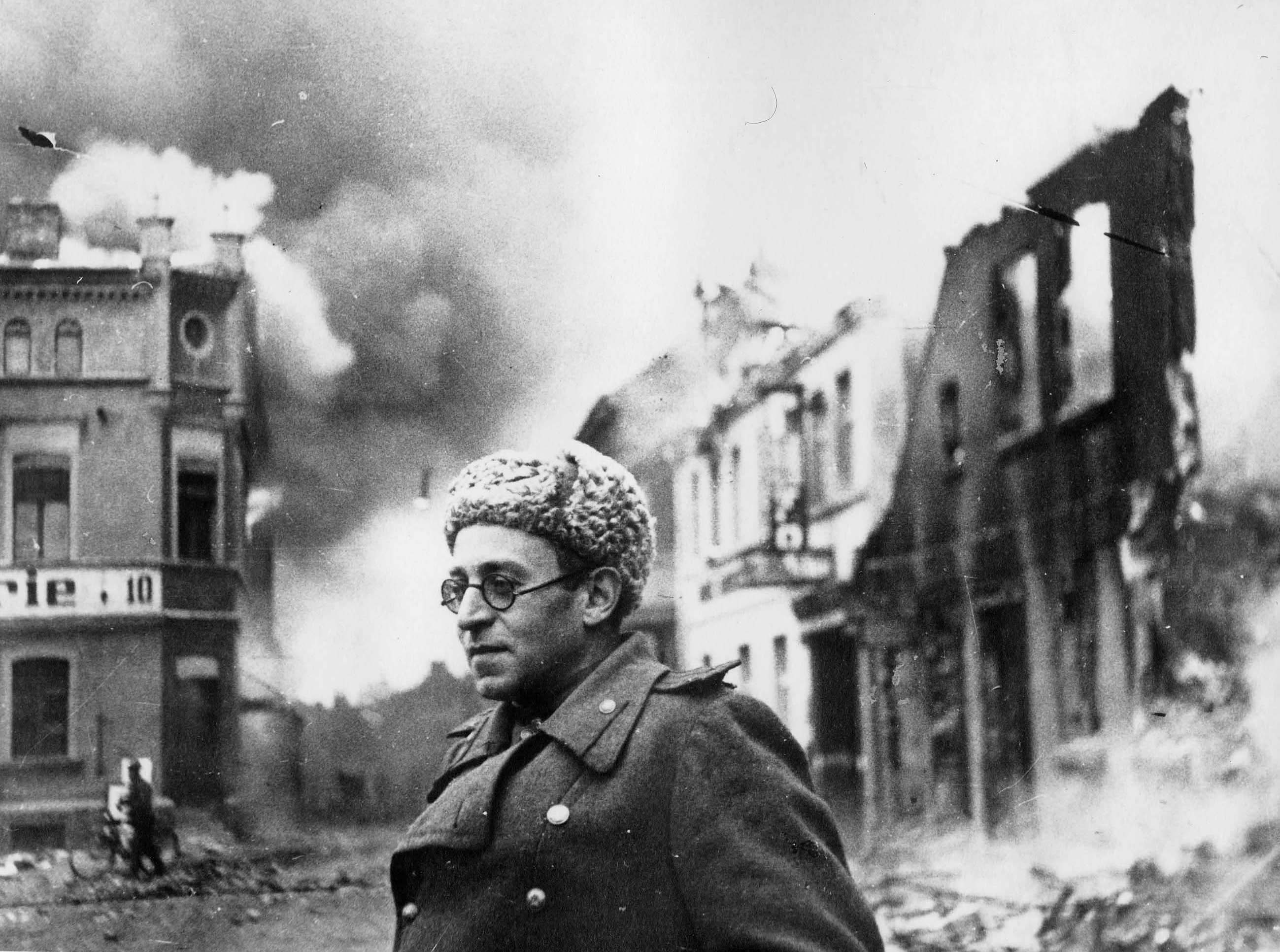
The photograph which appears in this post – not from Willett’s original review! – provides a good view of Grossman while serving as a correspondent in the Soviet Army.  Though I have no information about the date and location of the image, the demolished buildings behind in the background- one of which carries a sign ending in the letters “…rie, 10” suggest that the photo was taken within Germany in 1945.  The image is evidently one of a set of two (or more?) such photos taken at the same moment; you can view its counterpart at my blog post for Elaine Feinstein’s 1985 review of Life and Fate.

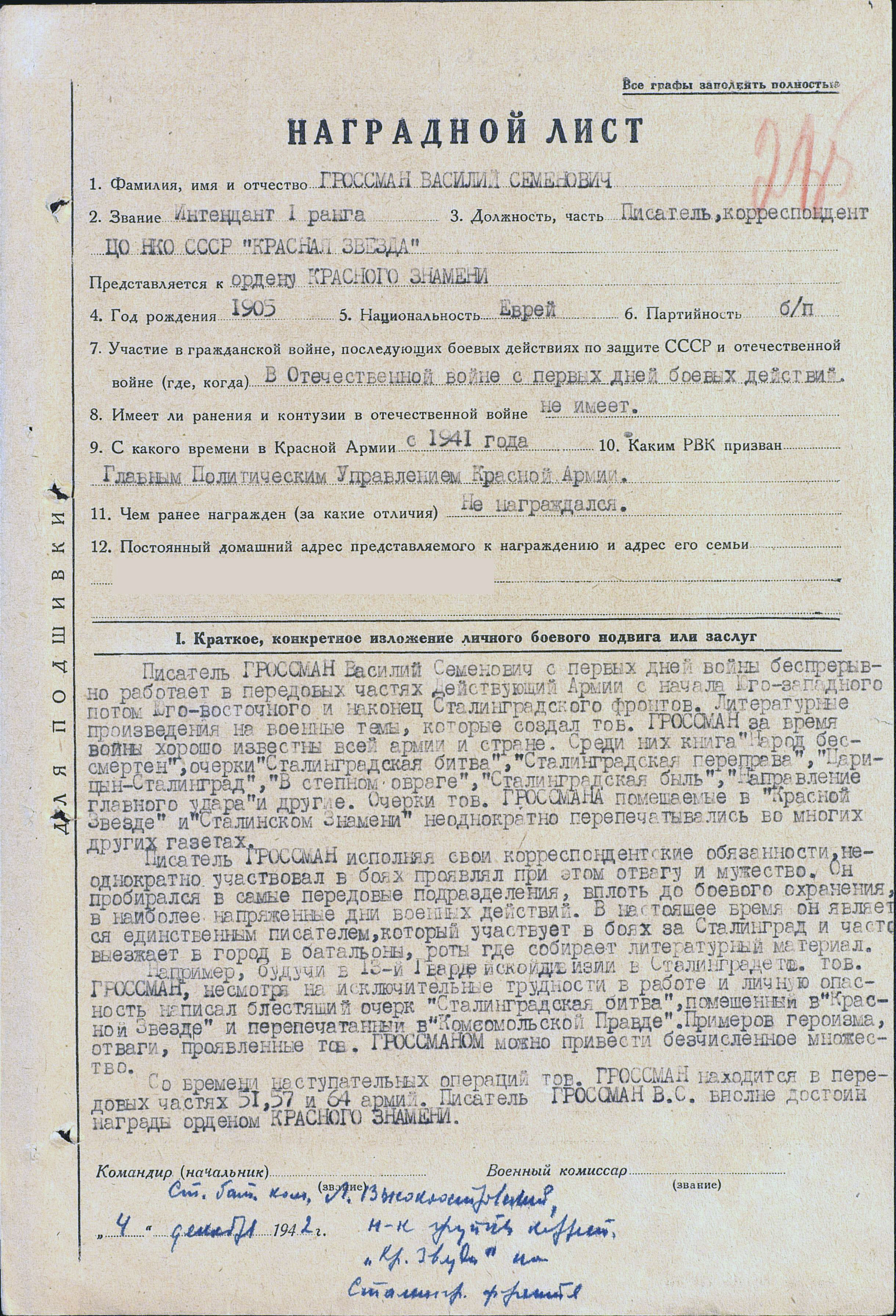
You may find interest in Grossman’s military award citation for The Order of the Red Star (Ordenu Krasnaya Zvezda – Ордену Красная Звезда), dated 9 December 1942, which is available at Heroic Feats of the People (Podvig Naroda- Подвиг Народа).  This citation specifically mentions Grossman’s works “The People are Immortal,” “The Battle of Stalingrad”, “Stalingrad Crossing”, and “Stalingrad Story”. 

Here’s the citation:

  ________________________________________

Overwhelming images of war

FICTION
H.T. Willetts
LIFE AND FATE By Vasily Grossman
Translated by Robert Chandler
Collins Harvill.  £15

December 19, 1985

(Photograph accompanying Zelda Gamson’s essay of May 23, 2015 “The Life and Fate of Vasily Grossman“, at Jewish Currents.)

Life and Fate is the richest and most vivid account to be found of what the Second World War meant to the Soviet Union.  Like all Soviet “epics”, ‘it is a mosaic – but not a bitter one.  Grossman does not, as Ehrenburg did in the thirties, drag in new characters and invent gratuitous episodes because he cannot keep the story going.  His characters are all connected, closely or by a long and intricate chain of circumstances, with the central figures, the Shaposhnikov sisters: we meet husbands, ex-husbands, children, ex-lovers … but also the politicos and commanders on whom the fate of their kin and friends depends … and the German officers and epauletted torturers who have many of their kin and friends under their paws.  The scene shifts, back and forth, rapidly, but never confusingly, from the Stalingrad front to the reserve armies in the rear, to the evacuees in Kuibyshev, to those privileged to return from Kuibyshev to Moscow, to a German POW camp, to a Jewish ghetto, a Jewish column en route from the death camps, to Auschwitz, even, for a brief glimpse, to a frightened Hitler at his field HQ after the Stalingrad reversal.

Places are as solidly realized as people – above all war-shattered Stalingrad (Grossman was there throughout as a war correspondent).  I shall never forget this utterly convincing and startlingly vivid picture of the (semi-barbaric) life of soldiers and workers among the rubble and the wrecked machines.  We attend conferences at HQs (even Army HQs, with unloving portrayals of famous generals like Chuikov and Eremenko), but military operations are seen mostly at micro-level: from the snipers’ outposts, or the forward tanks in the great counterattack – the only vantage points from which the realities of war can be felt.  In another extraordinary feat of descriptive writing the construction and equipment of Auschwitz are described in careful, dispassionate detail, as though what was before us was the building of a canning plant in a very superior Soviet “production novel” of the thirties.  The effect is flesh-creeping – and the climax, with the plant in use, and its operatives individualized, is overwhelmingly macabre.

The novel owes much of its tragic power to Grossman’s understanding of the ambivalence of patriotism.  He sees many resemblances between Soviet Russia and Nazi Germany – and the most fateful was the capture and perversion of patriotic feeling by unscrupulous politicians.  This theme is fascinatingly developed in his account of relations between the real soldiers and the political officers at the front.  Here is the supreme irony: the Soviet regime survived because it let patriotism, simple Russian patriotism, have its head – then took control of it, and perverted it to other purposes.  No book except Gulag has so enlarged my understanding of the way in which the regime distorts ordinary human relations – and the extent to which the regime was produced and is sustained by banal and venal human selfishness and callousness.

A by-product of Stalinist nationalism was the anti-semitism which received tacit, then more explicit official encouragement as the war drew to its end.  It is in this context that we see Grossman’s greatest triumph over the temptations of his material.  The atomic physicist, Shtrum is almost destroyed by a tidal wave of official anti-semitism, but plucked to safety by Stalin in person, who knows that atomic physics and anti-semitism both have their (limited) uses.  Grossman handles Shtrum’s story with irony and compassion.  Nobly, even self-destructively (to his family’s exasperation), defiant while he is persecuted, Shtrum, once “vindicated”, tries to shut his mind to doubt and enjoy his success.

No more powerful war novel has come from any country for many years past.

Suggested Readings

Aciman, Alexander, Book Review: Vasily Grossman, the Great Forgotten Soviet Jewish Literary Genius of Exile and Betrayal, Lives Inside Us All, Tablet, October 23, 2017

Capshaw, Ron, The Scroll: The Jewish Anti-Fascist Committee Was Created to Document the Crimes of Nazism Before They Were Murdered by Communists – For the crime of acknowledging Jewish identity, the committee’s members were killed in a Stalinist pogrom, Tablet, November 29, 2018

Epstein, Joseph, The Achievement of Vasily Grossman – Was he the greatest writer of the past century?, Commentary, May, 2019

Eskin, Blake, Book Review: Eyewitness – A collection of Vasily Grossman’s shorter work offers a chance to reassess the Soviet master’s life and legacy. A conversation with Grossman translator Robert Chandler, Tablet, December 8, 2010

Kirsch, Adam, Book Review: No Exit: Life and Fate, Vasily Grossman’s indispensable account of the horrors of Stalinism and the Holocaust, puts Jewishness at the heart of the 20th century, Tablet, November 30, 2011

Taubman, William, Book Review: Life and Fate: A biography of Vasiliy Grossman, the Soviet writer whose masterpiece compared Stalin’s regime to Hitler’s, The New York Times Book Review, p. 16, July 14, 2019

Vapnyar, Lara, Book Review: Dispatches – How World War II turned a Soviet loyalist into a dissident novelist.  Plus: An audio interview with the editor of A Writer at War, Tablet, January 30, 2006


Words in Print: Vasily Semyonovich Grossman (Василий Семенович Гроссман) – Book Review of “Life and Fate”, The New York Times, November 22, 1985

Here’s Elaine Feinstein’s New York Times’ review of Vasily Grossman’s magnum opus Life and Fate, as published by Collins Harvill in 1985.  I believe that the Collins’ edition of the book was the work’s first English-language publication.

Notice that Feinstein doesn’t address aspects of the work as literature (all books, regardless of the author, have their merits, idosyncracies, and foibles), instead focusing on the novel more in terms of its historical context – “history” history, and, literary history – and the characters who appear in its many pages.

The photograph which appears in this post – certainly not in the original book review! – provides an emblematic view of Grossman during his service as a correspondent in the Soviet Army.  Though I possess no information about the picture’s date and location, the demolished buildings in the background – on one of which appears a sign ending with the letters “…rie, 10” suggest that the photo was taken in Germany.  The image is evidently one of a set of two (or more?) such photos taken at the same moment; you can view its counterpart at my blog post for H.T. Willett’s 1985 review of Life and Fate.

In terms of Grossman’s military service, you may find interest in his military award citation for The Order of the Red Star (Ordenu Krasnaya Zvezda – Ордену Красная Звезда), dated 9 December 1942, which is available at Heroic Feats of the People (Podvig Naroda- Подвиг Народа).  This document specifically mentions Grossman’s works “The People are Immortal,” “The Battle of Stalingrad”, “Stalingrad Crossing”, and “Stalingrad Story”. 

The citation also appears below: 

  ________________________________________

From Workplace and Battlefield

Elaine Feinstein
VASILY GROSSMAN
Life and Fate
Translated by Robert Chandler

880pp.  Collins.  £15.
0002614545

November 22, 1985

(Photograph accompanying Alexander Anichkin’s blog post of January 31, 2011 “Grossman’s Life and Fate to be Serialised by the BBC“, at Tetradki – A Russian Review of Books.)

Through the narrative of Evgenia Ginzburg, the camp stories of Shalamov, and the memoirs of Nadezhda Mandelstam, we have learnt a good deal of what it meant to live in Stalin’s Russia during the years, of the Terror; but the Great Patriotic War, in which Hitler was turned back at Stalingrad, has largely remained sacred in our imagination.  The books in which .Solzhenitsyn attempts most stridently to persuade us that the fight against Communism was, even at that point, more vital to our civilization than the struggle against Nazism, have never seemed to be his best.  This extraordinary novel by Vasily Grossman is set precisely at the historical moment when the, outcome of the house-to-house fighting, at the height of the struggle, is still in doubt.  And as the book fans out to follow the fortunes of an extended family network, it poses a terrible question.  Could any military victory mean much, given what we now know men and women are capable of doing to one another?  It is important to understand that this question is asked by a man altogether inside the Soviet world; a writer discovered by Gorky, working alongside Ehrenburg; a man who understands contemporary science well enough to set a figure recalling Lev Davidovich Landau, a genius of theoretical physics, at the heart of his book; a man who came to think of himself as a Jew only with the death of his mother at German hands.

As it stands, the book is a sprawling giant, which might well have been re-worked by the author if his manuscripts had not been confiscated when he submitted the novel for publication.  (He died in 1964.)  It remains as remarkable a document of the conflicts of daily working lives under political and moral stress as we are likely to be given.  Grossman is a writer untouched by Modernism.  Essentially (since Socialist Realism always took the nineteenth-century novel as its pattern) he invites comparison with Tolstoy throughout his book.  Unlike most writers who Warrant that comparison through the sheer scope of their material, Grossman occasionally shows a delicacy of local observation and a quality of insight which genuinely recall War and Peace.  There is a particular freshness in the letter from Anna Semyovna, dismissed with other Jews from her hospital post and herded into a ghetto, hurt most by the thought of ending her life far away from her son.  Not every character that enters the battlefield has the same vitality.  The strength of Grossman’s work, however (and this is an overwhelmingly powerful novel), lies in his understanding both the multiplicity of human bitterness and the occasional miracles of kindness.

At the centre of the book, the mathematician Viktor Shtrum (to whom Grossman has given much of his own experience) lives with his wife Lyudmila.  He cannot help reproaching her for her coldness towards his Jewish mother, just as she cannot help resenting his indifference towards her son from an earlier marriage.  Lyudmila’s bitterness is fixed forever when her son dies at the front on a surgeon’s table.  When she meets the surgeon, she recognizes his need for the comfort of her forgiveness.  The sensitivity of such understanding is never extended to her husband.

For all his brilliance, Shtrum is at risk inside the laboratory; his wife refuses to share either his triumphs or his humiliations.  When he is emboldened by nomination for a Stalin Prize to telephone a superior who usually ignores him, only to find he has been excluded from an evening entertainment, she taunts him with having got off on the wrong foot.  And when he is explicitly accused of “dragging Science into a swamp of Talmudic abstractions”, the only person he can turn to is his colleague Chepyzhin, a character clearly based on the Cambridge-trained physicist, Kapitza, who refused to take part in any research relating to nuclear fission.

Chepyzhin’s grounds for such a refusal, in Grossman’s interpretation, go to the heart of human weakness.  Viktor’s colleagues are not wicked or stupid, but they cannot be trusted.  As Chepyzhin puts it: “You said yourself that man is not yet kind enough or wise enough to lead a rational life.”  Of the many memorable episodes, few are more moving than the sudden intimacy of conversation between Shtrum and Chepyzhin, two men who take the risk of trusting one another and thereafter talk as greedily as “an invalid who can think of nothing but his illness”.

Not everyone is so fortunate.  Betrayal is commonplace and there is always guilt.  Mostovskoy, an Old Communist in a German POW camp, recognizes his own features in the face of his weary interrogator; and another Old Comrade discovers, in the Lubyanka, that innocence is no defence against torture.  Grossman puts his deepest hopes into the mouth of an unhinged holy fool, Ikonnikov, who is executed because he refuses to take part in building an extermination camp.  Grossman’s triumph is to make it seem irrelevant which monstrous State demanded that he should do so.”

Suggested Readings

Aciman, Alexander, Book Review: Vasily Grossman, the Great Forgotten Soviet Jewish Literary Genius of Exile and Betrayal, Lives Inside Us All, Tablet, October 23, 2017

Capshaw, Ron, The Scroll: The Jewish Anti-Fascist Committee Was Created to Document the Crimes of Nazism Before They Were Murdered by Communists – For the crime of acknowledging Jewish identity, the committee’s members were killed in a Stalinist pogrom, Tablet, November 29, 2018

Epstein, Joseph, The Achievement of Vasily Grossman – Was he the greatest writer of the past century?, Commentary, May, 2019

Eskin, Blake, Book Review: Eyewitness – A collection of Vasily Grossman’s shorter work offers a chance to reassess the Soviet master’s life and legacy. A conversation with Grossman translator Robert Chandler, Tablet, December 8, 2010

Kirsch, Adam, Book Review: No Exit: Life and Fate, Vasily Grossman’s indispensable account of the horrors of Stalinism and the Holocaust, puts Jewishness at the heart of the 20th century, Tablet, November 30, 2011

Taubman, William, Book Review: Life and Fate: A biography of Vasiliy Grossman, the Soviet writer whose masterpiece compared Stalin’s regime to Hitler’s, The New York Times Book Review, p. 16, July 14, 2019

Vapnyar, Lara, Book Review: Dispatches – How World War II turned a Soviet loyalist into a dissident novelist.  Plus: An audio interview with the editor of A Writer at War, Tablet, January 30, 2006

Franz Kafka – The Complete Stories – 1983 [Anthony Russo] and 1971 (1946) [Klaus Gemming]

There are many ways to “illustrate” a story, without literally illustrating the story. 

For example, you can depict characters, events, and settings, either literally or symbolically.  You can portray physical objects or places; moods and expressions, or, reactions and emotions.  

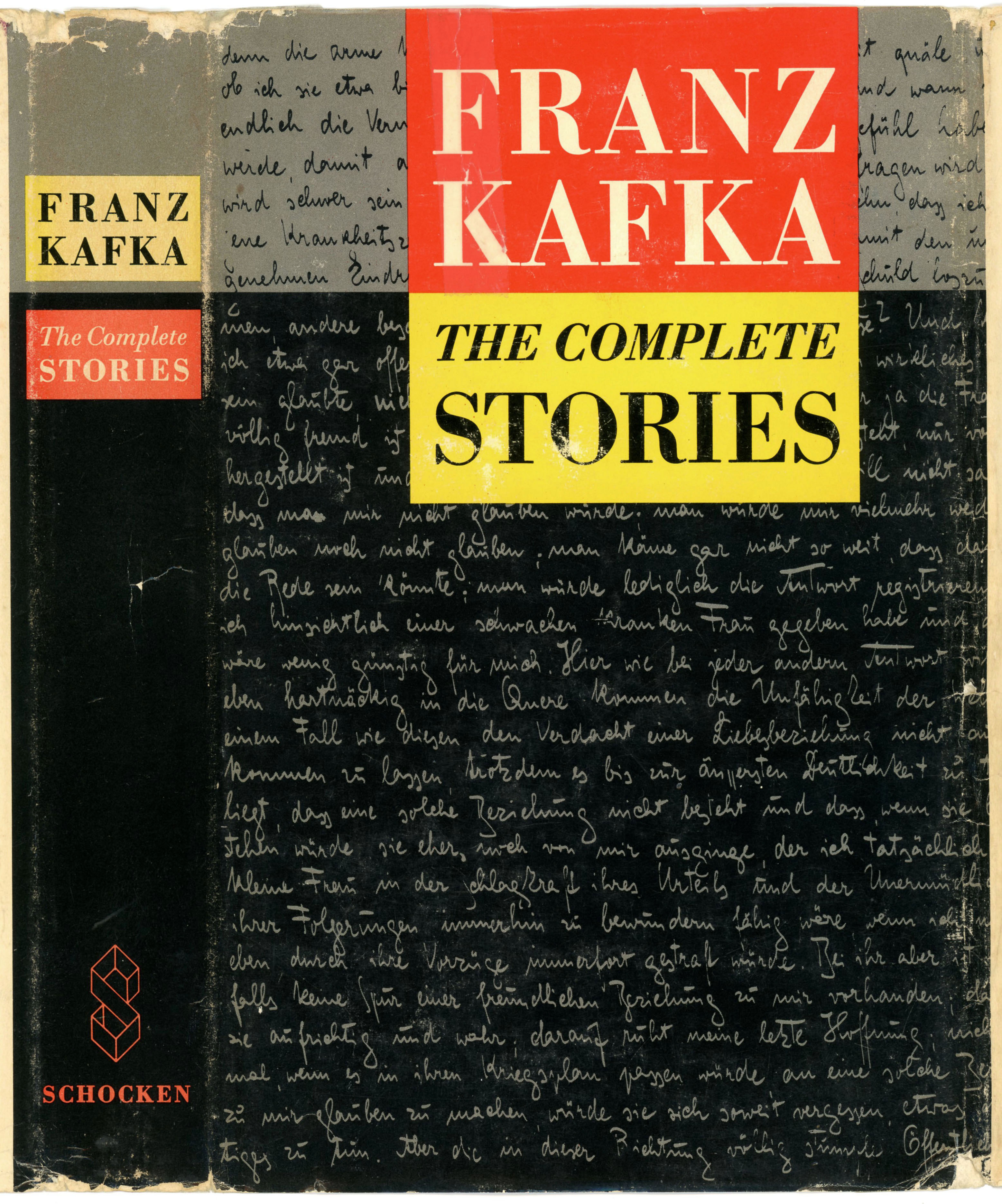
Another way to present an image of a story is by displaying the very text of the story.  A nice example of this appeared as the cover of Shocken Books’ 1971 edition of Franz Kafka – The Complete Stories, which was originally published in 1946.  The 1971 edition of the book shows a page of the handwritten text of one of Kafka’s stories, though (!) I don’t know the particular story – or perhaps novel – to which the text pertains, and neither the cover flaps nor title page reveal this information.  But, for a book cover of a collection of a writer’s writings, Klaus Gemmings’ cover “works”.

As stated on the cover flap, “FOR THE FIRST TIME, all the stories of Franz Kafka – one of the great writers of the twentieth century – are collected here in one comprehensive volume.  With the exception of the three novels, the whole of his narrative work is included.  The remarkable depth and breadth of his shorter fiction, the full scope of his brilliant and probing imagination become even more evident when the stories are seen as a whole. 

The collection offers an astonishing range of insights into the writer’s world: his war of observing and describing reality, the dreamlike events, his symbolism and irony, and his concern with the human condition.  The simplicity, precision, and clarity of Kafka’s style are deceptive, and the attentive reader will be aware of the existential abyss opening beneath the seemingly spare surface of a tale.

An irresistible inner force drove Kafka to write: “The tremendous world  have in my head.  But how free myself and free it without being torn to pieces.  And a thousand times rather be torn to pieces than retain it in me or bury it!”  For him, writing was both an agonizing and a liberating process: “God does not want me to write, but I – I must write!”  Kafka’s work was born from this tragic tension.”

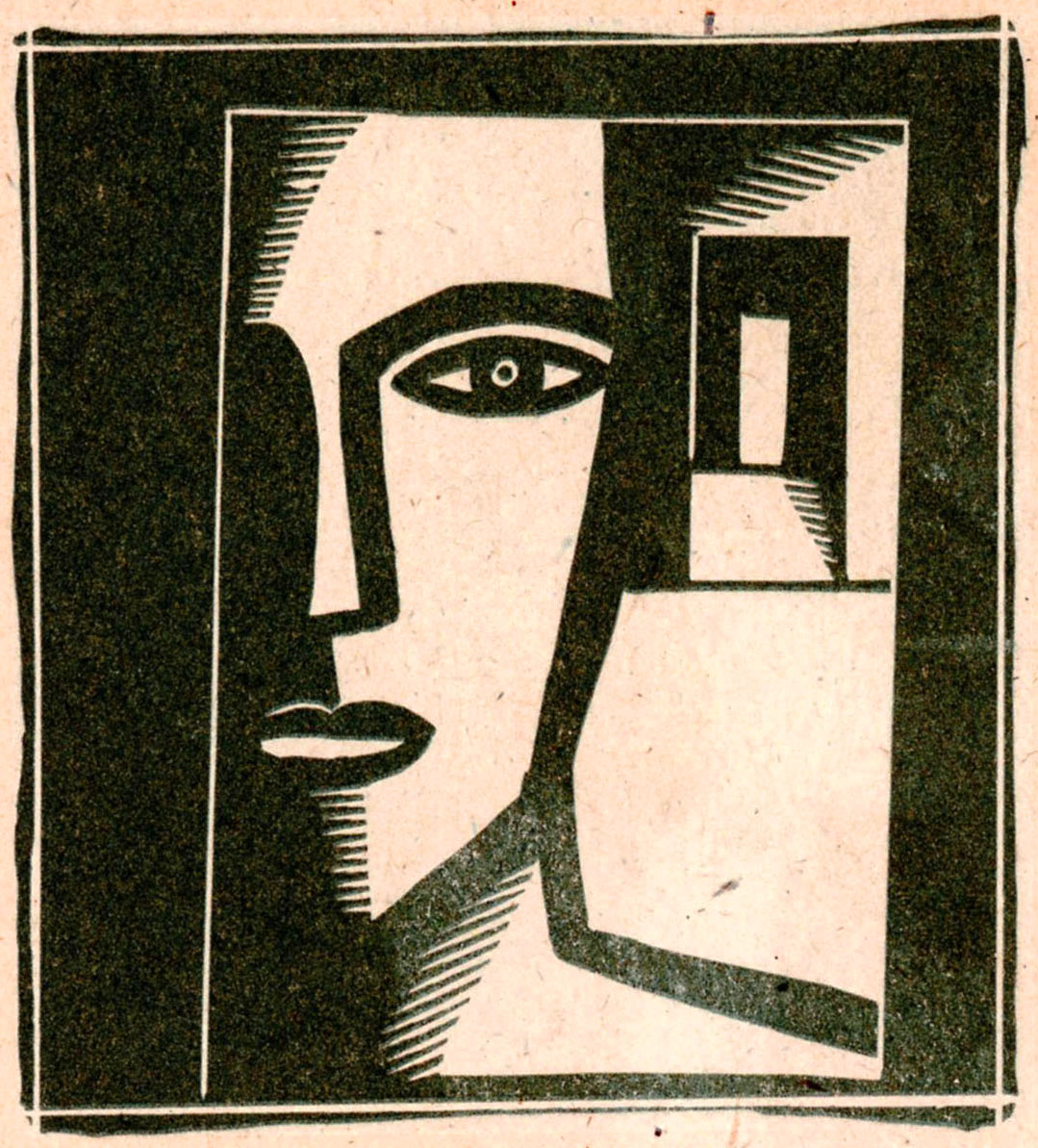
The book’s 1983 softcover edition (with a foreword by John Updike) takes a different approach:  Like other compilations of Kafka’s works published by Shocken in the 1980s, the cover displays a small, square-format, untitled, symbolic illustration by Anthony Russo.  Perhaps the interpretation of the image is meant to be enigmatic; perhaps left to the reader.  If so (I think so), I think the composition of an anonymous man staring through a window – or door? – yes, a door – with two open doors behind him, represents “Before The Law”, the full text of which is given below…

Before The Law

Before the Law stands a doorkeeper.
To this doorkeeper there comes a man from the country and prays for admittance to the Law. 
But the doorkeeper says that he cannot grant admittance at the moment.
The man thinks it over and then asks if he will be allowed in later. 
“It is possible,” says the doorkeeper, “but not at the moment.” 

Since the gate stands open, as usual, and the doorkeeper steps to one side,
the man stoops to peer through the gateway into the interior. 
Observing that, the doorkeeper laughs and says:
“If you are so drawn to it, just try to go in despite of my veto. 
But take note: I am powerful.
And I am only the least of the doorkeepers. 
From hall to hall there is one doorkeeper after another, each more powerful than the last. 
The third doorkeeper is already so terrible that even I cannot bear to look at him.” 

These are difficulties the man from the country has not expected;
the Law, he thinks, should surely be accessible at all times and to everyone,
but as he now takes a closer look at the doorkeeper in the far corner,
with his big sharp nose and long, thin, black Tartar beard,
he decides that it is better to wait until he gains permission to enter. 

The doorkeeper gives him a stool and lets him sit down at one side of the door. 
There he sits for days and years. 
He makes many attempts to be admitted, and wearies the doorkeeper by his importunity. 
He doorkeeper frequently has little interviews with him,
asking him questions about his home and many other things,
but the questions are put indifferently,
as great lords put them, and always finish with the statement that he cannot be let in yet. 

The man, who has furnished himself with many things for his journey,
sacrifices all he has, however valuable, to bribe the doorkeeper.
The doorkeeper accepts everything, but always with the remark:
“I am only taking it to keep you from thinking you have omitted anything.”
During these many years the man fixes his attention almost continuously on the doorkeeper.
He forgets the other doorkeepers,
and this first one seems to him the sole obstacle preventing access to the Law.
He curses his bad luck;
in his early years boldly and loudly;
later, as he grows old, he only grumbles to himself.
He becomes childish,
and since in his yearlong contemplation of the doorkeeper
he has come to know even the fleas in his fur collar,
he begs the fleas as well to help him and to change to doorkeeper’s mind.

At length his eyesight begins to fail,
and he does not know whether the world is really darker or whether his eyes are only deceiving him.
Yet in his darkness he is now aware of a radiance
that streams inextinguishably from the gateway of the Law.
Now he has not very long to live.
Before he dies, all his experiences in these long years gather themselves in his head to one point,
a question he has not yet asked the doorkeeper.

He waves him nearer, since he can no longer raise his stiffening body. 
The doorkeeper has to bend low toward him,
for the difference in height between them has altered much to the man’s disadvantage. 
“What do you want to know now?” asks the doorkeeper; “you are insatiable.” 
“Everyone strives to reach the Law,” says the man,
“so how does it happen that for all these many years no one buy myself has ever begged for admittance?” 

The doorkeeper recognizes that the man has reached his end,
and, to let his failing senses catch the words, roars in his ear:
“No one else could ever be admitted here, since this gate was made only for you. 
I am now going to shut it.”

(Translated by Willa and Edwin Muir)

________________________________________

Here are four other stories by Kafka, the page number of each denoting the softcover edition.  In terms of depth (upon depth, upon depth, upon…) each tale is stunning in its own way.

____________________

The Next Village (404)

My grandfather used to say, “Life is astoundingly short. 
To me, looking back over it, life seems so foreshortened that I can scarcely understand,
for instance,
how a young man can decide to ride over to the next village without being afraid that –
not to mention accidents –
even the span of a normal happy life may fall far short of the time needed for such a journey.”

(Translated by Willa and Edwin Muir)

Prometheus (432)

There are four legends concerning Prometheus.
According to the first
he was clamped to a rock in the Caucasus for betraying the secrets of the gods to men,
and the gods sent eagles to feed on his liver, which was perpetually renewed.
According to the second
Prometheus, goaded by the pain of the tearing beaks,
pressed himself deeper and deeper into the rock until he became one with it.
According to the third
his treachery was forgotten in the course of thousands of years,
forgotten by the gods, the eagles, forgotten by himself.
According to the fourth
everyone grew weary of the meaningless affair. 
The gods grew weary, the eagles grew weary, the wound closed wearily.
There remained the inexplicable mass of rock. 
The legend tried to explain the inexplicable. 
As it came out of the substratum of truth it had in turn to end in the inexplicable.

(Translated by Willa and Edwin Muir)

A Little Fable (445)

“Alas,” said the mouse, “the world is growing smaller every day. 
At the beginning it was so big that I was afraid, I kept running and running,
and I was glad when at last I saw walls far away to the right and left,
but these long walls have narrowed so quickly that I am in the last chamber already,
and there in the corner stands the trap that I must run into.” 
“You only need to change your direction,” said the cat,
and ate it up.

(Translated by Willa and Edwin Muir)

The Departure (449)

I ordered my horse to be brought from the stables.
The servant did not understand my orders. 
So I went to the stables myself, saddled my horse, and mounted. 
In the distance I heard the sound of a trumpet, and I asked the servant what it meant. 
He knew nothing and had heard nothing. 
At the gate he stopped me and asked, “Where is the master going?” 
“I don’t know,” I said, “just out of here, just out of here. 
Out of here, nothing else, it’s the only way I can reach my goal.” 
“So you know your goal?” he asked. 
“Yes,” I replied, “I’ve just told you. 
Out of here – that’s my goal.”

(Translated by Tania and James Stern)

The Nightmare of Reason – A Life of Franz Kafka, by Ernst Pawel – 1985 (1984) [Nancy Crampton]

Unlike Anthony Russo’s cover illustrations for the series of Schocken Books titles covering the works of Franz Kafka (published from the late 1980s through the early 1990s), the cover art of Ernst Pawel’s highly praised 1984 biography of Kafka, The Nightmare of Reason – A Life of Franz Kafka (Farrar – Straus – Giroux), is an illustration of a different sort:  Jacket designer Candy Jernigan used a photographic silhouette of Prague Castle to symbolize the physical, social, and psychological “world” of Franz Kafka’s writing.  Perhaps the image was made from a color negative, with the color saturation of the final image having been enhanced during printing.  Or, perhaps the picture is simply an accurate representation of the colors of the Prague skyline at dusk. 

Either way, the combination of black-clouded yellow-orange sky, with the castle in the distance, is quite striking. 

By way of comparison, this September, 2014 photograph, from Park Inn at Radisson, shows a sunset view of the Castle from the Charles Bridge.

________________________________________

Some of Ernst Pawel’s other works include: From the Dark Tower, In The Absence of Magic, Letters of Thomas Mann 1889-1955 (selected and translated from the German by Richard and Clara Winston), Life in Dark Ages: A Memoir, The Island in Time (a novel), The Labyrinth of Exile: A Life of Theodor Herzl, The Poet Dying : Heinrich Heine’s Last Years in Paris, and, Writings of the Nazi Holocaust. 

He passed away in 1994.  

This is his portrait, by Nancy Crampton, from the book jacket.

________________________________________

Ernst Pawel, 74, Biographer, Dies

The New York Times
Aug. 19, 1994

Section A, Page 24

Ernst Pawel, a novelist and biographer, died on Tuesday at his home in Great Neck, L.I.  He was 74.

The cause was lung cancer, his family said.

Mr. Pawel’s 1984 biography of Franz Kafka, “The Nightmare of Reason,” won several prizes, including the Alfred Harcourt Award in biography and memoirs, and was translated into 10 languages.  In a review for The New York Times, Christopher Lehmann-Haupt called the work “moving and perceptive.”

Mr. Pawel was also the author of “The Labyrinth of Exile,” a biography of Theodor Herzl, the founder of modern Zionism.  He had recently finished a book about the German poet Heinrich Heine and at the time of his death was working on his own memoirs, “Life in the Dark Ages.”  Both books are to be published posthumously, his family said.

He was born in 1920 in Breslau, then under German rule but now part of Poland, and fled Nazi Germany with his family in 1933, settling first in Yugoslavia and four years later immigrating to New York City.  After serving as a translator for Army intelligence during World War II, he received a bachelor’s degree from the City University of New York.

He was the author of three novels, “The Island of Time” (1950), “The Dark Tower” (1957) and “In the Absence of Magic” (1961), and numerous essays and book reviews.  Fluent in a dozen languages, he worked for 36 years as a translator and public relations executive for New York Life Insurance.  He retired in 1982.

He is survived by his wife of 51 years, Ruth; a son, Michael, and a daughter, Miriam, both of Manhattan, and a granddaughter.

________________________________________

A Nightmare of Reason was published by Vintage Books in 1985, in trade paperback format.  (Unfortunately, I don’t know the cover artist’s name!)  

War and Peace, by Leo Tolstoy – Abridged by Edmund Fuller – September, 1962 (1955) [Richard M. Powers]

The definition of abridgement, from Merriam-Webster: “A shortened form of a work retaining the general sense and unity of the original.”

Hmmm…. 

Given the number of characters, geographic and temporal scope, moral, political, and philosophical depth, complexity of plot, sheer quantity of details, and sheer length of Leo Tolstoy’s War and Peace, one would think that the novel would not be readily amendable to abridgement.  But as seen below, not so!

Having read the Penguin Classic paperback edition of the novel (copyright 1978; ISBN 0 14 044 417 3), which, including the 44 pages of “Part Two” runs to 1444 pages, it would be intriguing to read Edmund M. Fuller’s 1955 abridgement which, printed in a slightly larger font than the former, runs to 512 pages.  In any event, the effort to abridge Tolstoy’s novel must have been extraordinarily challenging.

But, for now, I can still appreciate the stylized composition of the Russian double-headed eagle that forms the central motif of the cover, which hovers over soldiers at the lower left, and church spires at the lower right. 

The artist?  Richard Powers, the same Richard Powers who created so many innumerable and stunning compositions for science-fiction paperbacks of the 50s and 60s.  The cover of this Dell paperback represents his only non-science-fiction art that I’ve thus far found. 

Perhaps there’s more, out there?