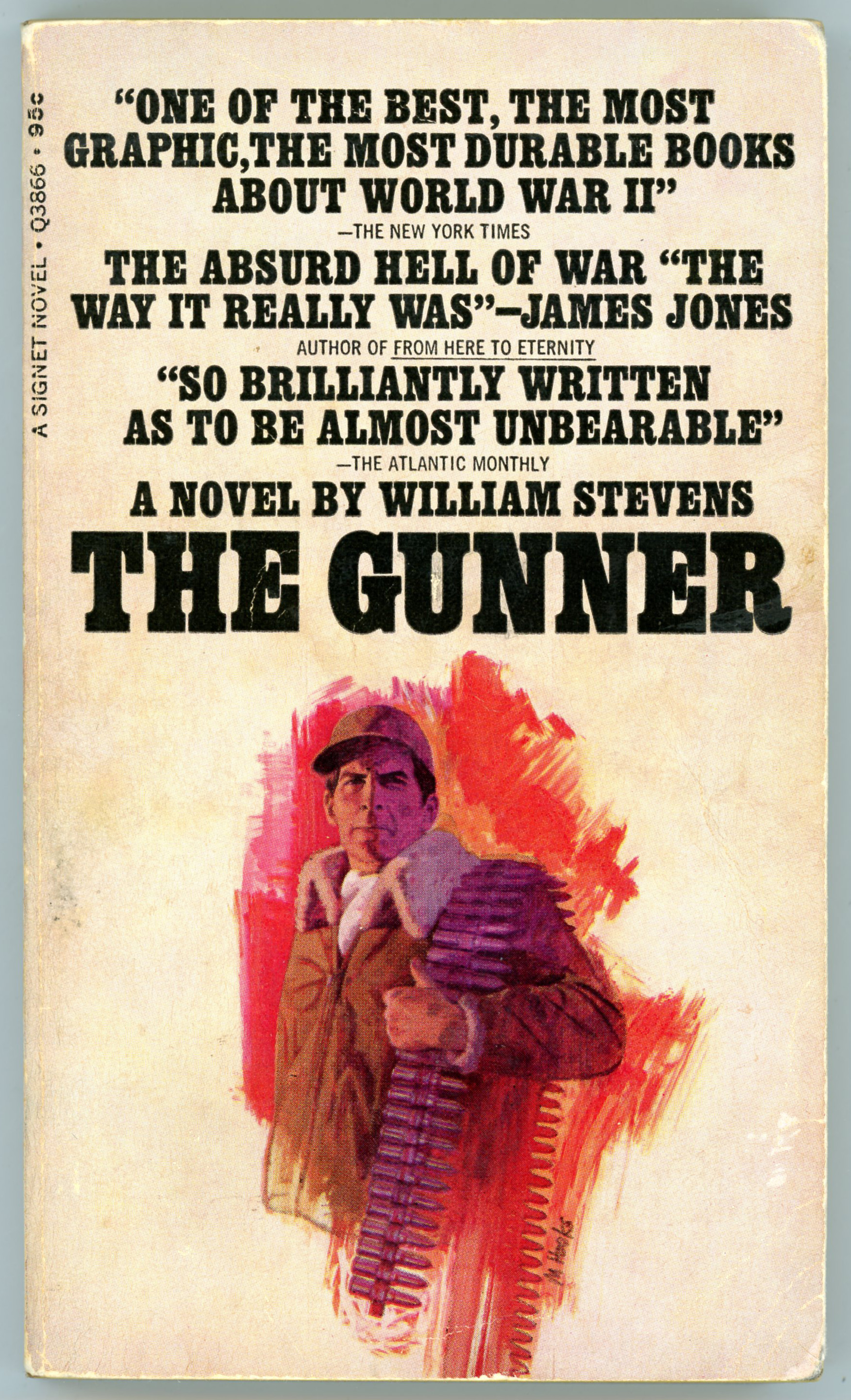
M. Hooks cover art for The Gunner appropriately depicts an aerial gunner in a shearling leather flying jacked and draped with a belt of 50-cailber ammunition, given that the protagonist of William Stevens’ 1967 novel is Sergeant Thomas Deacon, an aerial gunner on B-24 Liberator heavy bombers in the Italy-based American 15th Air Force.
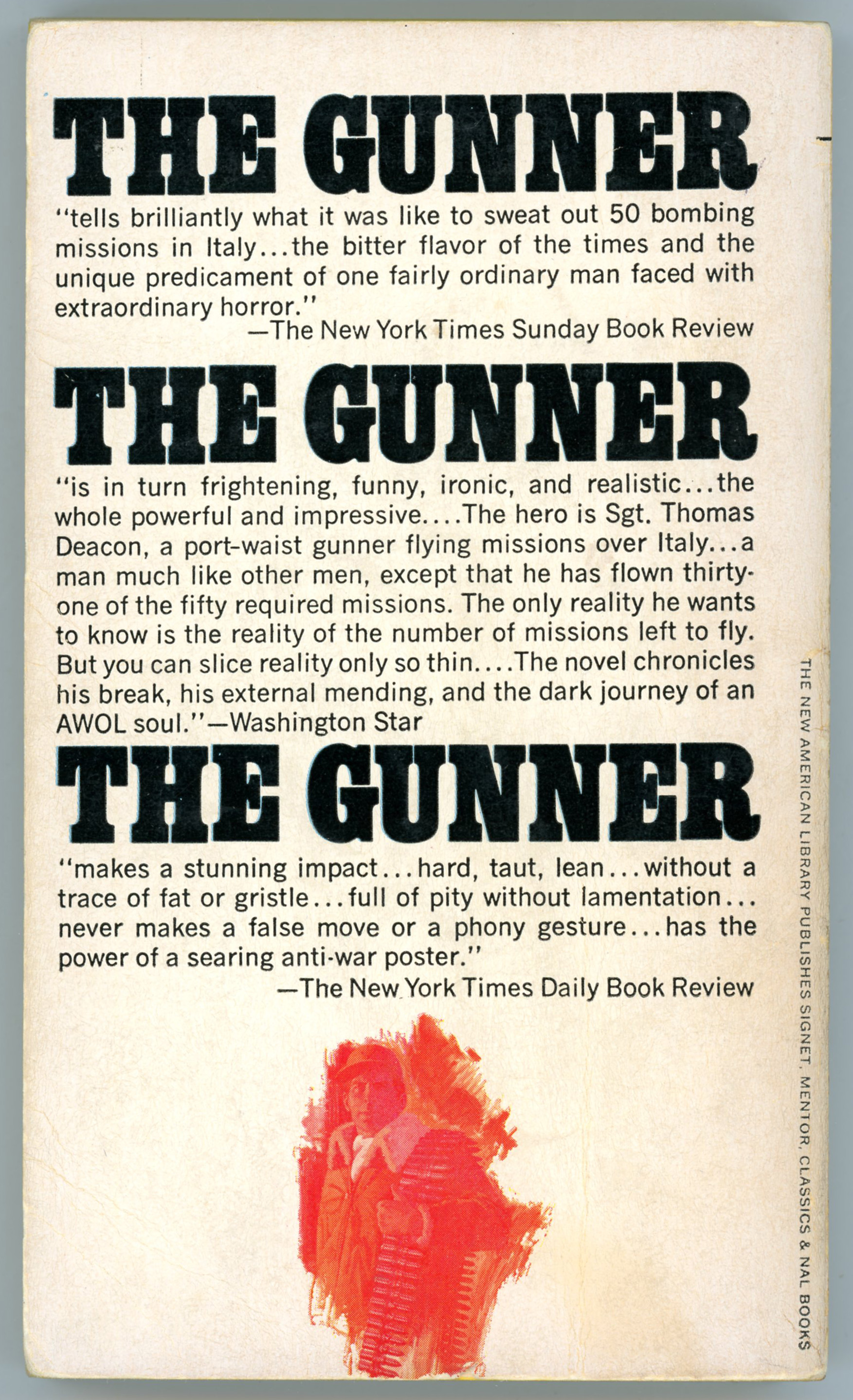
Rather than being a fictional exploration of the nature of military service and combat flying in the Second World War, the novel’s focus is quite different: While the opening pages present a dramatic but somewhat abbreviated account of aerial combat culminating in the horrific crash-landing of Deacon’s B-24, virtually the entire remainder of the novel deals with Deacon’s adventures (and misadventures) on “the ground” afterwards, in terms of his psychological rehabilitation for combat, and, his interactions with non-flying military personnel, as well as civilians.
Though interesting in concept, unfortunately, I felt that the novel was more than underwhelming, dwelling until its conclusion (which I shall not divulge here!) on Deacon’s mental state and mood, to the point of real tediousness. The main problem is that Deacon seems to be a palimpsest or cipher, reacting “to” situations and people, yet lacking a true inner life, distinctive mental state, and character, let alone a fleshed-put pre-war biography in terms of family and social ties, vocational history, or formative experiences. Or, if he does possess any inner life, this remains largely unexpressed.
Of course, one can’t help but notice the one endorsement (by James Jones, a fantastic writer) and five book-review excerpts gracing the cover of this Signet edition. Perhaps these snippets are just that, mere snippets of the reviews in their entirety (with any criticisms of the novel left on the “cutting room floor”). Perhaps these reviewers genuinely felt positively of the book. If so, I can only conclude that I neither read nor recognized the “same” novel, for I felt that The Gunner, while nominally interesting in a fleeting way, was anything but brilliant.
On July 3, 1968, The Knickerbocker News published this brief news item about The Gunner:
‘The Gunner’ Novel To Become a Film
“The Gunner,” a World War 2 novel by William Stevens, has been purchased by Universal and will be produced by Dick Berg, it was recently announced.
The dramatic story centered around an Air Force sergeant in Europe was published recently by Atheneum.
It would seem that things never proceeded beyond the “purchased” stage. As memory serves, and verified at the Internet Movie Database, no such motion picture ever emerged.
Being that the novel was penned in 1967, I wonder about the degree – if any – to which Stevens was influenced by Louis Falstein’s 1950 Face Of A Hero, or Joseph Heller’s astonishingly over-rated, near-irredeemably over-inflated, fortuitously-timed Catch-22 (*** gag ***) which without question is the worst of the trio, while the forgotten Face of a Hero is easily the best. It’s notable that the three works all center around the experiences of American airmen in either the 12th or 15th Air Forces in Italy, circa 1944-1945 (this was noted for Falstein’s and Heller’s novels, back in 1999), thus revealing a commonality of influence which found markedly different expression – well, yeah, admittedly, there are some similarities across all three works – in terms of the protagonist’s understanding and interpretation of his experiences and self-understanding, manifested through plot, character development, literary style (and for lack of a better word!) ideology, albeit the latter is really only manifest in Face Of A Hero.
As for Stevens, I know little about him, other than the blurb that appears on the jacket of the hardbound edition of The Gunner: “William Stevens was born in Flushing, New York, in 1925. He served with the U.S. Army during the Second World War and then worked as an electromechanic on guided missiles. Subsequently he was a war-surplus junkyard scout, a buyer and a purchasing agent from 1947 until 1964, when he moved his family to Marth’s Vineyard, Massachusetts, and began writing seriously. His first novel, The Peddler, was published in 1966.” So, just a thought: Given that so much of the The Gunner – at least early in the novel – occurs in the context of combat fatigue and psychological rehabilitation, and for this his writing is crisp and delineated – I wonder if Stevens’ military service occurred in a medical setting, rather than as an aircrewman. Just an idea.
According to Worldcat, Stevens’ literary oeuvre consists of the following titles:
The Peddler, 1966, Little, Brown
The literary “flavor” of The Peddler – perhaps drawn verbatim from the blurb on the book’s flyjacket? – can be found in an advertisement for the ninety-seventh anniversary of Ulbrich’s (whatever Ulbrich’s was!) in the Buffalo Courier-Express of October 6, 1968:
Book Sale $1 and up.
Publ. at much higher prices
Reprints of bestsellers, publisher’s overstocks – many in full color
Subjects of interest to everyone. Treasures for your own library – welcome gifts for friends. All at once-a-year savings!
The Life and death of a salesman, THE PEDDLER, by William Stevens. The story of a twelve-grand-a-year peddler who hawks goods in the most ruthless market place in the world – New York City. Like thousands of other peddlers hustling their ware in the city before catching the 5:12 to suburbia, he dreams of making it. Whenever the pack grows too heavy he puts it down and swings through a few martinis. But he cannot swing indefinitely, and there is always another buyer to see, another sale to close. Pub. at $5.95. Sale $1.00.
__________
The Gunner, 1968, Atheneum
__________
Cannibal Isle; A Novel, 1970, Little, Brown
__________
Best of Our Time, 1973, Random House
________________________________________
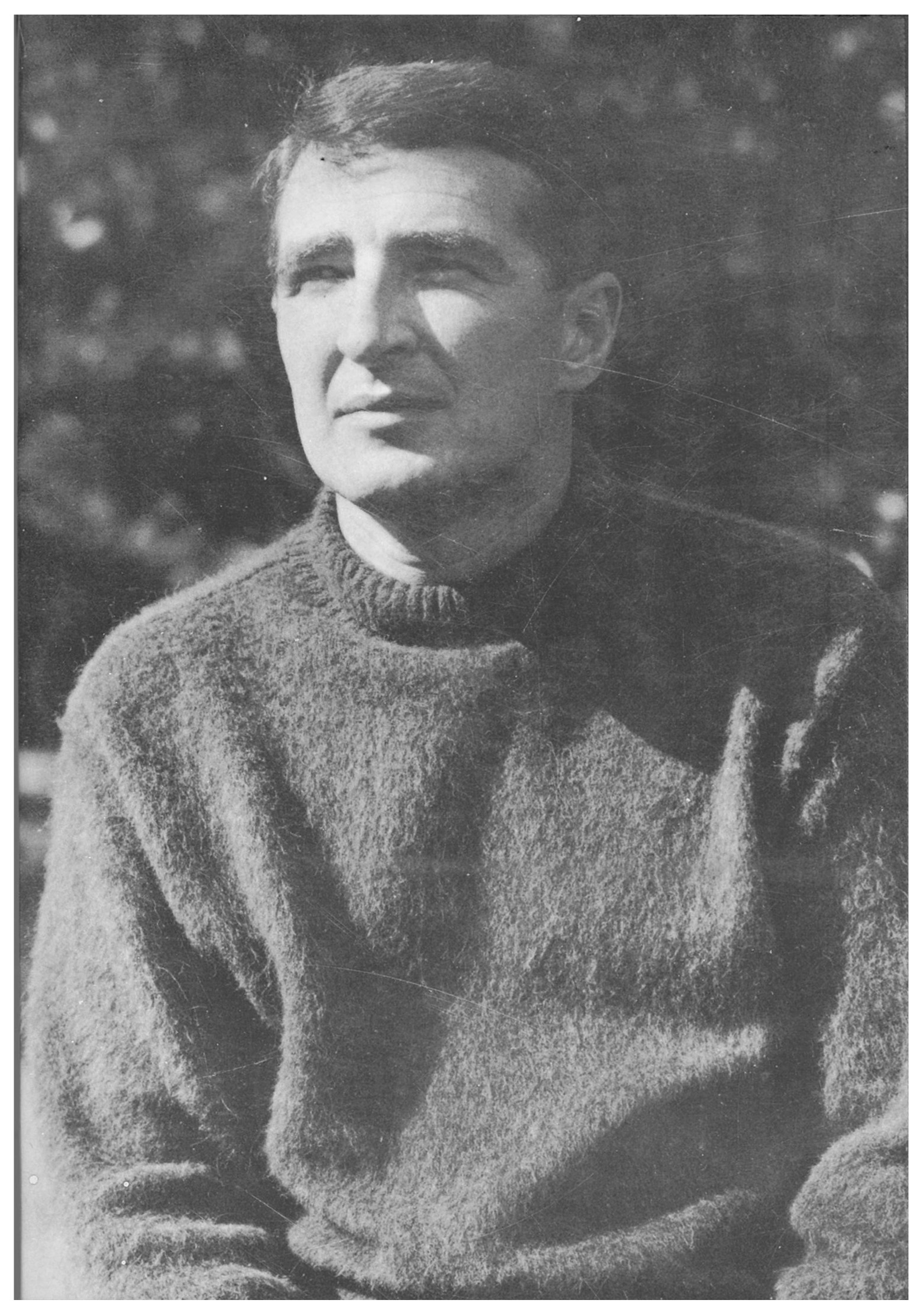
William Stevens, in a jacket photograph (by Howell’s Photo Studios) from the hardbound edition of The Gunner.
________________________________________
To conclude, here is an opening passage from The Gunner:
One there had been one crew, one ship.
They trained on the flat Midwestern plains,
in untroubled skies,
dropped dummy bombs and made long transitional flights.
They beered it up in Lincoln, Kansas City, Cheyenne,
sported coin-silver wings and corporal’s stripes.
One crew, forging an arrow, men and machine a single instrument to be brought to the war.
The airplane was taken away.
They were jammed into bucket seats along with other crews and flown across the ocean in a C-47.
They were not surprised to touch down in England.
Everyone knew that it was one huge airfield,
that the Eighth was winning the war,
that flight pay brought a lot of action in Piccadilly.
The Quonset huts were bearable, the beer strong, everyone spoke the same language.
That was what the war was all about – off to a day’s work, then home at five to pipe and slippers.
But the Eighth was primarily a B-17 air force.
The ship the crew had been trained for was being flown from Italy.
Someone arranged a slow boat for them, arranged to have waiting an airplane that could fly.
Jerry Juicer had made sixty-three missions, too many.
They knew it would never take them through their tour,
knew that no ship could last one hundred and thirteen missions.
Jerry Juicer was a relic, bald spots showing through its olive-drab paint,
flak patches creating crazy checkerboard patterns on the wings and empennage.
It was sure to die, to take them with it.
They needed a brand-new airplane, a new average to work against, new luck.
The crew took the ship up to get used to it.
The pilot found the controls sluggish, and number-four engine touchy.
He wanted the ship worked on, wanted an instrument fit for combat.
They were put on a mission alert their second day in the field;
if Jerry Juicer could get off the ground, it was fit enough.
It took them through four missions,
through a seven-hundred-plane raid on Ploesti
where ships much newer glittered all the more for being torn into fragments.
Jerry Juicer was breached over Toulon.
Flak shattered the nose section,
cleared away the co-pilot and bombardier.
It took a skilled nurse, a determined hand, to get them back.
They put down at Foggia,
left the ancient bird to be towed to the junkpile
where it would be cannibalized and made a part of other ships.
The crew was taken by truck sixty twisting miles to their own field,
had their first real look at Italy: barren roads, sodden orchards, the dismal towns of Apulia.
They crossed the Ofanto on a pontoon bridge stretched next to a string of bombed-out arches,
came home just as the uncertain sun failed, came home to the strange corroded gullies,
the bleached stones,
the sky turned a red deeper than that on the splotched walls of Jerry Juicer.
The crew got their new luck, their new airplane.
Shining silver, it was christened Peaches,
the name running beneath the figure of a flamboyant nude with fuzzy breasts.
Their replacement bombardier was a recruit,
their co-pilot a seedy-looking second lieutenant with twelve missions.
Both were outsiders.
Although their number had been diminished, there was still a single crew.
Peaches seemed to be a lucky ship – for everyone but the ball gunner.
He was blown out over Salon.
Caesar Cantori joined them, another veteran from a broken crew,
already twenty-one missions up the ladder.
Peaches lucked them right through a Bucharest raid
where the crazy Luftwaffe put up an effort so intense they attacked the bombers over the target, braving their own flak, salvoing into the hunched formations.
The enemy fighter quit only when they were out of ammunition, low on gas.
Peaches came through it with no more than a few small holes,
but the radio operator went on sick call for the next nine consecutive mornings.
He was finally removed from flight duty.
Zimmerman, who had been flying as a temporary replacement, became a fixture.
The original crew was down to a slim six,
but they still had something of that old nostalgic hang-together.
With their fatalities already thirty percent,
they were approaching the point where the averages began to work for the survivors.
The furious Oil Campaign kinked the graph slightly;
it figured that one,
maybe two,
more would have to go to the long way before percentages swung solidly in favor of the rest.
Tough on the losers, but you couldn’t have winners without them.
They lost another charter member, but it didn’t count on the scale.
On a raid over Vienna the sky seemed to come apart and most of the controls were shot out.
Both Horton and the pilot were wounded,
the pilot stiff and bleeding at the wheel as he wrestled and coaxed the ship,
a piece of Swiss cheese hanging on shredded propellers.
It was a marvelous performance, took them all the way home.
They fell into each other’s arms, a lucky crew after all.
Horton and the pilot compared wounds.
Both showed more blood than hurt.
Jerry Juicer had made sixty-three missions, too many.
They knew it would never take them through their tour,
knew that no ship could last one hundred and thirteen missions.
Jerry Juicer was a relic, bald spots showing through its olive-drab paint,
flak patches creating crazy checkerboard patterns on the wings and empennage.
It was sure to die, to take them with it.
They needed a brand-new airplane, a new average to work against, new luck.
The seedy shavetail became a first lieutenant and the airplane commander.
They got a co-pilot from a broken crew.
The tail gunner came down with malaria just as the weather broke.
Quinn joined them fresh from the replacement point.
They were given Bawl, Buster.
The ship had made eleven runs, a good safe number.
It had enough in it to take them through their tour.
But now they had been up seven straight days without incident
and Bawl, Buster was daring them for the eighth.
And now they were no longer a crew, or lucky.
Only the navigator was left of the original officers,
of the gunners only Deacon and Horton and Fitzgerald.
The men of Bawl, Buster were sweating out individual tours,
each deep in his own net of Fifty.
They were strangers, riding strange airplanes.
Each thumbed blindly for the catch of his own release, had his own magic number.
________________________________________
Something Further to Refer to…
… The Gunner, at GoodReads