Star Science Fiction Stories No. 6, Edited by Frederik Pohl – 1959 [Richard M. Powers]

Star Science Fiction No. 6, the final volume of Ballantine Books’ “Star Science Fiction” anthologies published from 1953 to 1959, presents a notable example of the evolution of Richard Powers’ art.  His earlier cover illustrations for the series are straightforwardly representational, albeit stylistically distinctive in terms of the use of color, and, the depiction of human figures and technology.  (See particularly Volumes 1 and 2.)  This cover, however, akin to some of Powers’ other illustrations from the late 50s and early 60s, marks a strong turn toward the abstract.  Three human-like forms are present, with the two largest figures painted in a style bearing a odd resemblance to wandjina figures of Australian Aboriginal mythology:  These have a vaguely humanoid shape, being formed of concentric patterns of contrasting colors.
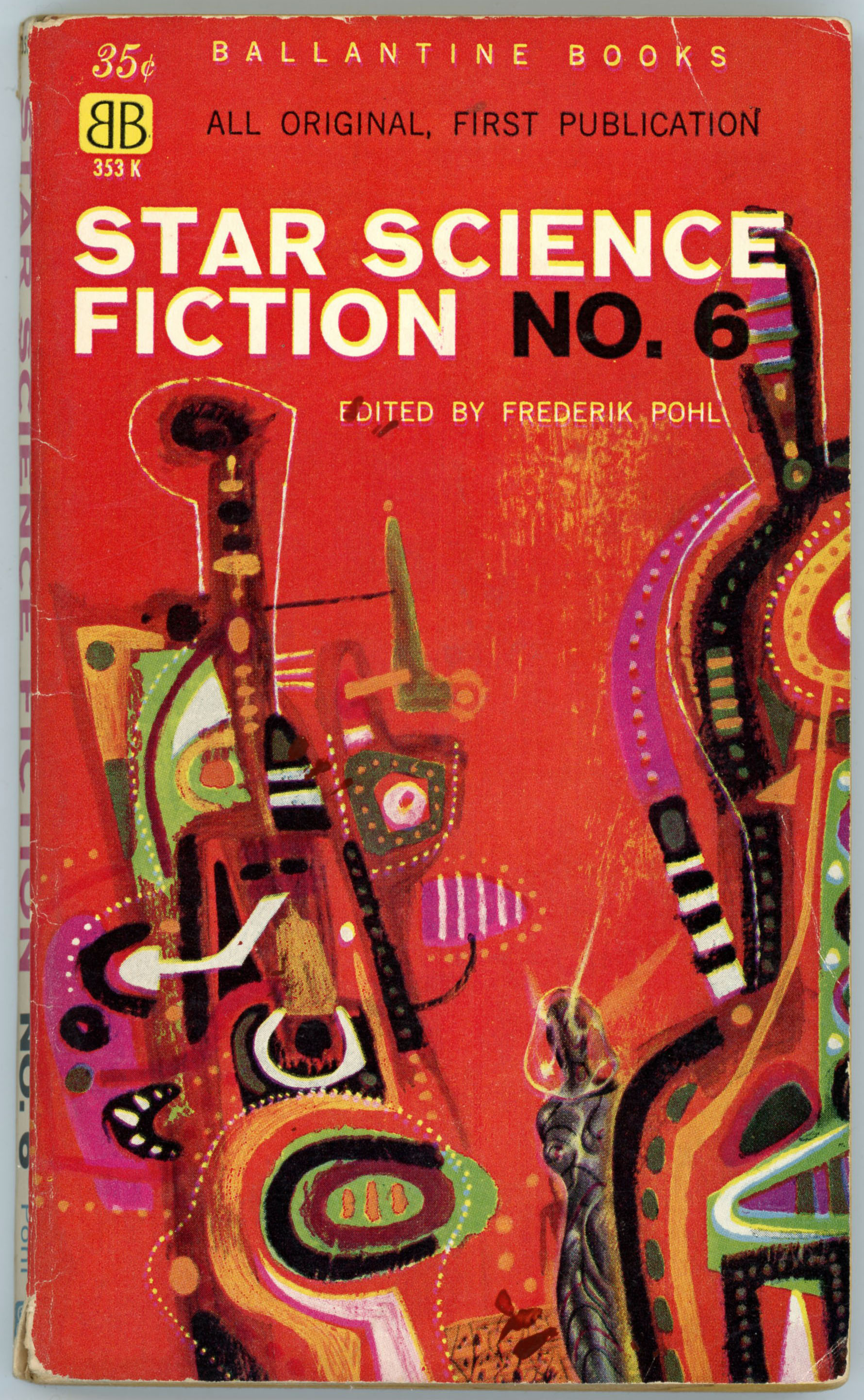
Against these, the only genuinely human form appears as a small female figure in the lower center of the image.  But, this figure too, is symbolic:  There are no facial features, and “she” wears only the vaguest representation of a space helmet.  And, unlike Powers’ earlier science fiction covers which present alien skies and strange extraterrestrial landscapes in a variety of colors and patterns, the background here is simple:  Red, red, and more red, with just a hint of brown land at the very bottom. 

As for the stories within?  Oh, yeahhh…  (!)  Well – * ahem * – the book is in my literary “queue”.  (At least, somewhere.)  Though – Cordwainer Smith being one of my favorite science fiction authors – I did at least read “Angerhelm” some years ago!

 Contents

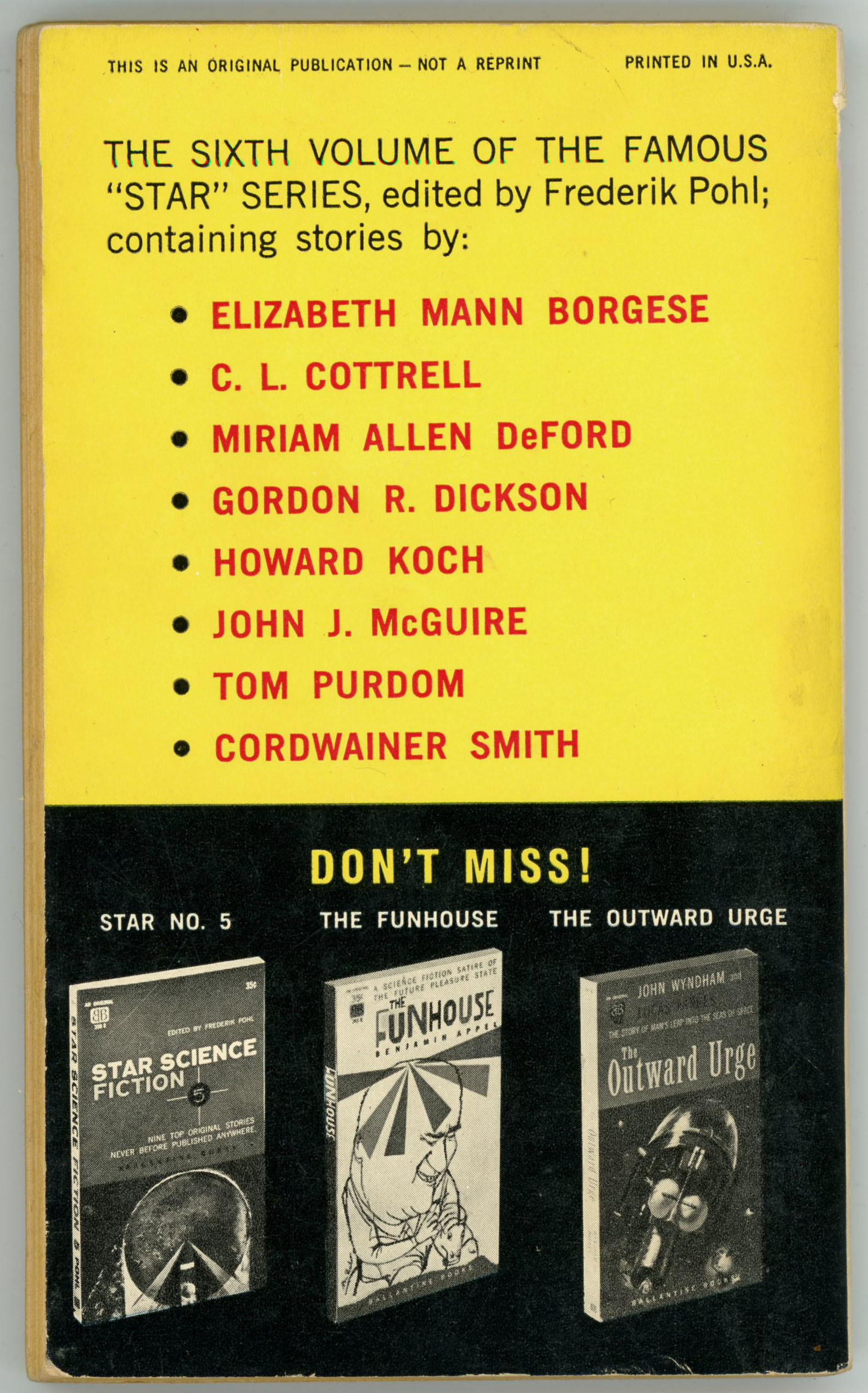
Danger! Child at Large, by C.L. Cottrell (Charles Cottrell)

Twin’s Wail, by Elizabeth Mann Borgese

The Holy Grail, by Tom Purdom

Angerhelm, by Cordwainer Smith

The Dreamsman, by Gordon R. Dickson

To Catch an Alien, by John J. McGuire

Press Conference, by Miriam Allen deFord

Invasion from Inner Space, by Howard Koch
 

Justine, by Lawrence G. Durrell – 1961 (1957) [Unknown Artist]

The first novel in Lawrence Durrell’sAlexandria Quartet” (which also comprised Balthazar, Mountolive, and Clea), Justine was produced for the screen in 1969 as a film directed by George Cukor and Joseph Strick.  The movie’s cast included Anouk Aimée in the title role, Dirk Bogarde as “Pursewarden”, and Michael York as “Darley”.  According to Wikipedia, the film … uh, er, ah … didn’t go over too well, either critically or financially. 

(C’est la vie!)

Though the full film is apparently unavailable in digital format, you can view the trailer – rather a brief trailer at only a minute in length – (uploaded to YouTube in 2010) here

As for Clea herself:
is it only my imagination which makes it seem so difficult to sketch her portrait? 
I think of her so much –
and yet I see how in all this writing I have been shrinking from dealing directly with her. 
Perhaps the difficulty lies here:
that there does not seem to be an easy correspondence between her habits and her true disposition. 
If I should describe the outward structure of her life –
so disarmingly simple, graceful, self-contained –
there is a real danger that she might seem either a nun
for whom the whole range of human passions had given place
to an absorbing search for her subliminal self,
or a disappointed and ingrown virgin
who had deprived herself of the world because of some psychic instability,
or some insurmountable early wound.

Everything about her person is honey-gold and warm in tone;
the fair, crisply trimmed hair which she wears rather long at the back,
knotting it simply at the downy nape of her neck.
This focuses the candid face of a minor muse with its smiling grey-green eyes.
The calmly disposed have a deftness and shapeliness
which one only notices when one sees them at work,
holding a paint-brush perhaps
or setting the broken leg of a sparrow in splints made from match-ends.

I should say something like this:
that she had been poured,
while still warm,
into the body of a young grace:
that is to say, into a body born without instincts or desires.

To have great beauty;
to have enough money to construct an independent life;
to have a skill – those are the factors which persuade the envious,
the dispirited to regard her as undeservedly lucky.
But why, ask her critics and observers, has she denied herself marriage?

She lives in modest though not miserly style,
inhabiting a comfortable attic-studio
furnished with little beyond an iron bed and a few ragged beach chairs
which in the summer are transferred bodily to her little bathing cabin at Sidi Bishr. 
Her only luxury is a glittering tiled bathroom in the corner
of which she has installed a minute stove
to cope with whatever cooking she feels inclined to do for herself;
and a bookcase whose crowded shelves indicate that she denies it nothing.

She lives without lovers or family ties, without malices or pets,
concentrating with single-mindedness upon her painting which she takes seriously. 
In her work, too, she is lucky; for these bold yet elegant canvases radiate clemency and humor.
They are full of a sense of play – like children much-beloved.

From rear cover:

The wine press of love

Alexandria – a thousand dust-tormented streets.  Flies and beggars own it today, and those who enjoy an intermediate existence in between.

Five races, five languages, a dozen creeds – but there are more than five sexes.  The sexual provender which lies to hand is staggering in its variety and profusion.  The Orient cannot rejoice in the sweet anarchy of the body – for it has far outstripped the body.

Someone once said that Alexandria was the great wine press of love; those who emerged from it were the sick men, the solitaries, the prophets – I mean all who have been deeply wounded in their sex.