As “no man is an island” – to use a hackneyed but entirely true aphorism – neither is any field of knowledge. The arenas of the arts, humanities, and sciences, disparate as they may be, have long intersected with and influenced one another in ways ranging from the intellectual, to the cultural, to the artistic. And, beyond. Certainly this has long been so in illustrations associated with science fiction, in venues ranging from books, to pulp magazines, to cinema, to the virtual world. By nature and intent, all of these present visions of worlds past, present, and future – and often “parallel” – based on the science and technology rooted in the real (or, ostensibly “real”!) world.
Two interesting examples of this appeared in the early 1960s, as cover illustrations for the August, 1962 issue of Amazing Stories, and, the April 1964, issue of Analog Science Fact -> Science Fiction. Though utterly different in artistic style, both compositions pertain to stories based upon the solar sail, a method of spacecraft propulsion by means of the radiation pressure of sunlight.
The Amazing Stories cover is by the very well-known artist Alex Schomburg, whose actual name (as I discovered when writing this post!) was either Alexander A. Schomburg, or, Alejandro Schomburg y Rosa. His painting presents Jack Vance’s story – well, the title is prominently displayed on the cover! – “Gateway to Strangeness”.
“The ship, its great sail spread to the fading sunlight, fled through space like a ghost – out, always out. There were still a billion miles to travel … a billion miles before they’d know whether they would ever come back.”
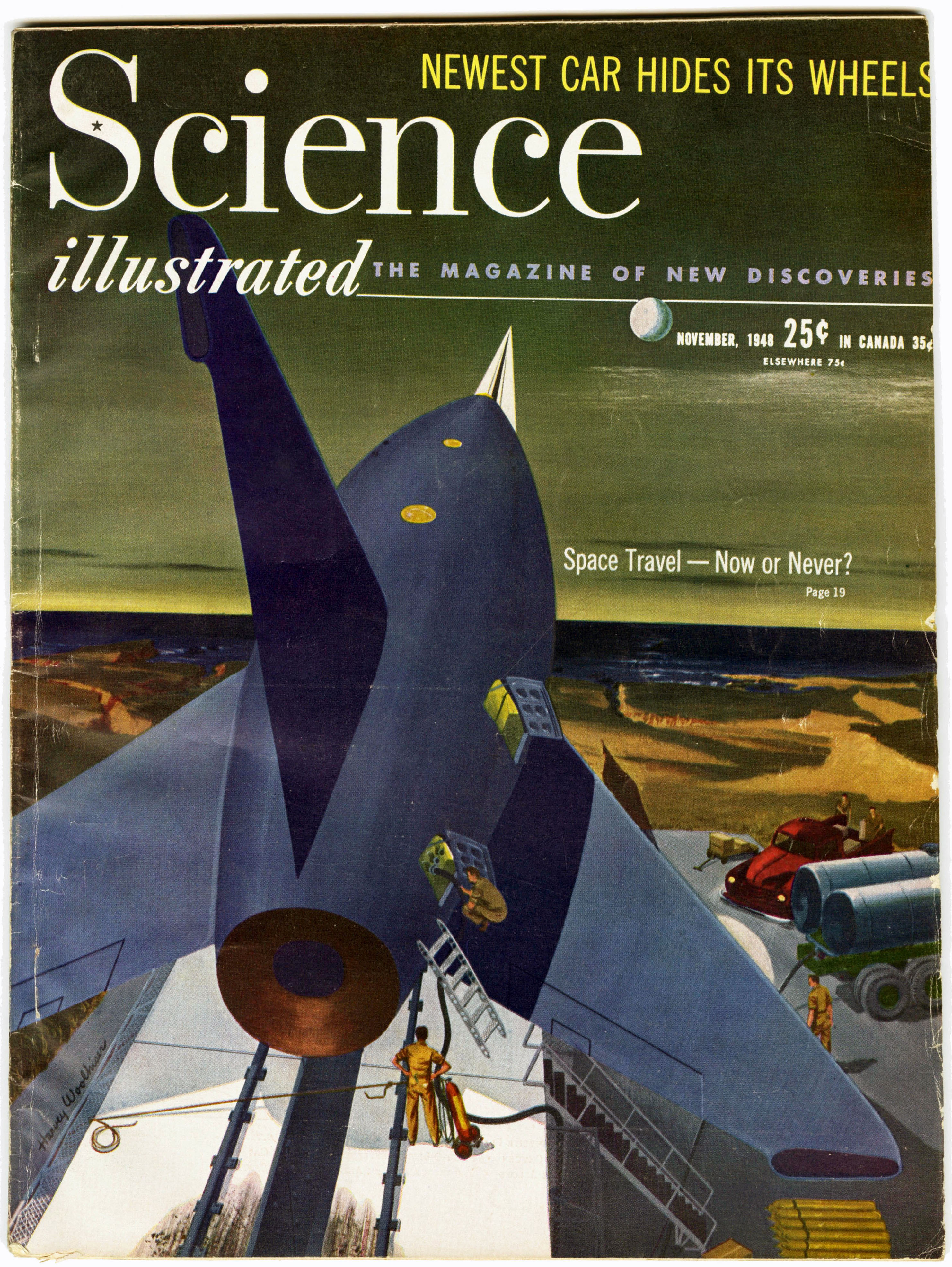
 The Analog cover is by Harvey Woolhiser (actual name James Harvey Woolhiser) for “Sunjammer”, by Winston P. Sanders. As far as I’ve been able to determine, this was the only cover illustration Woolhiser created for Analog, let alone Astounding. Unsurprising: his forte seems not to have been science fiction, albeit he did create a straightforward cover, in muted tones of blue and green, for the November, 1948 issue of Science illustrated, appropriately for the article “Space Travel – Now or Never?”
 But, what about “Sanders”? Who was he? (Hmmm… Certainly not Bernie Sanders… Definitely not Colonel Sanders…) At first, I thought he may have been a “one-shot” or at best an infrequent author. Then, a little searching quickly revealed that “Sanders” was actually one of the pen-names of the wonderfully talented Poul Anderson, under which were published these other stories, primarily in Analog.
Pact (1959)
Wherever You Are (1959)
Barnacle Bull (1960)
The Barrier Moment (1960)
The Word to Space (1960)
Industrial Revolution (1963)
What’ll You Give? (1963)
Say It With Flowers (1965)
Elementary Mistake (1967)
As you can see, not only are the covers different in design, style, and color palette, they’re slightly different in proportion as well: For Amazing Stories, Schomburg’s fits the magazine’s standard digest-size format nicely, while Woolhiser’s conforms to the larger, slick-upscale-coffee-table-ish (Manhattan-advertising-agency? Southern-California aeronautical-engineering-firm? Academic-think-tank? Suburban-office-lounge? University-dorm-room?) format in which Analog was published by Conde-Nast from March of 1963 through March of 1965.
Though both covers depict spacecraft and astronauts – the latter diminutive by virtue of their juxtaposition with spacecraft – I think Schomburg’s image “works” far better, precisely because there’s no central element to the composition: the very center of the scene is “empty” space: Your eye and mind have to “work”, moving from the moon to the earth to the star-mottled indigo blackness of space to the multi-colored sail, its supporting framework, and attached habitation pod. All the colors in the scene balance very nicely against the yellow and black “Amazing” logo at the upper left.
It’s interesting, really.
Though by the 50s and 60s and doubtless much earlier Amazing Stories lacked the gravitas and literary influence of the “big three” – Analog, Galaxy Science Fiction, and The Magazine of Fantasy and Science Fiction – the magazine’s art and illustrations, both cover and interior, sometimes stood – it seems to me – on a visual footing equal to and on occasion much better than those appearing in those publications. Then again, compared to The Magazine of Fantasy and Science Fiction that wasn’t too difficult, at least in terms of interior illustrations, for those appeared in that publication in only few issues from the late 1950s, most notably for Ray Bradbury’s “Fondly Fahrenheit”.
So, anyway: An Analog-ous cover… (Please pardon predictable pun!)
 …and, moving in for a closer view:
“The difference between ‘nothing’ and ‘practically nothing’ can turn out to be the most exceedingly practical, because anything whatever is an intolerable contaminant in nothing. And if that sounds like nonsense – read on and find out!”
 While these two covers depicted science-introducing-fiction during the early 1960s, today, nearly five decades later, they serve – indirectly, symbolically, and effectively – as fiction-introducing-science: Both can be found at the June, 2019 post LightSail 2 Inspires Thoughts on Fictional Sails, at Paul Gilster’s Centauri Dreams website.
Devoted to the presentation of peer-reviewed academic research on the exploration of deep space, Centauri Dreams, which began in August of 2004, encompasses subjects such as the technology of interstellar propulsion and long-duration space travel; the exploration for and identification of extrasolar planets; investigation of the origin, evolution, and nature of other planetary systems; the search for extraterrestrial life (not necessarily alien civilizations a la the works of Arthur C. Clarke or Carl Sagan (whose writings have distinctly theological overtones, with technology and alien intelligence providing a form of secular salvation) but simply plain ole’ “life”, per se, in any form); lengthy philosophical speculation about cosmology, and, well, far more. The majority of the posts are invaluable in presenting summaries of and excerpts from the latest academic journal papers in the fields of astrophysics, astrobiology, and space research, sometimes with an accompanying illustration or two from the original article, and virtually always with links to the original article in either abstract or open-access form.
Fundamentally, what makes the site so worthwhile is that the sense of curiosity, wonder, and speculation inherent to its ethos and mission is undergirded by an appreciation of and respect for solid science.
Well, why not let the website speak for itself? Thus:
“In Centauri Dreams, Paul Gilster looks at peer-reviewed research on deep space exploration, with an eye toward interstellar possibilities. For the last twelve years, this site coordinated its efforts with the Tau Zero Foundation. It now serves as an independent forum for deep space news and ideas.” Refreshingly (whew!)“…Centauri Dreams is not about the existence of UFOs, nor about alien abductions, ‘ancient astronauts,’ electric universe cosmology or other New Age talking points. It is a review of peer-reviewed research.”
However, that disclaimer is a nice (and slightly ironic!) segue to a significant aspect of Centauri Dreams: Though by no means the central focus of the site, its innumerable posts include a sizeable number (as of mid-2020, I count over twenty) directly pertaining to science fiction. These comprise discussions about landmark, significant, or just plain ‘ole interesting films (the posts about “Dark Star”, “Forbidden Planet”, and Howard Hawks’ “The Thing” are great), the history of science fiction (“Astounding in the Glory Years”, and Poul Anderson’s “We Have Fed Our Sea” / “The Enemy Stars”), literature (note the two 2006 posts on Astounding) and the mutual influence of space exploration and science fiction on one another. In a larger sense, many posts at Centauri Dreams are enhanced by science-fiction cover art from books and magazines, which serve as reference points for the topic at hand.
The site’s science-fiction themed posts are below…
2 0 2 0
January 3
Some Thoughts on Science Fiction Visuals
April 3
The Interstellar Ramjet at 60
________________________________________
2 0 1 9
June 10
LightSail 2 Inspires Thoughts on Fictional Sails
May 3
“An Intellectual Carrot – The Mind Boggles!” Dissecting The Thing from Another World
________________________________________
2 0 1 8
April 18
Civilization Before Homo Sapiens?
April 2
2001: A Space Odyssey – 50 Years Later
________________________________________
2 0 1 7
November 19
‘Dark Star’ and Staring into the Cosmic Abyss
September 11
Creating Our Own Final Frontier: Forbidden Planet
________________________________________
2 0 1 6
September 9
Star Trek Plus Fifty
February 5
The Distant Thing Imagined
January 25
Proxima Centauri & the Imagination
________________________________________
2 0 1 5
February 9
We Have Fed Our Sea
January 23
Who Will Read the Encyclopedia Galactica?
________________________________________
2 0 1 3
March 8
Stranger Than Fiction
________________________________________
2 0 1 2
March 9
Science Fiction and the Probe
________________________________________
2 0 1 1
November 18
Science Fiction and the Interstellar Idea
________________________________________
2 0 0 9
August 28
Science Fiction and Interstellar Thinking
January 26
A Science Fictional Take on Being There
________________________________________
2 0 0 8
November 15
Science Fiction: Future Past
________________________________________
2 0 0 7
March 10
Whither the Science Fiction Magazines?
________________________________________
2 0 0 6
September 4
Astounding in the Glory Years
April 15
A Key Paper from an Astounding Source
________________________________________
2 0 0 5
August 30
On the Evolution of Science Fiction
________________________________________
________________________________________
References
Centauri Dreams – Imaging and Planning Interstellar Exploration, at Centauri-Dreams.org
Alex Schomburg (Alexander A. Schomburg / Alejandro Schomburg y Rosa), at Wikipedia
James Harvey Woolhiser, obituary at Legacy.com
Poul Anderson, bibliography at Internet Speculative Fiction Database
Tau Zero Foundation – Pioneering Interstellar Flight, at tauzero.aero
“No man is an island,” at phrases.org