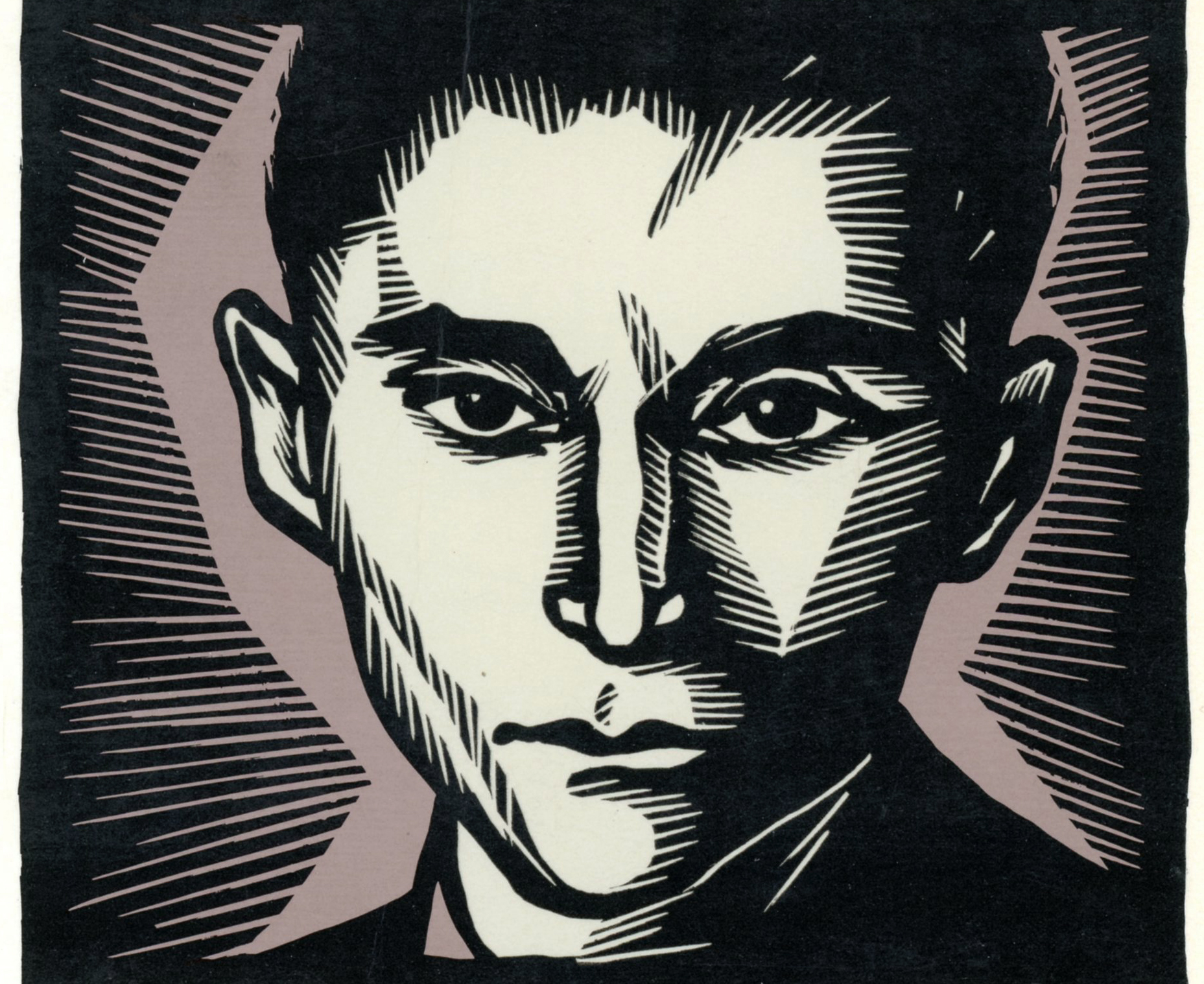
The Nightmare of Reason – A Life of Franz Kafka, by Ernst Pawel – 1985 (1984) [Nancy Crampton]

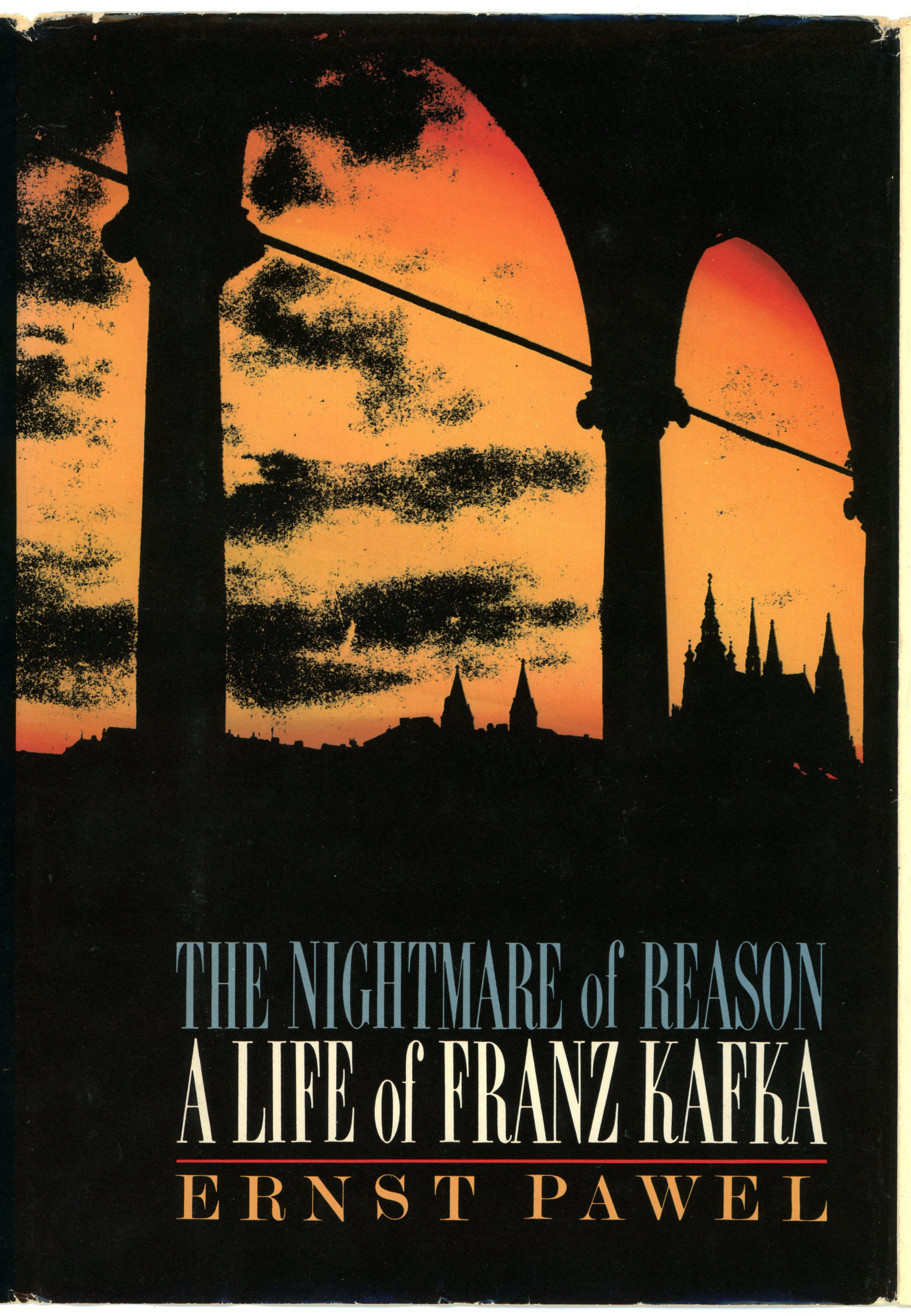
Unlike Anthony Russo’s cover illustrations for the series of Schocken Books titles covering the works of Franz Kafka (published from the late 1980s through the early 1990s), the cover art of Ernst Pawel’s highly praised 1984 biography of Kafka, The Nightmare of Reason – A Life of Franz Kafka (Farrar – Straus – Giroux), is an illustration of a different sort:  Jacket designer Candy Jernigan used a photographic silhouette of Prague Castle to symbolize the physical, social, and psychological “world” of Franz Kafka’s writing.  Perhaps the image was made from a color negative, with the color saturation of the final image having been enhanced during printing.  Or, perhaps the picture is simply an accurate representation of the colors of the Prague skyline at dusk. 

Either way, the combination of black-clouded yellow-orange sky, with the castle in the distance, is quite striking. 
By way of comparison, this September, 2014 photograph, from Park Inn at Radisson, shows a sunset view of the Castle from the Charles Bridge.

________________________________________

Some of Ernst Pawel’s other works include: From the Dark Tower, In The Absence of Magic, Letters of Thomas Mann 1889-1955 (selected and translated from the German by Richard and Clara Winston), Life in Dark Ages: A Memoir, The Island in Time (a novel), The Labyrinth of Exile: A Life of Theodor Herzl, The Poet Dying : Heinrich Heine’s Last Years in Paris, and, Writings of the Nazi Holocaust. 

He passed away in 1994.  

This is his portrait, by Nancy Crampton, from the book jacket.

________________________________________

Ernst Pawel, 74, Biographer, Dies

The New York Times
Aug. 19, 1994

Section A, Page 24

Ernst Pawel, a novelist and biographer, died on Tuesday at his home in Great Neck, L.I.  He was 74.

The cause was lung cancer, his family said.

Mr. Pawel’s 1984 biography of Franz Kafka, “The Nightmare of Reason,” won several prizes, including the Alfred Harcourt Award in biography and memoirs, and was translated into 10 languages.  In a review for The New York Times, Christopher Lehmann-Haupt called the work “moving and perceptive.”

Mr. Pawel was also the author of “The Labyrinth of Exile,” a biography of Theodor Herzl, the founder of modern Zionism.  He had recently finished a book about the German poet Heinrich Heine and at the time of his death was working on his own memoirs, “Life in the Dark Ages.”  Both books are to be published posthumously, his family said.

He was born in 1920 in Breslau, then under German rule but now part of Poland, and fled Nazi Germany with his family in 1933, settling first in Yugoslavia and four years later immigrating to New York City.  After serving as a translator for Army intelligence during World War II, he received a bachelor’s degree from the City University of New York.

He was the author of three novels, “The Island of Time” (1950), “The Dark Tower” (1957) and “In the Absence of Magic” (1961), and numerous essays and book reviews.  Fluent in a dozen languages, he worked for 36 years as a translator and public relations executive for New York Life Insurance.  He retired in 1982.

He is survived by his wife of 51 years, Ruth; a son, Michael, and a daughter, Miriam, both of Manhattan, and a granddaughter.

________________________________________

A Nightmare of Reason was published by Vintage Books in 1985, in trade paperback format.  (Unfortunately, I don’t know the cover artist’s name!)  

The Best of Barry N. Malzberg – January, 1976 [Robert Emil Schulz]

While common themes of science fiction art and illustration are inspired by technology, engineering, space exploration, let alone transcending the known and established physical laws governing the nature of the universe, another motif of the genre’s art pertains to the realm of the biological:

Genetic engineering, the effects of man upon his environment (and likewise, the effects of nature upon man – how jarringly topical now, in March of 2020…); relationships with alien species – whether romantic, sexual, or familial – as exemplified in striking combination through Philip Jose Farmer’s great “The Lovers“; the natural, random evolution of homo sapiens into forms and variants whose physical and intellectual abilities effectively create a new species of “man”.

These and other concepts have all been the basis of science fiction art, both in books and magazines.

A nice example of biological art appears as Robert E. Schulz’s cover illustration for The Best of Barry Malzberg.  No stylized, abstract spacecraft here, the symbolic center of the image is the form of a man, before whom are two helixes, probably representations of strands of DNA.  At his right side, glass laboratory-ware associated with chemistry (see that Erlenmeyer flask?), which seem to be involved in the condensation of some kind of chemical.  Plus, there’s that dark sphere outlined in a diffuse red halo (a planet?; a miniature black hole?), with an electrical circuit below.

But, his other side is different, for the symbolism isn’t scientific, it’s religious.  The central object is a huge chalice, above which is a crucifix, all ornamented by a seeming brass clockwork.  And, there seems to be a brass shield covering the man’s thigh.

Lots going on here!

As for the book itself?  – Oh, yes…  Though titled “The Best of…”, it’s actually a Pocket Books publication, rather than being part of the Del Rey / Ballantine Series “The Best of…” which covered the works of a variety of other authors.

Contents

Introduction to The Best of Barry N. Malzberg, by Barry N. Malzberg

Introduction to “A Reckoning”, by Barry N. Malzberg

“A Reckoning” (variant of Notes Leading Down to the Conquest), from New Dimensions III, October, 1943

Introduction to “Letting It All Hang Out”, by Barry N. Malzberg

“Letting It All Hang Out” (variant of Hanging), from Fantastic, September, 1974

Introduction to “The Man in the Pocket”, by Barry N. Malzberg

“The Man in the Pocket” (variant of The Men Inside), from New Dimensions II, December, 1972

Introduction to “Pater Familias”, by Barry N. Malzberg

“Pater Familias”, from The Magazine of Fantasy and Science Fiction, March, 1972 (by Kris Neville and Barry N. Malzberg)

Introduction to “Going Down”, by Barry N. Malzberg

“Going Down”, from Dystopian Visions, 1975

Introduction to “Those Wonderful Years”, by Barry N. Malzberg

“Those Wonderful Years”, from Frontiers 1: Tomorrow’s Alternatives, 1973

Introduction to “On Ice”, by Barry N. Malzberg

“On Ice”, from Amazing Science Fiction, January, 1973

Introduction to “Revolution”, by Barry N. Malzberg

“Revolution”, from Future City, 1973

Introduction to “Ups and Downs”, by Barry N. Malzberg

“Ups and Downs”, from Eros in Orbit, 1973

Introduction to “Bearing Witness”, by Barry N. Malzberg

“Bearing Witness”, from Flame Tree Planet, 1973

Introduction to “At the Institute”, by Barry N. Malzberg

“At the Institute”, from Fantastic, 1974

Introduction to “Making It Through”, by Barry N. Malzberg

“Making It Through”, from And Walk Now Gently Through the Fire and Other Science Fiction Stories, 1972

Introduction to “Tapping Out”, by Barry N. Malzberg

“Tapping Out”, from Future Quest, 1973

Introduction to “Closed Sicilian”, by Barry N. Malzberg

“Closed Sicilian”, from The Magazine of Fantasy and Science Fiction, November, 1973

Introduction to “Linkage”, by Barry N. Malzberg

“Linkage”, from Demon Kind, 1973

Introduction to “Introduction to the Second Edition”, by Barry N. Malzberg

“Introduction to the Second Edition”, by Barry N. Malzberg

Introduction to “Trial of the Blood”, by Barry N. Malzberg

“Trial of the Blood”, from The Berserkers, 1974

Introduction to “Getting Around”, by Barry N. Malzberg

“Getting Around”, from Frontiers 1: Tomorrow’s Alternatives, 1973

Introduction to “Track Two”, by Barry N. Malzberg

“Track Two”, from Fantastic, July, 1974

Introduction to “The Battered-Earth Syndrome”, by Barry N. Malzberg

“The Battered-Earth Syndrome”, from Saving Worlds, 1973

Introduction to “Network”, by Barry N. Malzberg

“Network”, from Fantastic, January, 1974

Introduction to “A Delightful Comedic Premise”, by Barry N. Malzberg

“A Delightful Comedic Premise”, from The Magazine of Fantasy and Science Fiction, February, 1974

Introduction to “Geraniums”, by Barry N. Malzberg

“Geraniums”, from Omega, 1973 (by Valerie King and Barry N. Malzberg)

Introduction to “City Lights, City Nights”, by Barry N. Malzberg

“City Lights, City Nights”, from Future City, 1973

Introduction to “Culture Lock”, by Barry N. Malzberg

“Culture Lock”, from Future City, 1973

Introduction to “As in a Vision Apprehended”, by Barry N. Malzberg

“As in a Vision Apprehended”, from The Berserkers, 1974

Introduction to “Form in Remission”, by Barry N. Malzberg

“Form in Remission”, from The Berserkers, 1974

Introduction to “Opening Fire”, by Barry N. Malzberg

“Opening Fire”, from Frontiers 2: The New Mind, 1973

Introduction to “Running Around”, by Barry N. Malzberg

“Running Around”, from Omega, 1973

Introduction to “Overlooking”, by Barry N. Malzberg

“Overlooking”, from Amazing Science Fiction, June, 1974

Introduction to “Twenty Sixty-one”, by Barry N. Malzberg

“Twenty Sixty-one”, from The Magazine of Fantasy and Science Fiction, July, 1974

Introduction to “Closing the Dead”, by Barry N. Malzberg

“Closing the Deal”, from Analog Science Fiction / Science Fact, March, 1974

Introduction to “What the Board Said”, by Barry N. Malzberg

“What the Board Said”, 1976

Introduction to “Uncoupling”, by Barry N. Malzberg

“Uncoupling”, from Dystopian Visions, 1975

Introduction to “Over the Line”, by Barry N. Malzberg

“Over the Line”, from Future Kin, 1974

Introduction to “Try Again” and “An Oversight”, by Barry N. Malzberg

“Try Again”, from Strange Gods, 1974

“An Oversight”, 1976, (variant of “Oversight”, from Strange Gods, 1974)

Introduction to “And Still in the Darkness”, by Barry N. Malzberg

“And Still in the Darkness”, 1976

References

The Best of Barry N. Malzberg, at the Internet Speculative Fiction Database

Robert E. Schulz, at the Internet Speculative Fiction Database

Facebook Page for The Art of Robert E. Schulz