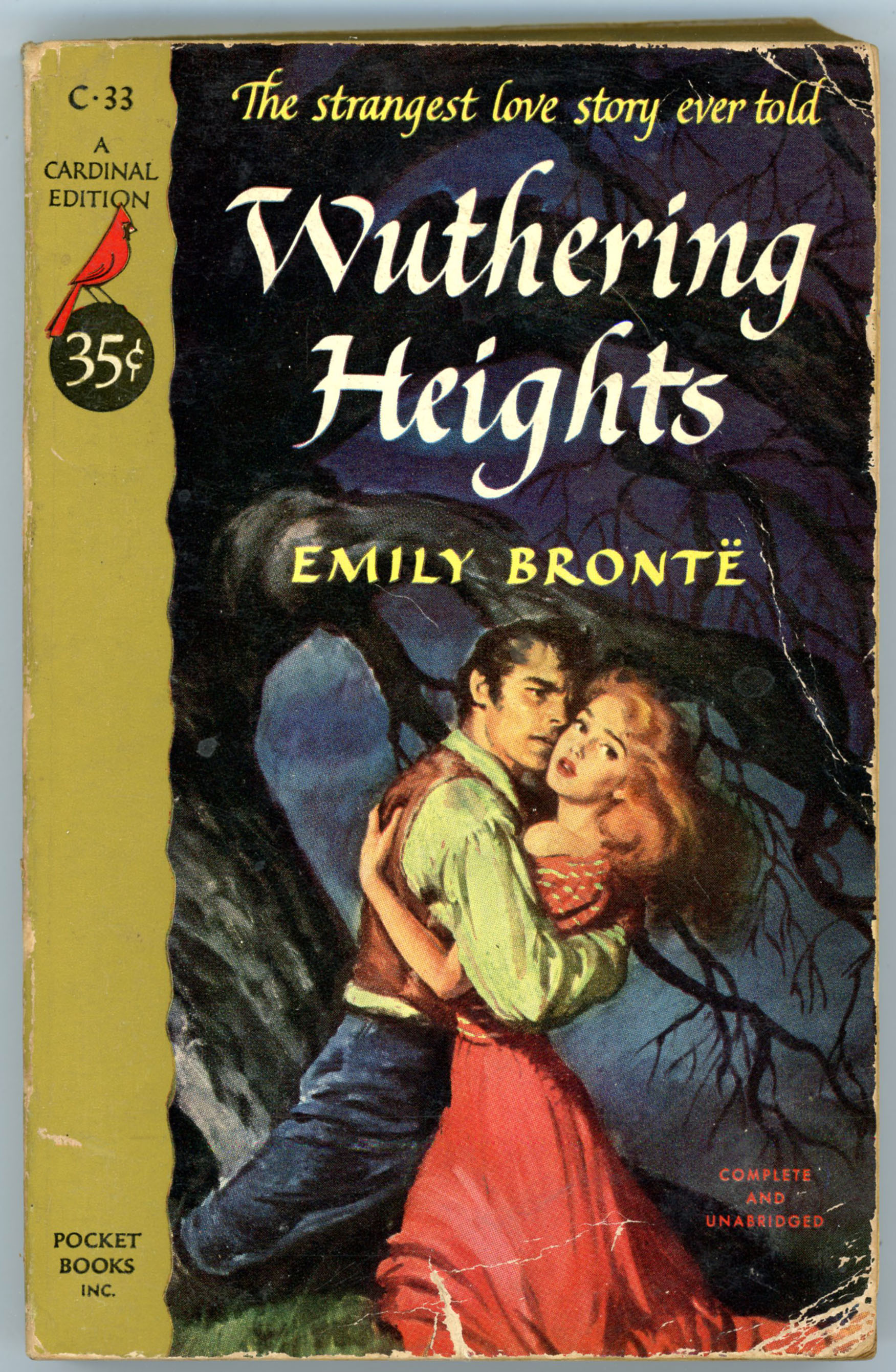
Wuthering Heights, by Emily Bronte – October, 1952 (December, 1847) [Walter M. Baumhofer]

“Is Mr. Heathcliff a man?  If so, is he mad?
And if not, is he a devil?”
Dear Ellen, it begins, —
I came last night to Wuthering Heights,
and heard, for the first time, that Catherine has been, and is yet, very ill. 
I must not write to her, I suppose,
and my brother is either too angry or too distressed to answer what I sent him. 
Still, I must write to somebody, and the only choice left me is you.

Inform Edgar that I’d give the world to see his face again —
that my heart returned to Thrushcross Grange in twenty-four hours after I left it,
and is there at this moment, full of warm feelings for him, and Catherine!
I can’t follow it though — (these words are underlined) —
they need not expect me, and they may draw what conclusions they please;
taking care, however, to lay nothing at the door of my weak will or deficient affection.

The remainder of the letter is for yourself alone. 
I want to ask you two questions: the first is, —
How did you contrive to preserve the common sympathies of human nature when you resided here?
I cannot recognise any sentiment which those around share with me.

The second question I have great interest in; it is this —
Is Mr. Heathcliff a man?  If so, is he mad?
And if not, is he a devil?
I sha’n’t tell my reasons for making this inquiry;
but I beseech you to explain, if you can, what I have married:
that is, when you call to see me; and you must call, Ellen, very soon.
Don’t write, but come, and bring me something from Edgar.

References

Wuthering Heights, at Wikipedia

Wuthering Heights (full text), at Project Gutenberg

A Decade of Fantasy and Science Fiction, edited by Robert P. Mills – 1962 [Richard M. Powers]

Here’s a nice Richard Powers cover from 1962, with elements typical of his art: Multicolored, curved, geometric, mobile-like shapes; a weird, irregularly-shaped, dented, floating, metallic king of thingy; a figure garbed in a space-suit.  (Well, it looks like a space-suit!) 

Like many of the images of “people” in Powers’ art, the space explorer’s outfit looks detailed and ornate, but on closer inspection, this arises from a series of rings or ridges covering the garment, giving it the suggestion rather than the reality of detail. 

But, it still looks cool.

The “lower” of the two images, appearing on the book’s back cover, is simply a reproduction of the art on the front cover, sans text.

As for the stories within the book?  Though I have read them all (some years ago!), none particularly currently stand out in memory.  Yet, in a larger sense, I was always impressed by the works of Zenna Henderson (“The People” series), Ward Moore (author of one of the best time travel stories I’ve ever read; fully worthy of a mini-series on Netflix or Amazon Prime (hint, hint, Mr. Bezos!): “Bring the Jubilee”), and, Manly Wade Wellman. 

Contents

Walk Like A Mountain, by Manly Wade Wellman, June, 1955

Men of Iron, by Guy Endore, Fall, 1949

Rabbits to The Moon, by Raymond E. Banks, July, 1959

The Certificate, by Avram Davidson, March, 1959

The Sealman, by John Mansfield, July, 1955

The Sky People, by Poul Anderson, March, 1959

The Causes, by Idris Seabright, June, 1952

The Hypnoglyph, by John Anthony, July, 1953

A Tale of The Thirteenth Floor, by Ogden Nash, July, 1955

Spud and Cochise, by Oliver La Forge, December, 1957

Unto The Fourth Generation, by Isaac Asimov, April, 1959

Jordan, by Zenna Henderson, March, 1959

Will You Wait?, by Alfred Bester, March, 1959

Proof Positive, by Graham Greene, August, 1952

Shock Treatment, by J. Francis McComas, April, 1956 (From 9 Tales of Space and Time, May, 1954)

Gandolphus, by Anthony Boucher, June, 1952

The Last Shall Be First, by Robert P. Mills, August, 1958

A Trick Or Two, by John Novotny, July, 1957

Lot’s Daughter, by Ward Moore, October, 1954

Saturnian Celia, by Horace Walpole, April, 1957 (May, 1774.  First known to have been published in The Letters of Horace Walpole, 1903)

Fear Is A Business, by Theodore Sturgeon, April, 1956

Meeting of Relations, by John Collier, January, 1959 (From The Yale Review, December, 1941)

First Lesson, by Mildred Clingerman, December, 1956

To Fell A Tree, by Robert F. Young, July, 1959

Reference

A Decade of Fantasy and Science Fiction, at Internet Speculative Fiction Database