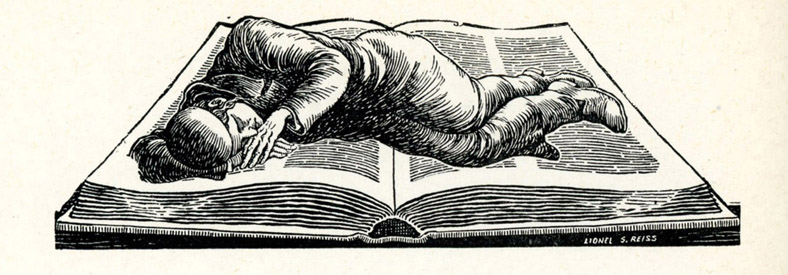
Winesburg, Ohio, by Sherwood Anderson – 1946 [Robert Jonas]

It will perhaps be somewhat difficult for the men and women of a later day
to understand Jesse Bentley. 
In the Last fifty years a vast change has taken place in the lives of our people. 
A revolution has in fact taken place. 
The coming of industrialism, attended by all the roar and rattle of affairs,
the shrill cries of millions of new voices that have come among us from over seas,
the going and coming of trains,
the growth of cities,
the building of the interurban car lines
that weave in and out of towns and past farmhouses,
and now in these later days the coming of the automobiles
has worked a tremendous change in the lives and the habits
of thought of our people of Mid-America. 

Books,
badly imagined and written though they may be in the hurry of our times,
are in every household,
magazines circulate by the millions of copies,
newspapers are everywhere.
In our day a farmer standing by a stove in the store in his village
has his mind filled to overflowing with the words of other men.
The newspapers and the magazines have pumped him full.
Much of the old brutal ignorance that had in it also
a kind of beautiful childlike innocence is gone forever.
The farmer by the stove is brother to the men of the cities,
and if you listen you will find him talking as glibly and senselessly
as the best city man of us all.


Christ Stopped at Eboli, by Carlo Levi – 1948 [Robert Jonas]

christ-stopped-at-eboli-carlo-levi-1948-jonas_edited-1The truth is that the internecine war among the gentry is the same in every village of Lucania. 

The upper classes have not the means to live with decorum and self-respect. 

The young men of promise, and even those barely able to make their way, leave the village. 

The most adventurous go off to America, as the peasants do, and the others to Naples or Rome; none return. 

Those who are left in the villages are the discarded, who have no talents, the physically deformed, the inept and the lazy; greed and boredom combine to dispose them to evil. 

Small parcels of farm land do not assure them a living and, in order to survive, these misfits must dominate the peasants and secure for themselves the well-paid posts of druggist, priest, marshal of the carabinieri, and so on. 

It is, therefore, a matter of life and death to have the rule in their own hands, to hoist themselves on their relatives and friends into top jobs. 

This is the root of the endless struggle to obtain power and to keep it from others, a struggle with the narrowness of their surroundings, enforced idleness, and a mixture of personal and political motives render continuous and savage. 

Every day anonymous letters from every village of Lucania arrived at the prefecture. 

And at the prefecture they were, apparently, far from dissatisfied with this state of affairs, even if they said the contrary.

__________

All that people say about the people of the South, things I once believed myself: the savage rigidity or their morals, their Oriental jealousy, the fierce sense of honor leading to crimes of passion and revenge, all these are but myths.

Perhaps they existed a long time ago and something of them is left in the way of a stiff conventionality.

But emigration has changed the picture.

The men have gone and the women have taken over.

Many a woman’s husband is in America.

For a year, or even two, he writes to her, then he drops out of her ken, perhaps he forms other family ties; in any case he disappears and never comes back.

The wife waits for him a year, or even two; then some opportunity arises and a baby is the result.

A great part of the children are illegitimate, and the mother holds absolute sway. Gagliano has twelve hundred inhabitants, and there are two thousand men from Gagliano in America.

Grassano had five thousand inhabitants and almost the same number have emigrated.

In the villages the women outnumber the men and the father’s identity is no longer so strictly important; honor is dissociated from paternity, because a matriarchal regime prevails.