The world of publishing stands for many things. Or, more aptly phrased, many things stand for the world of publishing, such as dogs, roosters, kangaroos (and cardinals), as well as monuments.
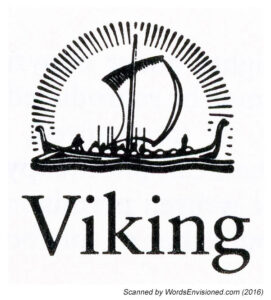
Another well-known symbol – colophon, as it were – in the publishing world is the Viking longboat, the symbol since 1925 of the Viking Press, founded in March of that year by Harold K. Guinzburg and George S. Oppenheimer. As described by Brian LaRossa at Design Observer, “…[Guinzburg] envisioned the Half Moon Press, named after Henry Hudson’s famed flyboat. He hired Rockwell Kent to render the vessel but Kent delivered what could only be interpreted as a Viking longboat. Though initially angry that Kent had missed the mark by such a wide berth, Guinzburg eventually embraced the Viking ship and name for its associations with enterprise, adventure, and exploration in publishing.”
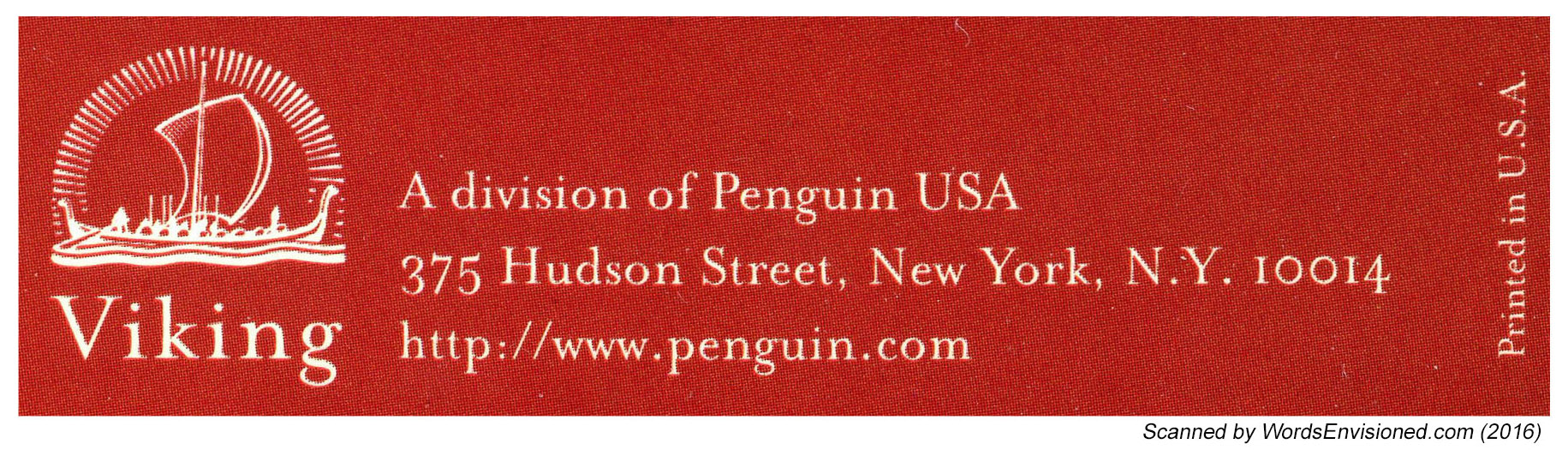
Viking having been part of Penguin since 1975, its longboat has been retained as the imprint’s colophon, nicely displayed in color (with a penguin atop the deck) at the Viking Penguin website. Here it is:

Five examples of Viking’s colophon – spanning the late 1940s through the late 1990s – follow below. Though there are obvious and necessary consistencies in the symbol’s design, note the subtle (and not-so-subtle) variations in detail and shape apparent when comparing these examples, most notably in regard to the colophon used in The Portable Plato. The longboat in this 1948 example is of a much simpler design, with the background displaying stars and waves – the ocean – comprising an appreciable part of the symbol. In subsequent years, the largest variation is in rays of the sun (I guess it’s the sun?!) that form the “rim” of the colophon, which differ in density and depth across the years.
Regardless, I like them all. My favorite is the colophon as used for The Story of Ernie Pyle.
Regardfull, I’ve read two of the five books below: Rick DeMarinis’ The Coming Triumph of the Free World, and, Alan Isler’s The Bacon Fancier, both collections of truly wonderful short – and meaningful – stories.
~~~~~~~~~~~~~~~~~~~~~~~~~~~~~~~~~~~~~~~~
The Portable Plato
The Most Famous Works of The Most Influential Mind
in Western Philosophy
Protagoras
Phaedo -Symposium
The Republic
All Complete
…edited by Scott Buchanan (1965 (1948))

~~~~~~~~~~~~~~~~~~~~~~~~~~~~~~~~~~~~~~~~
The Story of Ernie Pyle, by Lee G. Miller (1950)

~~~~~~~~~~~~~~~~~~~~~~~~~~~~~~~~~~~~~~~~
Bugles and a Tiger – A Volume of Autobiography, by John Masters (1956)

~~~~~~~~~~~~~~~~~~~~~~~~~~~~~~~~~~~~~~~~
The Coming Triumph of the Free World, by Rick DeMarinis (1988)
~~~~~~~~~~~~~~~~~~~~~~~~~~~~~~~~~~~~~~~~
The Bacon Fancier, by Alan Isler (1997)
I

II
Sailing Even Further…
Viking Press, at…
… Wikipedia
… Fonts in Use
… “Undercover Branding”, at Design Observer
… Viking Press is Sold to Penguin Books, by Alden Whitman, November 11, 1975 (The New York Times)
… “The Viking Ship“, in ALA Bulletin, V 50, N 8, pp 493-497, September, 1956 (via JSTOR)