I recently received a communication from Mr. Melvin Schuetz, former assistant to the curators of Baylor University’s Armstrong Browning Library and Museum, regarding Chesley Bonestell’s cover illustration for the December, 1950 issue of The Magazine of Fantasy and Science Fiction which – followed by my response – appears as a “Comment” to this post.
Mr. Schuetz has long had a deep interest in Chesley Bonestell’s body of work. As described at Baylor Blogs, “Melvin is also passionate about the space program and the work of space artist Chesley Bonestell. He authored A Chesley Bonestell Space Art Chronology, published in 1999; collaborated on an illustrated book The Art of Chesley Bonestell in 2001 for which he received a Hugo Award; and co-produced a multi-award winning documentary on Bonestell, Chesley Bonestell: A Brush with the Future, in 2018.”
Here’s more about Chesley Bonestell: A Brush with the Future:
P r o m o…

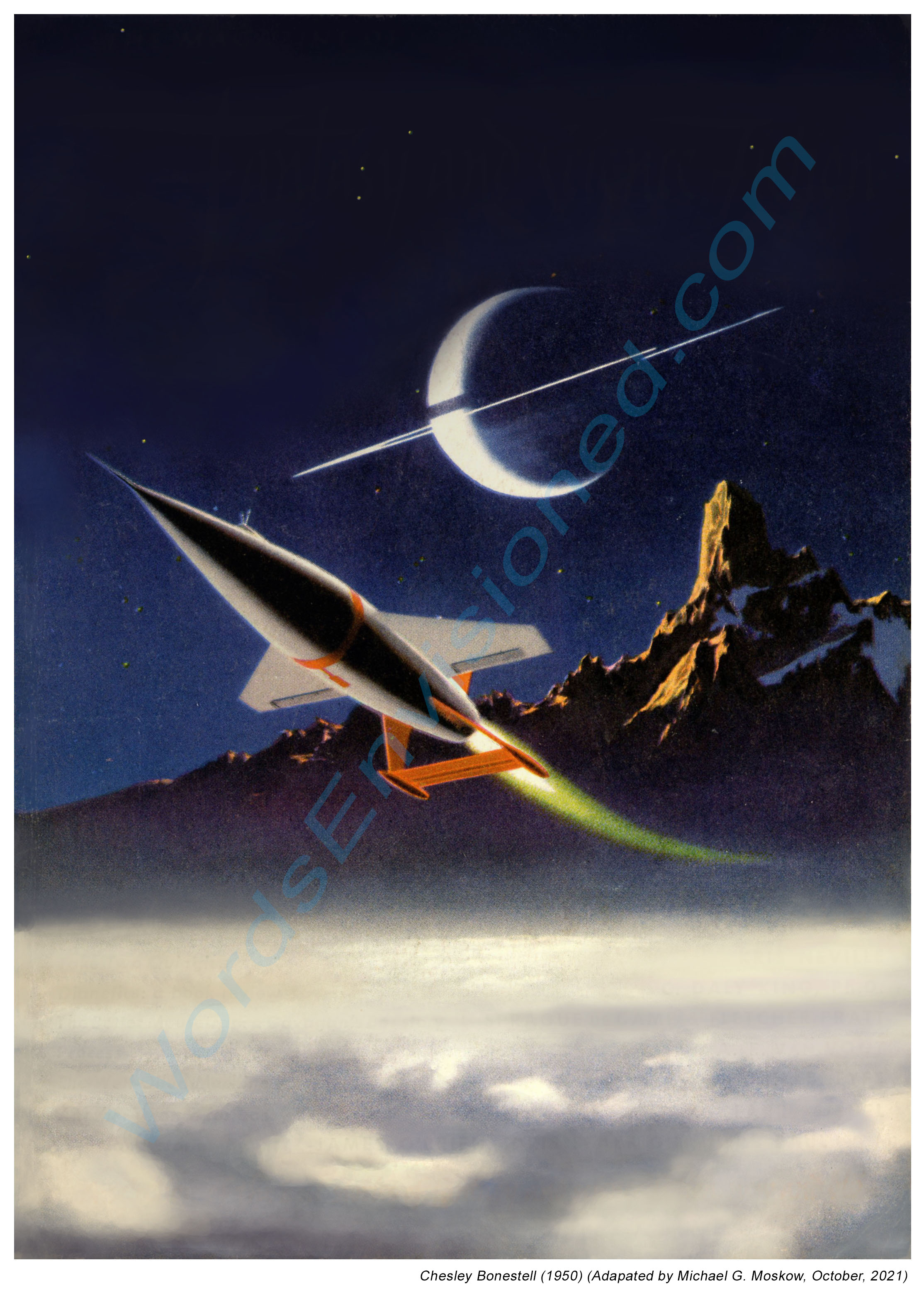
Following closely in the pixels of my prior post about William Timmins’ cover illustration of the January, 1946 issue of Astounding Science Fiction, here’s another reimagined magazine cover: Chesley Bonestell’s cover art for the December, 1950 issue of The Magazine of Fantasy and Science Fiction. Unlike, Timmins’ painting, Bonestell’s depiction of a spacecraft gracefully sweeping just above clouds of a moon of Saturn doesn’t pertain to any of the ten stories within the magazine. Similarly, the only information “about” the painting is the simple statement “Cover Illustration Chesley Bonestell”; the issue is absent of anything dealing with the imagined when, where, why, and how of the scene depicted.
Regardless, the illustration is wonderful; certainly for me, one of the best – if not the very best – covers that appeared during the magazine’s (thus far 74 year long) ongoing history, and I think very highly among the ranks of all science fiction pulps from the mid-twentieth century. The combination of glowing clouds in shades of gray, Saturn as a crescent with its rings a mere sliver of light, and, pale brown cliffs in the distance set against a thinly starlit deeply blue sky, combine to make a wondrous scene.
The painting imparts feelings of wonder, danger, and beauty. What is the spaceship’s origin? On what mission is it headed … to simply conduct a reconnaissance of the moon – Titan? – and then depart, to land on the moon’s surface, or, to sweep by, passing en-route to another – unknown – destination? Are any explorers aboard the craft, or is it entirely automated? What is the time-frame of the action – only a few decades hence, or in a future far, far distant, when not robots but men have finally leapt into the depths of the solar system, and beyond? The answers lie in our imagination.
Sweeping through the void.
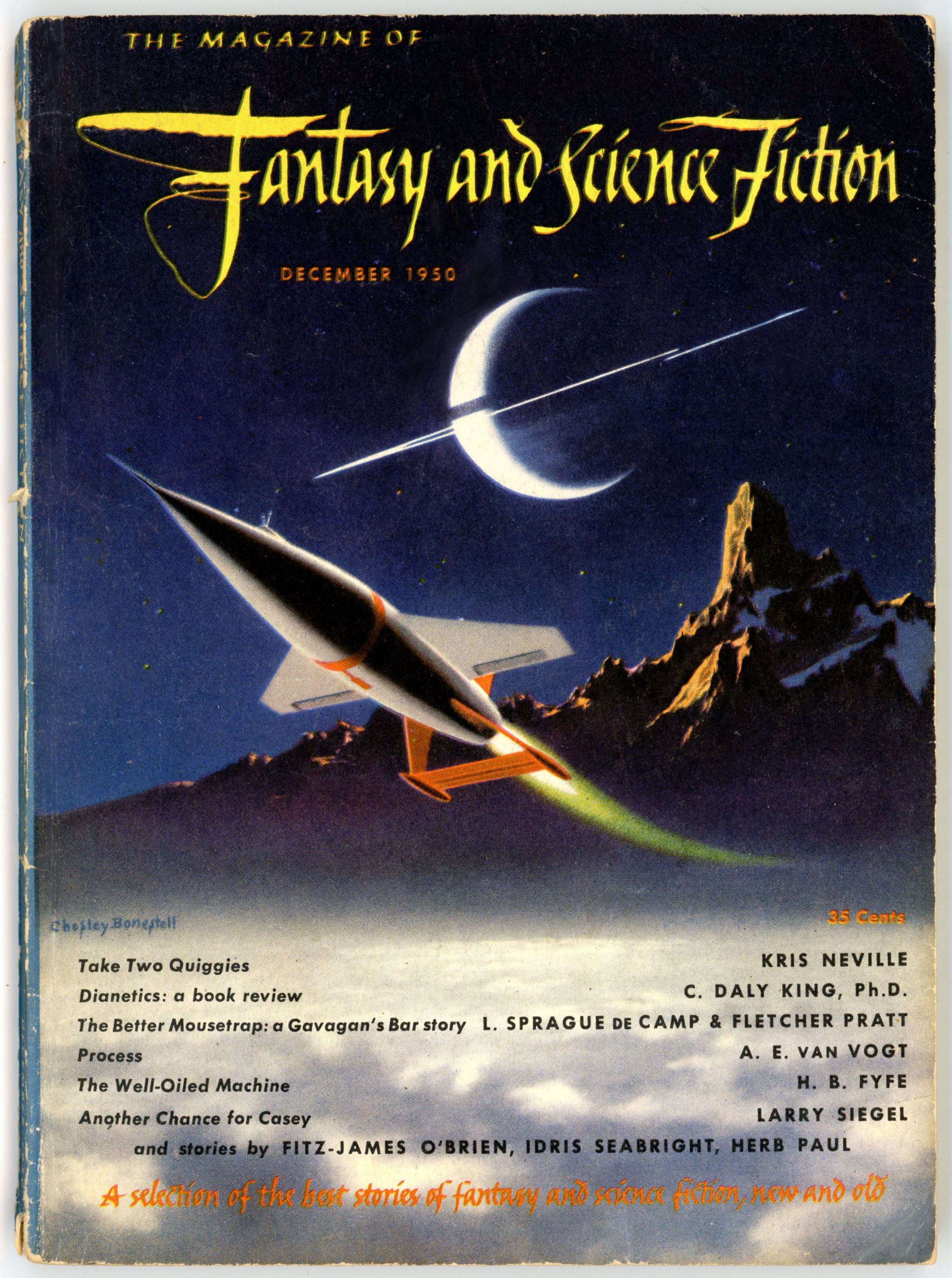
Here’s the original cover which is the basis of the above image. Lovely work by Chesley Bonestell.
12/13/23 – 52

