The Age of Advertising: The Ediphone – June 13, 1918

Heartily endorsed by C. Montgomery Burns…!

We have the Dictaphone.

Now, here’s an advertisement for the the competitor of the Dictaphone:  The Ediphone. 

Though similar in concept to the former, the difference between the two systems was, according to ObsoleteMedia.org, “…the recording method, with Edison using ‘hill and dale’ recording, while the Graphophone used lateral (side to side) recording.  The cylinders could have a layer of wax shaved off, to enable re-use.” 

The advertisement below, which appeared in The New York Times on June 13, 1918, is (hey, unsurprisingly!) strikingly similar in image and message to the three advertisements for the Dictaphone:  A pensive business owner or supervisor looks over the office floor, and noting three unoccupied desks – each with a placard prominently denoting that the worker is on (?! – gasp!) “Vacation”, muses upon the need to hire inadequately trained substitute employees (temps?) to accomplish the work of trained personnel.  To the rescue?  The Ediphone!

Intriguingly, the advertisement closes – again, as did the three ads for the Dictaphone – with the suggestion that the prospective customer obtain a copy of the Ediphone company’s free publication, “Better Letters Magazine”.

Scroll down to read the transcribed text of the advertisement…
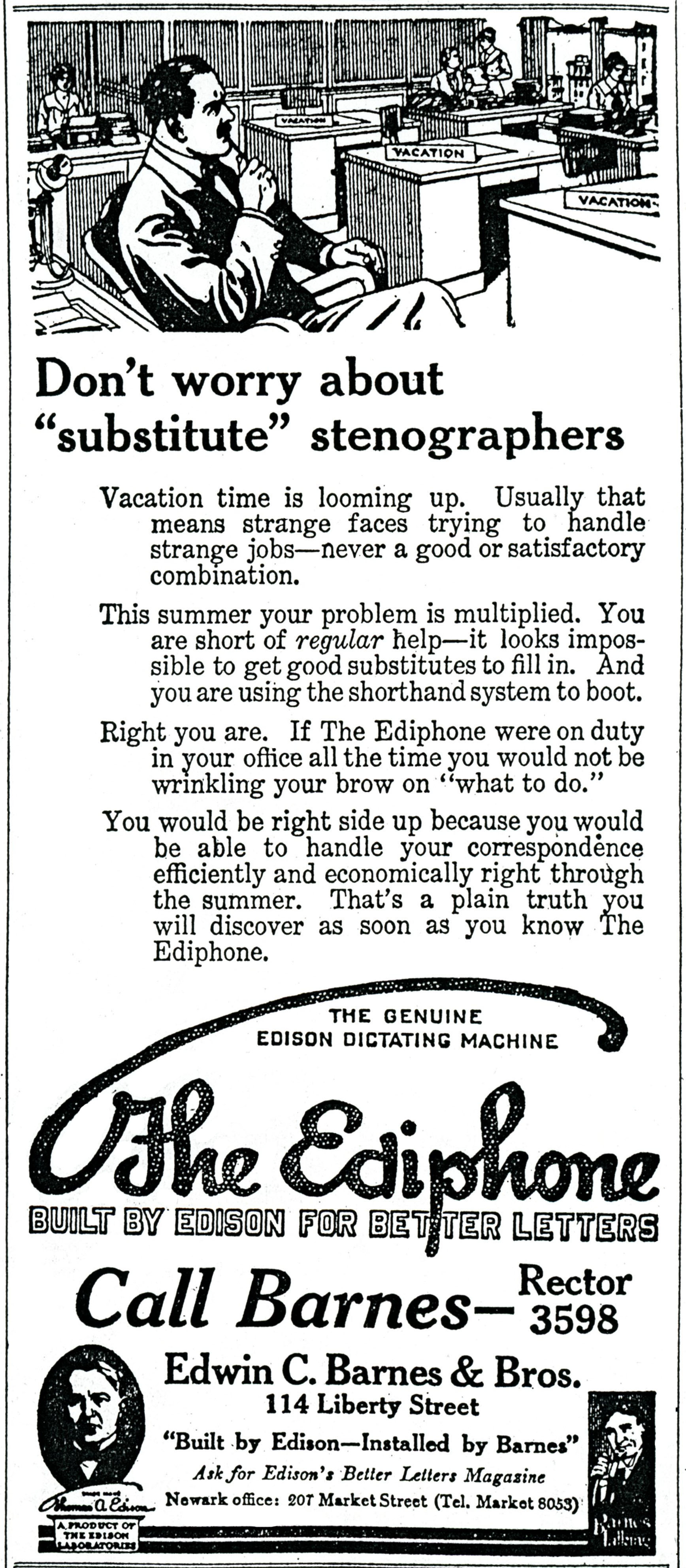
Don’t worry about “substitute” stenographers

Vacation time is looming up.  Usually that means strange faces trying to handle strange jobs – never a good or satisfactory combination.

This summer your problem is multiplied.  You are short of regular help – it looks impossible to get good substitutes to fill in.  And you are using the shorthand system to boot.

Right you are.  If The Ediphone were on duty in your office all the time you would not be wrinkling your brow on “what to do”.

You would be right side up because you would be able to handle your correspondence efficiently and economically right through the summer.  That’s a plain truth you will discover as soon as you know The Ediphone.

THE GENUINE EDISON DICTATING MACHINE

The Ediphone

BUILT BY EDISON FOR BETTER LETTERS

Call Barnes – Rector 3598

Edwin C. Barnes & Bros.
114 Liberty Street

“Build by Edison – Installed by Barnes”

Ask for Edison’s Better Letters Magazine
Newark office: 207 Market Street (Tel. Market 8053)

______________________________

This video, by Shawn Borri, demonstrates how to use the Ediphone…

This video, by The Victrola Guy, is a presentation of a complete Edison Ediphone and Transcription Machine…

Just Four References

Dictation Machine, at Wikipedia

Ediphone, at Museum of Obsolete Media

Shawn Borri’s YouTube Channel (“Postings of music, and experiments, even daily thoughts of Shawn Borri, controversial ” Mad Audio Scientist”.)

TheVictrolaGuy’s YouTube Channel (“This is an ongoing series of experiments of recording on the Edison Cylinder Phonograph…”)

The Age of Advertising: The Dalton Adding and Calculating Machine – 1918

An early adopter: C. Montgomery Burns…!

Akin to the frequent appearance of advertisements in The New York Times for devices and systems for faster and streamlined communication (such as the Private Automatic Exchange telephone system), so was the promotion of machines that would enable a firm or organization to rapidly manipulate numerical data.

That is, calculating machines.

The two advertisements below – for the Dalton Calculating and Adding Machine – appeared in the closing months of the First World War, and in terms of text and graphics are fitting examples of the way such devices were brought to the attention of the public.

Though known and marketed as “Adding” machines, the advertisements specifically emphasize the machine’s parallel capabilities in the performance of the subtraction, multiplication, and division.  Given the (simplified) description of how these operations are actually performed, in terms of keystrokes and data entry, it’s evident that the copy-writer assumed that his audience would have a basic familiarity with calculating machines, probably from the use of earlier generations of such devices.  Given the timing of the advertisements, it’s notable that the “first” example, from September 17, 1918, specifically alludes to mobilization for America’s effort in “The Great War”, a central issue underlying this effort being speed.  (A brief segue, as it were.)  An analogy is drawn to the capabilities of the Dalton Calculating Machine.  But, with appearance of the example from over a month later – in late October – the war, which would end thirteen days later, is neither mentioned nor alluded to.

Obviously, the future was at stake, not the present.

The full text of both advertisements is presented below.

______________________________

September 17, 1918

Put greater Speed into your
          Office Accounting

“Speed up” is our national “middle name”.  We gather our men, materials, machinery together and then the wheels commence to turn with mighty force.  The same is applicable to the new office girl who is given a DALTON Adding-Calculating Machine to figure with.

Here is her instrument for the production of figure facts. No machine equals it in simplicity of keyboard.  Only 10 keys, one for each numeral. She writes 1276.91 and then 1.53, then .77.  She notes each figure is put into its proper column automatically.  Consider the ease of figuring, the accuracy, the relief afforded by this service.

Shortly she begins to operate the keys without looking at them at all.  This is “touch operation”.  It is the fastest, moist accurate method of handling figures, and is practicable only on the DALTON. Multiplication – all figure work requiring multiplication is easily handled.  The DALTON adds, subtracts, multiplies, divides, makes out statements, tabulates.  It is the “all-around” adding, listing, calculating machine for figure work in any business.

Phone Barclay 9729 for Demonstration

Compare your present methods with the 10-KEY DALTON.  It may mean a saving in labor or time you did not consider possible.  Phone today or write for data descriptive of the DALTON.

GRUBBS & SHERIDAN
642-646 Woolworth Bldg.

Dalton

Main Office and Factory, Cleveland, Ohio

ADDING AND
CALCULATING MACHINE

____________________________________________

October 29, 1918

The All-around Calculating
Machine for Every Business

No other office figuring machine has the practical application of the DALTON.  Aside from the simplicity of the keyboard arrangement which eliminates the necessity of experienced help – aside from its utility as the fastest adding and listing machine made – it is also a versatile all-around calculating machine.

Adding machines, as a rule, are designed for adding and listing only.  The DALTON is far more than an adding machine. It is as easy to multiply on the DALTON as it is to add.  The cipher (0) key makes this possible.  Multiplication of the most complicated problems is but a question of seconds.

See it yourself.  Here is a machine for any arrangement in any business.  Railroads, great mercantile houses, business firms everywhere, are standardizing on DALTONS.  It adds, subtracts, multiplies, divides, lists, every operations, adds two totals at once, makes statements, tabulates, etc.

Phone Barclay 5350 for Demonstration

Is your office strictly efficient?  Office costs, like plant or store costs, can only be cut by more efficient machinery.  Let us bring a DALTON to your office for inspections.  Or write for booklet descriptive of this new time and labor saver.

New York Sales Agents: GRUBBS & SHERIDAN
642-646 Woolworth Bldg.

Dalton

Main Office and Factory, Cleveland, Ohio

ADDING AND
CALCULATING MACHINE

______________________________

Here are three views of a “Dalton Extra Special Adding Machine” of 1920 vintage, from, and as described in detail, at the Smithsonian’s National Museum of American History.

______________________________

Three Little References

Dalton Adding Machines, at Branford House Antiques

The History of James L. Dalton and The Dalton Adding Machine Company, at Dalton Genealogy

Mechanical Calculators, at Wikipedia