Air Combat at 20 Feet, by Garrett E. Middlebrook – 1989 [Fred Moore]

“May you live unenvied,
and pass many pleasant years unknown to fame;
and also have congenial friends.”
– Ovid

“A tribute which bears full truth and honesty
will refuse to apply the conventional words of courage,
gallantry, heroism and bravery to the acts
which every fallen soldier was performing at the time of his death.
Some of our beloved comrades died embittered, scared and lonely deaths.
None ever “gladly” died because they were inspired by patriotism.
But they all died in the fulfillment of their duty.”
– Garrett Middlebrook

Like R.E. “Peppy” Blount’s We Band of Brothers, Garrett Middlebrook’s Air Combat At 20 Feet is an account of the experiences of a B-25 Mitchell “strafer” pilot in the Pacific Theater of War, an aspect of Second World War military aviation history that’s generated far fewer first-hand accounts than – for example – fighter combat in general, or, the Eighth Air Force’s aerial campaign against Germany.  Perhaps this has been because the magnitude of Pacific Air Combat involved smaller numbers of men and aircraft – and thus total cumulative losses of either – than strategic bombing in Europe; possibly because due to factors of distance, climate, and living conditions, the Pacific engendered less attention and both public and media awareness than air combat in Europe.  And, maybe this is because – well, just an idea – in light of the above, in the decades following WW II, veterans of “strafer” units felt less impetus to preserve their memories in written form, out of the perception that the public would simply not be that interested in their memoirs.  (I don’t know.  Well, like I said, just an idea!)

But, there isn’t necessarily a relationship between quantity and quality, for Garrett Middlebrook’s book is almost singular in its nature (Peppy Blount’s book sharing the other half of the literary spotlight), and definitely singular in its historical, emotional, and literary quality.  At over 400 pages long and dense with detail, the book’s foremost aspect to me is actually the depth and sensitivity of Middlebrook’s writing, which – though very rich in detail about his military experiences – in a not-so-subtle way, directs a greater focus on recollection of his fellow aviators, both those who survived, and those who did not, in what might be deemed an understandably cathatric fashion.  Two such individuals, among many, are Major Ralph Cheli and navigator 2 Lt. Louis J. Ritacco, both of whom were murdered while POWs.  Another notable aspect of the book is that it provides a platform for Garrett Middlebrook to present thoughts of a philosophical nature, in forms of either lengthy musings, or dialogues with fellow members of the 405th Bomb Squadron, about the cruelty and comradeship inherent to war, government, economics, and, human nature.  To give you an inkling of the depth of his thoughts, this post includes – below – some passages from the book.

As for the book’s cover art, well, it’s unusual.  Though the B-25s (on front and rear covers), and Japanese Oscar (on the rear cover; the covers don’t form a continuous painting) are aren’t perfectly proportioned compared to the appearance of the actual aircraft, the symbolism of both covers is very striking, as are the colors that were used to create these compositions.  They’re both simple and complex at once, and reminiscent of the style of “Grandma Moses” (Anna Mary Robertson Moses). 

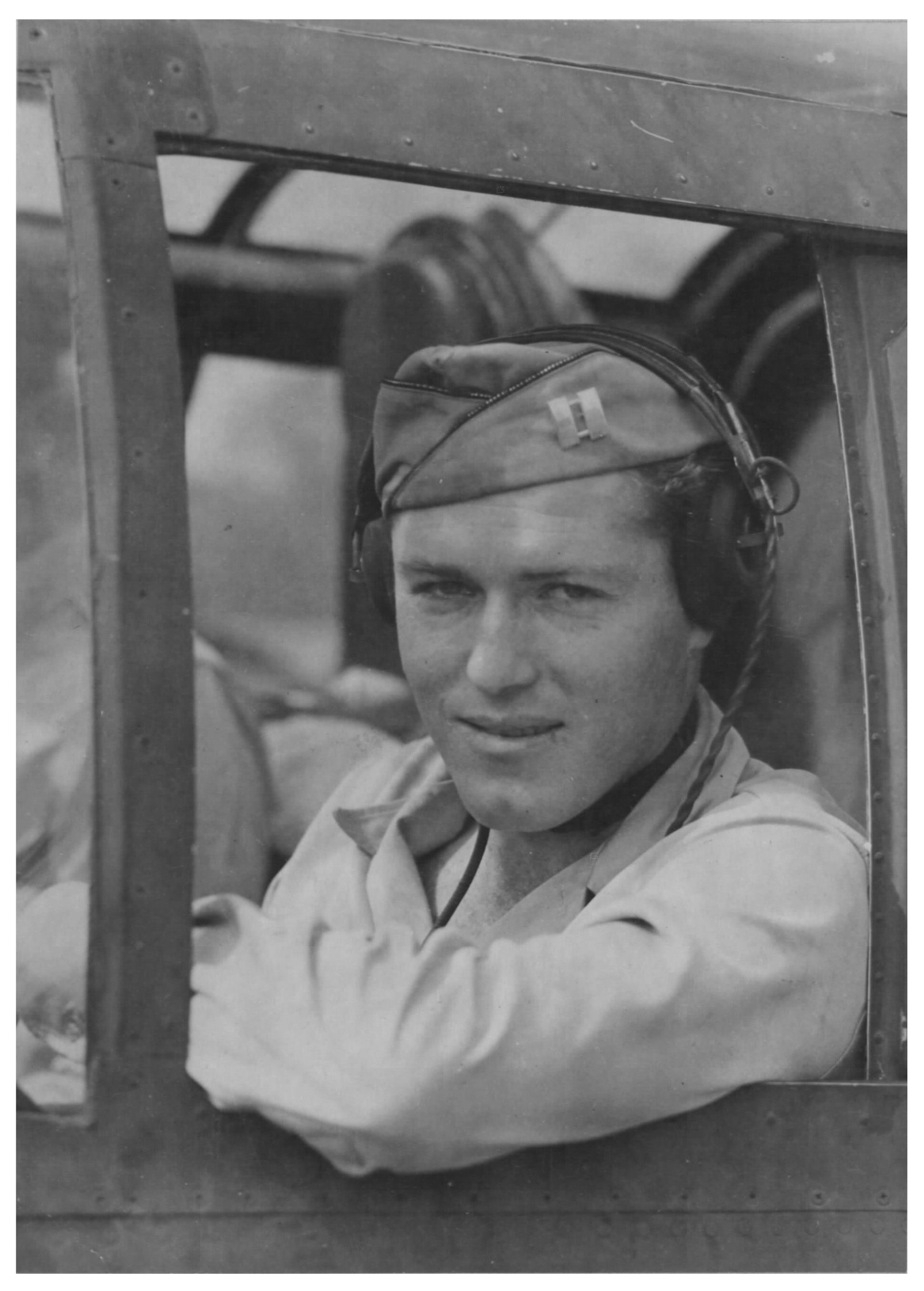
My only criticism of the book is its paucity of photographs, for images of the many men mentioned within its pages would give the text even greater impact.  And, though the book does feature an image of Garrett Middlebrook’s crew, it’s strangely lacking a good image of Garrett – himself. 

This blog post rectifies that:  Here’s a portrait of Garrett sitting in the pilot’s seat of a B-25.  It’s U.S. Army Air Force photo “A47039 / 4002”, from Fold3.com.  The caption?  “Captain Garrett B. Middlebrook, Springtown, Texas, Fifth Air Force bomber pilot who has been awarded the Distinguished Service Cross by General MacArthur “for extraordinary heroism in action” in New Guinea.”

“Print received from B.P.R. (Air Forces Group), date unknown.”

______________________________

Some passages, with mention of Major Ralph Cheli…

Even though I could not conquer my fear of death,
I felt it would be a sin and a violation of my manhood not to fight to live,
even though I might only extend my life one day or one hour.
It would also have been a grievous sin if I did not give all I had by way of experience,
skill, innovative methods, leadership and calm, collective demeanor to my comrades.
Perhaps if I did all that I could to assuage their fears and motivate them to fight,
one more crew would survive.
Besides, it only made sense that I had a better chance to survive if I did all those things.
I thought of Cheli; I knew he had experienced fear,
but he had controlled it never allowing it to surface in an apparent way.
Perhaps, I thought, notwithstanding centuries of rhetoric about courage,
all it really amounted to was the concealment of personal fear.
In all probability, that was all Cheli had done –
concealed his fear and kept it hidden even when he was going down.

For over a year I had lived within a few yards of the jungle
together with the other crewmen in my squadron.
Although we were all male and far from home and civilization,
we did form a little social community.
Values still existed, morals still prevailed
and it was important to me that my comrades respected me.
Respect was not something they accorded to me ceremoniously;
instead, they showed it only if I earned it through leadership
and I had to prove that leadership again on each mission.

When I came to grips with myself,
I knew I could not lose their respect nor fail to perform my duties to them.
I admitted to myself at last,
that although I fought first for personal survival,
I was also duty-bound to the survival of the group. (pp. 401-403)

______________________________

Here’s the insignia of an original (early 1945) Australian manufactured 405th BS “Green Dragon” squadron patch (from Flying Tiger Antiques).

______________________________

Images of Garrett Middlebrook with two crews, from the book Sun Setters of the Southwest Pacific Area – From Australia to Japan: An Illustrated History of the 38th Bombardment Group (m), 5th Air Force, World War II – 1941-1946, As Told and Photographed by the Men Who Were There.  Most, if not all, of the men in these images are mentioned or described in Middlebrook’s book. 

Captions appear below both photos.

The crew of 1 Lt. Garrett Middlebrook.  Front, from left, are S/Sgt.Robert J. Kappa, engineer-gunner; Sgt. Robert T. Lillard, Jr., radio operator; Sgt. George R. Pizor, gunner.  Back, from left, are 1 Lt. Middlebrook, pilot; 2 Lt. Leonard D. Perry, bombardier; 2 Lt. Louis J. Ritacco, navigator, and an unidentified airman.  (George Pizor collection)

__________

Capt. Garrett Middlebrook and his crew.  Front, from left, are S/Sgt. Robert S. Emminger, gunner, and T/Sgt. Robert T. Lillard, Jr., radio operator.  Back, from left, are 1 Lt. Everett L. Moffett, navigator, Capt. Middlebrook, pilot, and Capt. William H. Tarver, pilot and aircraft commander.  (Garrett Middlebrook collection)

______________________________

1 Lt. Louis J. Ritacco.  He was a member of Major Williston Madison Cox, Jr.’s crew in B-25D 41-30118 (“Elusive Lizzie” / “Miss America”), which was shot down by anti-aircraft fire during a search and destroy mission near the town of Madang.  One member of the crew of six was killed when the plane was ditched, and the five survivors swam to nearby Wongat Island, where four (including Major Cox) were captured later that day.  Lt. Ritacco evaded capture for several days, but without food or water, was forced to give himself up to the Japanese.

Eventually, Major Cox was flown to the Japanese base at Rabaul, and from there placed upon a transport ship and taken to Japan where, at Omori POW camp, he spent the remainder of the war as a POW.

Lt. Ritacco and his three surviving crew members remained at Madang, where – with another member of the 38th Bomb Group who was also a POW, 2 Lt. Owen H. Salvage – they were murdered by their captors on August 17, 1943.

You can read much more about this story at the history of B-25D 41-30118 and its crew, at Pacific Wrecks. 

______________________________

This image shows Louis J. Ritaccco as an Army Air Force aviation cadet…

…and his tombstone, at Saint Mary’s Cemetry, Rye Brook, New York, as photographed by FindAGrave contributor James Mayer

______________________________

And, below is Williston M. Cox, Jr.’s Aviation Cadet portrait.

Williston Madison Cox., Jr. passed away in 1980.  Of all the members of the 38th Bomb Group taken prisoner by the Japanese, he was the only man to survive captivity and return to the United States. 

The above two portraits are from the United States National Archives’ collection “Photographic Prints of Air Cadets and Officers, Air Crew, and Notables in the History of Aviation”, about which you can read more, here.  The story of Major Cox and his crew is addressed at length by Garrett Middlebrook. 

______________________________

EPILOGUE

The painful irony of war is that, aside from human loss,
suffering and agony, it creates more problems than it solves.
The victors, becoming powerful and dominating,
form new rivalries more intense than those which existed with the vanquished.
The peace treaties which are imposed upon the vanquished
are enigmatic riddles bereft of reason and certain
only to permit clever and ambitious politicians to start the next cycle of international friction
as a means of maintaining power.
Of course, in the process the memory of the war dead from the previous war must be dimmed;
otherwise enthusiasm for the next war would never be tolerated.

But we combat veterans dare not let their memory fade,
for God help a nation which forgets its war dead.
Hence this chronicler acknowledges a debt of immense gratitude to
the fallen World War II Service men and women.

A tribute which bears full truth and honesty
will refuse to apply the conventional words of courage,
gallantry, heroism and bravery to the acts
which every fallen soldier was performing at the time of his death.
Some of our beloved comrades died embittered, scared and lonely deaths.
None ever “gladly” died because they were inspired by patriotism.
But they all died in the fulfillment of their duty.
Courage, valiancy, dauntlessness, heroism and bravery are words used by the living

to try to place the altar of patriotism on the field of battle.
It does not belong there and it will not accurately reflect the sacrifices of our fellow comrades
even if it is erected.

But the Shrine of Duty,
embossed with walls of shining gold,
stands proudly upon that hallowed ground.
It stands because our war dead performed their duty to their comrades
and their commitment to themselves.
We do them a grave injustice if we condemn them for lacking the qualities we have selected for them.
They gave all they had to give
and their names must forever be spoken softly and reverently or else evil will fall upon this country,
for if we do not revere our war dead, we are unworthy of their sacrifice. (pp. 449-450)

References

Middlebrook, Garrett, Air Combat at 20 Feet – Selected Missions From a Strafer Pilot’s Diary (A World War II Autobiography) [2nd Printing – Expanded Edition], Garrett Middlebrook, Fort Worth, Tx., 1989

Hickey, Lawrence J.; Janko, Mark M.; Goldberg, Stuart W., and Tagaya, Osamu, Sun Setters of the Southwest Pacific Area – From Australia to Japan: An Illustrated History of the 38th Bombardment Group (m), 5th Air Force, World War II – 1941-1946, As Told and Photographed by the Men Who Were There, International Historical Research Associates, Boulder, Co. (and) The 38th Bomb Group Association – (or) Albert A. Kennedy, Sr. (or) David Gunn, 2011

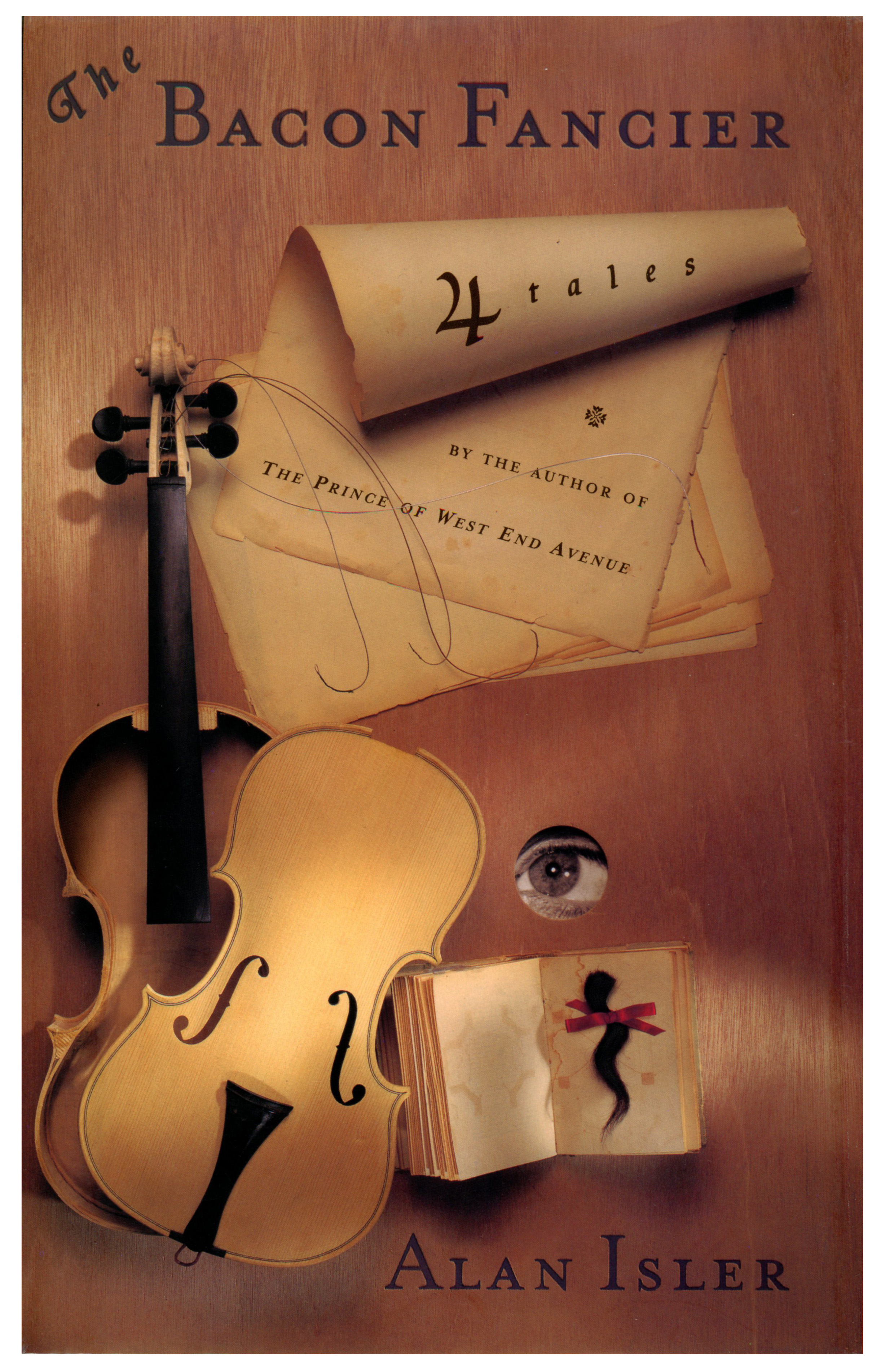
The Bacon Fancier – 4 Tales, by Alan Isler – 1997 [Mark Tauss]

Thus far the only work by Alan Isler that I’ve read, I found the four stories collected within The Bacon Fancier (the title of the book having been derived from the “second” of the four) to be beautifully written, illustrating Mr. Isler’s skill in illustrating commonalities in the historical experience of the Jews transcending time, geography, and the human personality. 

Mr. Isler does this through the creation of vividly depicted protagonists whose lives are crafted in the same degree of fullness regardless of the tales’ setting, or, the predicaments or perplexities that fate or personal decision (but are not fate and personal decision sometimes one and the same?) has forced them to contend with. 

Similarly, the plot of each of the four tales is constructed with a sensibility that bespeaks of serious historical research, undergirded by an understanding of the complexities and contradictions of human nature.  Ultimately, the undercurrent of moral clarity that emerges in his stories could, I think, only have arisen from an author whose own life history or even nominal understanding of life, as a Jew, had included parallel experiences. 

And if not parallel experiences, parallel perceptions.   

While each of the four stories is excellent as a “stand alone” tale, my favorites are “The Crossing” (as relevant today in 2020, as it was when published in 1997, as imagined by Mr. Isler in the world of the late 1800s), and, “The Bacon Fancier”. 

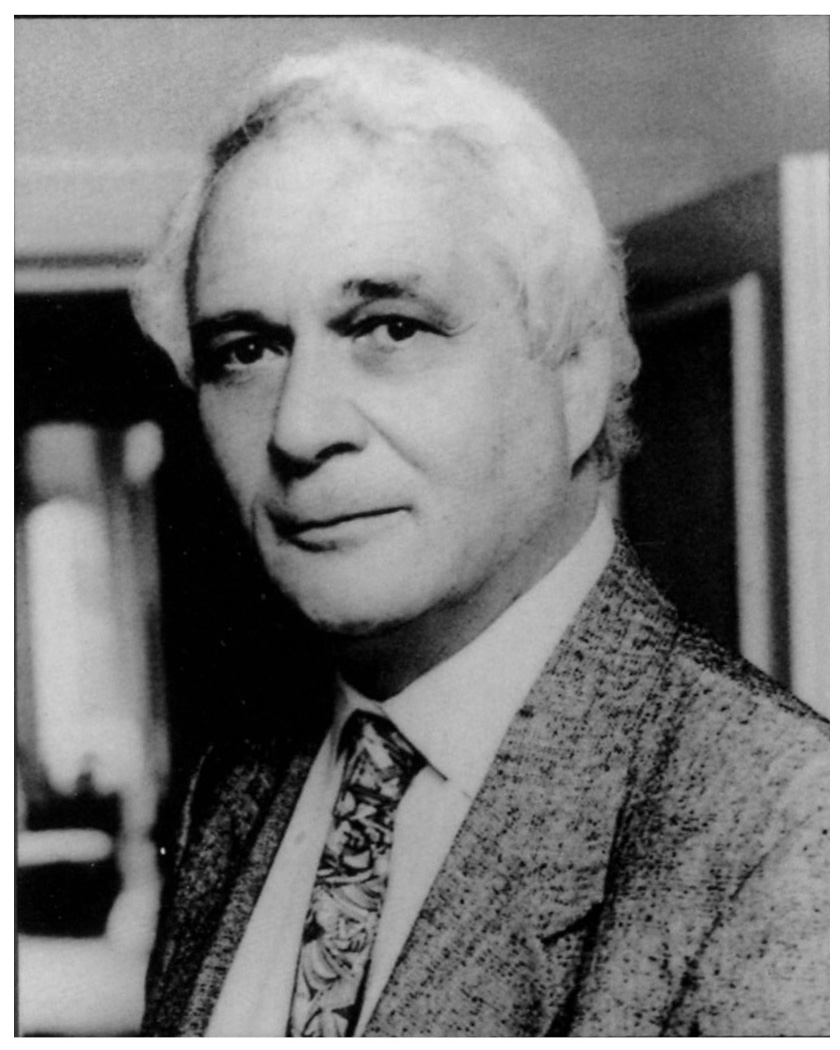
So.  Accompanying the image of Mark Tauss’ cover illustration are quotes from those two tales, as well as Michiko Kakutani’s book review of 4 Tales from the New York Times in July of 1997.

____________________

… the hold that time past exerts over time present …

____________________

The New World, so bright and glistening in the pure and frigid air,
so inviting at the birth of the new year,
offered no solace,
no alleviation.
(The Crossing)

Portait of Alan Isler, by Jerry Bauer

________________________________________

I have not lived my life as a Jew, not really, not here in Porlock. 
There is a mezuzah on my door, of course,
but I do not observe the holidays,
not even the Days of Awe; all these pass me by. 
Candles are alight on my table of a Friday night,
and of a Saturday I do no work. 
Still, I eat what I eat, although before Queenie never pork, never shellfish,
never deliberately a mixing of milk and meat;
and since Queenie, well, as I gave said, I found it prudent not to inquire. 
Of course, as the year rolls round, I say kaddish for my parents;
that, at least, I have always done. 
And I have welcomed the infrequent visits of the occasional Bristol and,
even less frequently, London Jew. 
My co-religionists pressed their fingers to my stomach and conveyed them to their lips. 
In my home they took only ale or cider or porter, bread, and salted herring. 
They talked of the small Jewish communities in this sceptered isle,
in London, in Leeds, in Bristol,
of the importance of marriage, Jew and Jewess,
and of the few others, like me in isolation, the very few, scattered in the south and west,
but married, so far as they knew, every one. 
What could have possessed me, they wondered,
a young man, who, apart from a slight physical disability,
enough perhaps to have denied me a priesthood in the ancient Temple –
here, they smiled ironically –
to separate himself from his fellows, to deny himself a helpmeet,
the very heart and hearth of his home? 
(Queenie, who cheerfully plied them with that sustenance they would,
at least, hungry, accept,
who soon learned that her puddings and her most accomplished dainties were forbidden,
not to say hateful, to them, they ignored as a nonpresence.)
Why, in short, had I chosen to live alone in Porlock?
Why indeed?

(“The Bacon Fancier”, pp. 52-53)

________________________________________

But Gladstone had had enough.
It was not that he lacked the stomach

to sit through yet another of Miss Courtneidge’s “programs” –

although that much was certainly true,
particularly since she herself had spoken of this evening’s list as “jumbo”.
Nor was it that he longed to return to his stateroom,
where, a little before midnight,
he was to be joined by the lubricious Victoria Gammidge –
although that much too was certainly true.
It was that Gladstone had always felt something alien among his gentile countrymen,
even those of that class among whom he had spent most of his life,
those among whom he moved with seeming ease and freedom.
There was forever something behind their hooded eyes, he felt,
some unspoken thing, that locked him out.
Yet through that he had learned to navigate.
So long as the discreet signposts of social intercourse remained fixed in place,
he negotiated quite successful the world in which fortune had placed him.
But when they began to disappear, as now,
when tongues began to loosen from too much wine,
when eyes began to blear or grew fever bright,
when politesse began to sink into good-fellowship,
then Gladstone began to sense his own vulnerability.
He did not fear a physical attack, of course.
No, what he feared was that the unspoken thing would be given utterance,
that acceptance,
conditional upon a conspiracy of silence,
would be publicly revealed as sham.
Making his excuses to his table companions, he rose and left.


(“The Crossing”, pp. 134-135)

________________________________________

Navigating in a World of Gentiles
By MICHIKO KAKUTANI

THE BACON FANCIER
Four Tales
By Alan Isler
214 pages.  Viking.  $21.95.

The New York Times
July 22, 1997

Alan Isler’s new book, “The Bacon Fancier,” reads uncannily like a distillation of his work to date.  His previously demonstrated weaknesses (most notably a tendency to italicize the significance of his stories) are on display in these pages, as are his previously demonstrated strengths: a gift for authoritative storytelling and an ability to combine comedy and tragedy in a unique, idiomatic voice.  What’s more, the volume’s four loosely linked stories recapitulate the central themes of his earlier fiction, the award-winning “Prince of West End Avenue” (1994) and “Kraven Images” (1996): namely, the hold that time past exerts over time present, the role that religion plays in shaping an individual’s identity, and the relationship between art and real life.

Spanning several centuries and two continents, the stories in “The Bacon Fancier” all deal loosely with what it means to be a Jew in a gentile world.  The first tale, “The Monster,” is a kind of improvisation on “The Merchant of Venice,” featuring a narrator who bears more than a passing resemblance to Shylock.  This narrator gives us his version of the notorious “pound of flesh” trial (he claims that Antonio tricked him into the agreement, as “a merry jest”), then goes on to recount another story that illustrates the anti-Semitism routinely directed against Jews in 16th-century Venice.  This second tale concerns a huge but harmless idiot named Mostrino who is beloved by the ghetto children.  To get rid of an annoying English tourist who’s intent on trying to win converts to Christianity, the narrator tells him that Mostrino is “the Defender of the Ghetto,” a golem with the power to destroy unbelievers.  It is a lie that will have tragic consequences when it collides with the city’s prejudice against the Jews.

In Mr. Isler’s other stories, the effects of anti-Semitism are both less violent and more personal.  In the title story, the narrator – a one-eyed violin maker who left the overtly anti-Semitic world of 18th-century Venice for the more covertly anti-Semitic world of London – contemplates leaving his gentile mistress,

Queenie, for a Jewish girl he can marry.  Though he loves Queenie and Queenie loves him, he knows that they can never enjoy a respectable life together.  Indeed Queenie will always be known as the “Jooey Zoor,” the “Jew’s Whore.”

Things are little better, Mr. Isler suggests, in the New World.  In “The Crossing,” a Jewish orphan named David, who has been adopted by the wealthy Gladstone family, boards a ship bound for America.  Though David’s adoptive parents own a financial interest in the ship, though David is traveling first class, he soon becomes aware of the prejudice directed against him.  He is mocked at dinner (“Gladstone?” says another dinner guest, “I’d’ve thought Disraeli”), put down by the father of a young woman he would like to court, and openly scorned by the ship’s captain, when he questions the actions of a drunken American bully.

Gladstone “had always felt somewhat alien among his gentile countrymen,” writes Mr. Isler, adding: “There was forever something behind their hooded eyes, he felt, some unspoken thing, that locked him out.  Yet through that he had learned to navigate.  So long as the discreet signposts of social intercourse remained fixed in place, he negotiated quite successfully the world in which fortune had placed him.  But when they began to disappear, as now, when tongues began to loosen from too much wine, when eyes began to blear or grow fever bright, when politesse began to sink into good-fellowship, then Gladstone began to sense his own vulnerability.  He did not fear a physical attack, of course.  No, what he feared was that the unspoken thing would be given utterance, that acceptance, conditional upon a conspiracy of silence, would be publicly revealed as sham.”

By the time we reach the last story, set in contemporary New York, anti-Semitism is less a conscious prejudice than a casual byproduct of callousness and greed.  In this case, the hero – an extra in a small Greenwich Village opera company – is offered the chance to star in a musical about the Dreyfus affair.  While he finds the show shallow and offensive, he – like many others – will profit from its success.

While Mr. Isler’s efforts to link these four stories feel highly perfunctory and his efforts to lend them resonance through a series of literary allusions can feel strained, his sheer abilities as a storyteller force the reader to shrug such misgivings aside.  There is an assurance to his writing that enables him to fold digressions and speculative asides effortlessly into his tales, coupled with a wry affection for his characters that makes their stories poignant and funny and sad.  Mr. Isler did not begin writing until late middle age – his first novel, “The Prince of West End Avenue” was published when he was 60 – but these stories make it clear that he’s a natural.


War and Peace, by Leo Tolstoy – Abridged by Edmund Fuller – September, 1962 (1955) [Richard M. Powers]

The definition of abridgement, from Merriam-Webster: “A shortened form of a work retaining the general sense and unity of the original.”

Hmmm…. 

Given the number of characters, geographic and temporal scope, moral, political, and philosophical depth, complexity of plot, sheer quantity of details, and sheer length of Leo Tolstoy’s War and Peace, one would think that the novel would not be readily amendable to abridgement.  But as seen below, not so!

Having read the Penguin Classic paperback edition of the novel (copyright 1978; ISBN 0 14 044 417 3), which, including the 44 pages of “Part Two” runs to 1444 pages, it would be intriguing to read Edmund M. Fuller’s 1955 abridgement which, printed in a slightly larger font than the former, runs to 512 pages.  In any event, the effort to abridge Tolstoy’s novel must have been extraordinarily challenging.

But, for now, I can still appreciate the stylized composition of the Russian double-headed eagle that forms the central motif of the cover, which hovers over soldiers at the lower left, and church spires at the lower right. 

The artist?  Richard Powers, the same Richard Powers who created so many innumerable and stunning compositions for science-fiction paperbacks of the 50s and 60s.  The cover of this Dell paperback represents his only non-science-fiction art that I’ve thus far found. 

Perhaps there’s more, out there?

The God in The Trash: A Review of the Works of Philip K. Dick, by Alexander Star (The New Republic, December, 1993)

Being that I’m currently binge-watching Amazon Prime’s The Man In The High Castle (on Season Three just now) while holding off on season four of The Expanse ’til I’m done (aaaargh! – how much longer can I wait?!), I though it apropos to present Alexander Star’s perceptive and pithy essay about Philip K. Dick’s life and literary oeuvre, which was published in The New Republic in 1993. 

Alexander Star’s essay includes a portrait of PKD by former punk rock band manager (for the Germs) and actor & writer (for The Pee-Wee Herman Show) / script editor / author / essayist / photographer / jeweler (and more) Nicole Panter.  (See photo below.) 

Nicole Panter’s Flickr photostream also includes a superb 1978 color image (posted in 2008) of PKD, Nicole herself, K.W. Jeter and Gary Panter.  Being that I’ve no idea whether the image is copyrighted or not, I’m not actually presenting it “here”, in this post.  Rather, you can view it at Ms. Panter’s Photostream, here.  

________________________________________

The God in the Trash

The fantastic life and oracular work of Philip K. Dick

BY ALEXANDER STAR

The New Republic
December 6, 1993
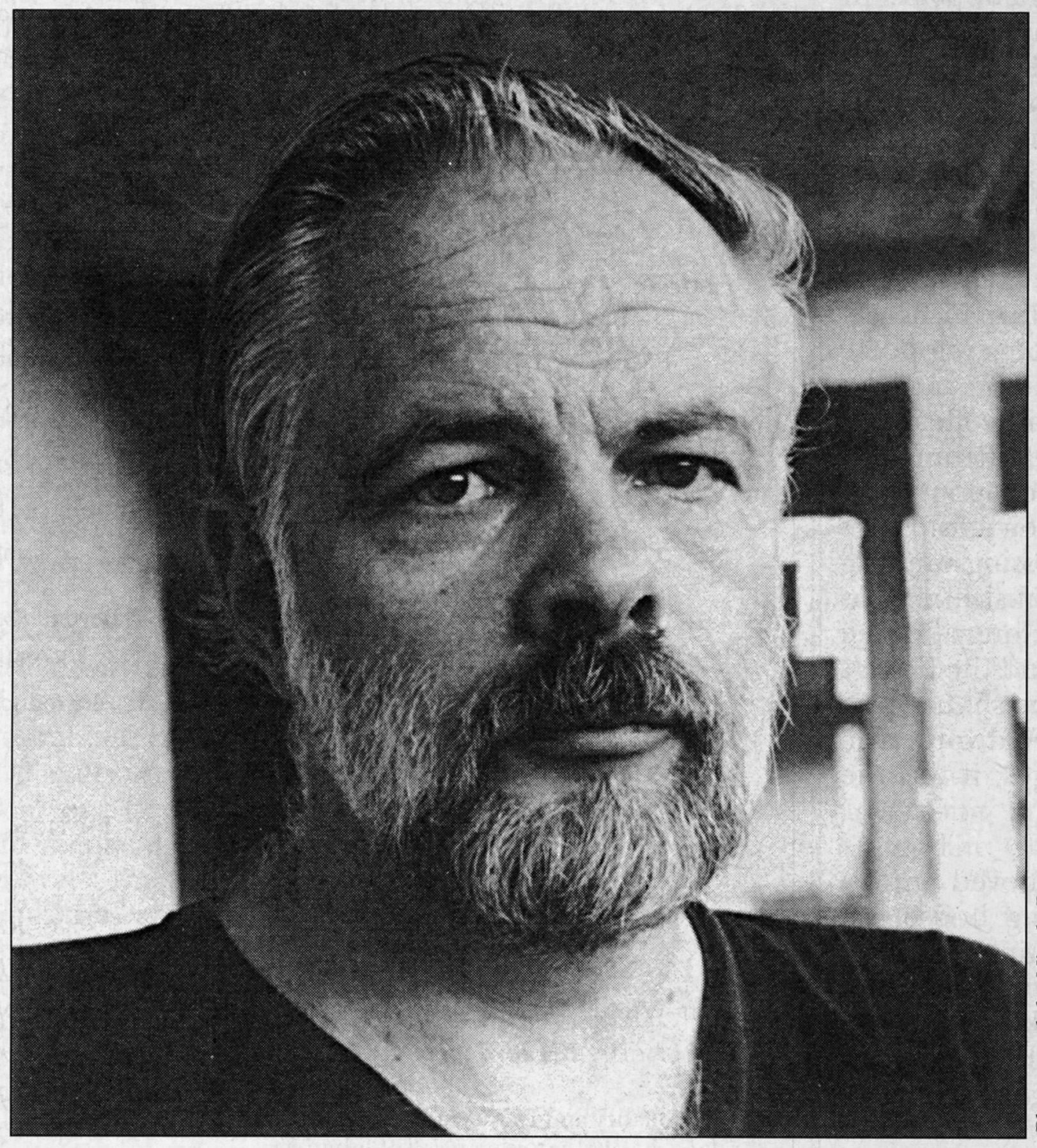
(Photograph of Philip K. Dick by Nicole Panter)

________________________________________

Eye in the Sky by Philip K. Dick (Collier, 243 pp., $9 paper)
Time Out of Joint by Philip K. Dick (Carroll & Graf, 263 pp., $3.95 paper)
The Man in the High Castle by Philip K. Dick (Vintage, 259 pp., $10 paper)
The Three Stigmata of Palmer Eldritch by Philip K. Dick (Vintage, 230 pp., $10 paper)
Ubik by Philip K. Dick (Vintage, 216 pp., $10 paper)
Do Androids Dream of Electric Sheep? by Philip K. Dick (Ballantine, 216 pp., $4.95 paper)
A Scanner Darkly by Philip K. Dick (Vintage, 278 pp., $10 paper)
Valis by Philip K. Dick (Vintage, 256 pp., $10 paper)
The Collected Stories of Philip K. Dick (Citadel Press, 5 volumes, $12.95 each)
In Pursuit of Valis: Selections from the Exegesis edited by Lawrence Sutin (Underwood-Miller, 278 pp., $14.95 paper)
Divine Invasions: The Life of Philip K. Dick by Lawrence Sutin (Citadel Press, 352 pp., $12.95 paper)
On Philip K. Dick: 40 Articles from ‘Science-Fiction Studies’ edited by R.D. Mullen et al.  (SF-TH Inc., 290 pp., $24.95, $14.95 paper)

I.

Eleven years after his removal to a Colorado graveyard, Philip K. Dick is among the busiest of American writers.  New novels arrive regularly from the tomb; box office smashes (Total Recall) and Hollywood classics (Blade Runner) are spliced from his work; young writers of diverse persuasions sit raptly at his icy feet.  A science fiction journeyman, ardent bohemian and restless observer of suburban life, Dick never discovered a place for himself while he lived.  He was dismissed as a crackpot and hailed as a “visionary among charlatans”; and like most visionaries, he had a hard time finding a publisher.  Today his published work could fill a small bookstore.

To enter a novel by Philip K. Dick is to enter a zone of disappearing worlds, nested hallucinations and impossible time-loops.  This domain is inhabited by lonely repairmen, egotistical entrepreneurs and hapless housewives, and strewn with slant humor and menacing paradox.  Although the books vary, their inspiration is always the same: they are governed by a passionate apprehension of appearances.  Few writers have ever been so distrustful of the phenomenal world.  Dick’s characters are driven to doubt their environment, and their environment is driven with an equal and opposite force to doubt them.  There is always some primal error in Dick’s fictions, something “out of joint,” and the location of that error – inside the individual or outside the individual – can never be decided upon.  Dick systematically blurs the boundaries between mind and matter, between storms in the psyche and crises of the atmosphere.  The coiling search to set things right is doubled and redoubled and doubled again.  Dick never met a story that ended or a regression that was finite.

Although he is still pigeonholed as a writer of science fiction, Dick had little respect for the prestige of science, and even less for the dignity of fiction, to which it must be said he contributed very little.  His interest in hard and applied science was minimal, extending not far beyond a persistent (and unhappy) acquaintance with the details of automobile repair.  His maddeningly profuse plots make a mockery of the notion that the novel can be a stable and self-sustaining work of art.  And yet, all this notwithstanding, Dick’s novels demand attention.  They intrude extreme experiences into everyday scenarios with compassion, humor and poise.  He is both lucid and strange, practical and paranoid.  (“By their fruits ye shall know them, and their fruits are that they communicate by radio.”)  There is nothing merely willful or notional in the bizarre aspects of Dick’s work.

As an experimental writer of the 1950s and ‘60s, Dick belongs in the company of William Burroughs, J.G. Ballard and Thomas Pynchon.  His novels recall Burroughs’s pitiless cycles of addiction and schizophrenia and Ballard’s eroticized landscapes of celebrity and death.  What he lacks of Ballard’s unnerving coolness and Burroughs’s deadpan swagger, he makes up for with a compassion that is quite alien to them.  His most esoteric dismantlings of reality still insist on the need for human empathy; and they do so with an alertness to the serious obstacles that empathy must sometimes encounter.  Like Burroughs, his clipped prose wittily recycles the cliches of advertising lingo (“Emigrate or Degenerate: The Choice is Yours”) and pulp writing (“You’re a successful man, Mr. Poole.  But, Mr. Poole, you’re not a man.  You’re an electric ant”).  Sometimes it reaches a higher level of eloquence.  In his later years, as he came to believe that the revelations of a medieval rabbi were reaching him through occult channels, Dick’s sanity was open to question.  But throughout his career he wrote with qualities that are rare in a science fiction writer, or in any writer at all.  These included a sure feel for the detritus and debris, the obsolescent object-world, of postwar suburbia; a sharp historical wit; and a searching moral subtlety and concern.

II.

A heavy man with an absent smile and an intent gaze, Philip Dick typed 120 words a minute even when he wasn’t on speed, drank prodigious quantities of scotch and completed five marriages and over fifty novels before the pills and the liquor conspired to kill him at 54.  His busy life has been ably narrated by Lawrence Sutin in his biography, Divine Invasions, which appeared a few years ago.  Born in 1928, Dick witnessed the Depression from inside a broken home.  His father, an employee of the Department of Agriculture, left the family in 1931 and went on to host a radio show in Los Angeles called “This is Your Government.”  Dick grew up with his mother on the fringes of Berkeley’s fledgling bohemia.  A troubled student, he was often “hypochondriacal about his mental condition,” as one of his wives later put it.  And like many troubled boys of the time, he became a voracious reader of the science fiction pulp magazines that were then at their peak.  In Confessions of a Crap Artist, a novel written in 1959, he wryly portrayed himself as an awkward kid spouting oddball ideas from Popular Mechanics and adventure stores: “Even to look at me you’d recognize that my main energies are in the mind.”

Dick evidently had few friends until he went to work at a record store in Berkeley, where he acquired an encyclopedic knowledge of classical music and the friendship of customers and colleagues.  “Art Music” was also a site of romance.  The employees, university dropouts with time to spare, courted their customers with cunning; after impressing one frequent browser with his musical expertise, Dick married her.  Not long after the wedding they quarreled, and the bride’s brother threatened to smash his precious record collection.  A divorce followed; of his five marriages, it was the shortest.

In 1947, Dick moved into a Berkeley rooming house, living for a short time with the poet Robert Duncan.  After one unhappy term at Berkeley in 1949, he married again and settled down to a writing career, publishing his first science fiction stories in 1952.  Dick entered the market at a time when the genre was in flux.  Like the big bands, the great pulp magazines of the ‘30s declined after the war.  They were replaced by a flood of cheap paperbacks, and the leading format for science fiction became the “double paperback” published by Ace Books, two novels together in one binding with a different lurid cover illustration on each side.  Throughout the ‘50s Dick worked closely with Ace’s top editor, Don Wollheim.  Typing from morning to night, he cranked out large quantities of prose, and turned himself into a typically prolific and typically uneven writer of the genre.

Dick was not unsuccessful at this: his novel Solar Lottery, published in 1955, sold 300,000 copies, and he became one of the first clients of the powerful agent Scott Meredith.  Still, it was not a writer’s life; royalties were meager and manuscripts were altered at will to ensure the proper amount of extraterrestrial warfare and gee-whiz gadgetry.  (The Zap Gun was written because Wollheim insisted on publishing a book with that title.)  As he read widely Dick’s frustrations with science fiction grew, and his discontent became apparent.

Throughout his career Dick longed for a wider audience, and sought to escape the science fiction ghetto.  He envied writers such as Ursula Le Guin, who acquired a serious reputation and was even published in The New Yorker.  His readers, he complained, were “trolls and wackos.”  In the ‘50s and early ‘60s, he wrote a series of non-science fiction novels, all of which were rejected by publishers at the time.  These books were mainly somber tales of thwarted love in northern California, peopled with cranky record salesmen and bitter couples and narrated in a glumly painstaking fashion.  On the whole, their vision of domestic life is an unhappy one.  In Confessions of a Crap Artist, an accumulation of errant jealousies and petty insults leads to illness and insanity.  The novel ridicules the newly formed UFO cults of Marin County, though years later Dick reflected that the cults “didn’t seem as crazy to me now …”

Rebuffed by “mainstream” publishers, Dick abandoned his realist writings in 1963.  By then he had discovered a different way out of the Ace formula: he would transform the genre of science fiction from within.  Concerned with psychic dislocation, and its moral and philosophical consequences, he began to ignore the expectations of his editors.  In particular, he disregarded the most honored conventions of “hard S.F.,” that science fiction should be rigorously “extrapolative” of hard science, and that it should be “prophetic” of plausible futures.

By the late ‘50s, these conventions had a long and venerable history.  When Hugo Gernsback started his magazine Amazing Stories in 1926, initiating modern science fiction, he hired Thomas Edison’s son-in-law as a fact checker.  In its heyday, John W. Campbell Jr.’s Astounding Stories [sic] insisted that writers postulate one outlandish circumstance – the “what if?” clause – and rigorously follow the laws of science from there.  After World War II these conventions loosened, as the optimistic narrative of invention and discovery was tempered by dystopian broodings and doubts about the authority and integrity of science.  But the most important figures, Asimov, Heinlen, Bradbury, remained faithful to the Campbellian requirements of scientific accuracy and plausible prophecy.  As Asimov put it, “In my stories I always suppose a sane world.”

Philip Dick’s fictional worlds have a great many attributes, but sanity is not among them.  Campbell, the monarch of postwar science fiction, refused to publish his stories because they were “too neurotic.”  In his preoccupation with abnormal psychology, collective delusions and implanted memories, Dick in part followed the path of irregular science fiction writers of the ‘50s such as A.E. van Vogt and Theodore Sturgeon.  Yet he ranged further in his subversions.  Dick continued to rely on the ready-made materials of science fiction, the pulp prose, the planetary conflicts, the “psionic” powers of “precogs” (who read the future) and “telepaths” (who read minds); but he employed these materials to his own extravagant ends.

Dick’s novels of the late ‘50s were littered with intellectual debris of the period: the existential psychoanalysis of Ludwig Binswanger, popularized in America by Rollo May; the cybernetics of Norbert Weiner [sic] and the game theory of John von Neumann; gestalt psychology and Carl Jung; Tibetan Buddhism and the I Ching.  Eye in the Sky (1957) amusingly presents a nation given over to ostentatious piety and soulless technocracy.  Its engineers stabilize “reservoirs of grace” while “consulting semanticians” secure communication lines with God and IBM computers tabulate credits toward salvation.  (The satire of religious fundamentalism worried Dick’s editors at Ace, who changed a central character into a Muslim to avoid offending readers.)

Time Out of Joint, which appeared in 1959, departed even further from the norms of science fiction.  Its first hundred pages unfold a slow-paced story set in a small west coast town.  Evidence that something is “out of joint” gradually amasses, until the startling scene when a soft-drink stand vanishes into a strip of paper labeled “SOFT-DRINK STAND” and the entire community is revealed to be a Potemkin village; it is, in fact, an artificial replica of the ‘50s constructed in 1994 to salve the nerves of the protagonist, whose sanity is essential to national security.  In 1959 Dick was already proposing that the ‘50s themselves were a kind of pacifying fantasy available for the nostalgia of future generations.  Where traditional science fiction stirred anxieties about the future, Dick deftly introduced his uncertainties into the present and recent past.  Despite the concluding narrative fireworks, Ace refused to publish Time Out of Joint, and Doubleday brought it out instead as a “novel of menace.”

Dick’s biggest literary advance came in 1962, when he published The Man in the High Castle.  This study of an alternate universe in which the Axis won the Second World War was entirely devoid of the usual sci-fi devices.  (“No science in it,” a character observes.  “Nor set in future.”)  Mr. Tagomi, a Japanese bureaucrat and connoisseur of American antiques, is one of Dick’s most sympathetic characters.  Repelled by international intrigue and devoted to the occult beauty of old bottle caps and cheap jewelry, he resists Nazi brutality with a fragile but steady will.  Alter Bormann dies, a power struggle breaks out among the remaining Nazi leaders (Hitler has long since entered a sanitarium) and Tagomi unhappily plays one faction off against another, aware that they are all unspeakably evil.  Ingeniously, the book contains its own counterfiction: in this America divided into German and Japanese zones, rumors spread of an incendiary novel speculating that the allies actually won the war.  The narrative adroitly maneuvers back and forth between these two competing accounts of what is real.  The Man in the High Castle was Dick’s most assured and subtle work, and he hoped it would win him a wider audience.  He was chagrined when reviewers treated it as just another thriller.  Ironically, it was the science fiction community that celebrated the book, bestowing the Hugo Award on it in 1963.

Fueled by marital troubles, esoteric visions and an epic diet of speed and scotch, Dick composed eleven novels in a hectic two-year period.  The Three Stigmata of Palmer Eldritch (1964) and Ubik, written in 1966, are his ‘60s classics, his wildest experiments in the manufacture and management of chaos.  These are not Dick’s most accessible or likeable books, but they are his tours de force.  (Both are among the dozen titles by Dick that Vintage Books has happily reissued over the past three years.)  The time-loops and the Conspiracies, the conflicts between frail human subjects and large unsettling forces, the disorientations of perspective: all of these deuces are brought to new levels of complexity and compression.

In 1963, Philip Dick experienced the first of a number of “visions” that were to augment and to anguish his life.  Depressed by a failing marriage and troubled by memories of his lather’s wartime gas mask, Dick reported that he saw “a vast visage of evil” in the sky.  It had “empty slots for eyes, metal and cruel, and worst of all, it was god.”  Out of this emerged the demiurgic figure of Palmer Eldritch in The Three Stigmata of Palmer Eldritch, an interstellar drug lord luring his customers and competitors into a “negative trinity” of “alienation, binned reality and despair.”  Eldrilch’s powers are not absolute, but they are sufficient to rob other characters of confidence in their reality and in themselves.  “We see into his eyes,” they fret, and we see out of his eyes.”  In a typical conundrum, the protagonist, Leo Bulero, finds himself stranded in a blurred landscape, a “plain of dead things,” unable to know whether he is still in the grip of one of Eldritch’s hallucinations or whether he has returned to his original “reality.”  He meets two men, shakes their hands and watches his lingers slip through theirs.  He would assume that they are phantasms but they assume, just as reasonably, that he is a phantasm; and he concedes that they might be right.  In the realm of the “irreal,” as Dick called it, to doubt the solidity of one’s surroundings is to doubt the solidity of oneself.

In Palmer Eldritch Dick perfected one of his “irreal” themes, the nested hallucination.  In Ubik he perfected another, the experience of entropy, the onset of “decay, deterioration and destruction.”  Imprisoned in a purgatorial “half-life,” the paralyzed characters of Ubik witness the spread of a cataclysmic force, a mass “reversion of matter” that causes objects lo revert to prior forms of themselves: televisions become radios, spray cans turn into jars of ointment.  They struggle with their “obsessive fears that the entire world is turning into clotted milk” and “worn-out tape recorders,” that “all the cigarettes in the world are stale.”  Stranded in his apartment, the central character resignedly watches his sleek, modern elevator become a creaky and dangerous relic.  Ubik is a comedy of enforced obsolescence; the most familiar things acquire an unruly resonance as they confront their own historicity.

These two novels established Dick’s reputation as a master of experimental science fiction.  Ubik inspired his election in Europe to the College du Pataphysique, a kind of Academie Francaise for Dadaists, and John Lennon expressed an interest in producing a film of Palmer Eldritch.  “New wave” science fiction writers of the late ‘60s, led by Harlan Ellison, regarded him as a godfather.  But Dick, as usual, received few financial rewards.  The middle-aged pataphysician found himself living on welfare in a “run down, rubble-filled” house in Santa Venetia, a notorious crash-pad for dealers and runaways.

Squabbling with girlfriends, fearing the FBI and the IRS, Dick succumbed to serious bouts of paranoia and unease.  (His paranoia was not entirely without foundation: in 1957 the CIA had in fact intercepted a letter that he had sent to a Soviet physicist.  Fortunately he never knew of the Department of Health, Education and Welfare’s intention to compile a bibliography of drug-related science fiction.)  In 1971 Dick’s stability declined further when someone broke into his home and looted his papers.  He devoted countless hours of speculation to the identity of the burglars.  It was his own private Watergate.  At various times he suspected the FBI, the Black Panthers, a gang of local drug dealers, right-wing militiamen and himself.  He retrieved one tentative lesson from the debacle: “At least I’m not paranoid.”

Dick’s writing of this period trembles with fear of a totalitarian “betrayal state” of advanced surveillance and narcotic intrigue.  His novels envisage a burned-out post-’60s nation headed into a dark age of police repression and entertainment-enforced normality.  In Flow My Tears, The Policeman Said (1974), the authorities deploy an arsenal of bugs, sensors, minicams and tattoos to solve the mystery of a man who thinks that he is a television talk show host even though no one has heard of him.  A Scanner Darkly (1977) sympathetically observes the unraveling of Bob Arctor, an undercover cop in a Los Angeles police state where “straights” and addicts inhabit segregated areas and where access to shopping malls is restricted to those with the correct credit cards.  Arctor slowly becomes unhinged as he is forced to narc on himself.  Witnessing his friends’ fuzzy chatter (“Bob, you know something …  I used to be the same age as everyone else”) and acute distress, he worries that “the same murk covers me.”  Eventually it does; his brain splits into two distinct identities, his thinking comes to a halt and he becomes dead to the world: “His circuits welded shut.”  With its well-scored drug talk and its terrible portrait of a mind becoming opaque to itself, A Scanner Darkly is Dick’s funniest novel, and his most affecting.

In 1972, striving to escape the druggy clutter, the spreading “murk,” of his life, Dick traveled to Vancouver, where he gave a speech to an annual convention of science fiction writers.  In his lecture, “The Android and the Human,” Dick fashioned a kind of homespun anarchism, honoring young people of the ‘60s for their “sheer perverse malice,” their willingness to defy power, to “build improved electronic gadgets in your garage that’ll outwit the gadgets used by the authorities.”  Eschewing the dogmas of the New Left, he warned that all systems of explanation tend toward overdetermination, toward paranoia.  Paranoia, for Dick, was a temptation and a trap.  He feared conspiracies, and he feared the debilitating consequences of his fears.  And so, he advised, one “should be content” with the fleeting and the marginal, the “mysterious, the meaningless, the contradictory, the hostile and, most of all, the unexplainably warm and giving.”  This sudden, self-justifying affection, which Dick also referred to as “caritas” and as “empathy,” was the only guarantee of the “human.”

Having diagnosed the breakdown of society in his speech, Dick suffered a breakdown of his own and checked into a Vancouver clinic run on brutal Synanon-style principles of rehabilitation.  He was appalled by the clinic’s ruthless assault on its patients and their personalities, but his worst pill-popping days were through.  Lured by a college professor who admired his work, he returned to California and moved into a “jail-like, full-security” apartment complex in Orange County.  He married again and began to clean up his life, even writing to President Nixon and offering his assistance in the war against drugs.

But a complacent Orange County serenity was not at hand.  In March 1974 Dick underwent a series of visions that astonished and thrilled and hounded him for the rest of his life.  An onslaught of otherworldly insight and illumination seemed to press down on him for weeks.  (“Once God started talking …  he never seemed to stop.  I don’t think they report that in the Bible.”)  The elements of this experience, which he returned to obsessively in his writing, were many: flickering sequences of abstract color, three-eyed “invaders,” Latin and Russian texts, visions of a “Black Iron Prison,” messages that the Roman Empire never died, “hideous words” spoken out of an unplugged radio, a beam of pink light conveying knowledge.

When it was over, he believed that he had received confirmation that the universe was indeed the “cardboard fake” that he had long portrayed it to be.  As in gnostic myth, the world of appearances was an “iron prison” under the sway of a defective deity; illumination was available only from outside the prison, from a pure source of knowledge that Dick referred to as a ‘Vast Active Living Intelligence System” (VALIS).  For the remaining eight years of his life he filled notebook after notebook with an “Exegesis” of these peculiar days, constructing a gnostic cosmology involving “a double exposure of two realities superimposed.”  But Dick was never satisfied with his speculations.  In the Exegesis and in his novel Valis (1981), he wrestled with himself, asking over and over whether his revelations were real, and if they were not, what had triggered them.  (Radio signals from the future?  Water-soluble vitamins?  A stroke?)

Dick observed in 1978 that “my life …  is exactly like the plot of any one of ten of my novels or stories.”  After systematically dislocating the reality-principles of his readers, he came to find his own relation to reality increasingly unsure.  He combed T.V. ads and record albums for signs of VALIS, the hidden god.  Dick left his last wife in 1976 and moved back north to Sonoma, where he cruised the local asylum for dates and wrote The Transmigration of Timothy Archer (1982), a troubled memorial to his friend James Pike.  (Pike, the former Episcopalian bishop of California, had vanished in the Jordanian desert looking for Jesus, leaving behind two bottles of warm Coke and a road map.)  Meanwhile the Exegesis became a sprawling spiritual diary, by turns ordinary and extraordinary, filled with philosophical disputation, personal reminiscence and analysis of his previous work.

In the early ‘80s Dick’s hopes for renown revived, as younger writers arrived at his doorstep, royalties increased and German, French and Japanese editions of his work proliferated.  Back in the early ‘70s he had optioned his 1968 novel Do Androids Dream of Electric Sheep? to Hollywood; by 1980 the producers of the film promised that it would be the next Star Wars.  (Dick hoped that Victoria Principal would have a starring role.)  In fact, Blade Runner was a commercial disappointment in its initial release.  But Dick never knew of its early unsuccess.  In March 1982, he died of a stroke after proudly attending an advance screening of the movie.

Despite the greater comfort and recognition in his last years, Dick maintained his restless work on the Exegesis, ever lamenting the failure of his visions to repeat themselves, their maddening resistance to explanation.  Later passages of the Exegesis express his mingled resignation, devotion and ingenuity: “My attempt to know (VALIS) is a failure qua explanation …  Emotionally, this is useless.  But epistemologically it is priceless.  I am a unique pioneer …  who is hopelessly lost.  & the fact that no one yet can help me is of extraordinary significance!”  Like one of his own perplexed characters, strung out between parallel worlds, Dick never solved the puzzles that rattled him.  “They ought to make it a binding clause that if you find God you get to keep him,” he wrote sadly in Valis.  “…  Finding God (if indeed he did find God) became, ultimately, a bummer, a constantly diminishing supply of joy, sinking lower and lower like the contents of a bag of uppers.  Who deals God?”

III.

In the years since his death, Philip Dick has attracted a small army of interpreters.  He has been seen as a prophet of “hyperreality”; as a beleaguered and heroic humanist, championing “moral sanity” as his mind suffered; and as a gnostic visionary of the suburbs.  Marxist critics and theorists of postmodernism have busily sifted through his work, investigating its debased commodities and corporate conspiracies, its cold war fears and its elevation of paranoia into principle.  Dick’s fiction, in the view of the critic Scott Durham, is nothing less than a full-blown “theology of late capitalism” that “reflects on the psychic strains of the transition to postindustrial capitalism.”  According to Jean Baudrillard, one of Dick’s many French fans, it is “a total simulation without origin, past or future.”

Dick himself, interestingly enough, was alternately gratified, amused and alarmed by the attention that modish critics gave to his work.  When a delegation of French authorities visited him in Orange County to discuss his notions of “irrealism,” he offered them an exposition of his views, but as soon as they left he telephoned the FBI and warned that there was a gang of subversives in the neighborhood.  (Dick’s politics were never especially coherent; he nearly dedicated A Scanner Darkly to Nixon’s Attorney General Richard Kleindienst, but in the Exegesis he treats Nixon’s resignation as a providential event in sacred history.)  The Marxist and postmodern readings of Dick’s work are often informative; his novels do have more than their share of simulacra and spectacles, fractured identities and postindustrial proletariats.  But these readings do not do justice either to his insistence on compassion as a stabilizing force or to his earnest search for an “absolute reality.”  Their anatomy of “irrealism” is incomplete.

What, then, does this “irrealism” consist of?  In the Exegesis, Dick confided that his writing had a single overriding theme: it indicted “the universe as a forgery (& our memories also).”  In book after book, Dick portrayed the onset of doubt, of an elemental estrangement from reality.  The perceived defect in the substance of the world is traced back to a variety of sources – atomic catastrophes and potent drugs, dangerous gods and political conspiracies, schizophrenic derangement and paranoid insecurity.  But the origin doesn’t really matter; it is the experience of “irreality” that interested him most.  As his characters confront exasperating hallucinations and intersecting time-sequences, they respond with a typical blend of desperate speculation, cautious empathy and brittle humor.  (“God is responsible for everything, but it’s hard to get him to admit it.”)

The most recurrent anxiety in Dick’s fiction is that beneath the surface of appearances there is nothing except crude building materials: struts, wire, floor joists, rotten boards.  This anxiety was suited to its times.  The postwar heyday of science fiction coincided with a nationwide accumulation of raw materials; the United States became a Popular Mechanics Utopia.  There was plenty of tin and wire and aluminum to go around, and there were plenty of young inventors prepared to devise ingenious contraptions in their garages.  More than any other science fiction writer, Dick turned these innocuous materials into the stuff of nightmare.  What if the paste and wire and tinfoil substratum of the built environment was also the substratum of our own bodies and minds?  Such a possibility arises in one Dick novel after another: that the world is made of “wires and staves and foam-rubber padding,” that a man is a “skeleton wired together …  with bones connected with copper wire …  artificial organs of plastic and stainless steel …  the voice taped.”

Indeed, you never know when one of Dick’s full-bodied characters might become a creaky automaton, no longer capable of empathy, love or spontaneity.  Sometimes the transposition is metaphorical: “Her heart …  was an empty kitchen: floor tile and water pipes and a drainboard with pale scrubbed surfaces, and one abandoned glass on the edge of the sink that nobody cared about.”  Often it is deadly literal.  In a harrowing passage of A Scanner Darkly, Dick compares an addict to a machine, programmed to find the next score.  A junkie is a “closed loop of tape” with a “brain of twisted wire”; his voice is “the music you hear on a clock-radio …  it is only there to make you do something …  He, a machine, will turn you into his machine.”

In many of Dick’s early novels, these distortions of perspective are attributed to paranoia.  His characters fear conspiracies and plots, preordained worlds where “there are no genuine strangers.”  They also fear ordinary appliances and fixtures, dreading that “everything has a life of its own, vicious and hateful.”  Things, appliances, entire houses suddenly come alive, bristling with menace.  In later novels, the focus shifts to schizophrenia.  Dick’s interest in abnormal psychology led him to the work of

Ludwig Binswanger, a Swiss psychoanalyst who believed that schizophrenia involved a disturbance in the patient’s orientation toward time.  In his famous paper, “The Case of Ellen West,” Binswanger described the “tomb world” that his subject seemed to inhabit, a realm of “moldering and withering” in which time no longer moved forward and West felt like “a nothing, a timid earthworm smitten by the curse surrounded by black night.”

For Dick, the tomb world connoted a kind of interior entropy, a sentiment that the world and oneself are inexorably “moving toward the ash heap.”  The process of decline is all-embracing: people, places, things, time and space themselves all seem caught in a great storm of regression.  Terrifying visions of the tomb world recur throughout Dick’s novels of the late ‘50s and ‘60s.  Tagomi, the sympathetic aesthete-bureaucrat of The Man in the High Castle, recoils from the presence of evil and likens human beings to “blind moles, creeping through the soil, feeling with our snouts.  We know nothing.”  In Martian Time-Slip (1964), the autistic child Manfred intuits a grotesque future of ashen limbs and dust-covered rubble.  In Do Androids Dream of Electric Sheep? a radiation-damaged truck driver lives amidst global scarcity and barren silence.  Ubik is his greatest distillation of the theme; in a film scenario for the novel, Dick brilliantly proposed to embed this decay in the movie itself, using older film stocks and directing techniques as the story progressed.

Dick’s alterations of ordinary reality, his tomb worlds and time-loops, never seem like conjuring tricks because he is able to establish the tangibility and the immediacy of the worlds that he disrupts.  In Time Out of Joint, the bitter couple-swapping and boredom of ‘50s suburbia are nimbly detailed.  Every potato peel and pinup photo is fully observed before the arrival of “leaks in our reality.”  As the town begins to flicker in and out of view, Dick hauntingly presents the edges of his pseudo-environment: Main Street trailing off into a half-glow of empty shopping strips and gas stations, the bus station queues that don’t move, the strange airplanes that signal overhead.

Setting the immediate and the “irreal” into a precarious balance, Dick presented litanies of destruction, detailed inventories of objects that are named only as they vanish.  In Time Out of Joint, we see “the soft-drink stand go out of existence, along with the counter man, the cash register, the big dispenser of orange drink, the taps for Coke and root beer, the ice-chests of bottles, the hot dog boiler, the jars of mustard, the shelves of cones, the row of heavy round metal lids under which were the different ice creams.”  In Eye in the Sky, the survivors of a nuclear accident find themselves trapped in each others’ hallucinations.  One member of the group is a fastidious Victorian moralist whose mind is a sexless place of soap factories and shrubbery.  (For her, Freud believed in a basic urge to create cultural masterpieces, and worried that this impulse might be sublimated into sexual desire.)  As she recoils from the polluted objects of the world, she wills their destruction.  “Cheese, doorknobs, toothbrushes,” she calls out, and they all vanish.  Her dismal roll call continues, and the entire planet begins to disappear.

Dick’s narrative method, here and elsewhere, is to furnish the world as he dismantles it.  On a political level, this operation encapsulates the nuclear anxieties of the ‘50s.  The artifacts of everyday life take on an extra poignancy, and a heightened presence, under the conditions of their own possible destruction.  Indeed, only the specter of total incineration can make the sprawling banality of the California suburbs into something precious.  But these vanishing things are also vulnerable to other, less apocalyptic dangers.  In the degraded landscape of postwar consumerism, commodities are obsolescent and bear the seeds of their own demise.  Dick sifts through the trash, the old magazines and the soiled wrappers; it is only a matter of time, he suggests, before the suburbs are swallowed by their own landfills.  On an occult level, Dick’s negations suggest something very different.  Just as the mind can make the world, he implies, so it can unmake it.  In a reversal of Adam’s naming of the animals, the bestowal of names robs things of their materiality, it causes them to vanish.  The danger, of course, is that you might not be the one with the power to name names.  You might be on the list.

Dick’s fallen worlds are not, to put it mildly, happy places.  And yet they are at least partially redeemed by fleeting glimpses of a hidden god.  ‘Trash” and divinity, Dick believed, were intimately linked.  In an Exegesis entry, he wrote: “Premise: things are inside out …  Therefore the right place to look for the almighty is, e.g., in the trash in the alley.”  A “concealed god,” he added in Valis, takes on “the likeness of sticks and trees and beer cans in gutters”; he “presumes to be …  debris no longer noticed” so that he can “literally ambush reality, and us as well.”  Dick did not regard the artifacts of industrial civilization as indices of man’s alienation from the divine.  God’s disavowal of the world was both older and deeper.  Carrying on a distinctly American visionary tradition, Dick proposed that God preferred industrial waste to holy sanctuaries.  In its spiritualization of the coarse and the vulgar, Dick’s demotic gnosticism unexpectedly echoes Emerson, or Whitman, or even Melville.  He sought a kind of urban sublime, looking for shards of divinity in piles of junk.

Dick’s spiritual beliefs were highly variable, but his ethical code was not.  What becomes of love and loyalty, he asked, in a deceit-ridden world, in which all surfaces are suspect and all foundations can be unforged?  Dick’s concise, somewhat saccharine and still moving answer was that empathy is the only ground for morality.  The existence of the “other” is a sufficient reason for helping the other.  The problem is that “we don’t have an ideal world where morality is easy because cognition is easy.”  The substitution of circuity for nerve tissue can murder the possibility of empathy.  Still, Dick insists that empathy is the only means to retain one’s humanity in a world that is “metal and cruel”.  Many of his most memorable characters – Tagomi in High Castle, Leo Bulero in Palmer Edritch – grope towards an identification with others in defiance of their hostile and unyielding circumstances.  Dick’s elevation of empathy is not a way to make morality easy; he was allergic to New Age bromides and to psychobabble of any kind.  In the company of paste-and-wire executives and mechanical sweethearts, empathy is always a challenge.

Dick explored the problem of decency in a dead world most forcefully in Do Androids Dream of Electric Sheep?  Rick Deckard is a bounty-hunter, paid to track down and destroy a party of androids that has infiltrated the planet.  Deckard employs an “empathy” test that records his subjects’ responses to unpalatable thoughts of cruelty and death; the test can distinguish between androids and their identical-looking human counterparts.  The typical Dickian twist comes when Deckard, unlike one of his partners, begins to empathize with the androids that he kills.  Does this mean that he might be an android himself, or does his powerful feeling of empathy confirm precisely that he is human?  Deckard investigates incidents of empathy with the care of an experiences detective, but he cannot take anything for granted.  The special horror of the work is that a sudden “flattening of affect” might occur at any time, to others or to himself.  The practice of empathy is fragile, uncertain and imperative.

IV.

Science fiction is a dangerous profession.  Its practitioners have often mistaken themselves for prophets.  L. Ron Hubbard began as a novelist, and his preliminary draft of Dianetics appeared originally in the pages of Campbell’s Astounding Science Fiction.  Dick, too, was often unable to distinguish his writings from reality (“All I know today that I didn’t know when I wrote UBIK is that VBIK isn’t fiction”).  But he never regarded himself as a priest or a propagandist.  He worked out no system of spiritual evolution, no fourteen-point program for cosmic harmony.  In his later work he diligently recorded his own struggle to cope with disquieting experiences and difficult losses.  He held strange views, but he held them provisionally, and with a healthy measure of doubt.  In his mystical writings, Dick was not trying to convert others, he was trying to comprehend himself.  (Lawrence Sutin has produced a fascinating selection from the Exegesis, but it is unlikely that Dick ever intended these writings to be published.)

Dick’s double compulsion to assemble and to disassemble fictional worlds might seem merely strange, the product of a fertile and eccentric mind.  Yet both tendencies also inform the history of fiction itself.  The traditional novel invents a solid material setting; it displays all the metronomes, mantle pieces and ledgers of middle-class life.  Yet it also investigates the social world with a stringent and destabilizing skepticism, questioning the correspondence of reality and appearances, of motives and deeds.  The objects that litter Dick’s novels are mostly empty matchbooks and rusty bottle caps, forgotten relics of modern domesticity, but like a latter-day archaeologist of the suburbs, he uncovered their underlying integrity and facticity.  At the same time, he subjected his ordinary things and citizens to a bracing and expansive doubt.

Paranoia is the flip side of omniscience; and so it is not surprising that the paranoid writer became a writer about God.  Dick’s social and psychological doubt was finally a kind of metaphysical doubt.  He was exercised less by hidden intentions than by hidden substances.  His fascination with the invisible foundations of the modern city led him to confront the problem of invisible foundations.  And the breakdown of modern buildings and streets, which exposed the stuff of which they were really made, taught him that breakdown was also the occasion when hidden things might be revealed.  In the most literal and physical way, modern life introduced Dick to the occult.

Dick was an esoteric writer who proposed dramatic revisions of reality whenever the inspiration came to him.  But even at his most arcane, he was aware of the vulnerabilities and uncertainties of ordinary people.  (The very antithesis of a Philip Dick character would be Arnold Schwarzenegger, who was disastrously miscast as the hero of Total Recall.)  He did not believe that the arrival of universal simulation and information theory required the writer to relinquish his grasp on reality or to jettison his moral imagination.  Rather, he regarded the novel as a laboratory in which to measure the tangibility of things and the shocks of sentience.  Visionary literature and realistic fiction, fantasy and conscience, rarely meet.  It took a man whose hunger was the match of his instability to bring them together.

References

Nicole Panter, at NoSuchThingAsWas

Nicole Panter, at PunkGlobe

Nicole Panter’s Flickr Photostream (Note especially this great image at Frogtown, Ca.)

Alexander Star’s essays and articles (1996 through 2008), at Slate (Note particularly The Filming of Philip K. Dick, from April 25, 2002)
Words in Print: Vasily Semyonovich Grossman (Василий Семенович Гроссман) – Book Review of “Forever Flowing”, February 23, 1973

Another review of Forever Flowing, albeit I don’t know the publication in which this item actually appeared!  Brief like Thomas Lask’s 1 April 1972 review in the New York Times, this anonymous reviewer focused upon the book from a literary – and thus not too complimentary – vantage point.

________________________________________

Synthesis with Slaves

VASILY GROSSMAN
Forever Flowing
Translated by Thomas P. Whitney
217 pp  Andre Deutsch £  2.25

February 23, 1973

(Photograph accompanying “Stalingrad“, by Vasily Grossman, at Granta, November 15, 2018.)

Vasily Semenovich Grossman was an important Russian writer, little known in the West, who was born in 1905, established himself as a novelist before he was thirty, and became famous during the Second World War for some impressive works of reportage and for a novel, The People Is Immortal, which rose above the prevailing level of social patriotism.  Despite his considerable contributions to Soviet literature, however, he got into trouble towards the end of Stalin’s life, when his old play If One Believes the Pythagoreans and his new novel, For The Just Cause, were suppressed.  After Stalin’s death he spent several years writing a bitterly subversive book called Everything Flows, which couldn’t possibly be published in Russia and was smuggled abroad after his death in 1964.  It was published in Germany in 1970, and now appears here in a very stiff American translation.

The new title, Forever Flowing, is rather misleading.  Grossman was of course quoting one of the old Heraclitan tags, which is repeated in the book, together with a grim parody of another instead of “You cannot step into the same river twice.”  He says, “You cannot get into the same prison train twice.”  The whole book, in fact, is permeated with the metaphysical ideas attributed to Heraclitus more than 2,000 years ago; and, while this destroys its literary quality, it gives it a special historical and philosophical interest. 

Everything Flows is not really a novel – or rather, it begins as a novel, describing one of the “Returners” (возвращающиеся – vozvrashchayushchiesya) a man who has come back from the labour camps after thirty years and finds that everything has flowed, everyone has changed, and the revolutionary enthusiasm of the old days has turned into sour disillusion and narrow careerism; but it soon breaks down into a series of semi-fictional stories about various aspects of the Stalinist dictatorship which are never properly drawn together but are linked and eventually overshadowed by a long meditation on the meaning and purpose the phenomenon of Stalinism.

Grossman is remarkable among Soviet writers fur seeing this not as some kind of error in development or interruption of progress hut as an essential culmination of the whole course of Russian history.  He sees Stalin as the true successor of Lenin, and Lenin as the destroyer of the liberty which had become possible for the first time in 1917.  Lenin is indicted for creating a synthesis of “socialism and unfreedom”, which derives from the Tsarist tradition of progress plus serfdom, embodied above all by Peter the Great.  This is a familiar theme in the West, but in Russia it is rank heresy, and it would be interesting to know in what circumstances Grossman came to such a conclusion.

Some of the stories have considerable power, especially those about Masha, the wife of an arrested man who is arrested in turn and suffers and dies in the camps, and about Anna, the Party activist who witnesses the Ukrainian famine at the beginning of the 1930s during the compulsory collectivization of the land.  But the main story, about Ivan, the hero whose life has been ruined by the regime, is weak, and the whole hook leaves an impression of artistic confusion mixed with intellectual conviction of a disturbing kind.

Everything flows, and yet remains tile same: tyrannies rise and fall, but tyranny lasts forever.  Grossman hints that liberty will come in the end, but it is hard to see how this fits into his scheme, and the terrible vision of Russia enduring perpetual slavery is the most striking feature of the hook.  It is a pity that, in spite of the time he spent on it, Grossman didn’t manage to make it as good as it deserved to be.

Suggested Readings

Aciman, Alexander, Book Review: Vasily Grossman, the Great Forgotten Soviet Jewish Literary Genius of Exile and Betrayal, Lives Inside Us All, Tablet, October 23, 2017
 
Capshaw, Ron, The Scroll: The Jewish Anti-Fascist Committee Was Created to Document the Crimes of Nazism Before They Were Murdered by Communists – For the crime of acknowledging Jewish identity, the committee’s members were killed in a Stalinist pogrom, Tablet, November 29, 2018
 
Epstein, Joseph, The Achievement of Vasily Grossman – Was he the greatest writer of the past century?, Commentary, May, 2019.
 
Eskin, Blake, Book Review: Eyewitness – A collection of Vasily Grossman’s shorter work offers a chance to reassess the Soviet master’s life and legacy. A conversation with Grossman translator Robert Chandler, Tablet, December 8, 2010
 
Kirsch, Adam, Book Review: No Exit: Life and Fate, Vasily Grossman’s indispensable account of the horrors of Stalinism and the Holocaust, puts Jewishness at the heart of the 20th century, Tablet, November 30, 2011
 
Vapnyar, Lara, Book Review: Dispatches – How World War II turned a Soviet loyalist into a dissident novelist.  Plus: An audio interview with the editor of A Writer at War, Tablet, January 30, 2006
 
Taubman, William, Book Review: Life and Fate: A biography of Vasiliy Grossman, the Soviet writer whose masterpiece compared Stalin’s regime to Hitler’s, The New York Times Book Review, p. 16, July 14, 2019


Words in Print: Vasily Semyonovich Grossman (Василий Семенович Гроссман) – Book Review of “Forever Flowing”, The New York Times, March 26, 1972 [Daniel Maffia]

Here’s Irving Howe’s 1972 New York Times review of Vasily Grossman’s Forever Flowing, with artist Daniel Maffia’s accompanying illustration.

Maffia’s art juxtaposes a portrait of Grossman with the image of a train, the latter symbolic of the book’s opening pages, which describe the journey of protagonist Ivan Grigoryevich (if he is actually a protagonist, for he seems far more having been acted upon than acting) back to Moscow after his release from decades of imprisonment in the Gulag.

While Grossman’s better known and far lengthier Life and Fate features characters fully “fleshed out” in terms of names and identities (personal history, life experiences, and relationships with family and friends) could the strikingly generic Russian name “Ivan Grigoryevich” – consisting solely of a given name and patronymic, thus lacking any connotation of nationality – have been an effort to  create within one character a literary template for universal themes of freedom and justice?

Having read both novels, I find a comparison between them to be strikingly difficult because of dissimilarities in their length, literary structure, scope of action, and the disparity between the depth of character development in Life and Fate, versus the near one-dimensionality of characters in Forever Flowing.  In addition, the books differ through Grossman’s focus within Life and Fate on the historical experience of the Jews of Russia (both civilian and military) within the context of the Second World War, against Forever Flowing’s universality, Jewish themes being apparent in only a single, searing, passage.

Yet, withall, I liked Forever Flowing more than Life and Fate, for despite the former’s lack of cohesion (Howe is entirely correct in his appraisal, “…he wrote out of so urgent a passion that he brushed aside the formal niceties of composition, these chapters have to be taken as set-pieces not well integrated with the plot.”) underlying themes are approached with a degree of directness and simplicity that is striking in effect and intensity.

Regardless and even because of their stylistic differences, both books are worthy of reading and contemplation.

________________________________________

A bold underground novel of the split Russian soul

Forever Flowing
By Vasily Grossman.

Translated from the Russian by Thomas P. Whitney.
247 pp.  New York: Harper & Row.  $6.95.

By IRVING HOWE

The New York Times Book Review
March 26, 1972

For two centuries now, under czars and commissars, Russia has given us the most brutal autocracy and brilliant literature.  During the last 20 years its best writing has come from poets, novelists and essayists who cannot publish in their own country but whose work, in defiance of the bureaucratic fist, finds its way into the West

Some of these writings, like Alexander Solzhenitsyn’s novel, “The First Circle,” Andrei Sinyavsky’s essay, “On Socialist Realism,” and Nadezhda Mandelstam’s memoir, “Hope Against Hope,” are masterpieces.  Their strength comes not merely from a high order of individual talent, but from the unconditional attachment to freedom that is the animating idea of Russian underground literature (samizdat).  Indeed, at a time when some Western intellectuals have again yielded themselves to authoritarian dogmas and charismatic dictators, it is these brave writers of the East – not only Russians but also Poles like Leszek Kolakowski and Yugoslavs like Milovan Djilas – who best uphold the values of independence, freedom, dissent.

Vasily Grossman’s “Forever Flowing,” written shortly before his death in 1964, is another of these remarkable books, known only to a few friends (and no doubt the secret police).  It is a novel portraying the experiences and reflections of a man who returns to Moscow after 30 years in the Siberian labor camps; it contains pungent discussions of political ideas; and it trembles with the vision of freedom.  At least in this book, Grossman is not so good a novelist as Solzhenitsyn or smooth an essayist as Sinyavsky.  Yet in one major respect his book seems the boldest to emerge from the suppressed literature of Russia: It is the first, to my knowledge, that comes to grips with the myth of Lenin.

Grossman’s career holds remarkable interest, precisely because for so long a time it was quite ordinary.  He began to publish in the 30s, when a novella of his attracted the favor of Maxim Gorky.  Other writings established him as a gifted novelist who was especially admired by Russian literary people for his style.  Apparently a decent man, he tried to maintain his integrity and nurture his talent during the Stalin years without paying too great a price in shame.  Neither heroic nor slavish, he remained silent when he had to, but meanwhile kept his mind alive, storing up explosive ideas and impressions.

In 1946 he published a play, “If You Believe the Pythagoreans,” that was denounced by the party-line critics, and then, during the anti-Semitic campaign against “homeless cosmopolites.” he was attacked again Konstantin Paustovsky, the distinguished Russian writer, privately told a friend in the West that in these years Grossman wrote a novel which he, Paustovsky, considered a masterpiece but that the manuscript was confiscated by the secret police and no copies were allowed to remain.  Nevertheless, Grossman kept writing “for the drawer,” completing “Forever Flowing,” not a masterpiece but a notable book, in his final years.

What seems most striking about his career is that, in ways not entirely clear from a distance, a man like Grossman could experience a major intellectual and moral transformation over a period of time – by himself? together with friends? – in which the received ideology of the Communist state was discarded and the scorned, “obsolete” values of liberalism or social democracy became a cherished possession.  Reading the pages of “Forever Flowing” with their glow of humane reflectiveness, one wonders: How did people like Grossman hack their way out of the ideological jungle in which circumstances had trapped them?  How, in their enforced isolation, did they find a path, and by no means uncritically, to the best of Western thought?  Whatever the answers, one is almost tempted after reading this book to accept Grossman’s view – a view not exactly encouraged by recent history – that there is a natural, indestructible striving toward freedom inherent in human nature.”

“Forever Flowing” begins in a familiar manner: a worn old man is on a westward-moving train to Moscow.  Mocked by the louts and officials who share his compartment, he keeps his silence.  Ivan Grigoryevich is returning from the camps to which, half a life earlier, he had been sent because of an impulsive student speech deviating from Communist orthodoxy.  The figure of the returned prisoner is a central one in recent Russian writing: the victim, the survivor, the man who remembers.

Ivan visits his cousin and boyhood chum, Nikolai, a small-talented scientist who has toadied a little over the years and now lives in “a world of parquet floors, glass-enclosed bookcases, paintings and chandeliers.”  One man well-fed, smug, and uneasy; the other gaunt, tormented and irritable.  Ivan makes no accusations.  It is his very silence that provokes Nikolai into self-defense: “I went through trials and tribulations,” though “of course I did not ring out like Herzen’s bell.”  It is hopeless, a dialogue of the deaf.  What can a man from the camps say to a man with an apartment?

Beyond these acrid, sharply-contoured opening chapters, “Forever Flowing” has little plot.  Ivan visits Leningrad, meets Pinegin, a former colleague, now a dignified gentleman with a fine coat.  “Don’t worry,” bursts out Ivan in anticipation of a rebuff,”… like you, I, too, have a passport.”  Pinegin replies with dignity: “When I run into an old friend, I am not in the habit of making inquiries about his passport”  It sounds good, a word of solidarity at last.  Later, we learn it was Pinegin who had denounced Ivan.

Ivan moves to a town in southern Russia, works as a laborer, meets a woman also worn out by suffering.  She lived through Stalin’s campaign against the kulaks and the forced collectivization.  They have a few moments together, not exactly of happiness, but of the peace that comes when people can at last speak with honesty.  The woman dies.  Ivan is again alone, with his thoughts and questions, “gray, bent and changeless.”

Woven through this simple story are linked segments of incident and passages of reflection.  Two scenes are especially strong.  One is an imaginary trial, perhaps running through Ivan’s mind, in which the informers who had sent millions to the camps are now arraigned.  Each speaks freely, from his own motives, for his own skin.  Especially forceful is “the well-educated informer”:

“Why are you determined to expose particularly those like us who are weak?  Begin with the state.  Try it!  After all, our sin is its sin.  Pass judgment on it!  Fearlessly, out in the open. …  And then explain one other thing, if you please.  Why have you waited till now?  You knew us all in Stalin’s lifetime.  You used to greet us cordially then and waited to be received at the doors of our offices.”

The other scene, rich with Dostoevskian echoes, consists of Ivan’s recollections of a critical moment in prison.  Next to him lay “the most intelligent of all the men I ran into.  But his mind was frightening.  Not because it was evil [but because] he refused to accept my faith in freedom.”  This fellow-prisoner believed “in the law of the conservation of violence.”  The history of life, he insisted, “is the history of violence triumphant.  It is eternal and indestructible.”  To Ivan the pain of these words seemed greater than the pain of the interrogator’s blows a few hours earlier.  “They dragged me off again to interrogation …  I felt relieved.  I believed again in the inevitability of freedom.”

The chapters of intellectual reflection are meant no doubt to be taken as the thoughts of Ivan.  But perhaps because Vasily Grossman could not properly finish his book or perhaps because he wrote out of so urgent a passion that he brushed aside the formal niceties of composition, these chapters have to be taken as set-pieces not well integrated with the plot.  No matter; they are striking in their own right.

Grossman is fascinated by the paradox that runs through the whole Russian revolutionary movement  How can it be that in the same people there exists a “meekness and readiness to endure suffering … unequaled since the epoch of the first Christians” together with “contempt for and disregard of human suffering, subservience to abstract theories, the determination to annihilate not merely enemies but those comrades who deviated even slightly front complete acceptance of the particular abstraction …”?  Grossman finds his answer in the tradition of Russian messianism, a “sectarian determinism, the readiness to suppress today’s living freedom for the sake of an imaginary freedom tomorrow.”

In a powerful sketch of Lenin, he connects the revolutionary leader with this two-sided tradition: the gentle selfless man who loved music and showed tenderness toward friends, and the harsh politician who, in rage against heresies, laid the basis for the party-state dictatorship.  This kind of revolutionary Grossman sees as a man who fancies himself a surgeon of history: “His soul is really in his knife.”  Grossman’s Stalin reduced Leninism to its political essentials.

But Grossman does not stop there.  Through a confrontation with those notions of a unique Russian destiny that course through the work of Tolstoy and Dostoevsky as well as, less assertively, Solzhenitsyn, he performs a first-rate intellectual service.  The great Russian writers, both the reactionaries and some revolutionaries, professed to find unique qualities in the Russian soul which they regarded as the last unsullied vessel of Christian purity; they sneered, too often and with disastrous results, at the liberalism of the West.  All these prophets “failed to see that the particular qualities of the Russian soul did not derive from freedom, and that the Russian soul had been a slave for a thousand years.”  And then a crucial passage:

“In the Russian fascination with Byzantine, ascetic purity, with Christian meekness, lives the unwitting admission of the permanence of Russian slavery.  The sources of this Christian meekness, and gentleness, of this Byzantine, ascetic purity, are the same as those of Leninist passion, fanaticism, and intolerance.”

This is the voice of a “Westerner,” the kind of Russian intellectual who, alas, never has had enough influence in his own country.  But now, after the ordeal of the past half-century, what Grossman wrote in the privacy of his study, perhaps without expecting that it would ever be published, takes on the strength of a central truth.  It is, I think, the one supremely revolutionary idea: that without democratic freedoms no society, whether it calls itself capitalist or socialist, whether it has an industrialized or backward economy, can be tolerable

It is also the one permanently revolutionary idea, for no one can say with assurance that it will survive our century and every thoughtful man knows that it will always have a precarious life, its triumph never assured.

Suggested Readings

Aciman, Alexander, Book Review: Vasily Grossman, the Great Forgotten Soviet Jewish Literary Genius of Exile and Betrayal, Lives Inside Us All, Tablet, October 23, 2017
 
Capshaw, Ron, The Scroll: The Jewish Anti-Fascist Committee Was Created to Document the Crimes of Nazism Before They Were Murdered by Communists – For the crime of acknowledging Jewish identity, the committee’s members were killed in a Stalinist pogrom, Tablet, November 29, 2018
 
Epstein, Joseph, The Achievement of Vasily Grossman – Was he the greatest writer of the past century?, Commentary, May, 2019.
 
Eskin, Blake, Book Review: Eyewitness – A collection of Vasily Grossman’s shorter work offers a chance to reassess the Soviet master’s life and legacy. A conversation with Grossman translator Robert Chandler, Tablet, December 8, 2010
 
Kirsch, Adam, Book Review: No Exit: Life and Fate, Vasily Grossman’s indispensable account of the horrors of Stalinism and the Holocaust, puts Jewishness at the heart of the 20th century, Tablet, November 30, 2011
 
Vapnyar, Lara, Book Review: Dispatches – How World War II turned a Soviet loyalist into a dissident novelist.  Plus: An audio interview with the editor of A Writer at War, Tablet, January 30, 2006
 
Taubman, William, Book Review: Life and Fate: A biography of Vasiliy Grossman, the Soviet writer whose masterpiece compared Stalin’s regime to Hitler’s, The New York Times Book Review, p. 16, July 14, 2019


Words in Print: Vasily Semyonovich Grossman (Василий Семенович Гроссман) – Book Review of “Forever Flowing”, The New York Times, April 1, 1972

Subsequent to Irving Howe’s review of Forever Flowing in The New York Times, came a shorter, penetrating, astute review by Thomas Lask in the same newspaper.  Different in approach from Howe, Lask’s analysis of Grossman’s book suggests that it was based upon a deep familiarity with the political history of the Soviet Union.

________________________________________

When Theories Are Made Flesh

By THOMAS LASK

FOREVER FLOWING.  By Vasily Grossman.
Translated from the Russian by Thomas P. Whitney.
247 pages.  Harper & Row.  $6.95.

The New York Times
April 1, 1972

(Photograph accompanying Simon Willis’ essay of January / February 2013 “Art, Freedom, and Cognac“, at 1843 Magazine.)

In one of the powerfully conceived images in Vasily Grossman’s novel, the Russian state is described in physical terms as an entity of such great mass as to warp everything that comes within its orbit.  How Russians were bent by that magnetic pull from their decency, their humanity is the substance of this novel.  It isn’t, strictly speaking, a novel at all, even within the latitude granted that term.  The characters, though distinctive, are types, examples in a dissertation on the post-revolutionary state. 

There is no story to speak of, and what story there is, one of betrayal, imprisonment and release, is neither new nor unknown.  But the form does not matter nor the old fashioned writing (if we judge the original by Thomas Whitney’s translation) nor such clumsy devices as the intrusion of the author to the forgetful exclusion of his main figure.  “Forever Flowing” is not intended as blithe entertainment; it is the thoughts of a man who has seen much, wondering amid the ruins and shards of his life how they came about.  As such it is as eloquent a memorial to the anonymous little man in the Stalinist state as “Dr. Zhivago” is to the artistic spirit in post-Czarist Russia and “The First Circle” to the scientific intelligentsia.

Enemy of the People

“Forever Flowing” is a look at the Soviet state from the very bottom, not from the bottom of society or the political spectrum, but from the place where all the lofty decisions from on high, all abstractly conceived theories, all high sounding resolves are translated into human endeavor and measured by human results.  It is the place where all theories are made flesh.  Grossman judges all theories by a simple rule: What happens to the people to whom they apply?

As he follows the results from the time of Lenin to that of the post-World War II leadership, he concludes that the state is a rapacious, relentless, soul-crushing adversary – an enemy of the people.  Yet so powerful is the embracing magnetism of the state that the citizenry contrive at their own downfall.  At the worst it allows the scum, the Yagodas and Berias to come to the top; at best it corrupts even the well-meaning and men of principle.  The real saints are few and far between.

Ivan Grigoryevich has been given his freedom after 30 years in the Russian slave labor camps, and he returns to Moscow, to Leningrad, to once familiar places an old, gaunt, bent man.  As he visits a cousin, encounters a comrade who had denounced him to the prosecutor, finds lodgings and a job for himself, Russia’s history, his own past and that of so many he knew boil and bubble in his mind.  His reappearance disconcerts those he meets; they find their dormant consciences flickering to life, unpleasant memories floating to the top of their minds.  Some had given in to base demands a little at a time only to find themselves so far in, it was as distasteful to turn back as to go on.  Some had believed that they were working for the good of the state.  Some were greedy, some were seduced by ambition or high office.  The motives and the reasoning were always complicated, intertwined, rationalized.  And as the author points out the thinking inside the camp was exactly the same as that of the world outside.  The ideologies of the prisoners were as varied and ingenious as the men who had put them there.  They were after all the same Russians.

Vasily Grossman, who died in 1964, was a novelist, playwright and war correspondent, whose work after World War II was so severely criticized that he never finished a novel about that war although part of it had already appealed in print.  The present work occupied him for the last eight years of his life.  It has not been published in Russia for reasons that will be clear to every reader.

Excesses of the State

One of them is that he goes beyond Stalin to Lenin when he comes to place the blame for the excesses of the Soviet state.  He dismisses the human side of Lenin, his personal modesty, his courtesy, his love of music, his patience with a citizen, not because they are not true, but because they did not really count in guiding the revolution and in establishing the new state.  These took intellectual arrogance, ruthlessness, insulting impatience with opposition and contempt for western notions of individual freedom.  Those who shared Lenin’s gentler side, Bukharin, Rykov, Kamenev and Zinoviev, were crushed as mercilessly by Stalin as these qualities were eliminated from the body politic.  Stalin, says the author, was Lenin’s true heir.  The force that fashioned the revolution later guided the purges.

But an idea of even greater abhorrence to the Russian hierarchy as well, perhaps, to the Russian people, is the one that sees the Soviet state as a natural result of Russian history.  The serf-like mentality of the Russian people has been a weight on the liberating spirit of the country for a thousand years.  In a passage that shoots a sharp light into the discussion, Grossman argues that Lenin was chosen by the Russian people.  He was their kind of leader.

In spite of all his pessimistic assessments, he contends that the spirit of freedom lives on in the Russian heart and that it will ultimately flower even in his native land.  How this will come about in the light of all he has said is never made clear.  Very likely it was Grossman’s last wan hope.  By the time he died, perhaps there was nothing left.

Suggested Readings

Aciman, Alexander, Book Review: Vasily Grossman, the Great Forgotten Soviet Jewish Literary Genius of Exile and Betrayal, Lives Inside Us All, Tablet, October 23, 2017
 
Capshaw, Ron, The Scroll: The Jewish Anti-Fascist Committee Was Created to Document the Crimes of Nazism Before They Were Murdered by Communists – For the crime of acknowledging Jewish identity, the committee’s members were killed in a Stalinist pogrom, Tablet, November 29, 2018
 
Epstein, Joseph, The Achievement of Vasily Grossman – Was he the greatest writer of the past century?, Commentary, May, 2019.
 
Eskin, Blake, Book Review: Eyewitness – A collection of Vasily Grossman’s shorter work offers a chance to reassess the Soviet master’s life and legacy. A conversation with Grossman translator Robert Chandler, Tablet, December 8, 2010
 
Kirsch, Adam, Book Review: No Exit: Life and Fate, Vasily Grossman’s indispensable account of the horrors of Stalinism and the Holocaust, puts Jewishness at the heart of the 20th century, Tablet, November 30, 2011
 
Vapnyar, Lara, Book Review: Dispatches – How World War II turned a Soviet loyalist into a dissident novelist.  Plus: An audio interview with the editor of A Writer at War, Tablet, January 30, 2006
Taubman, William, Book Review: Life and Fate: A biography of Vasiliy Grossman, the Soviet writer whose masterpiece compared Stalin’s regime to Hitler’s, The New York Times Book Review, p. 16, July 14, 2019


Words in Print: Vasily Semyonovich Grossman (Василий Семенович Гроссман) – Obituary, The New York Times, September 18, 1964

Vasily Grossman’s obituary, as it appeared in the New York Times in September of 1964.  The item’s brevity stands in ironic contrast to the future impact and continuing legacy of Grossman’s literary oeuvre…

________________________________________

VASILY GROSSMAN,
SOVIET NOVELIST

Writer of War Stories Dies
Criticized by Stalinists

Special to The New York Times

September 18, 1964

(Photograph accompanying book review “Perfection Is Always Simple“, of July 5, 2013, at Financial Times.)

MOSCOW, Sept. 17 – Vasily S. Grossman, the Soviet novelist and former war correspondent, I died Monday after a long illness.  He was 58 years old.

Mr. Grossman was best known for his war novels based on his experiences as a front-line correspondent for the Defense Ministry newspaper Krasnaya Zvezda.  He was repeatedly criticized in the postwar Stalinist period for a lack of party-minded orientation.  He did little subsequent writing.

A graduate of the mathematics-physics faculty of the University of Moscow, Mr. Grossman worked for several years as an Industrial safety engineer before turning to professional writing in 1934.

His first novel, “Glueckauf,” published in that year, was based on his experiences in the Donets Basin coal mines.  In the late nineteen thirties he wrote a major novel in three volumes, “Stepan Kolchugin,” dealing with the Bolshevik underground before the revolution.

In his wartime novel, “The People Are Immortal,” which is considered to be one of his best, the author avoided romantic eloquence and sought to stress the human side of soldiers in battle.

His play, “We Believed the Pythagoreans,” was attacked in the Soviet press in 1946 during a party crackdown on arts and literature.

A second novel of the war, “For the Just Cause,” which deals with the defense of Stalingrad, was criticized in 1952 for underemphasizing the role of the party in winning the war.  A corrected edition appeared in 1956.

Suggested Reading

Aciman, Alexander, Book Review: Vasily Grossman, the Great Forgotten Soviet Jewish Literary Genius of Exile and Betrayal, Lives Inside Us All, Tablet, October 23, 2017

Capshaw, Ron, The Scroll: The Jewish Anti-Fascist Committee Was Created to Document the Crimes of Nazism Before They Were Murdered by Communists – For the crime of acknowledging Jewish identity, the committee’s members were killed in a Stalinist pogrom, Tablet, November 29, 2018

Epstein, Joseph, The Achievement of Vasily Grossman – Was he the greatest writer of the past century?, Commentary, May, 2019

Eskin, Blake, Book Review: Eyewitness – A collection of Vasily Grossman’s shorter work offers a chance to reassess the Soviet master’s life and legacy. A conversation with Grossman translator Robert Chandler, Tablet, December 8, 2010

Kirsch, Adam, Book Review: No Exit: Life and Fate, Vasily Grossman’s indispensable account of the horrors of Stalinism and the Holocaust, puts Jewishness at the heart of the 20th century, Tablet, November 30, 2011

Vapnyar, Lara, Book Review: Dispatches – How World War II turned a Soviet loyalist into a dissident novelist.  Plus: An audio interview with the editor of A Writer at War, Tablet, January 30, 2006

Taubman, William, Book Review: Life and Fate: A biography of Vasiliy Grossman, the Soviet writer whose masterpiece compared Stalin’s regime to Hitler’s, The New York Times Book Review, p. 16, July 14, 2019


Mockingbird, by Walter S. Tevis – April, 1981 (1980) [Unknown Artist]

“When the drugs and the television were perfected by the computers that made and distributed them, the cars were no longer necessary. 
And since no one had devised a way of making cars safe in the hands of a human driver,
it was decided to discontinue them.”

“Who made that decision?” I said.

“I did.  Solange and I. 
It was the last time I saw him. 
He threw himself off of a building.”

“Jesus,” I said. 
“And then, “When I was a little girl there were no cars. 
But Simon could remember them. 
So that was when thought buses were invented?”

“No.  Thought-buses had been around since the twenty-second century. 
In fact there had been buses, driven by human drivers in the twentieth. 
And trolley cars and trains. 
Most big cities in North America had what were called streetcars at the start of the twentieth century.”

“What happened to them?”

“The automobile companies got rid of them. 
Bribes were paid to city managers to tear up the streetcar tracks,
and advertisements were bought in newspapers to convince the public that it should be done. 
So more cars could be sold, and more oil would be made into gasoline, to be burned in the cars. 
So that corporations could grow,
and so a few people could become incredibly rich,
and have servants, and live in mansions. 
It changed the life of mankind more radically than the printing press. 
It created suburbs and a hundred other dependencies –
sexual and economic and narcotic –
upon the automobile. 
And the automobile prepared the wat for the more profound –
more inward –
dependencies upon television and then robots and, finally,
the ultimate and predictable conclusion of all of it:
the perfection of the chemistry of the mind. 
The drugs your fellow humans use are named after twentieth-century ones;
but they are far more potent,
far better at what they do,
and they are all made and distributed –
distributed everywhere there are human beings – by automatic equipment.” 
He looked over at me from his armchair. 
“It all began, I suppose, with learning to build fires –
to warm the cave and keep the predators out. 
And it ended with time-release Valium.”
I looked at him for a minute. 
“I don’t take Valium,” I said.  (176-177)

The Blue Valleys – A Collection of Stories, by Robert Morgan – 1989 (Lisa Lytton-Smith)

This post, illustrating the cover of Robert Morgan’s The Blue Valleys, was originally created in April of 2017.  It’s now – in November of 2019 – been updated to include Joanne Kennedy’s 1989 book review from The New York Times, and, the book’s table of contents… 

THE BLUE VALLEYS, By Robert Morgan.

(Peachtree, $15.95.) 

The New York Times Book Review
Review of Joanne Kennedy
December 10, 1989

The strong, pungent stories in “The Blue Valleys,” a first collection by the poet Robert Morgan, are set in the Blue Ridge Mountains of North Carolina, whose hills and valleys are a sturdy home for his characters, mostly working people at the mercy of circumstance.  As these intricate tales progress chronologically from Civil War times to the present, the dignity of simple farm life is complicated by the advent of computers, working wives and disrespectful children, and the land becomes less a source of livelihood than a vital touchstone.  In perhaps the best story in the book, “Tailgunner,” a former prisoner of war named Jones realizes that he has spent his life doing things he never wanted to do, married a women he never intended to marry.  Wondering why he alone was spared in the World War II crash of a B-24, he encounters his real self only in the pine woods.  “It was as though he had forgotten something about himself for almost forty years,” James muses.  “He could not explain why the peacefulness of the trees reminded him of instants of great danger and sickness, why he felt close to some bedrock definition, some value.”  Similarly, in the story called “A Brightness New and Welcoming,” a soldier dying in the sordidness of a Yankee prison camp during the Civil War thinks about the pristine water of a spring that he had cleared on his home place, and the way the spring, “seemed the dial of some instrument.”  The resilience of childhood, the misery of life in a trailer and the humor of December romance are also among the diverse subjects of the stories in this beautifully crafted collection, a procession of tales rich with native detail and character, told in language as plain and deep as the hills, the whole weighed with an awareness of death that looms over the struggle for a meaningful life. 

________________________________________

Contents

A Brightness New and Welcoming (originally as “Camp Douglas”), from Jacaranda Review

Pisgah

1916 Flood, from South Dakota Review

Crossties

War Story, form St. Andrews Review

Let No Man, from Maryland Review

Family Land, from Appalachian Heritage

The Lost State of Franklin

Tailgunner

The Half Nelson, from Memphis State Review

Night Thoughts, from Epoch

The Pickup

Blinding Daylight, from Celery

________________________________________

Lorna had never understood the sharpness of her tongue.

It was a habit she had developed as a teenager,
and it had grown on her over the years.

She did not realize how she sounded.

He thought of recording her on tape and then playing it back to her.

She would be astonished at the harshness in her voice,
at the belittling tone of her comments.

She knew how to be polite in public, and with her friends from church.

It was only with him, and with her sisters, that side of her came out.

But she was mostly a good woman,
though he had not meant to spend his life with her.

That was why he seemed so tolerant, why he almost never quarreled.

If he let himself go who knows what he would end up saying.

He might let it out that he had never wanted to marry her,
never wanted to be with her.

It would tear away whatever grace their life had had,
pull down the scaffold and show how badly fitted and supported they really were.

It would ruin her opinion and pride in herself.

His very lack of feeling for her had been the essence of his devotion and patience,
which so many friends had praised,
especially at the times when other friends had divorced.

– “Tailgunner“, by Robert Morgan