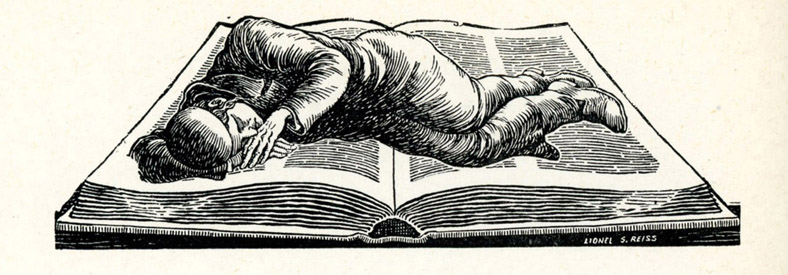
Cooper, by Hilary Masters – 1987 [Kingsley Parker]

Only much later would he understand that she lived in constant fear of her own imagination,
that her mind was sectioned into areas of frightening possibilities
through which she moved like a comic-strip heroine
sending up balloons of alarm and self-doubt. 

Am I pretty? 
Is he looking at me? 
What does he want from me? 
Are my poems dull? 
Commonplace? 
Anything? 

– Hilary Masters

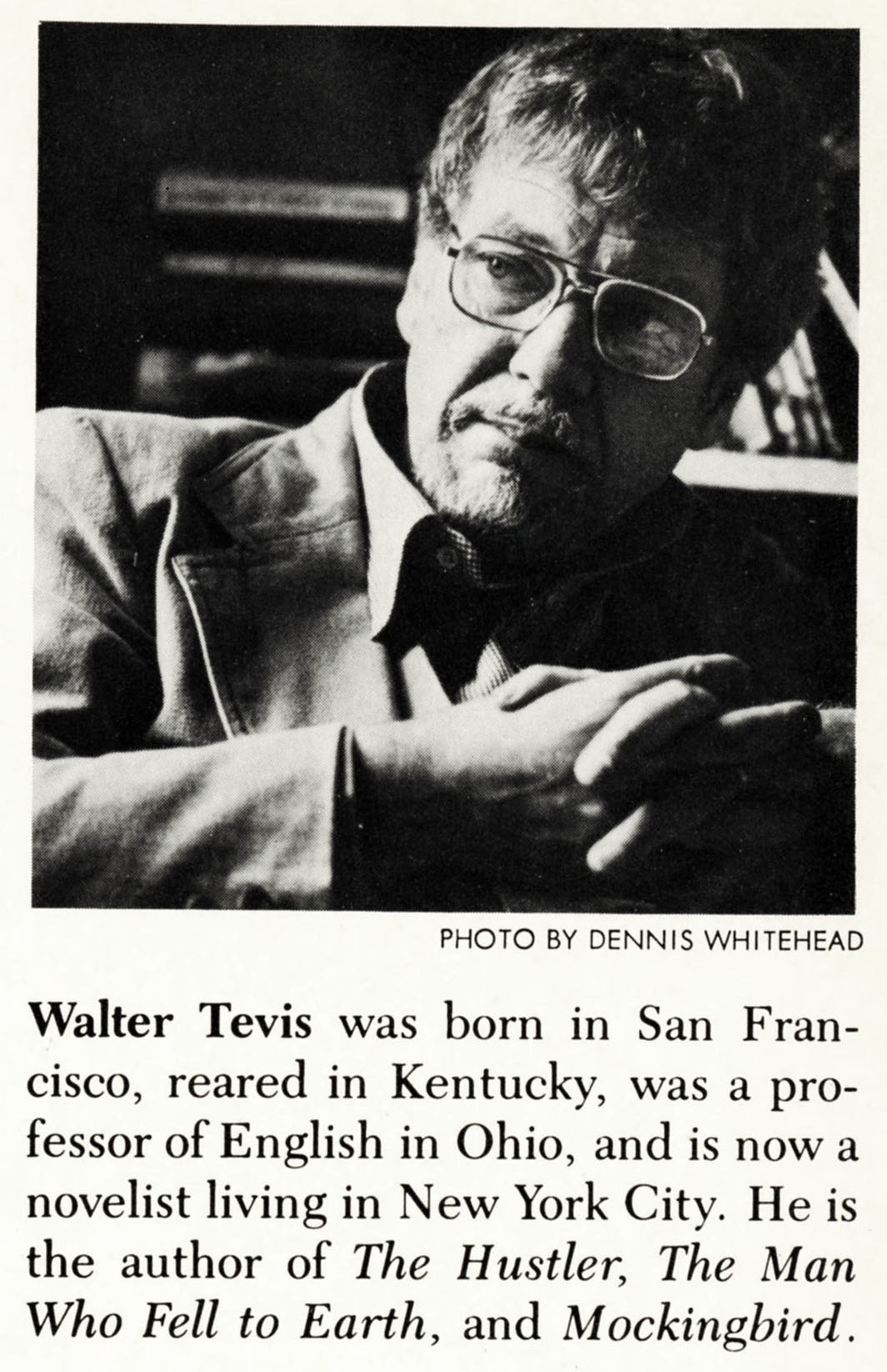
The Man Who Fell to Earth, by Walter Tevis – 1963 (1986) [Unknown Artist]; 1990 [Tim O’Brien]

He was sick; sick from the long,
dangerous trip he had taken,
sick from all the medicine – the pills,
the inoculations, the inhaled gases – sick from worry,
the anticipation of crisis,
and terribly sick from the awful burden of his own weight. 
He had known for years that when the time came,
when he would finally land and begin to effect that complex,
long-prepared plan, he would feel something like this. 
This place, however much he had studied it,
however much he had rehearsed his part in it,
was so incredibly alien – the feeling,
now that he could feel – the feeling was overpowering. 
He lay down in the grass and became very sick.

He was not a man; yet he was very much like a man. 
He was six and a half feet tall,
and some men are even taller that that;
his hair was as white as that of an albino,
yet his face was a light tan color;
and his eyes a pale blue. 
His frame was improbably slight,
his features delicate, his fingers long,
thin,
and the skin almost translucent, hairless. 
There was an elfin quality to his face,
a fine boyish look to the wide, intelligent eyes,
and the white,
curly hair now grew a little over his ears. 
He seemed quite young.

Yet he did have eyelashes,
eyebrows,
opposed thumbs,
binocular vision,
and a thousand of the physiological features of a normal human. 
He was incapable of warts;
but stomach ulcers, measles and dental caries could affect him. 
He was human; but not, properly, a man. 
Also, man like, he was susceptible to love,
to fear,
to intense physical pain and to self-pity.

____________________

(1990 Book-of-the-Month Club hardcover edition, art by Tim O’Brien)
HMS Ulysses, by Alistair MacLean – 1953 [Robert Emil Schulz]

Cap in hand, Ralston sat down opposite the captain.
Vallery look at him for a long time in silence.
He wondered what to say, how best to say it.
He hated to have to do this.

Richard Vallery also hated war. 
He always had hated it,
and he cursed the day it had dragged him out of his comfortable retirement. 
At least “dragged” was how he put it;
only Tyndall knew that he had volunteered his services to the Admiralty
on September 1, 1939,
and had had them gladly accepted.

But he hated war. 
Not because it interfered with his lifelong passion for music and literature,
on both of which he was a considerable authority,
not even because it was a perpetual affront to his aestheticism,
to his sense of rightness and fitness. 
He hated it because he was a deeply religious man,
because it grieved him to see in mankind the wild beasts of the primeval jungle,
because he thought the cross of his life was already burden enough
without the gratuitous infliction of the mental and physical agony of war,
and, above all,
because he saw war all too clearly as the wild and insensate folly it was, –
as a madness of the mind that settled nothing, proved nothing –
except the old, old truth that God was on the side of the big battalions.

But some things he had to do,
and Vallery had clearly seen that this war was to be his also. 
And so he had come back to the service and had grown older
as the bitter years passed, older and frailer,
and more kindly and tolerant and understanding. 
Among naval captains – indeed, among men – he was unique. 
In his charity, in his humility, Captain Richard Vallery walked alone. 
It was a measure of the man’s greatness
that this thought never occurred to him.


Winesburg, Ohio, by Sherwood Anderson – 1946 [Robert Jonas]

It will perhaps be somewhat difficult for the men and women of a later day
to understand Jesse Bentley. 
In the Last fifty years a vast change has taken place in the lives of our people. 
A revolution has in fact taken place. 
The coming of industrialism, attended by all the roar and rattle of affairs,
the shrill cries of millions of new voices that have come among us from over seas,
the going and coming of trains,
the growth of cities,
the building of the interurban car lines
that weave in and out of towns and past farmhouses,
and now in these later days the coming of the automobiles
has worked a tremendous change in the lives and the habits
of thought of our people of Mid-America. 

Books,
badly imagined and written though they may be in the hurry of our times,
are in every household,
magazines circulate by the millions of copies,
newspapers are everywhere.
In our day a farmer standing by a stove in the store in his village
has his mind filled to overflowing with the words of other men.
The newspapers and the magazines have pumped him full.
Much of the old brutal ignorance that had in it also
a kind of beautiful childlike innocence is gone forever.
The farmer by the stove is brother to the men of the cities,
and if you listen you will find him talking as glibly and senselessly
as the best city man of us all.


Appointment in Samarra, by John O’Hara – 1934 (1945) [Unknown artist]

appointment-in-samara-john-ohara-1945_edited-4

When Caroline Walker fell in love with Julian English she was a little tired of him. 
That was in the summer of 1926,
one of the most unimportant years in the history of the united States,
and the year in which Caroline Walker was sure
her life had reached a pinnacle of uselessness.


She was four years out of college then,
and she was twenty-seven years old,
which is as old as anyone ever gets,
or at least she thought so at the time.


She found herself thinking more and more and less and less of men. 
That is the way she put it, and she knew it to be sure and right,
but she did not bother to expand the -ism.


“I think of them oftener, and I think of them less often.”
She had attained varying degrees of love, requited and unrequited –
but seldom the latter.

The Coast of Chicago, by Stuart Dybek – 1990 [Tunis Ponsen]

the-coast-of-chicago-stuart-dybek-1990-tunis-ponsen-1The infield is for
wisecrackers,
pepper-pots,
gum-poppers;
the outfield is for
loners,
onlookers,
brooders who would rather study clover and swat gnats than holler. 
People could pretty much be divided between infielders and outfielders.
Not that one always has a choice. 
He didn’t necessarily choose right field so much as accept it

– Stuart Dybek

the-coast-of-chicago-stuart-dybek-1990-tunis-ponsen-2

Walk the Dark Streets, by William Krasner – 1949 [Herman E. Bischoff]

Dating back to 2016, this is one of my earliest posts…

walk-the-dark-streets-william-krasner-1950-1The Marne Hotel

The yellow fog was already creeping up around the Marne Hotel,
mingling with the white breath from the sewers,
carrying the faint, sweet, rotting scent off the Ohio River. 
It was not thick yet,
only a gentle curdling in the atmosphere,
but it laid damp greasy fingers on the crumbling granite,
on the pavement,
and on the windshield of the coupe
that Detective Captain Sam Birge of the Homicide Squad
was pulling to the curb across the street.

walk-the-dark-streets-william-krasner-1950-2He looked at his watch.  It was late now.
It was time to be on his way home.
Time to go home, to Edna, and to his son.
He got up.
Nobody called to him as he went through the outer office,
or through the brightly lit corridor.
No one was at the doors as he passed through.
It seemed to him, outside, that it should have been lighter there,
now that it was time for dawn.
But the fog was all around, a moving, blinding sheet,
and he could not see in any direction.
He lifted his eyes toward the sky.
Perhaps it was becoming lighter somewhere,
far above,
but there was not way to be sure.
He turned his collar up and stepped out into the dark street.

A Reference or Two…

Herman E. Bischoff, at…

Grapefruit Moon Gallery (“Lovelorn Beauty Admires 2 WWII Soldiers”)

Live Auctioneers 

WorthPoint (Original Gouache Pulp Illustration)

Rog Peyton, at…

Wikipedia

Internet Speculative Fiction Database

Novacon

Fancyclopedia (Andromeda Bookshop)

October 6, 2016

Forever Flowing, by Vasily Grossman – 1970 (1986) [Christopher Zacharow]

There is nothing more difficult than to be a stepson of time;

there is no heavier fate than to live in an age that is not your own. 
Time loves only those it has given birth to itself:
its own children, its own heroes, its own labourers.
Never can it come to love the children of a past age,
and more than a woman can love the heroes of a past age,
or a stepmother love the children of another woman.

forever-flowing-vasily-grossman-1986-christopher-zacharowAnd so he asked: “I was right, wasn’t I?”

Lyudmilla shook her head.  Decades of intimacy can also divide people.
‘Lyuda,’ said Viktor humbly,
‘people who are in the right often don’t know how to behave.
They lose their tempers and swear.
They act tactlessly and intolerantly.
Usually they get blamed for everything that goes wrong at home and at work.
While those who are in the wrong, those who hurt others,
always know how to behave.
They act calmly, logically and tactfully – and appear to be in the right.’

grossman-vasily-forever-flowing067_edited-2Why had his life been so hard?

He had not preached nor had he taught –
he had remained exactly what he had been from his birth:
a human being.
The slope of the mountain opened before him.
From behind the pass the peaks of the oak trees showed.
In his childhood, he had gone there into the forest twilight,
and searched out the remnants of the vanished life of the Circassians –
the fruit trees gone wild,
the traces of the fences around their obliterated houses.
Perhaps his own home was still standing there just as changelessly
as the streets and the stream seemed changeless.
Here was one more bend of the road.
For a moment, it seemed to him as if an impossibly bright light,
brighter than any he had ever seen in his life,
had flooded the earth.
A few steps more and in this light he would see that home,
and his mother would come out to meet him, her prodigal son,
and he would kneel down before her,
and her young and beautiful hands would lie upon his gray,
balding head.
He saw the thickets of thorns and hops.
There was nothing left of the house nor of the well –
only a few stones that shone white in the dusty grass,
burned by the sun.
He stood there – gray, bent, and changeless.

(1955-1963)

Here are book reviews of Forever Flowing from 1972 by Irving Howe and Thomas Lask, and a further anonymous review from 1973.