
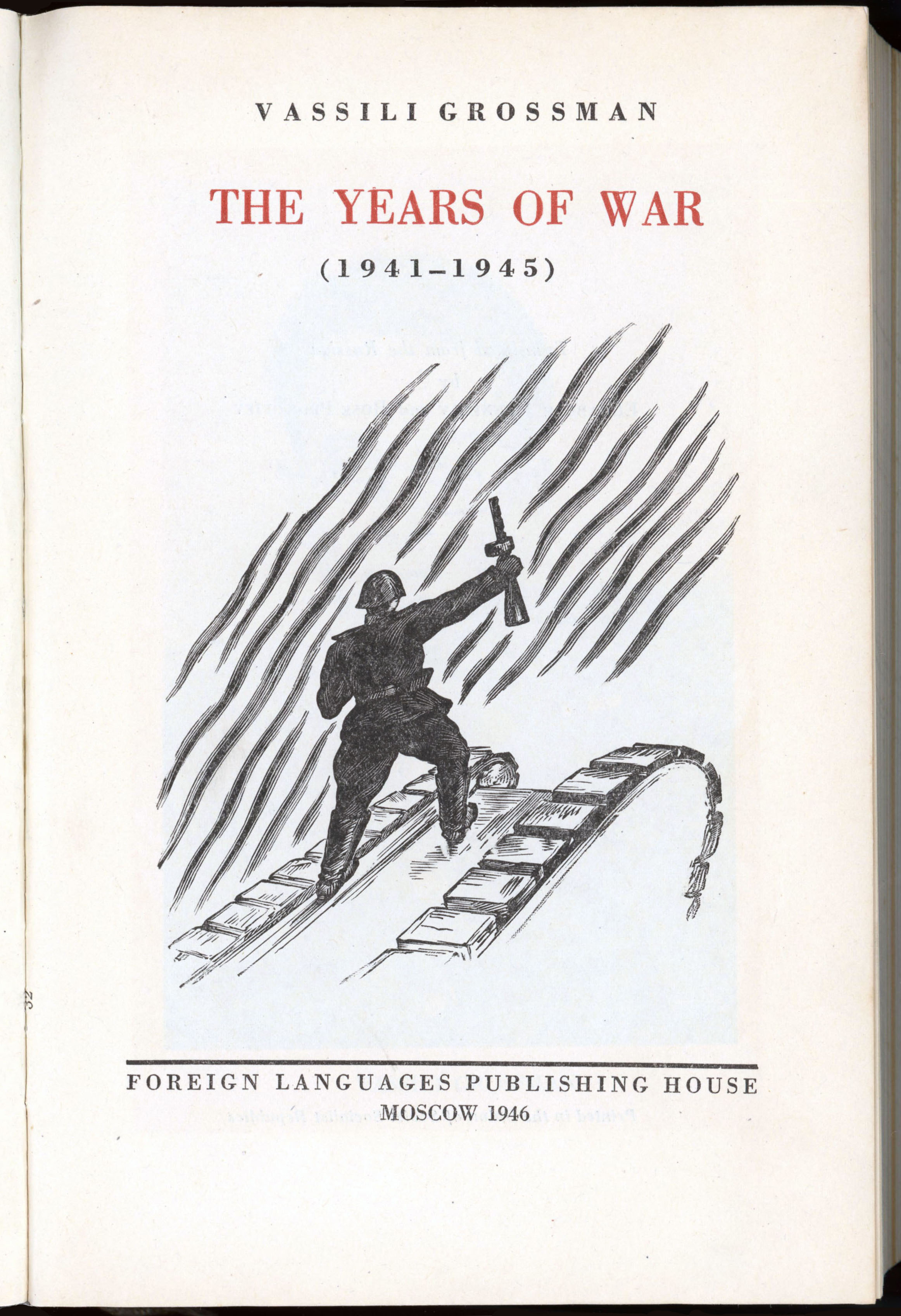
 The document below is Vasiliy Grossman’s Commendation for The Order of the Red Star (Ordenu Krasnaya Zvezda – Ордену Красная Звезда) , dated 9 December 1942. This document specifically mentions Grossman’s works “The People are Immortal,” “The Battle of Stalingrad”, “Stalingrad Crossing”, and “Stalingrad Story”. Grossman’s experiences, recollections, and reporting during the Battle of Stalingrad formed a central basis for the setting and characters in his postwar novel, Life and Fate.
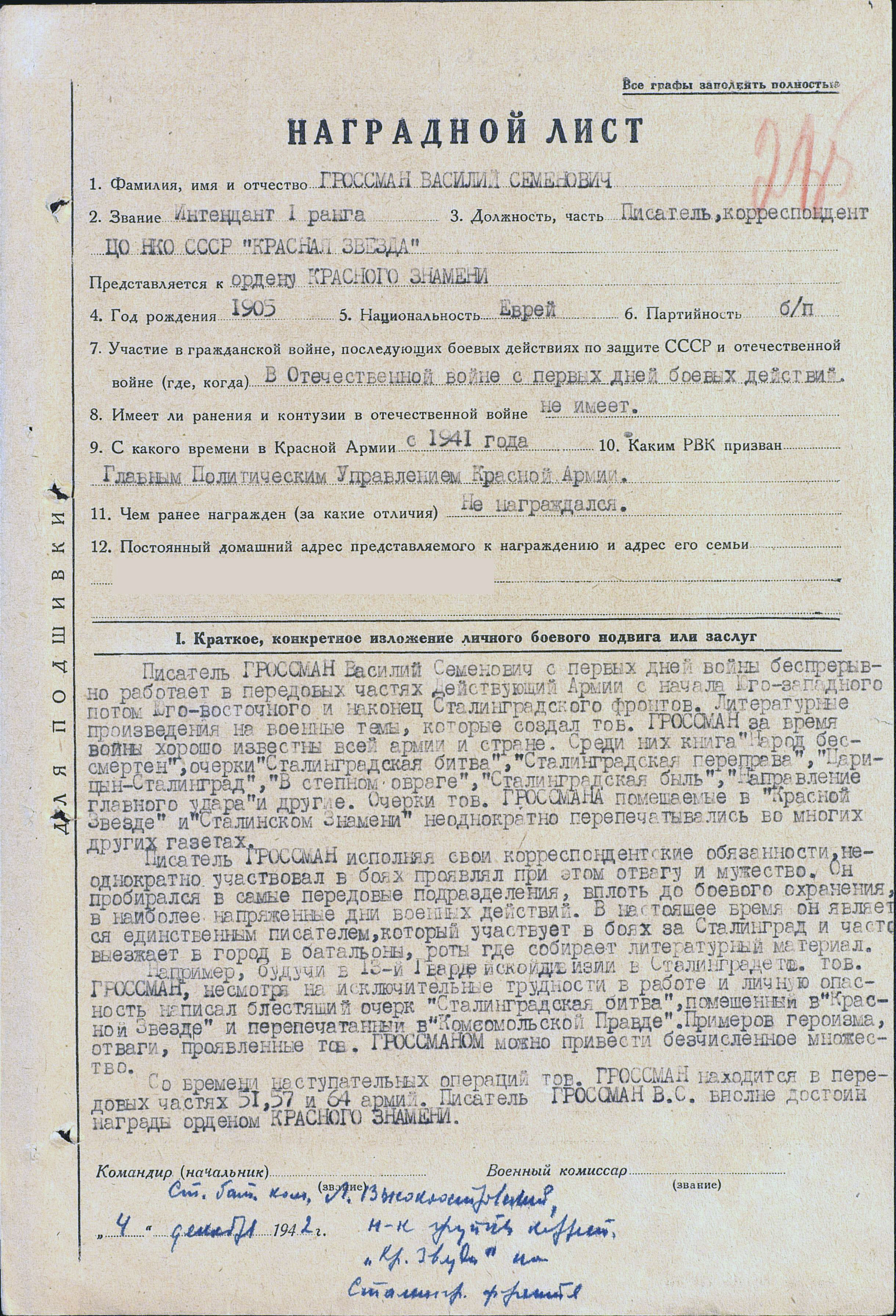

Краткое конкретное изложение личного боевого нодвига или заслуг
Писатель ГРОССМАН Василий Семенович с первых дней войны беспрерывно работает в передовых частях Действующий Армии с начала Юго-западного потом Юго-восточного и наконец Сталинградского фронтов. Литературные произведения на военные темы, которые создал тов. ГРОССМАН за время войны хорошо известны всей армии и стране. Среди них книга “Народ бессмертен”, очерки “Сталинградская битва”, “Сталинградская переправа”, “Царицын-Сталинград”, “В степном овраге”, “Сталинградская быль”, “Направление главного удара” и другие. Очерки тов. ГРОССМАН помешаемые в “Красной Звезде” и “Сталинском Знамени” неоднократно перепечатывались во многих Других газетах.
Писатель ГРОССМАН исполняя свои корреспондентокие обязанности, неоднократно участвовал в боях проявлял при этом отвагу и мужество. Он пробирался в самые передовые подразделения, вплоть до боевого охранения, в наиболее напряженные дни военных действий. В настояшее время он является Единственным писателем, который участвует в боях за Сталинград и части выезжает в город в батальоны, роты где собирает литературный материал.
На пример, будучи в 13-й Гвардейской Дивизии в Сталинград, тов. ГРОССМАН, несмотря на исключительные трудности в работе и личную опасность Написал блестяший очерк “Сталинградская битва”, помешенный в “Красной Звезде” и перепечатанный в “Комсомольской Правде”. Примеров героизма, отваги, проявленные тов. ГРОССМАН можно привести безчисленное множество.
Со времени наступательных операций тов. ГРОССМАН находится в передовых частях 51, 57 и 64 армий. Писатель ГРОССМАН В.С. вполне достоин награды орденом КРАСНОГО ЗНАМЕНИ.
~~~~~~~~~~~~~~~~~~~~~~~~~~~~~~~~~~~~~~~~
Summary of the specific statement of personal combat heroism or merit
Writer GROSSMAN Vasiliy Semenovich from the first days of the war constantly working in the forward parts of the army since the beginning of the South West subsequently South-east and finally Stalingrad Fronts. Literary works on military subjects, created by comrade GROSSMAN during the war are well known throughout the Army and the country. Among them the book “The People are Immortal,” essays “The Battle of Stalingrad”, “Stalingrad Crossing”, “Tsaritsyn-Stalingrad,” “The Steppe Gully”, “Stalingrad Story”, “The Direction of the Main Attack,” and others. The essays of Comrade GROSSMAN appearing in the “Red Star” and “Stalin Banner” were repeatedly reprinted in many other newspapers.
Writer GROSSMAN performing his duties as correspondent, has participated in battles at the same time showing bravery and courage. He made his way to the most advanced units, up to the outposts, in the most intense days of hostilities. At the present time he is the only writer who participated in the battles of Stalingrad and often traveled to the city in the battalions [and] companies where he collects literary material.
For example, while in the 13th Guards Division in Stalingrad, Comrade GROSSMAN, in spite of the extreme difficulties in his work and personal danger wrote the brilliant essay “The Battle of Stalingrad”, columns in the “Red Star” and was reprinted in “Komsomolskaya Pravda”. The examples of heroism and bravery shown comrade GROSSMAN can be cited by innumerable multitudes.
Since offensive operations Comrade GROSSMAN has been in the advanced parts of the 51st, 57th and 64th armies. Writer V.S. GROSSMAN is quite worthy of the Order of the Red Banner.
For a deeper understanding of the life and works of Vasiliy Grossman, I strongly recommend The Bones of Berdichev – The Life and Fate of Vasily Grossman, by John Garrard and Carol Garrard (The Free Press, 1996), and A Writer At War – Vasily Grossman with the Red Army, 1941-1945, by Anthony Beevor and Luba Vinogradova (Pantheon Books, 2005).