Mister Roberts, by Thomas Heggen – 1958 [Harvey Kidder]

He read a great deal, being embarked upon an ambitious program of self-improvement. 
By education Pulver was a metallurgical engineer,
and now read books that he had widely and willingly evaded during his college days. 
He read these books because they were the books that Lieutenant Roberts read;
consciously or not, Ensign Pulver had set out to make himself over in Roberts’ image. 
With regard to most objects, people, ideas, Pulver was languidly cynical;
with a few he was languidly approving, and with almost none he was overtly enthusiastic. 
His admiration for Roberts was utterly unabashed. 
He thought that Roberts was the greatest guy he had ever known. 
He prodded him with questions on every conceivable subject,
memorized the answers,
then went back to the bunk and assiduously absorbed them into his own conversation. 
He watched the careless, easy dignity with which Roberts met the crew,
and studied the way that Roberts got the crew to work for him;
and then he tried to apply this dignity and this control to his own small authority. 
Being honest with himself,
he couldn’t notice any increased devotion in the eyes of the men;
or indeed, anything more than the usual tolerance. 
It is not very likely that Ensign Pulver would ever have read Santayana,
or the English philosophers,
or Jean Christophe,
or The Magic Mountain,
if he had not seen Roberts reading them. 
Before this self-imposed apprenticeship,
he had been content to stay within the philosophical implications of God’s Little Acre
He had read God’s Little Acre twelve times,
and there were certain passages he could recite flawlessly.

When the girls came aboard that night,
escorted by the two officers,
 the entire crew was massed along the rail and up on the bridges.
As the white-stockinged legs tripped up the gangway,
one great, composite, heart-felt whistle rose to the heavens and hung there.
Ensign Pulver’s girl, Miss Girard, had turned out to be a knockout.
At dinner in the wardroom he could scarcely keep his eyes off her,
and no more could the other officers,
who feigned eating and made self-conscious conversation.
Miss Girard had lovely soft blond hair which she wore in bangs,
wide blue innocent eyes, and the pertest nose there ever was.
The total effect was that of radiant innocence; innocence triumphant.
Only Ensign Pulver noted that when she smiled her eyes screwed up shrewdly
and her mouth curved knowingly; but then only Ensign Pulver would.

– Thomas Heggen –

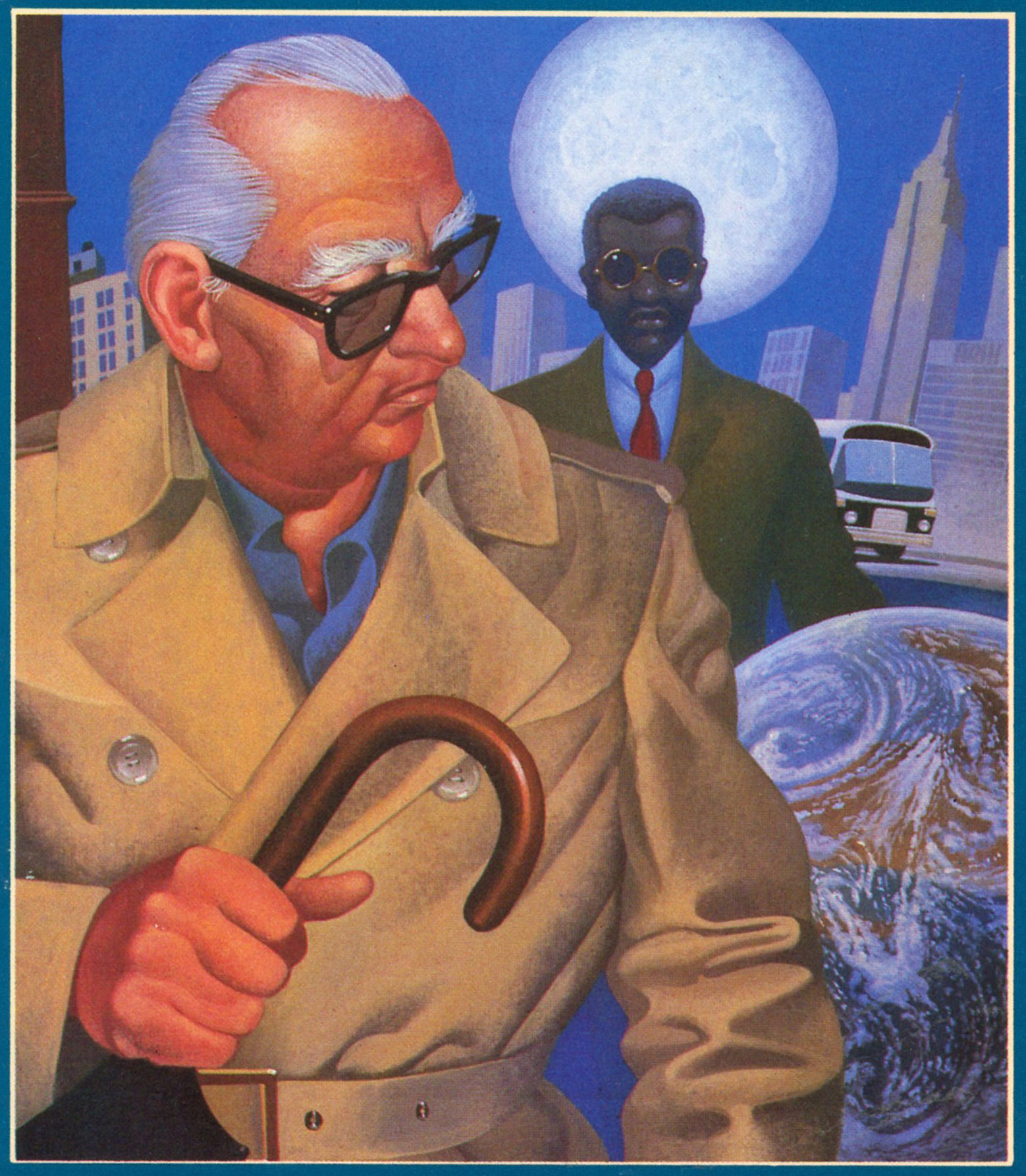
Mr. Sammler’s Planet, by Saul Bellow – 1969 (1977) [Roy Ellsworth]

And since he had lasted –
survived –
with a sick headache –
he would not quibble over words –
was there an assignment implicit? 
Was he meant to do something?

______________________________

“During the war I had no belief, and I had always disliked the ways of the Orthodox.
I saw that God was not impressed by death.
Hell was his indifference.
But inability to explain is no ground for disbelief.
Not as long as the sense of God persists.
I could wish that it did not persist.
The contradictions are so painful.
No concern for justice?
Nothing of pity?
Is God only the gossip of the living?
Then we watch these living speed like birds over the surface of a water,
and one will dive or plunge but not come up again and never be seen any more.
And in our turn we will never be seen again,
once gone through that surface.
But then we have no proof that there is no depth under the surface.
We cannot even say that our knowledge of death is shallow.
There is no knowledge.
There is longing, suffering, mourning.
These come from need, affection, and love –
the needs of the living creature, because it is a living creature.
There is also strangeness, implicit.
There is also adumbration.
Other states are sensed.
All is not flatly knowable.
There would never have been any inquiry without this adumbration,
there would never have been any knowledge without it.
But I am not life’s examiner, or a connoisseur, and I have nothing to argue.
Surely a man would console, if he could.
But that is not an aim of mine.
Consolers cannot always be truthful.
But very often, and almost daily, I have strong impressions of eternity.
This may be due to my strange experiences, or to old age.
I will say that to me this does not feel elderly.
Nor would I mind if there were nothing after death.
If it is only to be as it was before birth, why should one care?
There one would receive no further information.
One’s ape restiveness would stop.
I think I would miss mainly my God adumbrations in the many daily forms.
Yes, that is what I should miss.
So then, Dr. Lai, if the moon were advantageous for us metaphysically, I would be completely for it.
As an engineering project, colonizing outer space,
except for the curiosity, the ingenuity of the thing,
is of little real interest to me.
Of course the drive, the will to organize this scientific expedition must be one of those irrational necessities that make up life –
this life we think we can understand.
So I suppose we must jump off, because it is our human fate to do so.
If it were a rational matter, then it would be rational to have justice on this planet first.
Then, when we had an earth of saints, and our hearts were set upon the moon,
we could get in our machines and rise up …”
(236-237)

Margotte had much to say.
She did not notice his silence.

By coming back, by preoccupation with the subject,
the dying, the mystery of dying, the state of death.
Also, by having been inside death.
By having been given the shovel and told to dig.
By digging beside his digging wife.
When she faltered he tried to help her.
By this digging, not speaking, he tried to convey something to her and fortify her.
But as it had turned out, he had prepared her for death without sharing it.
She was killed, not he.
She had passed the course, and he had not.
The hole deepened, the sand clay and stones of Poland, their birthplace, opened up.
He had just been blinded, he had a stunned face,
and he was unaware that blood was coming from him
till they stripped and he saw it on his clothes.
When they were as naked as children from the womb,
and the hole was supposedly deep enough, the guns began to blast,
and then came a different sound of soil.
The thick fall of soil.
A ton, two tons, thrown in.
A sound of shovel-metal, gritting.
Strangely exceptional, Mr. Sammler had come through the top of this.
It seldom occurred to him to consider it an achievement.
Where was the achievement?  He had clawed his way out.
If he had been at the bottom, he would have suffocated.
If there had been another foot of dirt.
Perhaps others had been buried alive in that ditch.
There was no special merit, there was no wizardry.
There was only suffocation escaped.
And had the war lasted a few months more, he would have died like the rest.
Not a Jew would have avoided death.
As it was, he still had his consciousness, earthliness, human actuality –
got up, breathed his earth gases in and out, drank his coffee,
consumed his share of goods, ate his roll from Zabar’s, put on certain airs –
all human beings put on certain airs – took the bus to Forty-second Street
as if he had an occupation, ran into a black pickpocket.
In short, a living man.
Or one who had been sent back again to the end of the line.
Waiting for something.
Assigned to figure out certain things, to condense, in short views,
some essence of experience, and because of this having a certain wizardry ascribed to him.
There was, in fact, unfinished business.
But how did business finish?
We entered in the middle of the thing and somehow became convinced that we must conclude it.
How? 

– Saul Bellow –

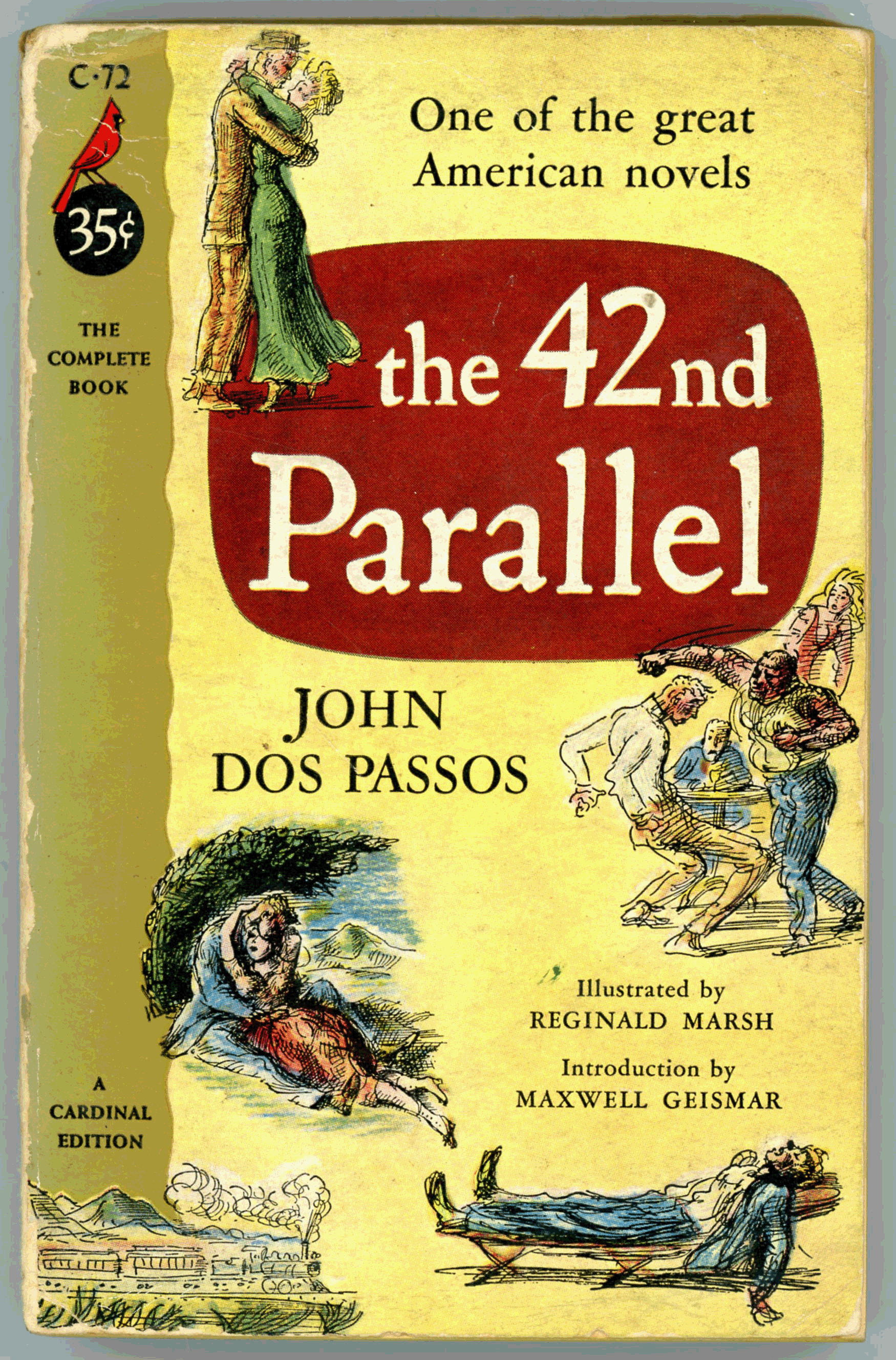
The 42nd Parallel, by John Dos Passos – 1930 (1952) [Reginald Marsh]

the-42nd-parallel-john-dos-passos-1952-frank-lieberman-1Newsreel XII
The Camera Eye (17)

the spring you could see Halley’s Comet over the elms from the back topfloor windows
of Upper House Mr. Greenleaf said you would have to go to confirmation class
and be confirmed when the bishop came
and next time you went canoeing you told Skinny that you wouldn’t be confirmed
because you believed in camping
and canoeing
and Halley’s Comet
and the universe
and the sound the rain made on the tent on the night you’d both read The Hound of the Baskervilles
and you’d hung out the steak on a tree
and a hound must have smelt it because he kept circling around you
and howling something terrible
and you were so scared (but you didn’t say that, you don’t know what you said)

the-42nd-parallel-john-dos-passos-1952-frank-lieberman-2

and not in church
and Skinny said if you’d never been baptized you couldn’t be confirmed
and you went and told Mr. Greenleaf
and he looked very chilly
and said you’d better not go to confirmation class any more
and after that you had to go to church Sundays
but you could go to either one you liked so sometimes you went to the Congregational
and sometimes to the Episcopalian
and the Sunday the Bishop came you couldn’t see Halley’s Comet any more
and you saw the others being confirmed
and it lasted for hours because there were a lot of little girls being confirmed too
and all you could hear was mumble mumble this thy child mumble mumble this my child
and you wondered if you’d be alive next time Halley’s Comet came round

3/15/18 257

Lost Horizon, by James Hilton – 1933 (1967) [Unknown Artist]

“There is a reason, and a very definite one indeed. 
It is the whole reason for this colony of chance-sought strangers living beyond their years. 
We do not follow an idle experiment, a mere whimsy. 
We have a dream and a vision. 
It is a vision that first appeared to old Perrault when he lay dying in this room in the year 1789. 
He looked back then on his long life,
as I have already told you,
and it seemed to him that all the loveliest things were transient and perishable,
and that war, lust, and brutality
might some day crush them until there were no more left in the world. 
He remembered sights he had seen with his own eyes,
and with his mind he pictured others;
he saw the nations strengthening,
not in wisdom, but in vulgar passions and the will to destroy;
he saw their machine-power multiplying until a single-weaponed man
might have matched a whole army of the Grand Monarque. 
And he perceived that when they had filled the land and sea with ruin,
they would take to the air… 
Can you say that this vision was untrue?”

“True indeed.”

“But that was not all. 
He foresaw a time when men,
exultant in the technique of homicide,
would rage so hotly over the world that every precious thing would be in danger,
every book and picture and harmony,
every treasure garnered through two milleniums,
the small,
the delicate,
the defenseless – all would be lost like the books of Livy,
or wrecked as the English wrecked the Summer Palace in Pekin.”

“I share your opinion of that.”

“Of course. 
But what are the opinions of reasonable men against iron and steel? 
Believe me, that vision of old Perrault will come true. 
And that, my son, is why I am here,
and why you are here,
and why me pray to outlive the doom that gathers around on every side.”

“To outlive it?”

“There is a chance.  It will come to pass before you are as old as I am.”

“And you think that Shangri-La will escape?”

“Perhaps. 
We may expect no mercy, but we may faintly hope for neglect. 
Here we shall stay with our books and our music and our meditations,
conserving the frail elegancies of a dying age,
and seeking such wisdom as men will need when their passions are all spent. 
We have a heritage to cherish and bequeath. 
Let us take what pleasure we may until that time comes.”

(James Hilton)

Appointment in Samarra, by John O’Hara – 1934 (1945) [Unknown artist]

appointment-in-samara-john-ohara-1945_edited-4

When Caroline Walker fell in love with Julian English she was a little tired of him. 
That was in the summer of 1926,
one of the most unimportant years in the history of the united States,
and the year in which Caroline Walker was sure
her life had reached a pinnacle of uselessness.


She was four years out of college then,
and she was twenty-seven years old,
which is as old as anyone ever gets,
or at least she thought so at the time.


She found herself thinking more and more and less and less of men. 
That is the way she put it, and she knew it to be sure and right,
but she did not bother to expand the -ism.


“I think of them oftener, and I think of them less often.”
She had attained varying degrees of love, requited and unrequited –
but seldom the latter.

The Thin Red Line, by James R. Jones – 1962 (1964) [Unknown Artist]

the-thin-red-line-james-jones-1962-1964Welsh had never been in combat.
But he had lived for a long time with a lot of men who had.
And he had pretty well lost his belief in,
as well as his awe of,
the mystique of human combat.
Old vets from the First World War,
younger men who had been with the Fifteenth Infantry in China,
for years he had sat around getting drunk with them
and listening to their drunken stories of melancholy bravery.
He had watched the stories grow with the years and the drinking sprees,
and he had been able to form only one conclusion
and that was that every old vet was a hero.
How so many heroes survived and so many non-heroes got knocked off,
Welsh could not answer.
But every old vet was a hero.
If you did not believe it, you had only to ask them,
or better yet, get them drunk and not ask them.
There just wasn’t any other kind.
One of the hazards of professional soldiering was that every twenty years,
regular as clockwork,
that portion of the human race to which you belonged,
whatever its politics or ideals about humanity,
was going to get involved in a war,
and you might have to fight in it.
About the only way out of this mathematical hazard
was to enlist immediately after one war
and hope you would be too old for the next; you might just make it.
But to accomplish that you had to be of a certain age at just exactly the right time,
and that was rare.
But it was either that, or enlist in the Quartermaster Corps or some such branch.
Welsh had already understood all this when he enlisted in 1930
exactly between wars at the age of twenty,
but he had gone ahead and enlisted anyway.
He had gone ahead and enlisted,
and he had enlisted in the Infantry.
Not in the Quartermaster Corps.
And he had stayed in Infantry.
And this amused Welsh too.


jones-1110_edited-2Doll had learned something during the past six months of his life.
Chiefly what he had learned was that everybody lived by a selected fiction.
Nobody was really what he pretended to be.
It was as if everybody made up a fiction story about himself,
and then he just pretended to everybody that that was what he was.
And everybody believed him, or at least accepted his fiction story.
Doll did not know if everybody learned this about life
when they reached a certain age,
but he suspected that they did.
They just didn’t tell it to anybody.
And rightly so.
Obviously, if they told anybody,
then their own fiction story about themselves wouldn’t be true either.
So everybody had to learned it for himself.
And then, of course, pretend he hadn’t learned it.
Doll’s own first experience of this phenomenon had come from,
or at least begun with,
a fight he had had six months ago with one of the biggest,
toughest men in C-for-Charlie,
Corporal Jenks.
They had fought each other to a standstill,
because neither would give up,
until finally it was called a sort of draw-by-exhaustion.
But it wasn’t this so much as it was the sudden realization
that Corporal Jenks was just as nervous about having the fight as he was,
and did not really want to fight any more than he did,
which had suddenly opened Doll’s eyes.
Once he’d seen it here, in Jenks, he began to see it everywhere,
in everybody.

jones-2111_edited-2Yes, makin’ mock o’ uniforms that guard you while you sleep

Is cheaper than them uniforms, an’ they’re starvation cheap;

An’ hustlin’ drunken soldiers when they’re goin’ large a bit

Is five times better business than paradin’ in full kit.

Then it’s Tommy this, an’ Tommy that, an’ “Tommy, ‘ow’s yer soul?”

But it’s “Thin red line of ‘eroes” when the drums begin to roll –

The drums begin to roll, my boys, the drums begin to roll,

O it’s “Thin red line of ‘eroes” when the drums begin to roll.

(Rudyard Kipling’s Verse, definitive edition, (1891), 1940)

Flight to Arras, by Antoine de Saint Exupéry – 1942 [Lewis Galantiere]

flight-to-arras-antoine-de-saint-exupery-lewis-galantiere-1942-19__-paul-bacon_edited-1Pure logic is the ruin of the spirit.

* * * * * * * * * *

I don’t think highly of physical courage.
Life has taught me that there is only one true kind of courage:
resisting the condemnation of a mode of thought.
I know that it took me much more courage
not to budge from the line of conduct my
conscience dictated to me,
despite two years of slander and insults,
than to photograph Mainz or Essen…

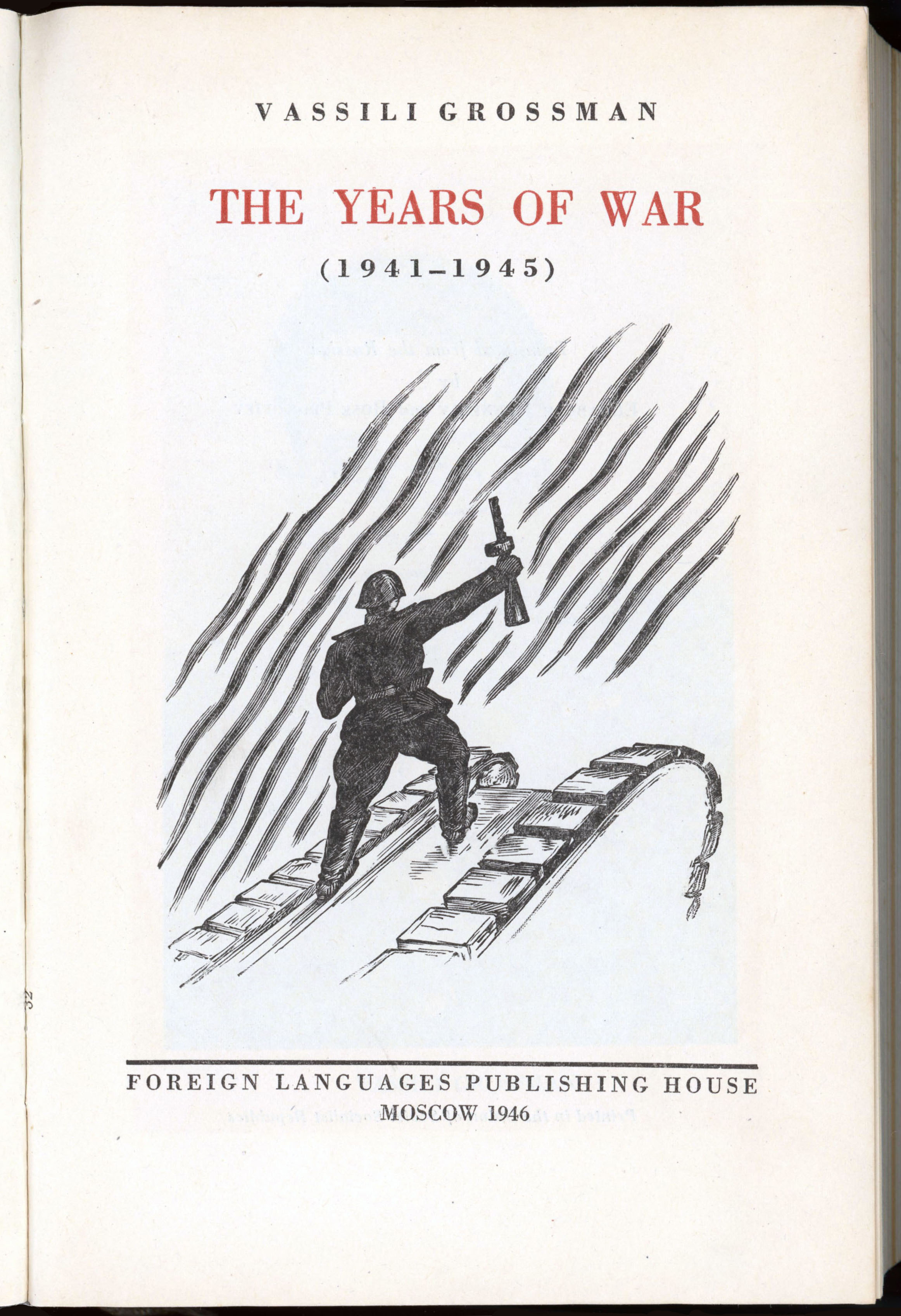
The Years of War, by Vasiliy S. Grossman – 1946 [Unknown Artist]

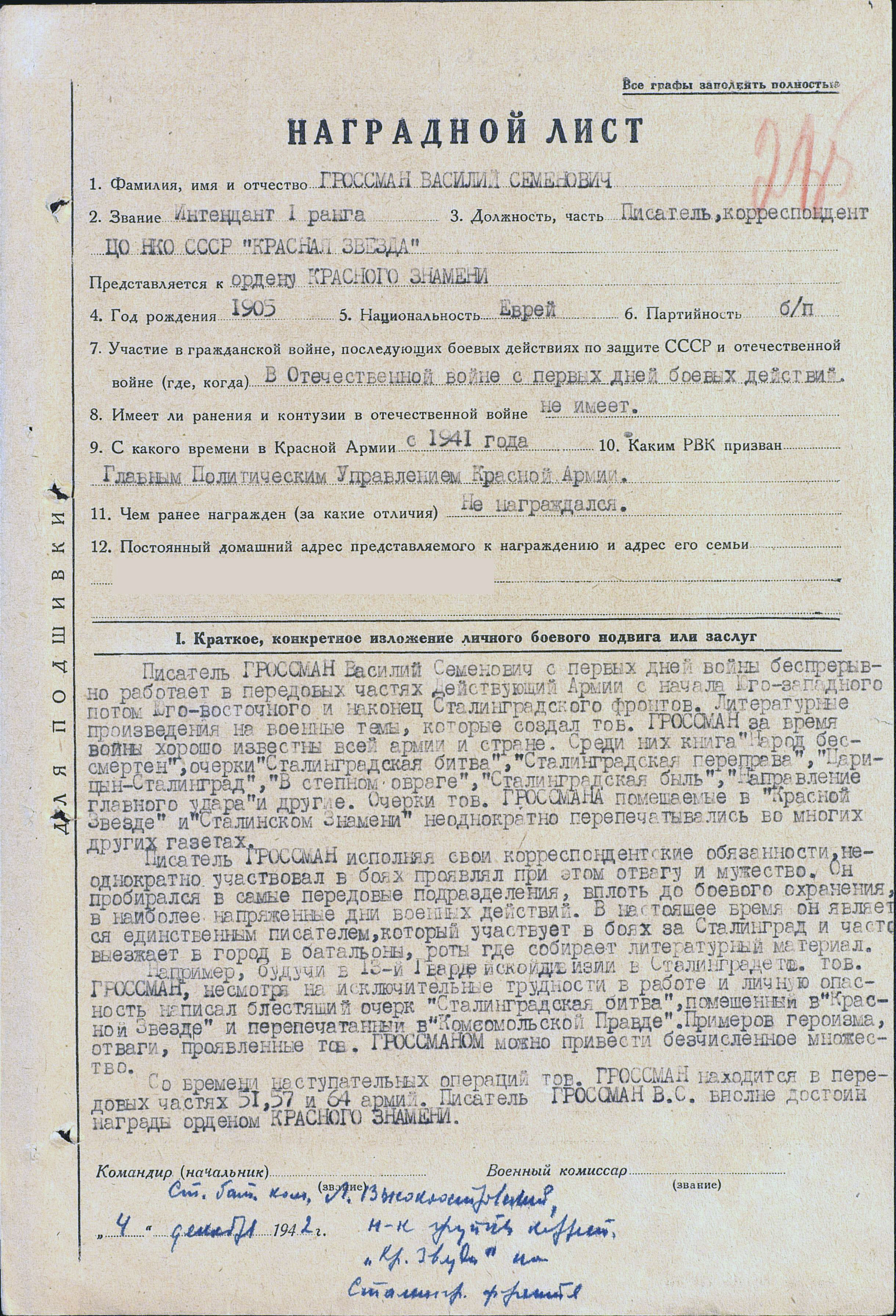
the-years-of-war-vassili-grossman-1946-1 the-years-of-war-vassili-grossman-1946-2_edited-1 grossman-vasily-ds-600 The document below is Vasiliy Grossman’s Commendation for The Order of the Red Star (Ordenu Krasnaya Zvezda – Ордену Красная Звезда) , dated 9 December 1942.  This document specifically mentions Grossman’s works “The People are Immortal,” “The Battle of Stalingrad”, “Stalingrad Crossing”, and “Stalingrad Story”.  Grossman’s experiences, recollections, and reporting during the Battle of Stalingrad formed a central basis for the setting and characters in his postwar novel, Life and Fate.

grossman-vasiliy-s-1a

grossman-vasiliy-s-1b

Краткое конкретное изложение личного боевого нодвига или заслуг

Писатель ГРОССМАН Василий Семенович с первых дней войны беспрерывно работает в передовых частях Действующий Армии с начала Юго-западного потом Юго-восточного и наконец Сталинградского фронтов.  Литературные произведения на военные темы, которые создал тов. ГРОССМАН за время войны хорошо известны всей армии и стране. Среди них книга “Народ бессмертен”, очерки “Сталинградская битва”, “Сталинградская переправа”, “Царицын-Сталинград”, “В степном овраге”, “Сталинградская быль”, “Направление главного удара” и другие.  Очерки тов. ГРОССМАН помешаемые в “Красной Звезде” и “Сталинском Знамени” неоднократно перепечатывались во многих Других газетах.

Писатель ГРОССМАН исполняя свои корреспондентокие обязанности, неоднократно участвовал в боях проявлял при этом отвагу и мужество.  Он пробирался в самые передовые подразделения, вплоть до боевого охранения, в наиболее напряженные дни военных действий.  В настояшее время он является Единственным писателем, который участвует в боях за Сталинград и части выезжает в город в батальоны, роты где собирает литературный материал.

На пример, будучи в 13-й Гвардейской Дивизии в Сталинград, тов. ГРОССМАН, несмотря на исключительные трудности в работе и личную опасность Написал блестяший очерк “Сталинградская битва”, помешенный в “Красной Звезде” и перепечатанный в “Комсомольской Правде”.  Примеров героизма, отваги, проявленные тов. ГРОССМАН можно привести безчисленное множество.

Со времени наступательных операций тов. ГРОССМАН находится в передовых частях 51, 57 и 64 армий.  Писатель ГРОССМАН В.С. вполне достоин награды орденом КРАСНОГО ЗНАМЕНИ.

~~~~~~~~~~~~~~~~~~~~~~~~~~~~~~~~~~~~~~~~

Summary of the specific statement of personal combat heroism or merit

Writer GROSSMAN Vasiliy Semenovich from the first days of the war constantly working in the forward parts of the army since the beginning of the South West subsequently South-east and finally Stalingrad Fronts.  Literary works on military subjects, created by comrade GROSSMAN during the war are well known throughout the Army and the country.  Among them the book “The People are Immortal,” essays “The Battle of Stalingrad”, “Stalingrad Crossing”, “Tsaritsyn-Stalingrad,” “The Steppe Gully”, “Stalingrad Story”, “The Direction of the Main Attack,” and others.  The essays of Comrade GROSSMAN appearing in the “Red Star” and “Stalin Banner” were repeatedly reprinted in many other newspapers.

Writer GROSSMAN performing his duties as correspondent, has participated in battles at the same time showing bravery and courage.  He made his way to the most advanced units, up to the outposts, in the most intense days of hostilities.  At the present time he is the only writer who participated in the battles of Stalingrad and often traveled to the city in the battalions [and] companies where he collects literary material.

For example, while in the 13th Guards Division in Stalingrad, Comrade GROSSMAN, in spite of the extreme difficulties in his work and personal danger wrote the brilliant essay “The Battle of Stalingrad”, columns in the “Red Star” and was reprinted in “Komsomolskaya Pravda”.  The examples of heroism and bravery shown comrade GROSSMAN can be cited by innumerable multitudes.

Since offensive operations Comrade GROSSMAN has been in the advanced parts of the 51st, 57th and 64th armies.  Writer V.S. GROSSMAN is quite worthy of the Order of the Red Banner.

For a deeper understanding of the life and works of Vasiliy Grossman, I strongly recommend The Bones of Berdichev – The Life and Fate of Vasily Grossman, by John Garrard and Carol Garrard (The Free Press, 1996), and A Writer At War – Vasily Grossman with the Red Army, 1941-1945, by Anthony Beevor and Luba Vinogradova (Pantheon Books, 2005).