The Age of Advertising: General Electric and Plastics – July 10, 1945

From July 10, 1945, here’s an advertisement by General Electric promoting and introducing “PLASTICS”.

The advertisement, divided into six sections – each with an emblematic illustration – describes the use of plastic in three contexts:  Military: The M-51 fuse; The home: kitchen utensils; Industry and machinery: gears; The military once again: the triple-cluster aerial bazooka as used by USAAF P-47s and P-51s, and, binoculars.  The ad then concludes with a section about the design and development of plastic. 

Though the first genuinely synthetic polymer had existed for some time (Bakelite, created by Leo Bakeland in 1907), only by the 40s and 50s did mass production of plastic actually commence.

The war was winding down, victory was obvious, and GE was thinking of the future.

______________________________

______________________________

General Electric answers your questions about

PLASTICS

26,000,000 fuses.  At the tip of this trench mortar is the M-51 fuse – most difficult mass production job ever done in plastics.  Sixty-seven different operations check its perfection.  Design was completed and mold started by G.E. the day before Pearl Harbor.  Why was General Electric picked for this job?

You’ll find the right answer in your own kitchen.  The handle on your coffee maker, the case on the kitchen clock, the light switch on the wall – chances are these are G-E plastics.  For General Electric has molded more plastic products than anybody else.  And some you’d never guess.  For example…

Cloth that wears like steel.  Steel against steel is noisy.  Wears fast.  Imagine, then, a gear made of cloth – packed in layers, impregnated with resin, pressed under heat.  Oddly enough, G-E engineers who discovered this found that for certain uses such gears were not only quieter, but actually outwore steel.

Would plastic bazookas blow up?  The first hundred plastics tried failed.  Then G.E. laminated a rare paper with a special resin.  The plastic tube stood the shock of repeated firings, was non-inflammable.  Now many planes carry these rocket launchers.  G.E.’s 1400 presses turn out everything from electronic equipment housings to submarine parts.

Salt-water-proof binoculars are new.  And won’t mildew in the tropics.  General Electric worked these out with the U.S. Naval Observatory and specialists in optics.  Plastics were combined with metal, and, to make shrinkage the same, a new metal alloy was developed.  The lenses are universal focus, specially treated for night vision.

How do plastics get born?  Designers say what shape, how heavy or light, soft or hard.  Engineers design special machinery.  Chemists then invent the plastic to fit the need.  Finally, a factory can go to work.  In war or peace, General Electric research and engineering count in plastics, too.  General Electric Company, Schenectady, New York.

Hear the G-E radio programs:  The G-E All-girl Orchestra, Sunday 10 p.m. EWT, NBC – The World News, Monday through Friday 6:45 p.m. EWT, CBS – the G-E House Party, Monday through Friday, 4 p.m. EWT, CBS.

FOR VICTORY – BUY AND HOLD WAR BONDS

Here’s One Little Reference

Thompson, Richard C., Swan, Shanna H., Moore, Charles J., and vom Saal, Frederick S., Our Plastic AgePhilosophical Transactions of the Royal Society of London, B, V 364, July 27, 2009. 

The Age of Advertising: General Electric and Television – March 14, 1945

On March 14, 1945, a few months prior to their advertisement promoting “Plastic” in military and civilian contexts, GE ran an advertisement – featuring a 6-panel design – presenting and explaining the economic, technical, and cultural aspects of “Television” for the postwar world.

In light of the world of 2022, there’s something almost quaint about the the content of and mindset behind this advertisement, exemplified by the description of the kind of programming that was expected to be available: studio stage shows; movies; sports events; news.  This was a natural reflection of the entertainment and informational “material” then available to the public, much already extant on radio.

Understandably, the ad’s writers could not have foreseen the technological, cultural, and economic changes that – acting in synergy – would sweep the world in the ensuing decades, and continue to do so now.  In their lack of knowledge about the future of entertainment, perhaps the copy-writers were fortunate.

An example, perhaps, of the way that the manifestation and anticipated use of any new technology, is – at the time of the introduction of that technology – seen in the immediate intellectual context of that time itself. 

______________________________

______________________________

General Electric answers your questions about

TELEVISION

Q. What will sets cost after the war?

A. It is expected that set prices will begin around $200, unless there are unforeseen changes in manufacturing costs.  Higher priced models will also receive regular radio programs, and in addition FM and international shortwave programs.  Perhaps larger and more expensive sets will include built-in phonographs with automatic record changers.

Q. How big will television pictures be?

A. Even small television sets will probably have screen about 8 by 10 inches.  (That’s as big as the finest of pre-war sets.)  In more expensive television sets, screens will be as large as 18 by 24 inches.  Some sets may project pictures on the wall like home movies.  Naturally, pictures will be even clearer than those produced by pre-war sets.

Q. What kind of shows will we see?

A. All kinds.  For example:  (1) Studio stage shows – dancers, vaudeville, plays, opera, musicians, famous people.  (2) Movies – any moving picture can be broadcast to you by television.  (3) On-the-spot pick-up of sports events, parades, news happenings.  G.E. has already produced over 900 television shows over its station, WRGB, in Schenectady [currently Channel 6].

Q. Where can television be seen now?

A. Nine television stations are operating today – in Chicago, Los Angeles, New York, Philadelphia, and Schenectady.  Twenty-two million people – about one-fifth of all who enjoy electric service – live in areas served by these stations.  Applications for more than 80 new television stations have been filed with the Federal Communications Commission.

Q. Will there be television networks?

A. Because television waveschannelchannel are practically limited by the horizon, networks will be accomplished by relay stations connecting large cities.  General Electric set up the first network five years ago, and has developed new tubes that make relaying practical.  G-E station WRGB, since 1939, has been a laboratory for engineering and programming.

Q. What is G.E.’s part in television?

A. Back in 1923, a General Electric engineer, Dr. E.F.W. Alexanderson [Ernst Frederick Werner Alexanderson], gave the first public demonstration.  Before the war, G.E. was manufacturing both television transmitters and home receivers.  It will again build both after Victory.  Should you visit Schenectady, you are invited to WRGB’s studio to see a television show put on the air.

TELEVISION, another example of G-E research

Developments by General Electric scientists and engineers, working for our armed forces on land and sea and in the air, are helping to bring Victory sooner.  Their work in such new fields as electronics, of which television is an example, will help to bring you new products and services in peacetime years to follow.  General Electric Company, Schenectady, N.Y.

FOR VICTORY BUY AND HOLD WAR BONDS20

Hear the General Electric radio program:  “The G-E All-girl Orchestra,” Sunday 10 p.m. EWT, NBC – “The World Today” news, every weekday 6:45 p.m. EWT, CBS.


The Age of Advertising: General Electric Television Network

A sign of the times; a herald of the times, in the Times

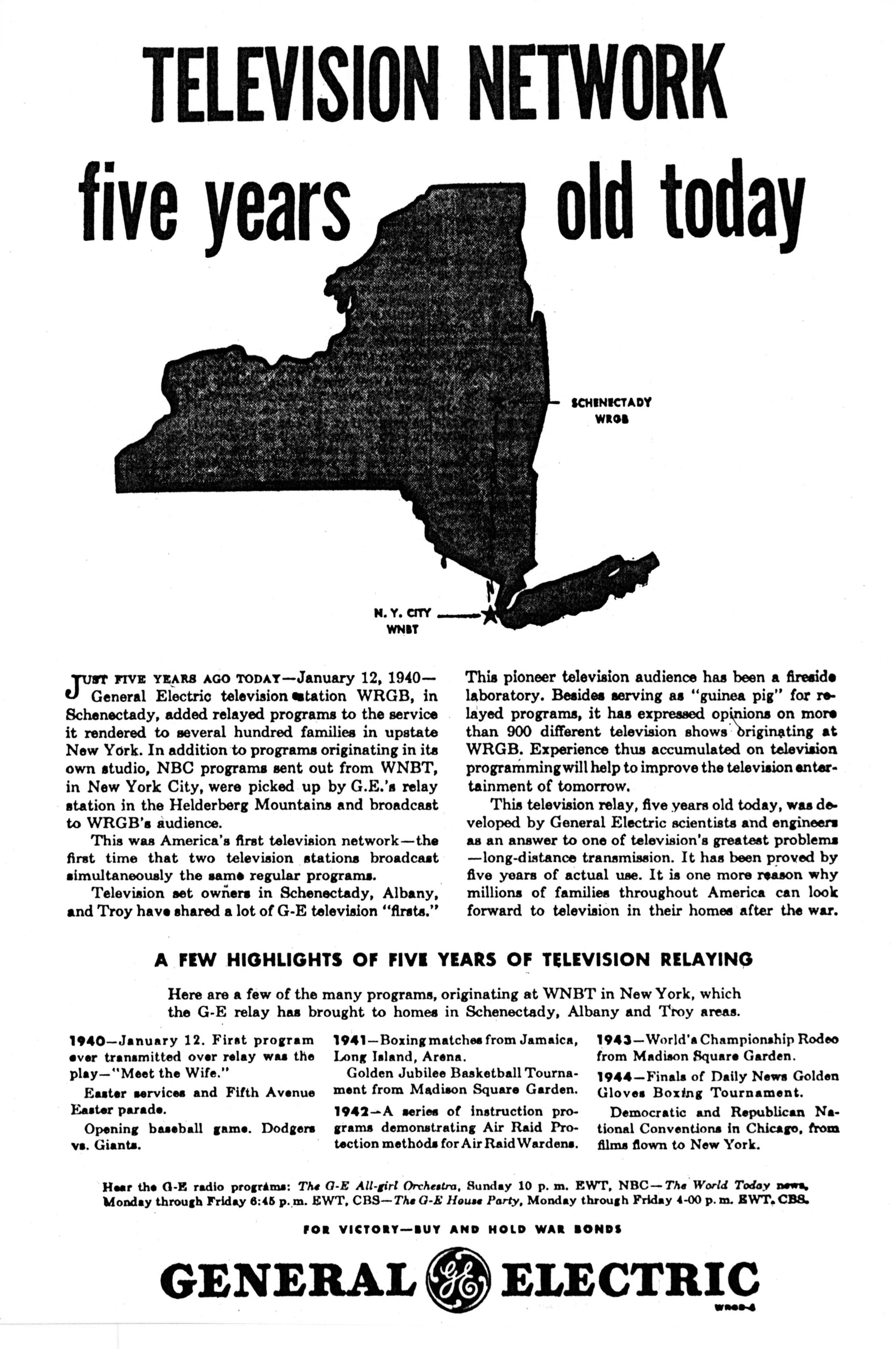
An advertisement by General Electric from early 1945, promoting GE’s television network, through station WRGB in Schenectady (currently Channel 6), New York.  Relying far more on explanation than illustration (that illustration being a simple map), the ad connotes pride in General Electric Television’s recent past, describes the then current scope – in terms of geography and content – of GE’s network, and includes a hint about a future where, “millions of families throughout American can look forward to television in their homes after the war.”  (They had no idea…)

In the context of today – 2022 – where accessing information can be done near instantaneously, an intriguing highlight of the ad is mention of a broadcast of the 1944 Democratic and Republican National Conventions, “derived from films flown to New York.” 

The ad thus implies – without needed to explain the steps involved – the use of photographic (motion picture) film to record these events, and, the use of aircraft to transport said film to New York for development, after which images would be broadcast to GE’s audience. 

Technology not only collapses space, it collapses time. 

(And, it collapses cognition as, well…)

The text of the ad follows…

____________________

TELEVISION NETWORK

five years old today

JUST FIVE YEARS AGO TODAY – January 12, 1940 – General Electric Television station WRGB, in Schenectady, added relayed programs to the service it rendered to several hundred families in upstate New York.  In addition to programs originating in its own studio, NBC programs sent out from WNBT, in New York City, were picked up by G.E.’s relay station in the Helderberg Mountains and broadcast to WRGB’s audience.

This was America’s first television network – the first time that two television stations broadcast simultaneously the same regular programs.

Television set owners in Schenectady, Albany, and Troy have shared a lot of G-E television “firsts”.  This pioneer television audience has been a fireside laboratory.  Besides serving as “guinea pig” for relayed programs, it has expressed opinions on more than 900 different television shows originating at WRGB.  Experience thus accumulated on television programming will help to improve the television entertainment of tomorrow.

This television relay, five years old today, was developed by General Electric scientists and engineers as an answer to one of television’s greatest problems – long-distance transmission.  It has been proved by five years of actual use.  It is one more reason why millions of families throughout American can look forward to television in their homes after the war.

A FEW HIGHLIGHTS OF FIVE YEARS OF TELEVISION RELAYING

Here are a few of the many programs, originating at WNBT in New York, which the G-E relay has brought to homes in Schenectady, Albany and Troy areas.

1940– January 12.  First program ever transmitted over relay was the play – “Meet the Wife”.

Easter services and Fifth Avenue Easter parade.

Opening baseball game.  Dodgers vs. Giants.

1941 – Boxing matches from Jamaica, Long Island, Arena.

Golden Jubilee Basketball Tournament from Madison Square Garden.

1942 – A series of instruction programs demonstrating Air Raid Protection methods for Air Raid Wardens.

1943 – World’s Championship Rodeo from Madison Square Garden.

1944 – Finals of Daily News Golden Gloves Boxing Tournament.
Democratic and Republican National Conventions in Chicago, from films flown to New York.

Hear the G-E radio programs: The G-E All-girl Orchestra, Sunday 10 p.m. EWT, NBC – The World Today news, Monday through Friday 6:45 p.m. EWT, CBS – The G-E House Party, Monday through Friday 4:00 p.m. EWT, CBS.

FOR VICTORY – BUY AND HOLD WAR BONDS

The Age of Advertising: The Time of Television – 1944

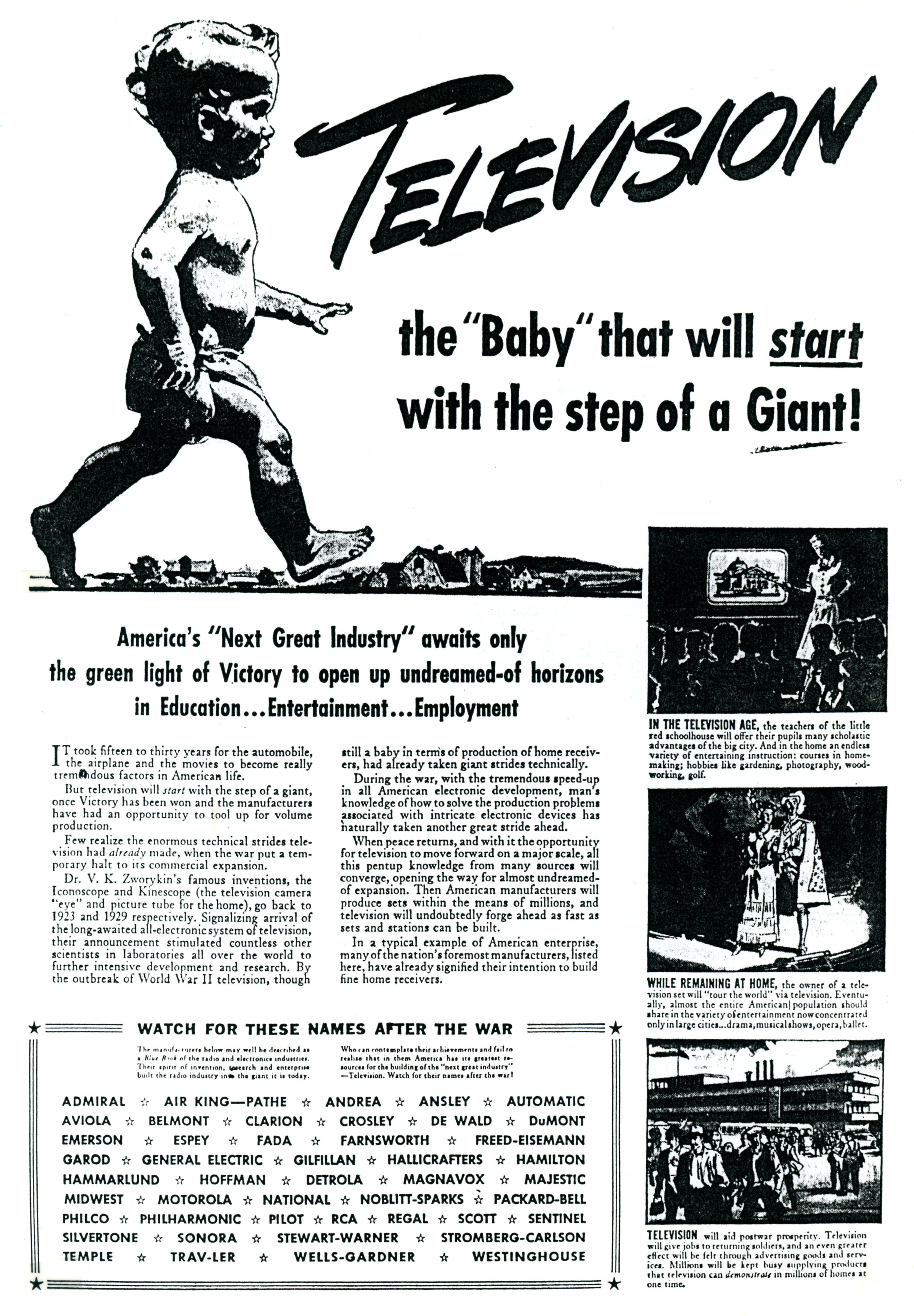
This 1944 RCA advertisement for television features an interesting combination of advocacy, sociological and technical prediction, and industry promotion. 

Like the prior post presenting GE’s 1945 advertisement about television, this earlier example explains the future uses of television within the context of education (“courses in home-making, hobbies like gardening, photography, wood-working, golf”) culture (“drama, musical shows, opera, ballet”), and large-scale future employment for returning veterans. 

All valid and true, at least in the mindset of 1944. 

All valid and true, at least until those nations (both of the – then – Allies and Axis) which had been physically devastated by the war eventually rose to levels of industrial and intellectual capability which would challenge the technical and industrial preeminence of the United States. 

All valid and true, until television, as well as other social and technological developments, would change – as much as reflect – the nature of American culture and society, and that of other countries, as well.

In terms of promotion of those firms involved in or contributing to the manufacture of televisions, the advertisement lists 43 different firms.  Of the 43, how many exist today, either independently, or as subsidiaries?

________________________________________

Television

the “Baby” that will start
with the step of a Giant!

America’s “Next Great Industry” awaits only
the green light of Victory to open up undreamed
-of horizons
in Education … Entertainment …Employment

It took fifteen to thirty years for the automobile, the airplane and the movies to become really tremendous factors in American life.

But television will start with the step of a giant, once Victory has been won and the manufacturers have had the opportunity to tool up for volume production.

Few realize the enormous technical strides television has already made, when the war put a temporary halt to its commercial expansion.

Dr. V.K. Zworykin’s famous inventions, the Iconoscope and Kinescope (the television camera “eye” and picture tube for the home), go back to 1923 and 1929 respectively.  Signalizing arrival of the long-awaited all-electronic systems of television, their announcement stimulated countless other scientists in laboratories all over the world to further intensive development and research.  By the outbreak of World War II television, though still a baby in terms of production of home receivers, had already taken giant strides technically.

During the war, with the tremendous speed-up in all American electronic development, man’s knowledge of how to solve the production problems associated with intricate electronic devices has naturally taken another great stride ahead.

When peace returns, and with it the opportunity for television to move forward on a larger scale, all this pentup knowledge from many sources will converge, opening the way for almost undreamed-of expansion.  Then American manufacturers will produce sets within the means of millions, and television will undoubtedly forge ahead as fast as sets and stations can be built.

In a typical example of American enterprise, many of the nation’s foremost manufacturers, listed here, have already signified their intention to build fine home receivers.

IN THE TELEVISION AGE, the teachers of the little red schoolhouse will offer their pupils many scholastic advantages of the big city.  And in the homes an endless variety of entertaining instruction: courses in home-making, hobbies like gardening, photography, wood-working, golf.

WHILE REMAINING AT HOME, the owner of a television set will “tour the world” via television.  Eventually, almost the entire American population should share in the variety of entertainment now concentrated only in large cities…drama, musical shows, opera, ballet.

TELEVISION will aid postwar prosperity.  Television will give jobs to returning soldiers, and an even greater effect will be felt through advertising goods and services.  Millions will be kept busy supplying products that television can demonstrate in millions of homes at one time.

WATCH FOR THESE NAMES AFTER THE WAR

The manufacturers below may well be described as a Blue Book of the radio and electronics industries.  Their spirit of invention, research and enterprise built the radio industry into the giant it is today.

Who can contemplate their achievements and fail to realize that in them America has its greatest resources for the building of the “next great industry” – Television.  Watch for their names after the war!

ADMIRALAIR KING-PATHEANDREAANSLEYAUTOMATIC
AVIOLABELMONTCLARIONCROSLEYDE WALDDuMONT
EMERSONESPEYFADAFARNSWORTHFREED-EISEMANN
GARODGENERAL ELECTRICGILFILLANHALLICRAFTERSHAMILTON
HAMMARLUNDHOFFMANDETROLAMAGNAVOXMAJESTIC
MIDWESTMOTOROLANATIONALNOBLITTSPARKSPACKARDBELL
PHILCOPHILHARMONICPILOT RCA REGALSCOTTSENTINEL
SILVERTONESONORASTEWARTWARNERSTROMBERGCARLSON
TEMPLETRAVLERWELLSGARDNERWESTINGHOUSE

________________________________________

Just Two Little References

Standage, Tom, Writing on the Wall: Social Media – The First 2,000 Years, Bloomsbury Publishing, 2014

Trimble, David C., Television: Airwaves Church of the Future, The Living Church, V 110, N 1, Jan. 7, 1945

The Age of Advertising: Stromberg-Carlson Company – 1942

An advertisement from The New York Times about new radios – well, not-so-new radios! – from 1942, by the Stromberg-Carlson Company, listing radio retailers in the New York Metropolitan area, northern New Jersey, and Connecticut.

(Stromberg-Carlson w h o?)

The company was founded in 1904, and after being purchased by the Home Telephone Company in 1904, relocated from Chicago to Rochester, New York, where it became, “…a major manufacture of consumer electronics including home telephones, radio receivers and, after World War II, television sets.” Notably – at least in terms of this blog – the company produced the BC-348 communications receiver, which was used in WW II Army Air Force multi-engine transports and bombers….

The company was purchased by General Dynamics in 1955, and by 1980, sold by them in several components.

The acronym “OPA” refers to the Office of Price Administration, an agency of the Federal Government established in August of 1941, within the Office for Emergency Management. The OPA became an independent agency in January of 1942, and, “…had the power to place ceilings on all prices except agricultural commodities, and to ration scarce supplies of other items, including tires, automobiles, shoes, nylon, sugar, gasoline, fuel oil, coffee, meats and processed foods. At the peak, almost 90% of retail food prices were frozen. It could also authorize subsidies for production of some of those commodities.”

The full text of the ad (sans the list of dealers’ names for metropolitan New York, and Connecticut) follows:

______________________________

AN IMPORTANT
ANNOUNCEMENT
ABOUT NEW RADIOS

MANUFACTURE of new radios stopped April 22nd, 1942. Early completion of production brought about by 100% conversion to war orders has again made available a variety of our Radios and Radio-Phonographs.

If you are thinking of a new instrument to last you beyond the duration, we suggest you make your purchase soon. For when the current stock of new radios is gone, there will be no more until the war is won.

And you know that, for a long-term investment in good music at its best, you will find “There is nothing finer than a Stromberg-Carlson!”

Visit your nearest dealer listed below, where you will find most models on display, at OPA prices.

COMPLETE LINE ON DEMONSTRATION
Gross Distributors, Inc., 570 Lexington, Avenue, New York City
Representative for New York and New England
Write for free booklet “Facts about FM”

STROMBERG-CARLSON
ROCHESTER, NEW YORK

A FINER RADIO FOR STANDARD PROGRAMS • THE ONLY RADIO FOR FM AT ITS BEST
TUNE IN WQXR MON, WED., FRI. 7:30 P.M. STROMBERG-CARLSON “TREASURY OF MUSIC”

______________________________

Well, since we’re talking FM, what better way to end this post, than with No Static At All?

References

Office of Price Administration (OPA), at Wikipedia

Stromberg-Carlson, at Wikipedia

The Age of Advertising: Pennsylvania Railroad – January 15, 1945

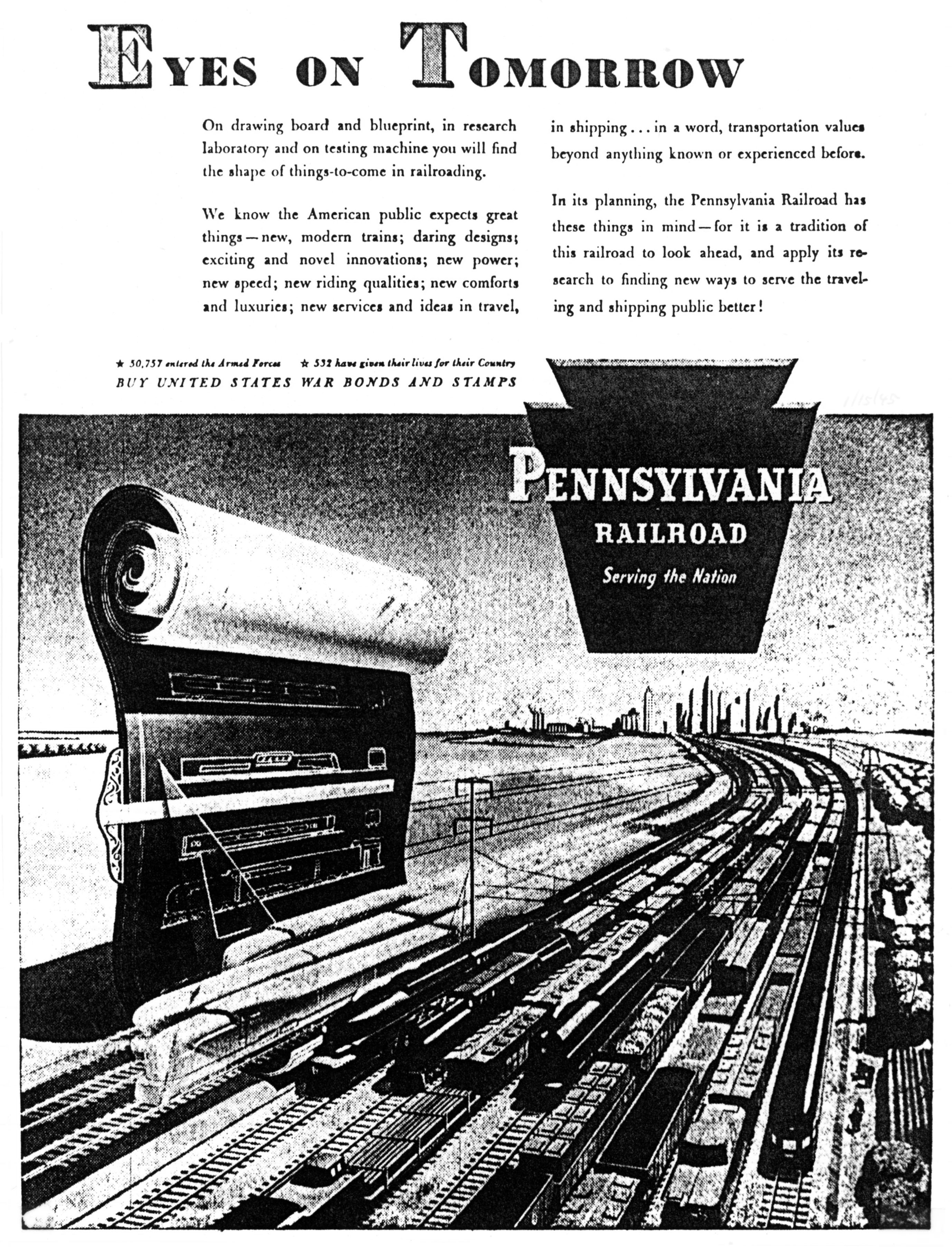
The advertisement below, for Pennsylvania Railroad – from January 15, 1945 – has a title that proved to be as optimistic as it was ironic, for after merging with New York Central Railroad in 1968, the resulting firm, the Penn Central Transportation Company, filed for bankruptcy in 1970. 

The advertisement combines three elements to produce a striking image.  On the left, symbolizing the future, new designs for railroad cars are displayed on a unfurled blueprint, against which are placed a T-square and right triangle.  Translucent images of those “future” railroad cards appear below.  On the right, a fleet of existing freight and railroad cars, en route from a “city” and a “factory” pass by a suburban rail station.  In the background, stylized images of that city and factory are set against the horizon of a cloudless sky, surrounded by farmland.  Above all is the emblem of the Pennsylvania Railroad.

Though “this” example of the advertisement was published in The New York Times, certainly the original advertisement was in color and doubtless intended for publication in magazines.

Here’s an example of that original ad, from Pinterest:

Here’s the full text of the advertisement:

________________________________________

EYES ON TOMORROW

On drawing board and blueprint, in research laboratory and on testing machines you will find the shape of things-to-come in railroading.
We know the American public expects great things – new, modern trains; daring designs; exciting and novel innovations; new power; new speed; new riding qualities; new comforts and luxuries; new services and ideas in travel, in shipping … in a word, transportation values beyond anything known or experienced before.

In its planning, the Pennsylvania Railroad has these things in mind – for it is a tradition of this railroad to look ahead, and apply its research to finding new ways to serve the traveling and shipping public better!

★ 50,757 entered the Armed Forces ☆ 532 have given their lives for their Country

BUY UNITED STATES WAR BONDS AND STAMPS

________________________________________

That the advertisement was created during the Second World War is strikingly evident by one particular facet of the text:  The number of Pennsylvania Railroad Employees who died on WW II military service.  Though listed as 532, the actual number is more than twice as many: 1,307.  The discrepancy was likely attributable to the fact that the advertisement was created before the war actually ended, and thus, well before the status of all casualties (especially those missing in action) was verified.

The 1,307 men are memorialized at Philadelphia’s 30th Street Station, in the form of a bronze sculpture – entitled “Angel of the Resurrection” – which portrays the Archangel Michael lifting a fallen soldier out of the “flames of war”.  The sculpture is set atop a four-sided black granite base, upon the sides of which are bronze plaques listing the soldiers’ names in alphabetical order, and, bearing symbols of the four branches of the armed forces.

Designed by Walter Hancock and unveiled in 1952, the sculpture is – even decades later – striking. 

References

Pennsylvania Railroad, at Wikipedia

Pennsylvania Railroad World War II Memorial, (once again), at Wikipedia 

The Age of Advertising: Grumman Aircraft Engineering Corporation – May, 1945

A simple, visually compelling advertisement by Grumman aircraft.  The innumerable silhouettes receding to the horizon are all of the same aircraft, probably representing the company’s F6F Hellcat fighter plane.

The emblem of the 7th War Loan would place the ad’s date at somewhere after May 7, 1945.

The Age of Advertising: Pilot Radio – 1945

It’s late 1945.  The war has just ended. 

G.I.s are returning; many have already returned.

Consumer products are once again becoming available.  In abundance.  In quality.  In variety.

Time for a return to normalcy.  (Albeit, in the retrospect of 2017, a fortuitous, temporary, historically anomalous, overly romanticized normalcy.  Hey, it was nice while it lasted.)

And so we encounter an optimistic, symbolic advertisement from Pilot Radio.  The company was founded in 1919 in Brooklyn, New York by former test pilot Isidore Goldberg, as the Pilot Electronic Manufacturing Company, the name changing in 1932 to “Pilot Radio”.  The company was acquired by Emerson Radio in 1965.   

The advertisement is symbolic and optimistic, with the curious image of an hourglass – denoting the march of time – before a receding horizon.  No actual products are promoted or described.  Rather, the ad’s message is one of pride:  “We’re back”…(note the “To Be Opened Soon” gift box) to manufacture radio and televisions for the consumer market. 

A VETERAN THAT STOOD THE TEST OF SERVICE

Tested by time in countless homes throughout the world, Pilot Radio has scored a triumph for dependability and unfaltering performance through the war years.  Let the satisfaction of present and past Pilot Radio owners be your guide to greater listening pleasure in the future.

Remember the Pilot Radio trademark.  You’ll be seeing it soon on radio sets that combine the experience of many years in the science of electronics with the artistry of quality production.  It will pay you to wait for a Pilot Radio.

Pilot Radio has also pioneered in television since 1928 and will soon bring you television in its most perfected form.  If you would like to receive further information about Pilot Radio’s activities in television, fill out and mail the coupon below.

“Symbol of Quality”

PILOT RADIO

Pioneers in Frequency Modulation and Television

PILOT RADIO-PHONOGRAOH COMBINATIONS   PILOT AM-FM RADIOS   PILOT PORTABLE RADIOS   PILOT RADIO-TELEVSION RECEIVERS

______________________________

Just Two Little References

Early Television Museum – Pilot Radio Corporation History (at Early Television)

Emerson Radio (at Wikipedia)

The Age of Advertising: Motorola Radio – 1945

An advertisement for Motorola Radio, from 1945. 

The Galvin Manufacturing Corporation (listed at the bottom of the advertisement) the actual progenitor of Motorola, was founded in 1928 in Chicago by brothers Paul V. and Joseph E. Galvin.  They originated the name “Motorola” in 1930 by “…linking “motor” (for motorcar) with “ola” (from Victrola)”, selling their first Motorola brand name radio that year.   

The text of the advertisement?…

electronics

Yes Sir…  THIS WAS AN Electronic Instrument Too…

FUNNY-LOOKING gadget, that old-time radio set.  Big, bulky horn…dials and more dials…squeaky and noisy as all get out.  Not much like the radio now in your living-room or car.  And yet the radio you buy not too long after the war may make your present-day set look and sound as antiquated as that early Electronic instrument looks now.  Today Electronics is fighting for America and its Allies brilliantly and successfully.  In battle it warns of approaching danger so can can destroy the enemy; in the electric eye it searches for and exposes flaws in heavy castings; in resistance-welding it doubles and triples production.  These and countless others are Electronic achievements of vast importance now and for the future.  The first Electronic instrument to benefit will be radio.

Motorola Engineers are making full use of the newest Electronic knowledge in the production and development of Radar and Communications Equipment now being used by American fighting men on every battle front.  Soon after Victory gives the green light to civilian production, the “know-how” of Motorola Engineers will be switched to the production of civilian radios for home and car with the same all-out efficiency and perfection.

Expect the finest in radio from Motorola.

Your First Post-War Electronic Purchase Should be a Motorola Radio

Take good care of your radio.  It is a vital wartime necessity.  For service, consult your local classified telephone directory for a nearby Motorola Dealer.

Motorola Radio FOR HOME & CAR
GALVIN MFG. CORPORATION CHICAGO, ILLINOIS

YORK AUTOMOTIVE DITRIBUTING CO., NEW YORK CITY
Wholesale Distributor

For the continued development and production of Radio Communications and other special Electronic equipment for our Armed Forces, the Motorola organization has been awarded two stars for their Army-Navy “E” Flag.  Motorola is proud of the part it has been privileged to play in the speeding of Victory.


The Age of Advertising: Dumont Precision Electronics and Television – 1946

Here is another sign of – well, actually from, “The Times”.  (The New York Times, that is) from 1946.  An advertisement for DuMont Televisions.

Dumont – what the heck is that? 

I’d heard of, seen, and viewed programs on, sets by RCA, Zenith, and Motorola.  But, DuMont?  What was DuMont?  Who was Hildegarde? 

A little searching (see the excerpts below) reveals the answers….

From Wikipedia: “The DuMont Television Network … was one of the world’s pioneer commercial television networks, rivalling NBC and CBS for the distinction of being first overall in the United States. It began operation in 1946.  It was owned by DuMont Laboratories, a television equipment and set manufacturer.  The network was hindered by the prohibitive cost of broadcasting, by regulations imposed by the Federal Communications Commission (FCC) which restricted the company’s growth, and even by the company’s partner, Paramount Pictures.  Despite several innovations in broadcasting and the creation of one of television’s biggest stars of the 1950s (Jackie Gleason), the network never found itself on solid financial ground.  Forced to expand on UHF channels during an era when UHF tuning was not yet a standard feature on television sets, DuMont fought an uphill battle for program clearances outside of their three owned-and-operated stations in New York, Washington, D.C., and Pittsburgh, finally ending network operations in 1956.”

“DuMont Laboratories was an American television equipment manufacturer.  The company was founded in 1931, in Upper Montclair, New Jersey, by inventor Allen B. DuMont.  Among the company’s developments were durable cathode ray tubes that would be used for TV.  Another product was a DuMont invention, the magic eye tube.”

But, who was Hildegarde?:  “Hildegard Frieda Albertine Knef (28 December 1925 – 1 February 2002) was a German actress, singer, and writer.  She was billed in some English language films as Hildegard Neff or Hildegarde Neff.”

______________________________

Here’s the text of the ad:

HILDEGARDE SAYS:

“Darling, quel amour… ce magnifique Du Mont Teleset!”

Soon you will echo Hiledgarde’s rapturous sentiments.  You’ll love seeing and hearing this vivacious chanteuse – especially on a DuMont Teleset.

For its superlative performance is more than mere chance.  DuMont’s 14-year pioneering leadership in radio-electronics guarantees uncompromising craftsmanship … assures the things important to you.  DuMont will give you incomparably clear pictures, exquisite FM tone, inspired cabinet artistry, technical dependability.  These are tested attributes of DuMont-engineered Television-FM receivers.  Soon they will be yours … soon you will realize the full richness of television’s tremendous promise if you remember this:

For the best in television, look and listen to a DuMont Teleset!

ALLEN B. DuMONT LABORATORIES, INC.
GENERAL OFFICES AND PLANT
2 MAIN AVENUE, PASSAIC, N.J.

TELEVISION STUDIOS AND STATION WABC
515 MADISON AVENUE
NEW YORK 22, NEW YORK