The Age of Advertising: General Electric Television Network

A sign of the times; a herald of the times, in the Times

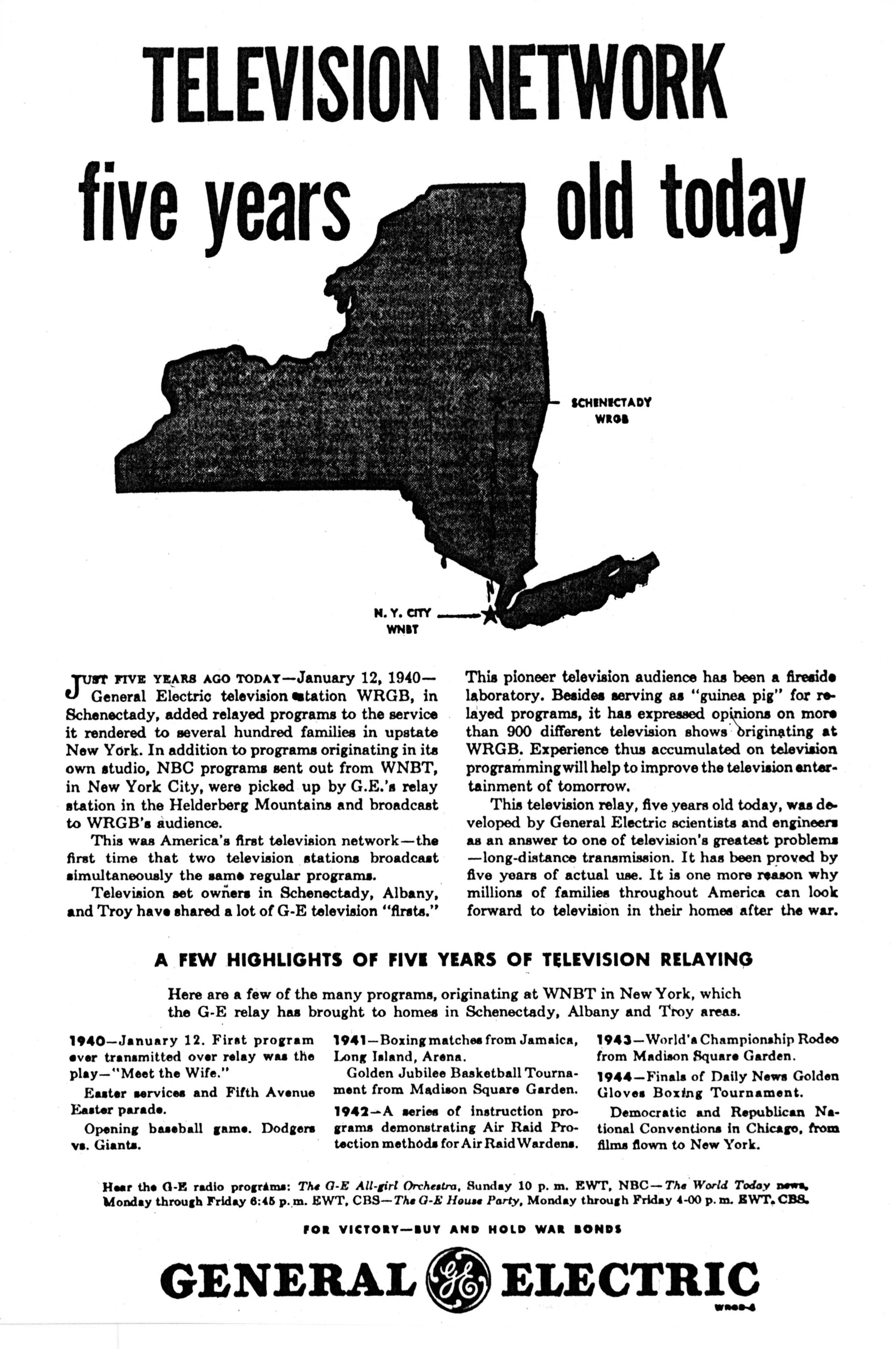
An advertisement by General Electric from early 1945, promoting GE’s television network, through station WRGB in Schenectady (currently Channel 6), New York.  Relying far more on explanation than illustration (that illustration being a simple map), the ad connotes pride in General Electric Television’s recent past, describes the then current scope – in terms of geography and content – of GE’s network, and includes a hint about a future where, “millions of families throughout American can look forward to television in their homes after the war.”  (They had no idea…)

In the context of today – 2022 – where accessing information can be done near instantaneously, an intriguing highlight of the ad is mention of a broadcast of the 1944 Democratic and Republican National Conventions, “derived from films flown to New York.” 

The ad thus implies – without needed to explain the steps involved – the use of photographic (motion picture) film to record these events, and, the use of aircraft to transport said film to New York for development, after which images would be broadcast to GE’s audience. 

Technology not only collapses space, it collapses time. 

(And, it collapses cognition as, well…)

The text of the ad follows…
____________________

TELEVISION NETWORK

five years old today

JUST FIVE YEARS AGO TODAY – January 12, 1940 – General Electric Television station WRGB, in Schenectady, added relayed programs to the service it rendered to several hundred families in upstate New York.  In addition to programs originating in its own studio, NBC programs sent out from WNBT, in New York City, were picked up by G.E.’s relay station in the Helderberg Mountains and broadcast to WRGB’s audience.

This was America’s first television network – the first time that two television stations broadcast simultaneously the same regular programs.

Television set owners in Schenectady, Albany, and Troy have shared a lot of G-E television “firsts”.  This pioneer television audience has been a fireside laboratory.  Besides serving as “guinea pig” for relayed programs, it has expressed opinions on more than 900 different television shows originating at WRGB.  Experience thus accumulated on television programming will help to improve the television entertainment of tomorrow.

This television relay, five years old today, was developed by General Electric scientists and engineers as an answer to one of television’s greatest problems – long-distance transmission.  It has been proved by five years of actual use.  It is one more reason why millions of families throughout American can look forward to television in their homes after the war.

A FEW HIGHLIGHTS OF FIVE YEARS OF TELEVISION RELAYING

Here are a few of the many programs, originating at WNBT in New York, which the G-E relay has brought to homes in Schenectady, Albany and Troy areas.

1940– January 12.  First program ever transmitted over relay was the play – “Meet the Wife”.

Easter services and Fifth Avenue Easter parade.

Opening baseball game.  Dodgers vs. Giants.

1941 – Boxing matches from Jamaica, Long Island, Arena.

Golden Jubilee Basketball Tournament from Madison Square Garden.

1942 – A series of instruction programs demonstrating Air Raid Protection methods for Air Raid Wardens.

1943 – World’s Championship Rodeo from Madison Square Garden.

1944 – Finals of Daily News Golden Gloves Boxing Tournament.
Democratic and Republican National Conventions in Chicago, from films flown to New York.

Hear the G-E radio programs: The G-E All-girl Orchestra, Sunday 10 p.m. EWT, NBC – The World Today news, Monday through Friday 6:45 p.m. EWT, CBS – The G-E House Party, Monday through Friday 4:00 p.m. EWT, CBS.

FOR VICTORY – BUY AND HOLD WAR BONDS
The Age of Advertising: The Time of Television – 1944

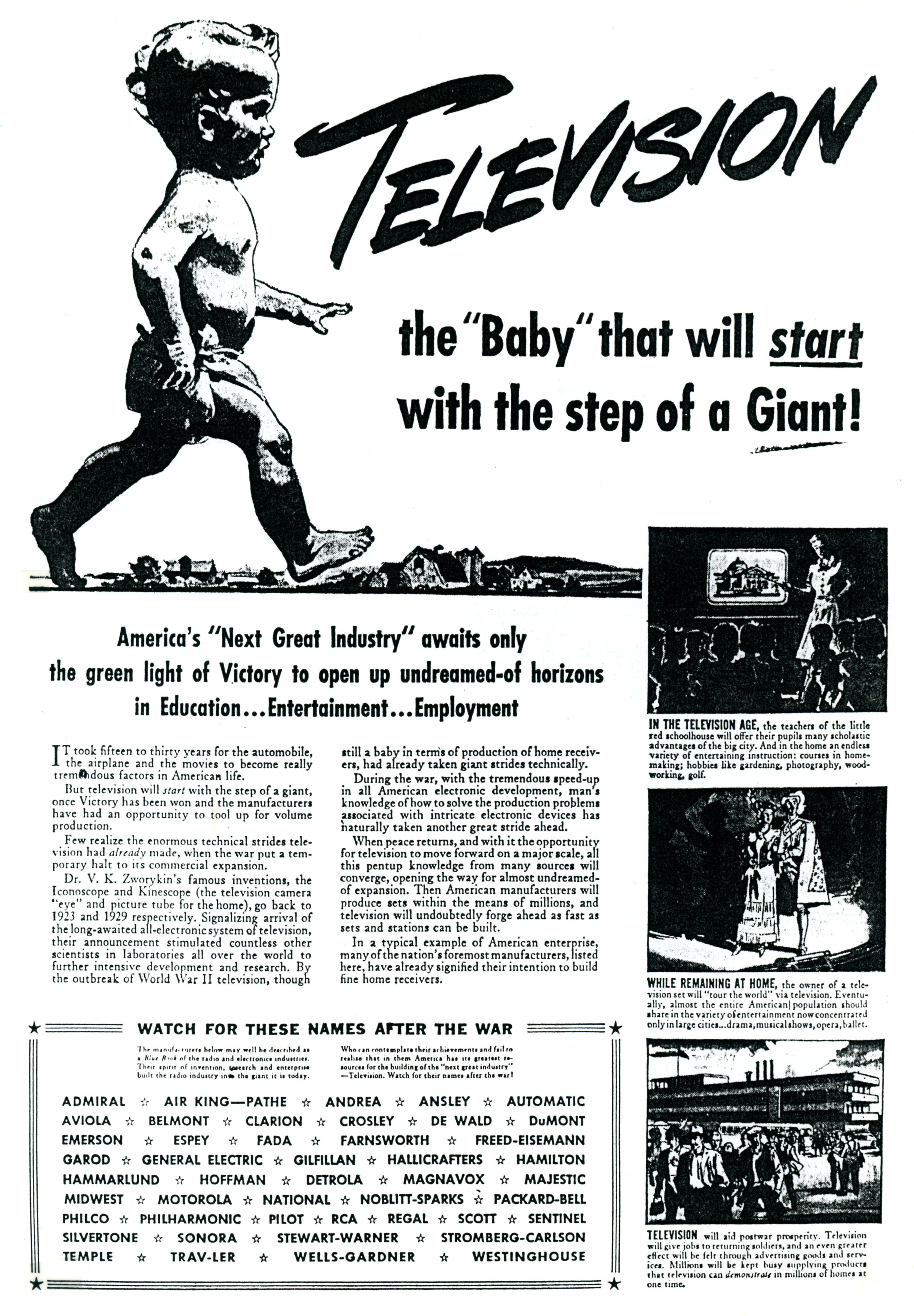
This 1944 RCA advertisement for television features an interesting combination of advocacy, sociological and technical prediction, and industry promotion. 

Like the prior post presenting GE’s 1945 advertisement about television, this earlier example explains the future uses of television within the context of education (“courses in home-making, hobbies like gardening, photography, wood-working, golf”) culture (“drama, musical shows, opera, ballet”), and large-scale future employment for returning veterans. 

All valid and true, at least in the mindset of 1944. 

All valid and true, at least until those nations (both of the – then – Allies and Axis) which had been physically devastated by the war eventually rose to levels of industrial and intellectual capability which would challenge the technical and industrial preeminence of the United States. 

All valid and true, until television, as well as other social and technological developments, would change – as much as reflect – the nature of American culture and society, and that of other countries, as well.

In terms of promotion of those firms involved in or contributing to the manufacture of televisions, the advertisement lists 43 different firms.  Of the 43, how many exist today, either independently, or as subsidiaries?

________________________________________

Television

the “Baby” that will start
with the step of a Giant!

America’s “Next Great Industry” awaits only
the green light of Victory to open up undreamed
-of horizons
in Education … Entertainment …Employment

It took fifteen to thirty years for the automobile, the airplane and the movies to become really tremendous factors in American life.

But television will start with the step of a giant, once Victory has been won and the manufacturers have had the opportunity to tool up for volume production.

Few realize the enormous technical strides television has already made, when the war put a temporary halt to its commercial expansion.

Dr. V.K. Zworykin’s famous inventions, the Iconoscope and Kinescope (the television camera “eye” and picture tube for the home), go back to 1923 and 1929 respectively.  Signalizing arrival of the long-awaited all-electronic systems of television, their announcement stimulated countless other scientists in laboratories all over the world to further intensive development and research.  By the outbreak of World War II television, though still a baby in terms of production of home receivers, had already taken giant strides technically.

During the war, with the tremendous speed-up in all American electronic development, man’s knowledge of how to solve the production problems associated with intricate electronic devices has naturally taken another great stride ahead.

When peace returns, and with it the opportunity for television to move forward on a larger scale, all this pentup knowledge from many sources will converge, opening the way for almost undreamed-of expansion.  Then American manufacturers will produce sets within the means of millions, and television will undoubtedly forge ahead as fast as sets and stations can be built.

In a typical example of American enterprise, many of the nation’s foremost manufacturers, listed here, have already signified their intention to build fine home receivers.

IN THE TELEVISION AGE, the teachers of the little red schoolhouse will offer their pupils many scholastic advantages of the big city.  And in the homes an endless variety of entertaining instruction: courses in home-making, hobbies like gardening, photography, wood-working, golf.

WHILE REMAINING AT HOME, the owner of a television set will “tour the world” via television.  Eventually, almost the entire American population should share in the variety of entertainment now concentrated only in large cities…drama, musical shows, opera, ballet.

TELEVISION will aid postwar prosperity.  Television will give jobs to returning soldiers, and an even greater effect will be felt through advertising goods and services.  Millions will be kept busy supplying products that television can demonstrate in millions of homes at one time.

WATCH FOR THESE NAMES AFTER THE WAR

The manufacturers below may well be described as a Blue Book of the radio and electronics industries.  Their spirit of invention, research and enterprise built the radio industry into the giant it is today.

Who can contemplate their achievements and fail to realize that in them America has its greatest resources for the building of the “next great industry” – Television.  Watch for their names after the war!

ADMIRALAIR KING-PATHEANDREAANSLEYAUTOMATIC
AVIOLABELMONTCLARIONCROSLEYDE WALDDuMONT
EMERSONESPEYFADAFARNSWORTHFREED-EISEMANN
GARODGENERAL ELECTRICGILFILLANHALLICRAFTERSHAMILTON
HAMMARLUNDHOFFMANDETROLAMAGNAVOXMAJESTIC
MIDWESTMOTOROLANATIONALNOBLITTSPARKSPACKARDBELL
PHILCOPHILHARMONICPILOT RCA REGALSCOTTSENTINEL
SILVERTONESONORASTEWARTWARNERSTROMBERGCARLSON
TEMPLETRAVLERWELLSGARDNERWESTINGHOUSE

________________________________________

Just Two Little References

Standage, Tom, Writing on the Wall: Social Media – The First 2,000 Years, Bloomsbury Publishing, 2014

Trimble, David C., Television: Airwaves Church of the Future, The Living Church, V 110, N 1, Jan. 7, 1945