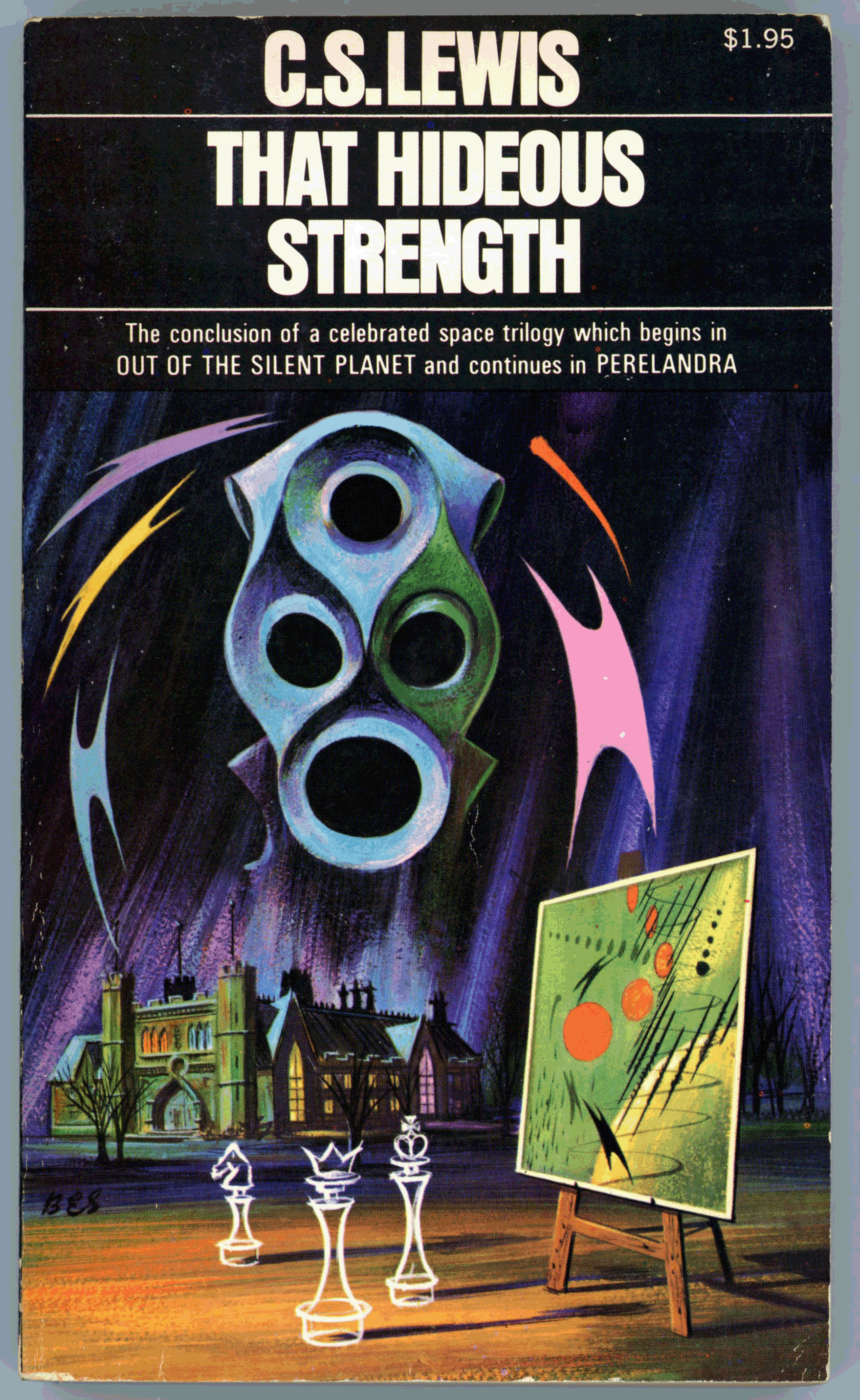
That Hideous Strength, by C.S. Lewis (Clive Staples Lewis) – 1965 (1946) [Bernard Symancyk] – Macmillan # 8692 [Ever-so-slightly updated…]

that-hideous-strength-cs-lewis-1946-1977“Why you fool, it’s the educated reader who can be gulled.
All our difficulty comes with the others.
When did you meet a workman who believes the papers?
He takes it for granted that they’re all propaganda and skips the leading articles.
He buys his paper for the football results and the little paragraphs
about girls falling out of windows and corpses found in Mayfair flats.
He is our problem.

We have to recondition him.

But the educated public,
the people who read the highbrow weeklies,
don’t need reconditioning.
They’re all right already.

They’ll believe anything.”

________________________________________

Since completing this post, I’ve made innumerable attempts to learn more about the NICE’s current incarnation, but information about the organization – at least, beyond what C.S. Lewis presents in his novel – is remarkably elusive.  (Understandable:  Much has changed since 1946, not least the fact that the NICE is no longer headquartered in England.)  Despite extensive searches using DuckDuckGo, and, that o t h e r search engine (y’know, the one headquartered in Mountain View, California, at which the arc of human history is tacitly understood to “progress” (Babel-like?) ever forward; always upward; ever higher…), I’ve been unable to identify either the Institute’s home page, or, links to the organization through any other website, whether governmental or private; whether in the Americas, Western or Eastern Europe, Africa, or Asia.    

Likewise, though the Institute assuredly has a presence on Twitter, Facebook, Instagram, and Snapchat, these too remain elusive.  

Well, not entirely true:  I did come across one possible link.  But, I’m not going to click on it.  (Y’never know what might happen…!)

(Okay, just kidding!  I thought it would be fun to indulge in brief speculation about parallel universes and alternate histories….)

But, I did find the image below:  It’s conceptual art of a promotional / propaganda poster for the NICE, fittingly done in 1940s “atomic” style: The kind of image you’d see – 1984-like – in abundance, weather-marked with tattered corners yet always freshly replaced – upon the walls of any urban center.   

The poster is one of many works created by J.P. Cokes as conceptual illustrations for That Hideous Strength, and can be viewed at Behance.  J.P. Cokes has also created a great series of stylistically similar illustrations for Alfred Bester’s The Stars My Destination, which – like That Hideous Strength; like so many other works of science fiction and fantasy (A.E. van Vogt, anyone?) – merits transfer from the printed page to animation, or, the “live” screen.  

________________________________________

You can view the cover of Avon Books’ 1958 abridged version of That Hideous Strength, published under the title The Tortured Planet (Avon # T-211), here

(See review and discussion at Chicago Boyz website…) 

The Tortured Planet (That Hideous Strength), by C.S. Lewis (Clive Staples Lewis) – 1958 (1946) [Richard M. Powers] – Avon # T-211 [Slightly updated…]

Here’s the cover of Avon Books’ 1958 edition of the third and final novel of the Space Trilogy, That Hideous Strength, published under the awkward title The Tortured Planet.  (Ugh.)  I don’t know the reason for the title change, though it may relate to this Avon edition being – as stated on the cover – C.S. Lewis’ abridged version of the original work. 

This edition’s cover art, which looks like two factory-reject Christmas tree ornaments floating confusedly in space, is by Richard Powers, and is the “weakest” of the cover illustrations of Avon’s three 1950s-era volumes of Lewis’ trilogy.  This is more than ironic, given the typically exceptional quality – in terms of complexity, symbolism, and originality – of Powers’ oeuvre.  

You can view the cover art of Macmillan’s 1965 edition of That Hideous Strength here.     

Here are two discussions concerning That Hideous Strength / The Tortured Planet – at ChicagoBoyz.  Both by David Foster, they are “Summer Rerun – Book Review: That Hideous Strength” (September 15, 2017), and, “Summer Rerun – Lewis vs. Haldane” (August 31, 2019).

A (the?) central plot element of the novel concerns an organization dubbed NICE., the National Institute for Coordinated Experimentation.  As stated by Foster, Lewis describes NICE as “the first fruits of that constructive fusion between the state and the laboratory on which so many thoughtful people base their hopes of a better world.”  Though thankfully there’s no congruent analogue of N.I.C.E. in our world, perhaps the Institute can be taken to represent the long-reigning academic / corporate / media “complex”, which has wielded, and continues to wield, vastly more power than than the stereotyped (albeit a somewhat hackneyed stereotype) “military industrial complex”. 

Just sayin’.

Oh, here’s a quote by, “…the Head of the Institutional Police, a woman named Miss Hardcastle … nicknamed the Fairy, who explains to sociologist Mark Studdock [a professor “on the make” at Bracton College], the ease with which the news media can manipulate the public.  (Specifically alluding to that portion of the public that is “educated”, credentialed, and perhaps meritocratic?) 

Whether in the world of the Space Trilogy or our world, her point is valid. 

Thus:

“Why you fool, it’s the educated reader who can be gulled.
All our difficulty comes with the others.
When did you meet a workman who believes the papers?
He takes it for granted that they’re all propaganda and skips the leading articles.
He buys his paper for the football results and the little paragraphs
about girls falling out of windows and corpses found in Mayfair flats.
He is our problem.

We have to recondition him.

But the educated public,
the people who read the highbrow weeklies,
don’t need reconditioning.
They’re all right already.

They’ll believe anything.”

________________________________________

Since completing this post, I’ve made innumerable attempts to learn more about the NICE’s current incarnation, but information about the organization – at least, beyond what C.S. Lewis presents in his novel – is remarkably elusive.  (Understandable:  Much has changed since 1946, not least the fact that the NICE is no longer headquartered in England.)  Despite extensive searches using DuckDuckGo, and, that o t h e r search engine (y’know, the one headquartered in Mountain View, California, at which the arc of human history is tacitly understood to “progress” (Babel-like?) ever forward; always upward; ever higher…), I’ve been unable to identify either the Institute’s home page, or, links to the organization through any other website, whether governmental or private; whether in the Americas, Western or Eastern Europe, Africa, or Asia.    

Likewise, though the Institute assuredly has a presence on Twitter, Facebook, Instagram, and Snapchat, these too remain elusive.  

Well, not entirely true:  I did come across one possible link.  But, I’m not going to click on it.  (Y’never know what might happen…!)

(Okay, just kidding!  I thought it would be fun to indulge in brief speculation about parallel universes and alternate histories….)

But, I did find the image below:  It’s conceptual art of a promotional / propaganda poster for the NICE, fittingly done in 1940s “atomic” style: The kind of image you’d see – 1984-like – in abundance, weather-marked with tattered corners yet always freshly replaced – upon the walls of any urban center.   

The poster is one of many works created by J.P. Cokes as conceptual illustrations for That Hideous Strength, and can be viewed at Behance.  J.P. Cokes has also created a great series of stylistically similar illustrations for Alfred Bester’s The Stars My Destination, which – like That Hideous Strength; like so many other works of science fiction and fantasy (A.E. van Vogt, anyone?) – merits transfer from the printed page to animation, or, the “live” screen.  

________________________________________

Note: December 2, 2020 – Having created this post only five days ago, I was happily surprised to discover Dr. Pedro Blas González’ essay, “Good and Evil in C.S. Lewis’ Space Trilogy“, at NewEnglishReview

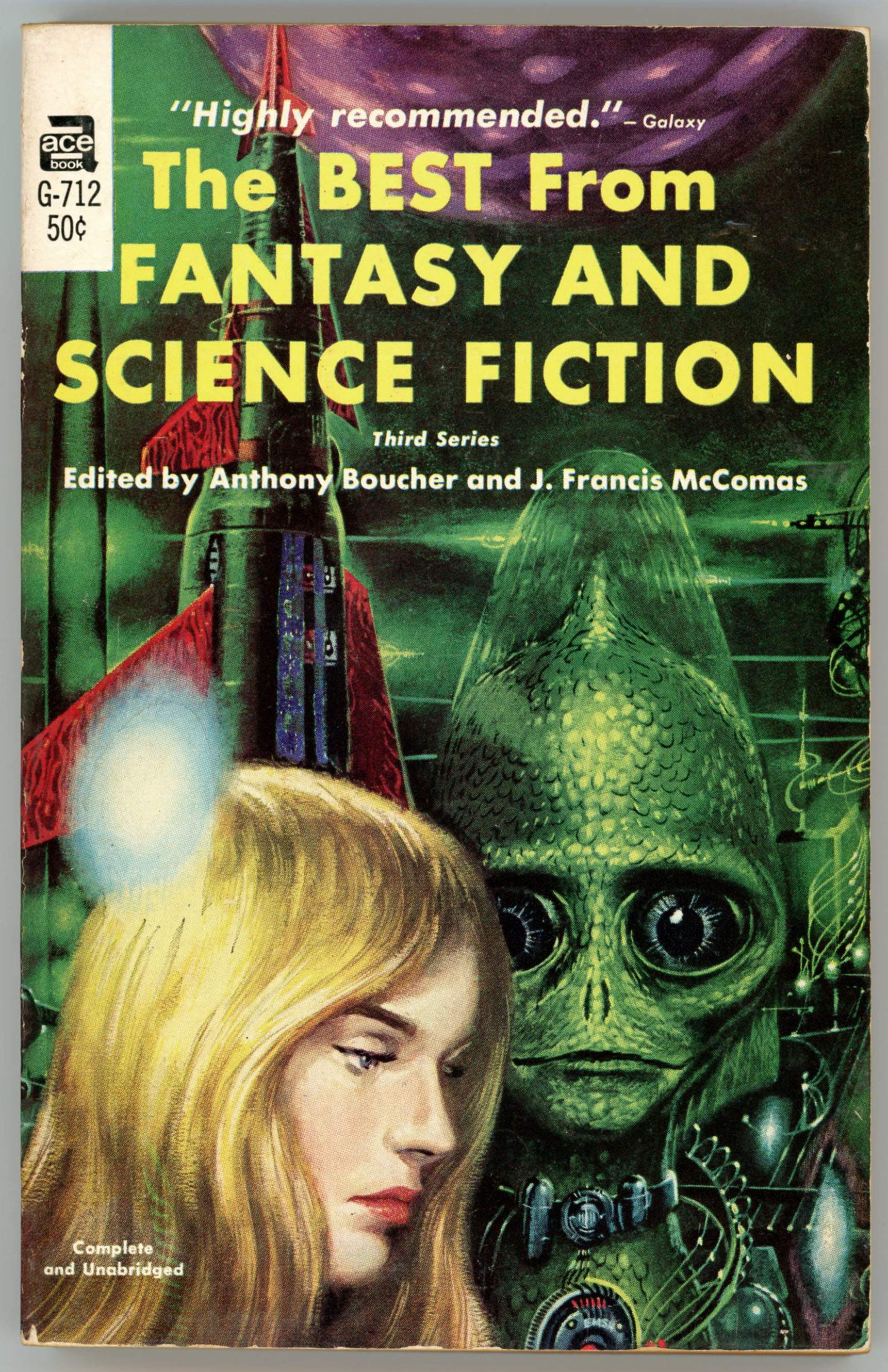
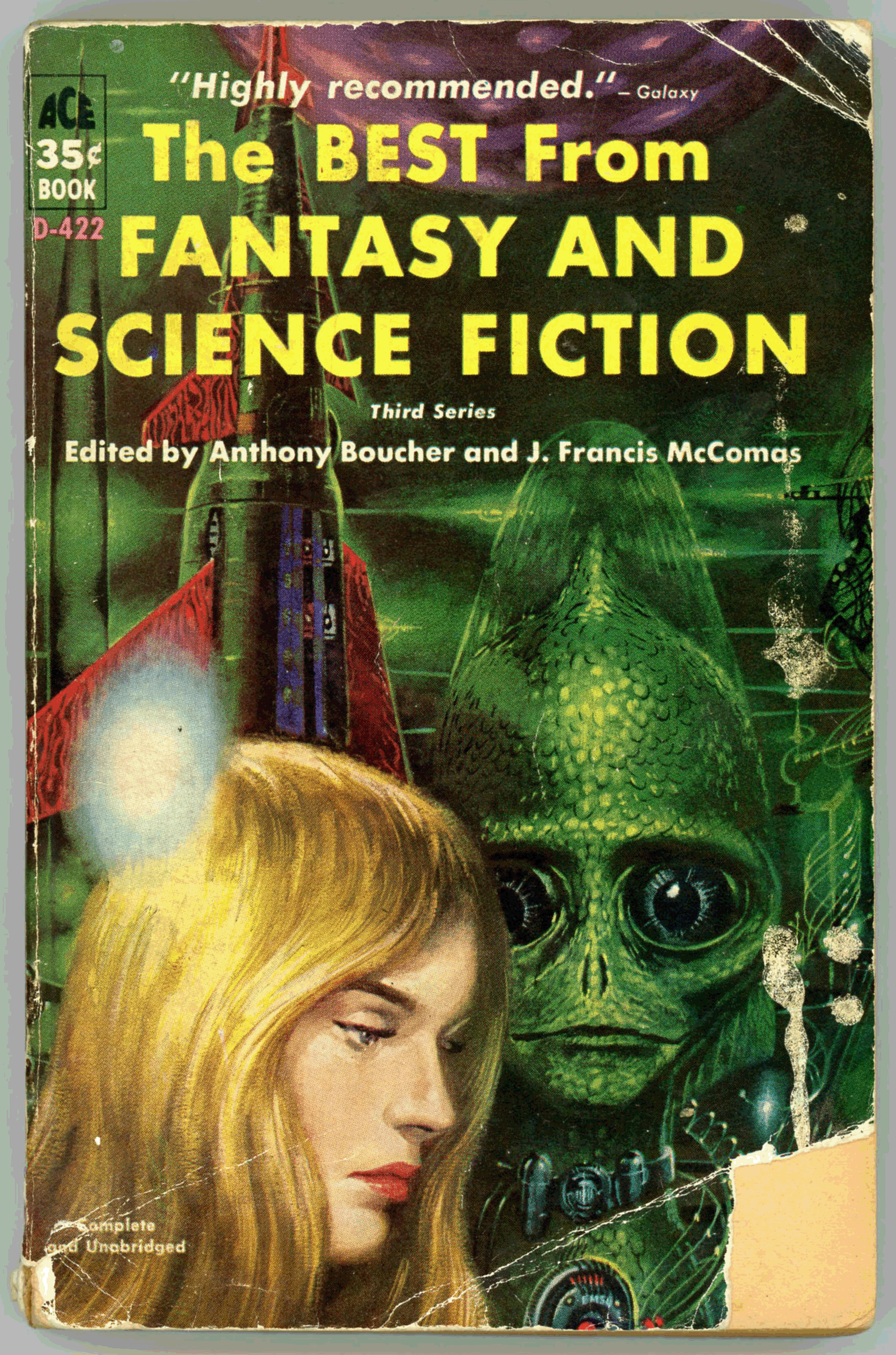
The Best From Fantasy and Science Fiction – Third Series, Edited by Anthony Boucher and J. Francis McComas- 1952 (1953, 1954) [Edmund A. Emshwiller] [Updated post…] – Ace D-422 / G-712

Dating from June of 2017 (gadzooks!), this was one the earliest posts at WordsEnvisioned: The cover of the third volume (or, third series, as it were) of stories published in The Magazine of Fantasy and Science Fiction during 1953.

The post originally showing a rather bedraggled copy of the book, which I purchased at a flea market some decades ago.  (See image at bottom.)  It’s now been updated with a pristine copy, which presents Edmund Emshwiller’s cover art in its complete imagination and intricacy.  In this case, for Kay Rogers’ tale “Experiment”. 

This is also a great example of how “Emsh” sort of “hid” his nickname in his illustrations:  In this case, “EMSH” appears in tiny blue letters in the center of the aquatic space-alien’s chest.  Uh, assuming the space-alien has a chest…

“Attitudes”, by Philip Jose Farmer, October, 1953

“Maybe Just a Little One”, by Reginald Bretnor, February, 1953

“The Star Gypsies”, by William Lindsay Graham, July, 1953

“The Untimely Toper”, by L. Sprague de Camp and Fletcher Pratt, July, 1953

“Vandy, Vandy”, by Manly Wade Wellman, March, 1953

“Experiment, by Kay Rogers, February, 1953

“Lot”, by Ward Moore, May, 1953

“Manuscript Found in a Vacuum”, by Philip Maitland Hubbard, August, 1953

“The Maladjusted Classroom”, by Homer Czar Nearing, Jr., June, 1953

“Child by Chronos”, by Charles L. Harness, June, 1953

“New Ritual”, by Idris Seabright, January, 1953

“Devlin”, by William Bernard Ready, April, 1953

“Captive Audience”, by Anne Warren Griffith, August, 1953

“Snulbug”, by Anthony Boucher, May, 1953 (originally in Unknown Worlds, December, 1941)

“Shepherd’s Boy”, by Richard Middleton, March, 1953 (originally in The Ghost Ship & Other Stories, May, 1912)

“Star Light, Star Bright”, by Alfred Bester, July, 1953

Reference

The Best From Fantasy and Science Fiction – Third Series, at Internet Speculative Fiction Database

6/19/17

Perelandra, by C.S. Lewis (Clive Staples Lewis) – 1957 (1943) [Art Sussman] – Avon # T-157

Following the theme of C.S. Lewis Space Trilogy, here’s Art Sussman’s cover for Perelandra, the second book of the series, as published by Avon in 1957.  Sussman also created the cover of Avon’s 1960 edition of Out of the Silent Planet.

You can view the cover of Macmillan’s 1965 edition of Perelandra here. The large human figures in yellow-orange are probably symbolic representations of Tindril, the Queen of Perelandra (a.k.a. to we inhabitants of Earth as “Venus”), and her un-named King.  There’s also a science-fiction element on the cover in the form of a rocket-plane, but no such craft figures in the story!

And as always, to give you a literary “taste” of the novel’s contents, here’s an excerpt:  A conversation between the hero, Dr. Elwin Ransom, and his antagonist, Dr. Weston. 

“My dear Ransom,
I wish you would not keep relapsing on to the popular level.
The two things are only moments in the single, unique reality.
The world leaps forward through great men
and greatness always transcends mere moralism.
When the leap has been made our ‘diabolism’
as you would call it becomes the morality of the next stage;
but while we are making it, we are called criminals, heretics, blasphemers…”

“How far does it go?
Would you still obey the Life-Force
if you found it prompting you to murder me?”

Yes.”

“Or to sell England to the Germans?”

“Yes.”

“Or to print lies as serious research in a scientific periodical?”

“Yes.”

“God help you!” said Ransom.

* * * * * * * * * * *

As the novel progresses, Dr. Weston is transformed into some thing no longer quite human, although physically human in superficial appearance.  Here are Dr. Ransom’s observations of what remains of Weston – physically, intellectually, and spiritually – after the latter has succumbed (voluntarily?) to demonic possession. 

It [Weston] looked at Ransom in silence and at last began to smile. 
We have all often spoken –
Ransom himself had often spoken –
of a devilish smile. 
Now he realized that he had never taken the words seriously. 
The smile was not bitter, nor raging, nor, in an ordinary sense, sinister;
it was not even mocking. 
It seemed to summon Ransom, with horrible naivete of welcome,
into the world of its own pleasures,
as if all men were at one in those pleasures,
as if they were the most natural thing in the world
and no dispute could ever have occurred about them. 
It was not furtive, nor ashamed, it had nothing of the conspirator in it. 

It did not defy goodness, it ignored it to the point of annihilation.

Ransom perceived that he had never before seen anything
but half-hearted and uneasy attempts at evil. 
This creature was whole-hearted. 
The extremity of its evil had passed beyond all struggle
into some state which bore a horrible similarity to innocence. 
It was beyond vice as the Lady was beyond virtue.

________________________________________

Note: December 2, 2020 – Having created this post only six days ago, I was happily surprised to discover Dr. Pedro Blas González’ essay, “Good and Evil in C.S. Lewis’ Space Trilogy“, at NewEnglishReview

Out of the Silent Planet, by C.S. Lewis (Clive Staples Lewis) – 1956 (1938) [Everett Raymond Kinstler] – Avon # T-27

C.S. Lewis’ Space Trilogy – Out of the Silent Planet, Perelandra, and That Hideous Strength – has had a long and continuous publishing history, extending from the appearance of the series’ “first” novel in 1938, through the HarperOne / HarperCollins  release of the three novels in a single volume as recently as 2013.  (And of course, now in ebook format.)

Among the series’ many imprints over the past eight-odd decades, perhaps the most immediately “recognizable” – in terms of duration of publication and (therefore!) especially cover art – has been the Macmillan edition.  Published from 1967 through 1979, all Space Trilogy books with that imprint bore cover illustrations by Bernard Symancyk, about whose career little information is available – albeit Terence E. Hanley at TellersofWeirdTales presents a brief biography at “From Things To Come into The Space Trilogy-Part One“. 

Well, Macmillan wasn’t alone.  In 1949, 1956, and 1960, Avon Books released its own edition of the Space Trilogy, with unique cover art for each “set”, and within each set, the cover illustrations having been created by different artists.

Certainly the art of the Space Trilogy is varied, but even moreso is the vast commentary the books have engendered across the decades.  While the Trilogy can ostensibly be categorized as science fiction, the tropes associated with that literary genre are far secondary to the ideas actually animating the books.  These are theological, though not purely couched in the verbiage of theology (the books’ ethos is clearly expressed in a allegorical manner), and concern the nature of good and evil; collectivism versus the worth of the individual as an individual; the nature, exercise, and temptation of power – whether that power be technological, biological, or governmental; the destiny of men as individuals and humanity as a civilization. 

Well…  The above sentences merely superficially (and ever so tangentially!) scratch the surface of depths vastly deeper.   

Well…  I can recommended these two discussions concerning the final novel of the series – That Hideous Strength (Avon’s awkward title The Tortured Planet) – at ChicagoBoyz, both by David Foster.  They are “Summer Rerun – Book Review: That Hideous Strength” (September 15, 2017), and, “Summer Rerun – Lewis vs. Haldane” (August 31, 2019).  These discussions can also serve as a sort-of-segue to the Trilogy’s other two novels. 

As a matter of fact, these two ChicagoBoyz posts are what let me to read the first two novels.  That Hideous Strength is in my “queue”, for the “world” depicted in Lewis’ final Space Trilogy novel has striking resonance with the world of 2020. 

And perhaps – depending on the winds of history and the choices of men – alas, beyond.

Oh, yes, as for cover art?

Here are the covers, front and back, of the 1956 edition of Avon’s first novel in the trilogy – Out of the Silent Planet – by artist Everett Raymond Kinstler. 

You can view the cover of Macmillan’s 1965 edition of Out of the Silent Planet here.

Here’s a brief excerpt from Out of The Silent Planet:  A conversation between the hero of both “this” first novel of the trilogy and the second, Perelandra: Between Dr. Elwin Ransom, and his (our?) nemesis, “Dr. Weston”, whose religion (if any) seems to be a variation on the theme of what is known to us as “scientism” – not science, which is altogether a thing quite different.

Or, put it another way, deification of rationality.  

Thus:

Weston: “…We are only obeying orders.”

Ransom: “Whose?”

There was another pause.
“Come,” said Weston at last,
“there is really no use in continuing this cross-examination. 
You keep on asking me questions I can’t answer;
in some cases because I don’t know the answers,
in other because you wouldn’t understand them. 
It will make things very much pleasanter during the voyage
if you can only resign your mind to your fate and stop bothering yourself and us. 
It would be easier if your philosophy of life
were not so insufferably narrow or individualistic. 
I had thought no one could fail to be inspired
by the role you are being asked to play:
that even a worm, if it could understand, would rise to the sacrifice. 
I mean, of course, the sacrifice of time and liberty, and some little risk. 
Don’t misunderstand me.”

“Well,” said Ransom, “You hold all the cards, and I must make the best of it.
I consider your philosophy of life raving lunacy.
I suppose all that stuff about infinity and eternity means
that you think you are justified in doing anything
– absolutely anything –
here and now,
on the off chance
that some creatures or other descended from man as we know him
may crawl about a few centuries longer in some part of the universe.”

________________________________________

Note: December 2, 2020 – Having created this post only six days ago, I was happily surprised to discover Dr. Pedro Blas González’ essay, “Good and Evil in C.S. Lewis’ Space Trilogy“, at NewEnglishReview

The Return of the King (Ace Books Title A-6), by J.R.R. Tolkien – 1965 (1955) [Jack Gaughan]

You never quite know what you’ll find…

Case in point: During a recent walk through a (for now) anonymous suburb, I chanced upon a copy of Ace Science Fiction Classics 1965 edition (Ace book number “A-6”) of J.R.R. Tolkien’s The Return of the King.  “Hmmm…,” I pondered, “Eh.  Neat, but, it’s not science fiction.  I just don’t know….  Meh.”  Then, I took a closer look at the cover art, and immediately realized that – though his name is absent from the illustration itself – the cover art was by Jack Gaughan, which was confirmed by a look at the title page.  “Okay, that’s interesting.  A find most worthy for the blog!”

So, you can see the book below.  Bedraggled; showing the full weight of its 55 years and probably having passed before the eyes of more than a few readers; bearing several age lines on its cover, it still’s passable:  In the center, Sauron (one eye barely visible) stands behind Barad-dûr (well, it sure ain’t Za’ha’dum, though I don’t know which would be worse), while five knights in green – members of the Fellowship, I suppose – approach from the foreground.

Yet, only upon putting together this post did I realize the unusual nature of this particular edition of The Return of the King.  As fully discussed in Clarence Petersen’s 1965 Chicago Tribune article (below), the publication of Ace’s edition of The Return of the King, along with the company’s The Fellowship of the Ring (Ace book number A-4), and The Two Towers (Ace A-5), was done with neither authorization from J.R.R. Tolkien nor payment of royalties to him, based on a (then?) loophole in copyright laws.  The cover illustrations of all three books were created by Jack Gaughan, and are distinguished by background color as well as title:  While the The Return of the King is in blue, The Fellowship of the Ring, with Gandalf surrounded by members of the Fellowship, is in red, and The Two Towers, showing a Nazgûl (ringwraith) is in yellow.  Each book cover has a different line of Celtic runes in the background.

The unusual nature of these Ace editions is indicated by the selling price – at both EBay and ABE books – of complete good-quality sets, with the trio going for between $200 and $500.  (No plug.  Just an observation!)

________________________________________

Another Battle of Editions Is Joined

Clarence Petersen
Chicago Tribune
August 15, 1965

COPYRIGHT laws, especially those involving reprint rights to books first published abroad, seem to be one of the biggest flies in the book industry ointment this season.

About half a dozen lawsuits have been filed in recent months in which one publisher has charged another – or two or three others – with getting out “unauthorized editions” of books to which the first publisher claimed exclusive rights.

At times the situation has become unbelievably confusing, even to the publishers themselves.  One Monday afternoon I received by mail a news release from New York in which Putnam announced its suit against Lancer over rights to Terry Southern and Mason Hoffenberg’s “Candy.”  Earlier the same day I had discovered another version of the book, published by Greenleaf, which had arrived in Chicago bookstores over the weekend.  There was no mention of the Greenleaf edition in the news release. Putnam had not yet heard about it.

THE latest battle, however, is not expected to reach the courts at all.  The public will decide the outcome.  It centers on the fantasies of British author J.R.R. Tolkien and involves Houghton Mifflin, Ballantine Books, and the author on one hand, and Ace Books on the other.  The drama will begin to unfold tomorrow morning.

At that time, if distribution schedules are met, Ballantine’s 95 cent edition of “The Hobbit” will go on sale in Chicago.  “The Hobbit” is the prelude to Tolkien’s imaginative trilogy, “The Lord of the Rings,” which has been one of those underground best sellers.  Since 1937, when Houghton Mifflin published the first American edition in hard cover, a persistent if never spectacular demand has put “The Hobbit” thru 19 hard cover printings.  Houghton Mifflin never sold the reprint rights until a few weeks ago.

What broke the ice was publication of “The Lord of the Rings” by Ace Books in three 75-cent paperback volumes [“The Fellowship of the Rings,” “The Two Towers,” and “The Return of the King”].  Although Ace paid nothing for reprint rights, either to Houghton Mifflin or to Tolkien, there is nothing illegal about the Ace editions, due to technicalities in the copyright laws during the early years of World War II.

Having no legal recourse, Houghton Mifflin did the next best thing by selling rights to an “authorized edition” to Ballantine Books, which will publish the trilogy in 95-cent editions in October.  The difference of 20 cents a copy, of course, pays Houghton Mifflin and Tolkien.

THE new Ballantine editions will offer some additional enticements for potential buyers.  The covers are a sort of squared-off jigsaw puzzle, so that when you stand them in line face out, they form a miniature mural of the landscape on which “The Fellowship of the Rings” takes place.  Inside, there is some additional material by Prof. Tolkien which should be of interest especially to those for whom “The Hobbitt” and the trilogy have formed the basis of a cult.

But the clincher is Prof. Tolkien’s pungent paragraph that will appear on the back covers of all four volumes: “This paperback edition, and no other, has been published with my consent and co-operation.  Those who approve of courtesy – at least to living authors – will purchase it, and no other.”

In a letter to booksellers, Houghton Mifflin, Ballantine, and Tolkien join in the statement that “tho there is no legal weapon to prevent exploitation of an author’s property, we believe that booksellers will prefer to sell authorized, royalty-paying editions if they exist.”

However, the Ace trilogy has been in the bookstores since May, and there is little indication that anyone plans to send copies back.  “In this case, where the issues aren’t clear, where there is no legal issue at all, I suppose we will wind up selling both versions,” said Paul Horowitz, paperback manager of Charles Levy Circulating company, which supplies paperbacks to most Chicagoland outlets.  “The public will have to decide which version they like best.”

________________________________________

One ring to rule them all,
one ring to find them,
One ring to bring them all
and in the darkness bind them.

Ash nazg durbatulûk,
ash nazg gimbatul,
Ash nazg thrakatulûk
agh burzum-ishi krimpatul.
________________________________________

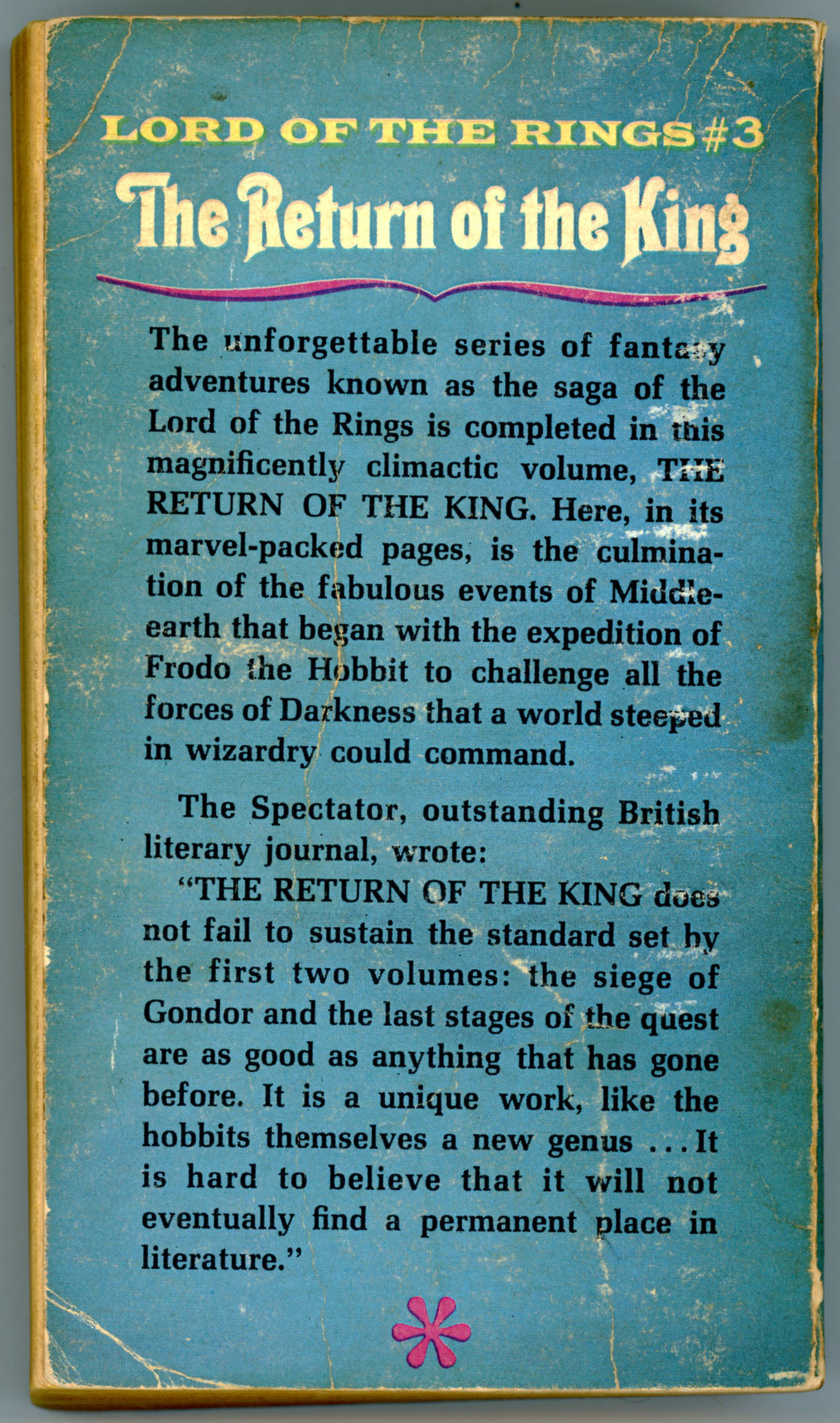
LORD OF THE RINGS # 3

The Return of the King

The unforgettable series of fantasy adventures known as the saga of the Lord of the Rings is completed in this magnificently climactic volume, THE RETURN OF THE KING.  Here, in its marvel-packed pages, is the culmination of the fabulous events of Middle-earth that began with the expedition of Frodo the Hobbit to challenge all the forces of Darkness that a world steeped in wizardry could command.

The Spectator, outstanding British literary journal, wrote:

“THE RETURN OF THE KING does not fail to sustain the standard set by the first two volumes: the siege of Gondor and the last stages of the quest are as good as anything that has gone before.  It is a unique work, like the hobbits themselves a new genus. … It is hard to believe that it will not eventually find a permanent place in literature.”

References

One Ring, at Wikipedia

Barad-dûr, at Wikipedia

Za’ha’dum, at Babylon 5 Fandom
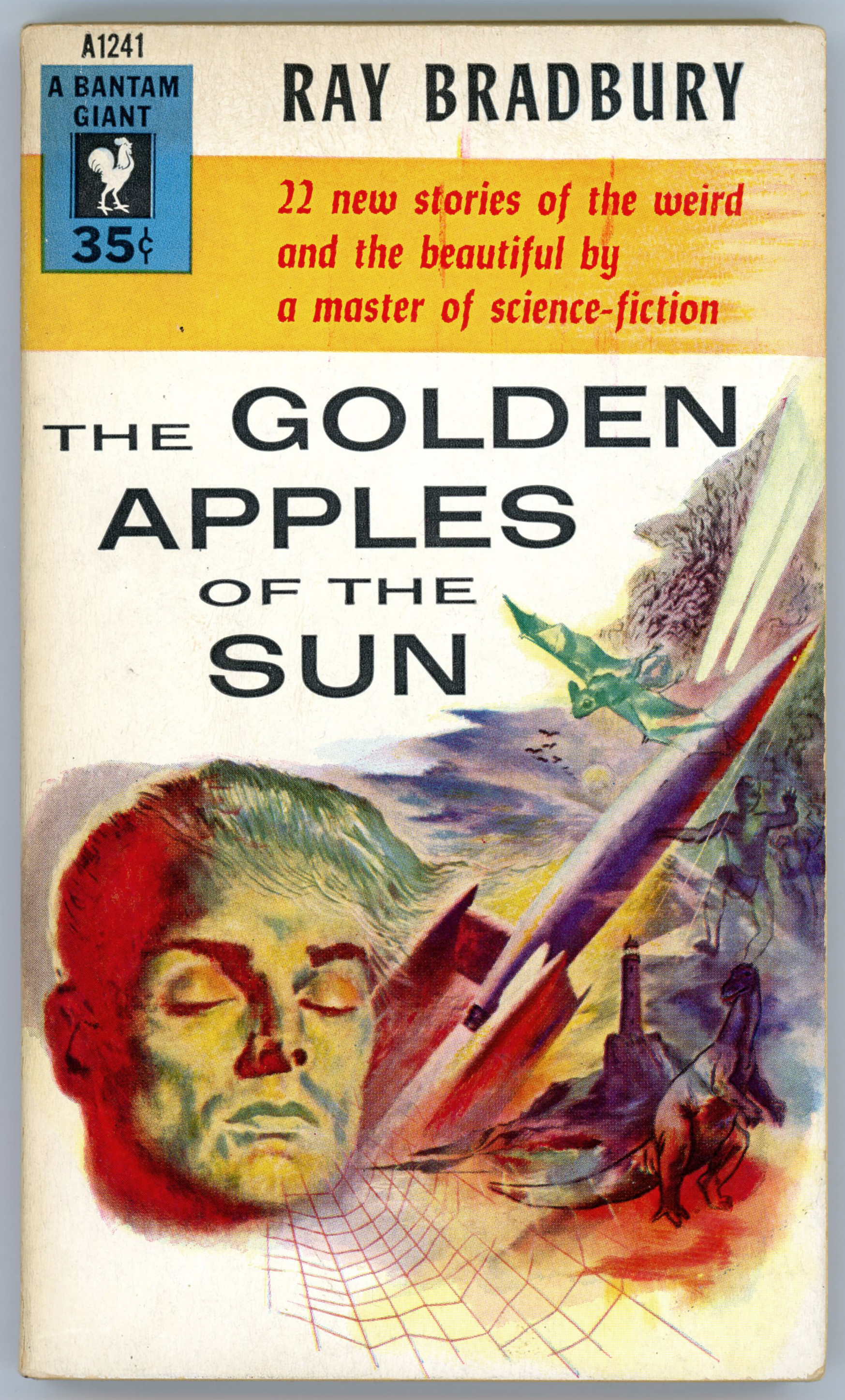
The Golden Apples of the Sun, by Ray Bradbury – 1954 [Barye W. Phillips…maybe]

Though I’ve never been partial to the literary style or underlying themes of Ray Bradbury’s writing, I can still appreciate and respect the cultural and historical significance of his body of work.  And, from what I know “about” him, he was a genuinely kind human being, quite willing to bestow time and advice to budding authors.  In that regard, the foremost qualities that emerge from his interview by Charles Platt (in Dream Makers – The Uncommon People Who Write Science Fiction) are a sense of integrity, and, a deep dedication to his craft.

You can’t ignore somebody like that.

So, here’s Bantam’s 1954 anthology of twenty-two of his stories, entitled (by virtue of the last listed title) The Golden Apples of the Sun.  For the story “Embroidery”, originally published in the November, 1951 issue of Marvel Science Fiction, I’ve included the magazine’s cover (by Hannes Bok), while for “The Golden Apples of The Sun”, which first appeared in the November, 1953 issue of Planet Stories, I’ve added the issue’s cover (by Frank Kelly Freas).  Both images were downloaded from Archive.org, and Photoshopified just a little bit.

Contents

The Fog Horn, from The Saturday Evening Post, June 23, 1951

The Pedestrian, from The Magazine of Fantasy and Science Fiction, February, 1952

The April Witch (from “The Elliott Family” series), from The Saturday Evening Post, April 5, 1952

The Wilderness (from “The Martian Chronicles” series) from The Magazine of Fantasy and Science Fiction, November, 1952

The Fruit at the Bottom of the Bowl, from Detective Book Magazine, Winter, 1948

Invisible Boy, from Mademoiselle, Winter, 1945

The Flying Machine

The Murderer

The Golden Kite, the Silver Wind

I See You Never, from The New Yorker, November 8, 1947

____________________

Embroidery, from Marvel Science Fiction, November, 1951

“This month’s 4-color cover by well-known cover and interior artist, HANNES BOK.  Using a mixed technique of dyes, color pencil, water-color, and ink.”

____________________

The Big Black and White Game, from The American Mercury, August, 1945

A Sound of Thunder, from Colliers, June 28, 1952

The Great Wide World Over There

Powerhouse (1948?)

En la Noche, from Cavalier, November, 1952

Sun and Shadow, The Reporter, 1953

The Meadow, World Security Workshop (ABC Radio Network radio program), 1947

The Garbage Collector

The Great Fire (“Green Town”?) (1949?)

Hail and Farewell

____________________

The Golden Apples of the Sun, Planet Stories, November, 1953

____________________

References

Platt, Charles, Dream Makers – The Uncommon People Who Write Science Fiction, Berkley Books, New York, N.Y., November, 1980

The Golden Apples of the Sun, at Internet Speculative Fiction Database

The Golden Apples of the Sun, at Wikipedia

Ray Bradbury, at RayBradbury.com

Out Of This World – An Anthology of Fantasy, Edited by Julius Fast – 1944 (1946) [Unknown Artist] [[Updated Post]]

(First created in March of 2018, this post has been updated to present greater detail about Out of This World’s contents…)

Evening Primrose, by John Collier, from Presenting Moonshine (book), 1941

Laura, by Saki (H.H. Munro), from Beats and Super-Beasts (book), 1914

Sam Small’s Tyke, by Eric Knight, from Sam Small Flies Again: The Amazing Adventures of the Flying Yorkshireman (book), 1940

Satan and Sam Shay, by Robert Arthur, from The Elks Magazine, August, 1942

A Disputed Authorship (excerpt from A House-Boat on the Styx), by John Kendrick Bangs, 1895

Mr. Mergenthwirker’s Lobblies, by Nelson S. Bond, Scribners Magazine, November, 1937

A Vision of Judgement, by H.G. Wells, from The Country of The Blind and Other Stories (book), 1911

Thus I Refute Beelzy, by John Collier, from Presenting Moonshine (book), 1941

The King of the Cats, by Stephen Vincent Benet, from Harper’s Bazar, February, 1929

The Canterville Ghost, by Oscar Wilde, from Court and Society Review, February 23, 1887

My Friend Merton, by Julius Fast

And Adam Begot, by Arch Oboler

The Club Secretary, by Lord Dunsany, from The Atlantic Monthly, August, 1934

The Scarlet Plague, by Jack London, from The London Magazine, June, 1912

Reference

Out of This World, at Internet Speculative Fiction Database

Mockingbird, by Walter S. Tevis – April, 1981 (1980) [Unknown Artist]

“When the drugs and the television were perfected by the computers that made and distributed them, the cars were no longer necessary. 
And since no one had devised a way of making cars safe in the hands of a human driver,
it was decided to discontinue them.”

“Who made that decision?” I said.

“I did.  Solange and I. 
It was the last time I saw him. 
He threw himself off of a building.”

“Jesus,” I said. 
“And then, “When I was a little girl there were no cars. 
But Simon could remember them. 
So that was when thought buses were invented?”

“No.  Thought-buses had been around since the twenty-second century. 
In fact there had been buses, driven by human drivers in the twentieth. 
And trolley cars and trains. 
Most big cities in North America had what were called streetcars at the start of the twentieth century.”

“What happened to them?”

“The automobile companies got rid of them. 
Bribes were paid to city managers to tear up the streetcar tracks,
and advertisements were bought in newspapers to convince the public that it should be done. 
So more cars could be sold, and more oil would be made into gasoline, to be burned in the cars. 
So that corporations could grow,
and so a few people could become incredibly rich,
and have servants, and live in mansions. 
It changed the life of mankind more radically than the printing press. 
It created suburbs and a hundred other dependencies –
sexual and economic and narcotic –
upon the automobile. 
And the automobile prepared the wat for the more profound –
more inward –
dependencies upon television and then robots and, finally,
the ultimate and predictable conclusion of all of it:
the perfection of the chemistry of the mind. 
The drugs your fellow humans use are named after twentieth-century ones;
but they are far more potent,
far better at what they do,
and they are all made and distributed –
distributed everywhere there are human beings – by automatic equipment.” 
He looked over at me from his armchair. 
“It all began, I suppose, with learning to build fires –
to warm the cave and keep the predators out. 
And it ended with time-release Valium.”
I looked at him for a minute. 
“I don’t take Valium,” I said.  (176-177)

The Macabre Reader, edited by Donald A. Wollheim – 1959 [Edmund Emshwiller]

Though his art is typically associated with science fiction, such as covers for The Magazine of Fantasy and Science Fiction, Galaxy Science Fiction, and (but of course…!) Ace Books, and other publications, Edmund Emshwiller’s creativity found a different outlet in Ace Books’ 1959 The Macabre Reader: horror.

Note that all the spaces in the composition that might otherwise be “blank” and “empty” are instead cleverly occupied by elements denoting horror, terror, and fear, such as a spider, a ghost, the figure of a woman-in-peril, and three menacing ghoul-like figures, all within or surrounding a sickly-green skull.  And, as per his works of science fiction, Emshwiller signed the composition with his trademark “EMSH” (visible in the lower right).

It’s notable that five of the volume’s thirteen (hmm…was it intentionally thirteen?!) works are either solely by, or by authors in collaboration with, H.P. Lovecraft. 

Contents

The Phantom-Wooer, poem from Death’s Jest Book, 1850, poem Thomas Lovell Beddoes

The Crawling Horror, from Weird Tales, November, 1936, by Thorp McClusky

The Opener of the Way, from Weird Tales, October, 1936, by Robert Bloch

Night Gaunts (variant of “Night-Gaunts”, alternative title “Fungi from Yuggoth”), poem from The Phantagraph, Spring, 1936, by H.P. Lovecraft

In Amundsen’s Tent, from Weird Tales, January, 1928, by John Martin Leahy

The Thing on the Doorstep, from Weird Tales, January, 1937, by H.P. Lovecraft

The Hollow Man, from The Evening Standard Book of Strange Stories, 1934, by Thomas Burke

It Will Grow On You, from Esquire, April, 1942, by Donald Wandrei

The Hunters from Beyond, from Strange Tales of Mystery and Terror, October, 1932, by Clark Ashton Smith

The Curse of Yig, poem by Zealia Bishop and H.P. Lovecraft (as by Zealia Brown Bishop)

The Cairn on the Headland, from Strange Tales of Mystery and Terror, January, 1933, by Robert E. Howard

The Trap, from Strange Tales of Mystery and Terror, March, 1932, by H.P. Lovecraft and Henry S. Whitehead (as Henry S. Whitehead)

The Dweller, poem from Weird Tales, March, 1940, by H.P. Lovecraft

Reference

The Macabre Reader, at The Internet Speculative Fiction Database