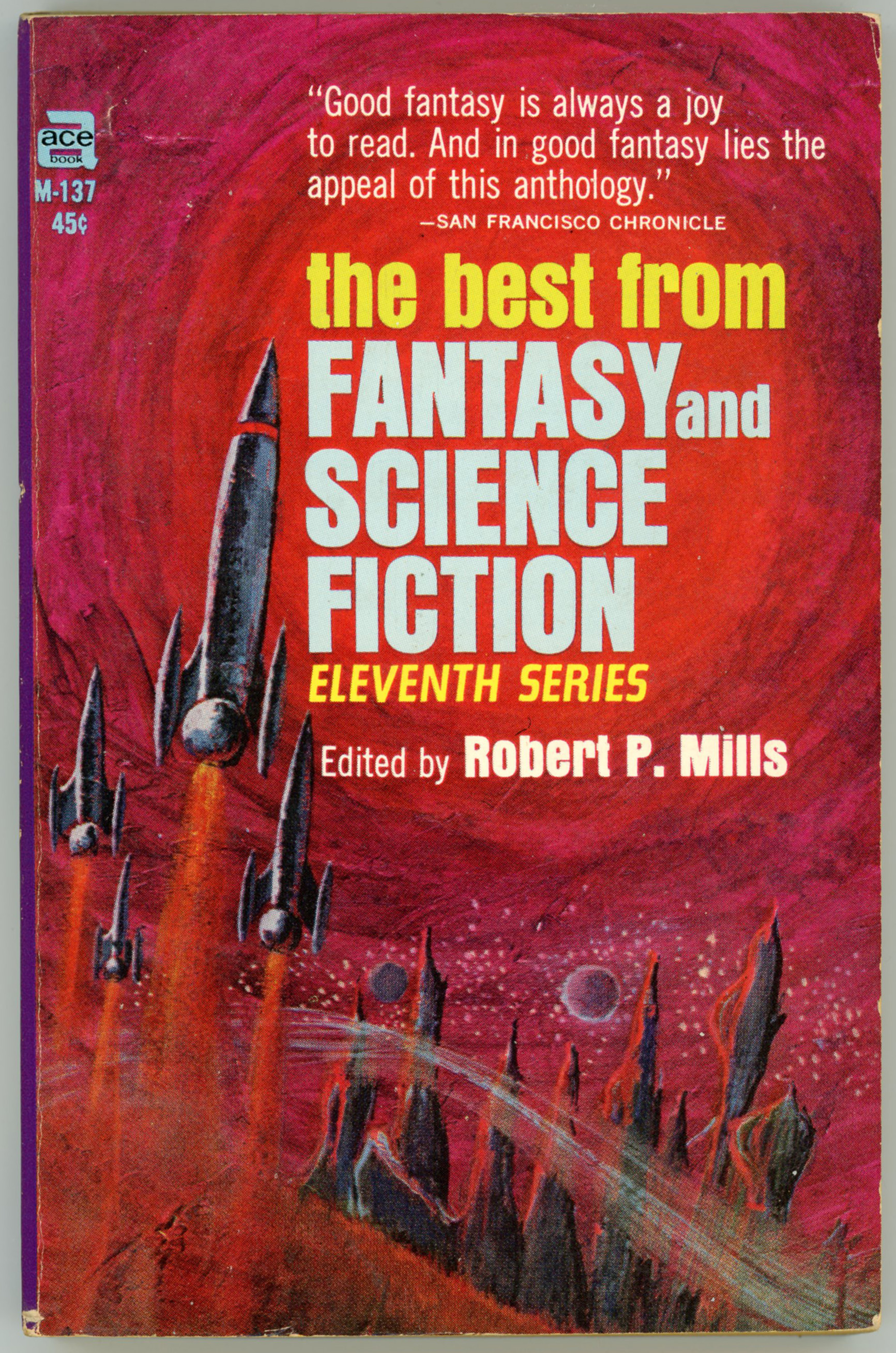
This is an olde post. Olde in Internet terms, that is: June of 2017. I’ve now updated it to include an image of Bob Schinella’s cover art for The Best From Fantasy and Science Fiction – Eleventh Series, which is far better than the dinged-up and slightly chipped original formerly featured in the post, now visible at the “bottom”.
The book offers a selection of the outstanding stories then typical and representative of the content of MF&SF; in this case, from the year 1961, albeit naturally and inevitably varying greatly in literary style, plot, and theme from author to author. Particularly outstanding are Poul Anderson’s “Time Lag”, Cordwainer Smith’s “Alpha Ralpha Boulevard”, and Kurt Vonnegut’s “Harrison Bergeron“, the impact of the latter extending far beyond the genre of science fiction to become culturally, if not politically, significant.
As far as the former two stories, central to the plot of Anderson’s tale are the impact and implications of time dilation – from space travel at relativistic speeds – in an interstellar war of conquest by a barbarian empire, viewed through the experiences of the novel’s main – female – protagonist. The story explores questions of politics, political intrigue, family and civilizational loyalty, and concepts of courage and honor, in a fast-moving and compelling way, typical of much of Anderson’s work.
“Alpha Ralpha Boulevard”? Well, what can one say? Smith was a wonderfully imaginative “world-builder”, and this story takes place in our world some ten to fifteen thousand years from now, in (or at?!) “Earthport”, an immensely tall facility in which is situated the Instrumentality of Mankind, which is the setting of Smith’s “The Ballad of Lost C’Mell”, which was published in Galaxy about a decade earlier. Any further explanation “here” would diminish the reader’s enjoyment and appreciation of the story’s sheer novelty…!
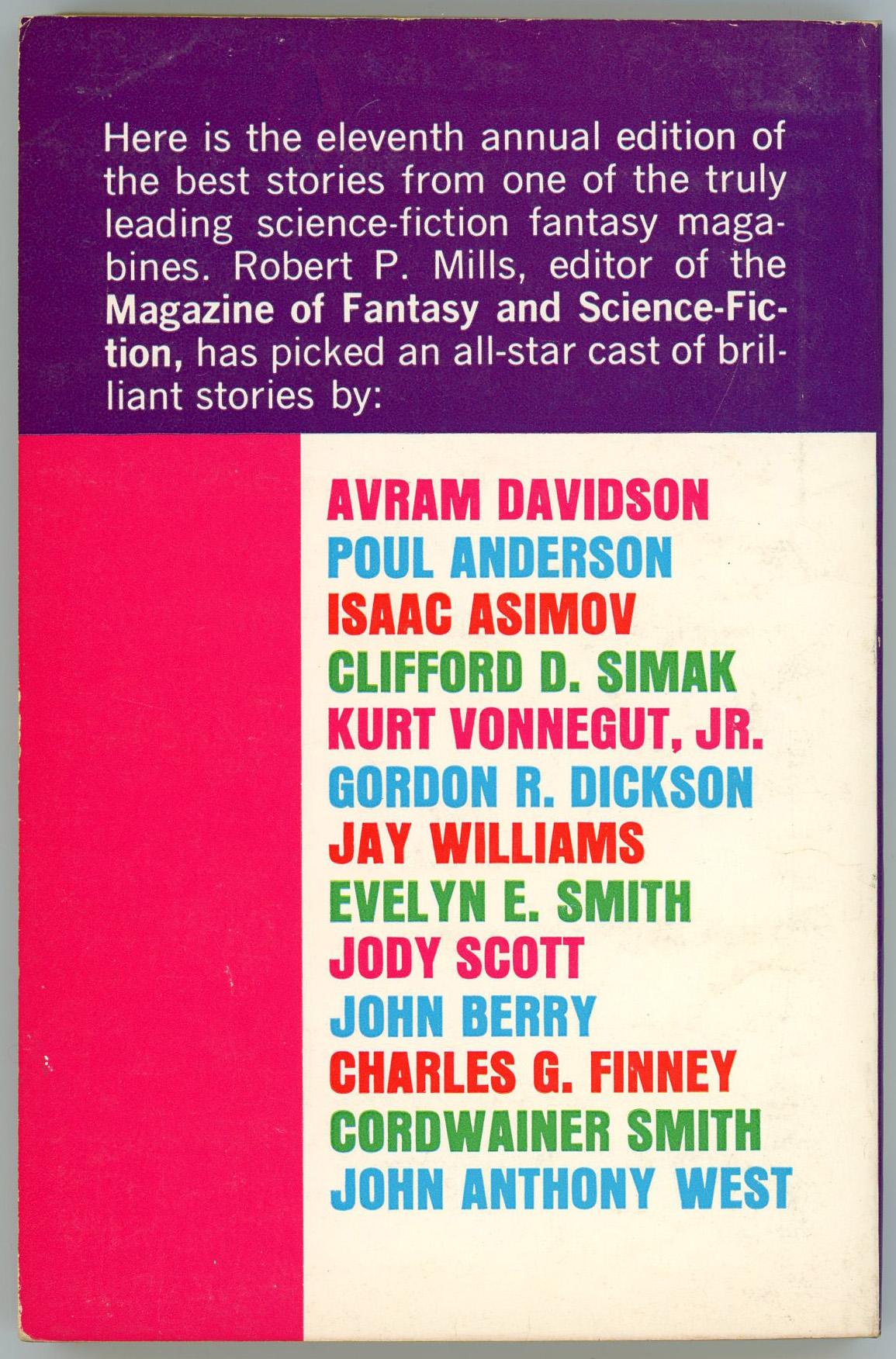
“The Sources of The Nile”, by Avram Davidson, January, 1961
“Somebody To Play With”, by Jay Williams, May, 1961
“Softly While You’re Sleeping”, by Evelyn E. Smith, April, 1961
“The Machine That Won The War”, by Isaac Asimov, October, 1961
“Go For Baroque”, by Jody Scott, June, 1961
“Time Lag”, by Poul Anderson, January, 1961
“George”, by John Anthony West, June, 1961
“Shotgun Cure”, by Clifford D. Simak, January, 1961
“The One Who Returns”, by John Berry, March, 1961
“The Captivity”, by Charles G. Finney, October, 1961
“Alpha Ralpha Boulevard”, by Cordwainer Smith, June, 1961
“Effigy”, by Rosser Reeves, August, 1961
“E=MC2″, by Rosser Reeves, September, 1961
“Harrison Bergeron”, by Kurt Vonnegut, Jr., October, 1961
“The Haunted Village”, by Gordon R. Dickson, August, 1961
My former blog post image…

A. Reference…
… Internet Speculative Fiction Database
June 19, 2017 – 158