Astounding Science Fiction, December, 1946 (Featuring “Metamorphosite” by Eric Frank Russell) [Alexander Cañedo [Alejandro de Cañedo]]

Now, t h i s is an interesting cover.

I first “noticed” it among six small black & white images illustrating the evolution of the logo and cover design of Astounding Science Fiction – from February of 1935 through April of 1965 – in James Gunn’s Alternate Worlds: An Illustrated History of Science Fiction (specifically, on page 152).  Only later, when I started building my collection of issues of Astounding and saw scans of the cover at VISCO (The Visual Index of Science Fiction Cover Art) and Archive.org, was I able to fully appreciate the balance of style and symbolism inherent to the composition. 

I first thought that it was created by William Timmins.  But, I was wrong.

The painting was created by Alexander Cañedo (Alejandro de Cañedo) who subsequently completed nine other covers for Astounding Science Fiction, encompassing issues published between September, 1947, and July, 1954.  Of these nine covers, only one other painting (like that illustrated below) actually pertains to a story published within “its” issue, the other eight covers being purely – very – symbolic and allegorical, such as this cover for August of 1948:  The other “literal” cover is for December of 1947, representing Clifford Simak’s tale “Aesop”. 

That issue, coincidentally, happens to be my favorite Cañedo cover:  The illustration powerfully uses light and shadow (notice that illumination comes from the background?), and a small number of colors (shades of blue, gray, yellow, and orange) to depict four elements inherent to the story: Wobots.  Robots.  (Well, just one wobot.  I mean robot.)  A wabbit rabbit.  A dog.  (Dogs figure prominently in Simak’s earlier tales.)  And, a post-nuclear-holocaust future in which mankind is an afterthought:  A mushroom cloud rises in an otherwise empty background.   

You can read more about the interestingly incongruous relationship between John W. Campbell, Jr., and Alexander Cañedo, in Alec Nevala-Lee’s October, 2018 blog post, The Beauty of the World.  

As for Eric Frank Russell’s tale “Metamorphosite”?  It’s been anthologized a number of times since its original publication, perhaps most prominently in the Del Rey / Ballantine Classic Library of Science Fiction’s The Best of Eric Frank Russell, of 1978.  Though I’ve not read too much of Russell’s body of work (I’d really like to get around to “Sinister Barrier”, from Unknown, October of 1939), I found it very similar – in respects positive and negative – to “Dreadful Sanctuary”, published in Astounding in June and July of ’48:  The plot, premise, and setting of the story are clearly delineated early on, and, genuinely interesting; the events of the story – whether action or contemplation – are crisply paced, without extraneous diversions that would cause the story to “lag” or go flat; the technology sensibly futuristic, yet neither driving the tale nor overwhelming the centrality of the characters.  And yet, like “Dreadful Sanctuary” … which I think is the better of the two … “Metamorphosite” suffers from the one-dimensionality of the protagonist and his allies, who confront and overcome challenges and dangers far too easily, leaving very (or no) room for doubt, growth, or change.    

Again, though, one point in the story’s favor lies in its premise and conclusion (small spoiler alert!):  It posits and is based upon a future in which humanity has extensively colonized other worlds, to the extent that as a result of the enormous variation in the physical conditions of these planets, and the passage of time, speciation has occurred on an interstellar scale, and humanity no longer exists solely as homo sapiens.  Though the specifics escape me as I compose this post (!), I think that this topic has been addressed in depth by Isaac Arthur in one of his many SFIA videos

________________________________________

For a few minutes he stood quietly regarding the shadows and musing within himself. 
He was alone — alone against a world. 
It didn’t bother him particularly. 
His situation was no different from that of his own people who formed a solitary world
on the edge of a great Empire. 
He’d one advantage which so far had stood him in good stead: he knew his own powers. 
His opponents were ignorant in that respect. 
On the other hand, he suffered the disadvantage of being equally ignorant,
for although he’d learned much about the people of the Empire,
he still did not know the full extent of their powers. 

“In the awful struggle for life on new and hostile worlds, you, too, sank,” Harold continued.
“But you climbed again, and once more reached for the stars.
Naturally, you sought the nearest system one and a half light-years away,
for you had forgotten the location of your home which was spoken of only in ancient legends.
We were three light-years farther away than your nearest neighboring system.
Logically, you picked that — and went away from us.
You sank again,
climbed again,
went on again,
and you never came back until you’d built a mighty Empire on the rim of which we waited,
and changed, and changed.’’

________________________________________

Some Other Things

Eric Frank Russell…

…at Wikipedia

…at Internet Speculative Fiction Database

Alexander Cañedo…

… at Wikipedia

…at Internet Speculative Fiction Database

…and…

Science and Futurism with Isaac Arthur

The Past Through Tomorrow, by Robert A. Heinlein – January, 1975 and July, 1987 [“Unknown”, and James Warhola]

[[Updated yet again…  Writer John C. Wright’s blog, SciFiWright, now features a fascinating post, “Wright on Asimov on Orwell“, which is a discussion of a book review by Asimov of George Orwell’s 1984 (review linked within the post), dating from approximately 1980, which appeared in the The New Worker.  The review is also mentioned at RedSails.org, where a footnote is linked to Ernie Trory Books, at which website the review is listed under the (appropriate) heading “George Orwell — a critique”.  You can read Mr. Trory’s bio here

Well.  As substantive and insightful as is Mr. Wright’s post, so are many of the thus-far – 12/14/21 – 330 (gad – 330!) comments in reply, many of which focus on Asimov’s body of work from standpoints literary and historic.

A full list of Mr. Wright’s own works can be found here.]]

____________________

[Update August 16, 2021: Here’s an interesting essay by Thomas Parker at the Black Gate, My Robert A. Heinlein Problem, strongly recommended for your consideration…]

Given his influence upon science fiction and popular culture, Robert Heinlein will need little in the way of an introduction for this post, which focuses on Berkley Books’ and Ace Books’ editions of Heinlein’s “future history” stories, The Past Through Tomorrow.  But…  For those so interested, let alone readers already (?!) familiar with Heinlein and the history of science-fiction, I strongly recommend Alec Nevala-Lee’s 2019 Astounding: John W. Campbell, Isaac Asimov, Robert A. Heinlein, L. Ron Hubbard, and the Golden Age of Science Fiction, as well as his blog, NevalaLee.  Where, to quote a blog post of August 3, 2016, Astounding Stories #14: “The Heinlein Juveniles”:

As well as being a cult figure, the first science fiction writer to break through to the mainstream, and an object of veneration for countless fans, he [Heinlein] was also the best writer the genre ever produced.  And believe me, I know how boring this sounds.  Frankly, I’d love to come up with a contrarian stance – that Heinlein is interesting primarily for his historical significance, that he’s revered mostly out of nostalgia, or that a handful of masterpieces allow us to overlook the fact that much of what he wrote was routine.  But none of this is true.  Of all the science fiction writers I’ve read, Heinlein is consistently the most compelling author, the most interesting thinker, and the most versatile artist.  He’s the one writer of his era who could seemingly do anything, and who actually did it over an extended period of time for a big popular audience: great ideas, meticulously developed science and technology, worldbuilding, plot, action, character, philosophy, style.  Heinlein was given what the sports writer Bill Simmons likes to call the “everything” package at the car wash, and he more than lived up to it.  To a very real extent, Heinlein was the golden age of science fiction, and it’s hard to imagine John W. Campbell doing any of it without him.

While I fully agree with Mr. Nevala-Lee’s opinion concerning the magnitude of Heinlein’s impact upon the genre, I’ve never felt (really, I’ve not!) Heinlein to be the field’s most compelling writer or innovative thinker, albeit he could unquestionably craft riveting prose; I readily grant that.  Yet, in a sense far wider, given the immense scope of science-fiction, and, the subjectivity inherent to such judgements, I don’t know if the appellation of “best” can even be accorded to any one author. 

But…!  Were I to chose, I believe that the genre’s best writers – at least, of the 40s, 50s, and 60s (I suppose this “dates” me – but then again, are we not in time all eventually “dated”?!) are, randomly listed: Cordwainer Smith (Paul M. A. Linebarger), Catherine L. Moore, Philip K. Dick, Jack Williamson, Walter M. Miller, Jr., Fritz Leiber, Jr.  And, Ray Bradbury.  And (and) Poul Anderson.  I could easily be persuaded to include in this august group A.E. van Vogt (okay, to be specific, generally the early van Vogt), Ward Moore (resting largely upon the strength of his brilliantly crafted novel, Bring the Jubilee – that’d be one hell of a mini-series, if pulled off correctly!), and, Theodore Sturgeon. 

Isaac Asimov?  Ironically, in light of my many posts displaying illustrations from books and pulp magazines featuring his work…  No, not so much.  No, not really.  No, not at all.  No.  Not ever.  And, that “never” definitely includes The Foundation Trilogy.

But.  Back to the book at hand…

Comprising twenty-one stories, the cover of Berkeley’s 1975 The Past Through Tomorrow features very generic “space art”, depicting four planets – one with an obligatory Saturn-ring – set against a starry background. 

My copy, purchased in mid-1975 and still holding up fairly well across the decades, is shown below.  On examining the table of contents, I notice that I “checked off” the stories “If This Goes On -” and “Coventry”.  At the time, those two tales must have left a particular impression!

Artist?  Unknown.  Perhaps a member of Berkeley’s in-house art department?

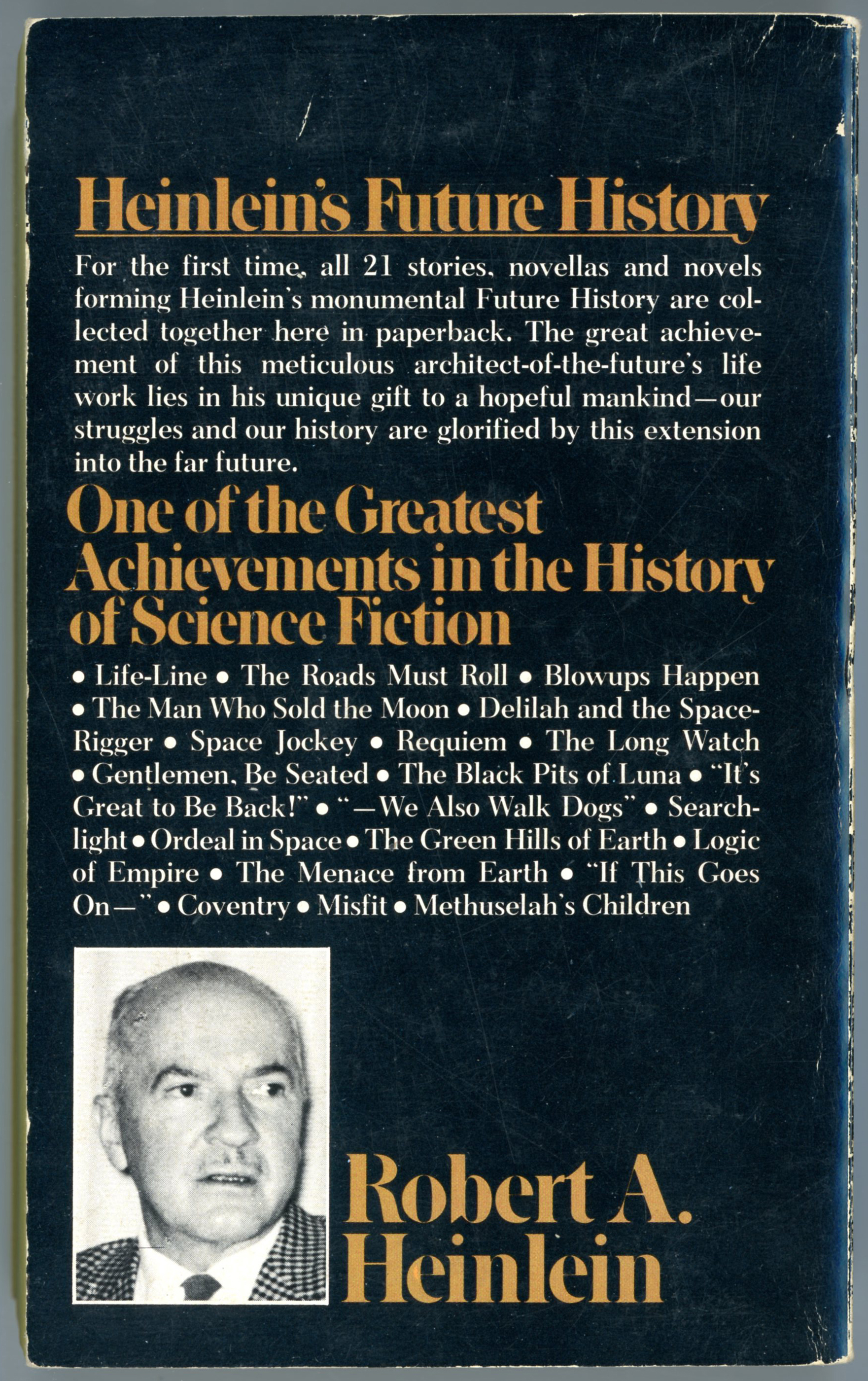
Rather than a continuation of art from the front cover, the rear cover simply lists the book’s content, and features Robert Heinlein’s portrait, though the photographer is uncredited.  

Contents

Introduction, by Damon Knight

Life-Line, from Astounding Science Fiction, August, 1939

The Roads Must Roll, from Astounding Science Fiction, June, 1940

Blowups Happen, from Astounding Science Fiction, September, 1940

The Man Who Sold the Moon, Shasta Publishers (book), February, 1950

Delilah and the Space Rigger, The Blue Book Magazine, December, 1949

Space Jockey, from The Saturday Evening Post, April 26, 1947

Requiem, from Astounding Science Fiction, January, 1940

The Long Watch, from Beyond Time and Space (book), May, 1950

Gentlemen, Be Seated, from The Green Hills of Earth: Rhysling and the Adventure of the Entire Solar System!, Shasta Publishers, 1952 (book)

The Black Pits of Luna, from The Saturday Evening Post, January 10, 1948

“It’s Great to be Back!”, from The Saturday Evening Post, July 26, 1947

“-We Also Walk Dogs”, from Astounding Science Fiction, July, 1947

Searchlight, from The Worlds of Robert A. Heinlein (book), 1966

Ordeal in Space, from The Green Hills of Earth, Shasta Publishers, June 25, 1951 (book)

The Green Hills of Earth, from The Saturday Evening Post, February 8, 1947

Logic of Empire, from Astounding Science Fiction, March, 1941

The Menace from Earth, from The Magazine of Fantasy and Science Fiction, August, 1957

“If This Goes On -”, from Astounding Science Fiction, February, 1940

Coventry, from Astounding Science Fiction, July, 1940

Misfit, from Astounding Science Fiction, November, 1939

Methuselah’s Children, from Astounding Science Fiction, July, 1941

____________________

The contents of Ace’s 1987 edition are identical to Berkeley’s 1975 imprint.  Thus, the book’s table of contents will not be repeated.  

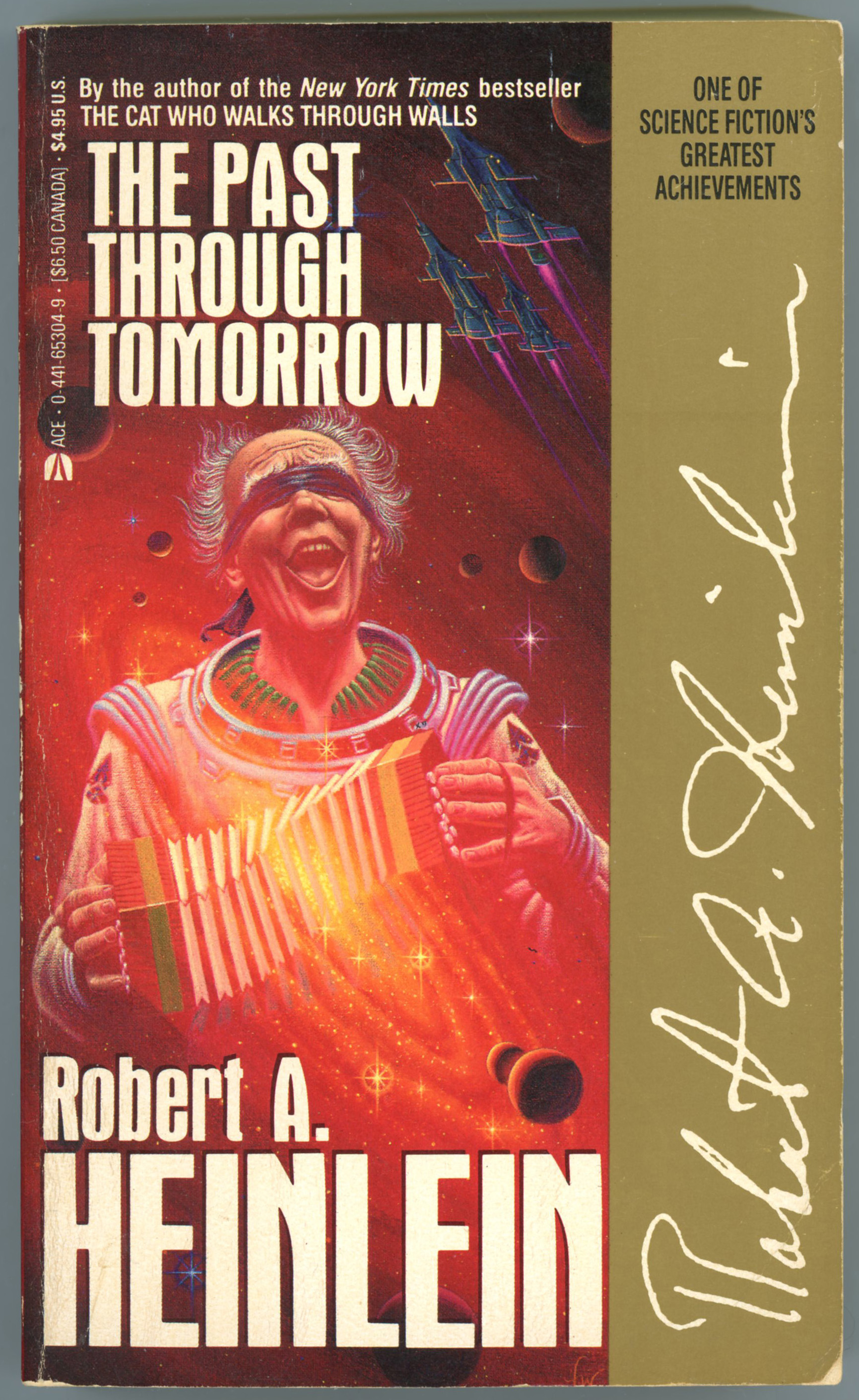
But here, James Warhola’s cover art is completely different in style and subject matter from the 1975 edition.  Along with a reproduction of Heinlein’s signature, the cover art is directly inspired by Heinlein’s 1947 tale “The Green Hills of Earth”, depicting blind spaceship engineer “Noisy” Rhysling and his squeeze-box, set against the symbolic backdrop of a spiral galaxy.  

The story was first published in the February 8, 1947, issue of The Saturday Evening Post:    

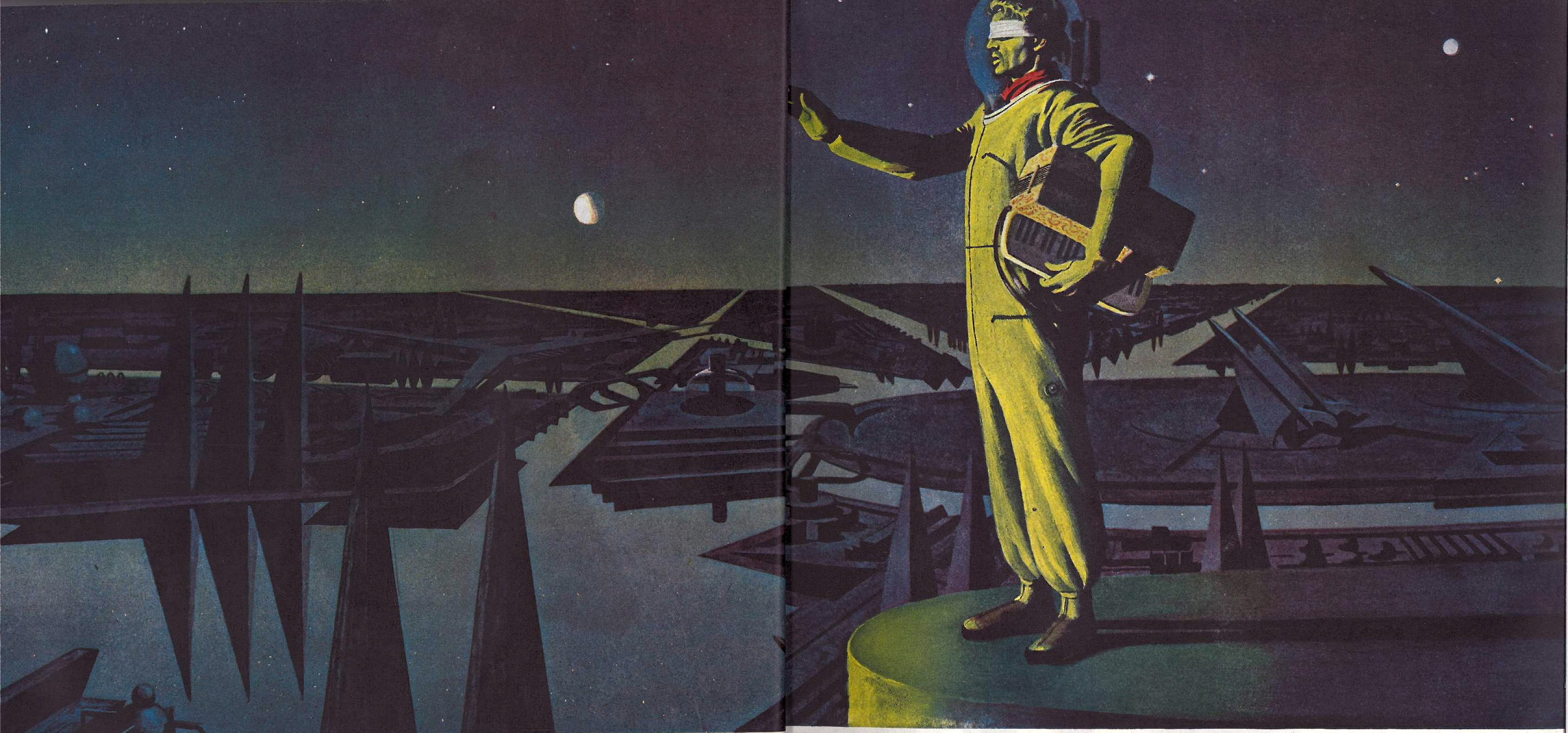
From the Norman Rockwell Museum, here’s Fred Ludekens‘ interior illustration (oil on canvas) that accompanied Heinlein’s tale in the Post.  The image below is the illustration “as is”, as it appears at the Museum’s website…

…while here’s the same illustration, enhanced via Photoshop Elements.    

Stylistically, Ludeken’s composition has a visual vibe somewhat (… s o m e w h a t …) akin to that of Frank McCarthy’s absolutely wonderful cover illustration for Bleiler and Dikty’s The Best Science Fiction Stories * 1949[In the “original” version of this post, from August of 2021, I assumed that the cover was by Edd Cartier.  A quick referral to the Internet Speculative Fiction Database revealed I was in error about that.  Veritably, “oops”!]

____________________

Partial lyrics for “The Green Hills of Earth” – presented below – can be found in “Quest of the Starstone”, by Henry Kuttner and Catherine L. Moore, from the November, 1937 issue of Weird Tales (pp. 559-560).

Across the seas of darkness
The good green Earth is bright –
Oh, star that was my homeland
Shine down on me tonight….

My heart turns home in longing
Across the voids between,
To know beyond the spaceways
The hills of Earth are green….

– and count the losses worth
To see across the darkness
The green hills of Earth….

____________________

References

Robert A. Heinlein

Wikipedia

Internet Speculative Fiction Database

Internet Movie Database

The Heinlein Society

The Heinlein Archives

Site RAH: The Home Page for Science Fiction’s Grand Master

“The Past Through Tomorrow”

Internet Speculative Fiction Database

“The Green Hills of Earth”

Wikipedia

Norman Rockwell Museum

The Saturday Evening Post (Issue of February 8, 1947)

StuffNobodyCaresAbout

Artist James Warhola

Wikipedia

Artist Fred Ludekens

Wikipedia