Get your ticket to that wheel in space while there’s time
The fix is in
You’ll be a witness to that game of chance in the sky
You know we’ve got to win
Here at home we’ll play in the city
Powered by the sun
Perfect weather for a streamlined world
There’ll be spandex jackets, one for everyone
What a beautiful world this will be
What a glorious time to be free
What a beautiful world this will be
What a glorious time to be free
From I.G.Y., “The Nightfly”, 1982
Here’s an interesting variation on a theme of space stations. Or, to be specific, the construction of a space station.
First, the front and rear covers of Pocket Books’ 1953 edition of Murray Leinster’s Space Platform, as illustrated by Earle K. Bergey (albeit sans Bergey Girl). Artistically it’s a fine illustration, and the scene depicted is consistent with the story, but with that, it’s still – well – odd. The setting of the space platform’s creation is weird: Given that the station is under construction on land – on the surface of the earth – in a facility that seems to be a cross between a shipyard and steel mill, how “on earth” (small pun there…) how did Leinster propose to get the thing into space once completed?
(Don’t know. Haven’t yet read the book. However, you can find numerous comments about it at GoodReads.)
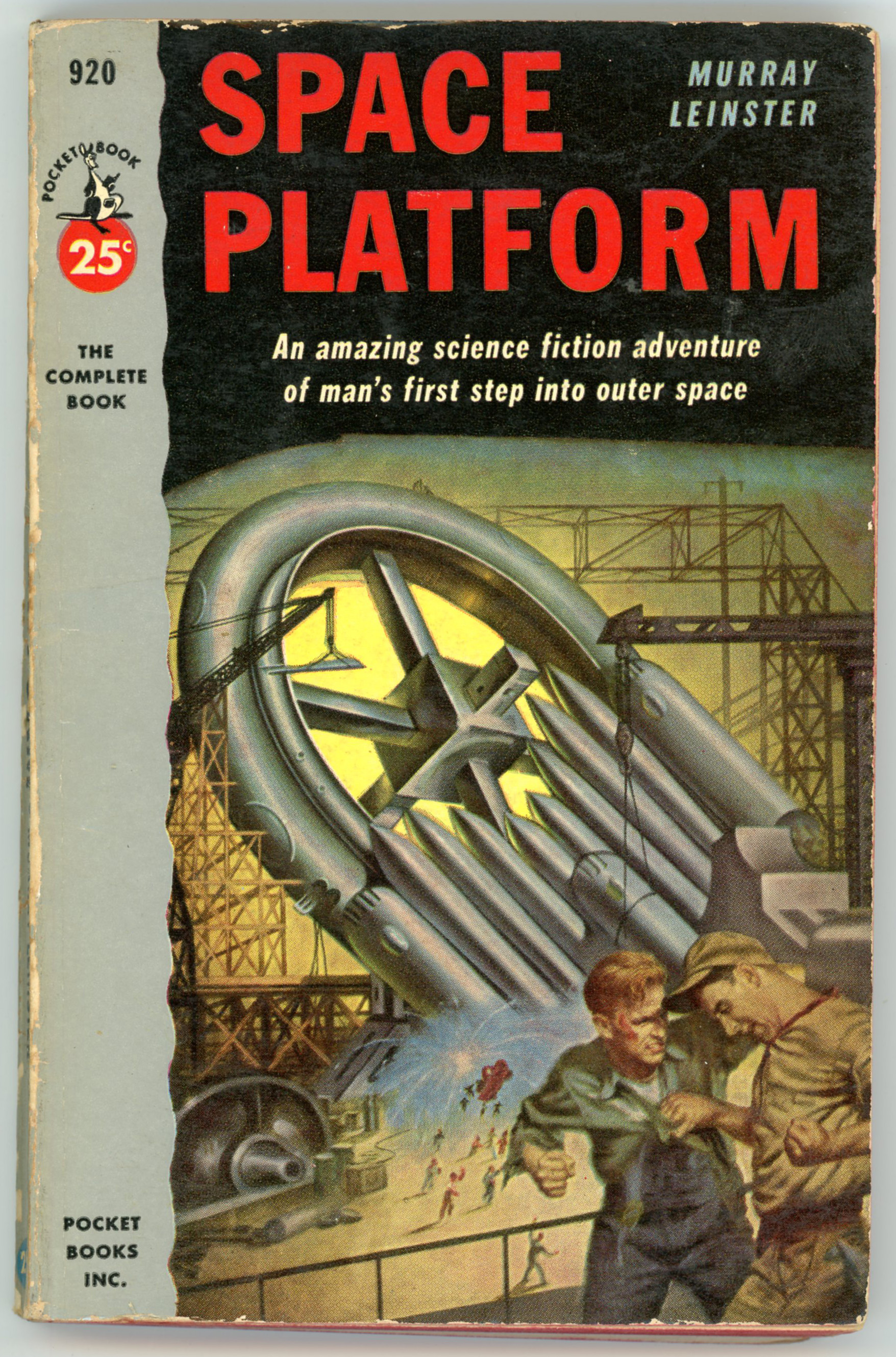

In the little desert town of Bootstrap stands a huge metal shed. In the shed men are building an object that can change the history of mankind. It is a Space Platform. Propelled to an orbit 4000 miles from Earth this platform will serve as the staring place for man’s exploration of mysterious outer space.
SPACE PLATFORM tells the exciting story of a young man helping to build this first station. With scientific accuracy and imagination Murray Leinster, one of the word’s top science-fiction writers, describes the building and launching of the platform. Here is a fast-paced story of sabotage and murder directed against a project more secret and valuable than the atom bomb!
__________
And then it hit me: The story and Bergey’s illustration reminded me of something quite contemporary: The scene of the entirely earthbound construction of the USS Enterprise, as depicted in J.J. Abrams stunningly, sublimely, transcendentally awful – not initially-panned-and-eventually-recognized-as-a-great-film awful, just irrevocably-and-perennially-awful – 2009 Star Trek. Though effective in terms of color and lighting (the bluish-white background illumination, suggesting a combination of floodlights the light from sunrise or sunset, works well), and imparting a feeling of “busy-ness”, the scene is – frankly – idiotic. I know that post-TV-series iterations of Star Trek have the Enterprise (and other Federation starships?) capable of some degree of atmospheric flight, but…
Really??
And, talking of security precautions: I’m sure the fence and “Authorized Personnel Only” sign is entirely capable of dissuading any intruders. Well, barbed wire has long been known to be utterly impenetrable to phasers, disruptors, anti-matter, paper airplanes, and stray golf-balls.
 (Digressing… Regarding what’s left of Star Trek, check out The Critical Drinker’s video of August 2, 2021, “Star Trek – It’s Dead, Jim“. Some of the comments are brilliant.)
____________________
Back to art: I guess the platform’s earthbound construction is genuinely a part of the novel, and not something invented by Bergey solely for the cover of the Pocket Books’ edition, as seen in I. Heilbron’s cover for the Shasta edition (one of five science fiction novels published by Shasta in 1953) which conveys a more sedate impression.

References and Stuff
Murray Leinster (William Fitzgerald Jenkins)…
…at Internet Speculative Fiction Database
“Space Platform” (1953 Edition)…
…at Internet Speculative Fiction Database
…at GoodReads
…at L.W. Currey, Inc. (Bookseller)
Earle K. Bergey…
…at Wikipedia
…at American Pinup
…at ArtNet
USS Enterprise (Star Trek) Under Construction…
…at reddit (see comments…)
I.G.Y. lyrics…
…at AZLyrics.com (Donald Fagen, “The Nightfly” (1982))


