Words in Print: Primo Levi – Obituary by John Tagliabue, The New York Times, April 11, 1987

Primo Levi’s obituary by John Tagliabue of Bates College, as it appeared in The New York Times on April 11, 1987.

A minor error: The title “The Damned and the Saved,” is incorrect, and should of course be The Drowned and the Saved

A minor point:  Previously, I’d been unaware of Primo Levi’s use of the pseudonym “Damiano Malaballa”, probably because – until learning more – I always associated Primo Levi with non-fiction.

________________________________________

Primo Levi, Author of Works On Holocaust, Is Found Dead
By JOHN TAGLIABUE

Special to The New York Times

The New York Times
April 11, 1987

ROME, April 11 – Primo Levi, whose autobiographical writings drew on his experiences as an Auschwitz survivor and his training as a chemist, died today in Turin.  He was 67 years old. 

The authorities said they were treating the-death as a suicide.  Mr. Levi was found by members of his family and neighbors at the foot of a stairwell in the home where he was born, in the Crocetta neighborhood, and he was pronounced dead on arrival at a hospital.

Renzo Levi, the writer’s son, said by telephone from Turin that his father had had serious bouts of depression in recent months.

“The elder Mr. Levi had undergone minor surgery recently, and friends suggested he was deeply troubled about the condition of his 92-year-old mother, who was partially paralyzed by a stroke last year.

Already well known in Europe, Mr. Levi became prominent among American readers with the appearance in 1984 of the third volume of his autobiographical reflections, “The Periodic Table,” in which he used the chemical elements as a bridge to weave an unusual account of his experiences in the Nazi death camps.

Pseudonym Sometimes Used

His other books include “Survival in Auschwitz,” the first volume of his autobiographical trilogy; “The Reawakening,” the second volume; “Moments of Reprieve,” a series of sketches of the author’s acquaintances from the camps, and, most recently, “The Damned and the Saved.”  He also wrote works of fiction, some of it under the pseudonym Damiano Malaballa.

Primo Levi was born in Turin on July 31, 1919, a descendant of Jews who had settled in the Piedmont, in northern Italy, after the expulsion of Jews from Spain.  He studied chemistry at the University of Turin, even after the Mussolini regime barred Jews from institutes of higher learning in 1938, and received a degree in 1941.

In 1943, he quit his job at a Milan pharmaceutical laboratory to join Italian Partisans fighting the Fascist fprces of Germany and Italy.  “I was not a very good Partisan,” Mr. Levi told Herbert Mitgang in The New York Times in 1985.  “When my unit was betrayed by an informer, I was interrogated by Italian Fascists and handed over to the Germans.  I was put on a train with hundreds of other Jews and sent to Monowitz-Auschwitz, the factory part of the camp that used slave labor.”

Number Tattooed on Arm

It was his experiences there, as No. 174517 – the number was tattooed on his left arm, a few inches above the wrist – that were to shape his life and work.

His 1947 account, “Survival in Auschwitz” – also published under the title “If This Is a Man” – described daily life in the death camps in rich detail, creating a monument to the triumph of lucid intelligence over Nazi barbarism.

He attributed his survival in the camp to luck, to the Germans’ need for chemists – he was given a job in a synthetic-rubber factory – and to an acquaintanceship with a fellow inmate, an Italian bricklayer who was not Jewish, who brought him bread and soup.

In “The Reawakening,” published in 1963, the author described his long and bizarre journey home to Turin after being liberated from the camp by Soviet soldiers.

He also drew on his Partisan days in a novel, “If Not Now, When?”  The novel, published in Italy in 1982, chronicled the exploits in the closing months of the war of a band of Eastern European Jewish Partisans who dream of finding freedom in Palestine.

A Turn to Fiction

In recent years, Mr. Levi turned increasingly to works of fiction, including novels and short stories, and was a regular contributor of poetry to the Turin newspaper La Stampa. 

He was the winner of several literary prizes, including the Strega Prize, a prestigious Italian award, in 1979.  In 1985 he and Saul Bellow shared the Kenneth B. Smilen fiction award, sponsored by the Jewish Museum in New York.

While devoted to his writing, Mr. Levi continued his career as a chemist, working for a Turin paint factory, SIVA, for almost 30 years.  From 1961 to 1974, he was the plant’s general manager.

In an interview with The New York Times in December 1984, Mr. Levi described himself as “a chemist by conviction,” but added.  “After Auschwitz, I had an absolute need to write.”

“Not only as a moral duty,” he said, “but as a psychological need.”

That need was reflected in a Yiddish proverb he used as an epigraph for “The Periodic Table”: “Troubles overcome are good to tell.”

Mr. Levi wrote in an Italian enriched by snatches of the disappearing jargon of the Piedmontese Jews, which combined Hebrew roots with local endings and inflections.

Mr. Levi, who came from a middle-class family of assimilated Jews, once wrote that “a Jew is someone who at Christmas does not have a tree, who shouldn’t eat salami but does, who has learned a little bit of Hebrew at 13 and then forgotten it.”

But he remained close to the Italian Jewish community and two years ago he contributed an introduction to the catalogue of a newly opened Jewish museum in Turin.

The novelist Phillip Roth, whose account of a conversation with the Italian appeared last October in The New York Times Book Review, said of Mr. Levi today:

“With the moral stamina and intellectual poise of a 20th-century titan, this slightly built, dutiful, unassuming chemist set out systematically to remember the German hell on earth, steadfastly to think it through, and then to render it comprehensible in lucid, unpretentious prose.  He was profoundly in touch with the minutest workings of the most endearing human events and with the most contemptible.”

Mr. Levi is survived by his wife, Lucia; a daughter, Lisa, and a son, Renzo.
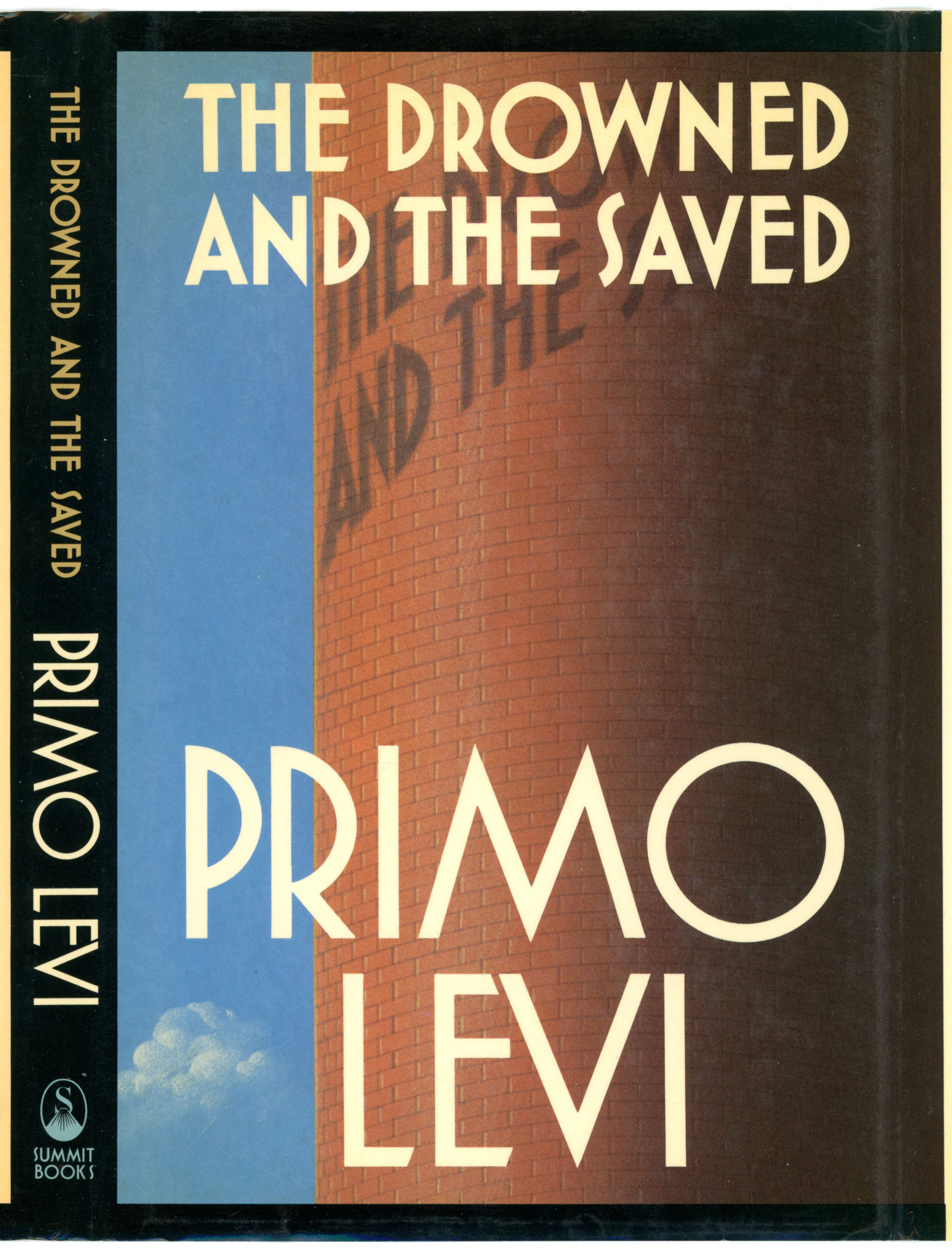
The Drowned and the Saved, by Primo Levi – 1986 (1988) [Fred Marcellino] [Updated post…]

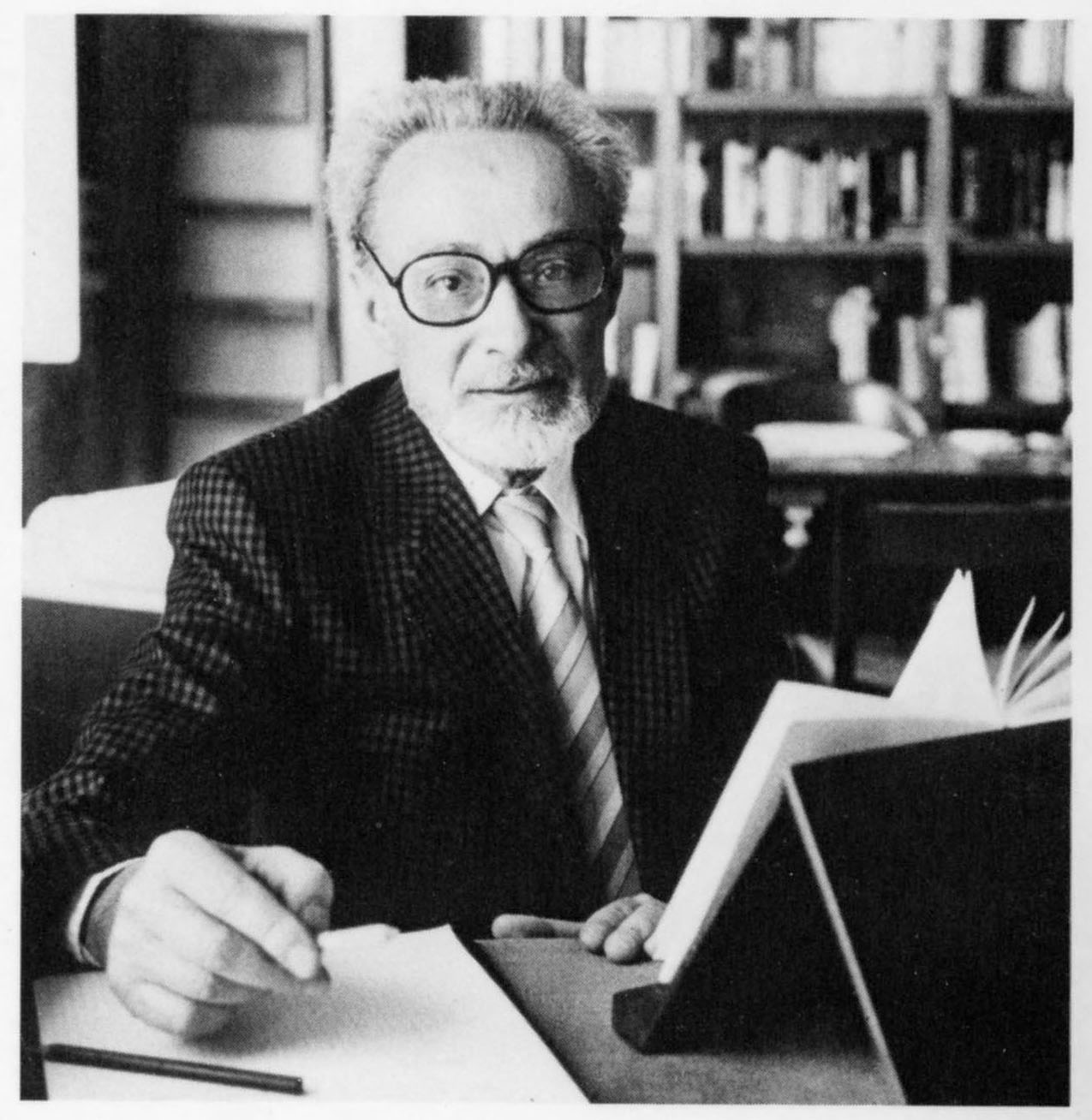
This is one of my earlier posts.  It displays Fred Marcellino’s cover art for Summit Books’ 1988 edition of Primo Levi’s The Drowned and The Saved, and includes -paralleling Summit Books’ edition of Primo Levi’s The Monkey’s Wrench – a portrait of author Levi, probably (it looks like…) at his home, in Turin, Italy.  Given that Mr. Levi was wearing the same suit and tie in two different portraits, the images were probably taken within a single session by photographer Jerry Bauer. 

The post now includes John Gross’ review of The Drowned and The Saved, which appeared in The New York Times – the main paper, not the Book Review – in January of 1988, and includes a less formal portrait of Primo Levi by a photographer from La Stampa, Cesare Bosio. 

Though the nature of Marcellino’s cover art isn’t immediately apparent – red bricks and a blue sky? – “stepping back”, it soon becomes clear that he has depicted a chimney, a terrible, and terribly appropriate, symbol of Levi’s subject matter.  In this respect, reviewer Gross has admirably presented the central aspects, or more appropriately questions, of the book, which focus on the challenge (or near-impossibility) of communicating that-which-cannot-be-communicated; the fallibility of memory – whether that memory be personal or historical; and particularly, the “gray zone” in which prisoners of the German concentration camp system found themselves enmeshed.

I think it quite fitting that Gross ends his review of The Drowned and The Saved with the very verse (from Samuel Taylor Coleridge’s The Rime of The Ancient Mariner) with which Primo Levi opened the book:

Since then, at an uncertain hour,
That agony returns,
And till my ghastly tale is told
This heart within me burns.

(Photograph of Primo Levi by Jerry Bauer)

Books of The Times

By John Gross

THE DROWNED AND THE SAVED.  By Primo Levi.
Translated from the Italian by Raymond Rosenthal.

203 pages. Summit Books. $17.95.

The New York Times
January 5, 1988

Photograph by Cesare Bosio (La Stampa)

IF you are a writer, and you have come back from hell, you really only have one subject.  It may be important for you to write about other subjects, too, in order to show that hell doesn’t have the last word; and yet in the end there is no shedding your burden.  In some of his later books Primo Levi moved away from the agonies of the Holocaust, but it was to the Holocaust that he finally returned.

“The Drowned and the Saved,” which Mr. Levi completed shortly before his death last April, is a series of meditations on some of the more perplexing aspects of “the Lager phenomenon” – the world of the extermination camps.  Like all Mr. Levi’s books, it is distinguished by courage, lucidity and intelligence, by a steadfast honesty and a refusal to take refuge in the consolations of rhetoric.

The guards and the prisoners in the camps had at least one thing in common.  Both groups knew that by the standards of the outside world, what they were taking part in was incredible.  Even if someone lived to tell the tale, who was going to believe him?

An agreeable thought for the tormentors, and a source of despair for their victims.  Most survivors, Mr. Levi tells us, can recall a recurrent dream that afflicted them during their nights of imprisonment: “They had returned home and with passion and relief were describing their past sufferings, addressing themselves to a loved one, and were not believed, indeed were not even listened to.”

In the event, the Nazis failed – not for want of trying – to destroy all the evidence and wipe out all the witnesses.  Yet as a relatively “privileged” prisoner, spared the worst on account of his usefulness as a scientist, Mr. Levi felt strongly that the full horrors would never be known, since almost all firsthand descriptions of the camps are the work of “those who, like myself, never fathomed them to the bottom.”  By contrast, very few “ordinary” prisoners survived, and very few of those who did, paralyzed as they were “by suffering and incomprehension,” were able to offer more than fragmentary testimony.

None of this made it less important, in Mr. Levi’s eyes, to bear witness as best he could.  There were the tricks that memory plays that had to be guarded against, for one thing – and the tricks we play on memory.  These can be seen at their most glaring in the case of the Nazi killer who “doesn’t remember” what he did: “The rememberer,” as Mr. Levi says, “has decided not to remember and has succeeded.” But among victims, too, though for very different reasons, the past is readily refashioned; indeed, Mr. Levi’s observations in Auschwitz had shown him that “for purposes of defense, reality can be distorted not only in memory but in the very act of taking place.”

Between them, defective memories and defective understanding have given rise to the stereotypes that Mr. Levi was anxious to clear away.  The one that he deals with at greatest length, and that raises the most sensitive issues, is the notion that relationships in the camps could be reduced to a simple contrast between oppressors and oppressed, that every prisoner was a victim and nothing but a victim.

Anyone who supposes this has a very inadequate idea of how monstrous the whole system was.  For it was an essential aim of the Nazis to destroy their victims morally as well as physically, to implicate them and drag them down.  At the most extreme, there were the special squads of prisoners given the job of running the crematories: organizing such squads, in Mr. Levi’s view, was “National Socialism’s most demonic crime.”  But there were many other levels of “privilege,” and immense pressures to take advantage of fellow prisoners in order to cling to life or gain a respite from pain.

Mr. Levi gives an eloquent account of “the gray zone” in which prisoners were set against one another, beginning with the blows from “privileged” prisoners that greeted and utterly disoriented new arrivals.  He doesn’t perhaps allow enough for the fact that some people are bound to seize on the existence of such a zone as an excuse for indulging in the comfortable game of “blame the victim,” but his own reactions are as nuanced and undogmatic as the situation demands.  He never loses sight of where the primary responsibility for Auschwitz lay, and he knows that a gray zone calls for gray judgments.

He is particularly good, too, on the sense of shame that overcame prisoners, and on the “unceasing discomfort that polluted sleep and was nameless.” It would be absurd, he says, to call this last a neurosis; it was more like the “tohu-bohu” of Genesis, the meaninglessness of a universe from which the spirit of man was absent.

Other topics he discusses include the situation of the intellectual prisoner, the reactions of German readers to his books and what “communicating” meant amid a babel of languages, where many prisoners understood little or nothing of the commands they were receiving.  (At one camp, a rubber truncheon was called “the interpreter.”)  Reflecting on the violence and oppression that still abound in the world, he doesn’t rule out the possibility that something comparable to the Holocaust could happen again – indeed, he reminds us that in Cambodia, it already has.

At the beginning of “The Drowned and the Saved,” Mr. Levi quotes a verse from “The Rime of the Ancient Mariner”:

Since then, at an uncertain hour,
That agony returns,
And till my ghastly tale is told
This heart within me burns.

Extremely powerful in themselves, these lines somehow become even more powerful in the new context he gives them.  But it isn’t only a ghastly tale that he offers; in telling it, he also provides a heroic example of humane and civilized understanding.

March 9, 2018