The Best of Henry Kuttner, Introduced by Ray Bradbury – April, 1975 [Dean Ellis]

Whatever the truth of the hackneyed expression “imitation is the sincerest form of flattery”, imitation most definitely characterizes other aspects of life: Ways of thought; similarities in the “mood” of an age, whether that mood be artistic and intellectual; technological or theatrical; parallels in language and speech.  And especially, similarities in literature.

In the literature of science fiction, a striking similarity occurred from the 1970s through the 1990s, in the form of anthologies issued by two different publishing houses: Donald A. Wollheim Books, and, Ballantine Books.

Wollheim Books (for short!) took the approach, under the dual aegis of Isaac Asimov and Martin H. Greenberg, of publishing a series entitled “Isaac Asimov Presents the Great SF Stories,” from 1939 through 1963.  Each book in the series – the sequential number of each volume appearing as part of its very tile – was devoted to short stories and novellas published during each successive calendar year over that twenty-five year time-frame.  In effect (I don’t know about intent!) the Wollheim approach resulted in a not-so-indirect eye upon the literary and cultural development of science fiction, as it moved from the semi-eyebrows-raised / not-necessarily-in-polite-company / harrumph! periphery of culturally acceptable literature to (well, by 1963) its increasing and open acceptance by the general public.  And even; and eventually, beyond.

Ballantine Books chose a different approach.

From 1974 through 1995, that company published its own set of anthologies, under the series title “Ballantine’s Classic Library of Science Fiction”, albeit the “header” on the cover page of each book simply used the verbiage (in rather small font, at that) “Classic Science Fiction”.  Rather than approach the genre on a year-by-year, stylistic, or topical basis, Ballantine chose to allocate each of its books to the stories of one author only, eventually resulting in anthologies of the works of 22 writers.  Most volumes included about sixteen stories, with a “low” of 11 for the works of Catherine L. Moore and Hal Clement, all the way up to 31 (!) for Fredric Brown.  Given that the books were generally of the same length – from 350 to 400 pages – these “story counts” were an indirect reflection of the authors’ writing styles.  Some writers preferred to pack a “punch” into relatively few(er) pages, while for others – like the extraordinarily talented Catherine Moore or the uncannily imaginative Cordwainer Smith, both of whose creativity equaled their originality (or was it the other way around?) – the power of a tale remained undiminished throughout the entirety of its text.

Unlike the approach of Wollheim, with Asimov and Greenberg being dual editors / commentators for every volume of the “Isaac Asimov Presents…” series, Ballantine presented their books’ contents in a way that was ultimately far more expressive, creative, and therefore less rote.  Regardless of whether each book’s stories were selected by the actual author of the stories within it (some authors, like John W. Campbell, Jr., and Cyril Kornbluth having passed away years before), each volume included an introduction and overview by an already-established author of science fiction, who approached the subject author’s collected work from vantages literary, cultural, and especially biographical.  In some books, every story is prefaced by a brief but substantive blurb about the literary origins or cultural context of the tale, while other books (like that devoted to stories by Henry Kuttner – check it out below…) are bereft of any “intros” at all.  In at least one book, that devoted to the wonderful tales of the aforementioned Cordwainer Smith (Paul M. Linebarger), the introduction is preceded by a diagram of the timeline of the “universe” created by the author, a touch utterly unlike the Wollheim series.

Having read every book in the Wollheim series, and some of the Ballantine series, I think that Ballantine’s approach was better.  Though the commentary by Asimov and Greenberg was – welllll, I’ll be charitable – en-ter-tain-ing as it were – the presence of introduction and commentary by different, recognized writers, each with their own perspective, writing style, and “world-view”, lent to the Ballantine volumes a deeper, more solid, and substantive literary and historical “heft” – by far – than the Wollheim series.  Within the latter, Asimov’s and Greenberg’s lightly humorous introductions and comments became – as you moved through the series – as predictable as they were empty.  (Entirely consistent with the shallowness of most of Asimov’s fiction.  But, that’s another topic…)

As for the cover art of the Ballantine series?  That, too, took a different approach from the Wollheim series.  For every book in the Ballantine series, the cover art occupied the entirety of the cover.  For the Wollheim series, the books started with “full” cover art, switched to small illustrations set within a solid color background, and for the last eleven books in the series, returned to full cover art.

So…

Like the post about the Wollheim series, “this” post summarizes the publishing history of the Ballantine series, all titles of which, arranged alphabetically by author’s surname, are listed below.  After the title, you’ll see the name of the introductory author, date of publication, name of cover artist, cover price, Ballantine or Del Rey-Ballantine book serial number, and ISBN.  Whew.  (Those books for which I’ve already created posts are linked, as well.) 

Here they are:

The Best of James Blish, Robert A.W. Lowndes, August, 1979 (H.R. Van Dongen), $1.95, 25600 / 0-345-25600-X

The Best of Robert Bloch, Lester Del Rey, November, 1977 (Paul Alexander), $1.95, 25757 / 0-345-25757-X

The Best of Leigh Brackett, Edmond Hamilton, September, 1977 (Boris Vallejo), $1.95, 25954 / 0-345-25954-8
(Republished June, 1986 (Boris Vallejo), $3.95, 33247 / 0-345-33247-4)

The Best of Fredric Brown, Robert Bloch, May, 1977 (H.R. Van Dongen), $1.95, 25700 / 0-345-25700-6

The Best of John Brunner, Joe Haldeman, November, 1988 (Barclay Shaw), $3.95, 35307 / 0-345-35307-2

The Best of John W. Campbell, Jr., Lester Del Rey, June, 1976 (H.R. Van Dongen), $1.95, 24960 / 0-345-24960-7
(Republished February, 1995 (H.R. Van Dongen) $5.99, 24960 / 0-345-24960-7)

The Best of Hal Clement, Lester Del Rey, June, 1979 (H.R. Van Dongen), $1.95, 27689 / 0-345-27689-2

The Best of L. Sprague de Camp, May, 1978 (Darrell Sweet), $1.95, 24574 / 0-345-25474-0

The Best of Lester del Rey, Poul Anderson, September, 1978 (H.R. Van Dongen), $1.95, 27336 / 0-345-27336-2

The Best of Philip K. Dick, John Brunner, March, 1977 (Vincent Di Fate), $1.95, 25359 / 0-345-25359-0
(Republished March, 1978 (Vincent Di Fate), $1.95, 25359 / 0-345-25359-0)

The Best of Raymond Z. Gallun, J.J. Pierce, August, 1978 (H.R. Van Dongen), $1.95, 25273 / 0-345-25273-X

The Best of Edmond Hamilton, Leigh Brackett, August, 1977 (H.R. Van Dongen), $1.95, 25900 / 0-345-25900-9

The Best of C.M. Kornbluth, Frederick Pohl, January, 1977 (Dean Ellis), $1.95, 25461 / 0-345-25461-9

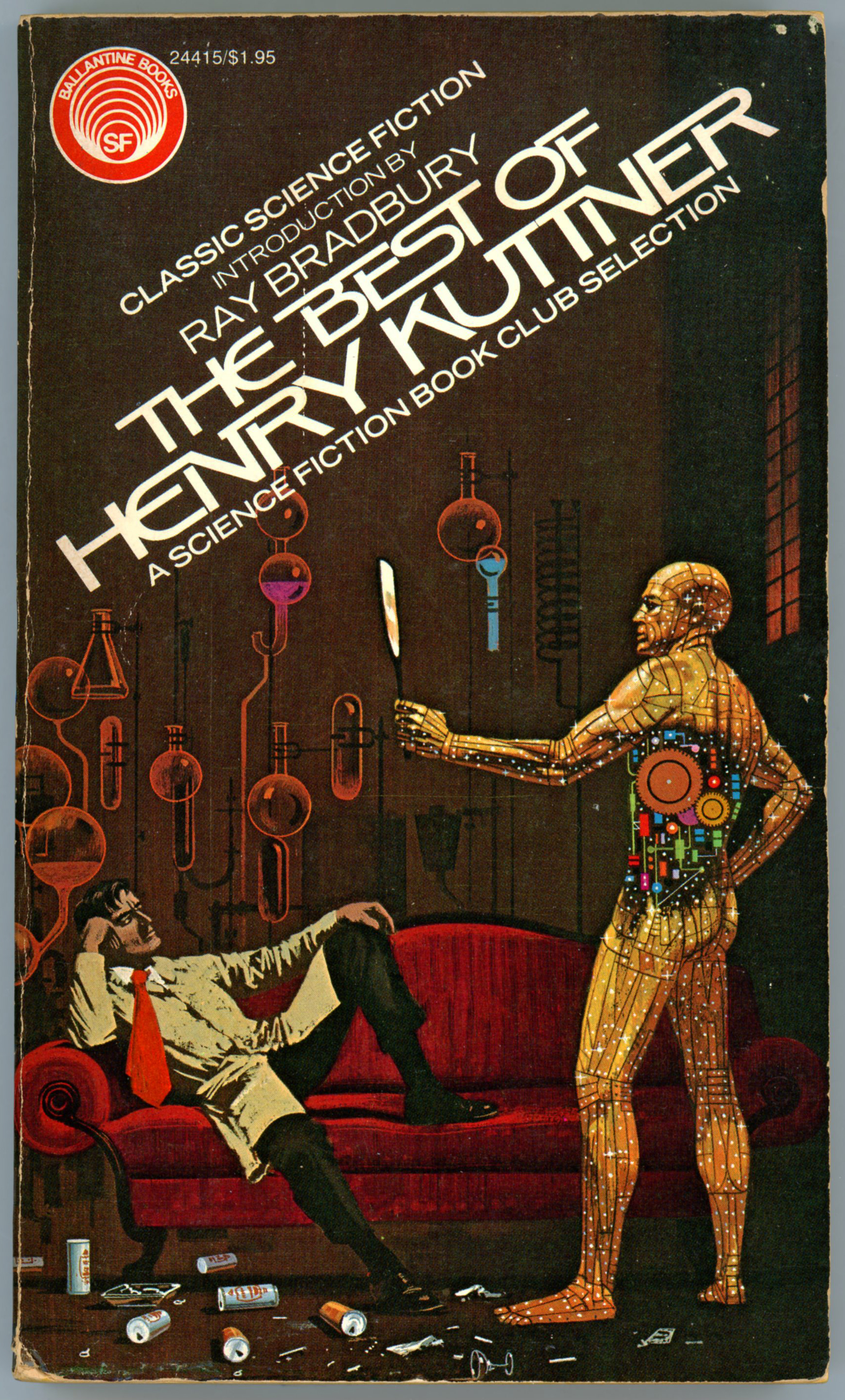
The Best of Henry Kuttner (this post!), Ray Bradbury, April, 1975 (Dean Ellis), $1.95, 24415 / 0-345-24415-X

The Best of Fritz Leiber, Poul Anderson, September, 1979 (Michael Herring), $2.25, 28351 / 0-345-28351-1

The Best of Murray Leinster, J.J. Pierce, April, 1978 (H.R. Van Dongen), $1.95, 25800 / 0-345-25800-2

The Best of C.L. Moore, Lester Del Rey, March, 1976 (Tim and Greg Hildebrandt), $1.95, 24752 / 0-345-24752-3
(Republished, December, 1980, $2.25, 28952 / 0-345-28952-8, and…

January, 1981, $2.25, 28952 / 0-345-28952-8,
…both covers by Tim and Greg Hildebrandt)

The Best of Frederik Pohl, Lester Del Rey, April, 1976 (Dean Ellis), $1.95, 24607 / 0-345-24507-5

The Best of Eric Frank Russell, Alan Dean Foster, October, 1978 (H.R. Van Dongen), $1.95, 27700 / 0-345-27700-7
(Republished July, 1986 (Barclay Shaw), $3.95, 33223 / 0-345-33223-7)

The Best of Cordwainer Smith, J.J. Pierce, September, 1975 (Darrell Sweet), $1.95, 24581 / 0-345-24581-4
(Republished October, 1977 (Darrell Sweet), $2.25, 27202 / 0-345-27202-1)

The Best of Stanley G. Weinbaum, Isaac Asimov, June, 1974 (Dean Ellis), $1.65, 23890 / 0-345-23890-7
(Republished January, 1979 (Dean Ellis), $1.95, 27965 / 0-345-27965-4)

The Best of Jack Williamson, Frederik Pohl, June, 1978 (Ralph McQuarrie), $1.95, 27335 / 0-345-27335-4

________________________________________

Here’s the cover of the first published volume in the series and the inspiration for this post: The Best of Henry Kuttner, with Dean Ellis’ cover illustration inspired by the story “The Proud Robot”.  All stories in this volume were co-authored with Kuttner’s wife Catherine L. Moore, except for “The Proud Robot”, “Misguided Halo”, “The Voice of the Lobster”, and, “The Big Night”.
Contents

Mimsy Were the Borogoves, from Astounding Science Fiction, February, 1943

Two-Handed Engine, from The Magazine of Fantasy and Science Fiction, August, 1955

The Proud Robot, from Astounding Science Fiction, October, 1943

The Misguided Halo, from Unknown, August, 1939

The Voice of The Lobster, from Thrilling Wonder Stories, February, 1950

Exit the Professor, from Thrilling Wonder Stories, October, 1947

____________________

The Twonky, from Astounding Science Fiction, September, 1942

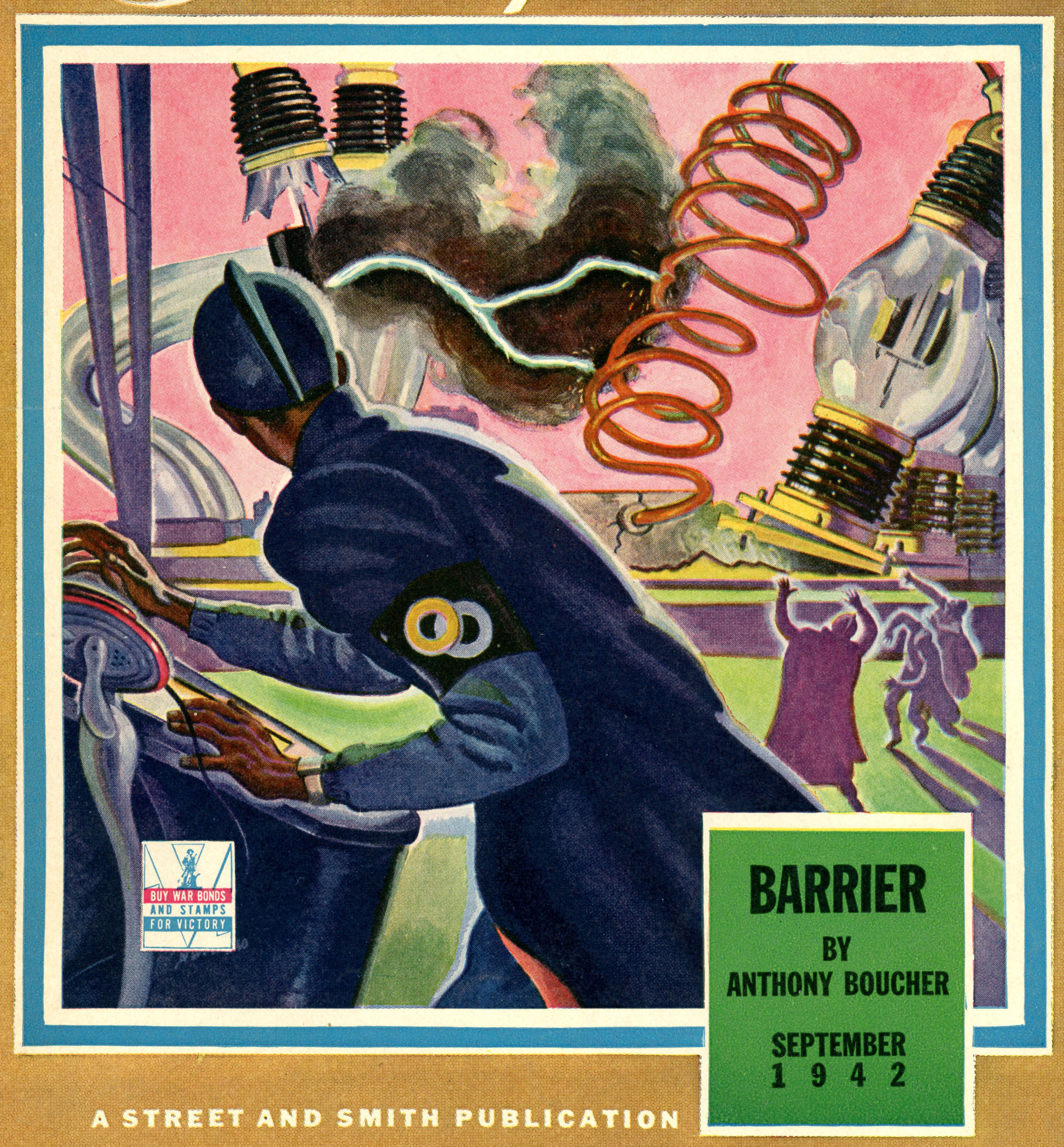
Here’s the cover of the September, 1942, issue of Astounding…
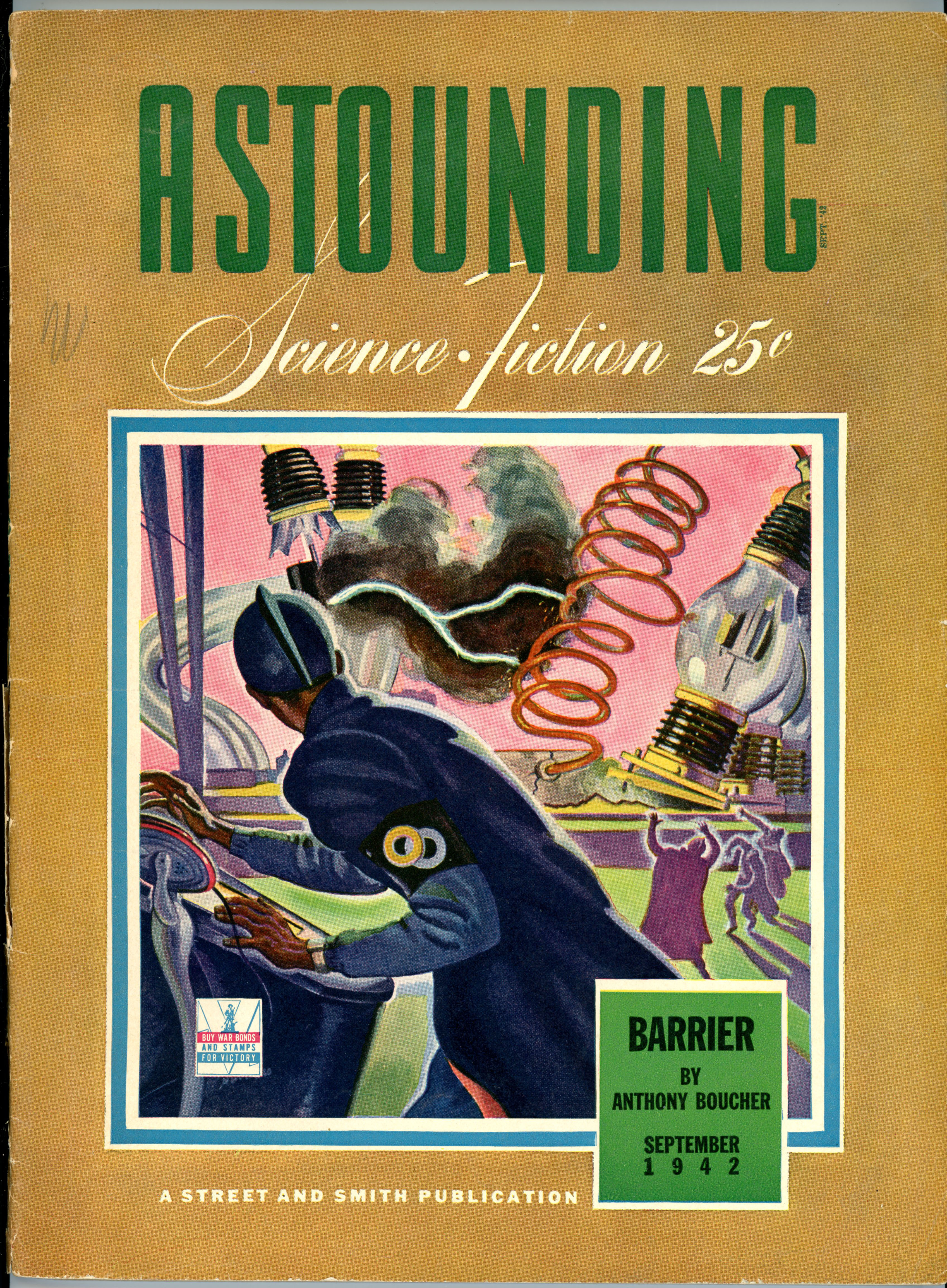
…and, a close-up of William Timmins’ cover art.  Giant light-bulbs a-bursting?  Well, it gets the point across!
The film adaptation of “The Twonky” (1953) can be found at Ayako Edwina’s YouTube channel.

____________________

A Gnome There Was, from Unknown Worlds, October, 1941

The Big Night, from Thrilling Wonder Stories, June, 1947

Nothing But Gingerbread Left, from Astounding Science Fiction, January, 1943

The Iron Standard, from Astounding Science Fiction, December, 1943

Cold War, from Thrilling Wonder Stories, October, 1949

Or Else, from Ahead of Time, 1953

Endowment Policy, from Astounding Science Fiction, August, 1943

Housing Problem, from Charm, October, 1944

____________________

What You Need, from Astounding Science Fiction, October, 1945

The basis of the identically-titled episode 12 of The Twilight Zone, first broadcast on December 25, 1959, profiled at the Internet Movie Database, “What You Need” is the subject of Twilight Tober-Zone’s critique, which also covers Tales of Tomorrow’s 1952 version of the story.

Absalom, from Startling Stories, Fall, 1946

____________________

References and What-Not

Publication History of Ballantine Books / Del Rey-Ballantine, “The Best of…” science fiction series, via Internet Speculative Fiction Database

Library of Congress Online Catalog (Advanced Search)

Biography of Dean Ellis, at askArt

Works by Dean Ellis, at Science Fiction Book Art

Works by Dean Ellis, at Artnet

Words in Print: Aharon Appelfeld, Interviewed by Aloma Halter, in “Appelfeld: The Man Who Makes Words Escape” – The Jerusalem Post, April 28, 1991

Continuing with the theme of articles about Aharon Appelfeld, here’s Aloma Halter’s substantive and insightful interview and discussion with the author, during a meeting at Beit Ticho in Jerusalem, at the time: nearly thirty years ago a cafe, and now, a gallery.   Appelfeld’s understanding of Jewish existence, identity, and survival are interpreted by focusing on the intersection between his life experiences before and during the Shoah, as reflected through characters, plot, and setting – both geographic and psychological – of the novels The Immortal Bartfuss, The Age of Wonders, To The Land of the Reeds, and especially, Tzili: The Story of a Life.

________________________________________

Does he mind being labeled a Holocaust writer?
“It saddens me, because I would like simply to be called a writer of fiction.
It seems that people who don’t like me so much attach that label.
But I don’t argue with anyone who says that I just write about the Holocaust.
There’s nothing to argue about:
either you understand the tone and color, or you don’t.”

________________________________________

Appelfeld: The Man Who Helps The Words Escape

Through words, writer Aharon Appelfeld has transcended the trauma of the Holocaust to produce some of the most memorable works of postwar Israeli literature.  By Aloma Halter

Jerusalem Post
April 28, 1991

EVEN BEFORE we had arranged to meet at a Jerusalem cafe, I felt I knew Aharon Appelfeld, major and prolific Israeli writer.  Like my father, like all my father’s friends, Appelfeld is a survivor.  The characters of his books also seemed familiar.  In Israel the past is always thrusting itself into the present.

“Sometimes you reach a certain place, a closed place you can’t get out of, and then you start to look for yourself.  Your past, your life.  That’s what happened to me in the forests, and later in Israel, and because of this, this is also what happens in my books.  Here the searing sunlight doesn’t let me forget that I have come from another place.  Sometimes I turn it into the snow and winter of Eastern Europe, and sometimes I turn the snow into sun.

“When I reached Israel I was 14, entirely without roots, without my own world, without culture, possessions, luggage or language.  This period of disorientation lasted many years, because not only me, but all my generation, preferred not to dwell on the past.  We wanted to be like other Israeli children; only stronger, taller, blonder.  Because if you have a defect, you want to be more, in order to compensate for it, and Israeli society subtly treated us as if we did have a defect.

“While I was searching for myself, the important question for me (not that I consciously asked myself it; a person doesn’t ask himself questions – they’re embedded in the flesh), was, what was I doing?  To whom did I belong?  I knew that I was alien here, and this bright sunshine, which wasn’t the sun I was used to, kept bringing me back to these basic questions.”

Aharon Appelfeld’s translated works include Badenheim 1939; The Age of Wonders, Tzili: The Story of a Life; The Retreat; To the Land of the Reeds; The Immortal Bartfuss; For Every Sin and The Healer.  His early books were translated by Dalya Bilu; for the past few years, all his books have been consistently, and superbly, translated by Jeffrey Green.  Appelfeld’s writing has gained international recognition for its subtlety and sensitivity.

Of all living Israeli writers, he is probably our most realistic candidate for the Nobel Prize; while we have other fine and powerful talents, Appelfeld’s work bears a quality of transcendent universality.  He was awarded the Israel Prize in 1983.  He holds honorary doctorates from the Orthodox movement’s Yeshiva University, the Conservative movement’s Jewish Theological Seminary, and was back in Jerusalem in August to receive his third honorary doctorate from the Reform movement’s Hebrew Union College.  It is with wryness that he notes these achievements together with the fact that, due to the war, he finished only the first grade of school.

WE’RE TALKING under the shade of lofty trees that overlook the terrace of Appelfeld’s favorite Jerusalem cafe: Beit Ticho.  Around are the genteel noises of subdued conversation and the clink of teaspoons and forks, as coffee is stirred and pastries eaten.  With no great effort of the imagination, this could be one of the spas or quiet holiday pensions which recur so often in his novels.

Appelfeld, who is observant, wears a little peaked marine cap, which reminds me of the one worn by the Polish train driver in the film Shoah.  He talks slowly, his voice low as if to persuade and disarm his listener.  He uses impeccable and distancing politeness to steer himself, unscathed, through the encounter.  There is no way of taking the measure of this extraordinary man.

Appelfeld was back in Jerusalem from a sabbatical at Harvard, where he teaches creative writing, researches and continues his writing, to collect his honorary doctorate from Hebrew Union College.  In another year he will resume his teaching post at Ben-Gurion University in Beersheba.

His reputation has grown steadily over the years.  In Israel, in the mid 1950s, no one understood why Appelfeld wrote about the Holocaust; it took years (from 1956 to 1962) for his first book, Ashan (“Smoke”), a collection of short stories, to be published.

He feels that the literary establishment treated him like an outsider.

“At first I was taken to task over my Hebrew.  At that time it was fashionable to sprinkle one’s writing with biblical references, and use as elevated a language as possible – even if your character was a simple peasant or porter who would never have spoken in such a way.  Critics took me to task over the ‘simplicity’ of my language, making me feel like a child who’d been kept three classes down.  Just as well I had the sechel not to listen.  But when the first book came out, an awful thing happened.  People said: (his voice drops to a self-mocking and melodramatic whisper): ‘Appelfeld is good, but he writes about the Shoah.’  And then they said: ‘Appelfeld is good, but he writes about Jews…’ and then the most nasty thing: ‘Appelfeld is good, but he’s not one of us.’’

“The tragic element is that my natural readers – those who had gone through the Holocaust – didn’t want to read about it, and I understood them.  But not the attitude of my colleagues and contemporaries.  For example, A.B. Yehoshua and I had studied together, Amos Oz was a pupil of mine.  Amalia Kahana Carmon I’d known for years … they didn’t react as if I’d brought something new to Israeli literature, something it didn’t have before.

“If someone has a different biography, the question is: how do you relate to it?  Do you welcome him, accept the differences?  Or, on account of the subject matter, do you say: ‘he’s different, he’s not one of us.’ “

APPELFELD’S “different” biography began in Czernowitz, Bukovina (now part of the Soviet Union), then a province of the Austro-Hungarian empire.  An only child of extremely wealthy parents, his father had made the family rich by introducing motorization to the country’s flour, water and windmills.

It was a diverse and cosmopolitan life.  “My parents spoke German.  My grandparents, Yiddish.  The town of Czernowitz was Ukrainian-Rumanian.  The regime, Romanian and later, toward the end of the war, I was with the Russians.  Every year there were excursions to spas and holiday resorts.  My parents were assimilated people, and saw Zionism as a death wish.  Who would want to go back in time to Palestine, that hole in the old Ottoman empire, and leave behind the culture of 20th-century Europe!”

When asked to speak about his childhood, Appelfeld talks simply, as if trying to defuse the effect he knows his words will have.  “At the start of the war in 1940, they killed my mother, and I was left with my father.  Later they separated us, when they took the men off to work.  I was eight.  I saw that, if I stayed alone, I would die.  So I ran away.”

His blandness is terrifying, and only his repetitions hint at emotion, as if he repeats to reassure himself too.  What is it like to be an 8-year-old child and totally alone in the world?

“So I ran away, slipping under the fence.  No, not with other children.  Alone, alone.  In the war, you learned very quickly to do things alone.  It’s a harsh rule, but you learn it quickly.  I became very, very conscious of my surroundings.  You couldn’t have survived if you weren’t aware of every noise, every movement – and it all had somehow to be interpreted.  And the interpretation was a matter of life and death.  So I spent most of the war in the forests, or near the outlying huts where ‘normal’ peasants wouldn’t have lived.  There you had the chronically ill, the slightly mad, the witches, the prostitutes.

“I’d escaped in summer and thought I could survive in the woods.  But autumn came with heavy rains, and I couldn’t stay there.  First of all, I lived in a prostitute’s hut.  I told her that I’d run away from a nearby town which had been bombed.  I couldn’t reveal that I was Jewish, even though she was often quite genial and kind to me, because in one of her drunken rages, she would have killed me or told one of her clients.  I was eight, and that was my first real school.  I had to buy the food from the village and clean the hut.  Yes, in my parents’ home there’d been servants to clean, but you learn.

“But one day, after about a year, one of her clients seized me and accused me of being Jewish.  My face was round, my eyes blue, but all the same, he must have sensed there was something not of his element.  Had he caught me out in the open, I might have run away.  But it was in her hut, all hemmed in.  ‘You’re Jewish!  You damned Jews!’  Till this day I can feel it.  I was dumbstruck as I stood there.  No sound would come from my mouth.  Only later, I was able to rally and fling back enough curses to make him doubt it.  But after a few days, I ran away: if one of her clients had noticed something, perhaps it had also crossed the minds of others.

“I fled to another place.  Then I was taken in by a horse thief; it’s a unique profession.”

APPELFELD’S CHARACTER Bartfuss, from Bartfuss the Immortal, is the archetypal survivor.  In Israel after the war, Bartfuss undergoes a crisis when he realizes that the strategies which had helped him to survive are exactly what prevent him from living and communicating in non-threatening situations.

“A lot of Bartfuss … is me, and a lot comes from observations of people I know.  Bartfuss is seeped in the Holocaust; he doesn’t have to talk about it.  He’s not a big speaker, he can’t get close to people, not even himself.  He’s closest to his coffee, cigarettes, and walks by the sea.”

Appelfeld says he is close to people, and likes a few of them a lot.  He speaks of his family, his children – now mainly grown up – his Argentinian wife.  There were friends like the poet Dan Pagis, another survivor who came from Czernowitz.  “He was a very closed kind of person.  Much more than myself; much more Bartfuss! (he laughs), a man with many secrets, yes, many secrets.”

Out of all Appelfeld’s books, I asked, which comes nearest to telling what happened to him, alone in the forest, at the age of eight?

“Sometimes, you have a strong emotion but can’t express it directly.  That happened all the years I wanted to write about my life as a child in the forests.  I couldn’t.  Only when I put it into the story of a little girl, in Tzili, was I able to express it.  When I wrote about myself, or even another boy, it wasn’t near the truth at all; the tone wasn’t right, nothing was right.”

She wandered in the outskirts of the forest.  Her food was meagre: a few wild cherries, apples, and various kinds of sour little fruits which quenched her thirst.  The hunger for bread left her.  From time to time she went down to the river and dipped her feet into the water.  The cold water brought back memories of the winter, her sick father moaning and asking for another blanket.  But these were only fleeting sensations.  Day by day her body was detaching itself from home …  She had severe pain in her stomach and diarrhea.  Her slender legs could not stand up to the pain and they gave way beneath her.  “God, God.”  The words escaped her lips.  Her voice disappeared into the lofty greenness.  If she had had the strength, she would have crawled into the village and given herself up.

IF APPELFELD had the choice, and could write about aspects of life totally separate from the Holocaust, would he focus on the problems and complexities of modem Israeli society?

“I can’t write about the Israeli-Palestinian struggle, for instance; I haven’t lived with Arabs for years.  Neither is my experience of, say, Ashkenazi-Sephardi conflicts so great.  But the Ukrainians, whose beds I slept in, and whose horses I ate with – I do have something small to say about them.”

Unlike other Israeli novelists, Appelfeld’s art begins and ends with personal experience.  He would not “go out,” seeking new experiences, doing research in the field as, for example a writer like David Grossman did for his book The Yellow Wind about Palestinians in Israel.  But neither is Appelfeld’s work simply narrative in the style of Polish-American survivor Jerzy Kosinski, who recently committed suicide.  “If I just told what happened to me in life, it would look like a madhouse,” Appelfeld says.  “A writer has to communicate something of his innermost truth.  If we want simply history, we can look to the historians.  For psychology, we can turn to the psychologists and sociology, to the sociologists, but that elusive inner truth a writer gives us can be found nowhere else.

“Chronology, which is the truth, isn’t entirely the truth.  It sometimes over-emphasizes.  People who write chronology are usually still drawn to the more dramatic events.  But at the time one lives through them, these events aren’t necessarily significant.  It’s also a matter of perspective.  Very often people write their memoirs and send them to me to read.  They’re 100 percent true, and I’m always stirred.  But at the same time, it’s rather sad, because in a way, these memoirs are not entirely true.”

I ASK HIM ABOUT the occasional times that Israelis, particularly since the start of the intifada, have been compared to Nazis.  How does he, with one son who has completed his IDF duty, and another about to be drafted, react to the comparison?

“Jews have been misunderstood for generations.  It’s a comparison engendered by malice and evil, but it’s hard to do away with either of them.  I deal a lot with that in my work.  I’m very upset by what the Arabs are suffering, but there is no comparison to that, even by this much (he holds up his little finger).

“Only about 10 to 15 percent of what I’ve written has been published.  There are two reasons for this: first of all, as you get older, you’re more critical about your work, and then there are many books which after I finish them, I just put away in a drawer, to see how they’ll age after five years or more.  From time to time I take one out and read it.  So there are usually two books on my desk at once – an old one in revision and a new one in writing.  When I get dulled by one, I turn to the other, and when things look black, and I feel as if I’ll never finish the one I’m writing, I know there’s one already written, full, and that’s encouraging.”

Does he treasure those which are unpublished more than those already published, like a parent’s pained love for a less successful child?  “No, my feeling is that I have to complete them.

“One of the writers I most admire is Kafka, whom I came to as an assimilated Jew, and not from the existential aspect.  The same with Bruno Schultz.  In The Healer, I wanted to explore the pain of the assimilated Jew who has no skin, an uneasy conscience.  I see the modern Jew as being torn between two tendencies, or two worlds: the first is to escape from himself and his culture; the second is to return to his heritage.  The first – the escaper – is much the stronger.  For torn as he is, the modem Jew has been a major partner in the making of the modem world: modem literature, music, psychology, even modem painting, philosophy.  That’s why the assimilated Jew is so interesting.”

A TRIVIAL, but tangible, side effect of reading Appelfeld is to find oneself drinking more coffee than usual.  To the Land of the Reeds, for example, is full of such lines: “Her longing for coffee secretly tortured her, but the torture was not unbearable.  She smoked two cigarettes, and they dulled her desire.”  Or: “Rudi prepared a cup of coffee for her.  She took the cup without a word and brought it to her lips.

“ ‘Hot,’ she said.  ‘Good.’ “

“In my early books,” Appelfeld explains, “it all went together: coffee, cigarettes, cognac.  Usually people drink because they want to drug or silence something in themselves.  My characters have a lot to silence, so they drink a lot.”

The conversation has been leisurely but lengthy, and I wonder if Appelfeld is flagging.  “No, no let’s go on.  When I returned to Jerusalem from Boston I couldn’t get to sleep easily, but last night I slept.  I’ve slept, we’ve eaten, we’re having a nice conversation.  What else will you have?  Coffee?”

I’m strongly reminded of his character, Bartfuss, who for months, years, can’t sleep properly until the end of the book, and then: “Only when he drew near the bed did he feel that that mighty sleep, that full sleep, which he had been struggling against for years, had gathered strength, and now it was about to spread its iron web over him.  He managed to take off his shoes and socks, to put his shirt on the chair, look about the naked room, and to say a sentence to himself that he had heard by chance:  ‘From now on I shall remove all worry from my heart and sleep.’ “

THOUGH APPELFELD’S books often depict the lost world of European Jewry before the Holocaust, his characters are remarkably multifaceted, human in their weakness and strengths.  Above all, he is a universalist, a subtle and keen observer of human beings.  Incredibly, absurdly, some Jewish critics have accused him of helping to exonerate the Nazi’s treatment of the Jews because he portrays Jews unfavorably – in some books he dwells on their weaknesses and hesitations, as in The Age of Wonders, or even in his recently published For Every Sin.  It seems hard to conceive of such a gross, and perhaps willful, misinterpretation of a writer’s work and intentions:

“After I’d written The Age of Wonders, which was mainly about my parents and their generation, I could suddenly appreciate all the lovely things about them.  Before I’d never been able to express my love for them, for all the lost Jews of Europe.  It had always seemed sentimental.  In the book Katerina, I found the character who could be the mouthpiece for this love.  When Katerina says: ‘I love Jews,’ it doesn’t sound sentimental.”

Does he mind being labeled a Holocaust writer?  “It saddens me, because I would like simply to be called a writer of fiction.  It seems that people who don’t like me so much attach that label.  But I don’t argue with anyone who says that I just write about the Holocaust.  There’s nothing to argue about: either you understand the tone and color, or you don’t.”

In a general way, Appelfeld is not an arguer.  He is an accepter and under-stander of how things are.

At the academic convocation held at the Hebrew Union College in August for the ceremonies of rabbinic ordination and presentation of two honorary doctorates – to Ayala Zacks Abramov and Aharon Appelfeld – Appelfeld spoke just as twilight was draping the courtyard with magenta and rose.  Although the audience was restive after more than two hours of speeches, and Appelfeld was the last speaker, people visibly calmed under the influence of his words.

His acceptance speech was a moving summary of the spiritual path the Jewish people had traveled, first away from religion, and more recently toward it, over the past 150 years.  He spoke of the phenomenon of the return to traditionalism in Israel, and the impatience or downright resentment of secular people toward this phenomenon.

“When I came to Israel in 1946, religion had been banished from this new country.  People sought to replace it with social positivism, with Zionism, with communism.  People had shrugged off religion; they wanted to shrug off old bonds.  The old world had been destroyed in the Holocaust, and now there would be a new one.  What we are now witness to is an outbreak of yearning which can’t be stemmed.  Those of us who find ourselves naturally more on the side of traditionalism and humanism than on the side of religious fervor should not try to fight them, but rather strengthen the moral kernel of those who are aligned with the more extreme elements of our religion.  Not to deride but to help: to refine, to bring out the good.”

Appelfeld’s works deal unflinchingly with a spectrum of life which is full of shadows, yet he manages to use these, like the strong shading effects of chiaroscuro, to illuminate and show the innate refinement of everyday human actions, human emotions and beliefs.