Out Of This World – An Anthology of Fantasy, Edited by Julius Fast – 1944 (1946) [Unknown Artist] [[Updated Post]]

(First created in March of 2018, this post has been updated to present greater detail about Out of This World’s contents…)

Evening Primrose, by John Collier, from Presenting Moonshine (book), 1941

Laura, by Saki (H.H. Munro), from Beats and Super-Beasts (book), 1914

Sam Small’s Tyke, by Eric Knight, from Sam Small Flies Again: The Amazing Adventures of the Flying Yorkshireman (book), 1940

Satan and Sam Shay, by Robert Arthur, from The Elks Magazine, August, 1942

A Disputed Authorship (excerpt from A House-Boat on the Styx), by John Kendrick Bangs, 1895

Mr. Mergenthwirker’s Lobblies, by Nelson S. Bond, Scribners Magazine, November, 1937

A Vision of Judgement, by H.G. Wells, from The Country of The Blind and Other Stories (book), 1911

Thus I Refute Beelzy, by John Collier, from Presenting Moonshine (book), 1941

The King of the Cats, by Stephen Vincent Benet, from Harper’s Bazar, February, 1929

The Canterville Ghost, by Oscar Wilde, from Court and Society Review, February 23, 1887

My Friend Merton, by Julius Fast

And Adam Begot, by Arch Oboler

The Club Secretary, by Lord Dunsany, from The Atlantic Monthly, August, 1934

The Scarlet Plague, by Jack London, from The London Magazine, June, 1912

Reference

Out of This World, at Internet Speculative Fiction Database

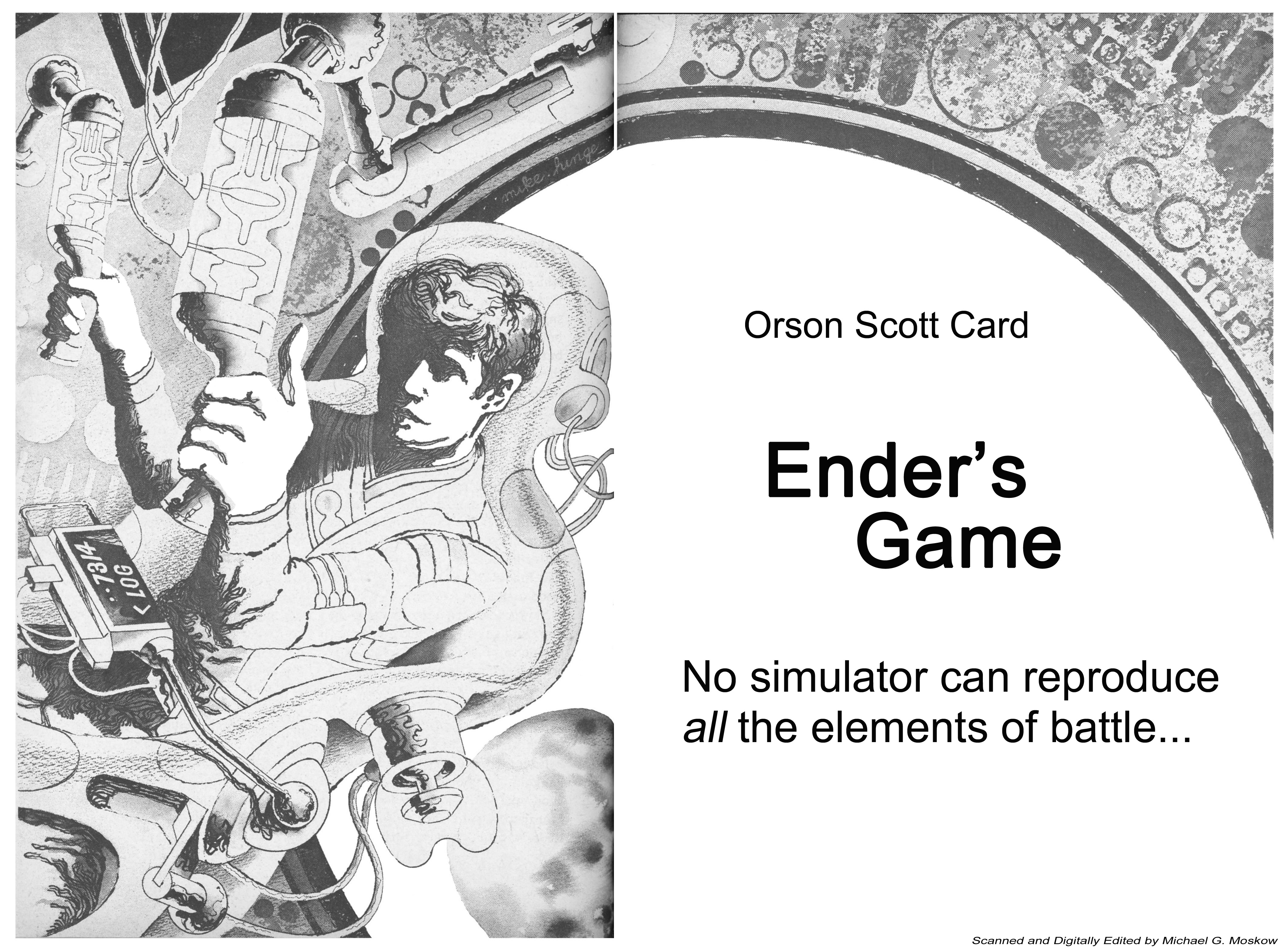
Ender’s First Game: Analog Science Fiction – Science Fact, August, 1977 (Featuring “Cold Cash War”, by Robert Lynn Asprin) … and, including “Ender’s Game”, by Orson Scott Card [Frank Kelly Freas]  [[Updated Post]]

The cultural impact of literature of most any genre – in terms of cultural impact and (maybe / maybe not) the financial and other rewards that may eventually accrue to its creator – is by nature unpredictable, and has ever been so. 

Case in point, Orson Scott Card’s “Ender’s Game, which first appeared in novelette form forty-three years ago, in the August, 1977 issue of Analog Science Fiction – Science Fact.  It’s notable that the story, given the books and film that have grown from the original tale, actually appears “deep” within the issue, on pages 100 through 134, and was not the subject for magazine’s cover art, which – by Frank Kelly Freas – pertains to Robert Asprin’s “Cold Cash War”, which appears towards the beginning of the issue.

Though the great majority of my posts pertaining to art and illustration in science-fiction pulps hark to pulps from the 40s and 50s, I thought it would be interesting to present one of Mike Hinge’s two illustrations that accompany “Ender’s Game”, which – as you can see – is a depiction of Ender himself.  Alas, Hinge’s “lead” illustration – not presented here – is very bland in comparison.  (Oh well.)

While I think that book cover and interior illustrations from science fiction of the 60s, let alone the 70s and 80s, is nowhere near as striking, symbolically powerful, or well crafted as that from earlier decades, some of this work is still significant in its own way, and quite worthy of recognition and viewing.

You can view many examples of Mike Hinge’s work at Ivan Richards’ Onyx Cube blog, which show the breadth and scope of his skill, ranging from direct and beautiful technical depictions of the Space Shuttle, circa 1985 (great presentations of the craft’s cockpit…!) to illustrations for advertisements, to record covers (Elleorde), to – even – more.  An Americanophile from Auckland, New Zealand, he was born in 1931, and passed away in 2003.   

You can also view another example of his art – a stunning illustration for the cover of the November, 1971 issue of Amazing Storieshere. 

Reference

Mike Hinge, obituary from The Dominion Post (Wellington, New Zealand) at OnyxCube