The Magazine of Fantasy and Science Fiction – May, 1957 (Featuring “Adjustment”, by Ward Moore) [Frank Kelly Freas] [Updated post 2024…!]

Note!…  Originally created in March of 2020, I’ve updated this post to include a comment by Brett Bayne, which follows:

Hello,
I have just finished reading your fascinating and informative blog post about Ward Moore’s story “Adjustment,” published in the Magazine of Fantasy and Science Fiction, and featuring cover art by Frank Kelly Freas.  You helpfully included a link to a PDF of the story.  Thank you for that.  Here’s my question: Is the young woman depicted in the original painting supposed to be Lucille Ball?  It sure looks like her!
Let me know your thoughts.
Many thanks,
Brett Bayne in L.A.

I present my thoughts about Mr. Bayne’s question below…!

~~~~~~~~~~~~~~~~~~~~~~~~~~~~~~~~~~~~~~~~

Like other science fiction artists, Frank Kelly Freas’ works display a certain style that makes them immediately (well, almost immediately!) identifiable. 

Though he was more than capable of rendering the human figure in a purely representative and natural form, the distinctive “quality” of Freas’ compositions seems to lie in the very faces of the central or most prominent figures in his compositions.  These are often exaggerated in dimension, proportion, or shape, making them symbolically “fit” the mood of the story, and, the character’s specific role within it.

Case in point, the cover of The Magazine of Fantasy and Science Fiction for May of 1957, illustrating a scene from Ward Moore’s tale “Adjustment”.  The surprised and utterly abashed fellow on the left is “Mr. Squith” (great choice of surname – though “Mr. Squish” or “Mr. Squid” would do just as well!), who, if not a hero in a classical sense – well, he’s no hero, in any sense! – is most assuredly the protagonist, albeit a protagonist of a passive and – to the reader – utterly exasperating sort.

Well.  “Adjustment” might have been just a little risque in its day, but in the brittle and tired world of 2020, the tale has an air of quaintness, charm, and even innocence of a sort.  Mr. Squith, it turns out, is rather oblivious to the nature of human social interactions, and the cues and signals – spoken and especially unspoken – that pass between people, in effect becoming the tale’s straight man and object of humor.

As for Freas’ art itself?

Well, here’s the cover as published…
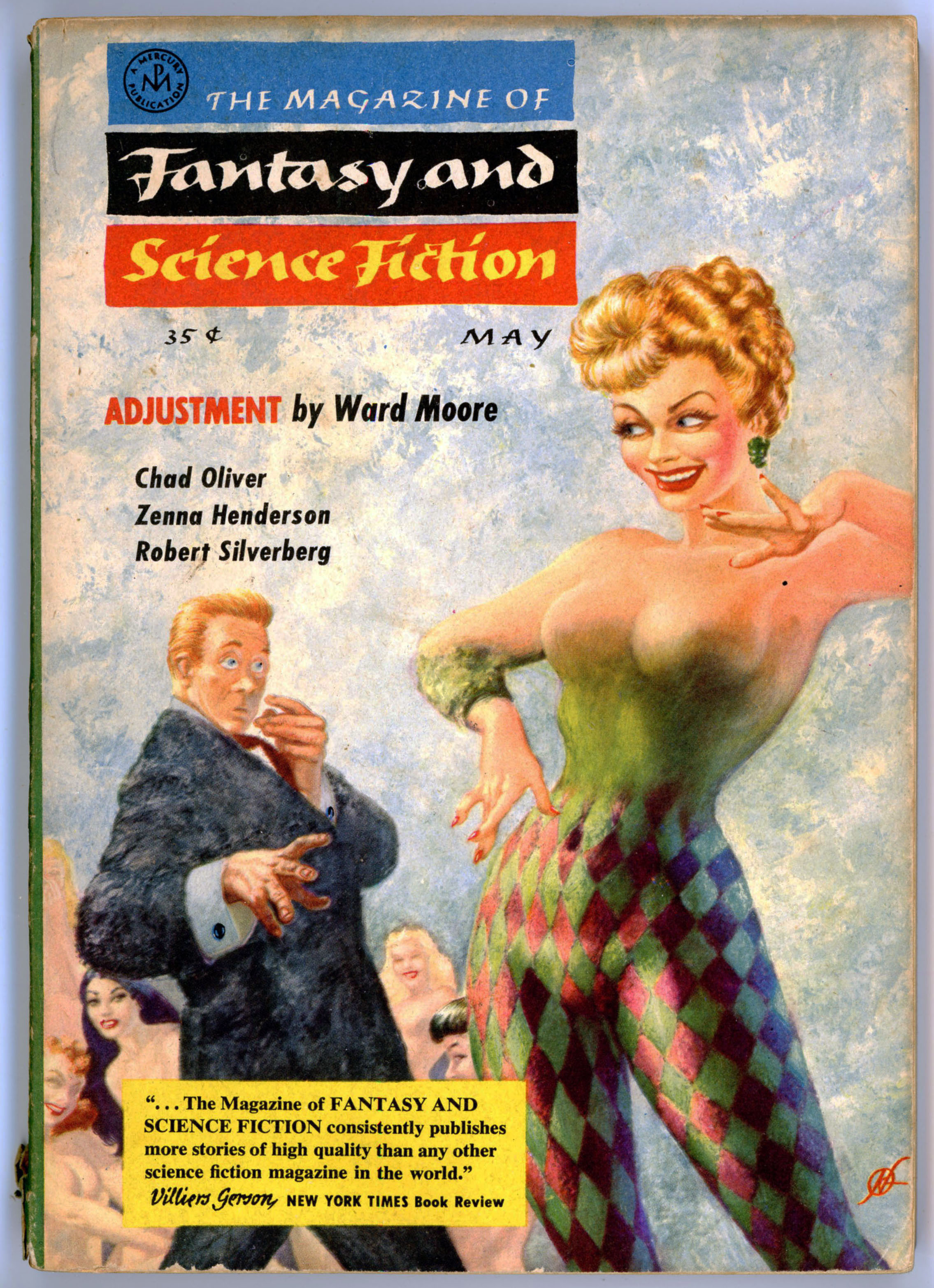
…and, below is the cover – from Heritage Fine Auctions – as originally painted.  (The painting was sold as part of an auction held on June 27- 28, 2012.) 

Though I’m not certain of the details, it seems that the editors of Fantasy and Science Fiction had second thoughts about Freas’ cover as originally created, with Freas adjusting the art for “Adjustment” accordingly.  Likewise, the promotional blurb about the magazine itself – which typically appeared on the rear cover, if at all – was strategically located to the front.

~~~~~~~~~~~~~~~~~~~~~~~~~~~~~~~~~~~~~~~~

And now for something sort of different.  Well, uh, divertingly different…  Well.  You know.

Yes, even when I created this post four years ago (now being 2024), I was immediately struck by the similarities (exaggerated similarities, but similarities nonetheless) between the “face” (not * ahem * physiognomy) of the woman on Freas’ cover – most immediately attracting the attention and astonishment of our preternaturally naive and (alas) erotically oblivious protagonist, Mr. Squith – and that of Lucille Ball.  I didn’t write as much at the time, but this is especially so in light of the pleasing but very generic faces of the bemused ladies at lower left.  Mr. Squith’s lady is very much an individual.  A recognizable individual.  An identifiable individual. 

By way of comparison, three pictures of Lucille Ball are shown below. 

The verdict?  No coincidence.

In other words, “Here’s Lucy!”    

“I Love Lucy” 1958 promo image.

New York Post, August 4, 2021:  “Rare tapes revealed: Lucille Ball has SiriusXM podcast decades after death”

Cast of I Love Lucy with William Frawley, Desi Arnaz, and Vivian Vance – Undated photo.  “The Lucy-Desi Comedy Hour aired on CBS from 1962 to 1967. … The photo has only a “date use” stamp for 27 April 1989, which is the day after Lucille Ball’s death.  The photo was apparently kept in the newspaper’s photo files after it was received and not published in that respective newspaper until after Ball’s death.”

You can read Mr. Squith’s adventure here, and about Lucy Ball at Wikipedia.

Alas, poor, naive Mr. Squith…

March 12, 2020 – 320

Video Time!: Planet Stories, January, 1954, featuring “A Sound of Thunder”, by Ray Bradbury [Frank Kelly Freas]

The theme of time travel, and specifically its implications in terms of causality, free will, parallel universes, and paradoxes, has been the basis of innumerable stories in science fiction, and to a lesser extent, fantasy.  A prominent example of the genre is Ray Bradbury’s 1954 tale “A Sound of Thunder”.  This tale first appeared in the June 28, 1952 issue of Colliers, and was republished in the January, 1954 issue of Planet Stories.  The story popularized the concept of the “butterfly effect“, though the general idea had been the subject of discussion among scientists and philosophers even in the 19th century.  

While I don’t think that Frank Kelly Freas’ resounding cover illustration for Planet Stories has a direct relevance to any story within…

______________________________

… Edmund Emshwiller’s lead illustration (pages 4-5) for “A Sound of Thunder” certainly does!  Note the notorious butterfly making a prominent appearance at lower right.  

Audio!

“A Sound of Thunder – Ray Bradbury”, narrated by Zach Walz (September 30, 2018)

While Bradbury’s short story has been the basis of a 2005 movie by the same name, unfortunately, as indicated at Rotten Tomatoes, the picture has fallen flat (or should I say “fallen splat“?), with a Tomatometer rating of 6%, and an Audience Score of 18%.  Here’s the trailer, at TheSciFiSpot (December 12, 2010)  You can read more about the film at the IMDB.

Working Title: “A Sound of Blunder”?

And even more, at…

A Book:

Ash, Brian (editor), The Visual Encyclopedia of Science Fiction, Harmony Books, New York, N.Y., 1977 (Emshwiller illustration on page 148)

A Thunderous Sound, at…

Wikipedia

GoodReads

Interesting Literature

SUNY Stone Brook Astronomy (full text)

Physics Forums

Internet Speculative Fiction Database

Tim Weed – Writer

Ellen Smith Writes (#TIMETRAVELSTORIES REVIEW: A SOUND OF THUNDER)

The Spirochaete Trail (Scampy’s blog)

Fangoria

The Philadelphia Inquirer (The Physics of Ray Bradbury’s “A Sound of Thunder”)

Frank Kelly Freas, at…

Wikipedia

SFE – The Encyclopedia of Science Fiction

FindAGrave

Field Guide to Wild American Pulp Artists

Internet Speculative Fiction Database

GoodReads

Wikimedia Commons (Cover Art) – 47 images

Comic Art Fans – some classic, “clickable” (relatively) full-size cover art

Dangerous Minds

invaluable – The World’s Premier Auctions and Galleries – original art for sale

Mad Magazine Covers by Frank Kelly Freas – Doug Gilford’s Mad Magazine Cover Site

Planet Stories, Summer, 1954, featuring “Dawn of The Demigods”, by Raymond Z. Gallun [Frank Kelly Freas]

“It’s us, Scharber…”

I’ve not yet read “Dawn of the Demigods” from the Summer ’54 Planet Stories – it’s never been anthologized – but, well, I do like Herman Vestal’s lead illustration…

____________________

Cover by Frank Kelly Freas  

____________________

…which is very unusual, for the era, in its depiction of spacesuit.  Rather than the elongated-cylinder-with-a-faceplate not uncommonly found in space art of the 50s, Vestal’s illustration evokes the bulbous helmets worn by Apollo astronauts … specifically, while inside the Command Module and LEM (rather than the Primary / Portable Life Support System used while on the lunar surface).  This is in terms of being molded as a single piece with 360-degree visibility, without antenna or other protrusions sticking out.  Vestal’s astronaut is also wearing a “Snoopy” type head covering with integral earphones, and, a microphone in front.  Hmmm…  Come to think of it, there is a certain Buzz Lightyear look going on here!

And, otherwise?

“Dawn of the Demigods”, at…

Internet Speculative Fiction Database

Project Gutenberg

Raymond Z. Gallun, at…

Internet Speculative Fiction Database

Science Fiction Encyclopedia

GoodReads

Wikipedia

Open Library

FindAGrave

Herman B. Vestal, at…

Internet Speculative Fiction Database

GoodReads

Frank Kelly Freas, at…

Wikipedia

SFE – The Encyclopedia of Science Fiction

FindAGrave

Field Guide to Wild American Pulp Artists

Internet Speculative Fiction Database

GoodReads

Wikimedia Commons (Cover Art) – 47 images

Comic Art Fans – some classic, “clickable” (relatively) full-size cover art

Dangerous Minds

invaluable – The World’s Premier Auctions and Galleries – original art for sale

Mad Magazine Covers by Frank Kelly Freas – Doug Gilford’s Mad Magazine Cover Site

Planet Stories, September, 1952, featuring “Evil Out of Onzar”, by Mark Ganes [Herman B. Vestal]

Despite the prominence and popularity of Frank Kelly Freas’ art, and, the presence of several images of his compositions at this blog, it must admit that he’s never been among the science fiction artists I most admire.  As in all things artistic, I suppose it’s a matter of style and personal preference, for despite the distinctiveness of his work, especially characterized by his way of capturing human facial expressions, and his use of color, I instead prefer themes of ambiguity, mystery, symbolism, and a sense of myth.  Thus, my liking for the works of such artists as Virgil Finlay, Paul Orban, Richard Powers, Hubert Rogers, and Henry Richard Van Dongen.

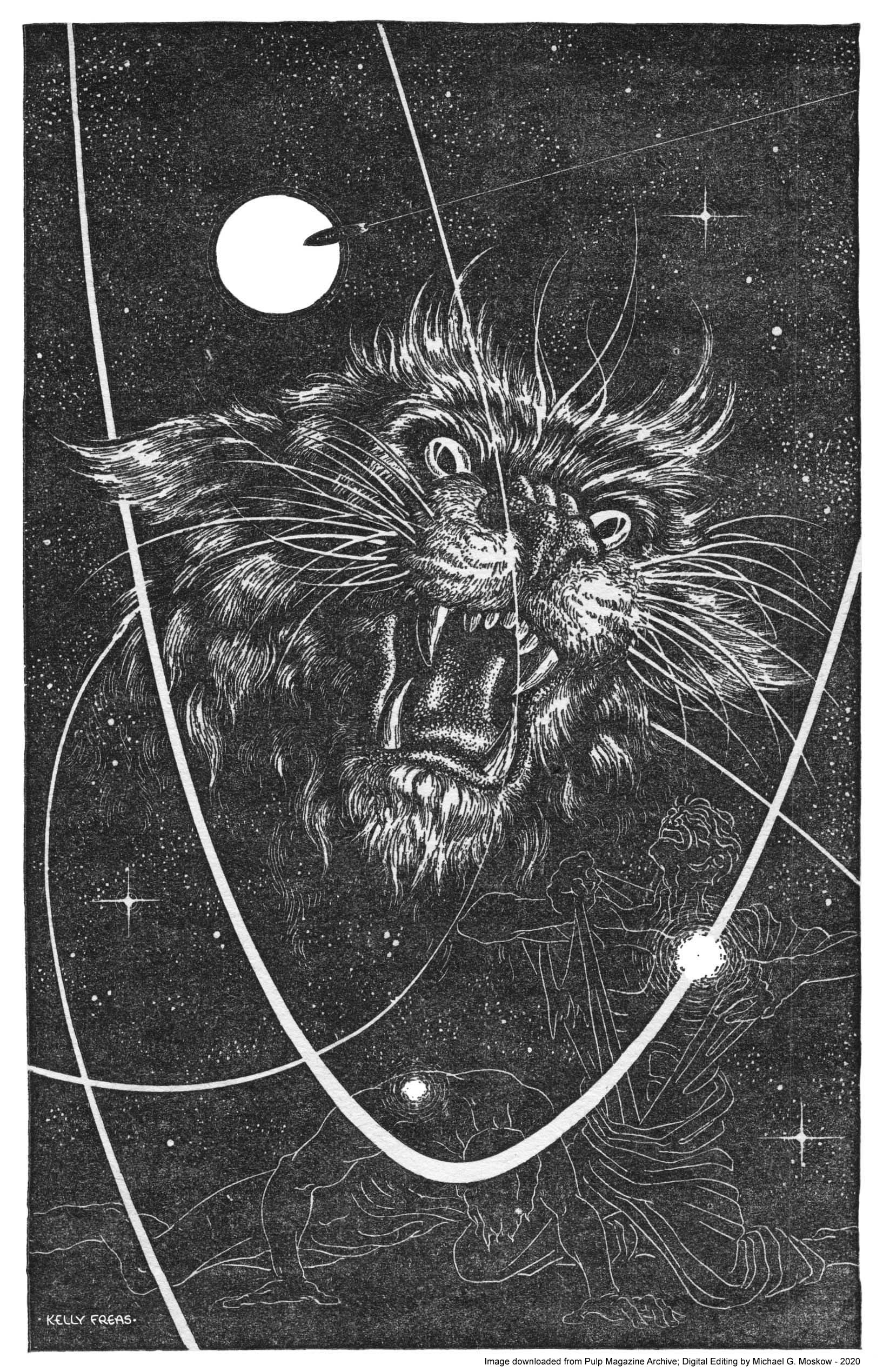
Yet, I really have to give Freas credit for this truly superb composition for “Thompson’s Cat”, in the September, 1952 issue of Planet Stories.  The combination of line drawings of men, illuminated trails of spacecraft, and a floating sun create the perfect visual frame for the head of a feline predator (a Kzinti, anyone?) which is depicted in expressive, near-Finlay-like detail.  

As far as the magazine’s content, “Evil Out of Onzar” appears to be the sole literary work of the mysterious Mark Ganes…

_____________________________

Illustration by Frank Kelly Freas for “Thompson’s Cat“, by Robert Moore Williams (page 72)

You May Like…

Mark Ganes…

Internet Speculative Fiction Database (not a helluva lot there!)

GoodReads

Robert Moore Williams, at…

Internet Speculative Fiction Database

Wikipedia

Herman B. Vestal, at…

Internet Speculative Fiction Database

Frank Kelly Freas, at…

Wikipedia

SFE – The Encyclopedia of Science Fiction

FindAGrave

Field Guide to Wild American Pulp Artists

Internet Speculative Fiction Database

GoodReads

Wikimedia Commons (Cover Art) – 47 images

Comic Art Fans – some classic, “clickable” (relatively) full-size cover art

Dangerous Minds

invaluable – The World’s Premier Auctions and Galleries – original art for sale

Mad Magazine Covers by Frank Kelly Freas – Doug Gilford’s Mad Magazine Cover Site

Five Science Fiction Novels, Compiled by Martin Greenberg – 1952 [Jacket Design by Frank Kelly Freas, Book Design by David Kyle]

Sometimes, you get lucky.  

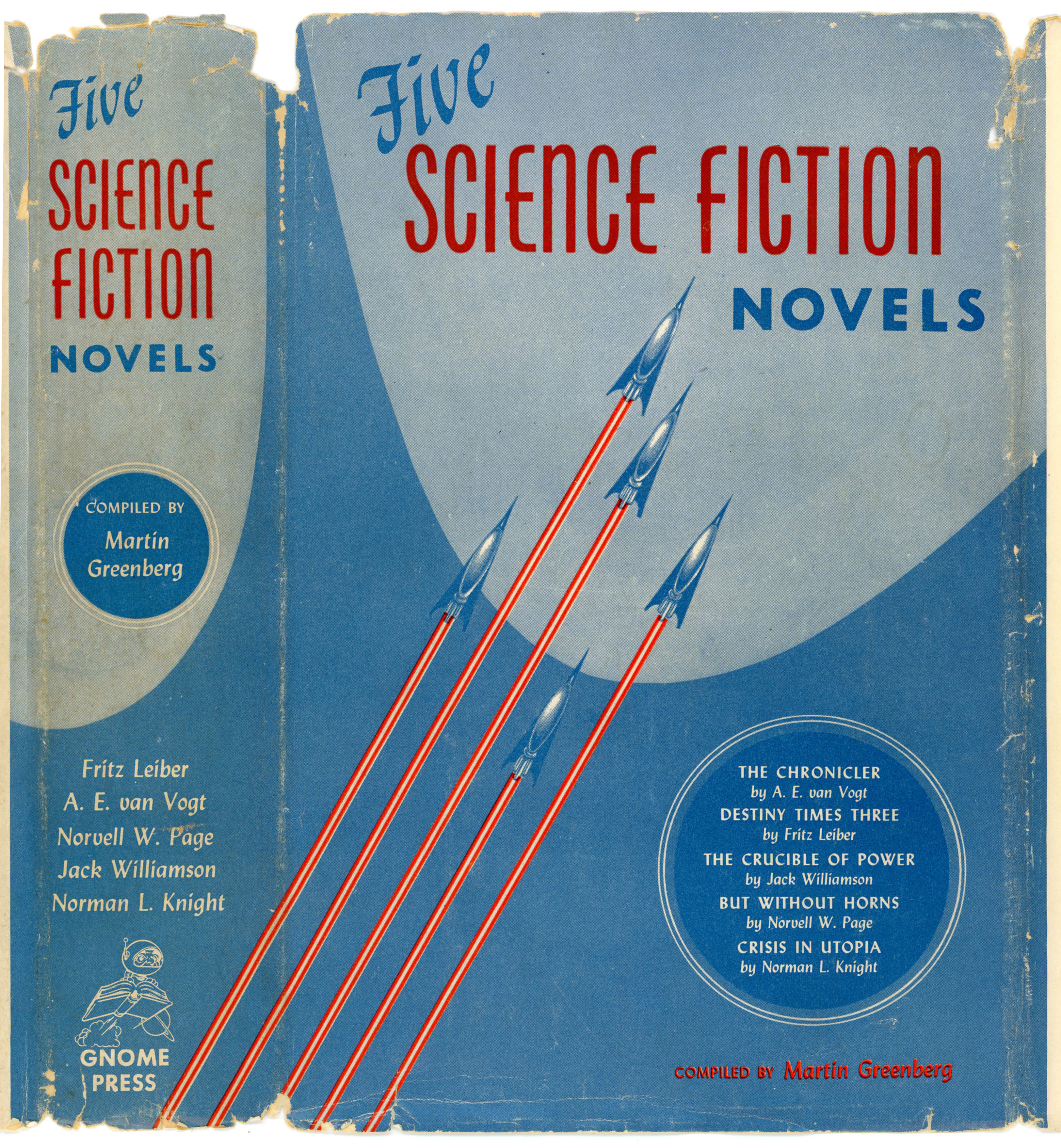
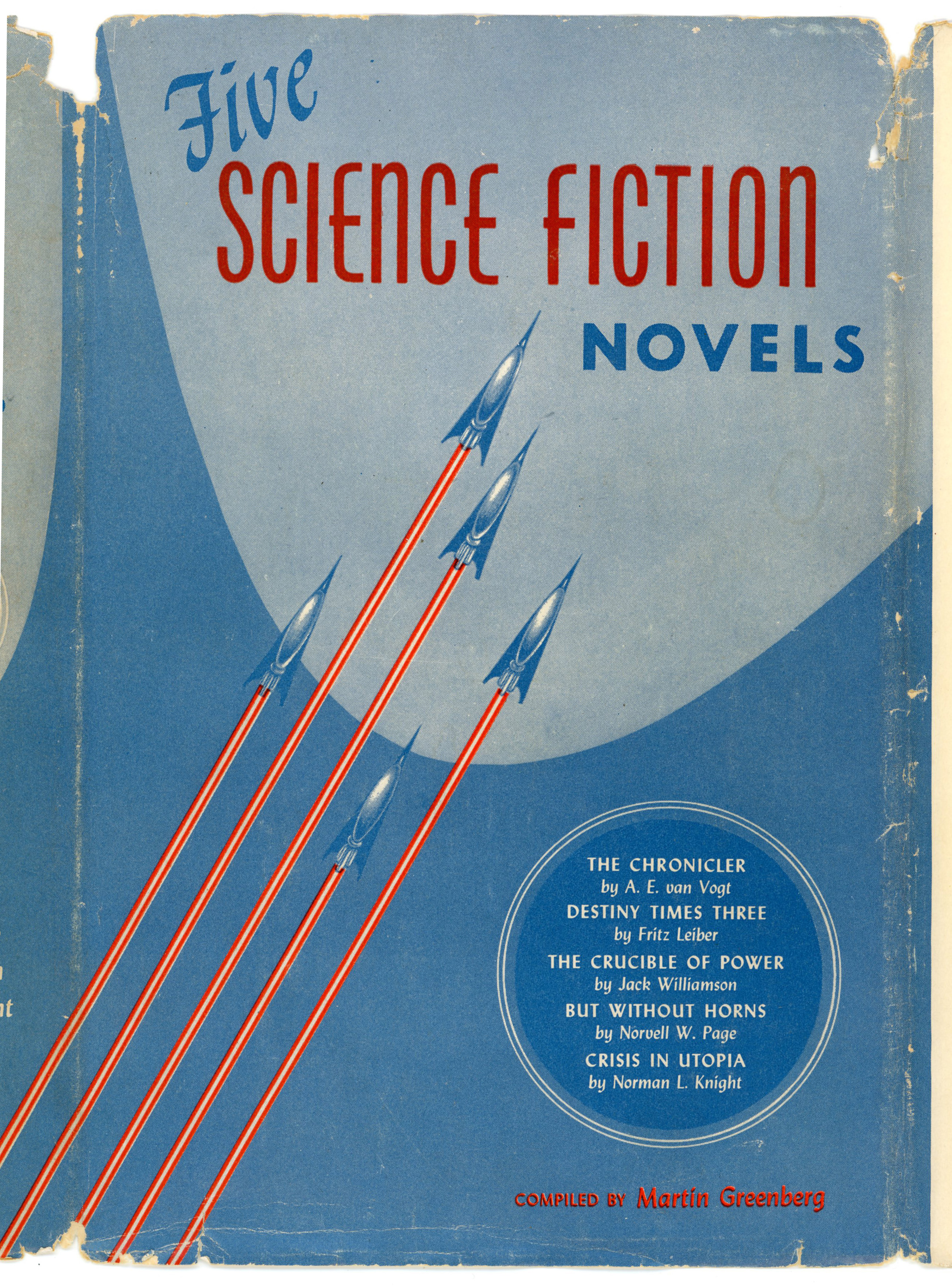
Case in point, Martin Greenberg’s 1952 anthology Five Science Fiction Novels, one of the 86 titles published by Gnome Press between 1948 and 1961, which I had the good fortune of discovering at a used bookstore just a few years ago.  Alas, the cover of my copy is flaky, fragged, and frayed around the edges.  But, Frank Kelly Freas’ simple yet effective cover design, featuring five rockets in formation, is still quite intact. 

Here’s a closer view…

______________________________

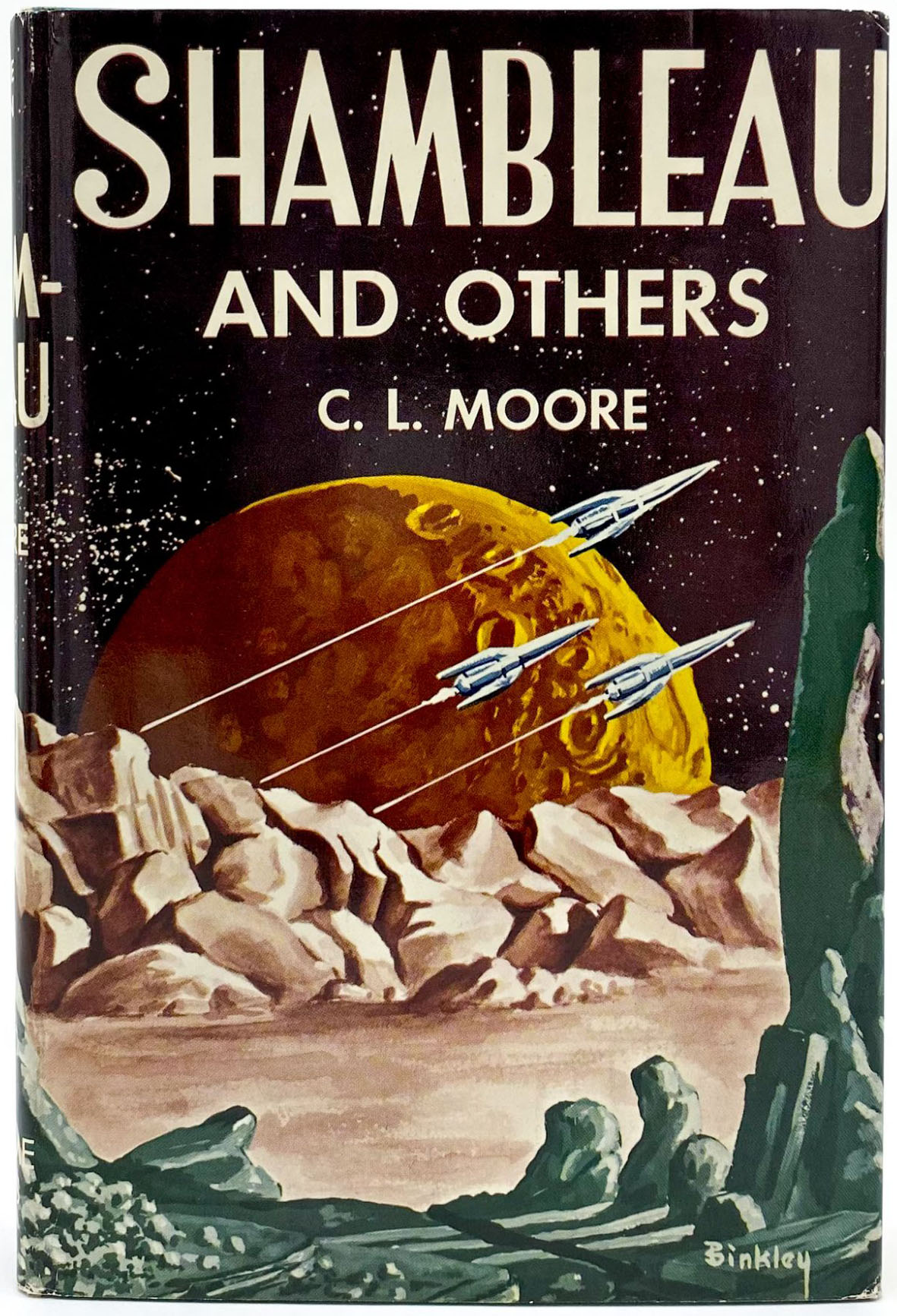
The same motif – perhaps inspired by images of fleets of Army Air Force Flying Fortress and Liberator bombers during the Second World War – is not difficult to find as an element of other illustrations, such as Ric Binkley’s composition for C.L. Moore’s 1953 Shambleau and Others, also published by Gnome Press. 

XXXXX ______________________________

The book is comprised of five stories, all published from the late 1930s through the mid-1940s; four drawn from Astounding, and another from Astounding’s sister publication, Unknown.  They are:

But Without Horns“, by Norvell W. Page, from Unknown Fantasy Fiction, June, 1940

Destiny Times Three“, by Fritz Leiber, Jr., from Astounding Science Fiction, March, 1945 (Later published as Galaxy Science Fiction Novel #28)

Crisis in Utopia“, by Norman L. Knight, from Astounding Science Fiction, July, 1940

The Chronicler“, by A.E. van Vogt (variant of “Siege of the Unseen”), from Astounding Science Fiction, October and November, 1946

The Crucible of Power“, by Jack Williamson, from Astounding Science Fiction, February, 1939

Having read all five stories, by far the best – in terms of literary quality and originality – is Fritz Leiber’s “Destiny Times Three”.  This is a truly wonderful tale of the intersection between and origin of parallel universes, and, the dramatic and not necessarily benign (!) interaction between not-so-identical versions of the same protagonist from these universes.  The other four stories are not at all mediocre; not at all bad; not at all lacking … by any means, but they’re much more straightforward in concept, and don’t manifest the same level of “What-happens-next-ness?”, as Leiber’s story.    

______________________________

The book’s rear cover features a list of contemporary Gnome Press titles, all selling for between $2.50 and $3.95.  (“Alas!… A time machine, a time machine, my book collecting kingdom for a time machine!”)

Here are contemporary – August, 2022, that is! – prices for a few of these books, via ABE Books:

Cosmic Engineers: $100 to $225
The Fairy Chessmen and Tomorrow and Tomorrow: $250
Foundation: $4,500
I, Robot: $15,000
Renaissance: $45 to $100
The Sword of Conan: $110 to $850

And, the rear cover bears Gnome Press’s book-propelled-astronaut emblem, designed by Edd Cartier.  You can view a more elaborate version of this little fellow below…

For Your Further Distraction!…

Five Science Fiction Novels, at…

GoodReads

The Great Gnome Press Science Fiction Odyssey

John W. Knott, Jr., Bookseller

Martin Greenberg, at…

… Internet Speculative Fiction Database

The Encyclopedia of Science Fiction

… Wikipedia

David A. Kyle, at…

… Internet Speculative Fiction Database

… Wikipedia

Gnome Press, at…

Classics of Science Fiction (“Remembering Fantasy Press, Arkham House, Prime Press, Gnome Press, Shasta Publishers, and Others“)

Kirkus Reviews (“The Meteoric Rise and Fall of Gnome Press“)

GnomePressMe (“For Gnome Press Collectors“)

Flying Cards and Food Pills (“Gnome Press“)

Hydraxia Books (“A Complete Collection of Gnome Press Publications“)

… Wikipedia

“The Chronicler”, by A.E. van Vogt, at…

MPorcius Fiction log

Roger Russell

“Destiny Times Three”, by Fritz Leiber, at…

Wikipedia (not much!)

Archive.org

“The Crucible of Power”, by Jack Williamson, at…

GoodReads

“But Without Horns,” by Norvell W. Page, at…

GoodReads

ThePulp.Net

“Crisis in Utopia”, by Norman L. Knight, at…

Vacation in the Golden Age

Astounding Science Fiction – October, 1953 (Featuring “The Gulf Between”, by Tom Godwin) [Frank Kelly Freas] [Updated post… [Yet further updated…]]

[Update – December 26, 2020: My search for additional sightings of Frank the Robot has been successful.  I’m happy to report that he’s been captured on video on many occasions, and entirely un-UFO-like, his identity has been definitively verified by amateur and professional observers from locales the world over.  It turns out that he’s not at all reticent about public appearances, seeming to quietly revel in and appreciate public recognition.  True, he doesn’t say much.  (Actually, he doesn’t say anything at all.)  After all, if you’re a metallic man several stories tall, your presence alone speaks for itself.

I’ve also included numerous links about Frank’s creator, Frank Kelly Freas.  Oh, yes…  Note Frank’s resemblance to the robot in Freas’ black & white illustration for Tom Godwin’s story “The Gulf Between”.  A distant relative?

So, to view a better Frank sighting, scroll down a little – just below Stewie Griffin – and enjoy.]

________________________________________

“What the hell is that, a killer robot monster?!”

Frank Kelly Freas’ art gets around, in ways quite unexpected: 

I recently discovered that the plaintive, puppy-dog-eyed, giant robot featured on the cover of the October 1953 issue of Astounding Science Fiction – the inspiration for the cover art of Queen’s 1997 album “News of the World” – was encountered in the latter form by none other than Family Guy’s Stewie Griffin, in the series’ 2012 episode “Killer Queen”.  As you can see in the clip below (original here), Stewie’s introduction to the un-named metal monstrosity – courtesy of Brian Griffin – is a meeting quite memorable.

________________________________________

A MACHINE DOES NOT CARE

“You wanted obedience Cullin – now you have it.
You climbed a long way up by forcing human beings to behave like machines.
But you were wrong in one respect;
no human can ever be forced to behave exactly like a machine,
and no machine can ever be constructed that
will behave exactly like a human.
Machines are the servants of humans, not their equals.
There will always be a gulf between Flesh and Steel.
Read those five words on the panel before you and you will understand.

– – – – – – – – – – – – – – – – – – – – – – – – – – – – – –

It was a good ship,
built to travel almost forever,
and it hurled itself on through the galaxy
at full acceleration;
on and on until the galaxy was a great pinwheel of white fire behind it
and there was nothing before it.

On and on,
faster and faster,
into the black void of Nothing;
without reason or purpose
while a dark-eyed robot stared at a skeleton
that was grinning mirthlessly at a five-word sentence:

A MACHINE DOES NOT CARE
(Tom Godwin, “The Gulf Between”, p. 56)
________________________________________

“God, why does he look sad?!  He’s already destroyed mankind; what else could he want?!”

“I’ll tell you what the news of the world is, we’re in a lot of #@%$*! trouble!”

______________________________

From the YouTube channel of TroyDouglas917, here’s Frank’s opening for Queen + Adam Lambert’s  November 25, 2017, show at 3Arena in Dublin, with great views of Adam Lambert and Brian May.

______________________________

Illustration by Frank Kelly Freas, for Tom Godwin’s story “The Gulf Between” (p. 35).

______________________________

Illustration by Richard Van Dongen, for James H. White’s story “The Scavengers” (p. 121).

______________________________

Illustration by Richard Van Dongen, for James H. White’s story “The Scavengers” (p. 136).

References

Killer Queen, at Internet Movie Database

Adam Lambert – Official Website

Adam Lambert – Wikipedia

Brian May – Official Website

Brian May – Wikipedia

Queen – Official Website

Queen – Wikipedia

Queen + Adam Lambert – Wikipedia

Frank Kelly Freas

Official Website

Wikipedia

SFE – The Encyclopedia of Science Fiction

FindAGrave

JVJ Publishing (Illustrators)

Field Guide to Wild American Pulp Artists

Internet Speculative Fiction Database

GoodReads

Galaxy Press

Wikimedia Commons (Cover Art) – 47 images

Comic Art Fans – some classic, “clickable” (relatively) full-size cover art

Dangerous Minds

invaluable – The World’s Premier Auctions and Galleries – original art for sale

Mad Magazine Covers by Frank Kelly Freas – Doug Gilford’s Mad Magazine Cover Site

1/28/17 – 9/7/20 — 3/23/18 1735

The Third of Freas: Weird Tales, January, 1953 – Featuring “Once There Was a Little Girl”, by Everil Worrell [Frank Kelly Freas]

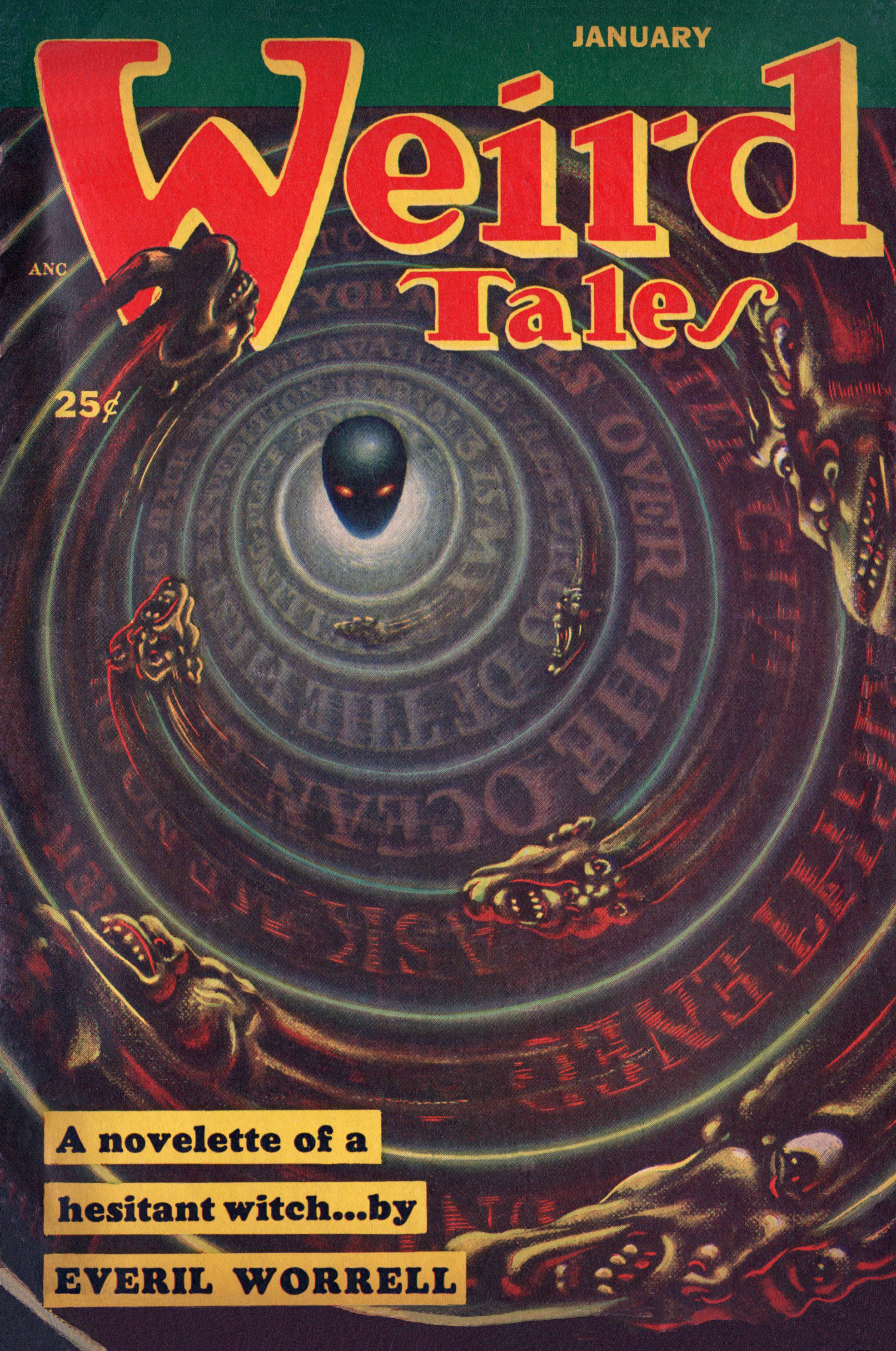
After creating cover illustrations for the November, 1950, and November, 1951 issues of Weird Tales, Freas’ next cover art appeared in the magazine’s issue of January, 1953.

Very different from his prior covers – neither satyr nor space-imps, this time! – Freas painted a cryptic message within an ornamented spiral filled with floating, demon-like faces. 

Not as powerful as the prior two covers, but still inventive.    

Follower by Joseph Eberle’s two-page interior illustration for Everil Worrell’s “Once there was a Little Girl”…

“In other days it was said, “Thou Shalt Not Suffer a Witch to Live!”

(Art by Joseph Eberle)

______________________________

References, Reading, and More, Concerning Frank Kelly Freas

Official Website

Wikipedia

SFE – The Encyclopedia of Science Fiction

FindAGrave

JVJ Publishing (Illustrators)

Field Guide to Wild American Pulp Artists

Internet Speculative Fiction Database

GoodReads

Galaxy Press

Wikimedia Commons (Cover Art) – 47 images

Comic Art Fans – some classic, “clickable” (relatively) full-size cover art

Dangerous Minds

invaluable – The World’s Premier Auctions and Galleries – original art for sale

Mad Magazine Covers by Frank Kelly Freas – Doug Gilford’s Mad Magazine Cover Site

The Second of Freas: Weird Tales, November, 1951 – Featuring “Hideaway”, by Everil Worrell [Frank Kelly Freas]

Following my prior post about Frank Kelly Freas “First” cover art, here – again based on information for Freas at the Internet Speculative Fiction Database – is his second cover:  For the November, 1951, issue of Weird Tales

Unlike his first effort, his second cover has a distinct science-fictiony – as opposed to fantasy – setting: Four antenna-ed aliens, two male and two female (ahh, how refreshingly heteronormative!), frolic in space before four cratered worlds.  Like Freas’ work for the November, 1950 issue, the cover probably has no relation to any of the stories actually in the magazine, simply catching the eye of a prospective buyer, and, setting up a mood.

(Like Freas’ first effort, this painting, too, seems reminiscent of the style of Hannes Bok.  If I didn’t know that Freas actually did this composition to being with, I would’ve assumed that the painting was created by Bok!)

Below, John Artstrom’s interior illustration for Everil Worrell’s “Hideaway”…

“…where even today the common people believe in vampires and werewolves, in wizards and witches.”

(Art by John Artstrom)

______________________________

References, Reading, and More, Concerning Frank Kelly Freas

Official Website

Wikipedia

SFE – The Encyclopedia of Science Fiction

FindAGrave

JVJ Publishing (Illustrators)

Field Guide to Wild American Pulp Artists

Internet Speculative Fiction Database

GoodReads

Galaxy Press

Wikimedia Commons (Cover Art) – 47 images

Comic Art Fans – some classic, “clickable” (relatively) full-size cover art

Dangerous Minds

invaluable – The World’s Premier Auctions and Galleries – original art for sale

Mad Magazine Covers by Frank Kelly Freas – Doug Gilford’s Mad Magazine Cover Site

The First of Freas: Weird Tales, November, 1950 – Featuring “The Third Shadow”, by H. Russell Wakefield [Frank Kelly Freas]

The prominence and significance of Frank Kelly Freas’ art is well-known, with general awareness of his work – in terms of pop-culture recognition of his most significant creations – certainly extending well beyond the realm of devotees of science fiction, science, fantasy, and humor.

Having featured his art in many prior posts, I thought it’d be worthwhile to present his first efforts at cover art.  Identification of these was straightforward, the Wikipedia entry for Freas stating:  “The fantasy magazine Weird Tales published the first cover art by Freas on its November 1950 issue: “The Piper” illustrating “The Third Shadow” by H. Russell Wakefield. His second was a year later in the same magazine…,” this information presumably based on the biographical profile of Freas at the Internet Speculative Fiction Database.

And so, his first cover:

It shows an image of a satyr (Pan?) conjuring translucent red things (bubbles? globules? spirits?) from the earth, appears below.  Even in this first work you can see an aspect an artistic technique which Freas developed and used to great effect in many of his compositions: The use of bright and dark shades of a single color to denote depth, texture, and “punch” to his characters.  As for the irregular grayish skyline in front of the huge moon, at first I thought (!) it was a silhouette of a city, for it does have a certain “Manhattan-skyline-viewed-from-within-Central-Park-ish” appearance. 

But, that’s probably just a coincidence, for the gray whatever-it-is simply and effectively adds depth to the scene.

(Curiously, the style painting is reminiscent of the work of Hannes Bok.)

And, here’s Lee B. Coye’s interior illustration for H. Russell Wakefield’s “The Third Shadow”…

“…a certain oppressive sense of malignity.”

(Art by Lee Brown Coye)

______________________________

References, Reading, and More, Concerning Frank Kelly Freas

Official Website

Wikipedia

SFE – The Encyclopedia of Science Fiction

FindAGrave

JVJ Publishing (Illustrators)

Field Guide to Wild American Pulp Artists

Internet Speculative Fiction Database

GoodReads

Galaxy Press

Wikimedia Commons (Cover Art) – 47 images

Comic Art Fans – some classic, “clickable” (relatively) full-size cover art

Dangerous Minds

invaluable – The World’s Premier Auctions and Galleries – original art for sale

Mad Magazine Covers by Frank Kelly Freas – Doug Gilford’s Mad Magazine Cover Site

Ender’s First Game: Analog Science Fiction – Science Fact, August, 1977 (Featuring “Cold Cash War”, by Robert Lynn Asprin) … and, including “Ender’s Game”, by Orson Scott Card [Frank Kelly Freas]  [[Updated Post]]

The cultural impact of literature of most any genre – in terms of cultural impact and (maybe / maybe not) the financial and other rewards that may eventually accrue to its creator – is by nature unpredictable, and has ever been so. 

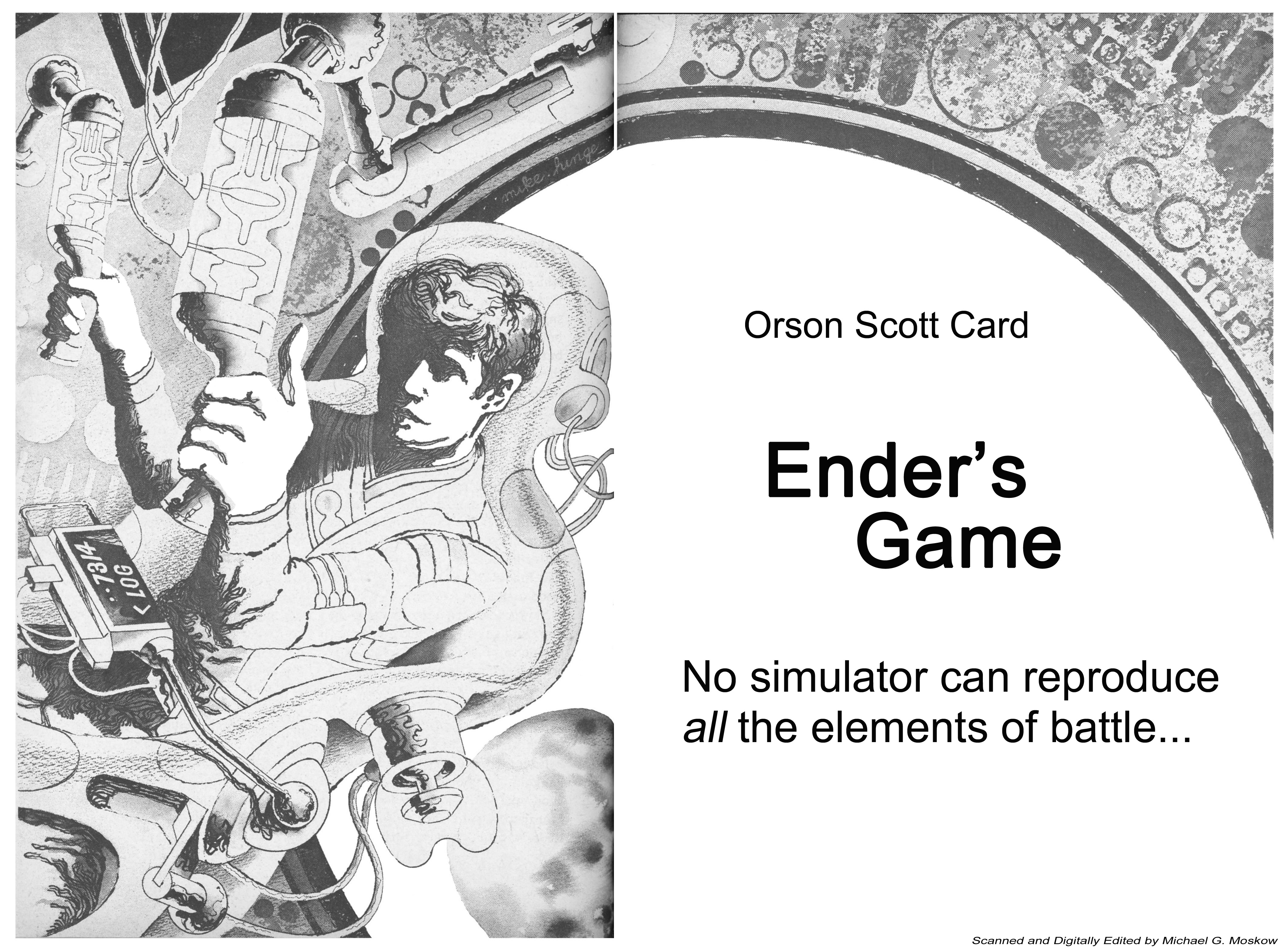
Case in point, Orson Scott Card’s “Ender’s Game, which first appeared in novelette form forty-three years ago, in the August, 1977 issue of Analog Science Fiction – Science Fact.  It’s notable that the story, given the books and film that have grown from the original tale, actually appears “deep” within the issue, on pages 100 through 134, and was not the subject for magazine’s cover art, which – by Frank Kelly Freas – pertains to Robert Asprin’s “Cold Cash War”, which appears towards the beginning of the issue.

Though the great majority of my posts pertaining to art and illustration in science-fiction pulps hark to pulps from the 40s and 50s, I thought it would be interesting to present one of Mike Hinge’s two illustrations that accompany “Ender’s Game”, which – as you can see – is a depiction of Ender himself.  Alas, Hinge’s “lead” illustration – not presented here – is very bland in comparison.  (Oh well.)

While I think that book cover and interior illustrations from science fiction of the 60s, let alone the 70s and 80s, is nowhere near as striking, symbolically powerful, or well crafted as that from earlier decades, some of this work is still significant in its own way, and quite worthy of recognition and viewing.

You can view many examples of Mike Hinge’s work at Ivan Richards’ Onyx Cube blog, which show the breadth and scope of his skill, ranging from direct and beautiful technical depictions of the Space Shuttle, circa 1985 (great presentations of the craft’s cockpit…!) to illustrations for advertisements, to record covers (Elleorde), to – even – more.  An Americanophile from Auckland, New Zealand, he was born in 1931, and passed away in 2003.   

You can also view another example of his art – a stunning illustration for the cover of the November, 1971 issue of Amazing Storieshere. 

Reference

Mike Hinge, obituary from The Dominion Post (Wellington, New Zealand) at OnyxCube