Mockingbird, by Walter S. Tevis – April, 1981 (1980) [Unknown Artist]

“When the drugs and the television were perfected by the computers that made and distributed them, the cars were no longer necessary. 
And since no one had devised a way of making cars safe in the hands of a human driver,
it was decided to discontinue them.”

“Who made that decision?” I said.

“I did.  Solange and I. 
It was the last time I saw him. 
He threw himself off of a building.”

“Jesus,” I said. 
“And then, “When I was a little girl there were no cars. 
But Simon could remember them. 
So that was when thought buses were invented?”

“No.  Thought-buses had been around since the twenty-second century. 
In fact there had been buses, driven by human drivers in the twentieth. 
And trolley cars and trains. 
Most big cities in North America had what were called streetcars at the start of the twentieth century.”

“What happened to them?”

“The automobile companies got rid of them. 
Bribes were paid to city managers to tear up the streetcar tracks,
and advertisements were bought in newspapers to convince the public that it should be done. 
So more cars could be sold, and more oil would be made into gasoline, to be burned in the cars. 
So that corporations could grow,
and so a few people could become incredibly rich,
and have servants, and live in mansions. 
It changed the life of mankind more radically than the printing press. 
It created suburbs and a hundred other dependencies –
sexual and economic and narcotic –
upon the automobile. 
And the automobile prepared the wat for the more profound –
more inward –
dependencies upon television and then robots and, finally,
the ultimate and predictable conclusion of all of it:
the perfection of the chemistry of the mind. 
The drugs your fellow humans use are named after twentieth-century ones;
but they are far more potent,
far better at what they do,
and they are all made and distributed –
distributed everywhere there are human beings – by automatic equipment.” 
He looked over at me from his armchair. 
“It all began, I suppose, with learning to build fires –
to warm the cave and keep the predators out. 
And it ended with time-release Valium.”
I looked at him for a minute. 
“I don’t take Valium,” I said.  (176-177)

Rendezvous With Rama, by Arthur C. Clarke – September, 1974 [Vincent di Fate – ?]

Though not as well known as the novel 2001: A Space Odyssey, which in 1968 was released in parallel with Stanley Kubrick’s groundbreaking film of the same name, Arthur C. Clarke’s 1973 Rendezvous With Rama is still based upon a basic theme of the former: Humanity’s first encounter with an extraterrestrial civilization.  However, Rendezous is vastly simpler in terms of plot and “story-line”, lying much more in the realm of straightforward exploration and purely descriptive “hard” science fiction than 2001.  Nevertheless, the product of Clarke’s literary skill and imagination was (and is) an engrossing, fast-paced, fascinating story, albeit a tale without a definitive conclusion or transformation – whether physical or psychological – of its central characters.

Ballantine Books followed an interesting route for the design of the 1974 (September publication; the hardcover edition was published in 1973) paperback edition of Rama.  Rather than using rectangular / vertical format cover art, so typical of and natural to the typical book, Rama’s cover (bearing the author’s name, book title, and reference to Clarke’s earlier works) features a circular “window” showing a glimpse of the interior of Rama (the alien spacecraft, not the book!). 

Upon opening the cover, the not-so-cover art visible through the circular “window” is revealed to be part of a square-format foldout showing Rama’s interior.

Here’s the book’s cover…*

….and, here’s the book’s interior art, fully opened.  Note the figures of the three astronauts in the left foregound.  Based on the image’s perspective and the scale of features in the scene, the figures seem vastly too large, but, they do impart a sense of wonder.

Unfortunately, neither the book’s title page nor the art itself present the artist’s name.  (Why – ? – ! – ?)  However – – – based on the painting’s combination of technology and human figures, and visually literal (rather than abstract / stylistic, such as the works of John Schoenherr or Jack Gaughan) rendering of the scene, it seems – that the painting was created by Vincent Di Fate.

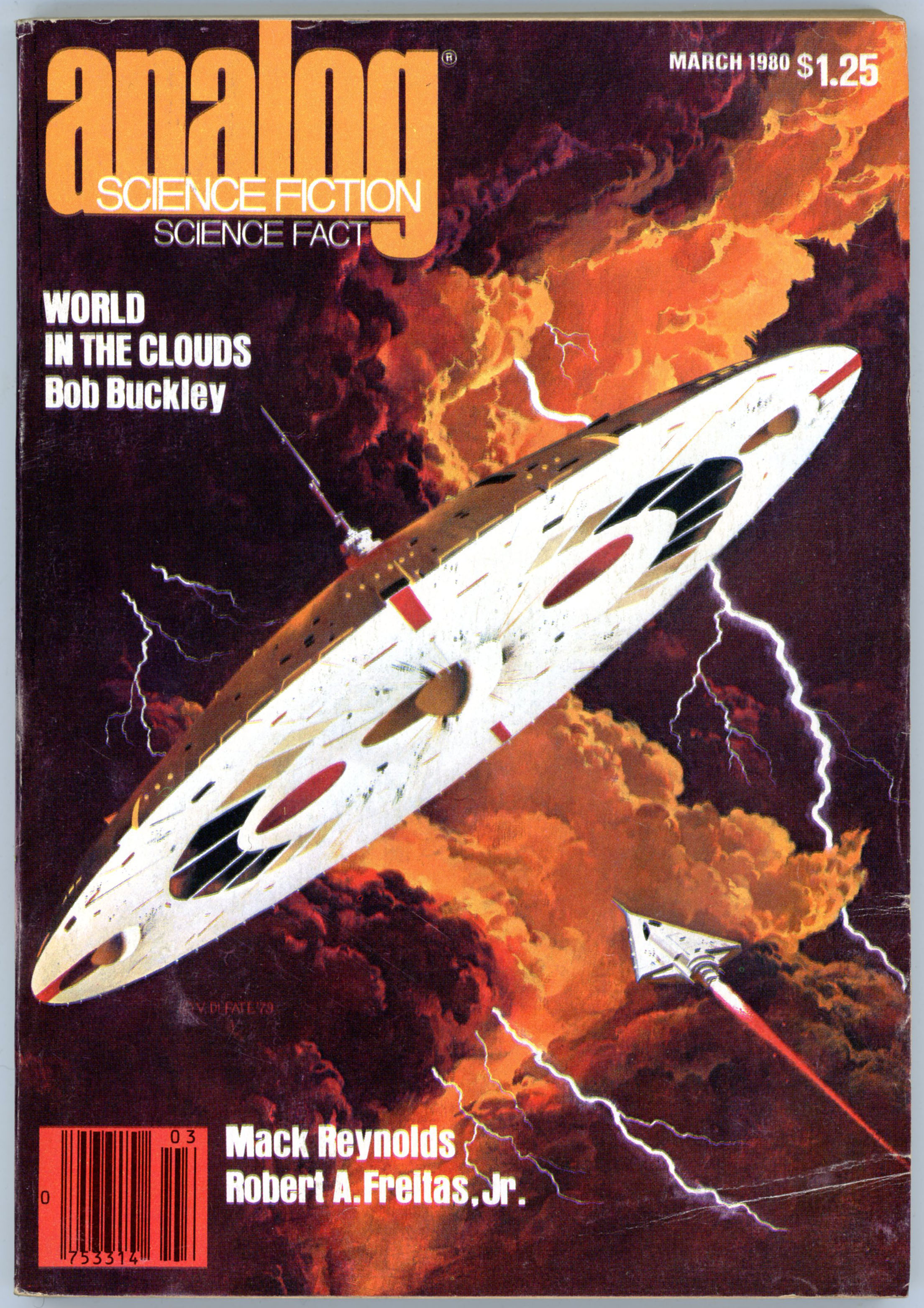
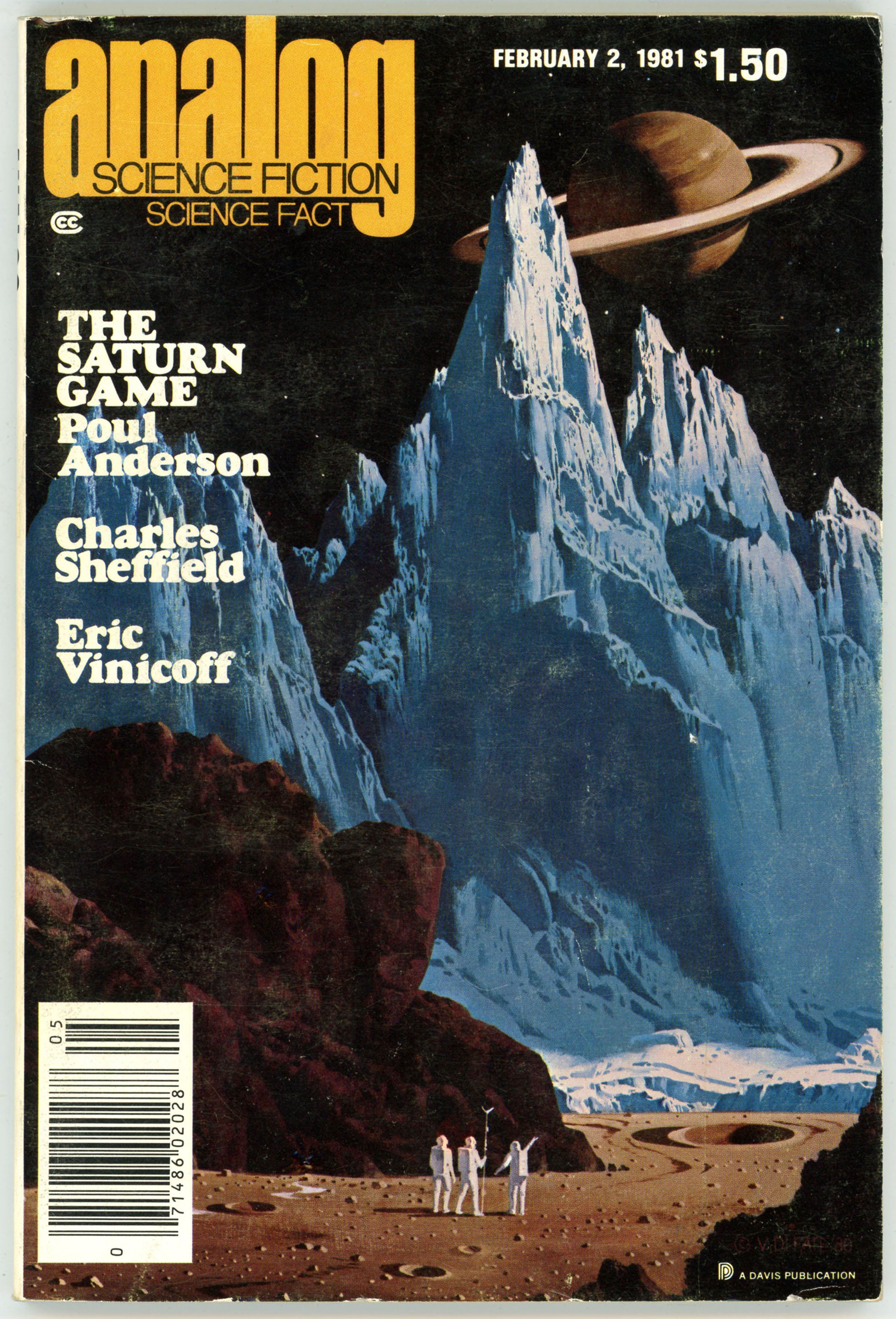
If so (I think so…) as evidence, here are two DiFate covers from Analog Science Fiction – Science Fact, the first from March of 1980 and the second from February of 1981, that have the same general style as the cover of Rama.

Analog Science Fiction – Science Fact, March, 1980

“Worlds in the Clouds”, by Bob Buckley

________________________________________

Analog Science Fiction – Science Fact, February, 1981

“The Saturn Game”, by Poul Anderson

I hope to rendezvous with the works of other science-fiction artists in future posts…

Reference

Rendezvous with Rama (Ballantine Books catalog number 25288), at Internet Speculative Fiction Database

* I’m using “this” image, found via Duck-Duck-Go, instead of my personal copy of the book, because my copy has become rather – ? – ragged around the edges (and beyond!) – over the past 45 years!