Featuring Finlay Further: A New Photo of Virgil W. Finlay

The marvelous illustrations of Virgil Finlay appear in many of my posts, while these two posts – Virgil Finlay – Dean of Science Fiction Artists, and, Further to Finlay, explore his life and work from a biographical slant.  The image below is a small addition to the latter theme.

A photo of Virgil Finlay, his mother, and sister, I don’t think (hmmm…) that it’s thus far appeared on the Internet.  I discovered it while perusing science fiction magazines and publications from a variety of other (offbeat!) genres, at the Luminist Archive.  The photo appears in the 1974 edition (was it the only one?) of Gerry de la Ree’s Fantasy Collectors Annual

Nothing all that fantastic about the image, but it does serve to show Virgil Finlay as a man like all men: simply as a person. 

The caption appears below. 

“FINLAY FAMILY PORTRAIT – Virgil Finlay, his mother, Ruby Cole Finlay, left; and his younger sister, Jean, posed for this picture outside their Rochester, N.Y., home in the 1930s about the time the young artist was breaking into the professional field as an illustrator for Weird Tales.  This picture was presented to Gerry de la Ree in 1970 and is previously unpublished.”
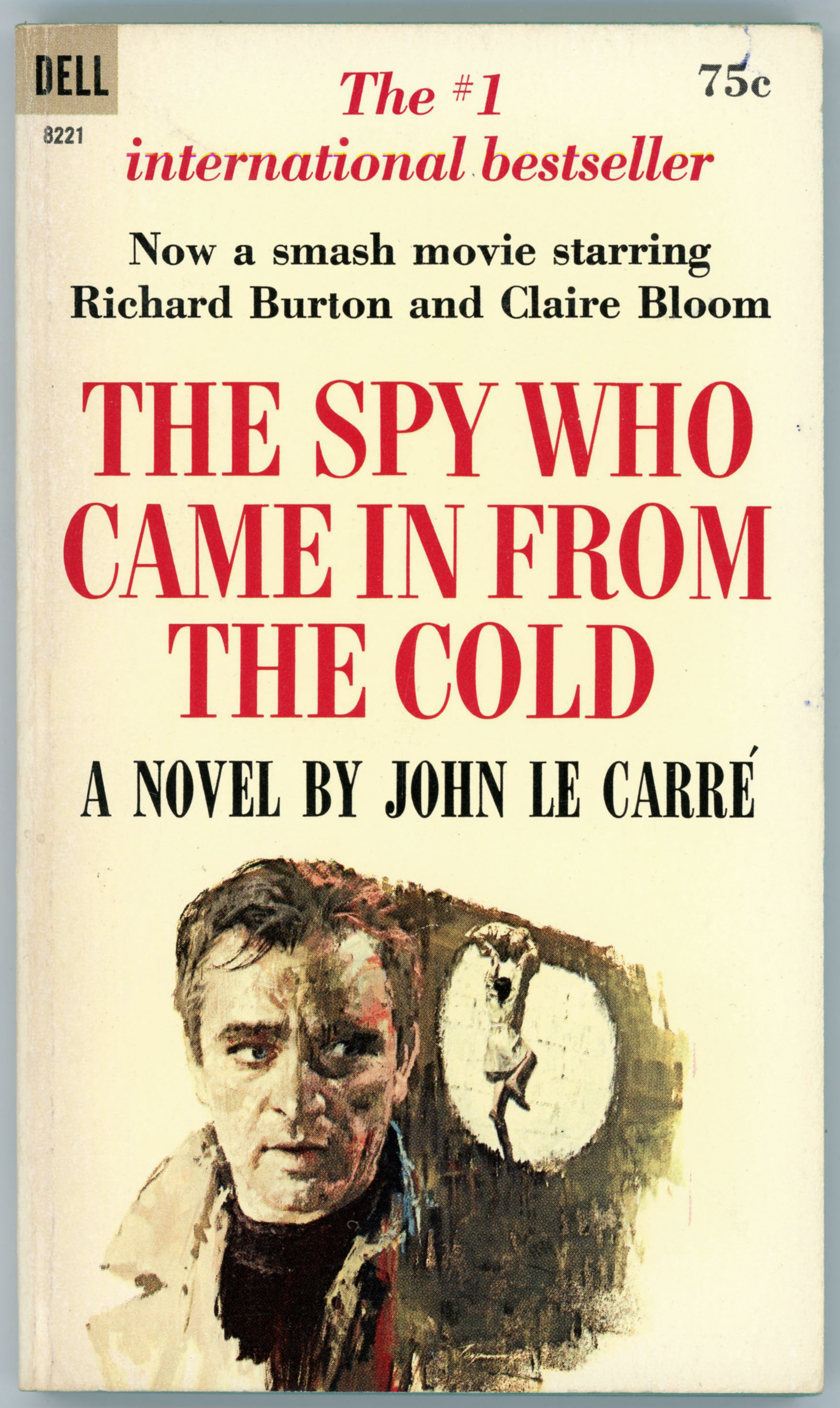
The Spy Who Came in From the Cold, by John le Carré – 1965 (1963) [Howard Terpning]

While not the most compelling cover illustration – it didn’t have to be, given the success of the novel! – artist Howard Terpning’s cover art for Dell’s 1965 edition of John le Carré’s The Spy Who Came in From the Cold includes a straightforward representation of actor Richard Burton, the book probably having been released during the same time frame as Paramount’s 1965 film by the same name.  

Searching hi, low, and every-virtual-where for the movie yields only one result: A Spanish-subtitled, low resolution version, which can be found at Archive.org.

Ashe was typical of that strata of mankind
which conducts its human relationships according to a principle of challenge and response.
Where there was softness, he would advance;
where he found resistance, retreat.
Having himself no particular opinions or tastes,
he relied upon whatever conformed with those of his companion.
He was as ready to drink tea at Fortnum’s as beer at the Prospect of Whitby;
he would listen to military music in St. James’s Park or jazz in a Compton Street cellar;
his voice would tremble with sympathy when he spoke of Sharpeville,
or with indignation at the growth of Britain’s colonial population.
To Leamas this observably passive role was repellent;
it brought out the bully in him,
so that he would lead the other gently into a position where he was committed,
and then himself withdraw,
so that Alex was constantly scampering back from some cul-de-sac into which Leamas had enticed him. There were moments that afternoon when Leamas was so brazenly perverse
that Ashe would have been justified in terminating their conversation –
especially since he was paying; but he did not.
The little sad man with spectacles who sat alone at the neighboring table,
deep in a book on the manufacture of ball bearings,
might have deduced, had he been listening, that Leamas was indulging a sadistic nature –
or perhaps (if he had been a man of particular subtlety)
that Leamas was proving to his own satisfaction
that only a man with a strong ulterior motive would put up with that kind of treatment.