Like A Treasury of Science Fiction, The Other Side of the Moon, and Worlds of Tomorrow, Berkley Book’s 1956 Science Fiction Omnibus is a diminutive paperback derived from an earlier hardback of the same – in this case, similar – name.
And, it similarly features distinctive cover art by Richard Powers.
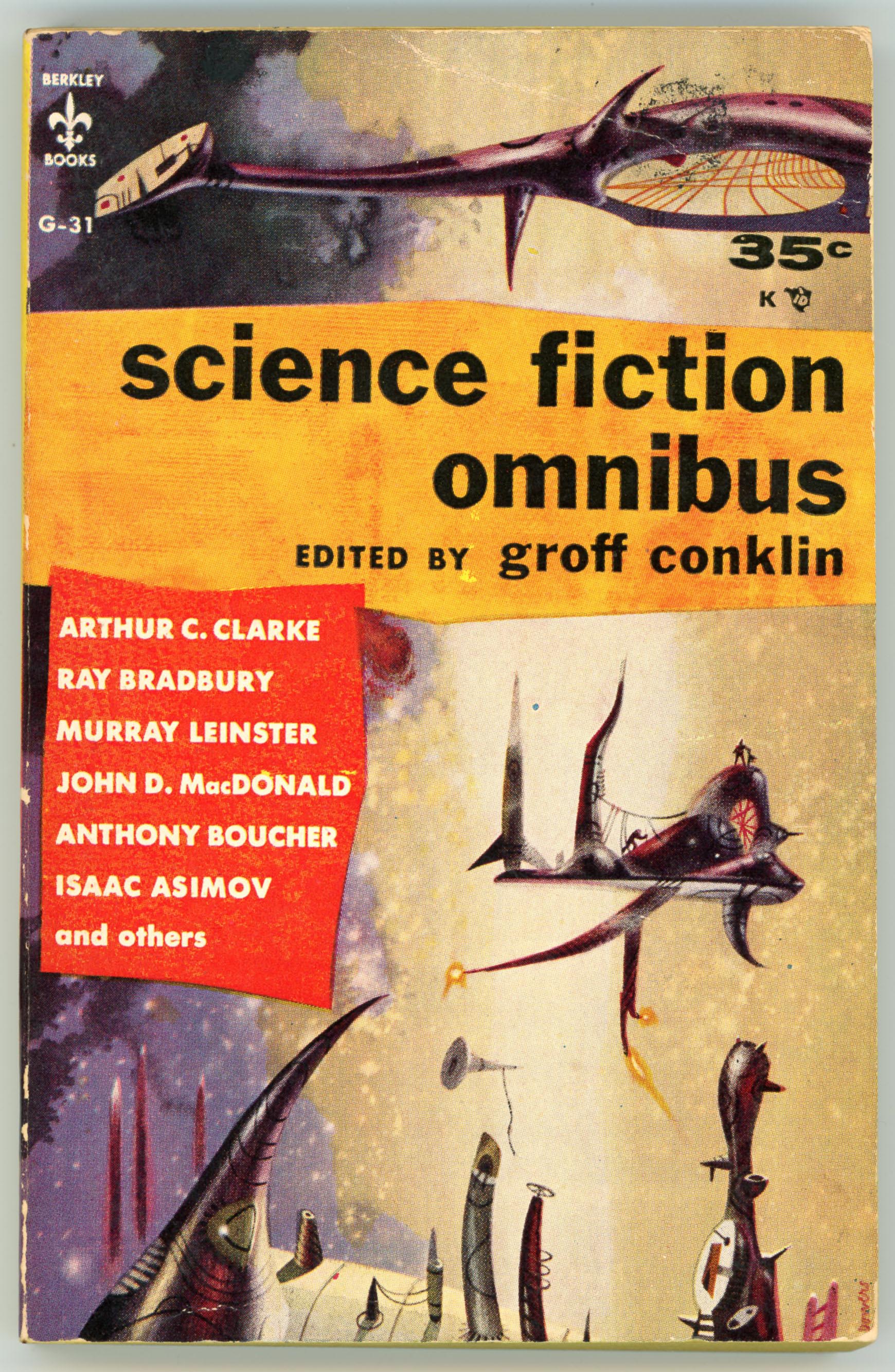
In this case, make that v e r y distinctive, because of these four books, the cover of the Omnibus – while not as boldly colorful as that of the Treasury – distinctly presents objects (for lack of a better word!) that make the covert art immediately recognizable as a Powers composition. Like the scene shown below: It shows an asymmetrical, weirdly bulging platform or space station, with flames sprouting from three odd rockets at the bottom. It’s got a metallic sort of color. And, like the floating thingy at the top of the page, it’s got a trapeze of wires attached to it.
Other, similar, weirdly elongated, uneven, indefinable things with a metallic sheen are present elsewhere in the painting. But, there’s no explanation as to what they are. They just float through space, asking for your own explanation.
And, there’s a final emblematic touch: The only things that are clearly recognizable from “our” world are as diminutive as they are innocuous. First, a tiny rocket stands on the floating platform. Second, two human figures are nearby, but they’re so tiny as to be near-invisible. Here, like in some of his other 50s paintings, Powers makes man negligible in the face of the unknown.
Take a look:
____________________

____________________
Otherwise, like the other Berkley anthologies, the Omnibus contains a limited number – eleven of forty-three – of the stories in the (originally titled) Omnibus of Science Fiction.
For the sake of completeness, here’s the rear cover. Notice that the endorsements are from newspapers, rather than science-fiction or fantasy magazines? I guess the idea is that praise from mainstream publications would have more cachet for a general audience than from pulp magazines.
Of the stories in this volume, I’ve only read (or at least, I remember having read!) “A Subway Named Mobius” and “Kaleidescope”, while I’ve listened to two or three radio dramatizations of “The Color Out of Space”. The first of the three is a well-written, entertaining, and light-but-not-necessarily-too-impactful tale typical of Astounding’s early 1950s content. The second inspired the closing scene of Dan O’Bannon’s 1974 Dark Star, specifically here:
As for “The Color Out of Space”, well, what can one say? Like much (all?) of Lovecraft’s work, crafting personalities and engaging in character development is largely irrelevant to Lovecraft’s purpose in creating mood and atmosphere; dread and wonder, in which the story, like “At The Mountains of Madness” (and so many other Lovecraft tales) is entirely successful.

What’s in the book?
“A Subway Named Mobius“, by A.J. Deutsch (from Astounding Science Fiction, December, 1950)
“The Color Out of Space”, by H.P. Lovecraft (from Best Supernatural Stories of H. P. Lovecraft, April, 1945; originally published in Amazing Stories, September, 1927)
“The Star Dummy”, by Anthony Boucher (from Fantastic, Fall, 1952)
“Homo Sol”, by Isaac Asimov (from Astounding Science Fiction, September, 1940
“Kaleidoscope“, by Rat Bradbury (from Thrilling Wonder Stories, October, 1949)
“Plague”, by Murray Leinster (from Astounding Science Fiction, February, 1944)
“Test Piece”, by Eric Frank Russell (from Other Worlds Science Stories, March, 1951)
“Spectator Sport”, by John D. MacDonald (from Thrilling Wonder Stories, February, 1950)
“The Weapon”, by Frederic Brown (from Astounding Science Fiction, April, 1951)
“History Lesson”, by Arthur C. Clarke (from Startling Stories, May, 1949)
“Instinct”, by Lester del Rey (from Astounding Science Fiction, January, 1952)
A reference or two…
Science Fiction Omnibus (August, 1956), at…
… Internet Speculative Fiction Database
Omnibus of Science Fiction (1952), at…
… Internet Speculative Fiction Database
Groff Conklin, at…

