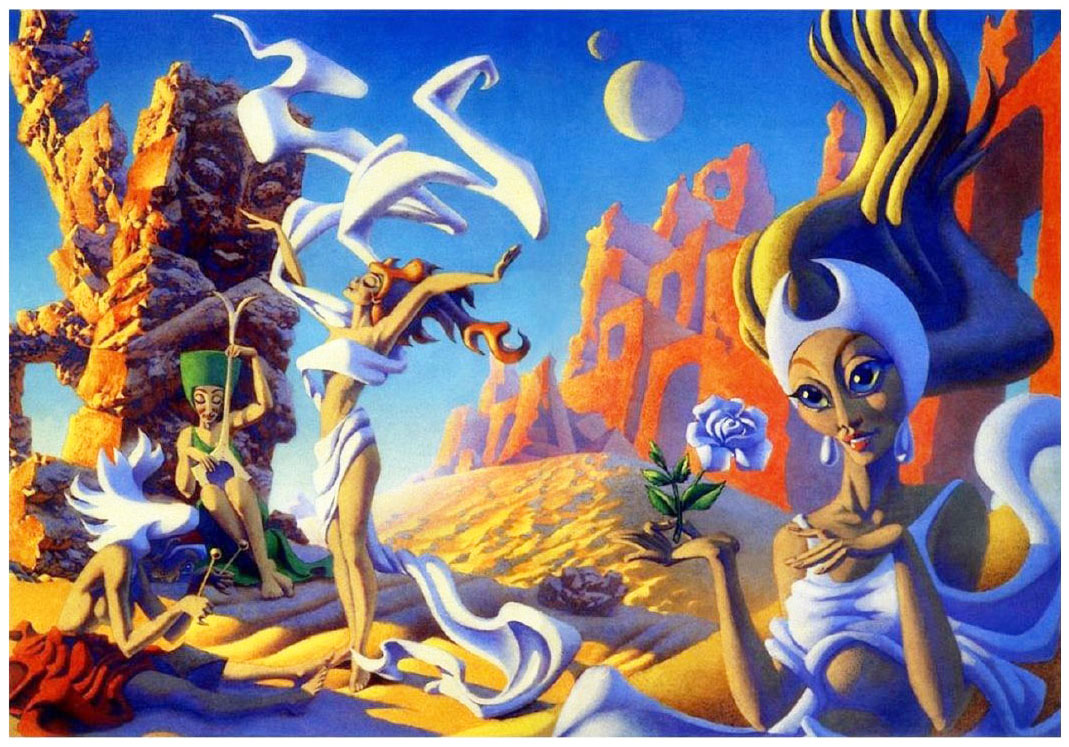
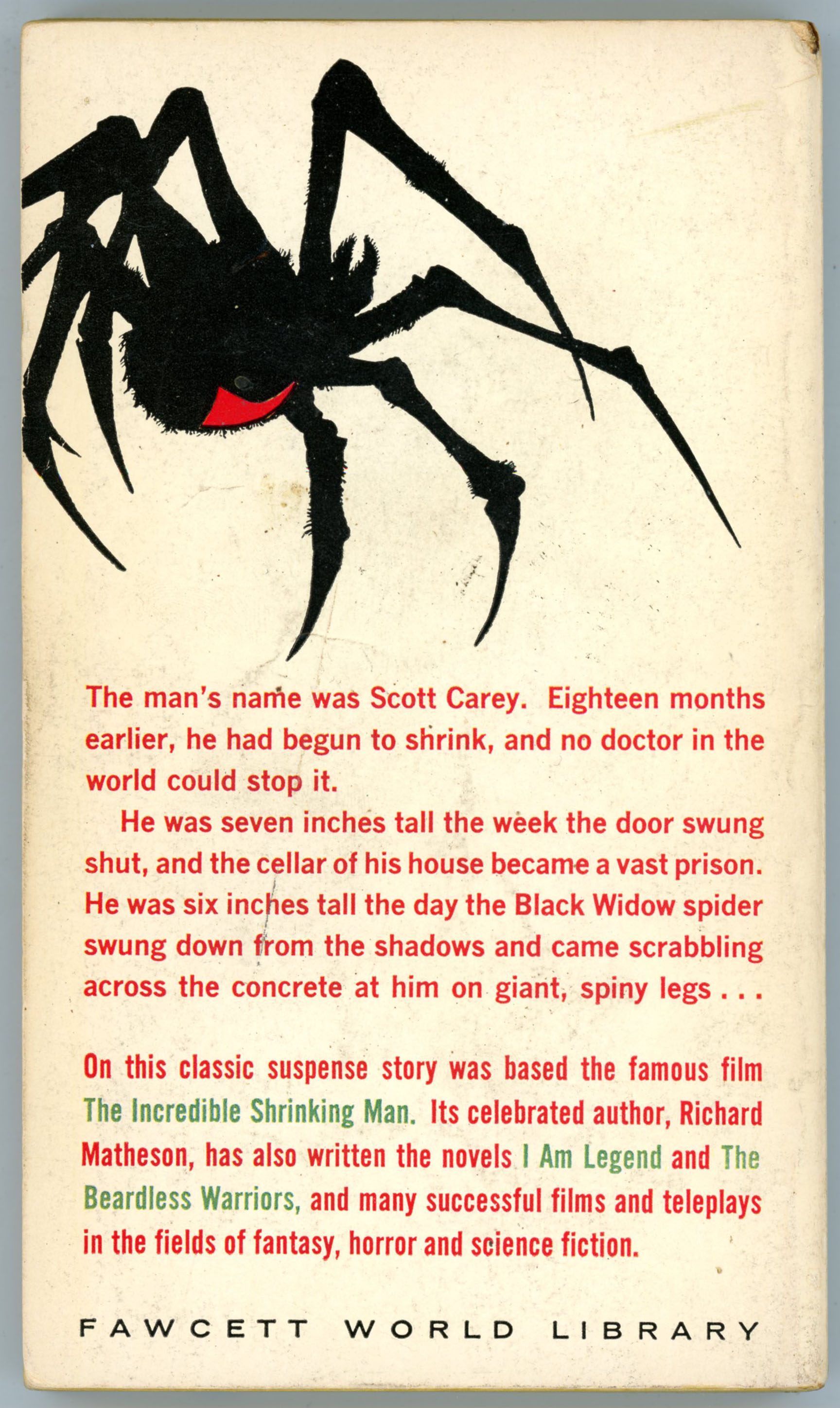
Dating back to February of 2019, I’ve now updated this post – displaying the cover of Fawcett / Gold Medal’s 1962 edition of Richard Matheson’s The Shrinking Man – to include a variety of videos about the book’s 1957 film adaptation. The book’s first edition – also published as a Fawcett / Gold Medal paperback, rather than hardcover – appeared in 1956.
On a personal note, I first viewed this film at about the age of eight (seriously) in the late 1960s. In accurate retrospect, I remember having been – in the parlance of 2023 – completely “blown away” on an emotional level (though I could hardly articulate as much at the time!) by two aspects of Richard Matheson’s screenplay.
First, the transformation of the commonplace and mundane to the horrific, in terms of Scott Carey’s confrontation with a house cat and spider, let alone his simple, solitary, desperate struggle for survival. Second, I found the movie’s conclusion to be profoundly affecting and deeply moving. It was not the happy ending that I anticipated and hoped for early in the film – Scott’s restoration to normal size; reuniting with his wife; the resumption of and return to the life that he knew before – but its quietly upbeat ambiguity, which has deeply religious undertones (the word “God” is actually spoken, let alone in a positive sense!), lifted the film in its entirety (not just its final moments) into the realm of the sublime. Ray Anthony’s refreshingly-un-theramin-like (for the 1950s) opening trumpet solo lends the film an almost noir-like dimension.
What we really have in Jack Arnold’s, Albert Zugsmith’s, and Richard Matheson’s production is a fully “A Movie” – well, at least aspects or parts of an A Movie – hidden within an ostensibly “B Film”.
Thankfully, there have been neither sequel nor remake. And in this I include – ahem – Joel Schumacher’s The Incredible Shrinking Woman.
See more below…!
____________________

Unsurprisingly, the 1957 film adaptation does have marked differences from its original literary version, one passage of which is very disturbing, and probably would have been far “beyond the pale” for audiences of the 1950s.
____________________
From Arrow Video, here’s the film’s trailer:
Via Larry Arpin, here’s Jack Arnold’s discussion of the movie’s creation…
…while History of Horror discusses the film in the context of other productions by Jack Arnold. Cleverly, this video opens with Ray Anthony’s trumpet solo:
The full film can be viewed at the link below, from Archive.org:
The film’s conclusion – which, paralleling the novel, carries with it an unusually profound theological and philosophical message – commences at 1:05:35.
Here are the movie’s final four minutes, via Marie Ruggirello:
Compare to Matheson’s original text, below…
Chapter Seventeen
AS ON ANY other morning, his lids fell back, his eyes opened. For a moment he stared up blankly, his mind still thick with sleep. Then he remembered and his heart seemed to stop.
With a startled grunt, he jolted up to a sitting position and looked around incredulously, his mind alive with one word:
Where?
He looked up at the sky, but there was no sky – only a ragged blueness, as if the sky had been torn and stretched squeezed and poked full of giant holes, through which light speared.
His wide, unblinking gaze moved slowly, wonderingly. He seemed to be in a vast, endless cavern. Not far over to his right the cavern ended and there was light. He stood up hastily and found himself naked. Where was the sponge?
He looked up again at the jagged blue dome. It stretched away for hundreds of yards. It was a bit of the sponge he’d worn.
He sat down heavily, looking over himself. He was the same. He touched himself. Yes, the same. But how much had he shrunk during the night?
He remembered lying on the bed of leaves the night before, and he glanced down. He was sitting on a vast plain of speckled brown and yellow. There were great paths angling out from a gigantic avenue. They went as far as he could see.
He was sitting on the leaves.
He shook his head in confusion.
How could he be less than nothing?
The idea came. Last night he’d looked up at the universe without. Then there must be a universe within, too. Maybe universes.
He stood again. Why had he never thought of it; of the microscopic and the submicroscopic worlds? That they existed he had always known. Yet never had he made the obvious connection. He’d always thought in terms of man’s own world and man’s own limited dimensions. He had presumed upon nature. For the inch was man’s concept, not nature’s. To a man, zero inches means nothing. Zero meant nothing.
But to nature there was no zero. Existence went on in endless cycles. It seemed so simple now. He would never disappear, because there was no point of non-existence in the universe.
It frightened him at first. The idea of going on endlessly through one level of dimension after another was alien.
Then he thought: If nature existed on endless levels, so also might intelligence.
He might not have to be alone.
Suddenly he began running toward the light.
And, when he’d reached it, he stood in speechless awe looking at the new world with its vivid splashes of vegetation, its scintillant hills, its towering trees, its sky of shifting hues, as though the sunlight were being filtered through moving layers of pastel glass.
It was a wonderland.
There was much to be done and more to be thought about. His brain was teeming with questions and ideas and – yes – hope again. There was food to be found, water, clothing, shelter. And, most important, life. Who knew? It might be, it just might be there.
Scott Carey ran into his new world, searching.
THE END
of a novel by
Richard Matheson
293 Feb. 4, 2019