There’s a well-known adage that pertains to many aspects of life: “Less is more.” This is so in the field of advertising, where relegating the name or image of a corporation, product, or service to the “background” – sometimes humorously; sometimes ironically; sometimes idealistically – can ignite a flame of curiosity and interest that would otherwise lay fallow.
A superbly done example of this approach (who’s the person who dreamed this one up?!) appeared in The New York Times on December 27, 1942, in the form of an advertisement for the Nash-Kelvinator corporation, a manufacturer of automobiles and household appliances. The ad consists of a painting – though in a newspaper obviously printed by the half-tone process – of the bombardier of a B-17 Flying Fortress bomber in the nose of his aircraft during a mission over Europe, followed by his thoughts as expressed in stream-of-consciousness internal monologue. Only at the very “bottom” of the advertisement – placed after the bombardier’s message – appear symbols for Nash-Kelvinator (a car and kitchen refrigerator). This is followed by a statement about the company’s mission: To manufacture weapons and material in support of the war effort, with the ultimate goal of ensuring that life in the United States will continue once victory is achieved and servicemen return. There is absolutely no mention – in this age before the primacy of shareholder value, and, America’s deindustrialization only three short decades later – of any of Nash-Kelvinator’s products. The ad, published only a year and nearly a month after the Japanese attack on Pearl Harbor, is simply a message of patriotic solidarity, cautious optimism, and, hope.
~~~~~~~~~~~~~~~~~~~~~~~~~~~~~~
Here’s the ad in its entirety:
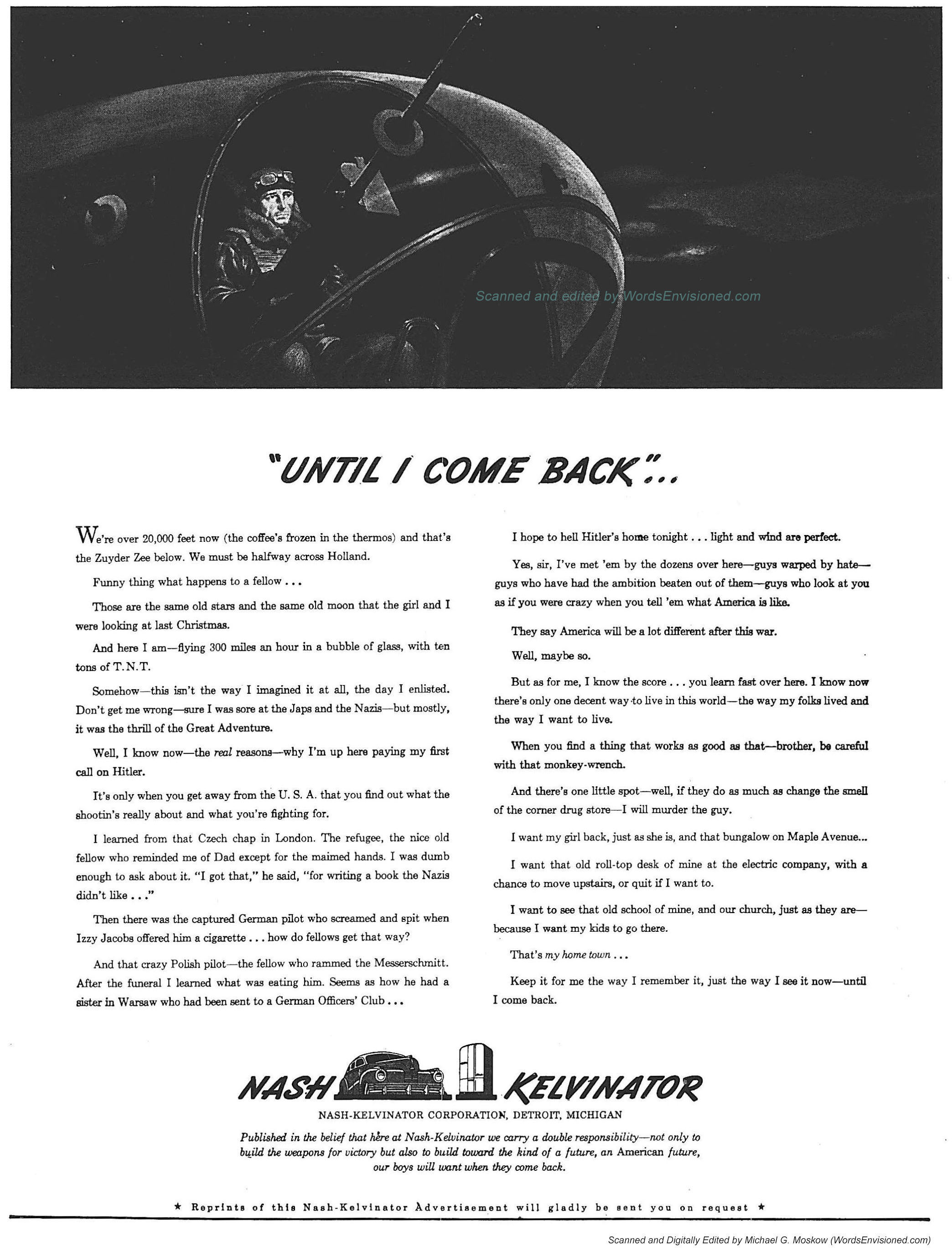
The text of the ad is striking in – through very few words – encompassing several aspects of the war in general, and America’s air war, in particular.
First – this stands out! – the B-17 is shown and described as being on a night-time mission, rather than a daylight sortie. This probably reflects currents of news about the 8th Air Force prevailing in 1942 (assuming such information was available to the public?!) in terms of discussions concerning whether the 8th would switch to night operations and participate with Royal Air Force Bomber Command in wide-area bombing. Of course, this never came about. As described by John T. Correll at Air & Space Forces Magazine in “The Allied Rift on Strategic Bombing“, “Churchill had President Franklin D. Roosevelt almost convinced that the B-17s should join Bomber Command in operating at night. Before that happened, Churchill met with Eaker during the Allied conference at Casablanca, Morocco, in January 1943, and Eaker talked him out of the idea. His key point was the value of keeping the Germans under attack both day and night.”
Caliban Rising addresses the issue of the RAF’s advocacy of night bombing for the 8th Air Force, versus the American intention of bombing by day, in his video “Shocking Comments About RAF Bomber Command vs 8th Air Force,” commencing at 4:55.
Then, we learn that the bombardier signed up because of the adventure involved in combat flying, but only upon reaching England and encountering the reality of war, and, the nature of the Third Reich, did he begin to appreciate the true gravity (accidental pun, there) of his decision.
This takes the form of symbolic encounters with symbolic representatives of two of the nations which have have been conquered by Germany: A Czech civilian refugee in London, and, a fallen Polish fighter pilot who sacrificed his life to destroy an Me-109. A third encounter is of a very different sort, and expressed in a very different way. A fellow American aviator’s offer a a cigarette to a captured German flyer is refused with sheer fury, the aviator being “Izzy Jacobs”, obviously and clearly by the “sound” of his name a Jew. A sign of the times (and the Times?) the word “Jew” is absent from the ad, unlike “Czech” and “Polish”. Well, that this point was even made in a mainstream advertisement by a major American corporation in 1942 is itself remarkable.
Then follow the bombardier’s thoughts about past, present, and future. His central hope is that the country he returns to – for he expects to return – will be much the same as the country he left, with the hope that the reader – the American public, will, “Keep it for the way I remember it, just the way I see it now – until I come back.”
Whoever he was, I hope he made it back.
“UNTIL I COME BACK”…
We’re over 20,000 feet now (the coffee’s frozen in the thermos) and that’s the Zuyder Zee below. We must be halfway across Holland.
Funny thing what happens to a fellow…
Those are the same old stars and the same old moon that the girl and I were looking at last Christmas.
And here I am – flying 300 miles an hour in a bubble of glass, with ten tons of T.N.T.
Somehow – this isn’t the way I imagined it at all, the day I enlisted. Don’t get me wrong – sure I was sore at the Japs and the Nazis – but mostly, it was the thrill of the Great Adventure.
Well, I know now – the real reasons – why I’m up here paying my first call on Hitler.
It’s only when you get away from the U.S.A. that you find out what the shootin’s really about and what you’re fighting for.
I learned from the Czech chap in London. The refugee, the nice old fellow who reminded me of Dad except for the maimed hands. I was dumb enough to ask about it. “I got that,” he said, “for writing a book the Nazis didn’t like…”
Then there was the captured German pilot who screamed and spit when Izzy Jacobs offered him a cigarette…how do fellows get that way?
And that crazy Polish pilot – the fellow who rammed the Messerschmitt. After the funeral I learned what was eating him. Seems as how he had a sister in Warsaw who had been sent to a German Officers Club…
I hope to hell Hitler’s home tonight…light and wind are perfect.
Yes, sir, I’ve met ‘em by the dozens over here – guys warped by hate – guys who have had ambition beaten out of them – guys who look at you as if you were crazy when you tell ‘em what America is like.
They say America will be a lot different after this war.
Well, maybe so.
But, as for me, I know the score…you learn fast over here. I know how there’s only one decent way to live in the world – the way my folks lived and the way I want to live.
When you find a thing that works as good as that – brother, be careful with that monkey-wrench.
And there’s one little spot – well, if they do as much as change the smell of the corner drug store – I will murder the guy.
I want my girl back, just as she is, and that bungalow on Maple Avenue…
I want that old roll-top desk of mine at the electric company, with a chance to move upstairs, or quit if I want to.
I want to see that old school of mine, and our church, just as they are – because I want my kids to go there.
That’s my home town…
Keep it for the way I remember it, just the way I see it now – until I come back.
NASH KELVINATOR
NASH-KELVINATOR CORPORATION, DETROIT, MICHIGAN
Published in the belief that here at Nash-Kelvinator we carry a double responsibility – not only to build the weapons for victory but also to build toward the kind of a future, an American future, our boys will want when they come back.
Reprints of this Nash-Kelvinator advertisement will gladly be sent you on request.
~~~~~~~~~~~~~~~~~~~~~~~~~~~~~~
Here’s a close-up of the ad’s single illustration, showing our pensive bombardier in the nose of his aircraft.

(By way of explanation, the image above was scanned from a paper photocopy made by a 35mm microfilm viewer (I think manufactured by Minolta … it’s been a few decades since I made this!) which I used to review this issue of the Times … as 35mm microfilm … rather than from a digitized image “copied & pasted” from the Internet such as from the “Times Machine”. The ubiquity and ease of access of digitized images from newspapers, though fantastic for accessing text, is typically a step far down in terms of the quality of the images that accompany such news items. In other words, technological convenience is often an unrecognized and unanticipated step far, far backwards in terms of preserving the past.)
Intentionally or not, the unknown artist who created this illustration changed the mood of the art by making the figure of the bombardier – relative to the size of the B-17 – perhaps twice as small as in actuality, making the aircraft look practically cavernous. You can see this in the image below, which illustrates a B-17 bombardier as seen looking forward from the crew station of the aircraft’s navigator. If he’s seated, there’s just enough room for him and not much more. This WW II Army Air Force Photo 3200 / A45511) is captioned, “Lt. Maurice A. Bonomo, Bombardier, 333 W. 86th St., New York City, 18 daylight missions; holds Air Medal with two Oak Leaf Clusters”. The picture gives an excellent representative view of the the bombardier’s position in a B-17 Flying Fortress (specifically, a B-17G Flying Fortress).
Given that Lt. Bonomo isn’t (!) wearing his oxygen mask, and is directly touching the control panel without (!) gloves (neither of which would be advisable at altitude…) this is certainly a “posed” photograph, taken while the B-17 was on the ground.

Though the date of this photograph is unknown, what is known is that Lt. Bonomo, a member of the 401st Bomb Squadron, 91st Bomb Group, became a prisoner of war on July 20, 1944, during a mission to Leipzig, Germany. On that date, he was a member of 1 Lt. Arthur F. Hultin’s crew in B-17G 42-102509, which was lost due to anti-aircraft fire. Fortunately, all 10 crewmen survived as POWs. The plane’s loss is covered in MACR 7274 and Luftgaukommando Report KU 2560, the latter document being unusually detailed in its description of the plane.
The husband of Janet A. Bonomo, of 333 West 86th Street, in New York, Maurice Bonomo was imprisoned in North Compound 2 of Stalag Luft I, in Barth, Germany.
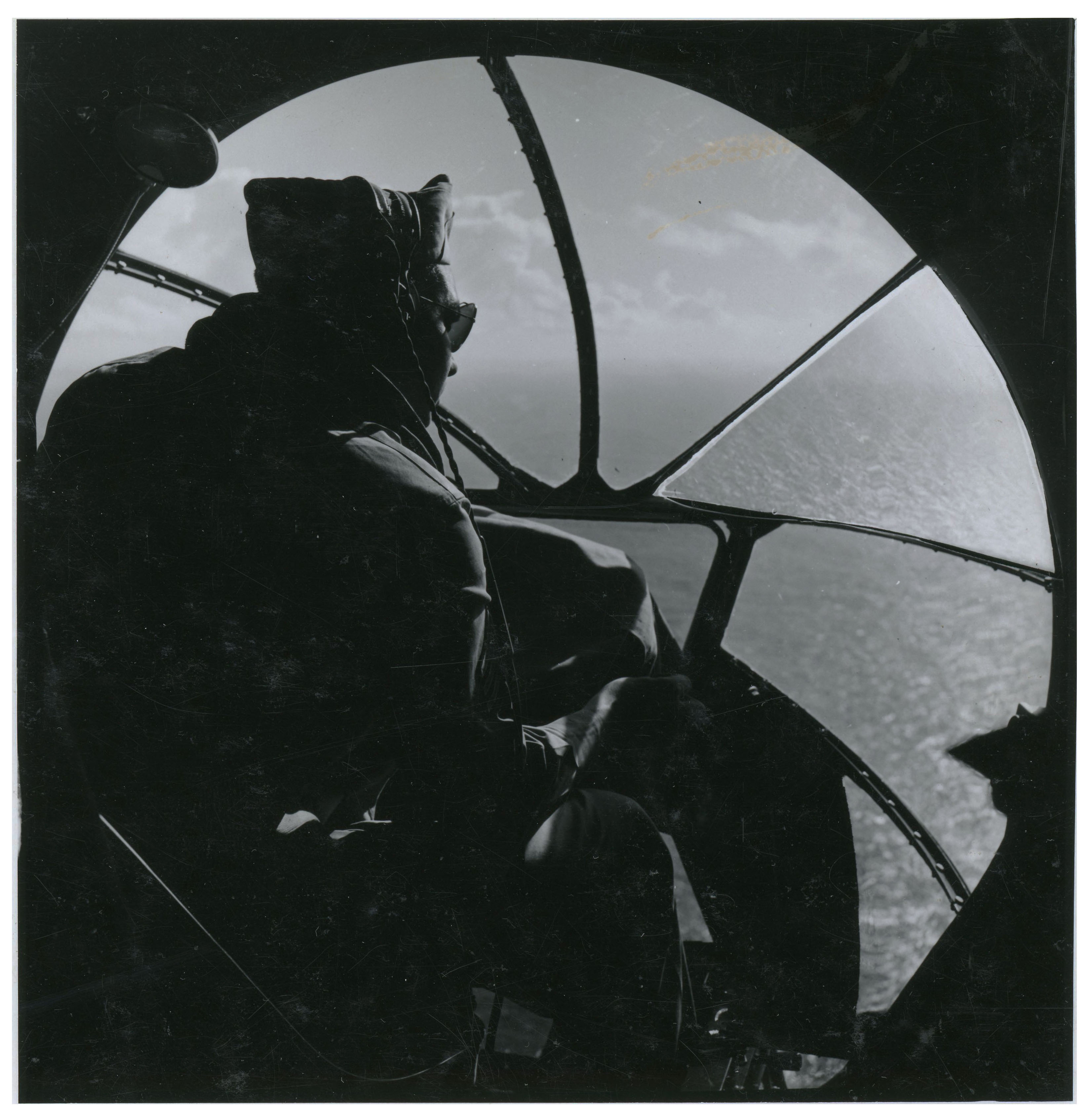
Here’s a similar picture. Taken on or before December 28, 1942, Army Air Force photo 3A40521 / 23535AC is captioned, “Bombardier on a Boeing B-17 flying on a search mission in the Hawaiian Islands.” The nose framing reveals that this is an “E’ model of the B-17, unlike the “G” version in the photo of Lt. Bonomo. (I scanned this picture at the National Archives in College Park, Maryland.)

And, here’s a view limited to the photo itself, with contrast and lighting slightly adjusted to render details (clouds in the distance) in greater clarity.
~~~~~~~~~~~~~~~~~~~~~~~~~~~~~~
The contemplative and serious nature of the advertisement, both in print and art, cannot help but remind one of the scene – in William Wyler’s wonderful 1946 movie (see at Archive.org) “The Best Years of Our Lives” – in which former 8th Air Force bombardier Capt. Fred Derry, played by Dana Andrews, highly uncertain of his place in the America to which he has returned; completely uncertain about his future, and certainly seeing no future for himself in his hometown of “Boone City” (any-midwestern-state-USA), decides to leave for parts unknown.
While awaiting the departure of his flight at a nearby Army Air Force Base (the sequence having been shot at Ontario Army Airfield, California), he happens to wander through a boneyard of surplus warplanes (past rows of Wright Cyclone Engines with Hamilton Standard propellers stacked alongside, like lines of soldiers-all-in-a-row, engineless P-39 Airacobras, and then engineless B-17s; this would’ve been under the auspices of the Reconstruction Finance Corporation).
Randomly coming across an aircraft nicknamed “ROUND ? TRIP” (the plane is B-17F 42-3463, which never actually left the United States, its nose art having been created for the movie), he enters the nose compartment and climbs into the bombardier’s position. (Once and again.) Then, in one of the most evocative and moving scenes to emerge from a film of this era – truly, any era – he relives the past. Viewed from the front, the camera zooms in on the aircraft and then pans across each of the B-17’s four nacelles from the plane’s left to right, momentarily focusing on each as the background music rises in pitch and intensity, symbolizing the plane coming to life for a combat mission. The fact that the aircraft’s engines are actually missing from this plane – the camera focusing on each nacelle’s empty bulkhead – reveals to us that for Captain Derry, past and present are indistinguishable.
The camera then zooms in on Derry as (breaking out in a sweat), he leans forward as if to peer through imagined bombsight, and relives the experience of witnessing a friend’s B-17 being shot down in combat – with no survivors. Only when the foreman of a salvage crew looks up to notice Derry in the aircraft and yells from below, does Derry abruptly awaken from his dark reverie. This transition is symbolized in the way that Derry (as viewed from outside the bombardier’s nosepiece) is filmed out of focus amidst his flashback, and only comes into clear focus when he leaves the past. Having returned to the present, Derry leaves the plane, and after a brusque but straightforward conversation with the foreman that entails the possibility of a job – a menial job for a former Captain but a job nonetheless – returns to the present, and the possibility of a real future.
Below you’ll find a clip of this sequence. In the full version at Archive.org, it begins near the film’s end, at @ 2 hours 32 minutes.
~~~~~~~~~~~~~~~~~~~~~~~~~~~~~~
It was an arduous journey, but our bombardier came back.
~~~~~~~~~~~~~~~~~~~~
A Reference or Two (and More)
Nash-Kelvinator, at…