Henderson The Rain King, by Saul Bellow (II) – 1983 (1958) [Roy Ellsworth]

Here’s a second, later (1983; Penguin Books) version of the cover of Saul Bellow’s Henderson the Rain King, by Roy Ellsworth. 

It’s a very different from Bill Preston’s 1972 cover, which was stylistically a little more traditional, relying on the use of brighter colors and not at all on the direct representation of the novel’s characters. 

The manner in which the two artists visually depicted Bellow’s animating idea in such a different manner is an interesting – albeit ironically wordless! – commentary on the rapidity of change in artistic style over a short period of time. 

“The glorious, spirited adventures of an eccentric American millionaire who finds a home of sorts in deepest Africa”. (Cover blurb)

______________________________

This is how I became the rain king
I guess it served me right for mixing into matters that were none of my damned business
But the thing had been impossible,
one of those drives which there was no question of fighting.
And what had I got myself into?
What were the consequences?
On the ground floor of the palace,
filthy, naked, and bruised,
I lay in a little room
The rain was falling, drowning the town,
dropping from the roof in heavy fringes, witchlike and gloomy
Shivering, I covered myself with hides and stared with circular eyes,
wrapped to the chin in the skins of unknown animals
I kept saying, “Oh, Romilayu, don’t be down on me.
How was I supposed to know what I was getting myself into?”
My upper lip grew long and my nose was distorted;
it was aching with the whiplashes and I felt my eyes had grown black and huge
“Oh, I’m in a bad way
I lost the bet and am at the guy’s mercy.” – Saul Bellow (p. 203)


Henderson The Rain King, by Saul Bellow (I) – March, 1972 (1958) [Bill Preston]

Here is the first of “two takes” on Saul Bellow’s Henderson the Rain King.

This post illustrates Viking Press’ 1972 paperback edition of Bellow’s novel, with cover art by Bill Preston.  You can view Roy Ellsworth’s strikingly different 1983 cover art – combining elements of symbolism, humor, and irony – here.  

Seize the Day, by Saul Bellow (II) – 1958 (1985) [Roy Ellsworth]

Roy Ellsworth, who created cover art for the 1977 edition of Mr. Sammler’s Planet, and the 1983 release of Henderson the Rain King, was also the artist for the 1985 publication of Seize the Day – all authored by Saul Bellow; all published by Penguin Books.  

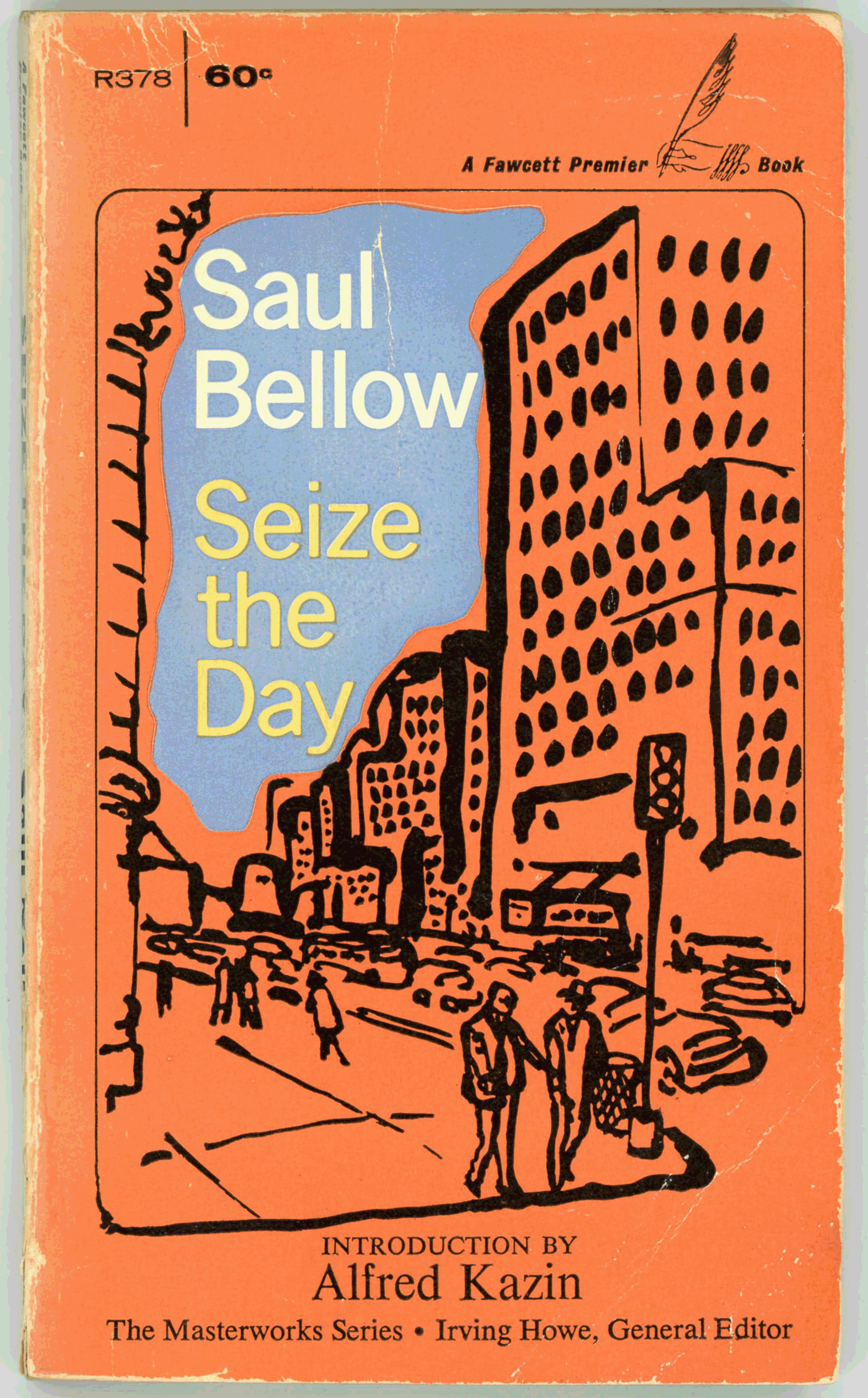
His cover for the latter novel – shown in this post – is strikingly different from the simple, somewhat impressionistic illustration featured on the cover of the novel’s 1958 Fawcett Crest edition, which I first posted in April of 2019.  In the latter, the emphasis is on an un-named New York City street, with the protagonist and his father, Tommy Wilhelm and “Dr. Adler”, appearing as diminutive, nondescript figures. 

For the book’s 1985 edition, Ellsworth rendering of father and son shows them as distinct individuals, with a notable resemblance.  Curiously, as he did for Henderson the Rain King, his cover coveys a mood of lightheartedness and whimsy, more than a little at variance (!) with the novel’s utter seriousness. 

References

The Day Seized, at…

… Rotten Tomatoes

… Internet Movies Database

… Wikipedia

Seize the Day, by Saul Bellow (I) – 1958 [Unknown Artist]

I labor,
I spend,
I strive,
I design,
I love,
I cling,
I uphold,
I give way,
I envy,
I long,
I scorn,
I die,
I hide,
I want.

On Broadway it was still bright afternoon
and the gassy air was almost motionless under the leaden spokes of sunlight,
and sawdust footprints lay above the doorways of butcher shops and fruit stores.
And the great, great crowd,
the inexhaustible currents of millions of every race and kind pouring out,
pressing round, of every age, of every genius,
possessors of every human secret, antique and future,
in every face the refinement of one particular motive or essence –

______________________________

Faster, much faster than any man could make the tally. 
The sidewalks were wider than any causeway;
the street itself was immense,
and it quaked and gleamed and it seemed to Wilhelm to throb at the last limit of endurance. 
And although the sunlight appeared like a broad tissue,
its actual weight made him feel like a drunkard. 

– Saul Bellow –

Adapted for film by Fielder Cook and Robert Ribman, “Seize The Day” was released on September 9, 1986 at the Toronto International Film Festival, as a made-for-television film for PBS’ Great Performances series, with the late Robin Williams starring in the role of Tommy Wilhelm. 

A caveat:  I’ve neither (yet) read the book, nor (just yet) fully viewed the movie – though after the creation of “this” post, I well may.  I do recall sitting down to view the film on PBS, but – due to the sheer pathos of the story, particularly Tommy’s repellent, if not loathsome father, “Dr. Adler” (played by Joseph Wiseman), and his entirely unsympathetic wife, “Margaret” (played by Katherine Borowitz) – I gave up early:  I couldn’t bring myself to watch the production in ts entirety.

The video below, a composite of different scenes from the film (at the YouTube channel of hannahskaye) gives a glimpse of the power and intensity of Williams’ performance. 

Tommy’s life is a series of walls, which can neither be surmounted nor demolished.   He is left with one thing only: Himself.   

If the story is not a happy one, well, somehow, it nonetheless is a tale that can be appreciated.   

References

Seize the Day – at Rotten Tomatoes

Seize the Day – at Internet Movies Database

Seize the Day – at Wikipedia

Congo Song, by Stuart Cloete – 1952 (1943) [George Mayers]

My previous post for Congo Song, from November of 2016, shows the 1943 (first) edition of Stuart Cloete’s novel. 

Notably different is the cover of this – 1952 – edition of the work:  The cover art of the first edition is a simple, very colorful  and somewhat symbolic composition probably done using an airbrush.  However, the cover art of this Popular Giant edition is as suggestive as it is direct (albeit tame by today’s standards), while the blurb on the book’s back cover luridly describes the novel’s plot.   

As for the un-named gorilla, well, he does looks rather contemplative.

This is most unlike the book’s first edition, which features cover art that is simple, and appealing in that simplicity, while the back cover merely presents Cloete’s biography. 

Congo Song, by Stuart Cloete – 1943 [Unknown Artist]

Lovely art, which an unknown artist probably created with an airbrush, illustrates the cover of this first edition of Stuart Cloete’s Congo Song.  The art depicts three elements central to the novel: The face of Olga le Blanc, the silhouette of her “tame gorilla” (? – !), and, a tropical sunset.  All rather different from the cover of the 1952 edition, which leaves less to the imagination…

congo-song-stuart-cloete-1943-1_edited-2Channel went back over his life in his mind.
He thought of the things he had done…the things he had not done.
There were always regrets at the things that had ended before their time.
There was regret, too, at the loss of pain that was almost pleasure,
at the pleasure that was almost pain.
For many years these regrets had come back continually at the sight of a shop,
a restaurant,
a street,
the name of a certain dish on a menu,
a word found in a book, at hazard, as you turned the page;
at a song,
at a bar of music,
at the turn of some woman’s head in the street,
at the color of a dress or the sound of a voice.
All this because it was not done,
because it had never been finished one way or the other,
and your heart had been left dangling like a puppet on a string.

congo-song-stuart-cloete-1943-2He thought of his own father;
he remembered him singing him to sleep,
walking up and down,
holding him in his arms.
He remembered him swimming with him sitting on his back,
his legs about his neck, his hands in his hair.
He remembered riding in the front of his saddle.
His father must have had similar memories of his father;
and his father of his father, and so on,
an interminable chain;
each generation tending to repeat stories that they remembered
from their own childhood…
fairy tales, folklore,
superstitions that came down like this by word of mouth
from the ancient past, were absorbed in the mothers’ milk,
transmitted by nurses, grooms, servants.
His father had been born in 1844.
His grandfather had been a boy at the time of Waterloo.
And it went on like that, back into the past,
each life overlapping another life, as tiles overlapped each other on a roof.
The more you saw of life,
the stranger was its variety and differentiation.

– Stuart Cloete

Almayer’s Folly, by Joseph Conrad – 1947 (1895) [Robert Jonas]

Here is Penguin Books’ 1947 edition of Joseph Conrad’s first novel…   

Though the portrait of Conrad on the book’s rear cover is undated, in terms of his general appearance and style of dress, the image is similar to Alvin Langdon Coburn’s photogravure of March 11, 1916 (at bottom), as seen in Conrad’s Wikipedia profile.

References

Joseph Conrad, at Wikipedia

Joseph Conrad, Alvin Langdon Coburn photogravure of March 11, 1916, from New York Public Library Digital Collection (Item 297498): “The Miriam and Ira D. Wallach Division of Art, Prints and Photographs: Photography Collection, The New York Public Library. “Joseph Conrad, London, March 11th, 1916.” The New York Public Library Digital Collections. 1922.”

The Year Of The Zinc Penny, by Rick DeMarinis – 1989 [Anne Bascove]

This post, which first appeared in mid-2018, has been updated to include Michiko Kakutani’s New York Times October 1989 book review of The Year of the Zinc Penny.  The “initial” version of the post included the review as a scan, but this revision includes the review in full text, followed by a close-up of Anne Bascove’s cover art, which is as evocative as it is stylistically distinctive.

Scroll down, and enjoy…

She understood me, though. 
Not my words but my acquiescence. 
I relaxed back into the pillow and stared at the white ceiling. 
She began to sing again as she dipped the washcloth into the pan of warm water. 
“When the lights go on again, all over the world,”
she sang, her voice plaintive and sad. 
Her melancholy tone made me think
that she had a boyfriend or husband overseas.
I imagined him an airman, a fighter pilot stationed in London. 
He flew P-51 Mustangs and had shot down twelve Messerschmitt Me-109s
before getting shot down himself. 
He was lying, helpless, in a hospital on the outskirts of London. 
He couldn’t remember his name of where he came from,
and no one had told him just yet that his legs had been amputated. 
He could remember his girlfriend or wife,
but only her pretty face and mournful singing voice,
not her name. 
“Jenny,” he’d cry out in his delirium. 
Then he’d sink back into his confused gloom. 
“No, not Jenny,” he’d mumble. 
(105)

I had discovered something about myself. 
I knew that I was now capable of mustering any necessary lie at will. 
I could say “Dad” and not mean it
and I could accept being called “son” by someone who did not mean it. 
It was like discovering an unsuspected talent. 
William and Betty didn’t have this talent,
and I was dimly aware that it was a deficiency that would cost them dearly. 
I was also dimly aware that if this talent could be used without shame,
its power would be awesome.

And dangerous. 
As dangerous as the one who used it as leukemia. 
Because necessary lies trick the liar himself. 
He wants to believe them. 
Then he does.

“Stay clear of it,” Aunt Ginger had said.
Her words repeated themselves in my mind, gathering meaning. 
(130-131)

____________________

Books of The Times

World War II Los Angeles, as a Boy Sees It

By MICHIKO KAKUTANI

The Year of the Zinc Penny
By Rick DeMarinis

174 pages. W.W. Norton & Company.
$17.95.

The New York Times
October 3, 1989

The year is 1943, when the war effort required that pennies be manufactured of zinc instead of precious copper; and Trygve Napoli, the narrator of Rick DeMarinis’s new novel, is 10 years old.  His story of that year is, at once, a portrait of a vanished era, and an old-fashioned coming-of-age tale, showing one boy’s initiation into the solemnities of the adult world.  If the novel’s material sometimes feels derivative – there are echoes throughout the narrative of the movies “Radio Days,” “Hope and Glory” and “Empire of the Sun” – Mr. DeMarinis’s voice remains distinctively his own, by turns comic and melancholy, lyrical and street smart.

Writing in brisk, observant prose, Mr. DeMarinis quickly immerses us in the staccato rhythms of life in wartime Los Angeles: rowdy sailors on leave, showing off their war wounds and tattoos; war widows working in aircraft factories, riveting wings and tails; children searching the skies above the city with their tin binoculars, on the lookout for enemy planes.  A huge camouflage net spans one boulevard, covering the Douglas aircraft plant, and Tryg and his friends notice that it has been painted – surreally – to look like an ordinary farmland scene with houses, barns, and herds of dairy cows.  The Japanese will never fall for it, says his friend William, noting that a Midwestern farm scene looks incongruously out of place in downtown Los Angeles.  “The nut who designed it must have been from Iowa.”

When Tryg isn’t at the movies watching Ronald Colman, Claudette Colbert and Franchot Tone, he’s home listening to the radio, tuning in the Lone Ranger or whatever foreign station he can locate on his shortwave machine.  With the help of his uncle, he builds a huge antenna on the top of his parents’ apartment building – an antenna that enables him to listen to the likes of Tokyo Rose, as he sits in the living room playing Parcheesi or concocting secret codes.

Tryg’s favorite pastime, however, is fantasizing about the war.  Sometimes, he is an anonymous figure like Kilroy – someone who is everywhere and nowhere, partly hidden, in disguise.  Other times, he is a brave fighter pilot named Charlie Jones or Bill Tucker, Jerry Granger or Buddy Thompson – someone without an awkward foreign name.  He shoots down enemy pilots, dive-bombs strategic targets, and after his plane crashes, dies a heroic death in the arms of a beautiful girl.

“I loved the pose,” Tryg recalls.  “I loved being someone everyone could like.  To encourage this view of myself, I had to make it real.  To make it real required a strong and unwavering imaginative act.  I had to elaborate the details of my coming death in combat.  This was important.  I had to work at it.  I couldn’t afford to be slack on the details.”

Though these fantasies earn Tryg a reputation as an oddball – “Monk, the Nut,” who’s constantly spacing out and mumbling to himself – they also provide a necessary respite from the boring rigors of school and the tensions of his squabbling family.

Tryg’s mother, who left his father for a smirking would-be actor named Mitchell, is a disturbingly cold woman, possessed of “a Norwegian fatalism.”  When he was an infant, she abandoned him for four years, leaving him with her autocratic father; and now that she has retrieved him, she seems quite indifferent to his happiness or welfare.  Mitchell, on his part, is a vain, selfish man, obsessed with parlaying his job as a Hollywood milkman into a movie career.  He is completely cynical about the war – it doesn’t much matter, he says, which side ends up winning.

Filling out the Napoli household are Ginger, Tryg’s neurotic aunt, who acts like a California version of Blanche DuBois, and her violent husband, Gerald, who’s constantly getting into drunken brawls.  Their son, William, a sullen, chain-smoking teen-ager, becomes Tryg’s mentor and surrogate brother.  And William’s girlfriend, Betty, becomes a symbol to Tryg of the mysteries of sex that await him in adolescence.

Although these characters are all drawn in broad, colorful strokes, they never become generic cartoons, so deft is Mr. DeMarinis in portraying Tryg’s mixed feelings toward them of love and resentment, sympathy and irritation.  In the course of the year, we watch him exchange needy loneliness for a more melancholy detachment, and we see him attempt to use the clear-sighted logic of childhood to solve the mysteries of love and death.  By the end of the book, he is old beyond his years – initiated, by the war and assorted family tragedies, into the sadnesses of grown-up life.

“I had discovered something about myself,” Tryg says, recalling an exchange with his stepfather, who has just been drafted.  “I knew that I was now capable of mustering any necessary lie at will.  I could say ‘Dad’ and not mean it and I could accept being called ‘son’ by someone who did not mean it.  It was like discovering an unsuspected talent.”

Without ever resorting to easy nostalgia or cheap sentimentality, Mr. DeMarinis gives us both a picture of the eternal realities of childhood – the humiliations of playground gamesmanship, the cruelties of puppy love – and a tactile portrait of life in the wartime 40s.  In that sense, “The Year of the Zinc Penny” is like one of Proust’s madeleines: for those old enough to remember, it captures a receding past; for those too young to recall, it conjures up a vanished era.

____________________

– Rick DeMarinis –

____________________


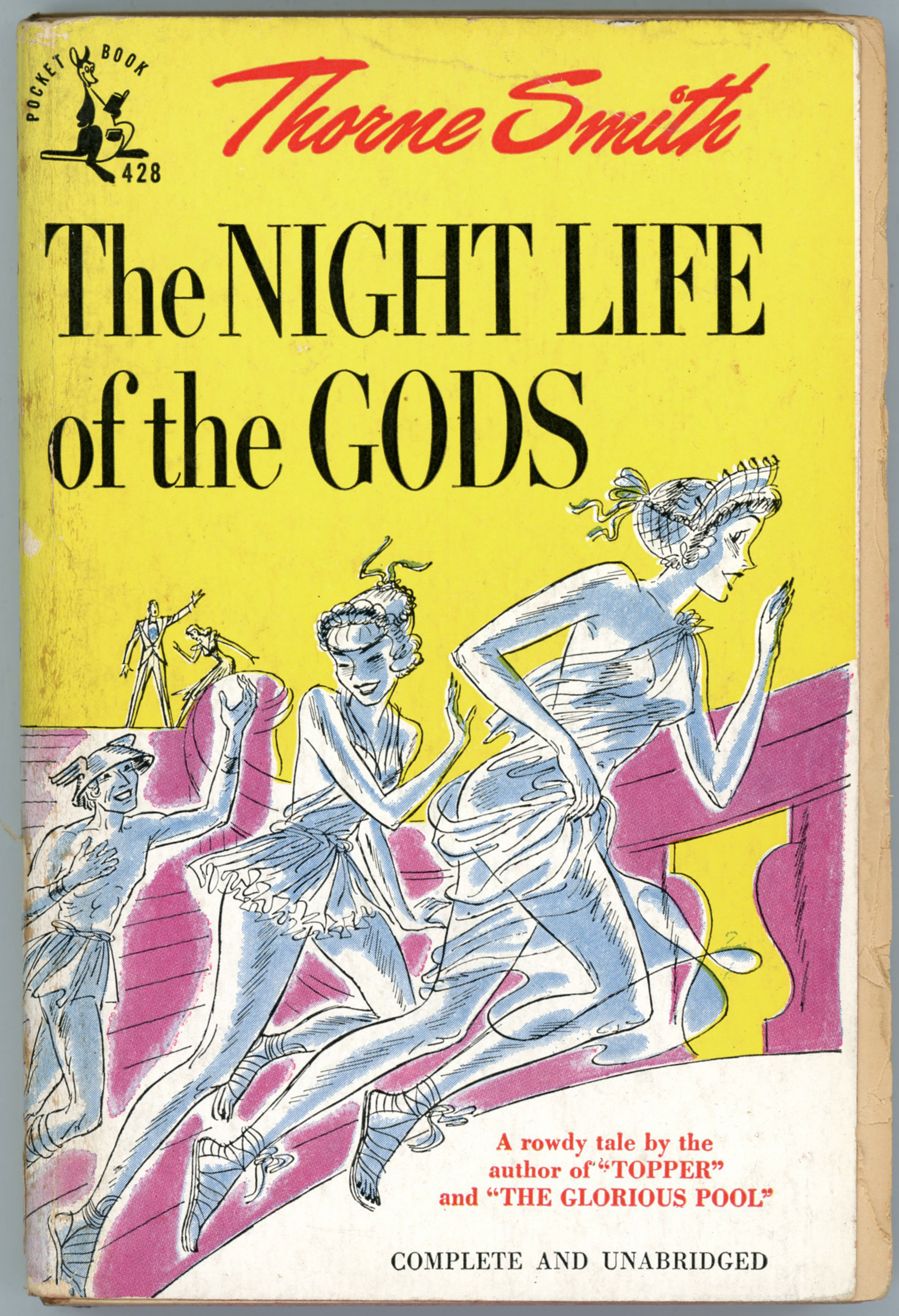
The Night Life of The Gods, by Thorne Smith – January, 1948 (March, 1931) [Gordon Hake]

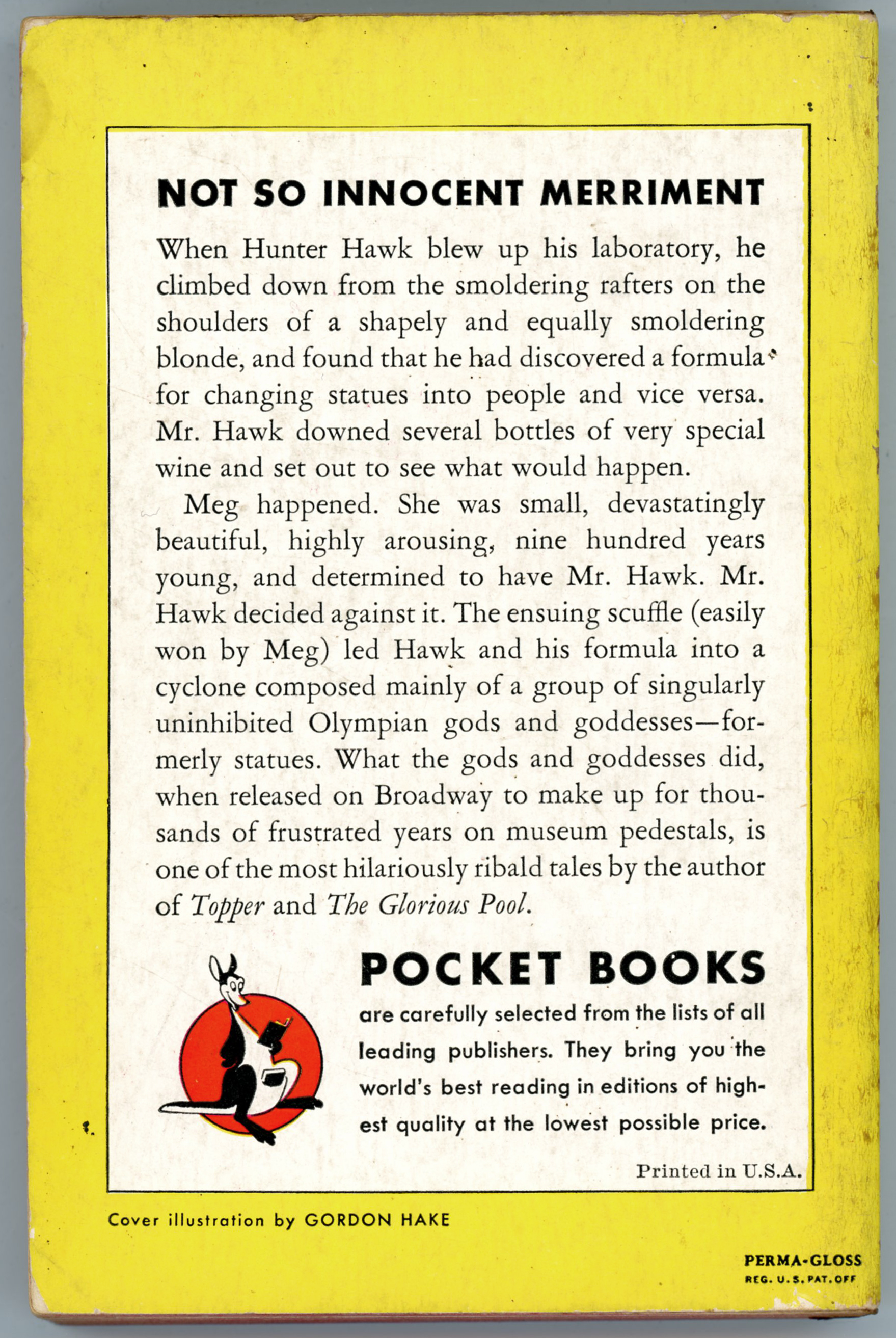
By the time Megara had initiated Mr. Hawk so well into her magic for turning statues into people
and back again that he would remember the simple ritual even when not quite sober,
no one was quite sober,
not even Megara herself. 

As she had previously told him,
it was really a bang-up trick
and not so difficult to master if taken without applejack. 

With his own discovery and Meg’s magic literally at the tips of his fingers,
Hunter Hawk,
with an emotion of exultation not entirely unbeholden to applejack,
felt himself well-equipped to face a new and eventful life.  (64) 

Desire Provoked, by Tracy Daugherty – 1986 [Richard Mantel]

In the fall the valley turns green.
Scholars and mystics have joined hands in attempts to explain why our seasons misbehave.
Weathermen pepper our skies with balloons,
diviners scratch with earth with sticks.
Legends, and curious accounts in leather pouches found in the hollow of a tree,
suggest that the valley was once a lake.
Dogwood blossomed on its banks, peacocks danced in the hills.

Fisherman reported seeing water sprites, twinkling,
no fatter than fingers,
change into bulbous squashlike creatures in the middle of the night. 
What appeared to be falling leaves drifted slowly out over the lake,
then turned into metal filings, which rained down hard upon the men. 
Nothing was safe. 
The shapeshifters smashed turtles, birds, trawlers, anything that settled on the lake.

On shore a chubby boy, an orphan, lived on the pumpkins of the fields. 
He longed to swim.
As he had no family, the villagers assumed responsibility for him.
They warned him of the danger in the water,
but he seemed to have an intimate knowledge of the lake.
He spoke of the colors at the bottom as though he’d been diving.
Some people suggested that he came from the lake;
after all, he had no family.
Where did he come from?

One night,
having informed the fishermen that he was tired of travelling the earth,
he jumped into the shallows and swam.
From time to time the townsfolk saw him in the middle of the lake,
riding a shaggy white buffalo.
Eventually the boy wrenched a horn from the animal’s head and tossed it ashore.
A tree laden with heavy fruit sprang up where it landed.
Next the boy surfaced gripping a black obelisk.
The obelisk was slippery;
often the boy lost his grip,
but finally managed to fling it ashore.
An artesian well burst forth, spraying water high into the air.
The villagers danced beneath the spring,
feasting on heavy fruit as the boy battled tumbleweeds, crates, panes of glass.
Each time he hurled an opponent ashore it became,
instantly,
a source of beauty and health.
The people were delighted.

Finally one creature remained – the mother squash, the biggest in the lake.
The boy caught his breath, ate a chunk of pumpkin, submerged.
He was underwater for hours.
The lake boiled.
Orange steam patches off the water.
The water began to blaze.
Women from the village tossed ice into the deepest part.
A mixture of blood –
male and female, mother and son –
hardened on the surface, burst into flames.
It burned until the lake dried up.
Afterwards there was no sign of the boy or the squash –
just a salt deposit, as if from giant tears.
For years boiling rain seared the dogwoods in the valley.
The grass dried up in summer.

He turns out the light.  “Good night,” he says.

“Daddy?”

“Yes?”

“That was neat.  Will you tell us another story tomorrow night?”

“Sure.  Go to sleep now.” (91-93)

– Tracy Daugherty –