Among the many artists responsible for the vast number of cover and interior illustrations featured in “pulp” science fiction and fantasy of the mid-twentieth century, there are particular individuals whose works – by varying aspects of their unique artistic styles – immediately identify their creators: Among them, Virgil Finlay, Chesley Bonestell, Richard Powers, Hubert Rogers, Kelly Freas. And, Wayne Francis Woodward, who – as an artist and occasional author – went by the name “Hannes Bok”.
Bok’s artistic style – as shown by the cover below, from the November, 1963 issue of The Magazine of Fantasy and Science Fiction – is characterized far less by intricate detail, depictions of technology, and thematic symbolism, than by a mild but pleasing degree of exaggeration of aspects of the human form (note the large eyes, delicate fingers, and elongated bodies of the four subjects in the painting); variations in the degree of saturation of the same color (or related group of colors); above all, a kind of subtle, vaguely three-dimensional “texture” – a visual texture, that is! – to objects and subjects appearing in the painting.
This cover, an outstanding example of Bok’s work, was published only five months before his death in April of 1964. Notably, The Magazine of Fantasy and Science Fiction was one of the few (perhaps the only?) pulp science fiction (and fantasy!) literary magazines of its era to feature such wrap-around covers, which are very striking, regardless of the artist. The first such cover (by George Gibbons) appeared in MF&SF of August of 1952, and others appeared once-or-twice-and-sometimes-thrice (!) per year, from 1958 through 1975.
I hope to bring you some of those full-cover-covers, from my own collection, in the future.
Note: I created this image by separately scanning the front and rear covers, and spine (that was tricky) of my copy, and then digitally combining the three scans into one file, using Adobe. No way was I gonna’ take a chance at breaking the binding of such a notable issue!
By way of comparison, the following two images – from Randy Marcy’s collection at Pinterest – show Bok’s art as originally created. First apparent is that the cover art as published was transposed from left to right (or, right to left, if you prefer). This allowed the image of Martian high-priestess (the woman fascinated by the purple rose) to remain completely unobscured as “stand-alone” art on the back cover, while ample “real-estate” on the front cover remained for magazine title, logo, and authors’ names. Second apparent is that the original art (at least, as present on Pinterest) has substantially higher saturation and contrast than the magazine cover as actually published, like Bok’s art on the cover of Volume 1, Number 1, Science Stories.
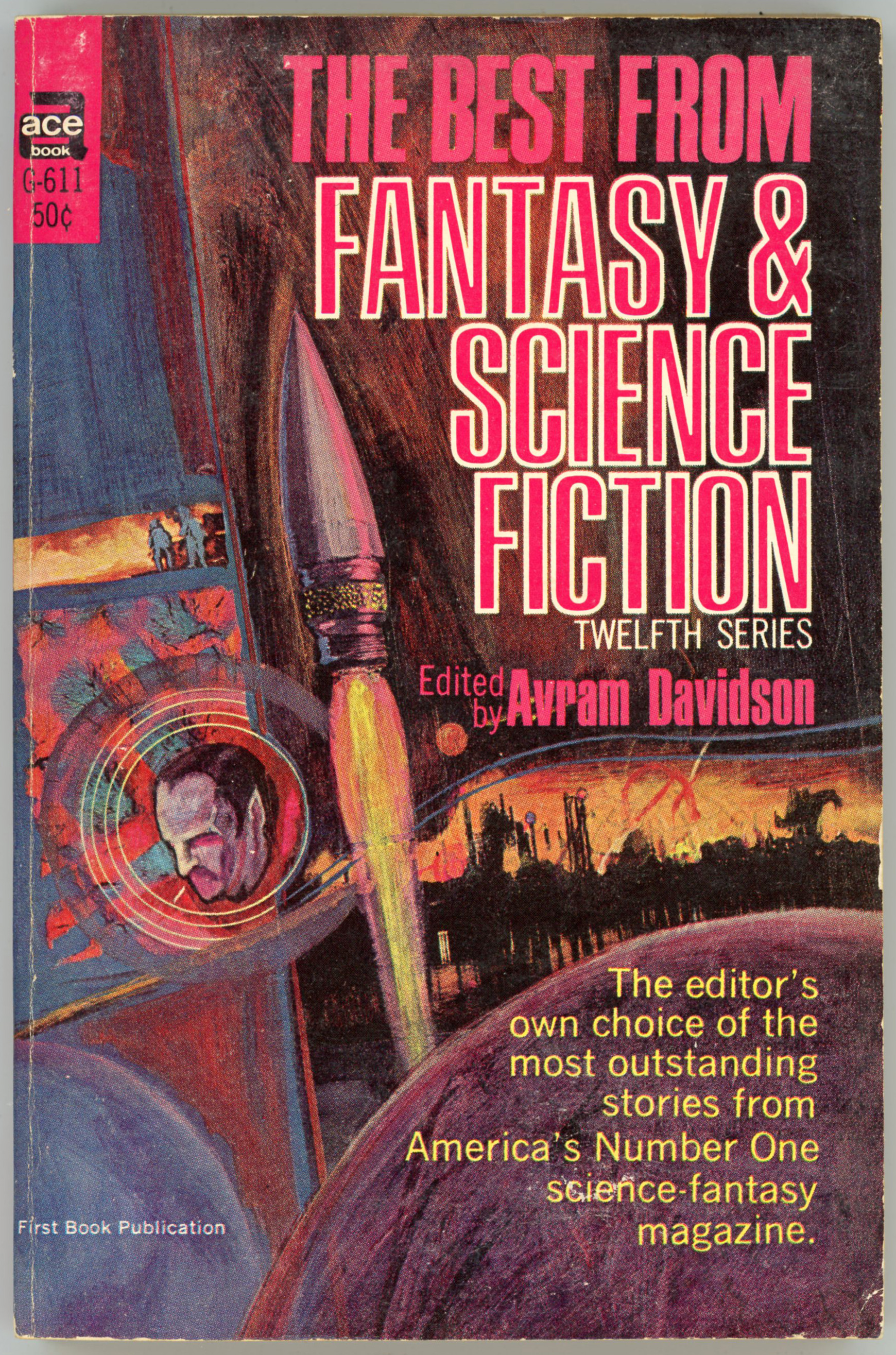
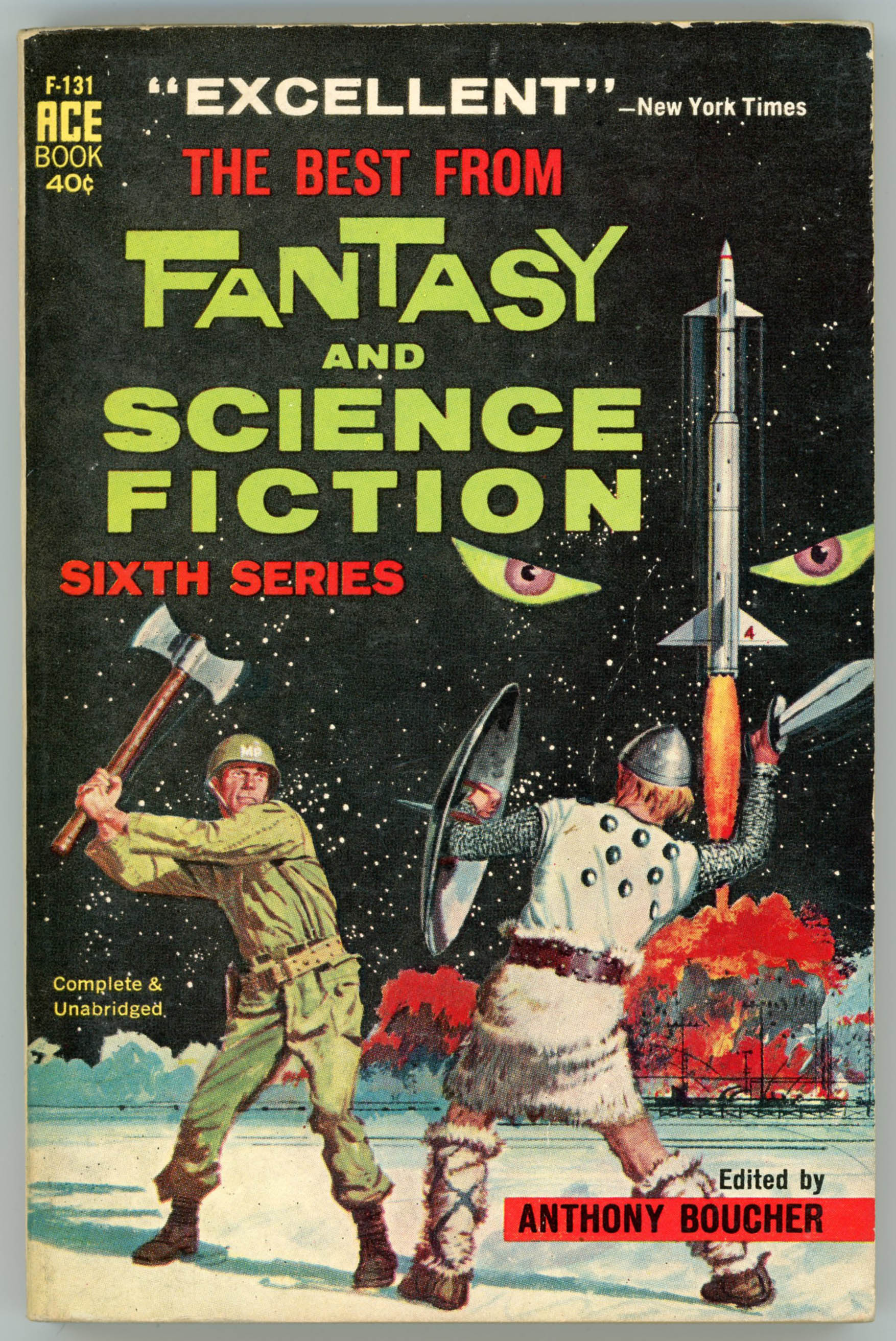
The cover of the Twelfth Series anthology of The Best From (The Magazine of) Fantasy & Science Fiction is certainly “science-fictiony” in terms of a rocket, an alien landscape, and a portrait of a pointy-eared, red-eyed generic “alien”, but is otherwise rather bland. The name of the artist – perhaps someone in Ace’s art department? – is unknown.
Jack Gaughan’s interior, title-page illustration is much more compelling.
(The main image originally at this post – at bottom – was of a sticker-damaged copy of the book, which just demanded the replacement shown below!)
Test, by Theodore L. Thomas
Please Stand By, by Ron Goulart
Who’s In Charge Here, by James Blish
Three For The Stars, by Joseph Dickinson
When Lilacs Last in The Dooryard Bloomed, by Vance Aandahl
Landscape With Sphinxes, by Karen Anderson
My Dear Emily, by Joanna Russ
The Gumdrop King, by Will Stanton
The Golden Horn, by Edgar Pangborn
The Singular Events Which Occurred in the Hovel on The Alley Off of Eye Street, by Avram Davidson
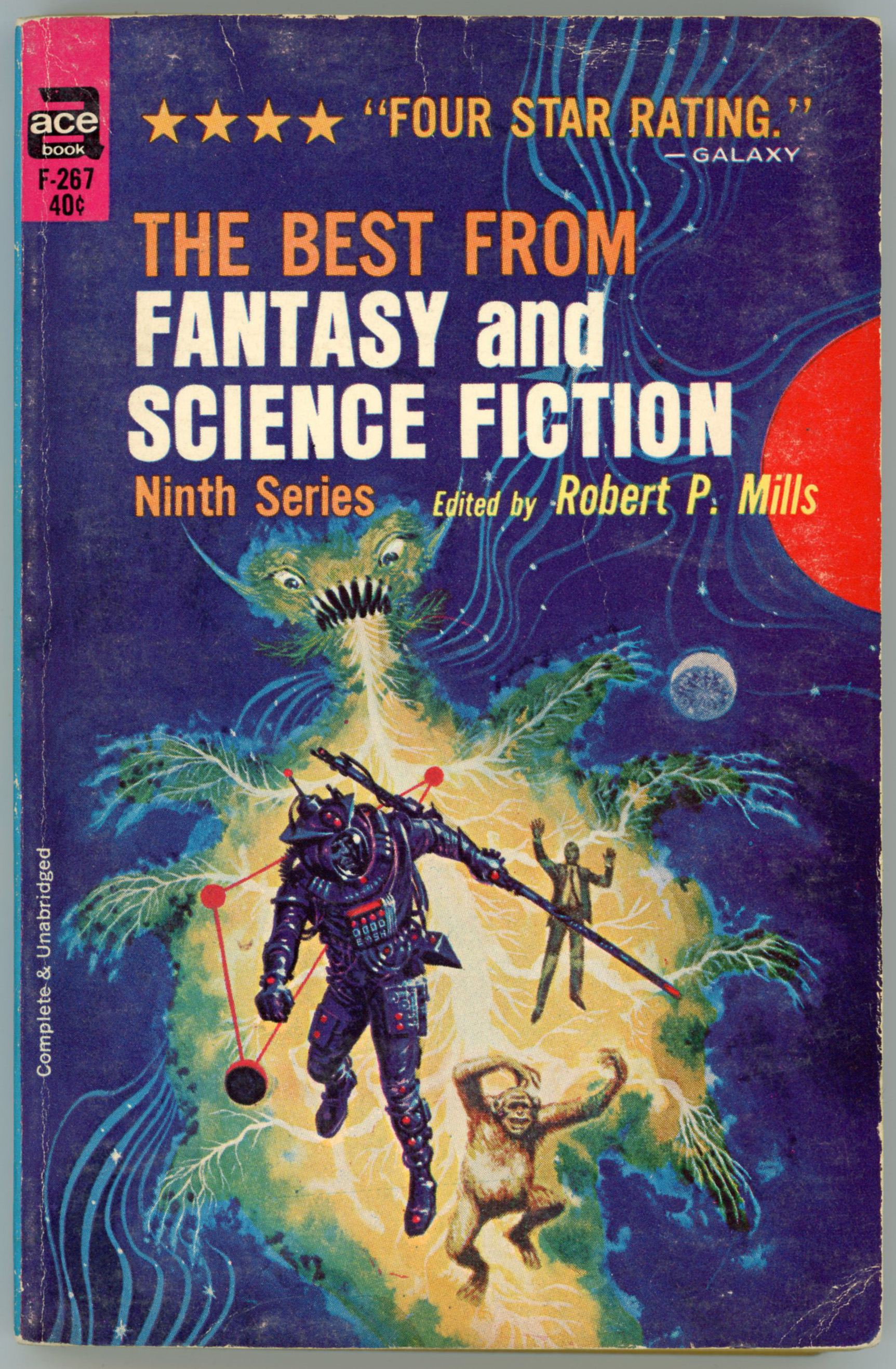
Great cover art by Emsh (Edmund Emshwiller) from 1959: Colorful, directly representational, complex, and dynamic. Not tied to any specific story in the anthology, the art seems (?) to imply a kind of progression: from chimpanzee, to man-in-gray-flannel-suit (Don Draper in an off moment?), to an astronaut, to a kind of fearsome, glowing, lightningy, greenish-blue energy-dragon looking thing.
The astronaut especially stands out: In his left hand he’s carrying some kind of weapon, as if arrayed for battle, or, an ambiguously sciencey probe. If you look closely at the blue and red buttoned-box on his chest, you’ll notice the letters EMSH – as individual letters on the box – which represents Emshwiller’s logo. This was typical of Emshwiller, for he cleverly and unobtrusively incorporated this abbreviation into all his compositions, in lieu of an actual signature at bottom.
Like other Ace science-fiction anthologies, the title page includes a composition – this one by Jack Gaughan.
(The cover scan in this post is an update from the original, which appeared in June of 2017 and featured a rather worn and creased cover. You can see the original image at the bottom of the post.)
Flowers for Algernon, by Daniel Keyes
A Different Purpose, by Kim Bennett
Ralph Wollstonecraft Hedge: A Memoir, by Ron Goulart
“All You Zombies- ”, by Robert A. Heinlein
Casey Agonisties, by R.M. McKenna
Eastward Ho!, by William Tenn
Soul Mate, by Lee Sutton
What Rough Beast, by Damon Knight
Far From Home, by Walter S. Tevis
Invasion of the Planet of Love, by George P. Elliott
Like the great majority of Anderson’s work – at least, what I’ve read of Anderson! – The Man Who Came Early is excellently written, and of greater import, tackles with profound social, psychological, and philosophical questions, all the more impressive in that these are manifested in the form of a short story, rather than a book or novelette. Though ostensibly a tale of science-fiction, themes of technology and science, whether real or conjectural are not really the tale’s focus – this is emphatically not “hard” science fiction! – and only serve as a brief and opening springboard to set the plot in motion. An air of inevitability emerges as the story progresses, and it concludes on a note of pathos, which perhaps makes it all the more effective, and, memorable.
(The copy originally serving as this post’s image – see at bottom; rather bent and worn; I purchased it at a flea market in the 1970s! – has now been supplanted by a scan of a copy in far better condition.)
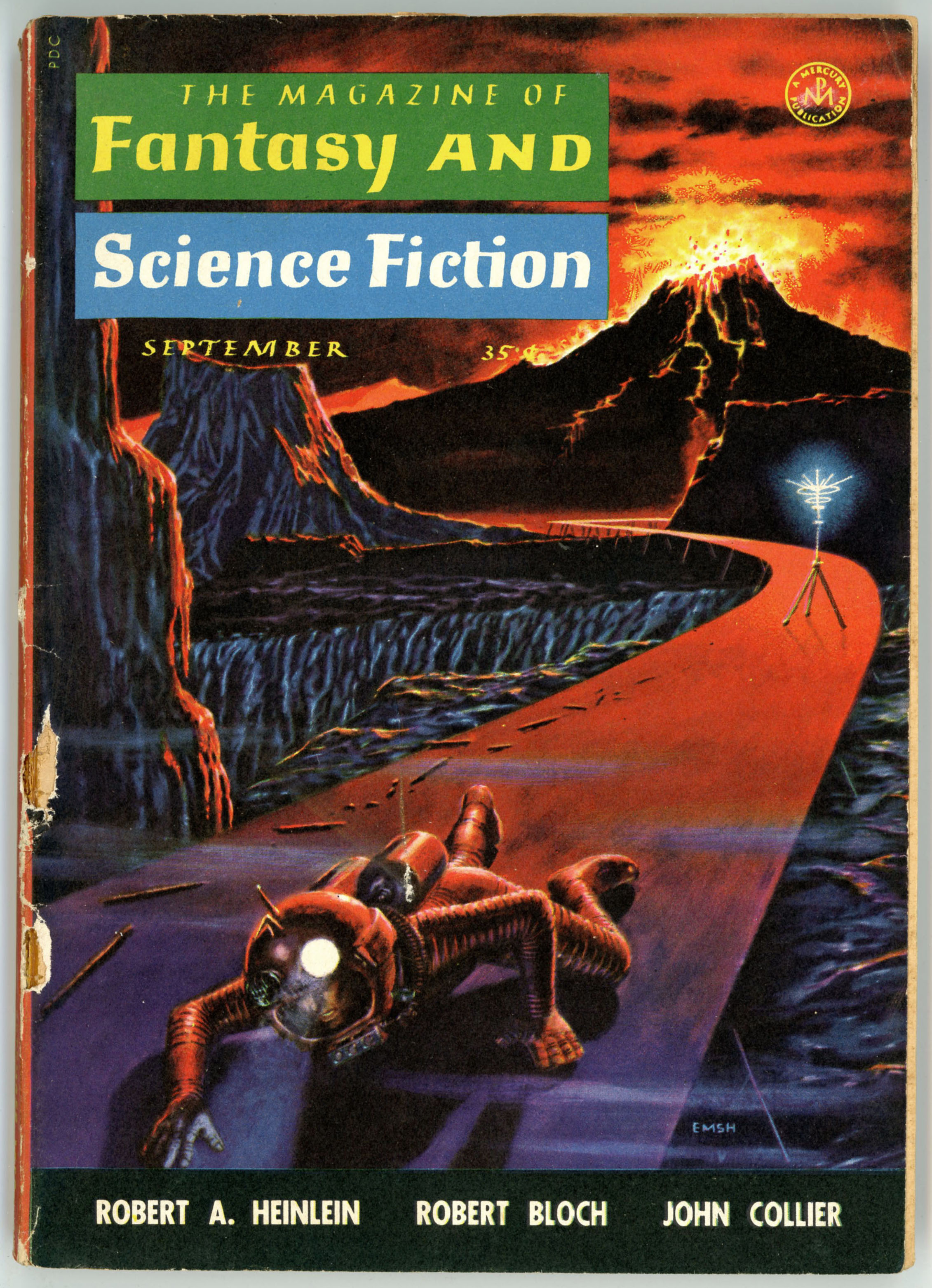
Dating all-the-way-back to August of 2018 (gadzooks!), the cover of MF&SF originally displayed in this post – at bottom – was damaged. But at the time I had no choice: It was the only copy in my possession at the time.
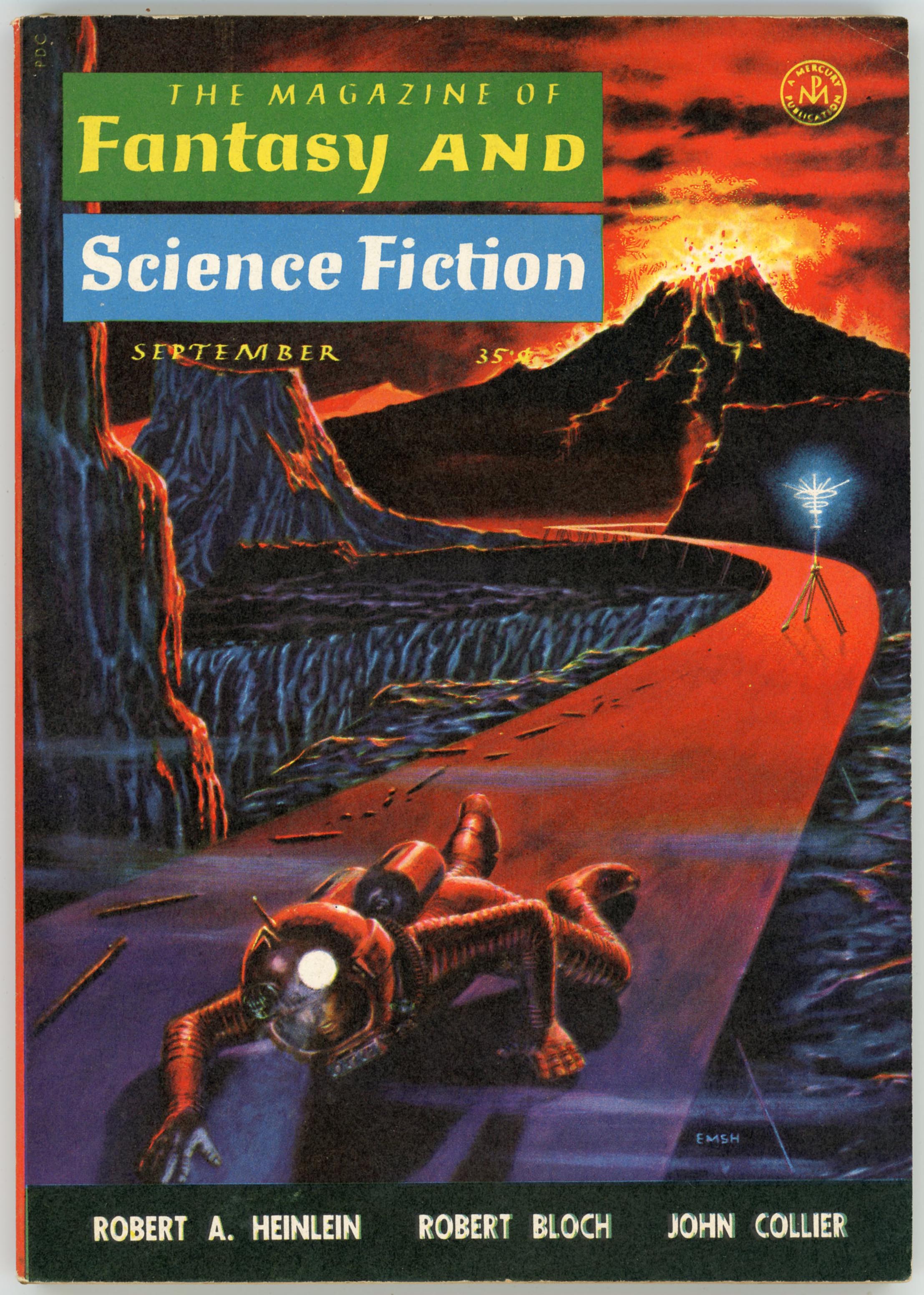
Four years having passed, I’ve recently obtained a near-pristine copy of MF&SF’s September, 1958, issue, which displays Emshwiller’s great cover art in its full complexity and color: It’s for the second of the three-part Robert Heinlein story, “Have Space Suit – Will Travel”.
Sometimes, you buy a magazine because of the content. Sometimes, you buy a magazine because of the cover. And a few times, you buy it for both. (But mostly, just for the cover…)
Case in point, The Magazine of Fantasy & Science Fiction for March of 1980, which featured cover art by Gahan Wilson.
I’d already been somewhat familiar with his cartoons from The New Yorker, but seeing his unique and immediately identifiable work – in color, as a magazine cover – added an entirely new dimension (well, for me) to his oeuvre.
What stands out within this composition? The deliberately dingy atmosphere depicted by dint of darkly shaded green and gray; the goggle-eyed guy gazing in ghastly terror at his own reflection – from the chromed side of the Brave Little Toaster itself; the retinue of raggedy rats reflecting (ruefully?) on the scene revealed before them.
As indicated at the Visual Index of Science Fiction Cover Art, Wilson completed four covers for The Magazine of Fantasy & Science Fiction. Aside from the issue below, the other three were featured in March and August of 1968, and, January of 1969. Among all four, I think that the composition shown in “this” post is easily the best.
Well, though I previously knew of the name “Thomas M. Disch”, by 1980, I’d not read any of his stories prior to that time. But (I thought his tale would be on the humorous side from the humor ofWilson’s cover…) I really enjoyed his story. A pure fantasy – not at all science fiction – it’s an upbeat adventure, and surprisingly substantive as well.
Happily, others realized the depth, fun, and merit of Disch’s story, and in 1987, his work was released as an animated film, directed by Jerry Rees. It’s a great adaptation; a little lighter in tone, perhaps, than the written version, but still true to Disch’s original idea. Simply put, the film is delightful, and in visual terms – viewed from the perspective of 2021 – refreshing and relaxing by virtue of having been completed well before (whew!) the advent of sophisticated CGI.
In his film review, Stephen Holden was entirely correct in writing, “Visually the movie has a smooth-flowing momentum and a lush storybook opulence that is miles away from the flat, jerky look of Saturday-morning cartoons. The fable of bored, squabbling playmates who become closer as they voyage into the unknown is unmarred by sentimentality and preachiness. At the same time, it exudes a sweetness and wit that should tickle anyone, regardless of age.”
Here’s Holden’s review, as it appeared in print, in The New York Times on May 31, 1989…
…and, a transcript of the review:
The Odyssey of a Band of Lonely Gadgets
By STEPHEN HOLDEN
It’s wake-up time in an empty mountain cabin, and the first appliance in the house to rouse itself is a jazzy-looking bedside radio that blares out an Al Jolson-style song. The noise quickly wakens the other appliances. The doggy-faced desk lamp flashes on, Kirby, the cranky, growling vacuum cleaner is ready for action, and Blankey, the meek, frightened electric blanket peeps awake. The most optimistic gadget is a toaster with a perky voice, big round eyes and a cute bowed smile. On this particular morning, the toaster tries to organize everyone into doing their usual chores. But without their master to use them, their existence seems lonely and purposeless.
Jerry Rees’s charming animated feature, “The Brave Little Toaster,” tells what happens when the appliances finally band together with a battered old desk chair using an old car battery for power, and embark on a journey to the city to find their master. If the film’s world of talking appliances with distinctive personalities has much in common with Pee-wee Herman’s Playhouse, its tone is more lyrical and dreamy than Mr. Herman’s squeaky, crowded Saturday-morning habitat. Their odyssey from the mountains to the city takes them through a redwood forest, into quicksand and over a waterfall. During the course of their journey, each traveler does something generous and brave, and the bonds between them strengthen.
Once they reach the city and are directed by a friendly traffic light to their master’s apartment, the appliances are dismayed to find themselves superseded by newer, more sophisticated technology. Ruling the apartment is a slick and snooty digital television set. Before their master comes home to find them, they are unceremoniously thrown out the window into a passing garbage truck. Only an act of heroism by the toaster prevents them all from being crushed for scrap in a junkyard.
“The Brave Little Toaster,” which opened a two-week engagement today at the Film Forum, brings one back nostalgically to the age when everyday household objects seemed to have faces and personalities. The screenplay by Mr. Dees and Joe Ranft, based on a novella by Thomas M. Disch, maintains a delightfully informal tone. The appliances are like any pack of kids. In moments of pique along their journey, they snap epithets like “chrome-dome,” “dialface,” and “slot-head” at one another.
Visually the movie has a smooth-flowing momentum and a lush storybook opulence that is miles away from the flat, jerky look of Saturday-morning cartoons. The fable of bored, squabbling playmates who become closer as they voyage into the unknown is unmarred by sentimentality and preachiness. At the same time, it exudes a sweetness and wit that should tickle anyone, regardless of age.
Several Appliances In Search of an Owner
THE BRAVE LITTLE TOASTER, directed by Jerry Rees; written by Mr. Rees and Joe Ranft, based on a novella by Thomas M. Disch; music by David Newman; produced by Donald Kushner and Thomas L. Wilhite; distributed by Hyperion Entertainment Inc. At Film Forum 1, 57 Watts Street. Running time: 90 minutes. This film has no rating.
Voices by: Jon Lovitz, Tim Stack, Timothy Day and Thurl Ravenscroft
Fortunately, the entire film can be viewed at YouTube. (Thus far.) Here it is:
[This post, created on June 30, 2018, is very simple: It shows the cover of the August, 1958 issue of The Magazine of Fantasy and Science Fiction, in which appeared the first installment of Robert Heinlein’s Have Spacesuit – Will Travel. It’s now updated to an image of Edmund Emshwiller’s (a.k.a. EMSH) original cover art. The original composition readily conveys how the center of activity and therefore visual interest in Emshwiller’s composition, is situated to right and at bottom, leaving room for the magazine’s title and contents to left and at top. Also, both the original painting and the cover as published are a great example of how Emshwiller would cleverly situate his logo – EMSH – within the painting in such a manner as to make it an almost natural part of the scene.]
____________________
The cover as published…
…Edmund Emshwiller’s original art, from Heritage Auctions. The original is described as “acrylic on board, 19.75 x 13.5 inches, framed under acrylic to 24.5 x 18.25 inches, from the Glynn and Suzanne Crain Collection“.
Reference
“Have Spacesuit-Will Travel, Fantasy and Science Fiction cover”, August 1958, at Heritage Auctions
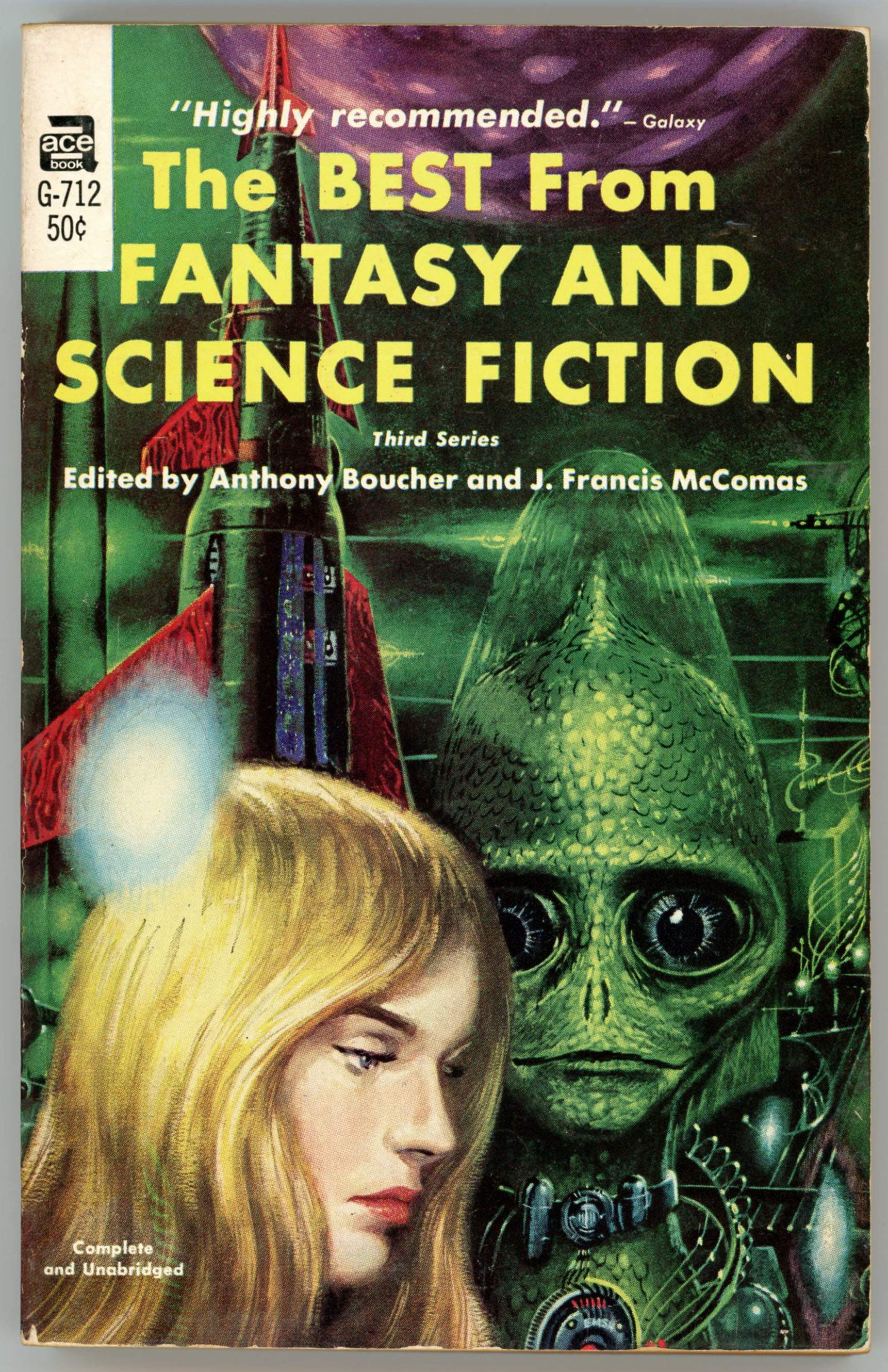
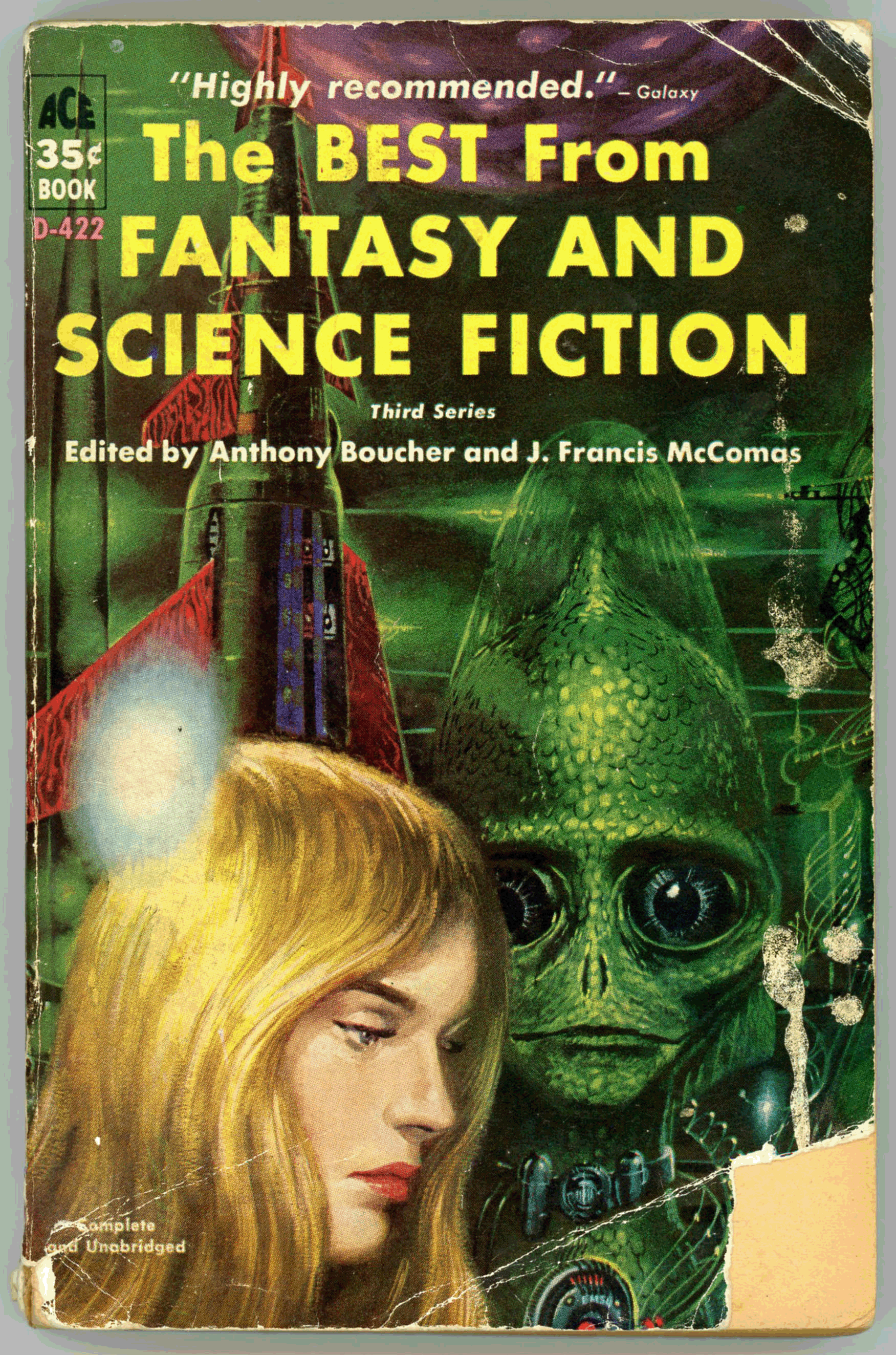
Dating from June of 2017 (gadzooks!), this was one the earliest posts at WordsEnvisioned: The cover of the third volume (or, third series, as it were) of stories published in The Magazine of Fantasy and Science Fiction during 1953.
The post originally showing a rather bedraggled copy of the book, which I purchased at a flea market some decades ago. (See image at bottom.) It’s now been updated with a pristine copy, which presents Edmund Emshwiller’s cover art in its complete imagination and intricacy. In this case, for Kay Rogers’ tale “Experiment”.
This is also a great example of how “Emsh” sort of “hid” his nickname in his illustrations: In this case, “EMSH” appears in tiny blue letters in the center of the aquatic space-alien’s chest. Uh, assuming the space-alien has a chest…
“Attitudes”, by Philip Jose Farmer, October, 1953
“Maybe Just a Little One”, by Reginald Bretnor, February, 1953
“The Star Gypsies”, by William Lindsay Graham, July, 1953
“The Untimely Toper”, by L. Sprague de Camp and Fletcher Pratt, July, 1953
“Vandy, Vandy”, by Manly Wade Wellman, March, 1953
“Experiment, by Kay Rogers, February, 1953
“Lot”, by Ward Moore, May, 1953
“Manuscript Found in a Vacuum”, by Philip Maitland Hubbard, August, 1953
“The Maladjusted Classroom”, by Homer Czar Nearing, Jr., June, 1953
“Child by Chronos”, by Charles L. Harness, June, 1953
“New Ritual”, by Idris Seabright, January, 1953
“Devlin”, by William Bernard Ready, April, 1953
“Captive Audience”, by Anne Warren Griffith, August, 1953
“Snulbug”, by Anthony Boucher, May, 1953 (originally in Unknown Worlds, December, 1941)
“Shepherd’s Boy”, by Richard Middleton, March, 1953 (originally in The Ghost Ship & Other Stories, May, 1912)
“Star Light, Star Bright”, by Alfred Bester, July, 1953
Four short months after the appearance of his cover illustration for the June, 1962, issue of The Magazine of Fantasy and Science Fiction, Edmund Emshwiller – “Emsh” – created cover art for the magazine’s November issue that was utterly different in style and mood. Though this painting, too, depicted an astronaut, this space explorer seems to be a person quite different from “George”, the intergalactic dispenser of unknown elixers!
Taken at first (and second?) glance, the viewer might be hard-pressed to think that the two illustrations were products of the same hand. November’s astronaut is painted in bold, rough-edged, unrefined strokes. His spacesuit is odd: His visor is a little confining, if it is a visor: It iincorporates a set of vertical bars. His helmet is decorated with two cylindrical, mechanical protrusions: While they could be thrusters for maneuvering in space, they look all the world like something a little more earthbound: Spigots. Beer spigots, that is. Well, there is lots of ambiguity going on here, which is reflected in the astronaut’s pensive countenance.
The sky behind provides an interesting contrast: Rather than appearing as gradations of a particular shade of color, or a series of colors gradually blending into and away from one another, the sky appears as distinctly-edged waves of green, purplish-brown, medium blue, and dark blue, with a few small stars floating just above the horizon: The feel is vaguely reminiscent; lightly akin, to Vincent van Gogh’s The Starry Night, albeit spacecraft were not known to have existed during van Gogh’s lifetime. At least, as far as is known. At least, on earth.
Something else; a tiny detail: Ed Emshwiller typically signed his art with the four-letter moniker “EMSH” tiny in capital letters, often “hiding” his diminutively-written signature somewhere within the details of his finished work, whether painting or black & white interior illustration. For example, in the June, 1962 issue of TMFandSF, “EMSH” appears on the sole of the astronaut’s left boot.
But, November’s cover is anonymous: EMSH is nowhere to be found. And, another similarity with June: This, too, is a “stand-alone” illustration: The painting pertains to none of the stories within the issue, and, is un-named in the table of contents.
Usually, we think of whimsicality in terms of the play of words and sentences.
But, the visual arts can be whimsical as well.
Case in point, the work of Edmund Emshwiller (or, “EMSH”, for short). An artist whose extraordinarily prolific output was only exceeded by his sense of imagination and creativity, Emsh’s oeuvre primarily comprised cover art for softcover books and pulp magazines, as well as – perhaps more abundantly – black and white interior illustrations. His cover paintings for both literary formats are characterized by boldness and variety of color, an almost camera-like, stop-motion “capture” and portrayal of action (whether of individual men and women, machines, or both), and, an almost physicalized and detailed crispness and clarity to alien worlds and imagined future technology, the latter particularly in terms of the interiors of spacecraft, as well as spacesuits, weapons, and related equipment.
But on occasion, his art took a different (or latent?!) turn: It could be humorously insightful, as shown on the cover of the January, 1955 issue of Galaxy Science Fiction.
Or, it could playful, as seen in cover of the June, 1962 issue of The Magazine of Fantasy and Science Fiction. Here, while the taken-for-granted scenario of an astronaut floating in the void of intergalactic space might conventionally focus on the rather – um, er, ah – challenging (?!) aspects of this predicament most dire, Emsh – presumably inspired by illustrations of spacesuits prevalent at the time, particularly Randall F. White and George J. Scott’s 1961 design for a full pressure flight suit (below), from Patent Room.com – takes a different turn.
Our hero George (or, is he an anti-hero!?) is equipped with an air tank decorated with the phrase “GEORGE’S ELIXIR – GUARANTEED MONEY BACK IF NOT COMPLETELY SATISFIED.”
On his arm, where a tattoo would be: “MOTHER”
Oh his torso, where a tattoo could be: an octopus, a pair of dice, and the shield from the Great Seal of the United States.
On his thigh, where a tattoo might be: a nude image of “ROSIE”, and, the head of a bald eagle.
On his calf, where a tattoo almost certainly is: “HOME SWEET HOME”.
Alas. This is a stand-alone illustration: While the table of contents lists the artist as “Ed Emsh”, no title attached to the painting, and the painting pertains to no story.