A quick perusal of my blog posts covering the art of Richard M. Powers, let alone an examination of the over 17,500 Oogle “hits” – as of July, 2022 – for the text-string “Artist “Richard M. Powers””, immediately reveals that his oeuvre overwhelmingly took the form of cover illustrations for books, both paperback and hardcover, largely but not exclusively in the genre of science fiction. (Thus far, Duck Duck Go doesn’t display figures for search results!. Alas, alas!)
The primary distinguishing quality of his work, in comparison with that of other, probably better-known (?!) illustrators in the realms of science-fiction (and to a lesser extent fantasy and adventure) is that it’s not purely representative: Though Powers was more than capable of rendering compelling images of the human form and facial features, the objects and settings, as well as backgrounds and foregrounds, appearing in his compositions are really the most compelling aspects of his art. In these, the primary emphasis is upon visual symbolism, in the form of stylized spaceships and astronauts; landscapes and planetscapes, and the use of background colors that serve to accentuate and enhance foreground features. Taken together, these qualities impart a sense of mystery to his paintings: The scene is more than an image: It is a question. As for Powers’ impact on the field of illustration, John Schoenherr’s works seem to share at least some aspects of the former’s work, while those of British artist Brian M. Lewis most definitely do. In fact, the similarities between Lewis’ late 1950s-early 1960s cover art for New Worlds, Science Fantasy, and Science Fiction Adventures and those of Powers are absolutely unmistakable, the major difference being that scenes and objects in Lewis’ illustrations have a cleaner, crisper, more defined appearance than those in Powers’. In a way, Lewis took Powers’ style to another – not necessarily better, but perhaps more refined! – level.
So…
The vast majority of Powers’ work having appeared in book format, his work appeared as the cover art of seven science fiction magazines … at least, that I know of! He created two covers for Beyond Fantasy Fiction, two for Galaxy Science Fiction, two for Galaxy Science Fiction Novels, and one for the cover of the first (and only) issue of Star Science Fiction (magazine), an outgrowth of the Star Science Fiction anthology, for which he completed covers for five of the six books in that series. Links to these covers follow:
This brings up a curious “inside” question: Unlike, say, Frank Kelly Freas, Edmund Emshwiller, or Hubert Rogers – who did both cover art and black and white interior illustrations – Powers interior art seems (seemed) to have been limited to the eight sketches that accompanied story titles in the single 1958 issue of Star Science Fiction.
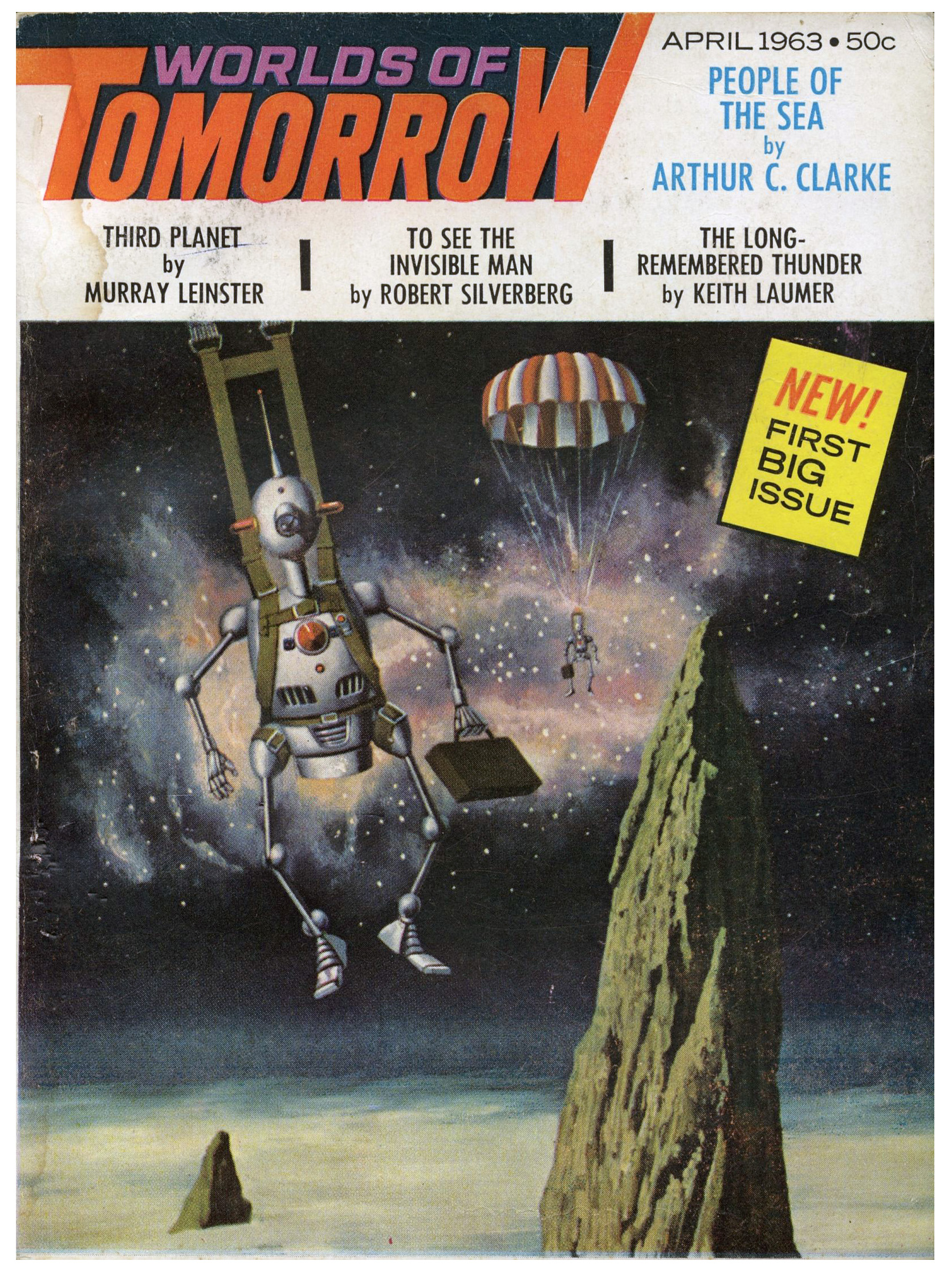
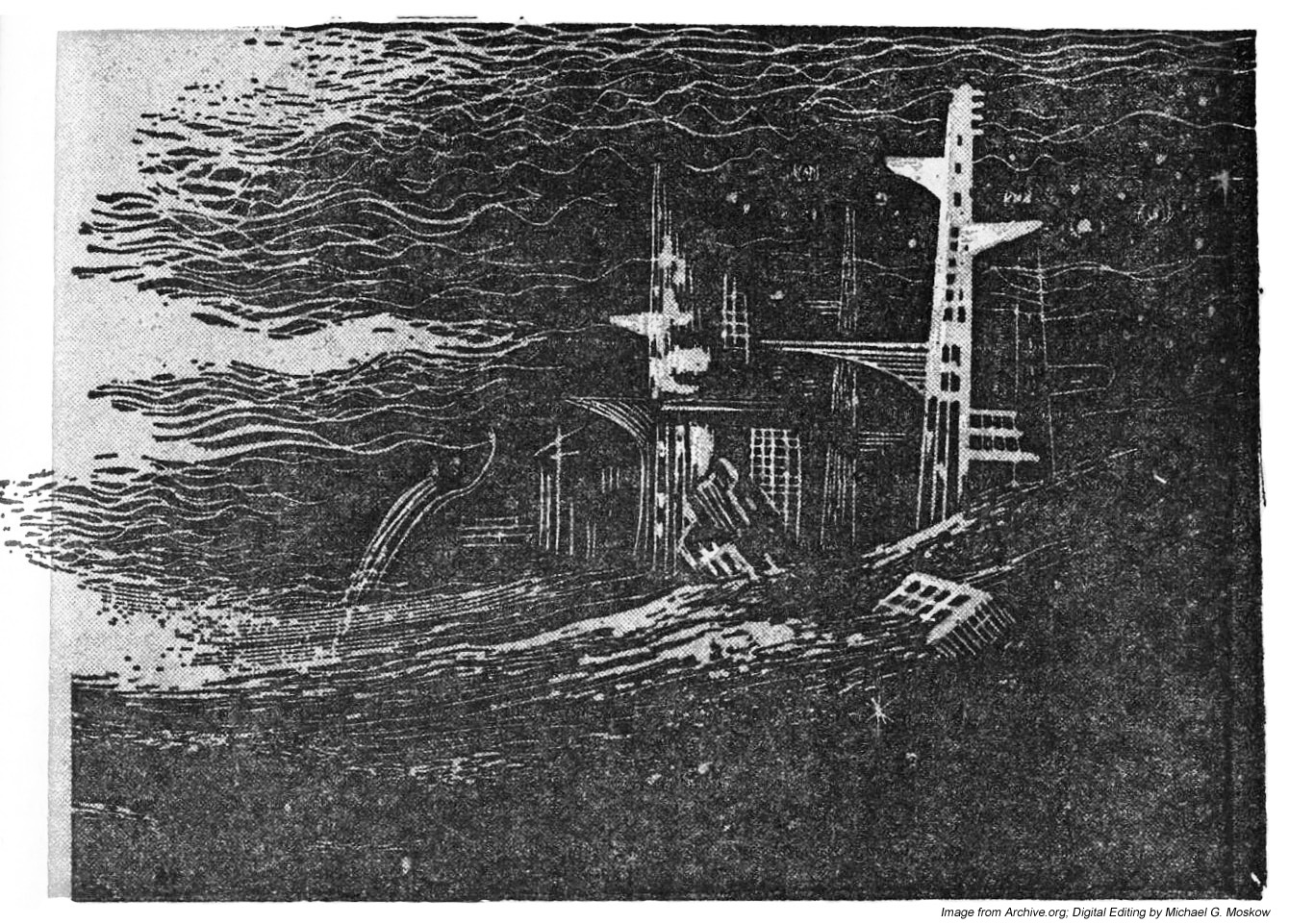
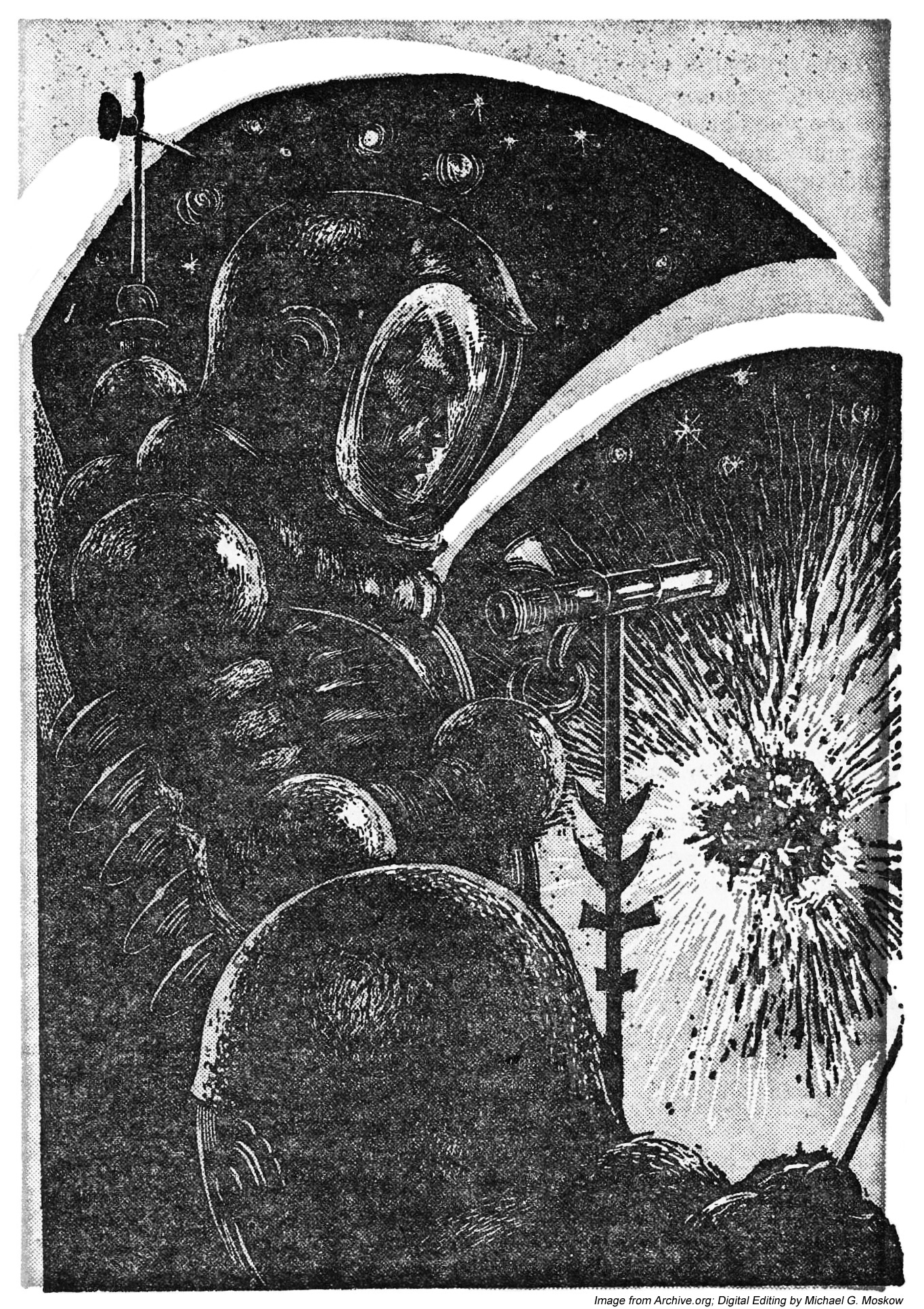
Then, I noticed something. While quite randomly perusing issues of Worlds of Tomorrow at the Pulp Magazine Archive, I chanced across the magazine’s issue for April of 1963, which featured humorous cover art by John Pederson, Jr., showing two robots, each carrying a briefcase, parachuting onto the surface of a cloud-covered, craggy, alien world. (Gadzooks! Shades of robotic Mad Men in space?!) Then, a little more clicking through the magazine’s pages revealed three very interesting uncredited black and white sketches, accompanying Murray Leinster’s story “Third Planet”. (Though I don’t know if the drawings have any relation to Leinster’s story; I’ve not read it.) Each picture is highlighted by red, perhaps in an attempt to enhance the picture. If so, it’s a futile gesture, for coloring these drawings makes them look absolutely awful; they’re better served by remaining in black and white. So, for the purposes of this post, I’ve “deleted” the red via Photoshop. (Well, it helps. A little.)
Anyway, it’s the second and third images – the destroyed cityscape, and, the two astronauts observing an exploding something-or-other in space – that make it certain that this set of drawings is by Powers. Comments follow…
____________________
____________________
____________________
Page 103
__________
____________________
Page 104
This image is strongly reminiscent of Powers’ cover art for Horace Coon’s 43,000 Years Later.
__________
____________________
Page 116
This illustration is a dead-ringer for Powers’ other 1950s and 1960s depictions of space explorers: The really bulbous, medieval-armor-like spacesuit; the astronaut being shown in profile; the weather-wave-thingy atop his backpack; his spacesuit arm ending in a grappling hook, rather than a glove, while manipulating a long, vaguely sciency-looking metal something or other.
[Though I created this post back on August 15, 2021, I’ve felt through the intervening year (it’s now July of 2022) that a central aspect of the story of “Red Sky at Morning” – the movie “Red Sky”, rather than Richard Bradford’s original novel upon which the film is based – has been missing. That missing piece is, given the centrality of Catherine Burns’ performance to the movie “Red Sky”, the story of Burns’ own life. While some of the links listed below, such as Wikipedia and IMDB, shed light on Burns’ life and brief acting career, by nature the information therein is limited in scope and depth.
However, the puzzle is a puzzle no longer. Scott Feinberg and Scott Johnson’s poignant and moving article “Catherine Burns: The Vanishing of an Oscar-Nominated Actress”, from February 3, 2020, atHollywoodReporter.com, provides a much fuller biography of Burns, encompassing her upbringing, brief acting career, and subsequent, intentionally anonymous life as a writer.]
______________________________
“I am one of a kind,” she said. “Ah, but what kind?” – Catherine Burns, 1989
_____
There wasn’t anything I could do. I just stood there with my hands behind me, wondering what was happening, and what was going to happen.
_____
“How old is this friend of yours that has the figure?” “My age. Seventeen.” “My God, are you insane? I already have a civic reputation as a lewd old man.” “This is a really nice girl. Her father’s a minister.” “Worse and worse.”
________________________________________
“Red sky at night, sailors’ delight. Red sky at morning, sailors take warning.”
Red Sky at Morning. I remember this movie.
I remember catching it on NBC television in the 1970s. (The specific date and time were, just now I’ve found, Wednesday, January 30, 1974, at ten PM. )
I remember being as uninterested as I was unimpressed with the film – “Boring!”– which – looking back – was probably more reflective of my age than the film itself. Yet even then, to the small extent that I viewed it (“Isn’t anything going to happen?! It’s World War Two after all…!”) I noticed what I’d deem, in retrospect, to have been the air of skepticism? – distance? – deliberate anti-nostalgia? – surrounding the characters and story, especially in light of it having been set well into America’s engagement in the Second World War. The events of which, I noticed, were far, far more backdrop than central to the story.
And, I remember the presence of Richard Thomas in the film. That guy from The Waltons… What was he doing in New Mexico? I thought he was in Virginia…
(I was always interested in movies, television programs, and books dealing with history, but somehow, The Waltons left me cold. The show seemed to have been permeated by a Potekmin-Village-like air of near mathematically-generated-sentimentality, especially the grating, contrived, ingenuous “Niiight, ‘sooo-and-sooo’…. routine that accompanied each episode’s closing credits (I’d turn the volume down whenever that came on) particularly ironic given the post-WW II ideological ethos of the CBS Television network (and not just CBS) – which today, looking back from 2021, seems quaint.)
________________________________________
So, moving forward.
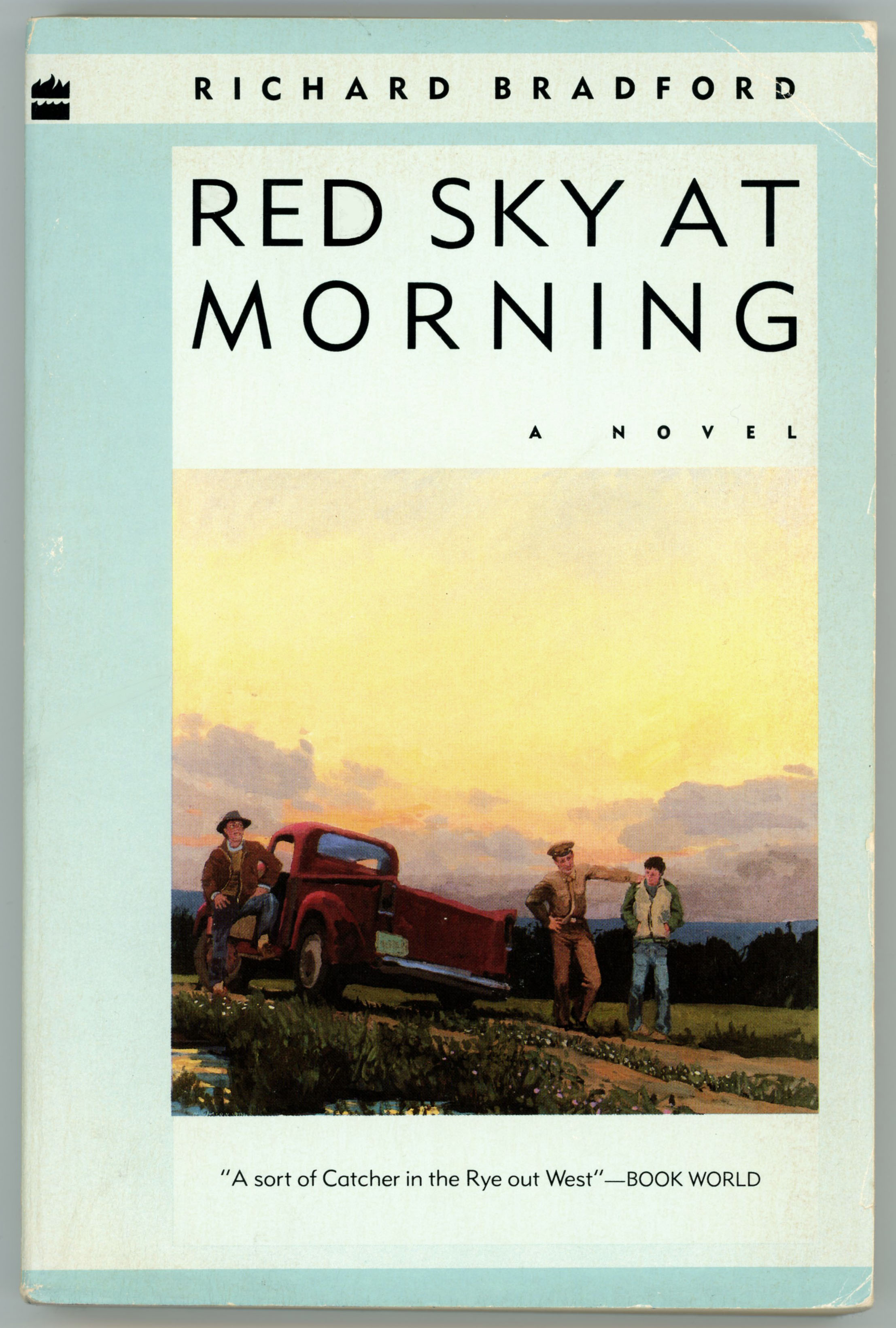
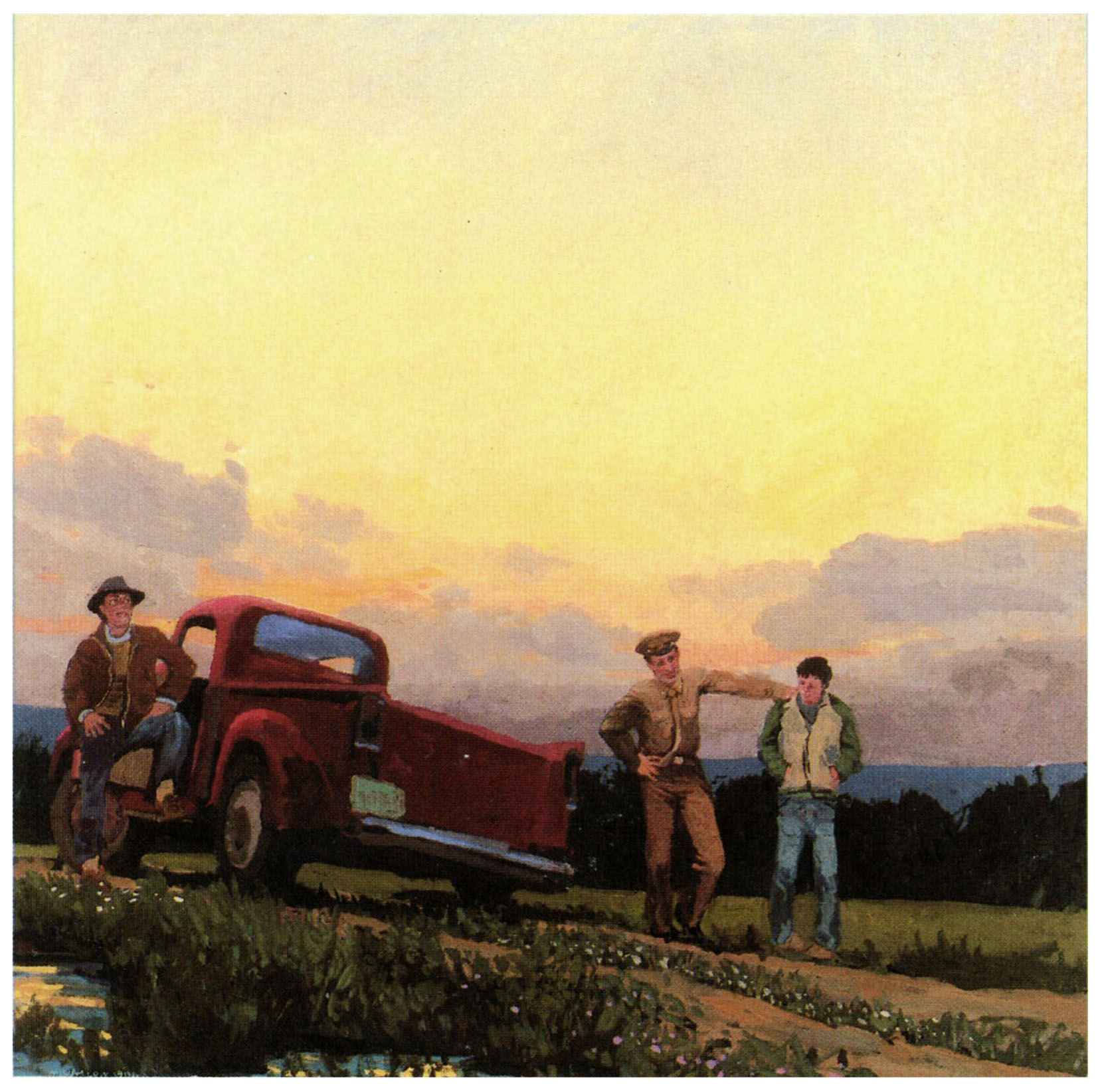
Here’s the 1986 Harper Perennial edition of Richard Bradford’s Red Sky At Morning. What really caught my attention far more than the story itself (!) – well, thus far! – is William Low’s lovely, subtle, and entirely well-conceived cover art, which expresses a transition from youth to adulthood; the uncertainty between moods of “beginning”, “possibility”, and the arrival of a new horizon – or impending danger, the “unknown”, and “oncoming challenge” – all depending on the viewer’s mindset – “Do you see morning or evening?”; the manner in which most of the composition is actually occupied by horizon and sky, rather than characters and action; the characters themselves, representing a triad of youth, young adulthood, and (wizened? detached? patient? skeptical?) middle age:
There’s a conversation going on…
________________________________________
So. I have not read the novel just yet (too much of a backlog!), but these excerpts give an appreciation for Bradford’s prose…
____________________
“Amadeo,” she said, “seems to be forgetting that he’s a servant and not a member of the family. Your father’s always been too lenient with both of them. He seems to lose all perspective when he come to Sagrado, and forgets his class distinctions. Class distinctions are extremely important, because without them nobody knows where his place in life is. A stable society is a society in which everyone knows his situation.”
“And anything else is Red Communism, right?”
“Don’t you dare be sarcastic with me. Don’t you dare be snotty. You’re already picking up a lot of filthy manners from those tacky trash you go to school with, that Greek boy and that Davidson girl. Do you know that she’s Jewish?”
“I thought her father was the Episcopal minister,” I said.
“He is,” she said. “That’s just the point. That’s the first thing they do, become Episcopals.”
“Well, if they’re Episcopals, how can they be Jewish? I mean, if you switch from being a Baptist to being a Methodist, you’re not a Baptist any more.”
“I don’t care how Episcopalian they pretend to be. I don’t care if one of them becomes the Archbishop of Canterbury.”
“Okay,” I said. “First thing tomorrow I’ll go out and paint a swastika on St. Thomas’s.”
“You just shut your mouth, Joshua M. Arnold, or I’ll come over there and slap it shut for you. I’m going to write your father about your behavior.”
“You might mention in the same letter that Kimbob’s got pneumonia. Dad might need some cheering up.”
She got up from he chair and walked three or four steps and slapped me on the check with her right hand. I didn’t even have time to finch; she’d never slapped me before. It didn’t really hurt, but it stung, and it made me sick to my stomach. I felt as though I’d been hit by a crazy stranger. I wanted to hit her back, to slug her a good one, so I locked my hands behind my back to be sure I wouldn’t. She cracked me another one, backhand, on the nose, and it made tears come to my eyes. I could feel my nose starting to bleed. There wasn’t anything I could do. I just stood there with my hands behind me, wondering what was happening, and what was going to happen. I was much bigger than she was, and heavier and stronger. I’d never noticed before what a little woman my mother was. I looked at her face closely while she was hitting me, and it was a stranger’s face. Her cheeks were fuller than they’d ever been, and her skin was gray. There were tiny grape-colored lines in her cheeks near her nose, and the whites of her eyes were pink, as it she’d been swimming in a chlorinated pool. Each time she slapped me I caught a whiff of sherry.
She said, “Apologize! Apologize! Apologize!” and each time she said it she slapped me. But when I opened my mouth she hit me in it. I don’t know how many time she slapped me. My face was getting numb, and the slaps sent little dark red drops of blood from my nose flying around the room. After five or six blows, I realized, in a detached and clear-headed way, that I wasn’t angry any more, just bored. So I finally brought my hands around in front of me and grabbed her wrists and held them. They were thin and without strength. I said, as slowly and clearly as I could, “I’m sorry, Mother,” and dropped her wrists and walked into my bedroom. It was only after I’d sat down on the side of the bed that my legs began to tremble.
I sat in the dark for several minutes, waiting for her to come in and start again, but she didn’t. I turned on the light and went into the bathroom and wiped the blood off my face with a wet washcloth, and then I threw up the coffee that Chango’s parents had served me. (115-117)
________________________________________
________________________________________
I walked home alone, and saw that the frying pan from breakfast was still in the sink where I’d left it. My mother was still in her room; I could hear her humming tunelessly to herself. I washed the frying pan and put it away, and then went down the hill, turning left on Camino Chiquito to go to Romeo’s studio.
He had a dirty white bandage wrapped around his head, and a purple bruise extending down his jaw. He pointed to it. “Anna moved out, and left me with this. She hit me with an iron saucepan during a perfectly civil discussion about art, and when I awoke she was gone, along with eighteen dollars and several cases of Vienna sausage, which I’d been saving for when I was really broke. Come in. I want you to meet Shirley.”
Shirley was sitting at the table, smoking a cigarette, and wearing the same dirty bathrobe that Anna had worn. She was very large and sleepy-looking, and acknowledged my presence by slowly nodding her head. Her bathrobe was untied, and she was naked underneath it. She arranged it arranged her very deliberately, without changing her expression. “Romeo”, she said, yawning, “I’m tired. Can I rest now?”
“Shirley, my dear, you’ve been resting for half an hour. Don’t you remember? Look at all the cigarette butts in the ashtray.”
“Oh,” she said, “half an hour. I’m so-o-o tired.” She cradled her head on her arms and conked off.
Romeo took the burning cigarette from between her fingers and put it out. “You want some coffee?”
I nodded, and we walked over to the kitchen area. “Have you been giving her sleeping pills?” I asked him.
“No, it’s her thyroid. When she first came three days ago I took her down to my doctor, and he gave her a basal metabolism test. He told me that clinically she’s been dead for some time. Has no thyroid gland at all. He wrote a prescription for thyroid stimulants, but I like her this way. If I gave her the pills she might get jumpy and start throwing things, like Anna. This way she’s easy to handle.”
“Can she model?”
“She’s a terrific model. She’s like a catatonic. I can arrange her in any position, standing, sitting, kneeling, leaning over, balanced on one toe, and she falls asleep and never moves. Of course, she’s not very good as a housekeeper, but she eats very little. It doesn’t take much fuel to keep an engine that sluggish moving. All in all, I’d say she was about perfect. She may even be intelligent, but she can’t stay alert long enough to let me know.”
“I know a girl who’d be a good model,” I said. “She has a good figure, anyway.”
“Good figures have nothing to do with it. Or very little. A model has to have some imagination and lots of muscular control, and she has to know how to take orders. If she looks like Miss America she’ll probably be a lousy model. Girls that are always preening themselves and showing you their profiles and wondering if they have a pimple on their behinds. How old is this friend of yours that has the figure?”
“My age. Seventeen.”
“My God, are you insane? I already have a civic reputation as a lewd old man.”
“This is a really nice girl. Her father’s a minister.”
“Worse and worse. I can see that you have no appreciation for the niceties. Here, drink your coffee. It may help to clear your mind.” (120-122)
________________________________________
“At the heart of this coming-of-age story of young man sitting out World War II with his mother is a father-son relationship of intense mutual respect and loyalty. The year is 1944. When Mr. Arnold volunteers his services to the navy, Josh Arnold and his mother are transplanted from Mobile, Alabama, to the hills of New Mexico. The leading player is seventeen-year-old Josh, who narrates the story with deadpan irreverent humor. Miss Anne, Josh’s genteel Southern Belle mother, gradually withers in Sagrado, tippling sherry and playing bridge with Jimbob Buel, their permanent houseguest, while Josh becomes an integral member of the Corazon, Sagrado community – Chango, a criminal kid turned softie and Chango’s sister Viola, a would-be-nun-turned criminal; Steenie Stenopolus, who collects sex facts from his father, the OB-GYN; Marcia, the rector’s daughter; and others. The group is as delightful as they disreputable. In the correspondence between father and son, we watch Josh come into his own as he reconciles news of the war with the events and people that are shaping his life in Sagrado. In this New Mexican hill town, Bradford takes a piece of America and catches the enduring spirit of youth and the values of life that count.”
________________________________________
The 1971 film Red Sky at Morning is the subject of Larry Karaszewski’s review, at Trailers from Hell.
On another note, it was only while completing this post that I learned about the extraordinarily talented Catherine Burns who played Marcia Davidson, her acting career having spanned 1967 through 1984. Burns also published a children’s novel, The Winter Bird (link given below), possibly (?) one of a number of works. According to Wikipedia, “Little is known about Burns’ life following her acting career; Shire said that she had resented the publicity and scrutiny from it, saying “She hated the movie [Last Summer]… and most everything that came with it. She wanted to be remembered as a published writer of novels.”
You can listen to the movie’s theme, “Red Sky at Morning Suite” (quite an appropriate name!), by Billy Goldenberg (William Leon Goldenberg), at Valdez444’s YouTube Channel.
And – yes! – you can view the full movie at Christian Arthur’s YouTube Channel (Gadzooks – download it now while you still can….!) ((Just kidding.)) (((Or am I…?))) ((((!))))
 ____________________
 ____________________
 __________
 ____________________
 __________
 ____________________
 __________
 __________