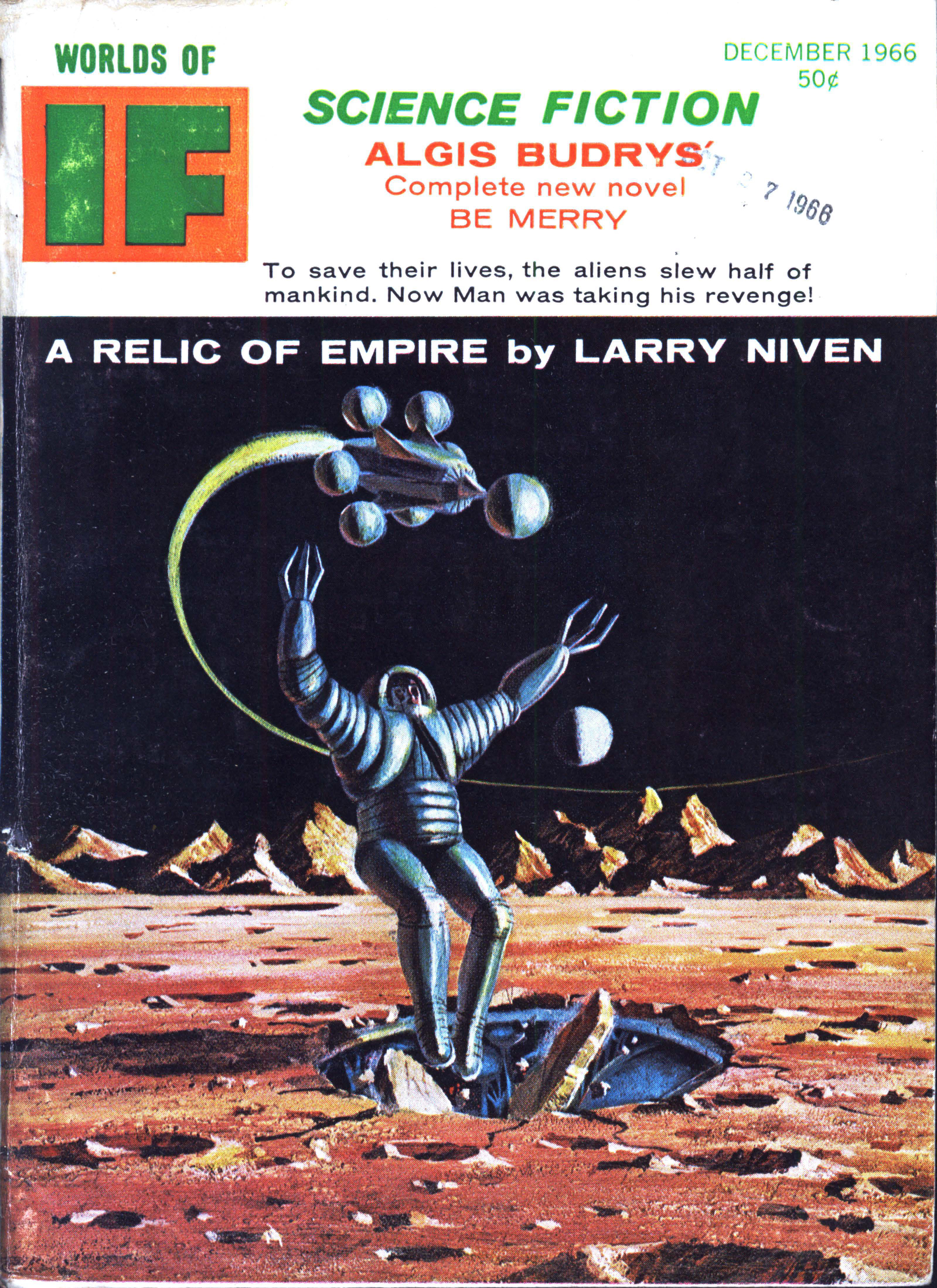
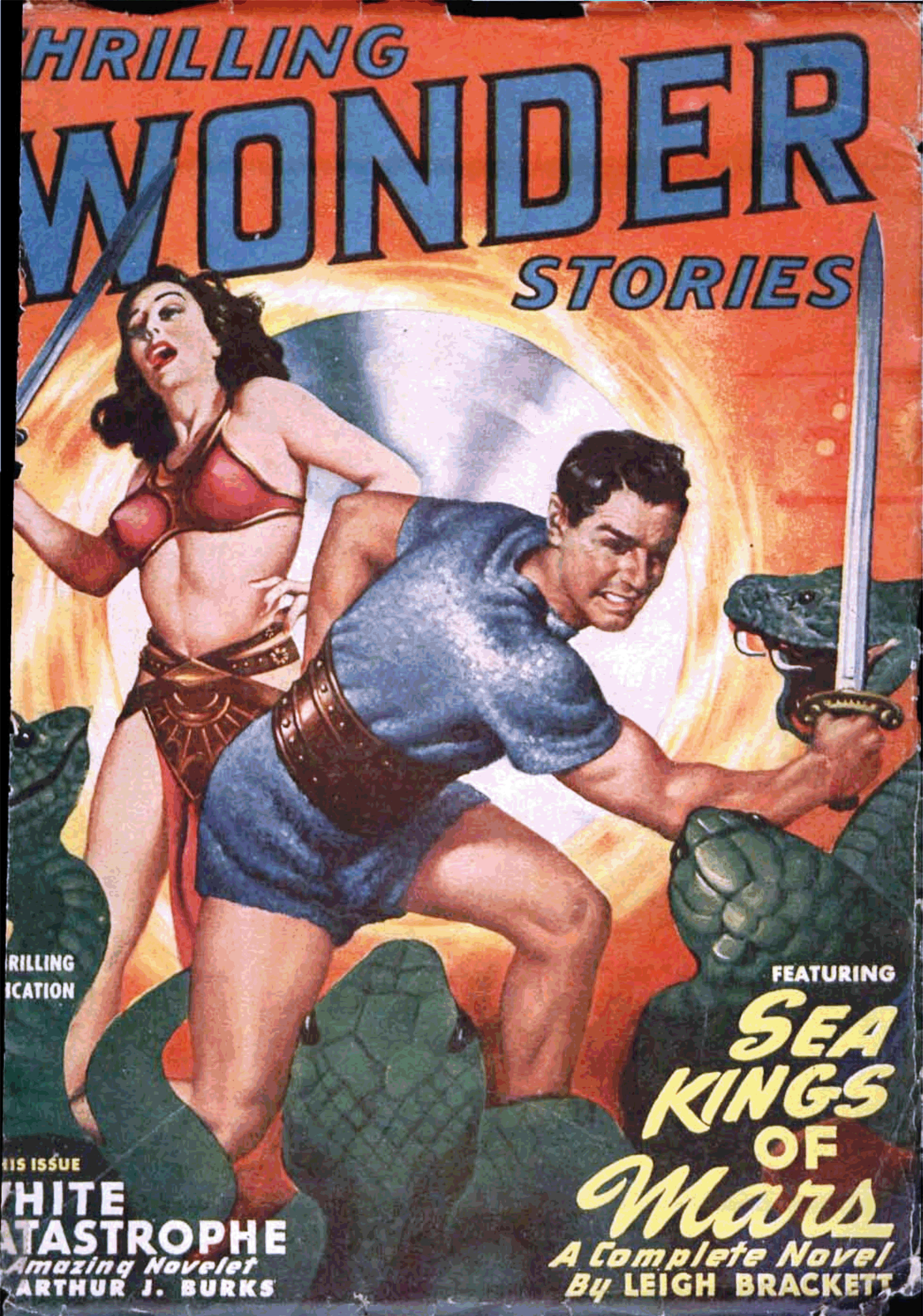
Amidst blogging, I’ve spent the last several weeks working on a certain “project”, fruitlessly searching for a Cathmium tube with an Indium Complex of +4, Bead Condensers (Model # AB-619*), and Intensifier Disks. So far, no luck. Needing a respite from my quest – which I naively assumed has been unknown to the outside world – I sought diversion in the pages of a certain pulp magazine which features Leigh Brackett’s story “Sea Kings of Mars”: Thrilling Wonder Stories, of June, 1949.
*Supercedes Models AA, and, all Models prior to AB 617, as these are only compatible with Cathmium Tubes having an Indium Complex of +3 and lower.
 Perusing the magazine, I was at once aghast…startled…to find the illustration below:

So, being that I’m not at all alone in my “project” (drat!) I finally confess that I’ve been building (ahem * trying to build * ahem) an Interocitor. But…!
…really! I’d first assumed that this double-page illustration was created by Virgil Finlay, given its detail and intricate, fine line-work. But, not so, for it lacks Finlay’s distinctive logo, which typically appeared in the lower right or left corners: The artist is unknown.
Artistic aspects aside, until actually reading Raymond Jones’ tale, I hadn’t known that this story is actually the first of a trilogy in Thrilling Wonder Stories (the second and third being “The Shroud of Secrecy” (December, 1949) and “The Greater Conflict” (February, 1950)) that combined became the 1952 novel entitled This Island Earth, which then became the basis for the 1955 science fiction film by that name. As such, “The Alien Machine” (I’ve not yet read the second and third stories) is only the basis of the first, purely earthbound, part of the movie.
As for the film “This Island Earth“, well (so this dates me…) I saw the film, in whole or in part, several times during the 60s and 70s: on “Dialing For Dollars” broadcast on late afternoon weekdays by my local television station; on late (very late) night television; on weekend afternoons. Then, I wasn’t interested in appreciating nor admiring nor critiquing it. I simply enjoyed it; no more, no less. It was fun.
(Well, even then, though, I kind’a really liked the part where, y’know, the hero and heroine are taken to that planet far out in space and the sky’s all purple and blue and there’s these explosions going off above them and there’s this ugly big-headed-big-brained goggle-eyed monster chasing them, and… Yeah, for a kid, it was fun.)
But unsurprisingly, the description of Raymond Jones’ novel at Wikipedia reveals that the full story is more substantive, complex, and ambiguous than the movie. (What else is new?) In this, the plot does not revolve around an alien civilization obtaining the assistance and knowledge of human scientists – through persuasion or kidnapping – in order to defend themselves in a war between their own world, an another alien race. Rather, Earth serves as a backdrop or near-incidental place of conflict between the two alien civilizations (the Guarrans and the Llannans), with the Llannans eventually becoming defenders of earth against their Guarran foes.
As for the interocitor? In some ways, it’s the coolest part of the film. Some of the parallels between that device, as depicted in the June, 1949, issue of Thrilling Wonder Stories, and the interocitor as created for the the movie, are more than coincidental: The flat (as opposed to deep cathode ray tube) view screen; those thick, clunky cables; the huge coils and vacuum tubes. Doubtless this illustration influenced the film to some extent, though the flat view screen in the movie is triangular in shape.
Anyway, you can learn much more about the interocitor in this article by G.F. Willmetts, at SFCrowsNet. You can also find a nice discussion of the film, with insightful talk-back comments, at ThePulp.Net.
Now where’d I put that intensifier disk…?
____________________
The 1955 trailer for “This Island Earth”, showcasing Jeff Morrow and Faith Domergue, at Trailer Chan’s YouTube channel:
____________________
At Jack Fuller’s YouTube channel, you can view “This Island Earth” in all it’s 50s color glory…
____________________
Here’s SciFiSteve1954’s imagineering of the interior of Exeter’s spacecraft. Appropriate title: “3D tour of Exeter’s Ship from the movie This Island Earth”. Though I’m not certain, I’m wondering if SciFiSteve1954 is (was?!) the alter-ego of pop-culture / film / science-fiction critic and commentator Dicktor Van Doomcock…!
References
Raymond F. Jones, at Wikipedia
Raymond F. Jones, at FindAGrave
This Island Earth (Novel), at Wikipedia
Exploring This Island Earth, at ThePulp.Net
The Interocitor… For fun, profit, superluminal communication, and occasional destruction! – Buy one today, at your favorite YoYoDyne store!
The Interocitor, an article by G.F. Willmetts, at SFCrowsNet
This Island Earth Interocitor and Exeter Resin Model Kit, at Monsters in Motion
Interocitor, at Wikipedia
Interocitor Mark IV, at Yoyodyne Propulsion Systems
Yoyodyne Propulsion Systems, at YoYoBBMAS.com
Yoyodyne Propulsion Systems Tri Wing Bomber (Model 6524), at YoYoBBMAS.com (“Laugh while you can, monkey boy!“)