This post is pretty antiquated – by internet standards, that is! – having first appeared in July of 2017 (gadzooks!), and now includes Jack Gaughan’s title page interior art.
This anthology would be reprinted under Ace Books catalog number 91355, which also featured cover art by Jack Gaughan. Note the great difference in style between Gaughan’s two compositions: This image is pretty straightforward and representational, while the wrap-around cover art of the reprint is much more symbolic and hard-to-define, reminiscent of the work of Richard Powers.
__________
Contents
We Can Remember It For You Wholesale, by Philip K. Dick, from The Magazine of Fantasy and Science Fiction
Light of Other Days, by Bob Shaw, from Analog Science Fiction – Science Fact
The Keys to December, by Roger Zelazny, from New Worlds SF
Nine Hundred Grandmothers, by R.A. Lafferty, from Galaxy Science Fiction
Bircher, by A.A. Walde, from If
Behold The Man, by Michael Moorcock, from New Worlds SF
Bumberboom, by Avram Davidson, from The Magazine of Fantasy and Science Fiction
Day Million, by Frederik Pohl, from Rogue Magazine
The Wings of A Bat, by Paul Ash, from Analog Science Fiction – Science Fact
The Man From When, by Dennis Plachta, from If
Amen and Out, by Brian W. Aldiss, from New Worlds SF
For a Breath I Tarry, by Roger Zelazny, from New Worlds SF
This is a reprint of Ace Books 1967 edition, which was released under Ace Books catalog number A-10, and also featured cover art by Jack Gaughan. It’s hard to discern what the cover art is actually portraying, other than the three diminutive rockets exiting the scene at the lower right. Then again, perhaps it’s intentionally ambiguous!
Contents
We Can Remember It For You Wholesale, by Philip K. Dick, from The Magazine of Fantasy and Science Fiction
Light of Other Days, by Bob Shaw, from Analog Science Fiction – Science Fact
The Keys to December, by Roger Zelazny, from New Worlds SF
Nine Hundred Grandmothers, by R.A. Lafferty, from Galaxy Science Fiction
Bircher, by A.A. Walde, from If
Behold The Man, by Michael Moorcock, from New Worlds SF
Bumberboom, by Avram Davidson, from The Magazine of Fantasy and Science Fiction
Day Million, by Frederik Pohl, from Rogue Magazine
The Wings of A Bat, by Paul Ash, from Analog Science Fiction – Science Fact
The Man From When, by Dennis Plachta, from If
Amen and Out, by Brian W. Aldiss, from New Worlds SF
For a Breath I Tarry, by Roger Zelazny, from New Worlds SF
Rather, Dan Adkins’ illustration for Neal Barret, Jr.’s story “Starpath”. It shows a space-suited soldier running across a barren alien landscape, with a nondescript alien spacecraft in the background. The most compelling aspect of the composition is not its setting, but rather, the posture and position of the soldier: He’s depicted in mid-run, right foot on the ground and left foot raised, body bent, head raised and looking ahead, carrying a rifle (note the strap) in his right hand. Then, I remembered: The original soldier wasn’t a spacemen. Much more earthbound, he was a United States Marine in the Pacific Theater during the Second World War…
____________________
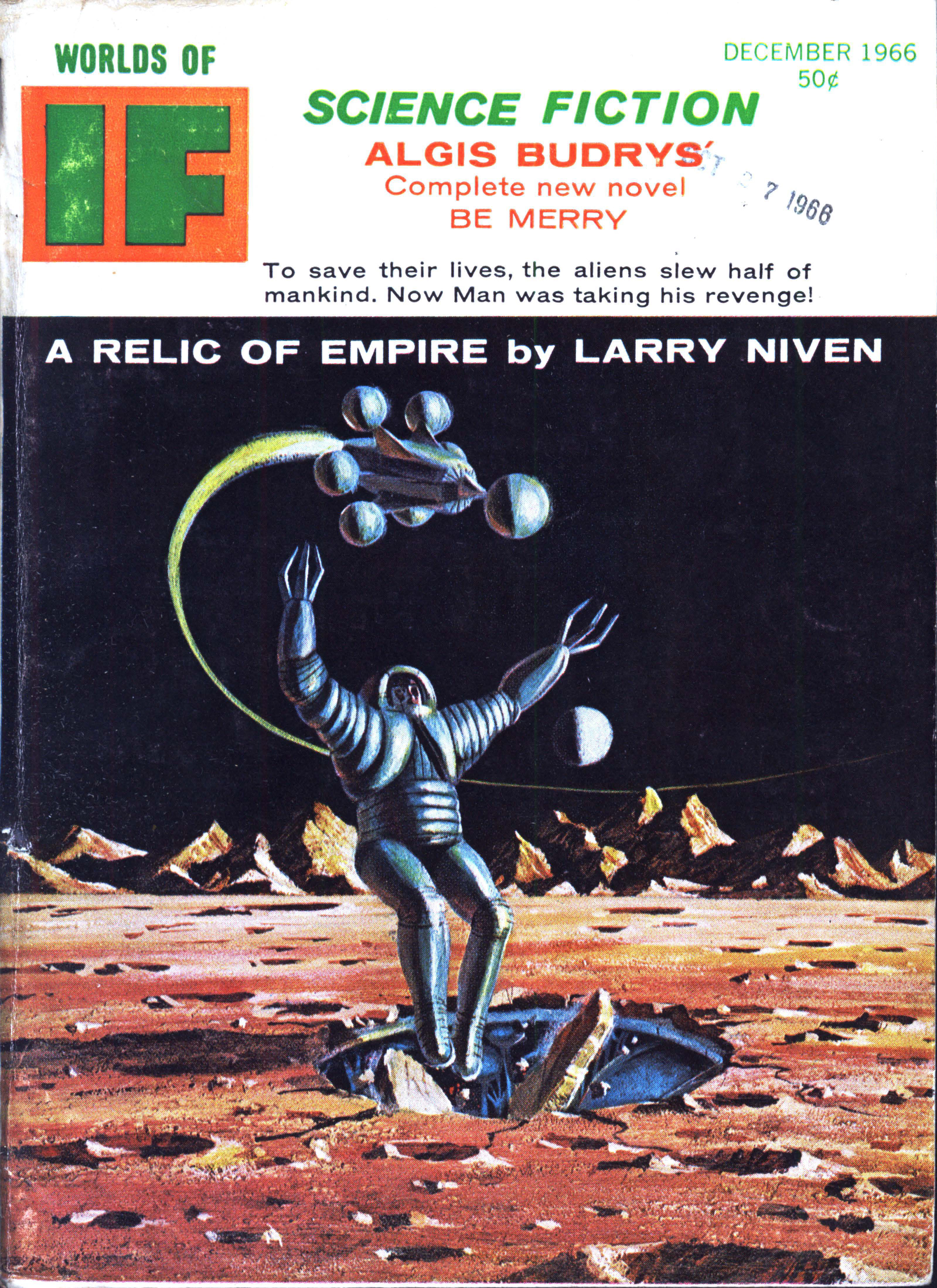
Jack Gaughan’s cover illustrating Larry Niven’s “A Relic of Empire”. The story was republished by Ballantine in a 1978 anthology of Niven’s stories, which featured cover art by Rick Sternbach.
___________
Here’s the image that caught my eye, and, my attention: Dan Adkins’ illustration for “Starpath”, by Neal Barrett, Jr. (pp. 58-59) (I created this image by using Photoshop Elements to combine two images. Pretty straightforward.)
______________________________
Below, Adkins’ likely – probable – almost certain inspiration: Note the parallels between the photo and art, in terms of the Marine’s posture, the position of canteen and rifle, and, the barren landscape (notice how the terrain is rising to the right?). Born in 1937, Adkins would have been twelve years old during 1945; probably aware even then, and doubtless with an artist’s perceptive eye after, of the striking nature of the photo.
But, who was this man? It turns out that information about him is readily available. He was PFC Paul Edward Ison. While serving as a Private First Class in the First Marine Division, he was photographed while running through Japanese fire at “Death Valley”, Okinawa on May 10, 1945. Born in Ashland, Kentucky, in 1916, he died in Fort Myers, Florida, in 2001. Further information about him can be found at Wikipedia.
As for the image itself, the caption of the photograph (the image can be found at Wikipedia) states “Through “Death Valley” – Moving on the double, a Marine dashes to a forward point of cover through a hail of Jap machine gun fire. The Marines sustained more than 125 casualties in eight hours while crossing this draw and dubbed in “Death Valley.”” From the Photograph Collection (COLL/3948), Marine Corps Archives & Special Collections OFFICIAL USMC.”
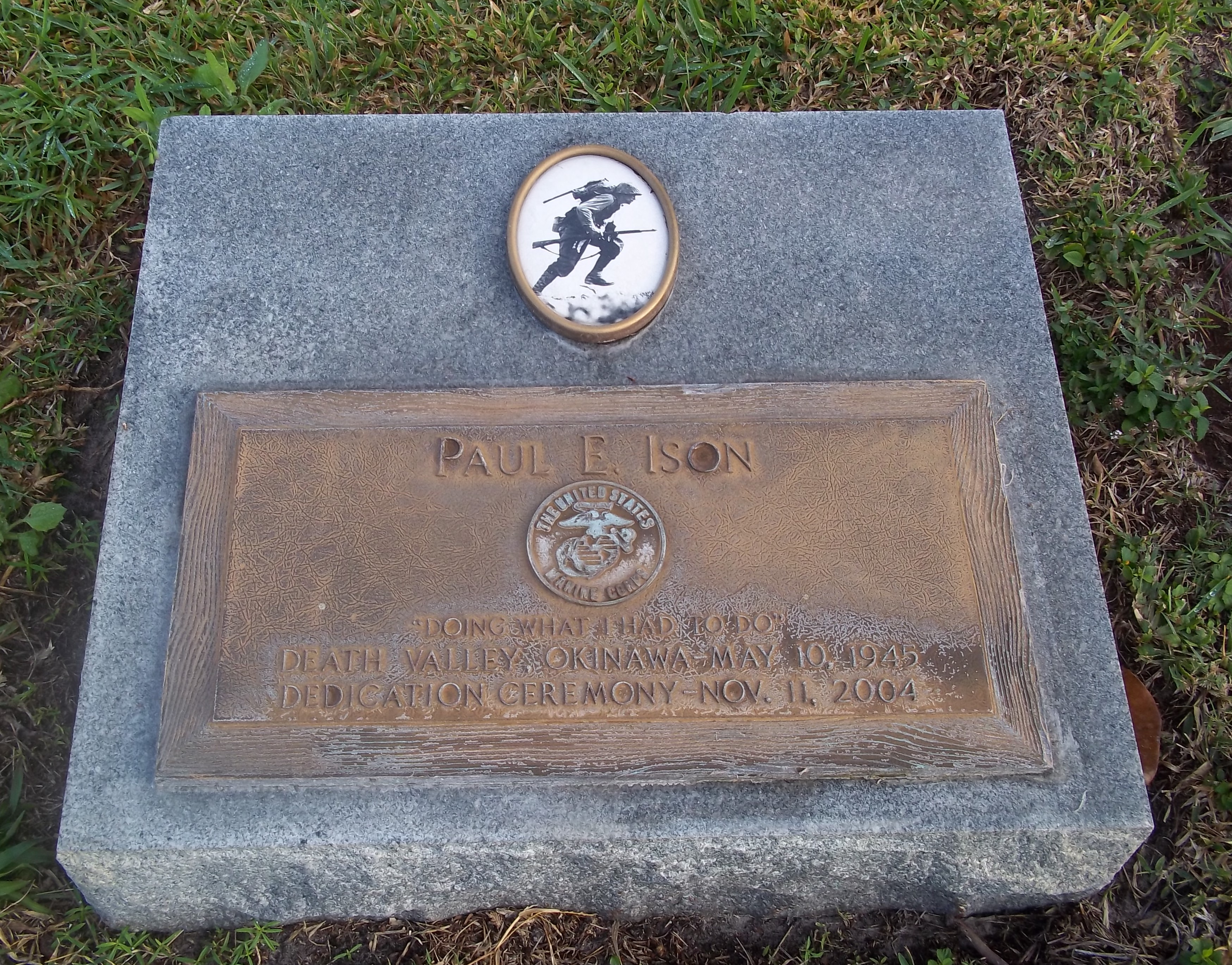
Here’s Mr. Ison’s tombstone (from FindAGrave), by Helen Farrell.
______________________________
Utterly different in style and technique than Dan Adkins, this issue of If provided a venue for the unique and striking work of Virgil Finlay. Though a digest-size magazine unfortunately did not provide a format for best possible display of Finlay’s creativity, for his work (and income!) it provided a format, nonetheless: Here, an eye floats – serenely? – in a box, in the waters of a stream.
Illustration by Virgil Finlay, for “Call Me Dumbo”, by Bob Shaw (p. 97)
______________________________
And, two examples of the work of Dwight Morrow, for Algis Budrys’ “Be Merry”. Slightly on the Wally Woodish side, but distinct in their own way.
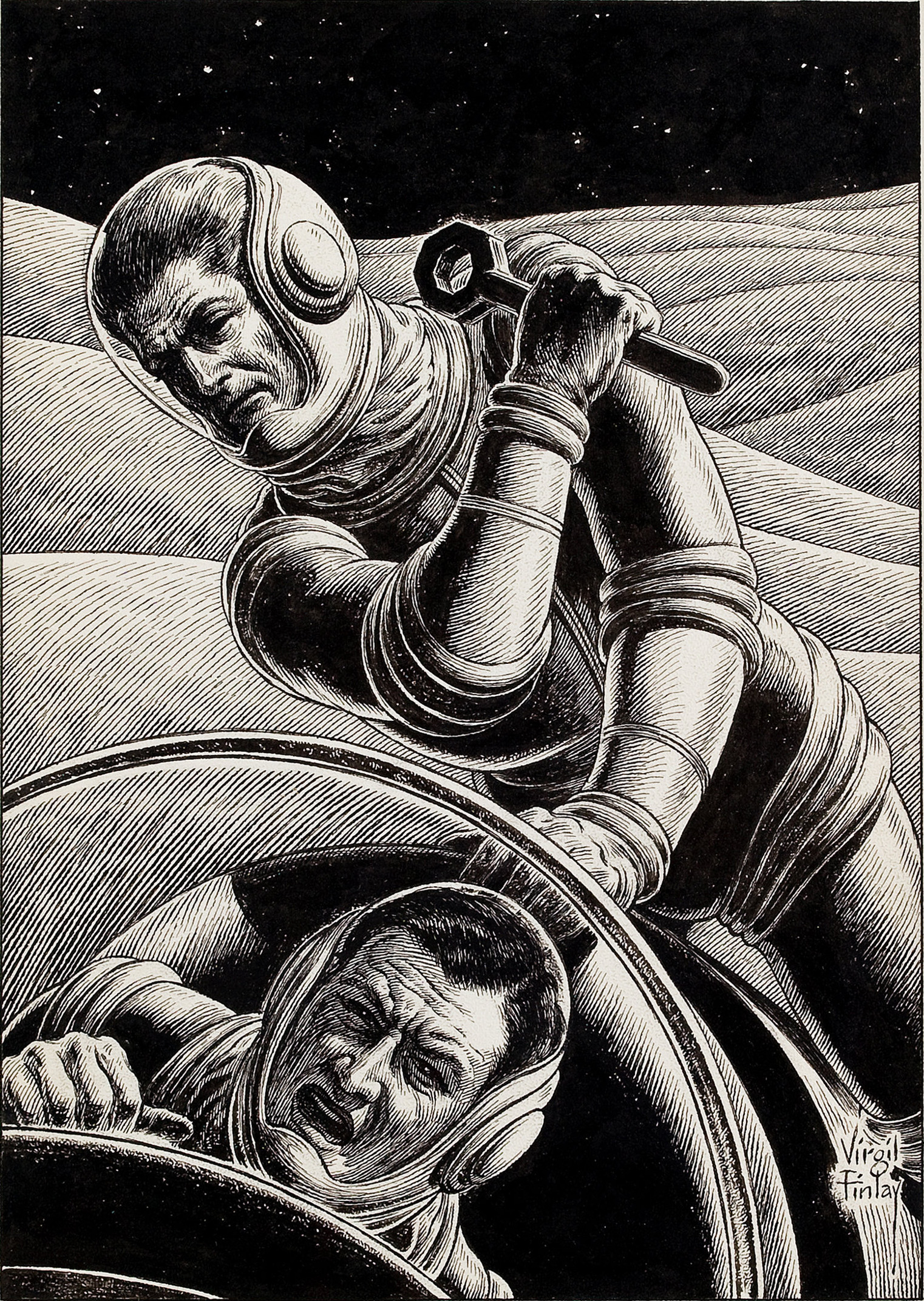
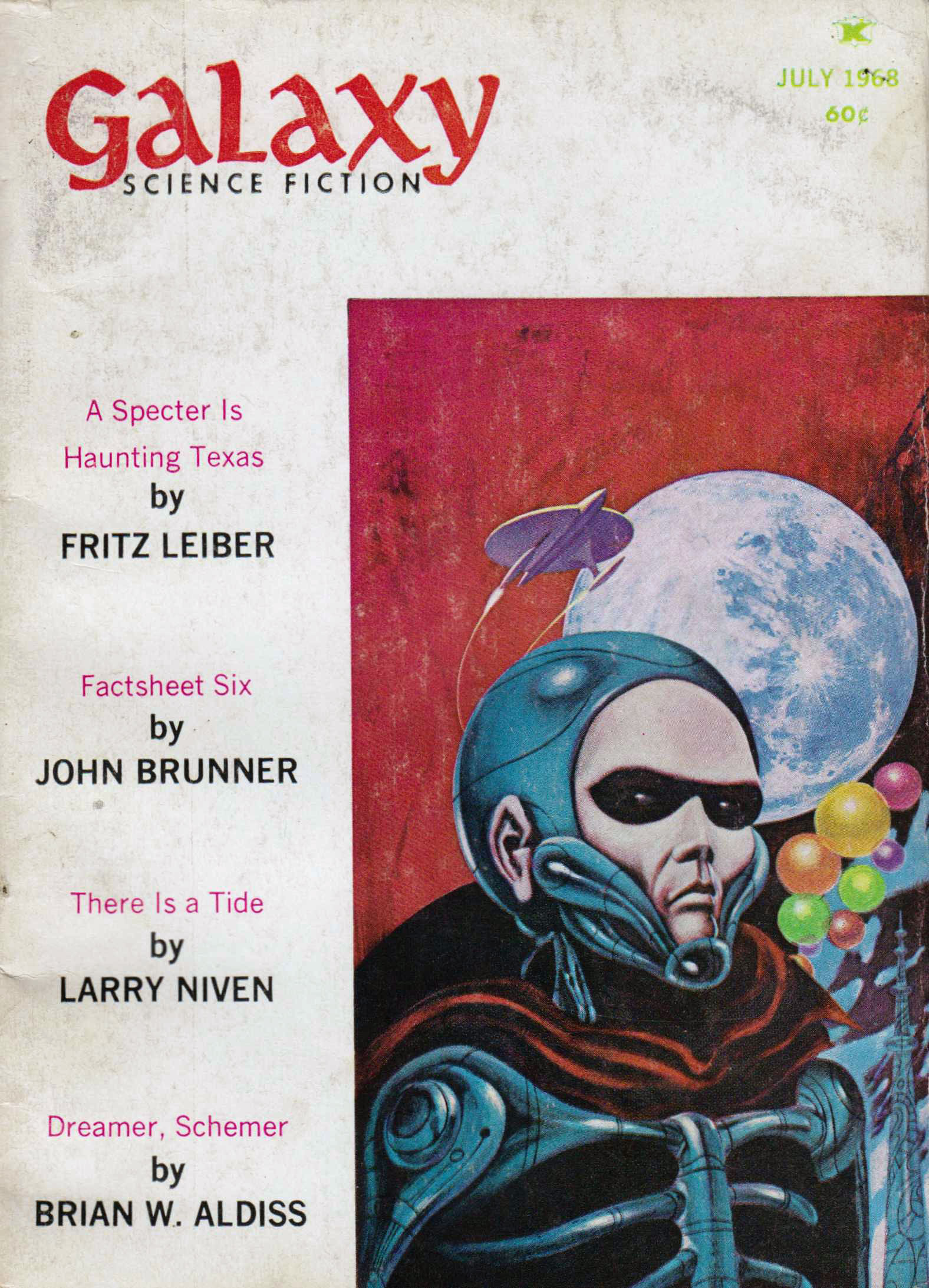
[This post, created on May 8, 2017, is pretty simple: It shows the cover (by Dember) of the October, 1966 issue of Galaxy Science Fiction, and interior illustrations by Virgil Finlay for Larry Niven’s “How The Heroes Die”, and one illustration by Jack Gaughan for Arthur C. Clarke’s “A Recursion in Metastories”. I’ve updated the post to include an image of Finlay’s original art for the second of his two pieces for Niven’s story. Just a black and white image, but it shows his work with much better crispness than even the best scan from the actual magazine. Even when limited to a vertical / rectangular format, his art was stunning.]
____________________
Finlay’s illustration for Larry Niven’s story “How The Heroes Die” (p. 59).
Finlay’s illustration for Larry Niven’s story “How The Heroes Die” (p. 71).
…Virgil Finlay’s original art, from Heritage Auctions. The original is described as “pen and ink on paper, 9.5 x 6.5 inches, signed lower right, from the Jerry Weist Collection“.
Jack Gaughan’s illustration for “A Recursion in Metastories”, by Arthur C. Clarke (p. 87).
Reference (…well, just one reference…)
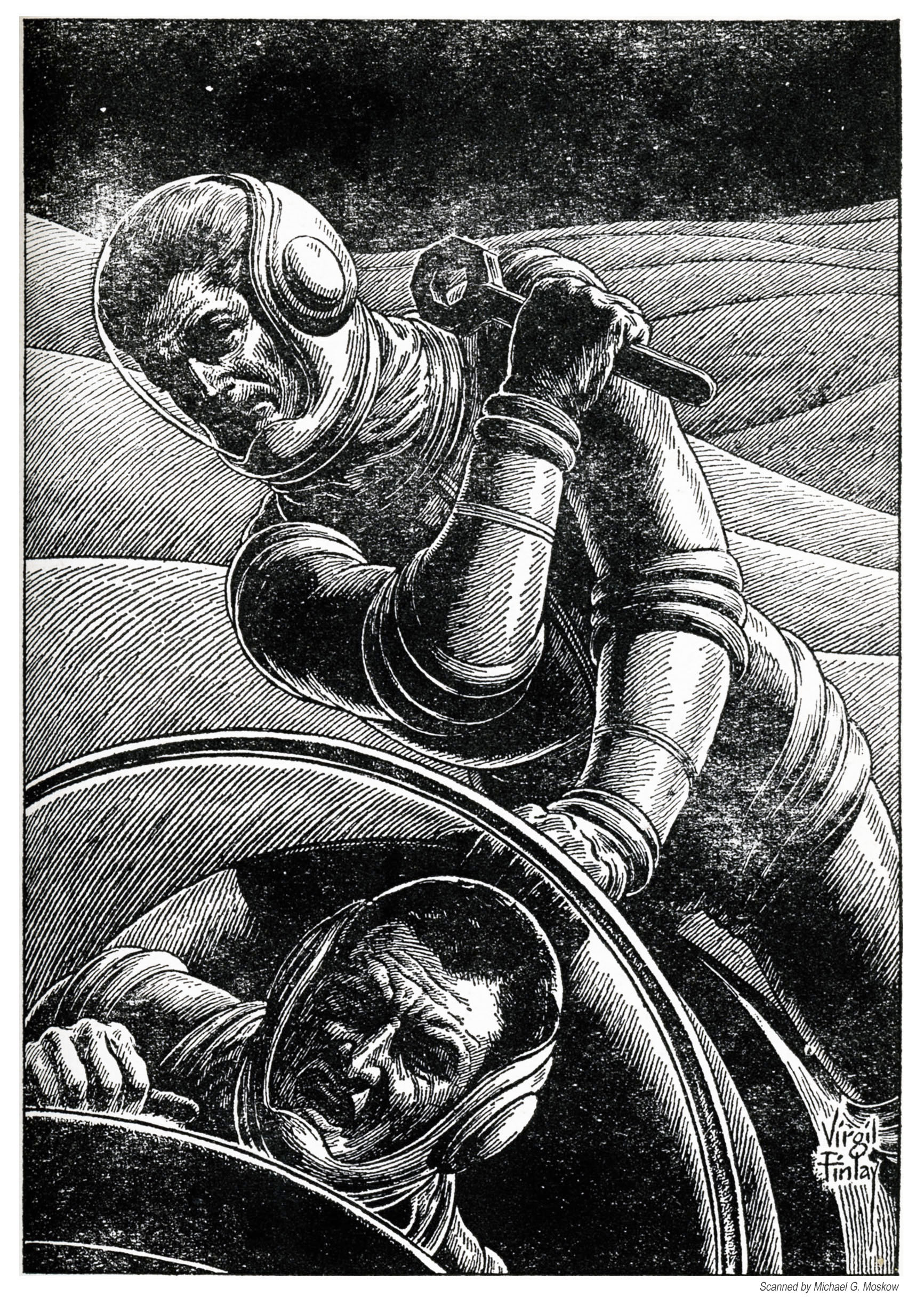
“Two Spacemen Fighting, science fiction pulp interior story illustration”, at Heritage Auctions May 8, 2017
Symbolic illustration of Scully La Cruz (facing title page) by Jack Gaughan.
________________________________________
From rear cover …
“Scully La Cruz was a Thin – a muscleless free-fall phenomenon whose home was the Sack circling the Moon, who could only support life in Earth-gravity conditions by having himself encased in a titanium exo-sekleton. To the inhabitants of the ravaged post-war Earth, he looked spectrally outlandish.
To Scully, the inhabitants of the Earth looked equally odd. Because the U.S.A. had disappeared in the aftermath of the atomic conflict and had been replaced by Greater Texas. And Greater Texas was dominated by the Greater Texans, masterful giants created by hormone treatments, who strode lordly about amidst their dwarvish peons and slaves.
To these unhappy underlings, Scull appeared as a Sign, a leader for revolt. To Scully, this reverence sparked his actor instinct sufficiently to make him decide to accept that role.
This is one of Fritz Leiber’s most astonishing and satirical novels … a caricature of the future as living, chilling and ultimately serious of purpose as a Jules Feiffer cartoon.”
Excerpt (from pages 14-15) …
They were looking I discovered, at a handsome, shapely, dramatic-featured man, eight feet eight inches tall and massing 147 pounds and ninety-seven pounds without his exoskeleton. Except for relaxed tiny bulges of muscle in his forearms and calves (latter to work lengthy toes, useful in gripping), this man was composed of skin, bones, ligaments, fasciae, narrow arteries and veins, nerves, small-size assorted inner organs, ghost muscles, and a big-domed skull with two bumps of jaw muscles. He was wearing a skintight black suit that left bare only his sunken-chested, deep-eyed, beautiful tragic face and big, heavy-tendoned hands.
This truly magnificent, romantically handsome, rather lean man was standing on two corrugated-soled titanium footplates. From the outer edge of each rose a narrow titanium T-beam that followed the line of his leg, with a joint (locked now) at the knee, up to another joint with a titanium pelvic girdle and shallow belly support. From the back of this girdle a T-spine rose to support a shoulder yoke and rib cage, all of the same metal. The rib cage was artistically slotted to save weight, so that curving strips followed the line of each of his very prominent ribs.
A continuation of his T-spine up the back of his neck in turn supported a snug, gleaming head basket that rose behind to curve over his shaven cranium, but it front was little more than a jaw shelf and two inward-curving cheekplates stopping just short of his somewhat rudimentary nose. (The nose is not needed in Circumluna to warm or cool air.)
Slightly lighter T-beams than those for his legs reinforced his arms and housed in their terminal inches his telescoping canes. Numerous black, foam-padded bands attached this whole framework to him.
A most beautiful prosthetic, one had to admit. While to expect a Thin, or even more than a Fat, from a free-fall environment to function without a prosthetic on a gravity planet or in a centrifuge would be the ultimate in cornball ignorance.
Eight small electric motors at the principal joints worked the prosthetic framework by means of steel cables riding in the angles of the T-beams, much like antique dentist’s drills were worked, I’ve read. The motors were controlled by myoelectric impulses from his ghost muscles transmitted by sensitive pickups buried in the foam-padded bands. They were powered by an assortment of isotopic and lithium-gold batteries nesting in his pelvic and pectoral girdles.
“Did this fine man look in the least like a walking skeleton?” I demanded of myself outragedly. “Well, yes very much so,” I had to admit now that I had considered the matter from the viewpoint of strangers. A very handsome and stylish skeleton, all silver and black but a skeleton nonetheless, and one eight feet eight inches tall, able to look down a little even at the giant Texans around him.
________________________________________
________________________________________
Scully La Cruz, as originally envisioned by Jack Gaughan in Galaxy Science Fiction …
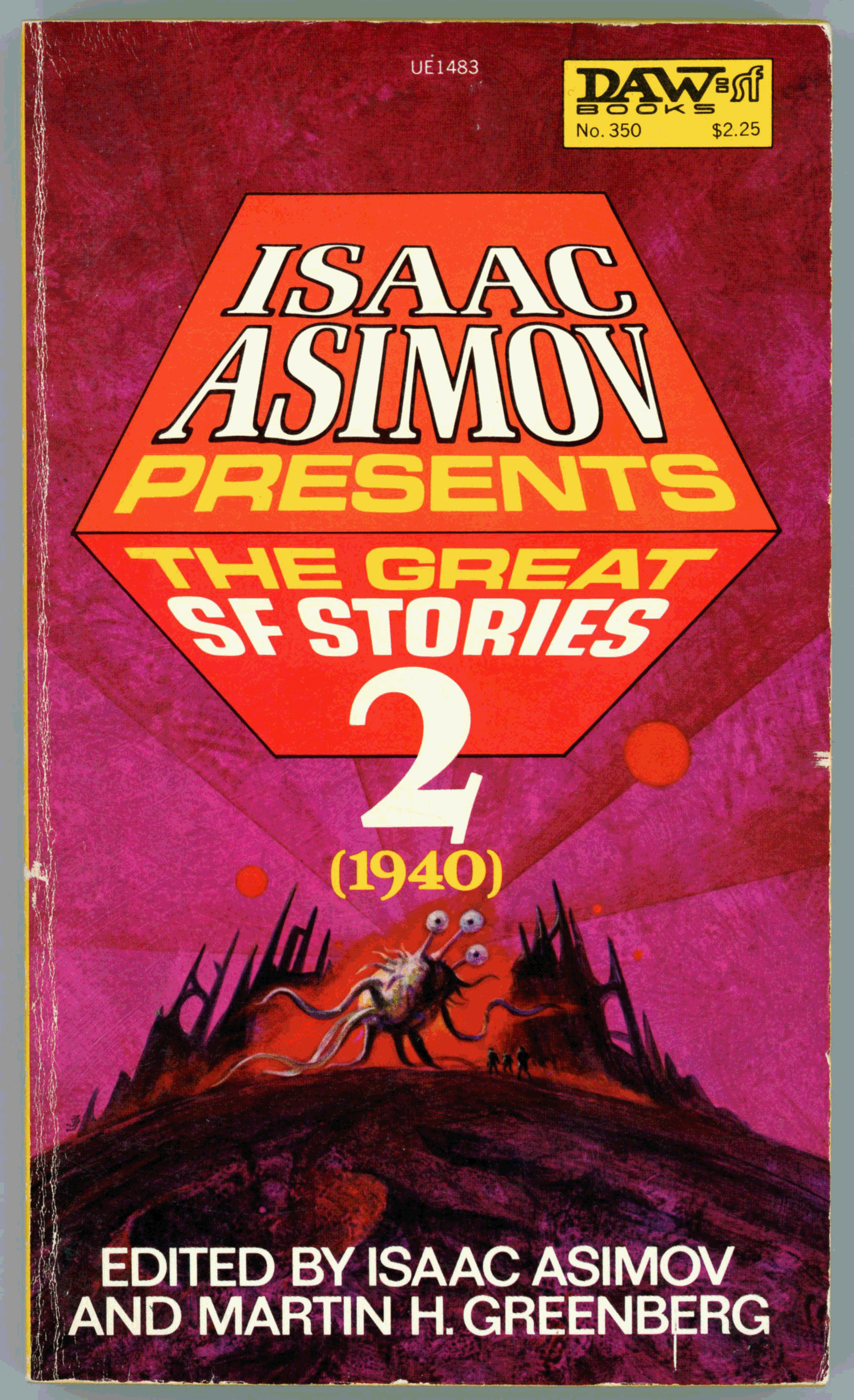
From 1979 through 1992, Donald A. Wollheim books – founded by editor, publisher, and write Donald A. Wollheim, and his wife Elise – published twenty-five volumes of the Science Fiction Anthology Isaac Asimov Presents the Great SF Stories. Series authors Isaac Asimov and Martin H. Greenberg (whose names appear on each volume’s cover) designed the series such that each volume comprised a set of short stories that they deemed the best science fiction published every year (and only within “that” particular year) from 1939 through 1963, in terms of literary quality and cultural significance. Each volume includes approximately twelve to fifteen stories, the stories themselves chronologically arranged by month of publication within each given year.
At variance from retrospective anthologies wheres stories are arranged by theme, the chronological design of Asimov and Greenberg’s anthology created a “snapshot” of the evolution and development of science fiction across a quarter-century, shedding light on technological, social, ideological, and cultural changes in society commencing with the years just before the Second World War (the first volume covering 1939), through the early years of space exploration (the final volume covering 1963).
An invaluable aspect of the series, especially for one new to science fiction and unacquainted with the stories’ writers, was the way that Asimov and Greenberg presented very brief two-part introductions to each story. These typically comprised a short, “light” biographical blurb focused upon the literary and vocational career (sometimes one and the same; sometimes not!) of the story’s author, written by Greenberg, followed by commentary about the story itself, composed by Asimov. The latter would focus on the story’s literary significance, its “place” in the literature of science fiction (and sometimes literature in general), the cultural and social mechanics of publishing, and simply, the not-so-simple art of writing.
The cover art and content list of every volume can be viewed “here”, at WordsEnvisioned.
As for Volume 13, well… As good, sometimes excellent – and one or two times superlative – as the cover art is for some volumes, that for Volume 13, well…uh…er…leaves much to be desired. Enough said.
The series’ publication history is given below. You’ll see the volume number; the year represented by that volume; the publication date; cover artist or studio; New American Library / DAW Science Fiction Library serial numbers, and, price.
So (no drum roll needed…) here’s the cover and contents of Volume 1.
I, Robot, by Eando Binder, from Amazing Stories
The Strange Flight of Richard Clayton, by Robert Bloch, from Amazing Stories
Trouble With Water, by Horace L. Gold, from Unknown
Cloak of Aesir, by John W. Campbell, Jr. (as “Don A. Stuart”), from Astounding Science Fiction
The Day Is Done, by Lester del Rey, from Astounding Science Fiction
The Ultimate Catalyst, by John Taine, from Thrilling Wonder Stories
The Gnarly Man, by L. Sprague de Camp, from Unknown
Black Destroyer, by A.E. van Vogt, from Astounding Science Fiction
Greater Than Gods, by Catherine L. Moore, from Astounding Science Fiction
Trends, by Isaac Asimov, from Astounding Science Fiction
The Blue Giraffe, by L. Sprague de Camp, from Astounding Science Fiction
The Misguided Halo, by Henry Kuttner, from Unknown
Heavy Planet, by Milton A. Rothman, from AstoundingScience Fiction
Life-Line, by Robert A. Heinlein, from AstoundingScience Fiction
Ether Breather, by Theodore Sturgeon, from Astounding Science Fiction
Pilgrimage, by Nelson S. Bond, from Amazing Stories
Rust, by Joseph E. Kelleam, from Astounding Science Fiction
The Four-Sided Triangle, by William F. Temple, from Amazing Stories
Star Bright, by Jack Williamson, from Argosy
Misfit, by Robert A. Heinlein, from Astounding Science Fiction
______________________________
During publication of the series, between 1979 and 1992, the volumes were released on a semi-annual basis. The exceptions were 13, 16, and 17 (which respectively covered 1951, 1954, and 1955) having been the only volumes published in 1985, 1987, and 1988. (Again, respectively!) The covers of all volumes (except for the above-mentioned 1951) are available for your viewing here, at WordsEnvisioned.
Interestingly, an effort seems to have to re-release the series, with Volumes 1 and 2 (1939 and 1940) having been published by the Dorset Press in 2001 and 2002. However, it seems that no further volumes were re-published. (Why not?…)
The two Dorset Press volumes were printed in a notably larger format than the original books.. They measure 21 cm, while the original volumes are of a standard paperback size and measure 17.5 cm.
The other difference is the cover art of both Dorset Press volumes, both of which were designed by artist Tom McKeveny, whose digital portfolio can be viewed here, while his book cover designs can be viewed here.
The 1939 cover is beautifully adapted from a scene in David Butler’s 1930 science-fiction film Just Imagine, showing a 1930s vision of a city (New York?) of the future half-a-century hence: in 1980. (Now in 2019, thirty-nine years ago…)
You need not merely imagine Just Imagine. Uploaded to YouTube by Geography Video, you can watch the movie, below:
Like Volume 1 of Isaac Asimov Presents the Great SF Stories, which covered science-fiction short stories published during 1939, Volume 2 of this series was re-issued by Dorset Press; in this case, in 2002. It seems that Dorset did not proceed beyond Volume 2 in the Series’ re-publication.
Both covers are shown below.
______________________________
Here’s the cover of the original volume, with art by Jack Gaughan…
Contents
The Dwindling Sphere, by Willard Hawkins, from Astounding Science Fiction
The Automatic Pistol, by Fritz Leiber, from Weird Tales
Hindsight, by Jack Williamson, from Astounding Science Fiction
Postpaid to Paradise, by Robert Arthur, from Argosy
Into the Darkness, by Ross Rocklynne, from Astounding Science Fiction
Dark Mission, by Lester Del Rey, from Astounding Science Fiction
It, by Theodore Sturgeon, from Unknown
Vault of the Beast, by A.E. van Vogt, from Astounding Science Fiction
The Impossible Highway, by Oscar J. Friend, from Thrilling Wonder Stories
Quietus, by Ross Rocklynne, from Astounding Science Fiction
Strange Playfellow, by Isaac Asimov, from Super Science Stories
The Warrior Race, by L. Sprague de Camp, from Astounding Science Fiction
Farewell to The Master, by Harry Bates, from Astounding Science Fiction
Butyl and the Breather, by Theodore Sturgeon, from Astounding Science Fiction
The Exalted, by L. Sprague de Camp, from Astounding Science Fiction
Old Man Mulligan, by P. Schuyler Miller, from Astounding Science Fiction
______________________________
…and this is Tom McKeveny’s cover for the Dorset Press Volume. The styles are obviously, utterly, completely different, but each “works” in its own way.
My preference? McKeveny’s. The representational and symbolic nature of his art is strikingly emblematic and evocative of the theme and “feeling” of pulp magazines of the 40s. (And early 1950s.) Particularly effective is the contrast between the pale golden-yellow of the spacecraft against the star-speckled dark blue “space” background, wand the “wrap-around” look of the orange-red-violet rocket trails across the cover.
You can view Mr. McKeveny’s digital portfolio here, and his book cover designs can be viewed here.
“The only hope for mankind’s survival after the contamination of the Earth lay in the Pritcher Mass, a psychic forcefield construction out beyond the orbit of Pluto. Created by the efforts of individuals with extraordinary paranormal powers, the Mass was designed to search the universe for a new habitable planet.
Chaz Sant knew he had the kind of special ability to contribute effectively to the building of the Mass, but somehow the qualifying tests were stacked against him. Then he learned that he had become the special target of an insidious organization that fattened on the fears of the last cities of the world. His confrontation with this organization, their real motives and his unexpected reactions, were to touch off the final showdown for mankind’s last enterprise.”