[Updated again! I’ve now included William Ferguson’s 1990 book review of A Relative Stranger from The New York Times.]
______________________________
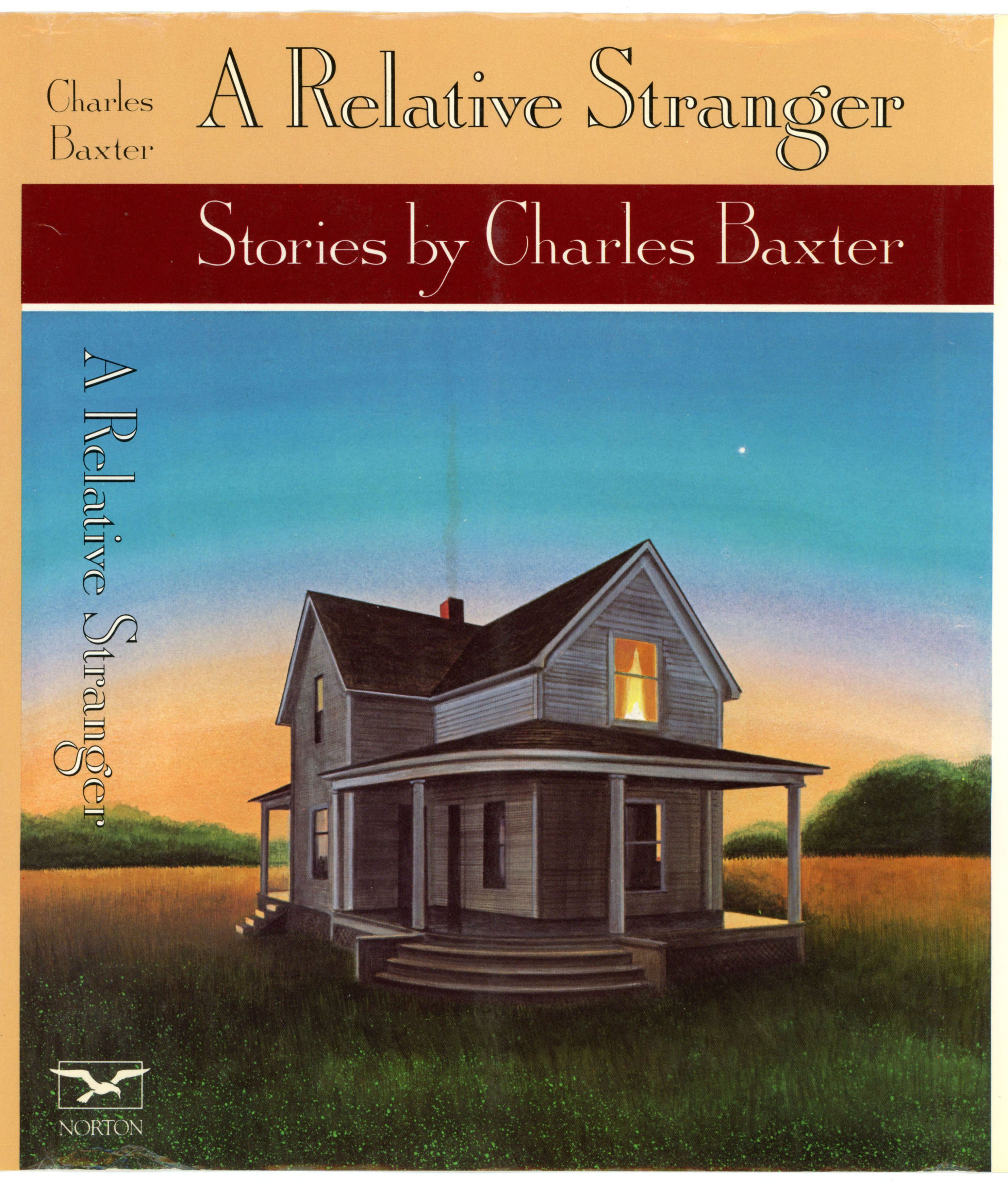
Dating back to November of 2016, this is one of my earliest posts at this blog. It’s now been updated to better present illustrator Wendell Minor’s cover art, and, to include an excerpt from one of author Richard Baxter’s stories: “The Disappeared.”
The Timid Life
A RELATIVE STRANGER
By Charles Baxter.
223 pp. New York:
W.W. Norton & Company. $17.95.
By William Ferguson
The New York Times
October 21, 1990
THE 13 stories in “A Relative Stranger,” all quietly accomplished, suggest a mysterious yet fundamental marriage of despair and joy. Though in one way or another each story ends in disillusionment, the road that leads us to that dismal state is so richly peopled, so finely drawn, that the effect is oddly reassuring.
The much-praised author, Charles Baxter, has published a novel, “First Light,” as well as two previous collections of stories, “Harmony of the World” and “Through the Safety Net.”
Many of the male protagonists in this new collection are confused and timid souls in search of something to believe in; they are all intelligent and sensitive, yet somehow unexceptional. By contrast, the women around them tend to be strong and colorful people who accept life easily – and whose impatience with the men is manifest.
In “Prowlers,” Pastor Robinson manages to tolerate a visit by his wife Angie’s lover, an abrasive person named Benjamin; when the visit is over, Angie muses to her husband that she and Benjamin know all each other’s secrets. Robinson gently protests: “You know my secrets.” Angie: “Sweetheart, you don’t have any secrets. You’ve never wanted a single bad thing in your life.”
Characters like Robinson have the fatal transparency of goodness, a passive blamelessness that may in itself be a tragic flaw. This hapless virtue has a parallel in Cooper, the hero of a story called “Shelter.” Cooper is a generous soul who becomes so involved with the homeless – entirely out of brotherly love, a quality he refuses to recognize in himself – that he puts the autonomy of his own family in danger.
* * *
Anders, a Swedish businessman in “The Disappeared,” finds his childish expectations of America are crippled by his relationship with a stranger in Detroit. Fenstad is a teacher whose pallid devotion to logic is no match for his mother’s irrational vitalities (significantly, the story’s title is not “Fenstad” but “Fenstad’s Mother”). Warren, in “Westland,” is hanging around the zoo one day when he meets a teen-age girl who announces that she wants to shoot a lion. She doesn’t do it, but in a bizarre echo of the girl’s words, Warren later fires shots at the local nuclear reactor to protest the fouling of the environment. It’s another portrait of impulsive, undirected goodness, and again its medium is a heartbreaking ineffectuality.
One story that stands out from all the others, in both style and theme, is “The Old Fascist in Retirement,” an elegant fictional imagination of Ezra Pound’s latter days in Italy. The bitterness of the title contrasts with the rather sympathetic portrait the story contains; the underlying message (so familiar) may be that Pound was not really evil, only deeply confused. If so, then the old poet begins to look like a version – augmented, to be sure, by his peculiar genius – of Fenstad or Cooper or Robinson: a good, articulate man who tragically failed to understand something fundamental about the social contract.
IN the powerful title story, “A I Relative Stranger,” a man discovers late in life that he has a brother. Both men, as infants, were given up for adoption. It appears that two lost souls are headed for a joyful reunion. Yet fraternity turns out to be a burden, another of nature’s unpardonable hoaxes; the two brothers are wholly incompatible. One of the brothers says: “I was always homesick for the rest of the world. My brother does not understand that. He thinks home is where he is now.”
Few of the protagonists in this collection would make the brother’s mistake (if it is one). They are the temperamentally homeless, the ones who look on in amazement as other people accept the conditions of the everyday world without even the murmur of an existential question. If these stories have a common theme, it may be this abiding failure, in leading characters, to imagine what is most real. By contrast, Charles Baxter’s chronicling of such human debilities represents a continuing triumph of the imaginative will.
William Ferguson is the author of “Freedom and Other Fictions,” a collection of stories.
____________________
Contents
Fenstad’s Mother, from The Atlantic
Westland, from The Paris Review
Prowler, from Grand Street
A Relative Stranger (published as “How I Found My Brother”), from Indiana Review
Shelter, from The Georgia Review
Snow, from The New Yorker
Silent Movie
The Old Fascist in Retirement, from Denver Quarterly
THREE PARABOLIC TALES
Lake Stephen, from PEN Syndicated Fiction
Scissors, from PEN Syndicated Fiction
Scheherazade, from Harper’s
The Disappeared, from Michigan Quarterly Review
Saul and Patsy Are Pregnant, from The Iowa Review
________________________________________
(From “The Disappeared”, pp. 180-181)
HE FELT itchy: he went out running, returned to his room, and took another shower. He did thirty push-ups and jogged in place. He groaned and shouted, knowing that no one would hear. How would he explain this to anyone? He was feeling passionate puzzlement. He went down to the hotel’s dining room for lunch and ordered Dover sole and white win but found himself unable to eat much of anything. He stared at the plate and at the other men and women consuming their meals calmly, and he was suddenly filled with wonder at ordinary life.
He couldn’t stand to be by himself, and after lunch he had the doorman hail a cab. He gave the cabdriver a fifty and asked him to drive him around the city until all the money was used up.
“You want to see the nice parts?” the cabbie asked.
“No.”
“What is it you want to see then?”
“The city.”
“You tryin’ to score, man? That it?”
Anders didn’t know what he meant. He was certain that no sport was intended. He decided to play it safe. “No,” he said.
The cabdriver shook his head and whistled. They drove east and then south; Anders watched the water-ball compass stuck to the front window. Along Jefferson Avenue they went past the shells of apartment buildings, and then, heading north, they passed block after block of vacated or boarded-up properties. One old building with Doric columns was draped with a banner:
PROGRESS! THE OLD MUST MAKE WAY
FOR THE NEW
Acme Wrecking Company
The banner was worn and tattered. Anders noticed broken beer bottles, sharp brown glass, on sidewalks and vacant lots, and the glass, in the sun, seemed perversely beautiful. Men were sleeping on sidewalks and in front stairwells; one man, wearing a hat, urinated against the corner of a burned-out building. He saw other men – there were very few women out here in the light of day – in groups, gazing at him with cold slow deadly expressions. In his state of mind, he understood it all; he identified with it. All of it, the ruins and the remnants, made perfect sense.
________________________________________
 ________________________________________
 1980s portrait of Richard Baxter by poet Michael Lauchlan
November 16, 2016, November 27, 2019, and January 28, 2020

