
Tag: Frank Kelly Freas
Code Duello, by Mack Reynolds – 1968 [Frank Kelly Freas]

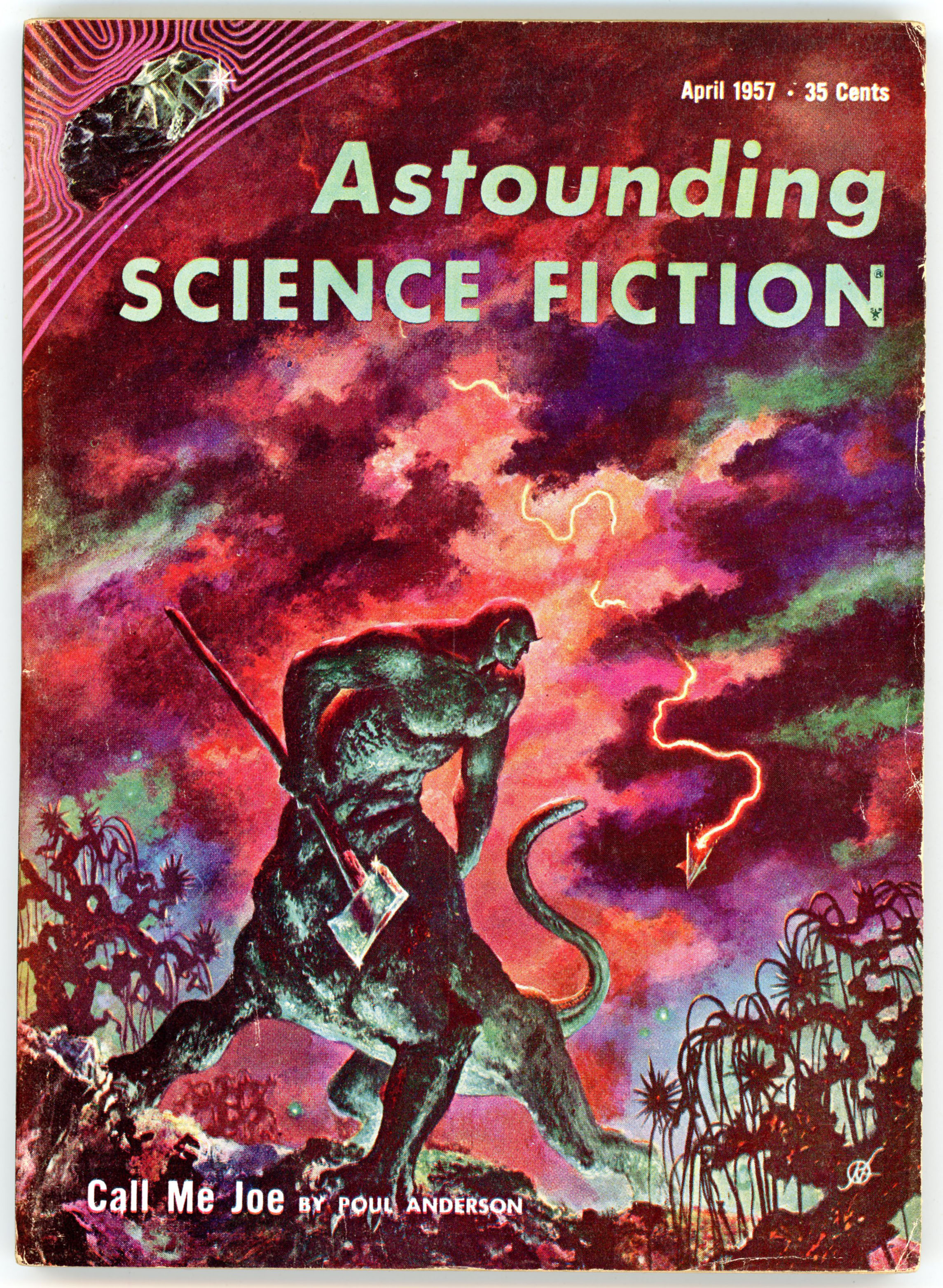
Astounding Science Fiction, April, 1957 (Featuring “Call Me Joe” by Poul Anderson) [Frank Kelly Freas]
“Joe roared.”
“Imagine being strong!”
The cover art for Astounding Science Fiction for April of 1957 represented the 19th such illustration for that magazine created by Frank Kelly Freas, his first cover art having been an allegorical illustration for the story The Gulf Between, in the magazine’s March, 1954 issue. Portraying Poul Anderson’s story “Call Me Joe”, Freas’ painting – and his accompanying interior art – fits the scenes, mood, technology (at least, what few technological descriptions there are!), and science (at least, science of the future) marvelously.
Freas’ use of shades of violet, orange, red, and brown for the Jovian sky, in combination with greens and blues for the the planet’s surface and vegetation – finished with a yellowish-red exhaust / re-entry trail for a descending spacecraft – lend an almost iridescent quality to the image.
Of course, you can’t overlook Joe, himself: the metallic green centaur-like creature – a genetically engineered being – silhouetted against the glowing sky, who is a – but not solely “the” – center of the story.
In any event, I’m under the impression that – akin to Arthur C. Clarke’s The Sentinel, which formed a plot element of, but was not the sole and central basis for 2001: A Space Odyssey, Poul Anderson’s story was, to lesser or greater degree, part of the inspiration for James’s Cameron’s 2009 film “Avatar”. (That’ll require some clarification via DuckDuckGo.)
If so – and I think this is so – this would have done a great disservice to the depth, profundity, and originality of Anderson’s story, which is actually an exploration of concepts of identity, individuality, and personality, as well as – to a lesser extent – the ethics and morality surrounding the creation of artificial, sentient life. An example of the latter being “Joe”, on the cover. Another interesting feature of the tale is Anderson’s conception of a temperamental electronic device known as a “K-tube”, which enables real-time telepathic communication between controller Ed Anglesey, and receiver / test subject, “Joe”.
You can read a very nice summary of the story at Wikipedia.
This is unlike Cameron’s film, which – though it has elements and stereotypical tropes of science fiction – (well, hey, oh wow – it’s got fancy technology) is not a work of science fiction, and I think was never intended to be so. Quite the opposite.
“Avatar” is best understood as less science-fiction, and vastly more as an exercise in virtue signalling (to the tune of $237,000,000), by which the technocratic / meritocratic elite of 21st Century Western Civilization – the “ruling class” – validates its ever-uncertain social status, and, affirms its intellectual superiority, moral virtuosity, and spiritual refinement.
(That is, of course, in its own eyes.)
But, that’s for another discussion.
Enough, with the politics.
(For now.)
I hope you enjoy Kelly Freas’ art, and excerpts from Poul Anderson’s text. The symbol in the upper left corner is typical of the cover design of late-1950s issues of Astounding, which featured symbolic or literal representations of objects and concepts having a scientific theme. In this case, “Transformation under heat and pressure.”
 _____________________
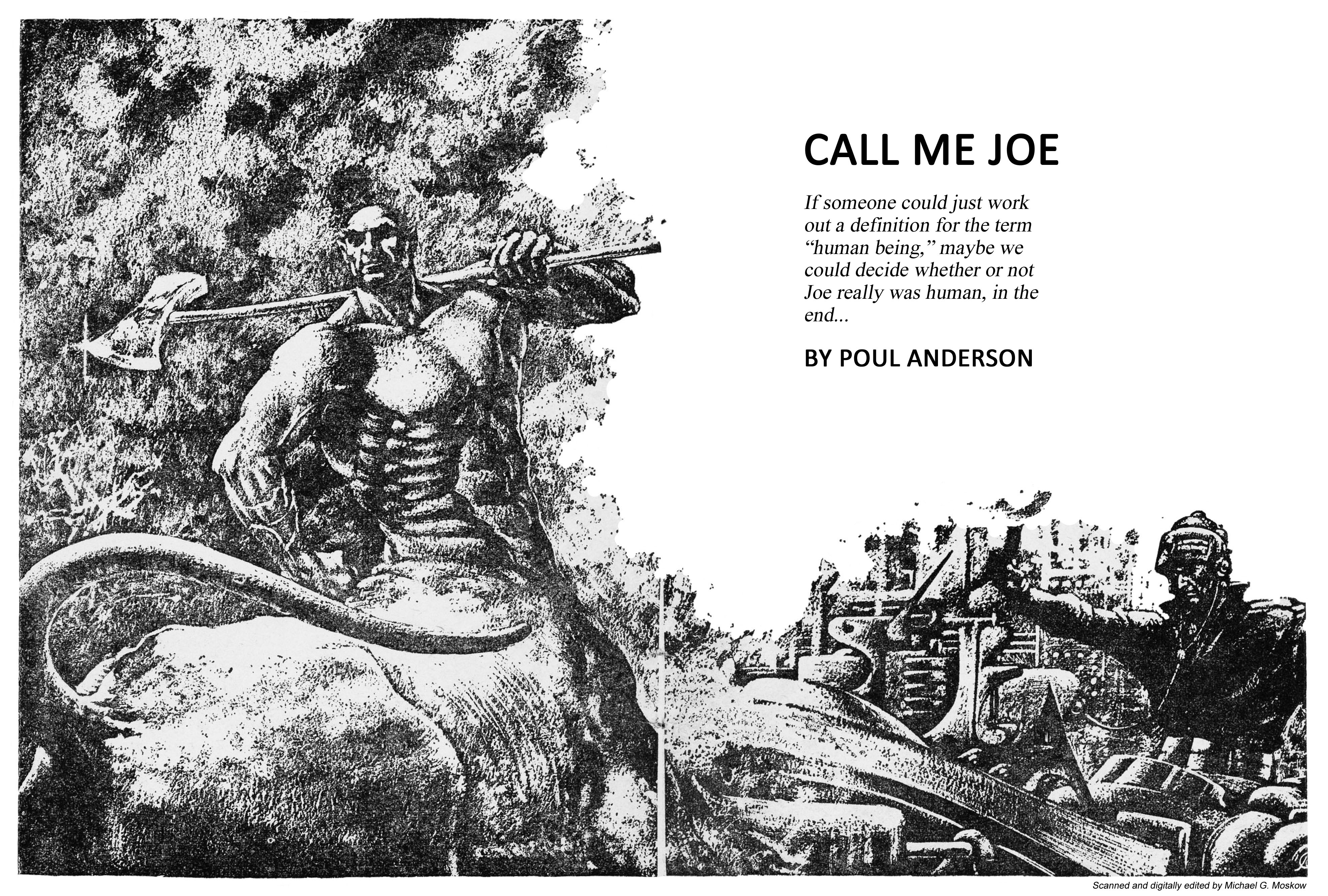 (Illustration on pages 8-9)
_____________________
For a moment, then, he knew only a crazy smothering wave of panic.
He thought he was back on Earth Station,
floating in null-gee at the end of a cable
while a thousand frosty stars haloed the planet before him.
He thought the great I-beam had broken from its moorings and started toward him,
slowly,
but with all the inertia of its cold tons, spinning and shimmering in the Earthlight,
and the only sound himself screaming and screaming in his helmet
trying to break from the cable the beam nudged him ever so gently
but it kept on moving he moved with it
he was crushed against the station wall nuzzled into it
his mangled suit frothed as it tried to seal its wounded self
there was blood mingled with the foam his blood
Joe roared. (p. 17)
_____________________
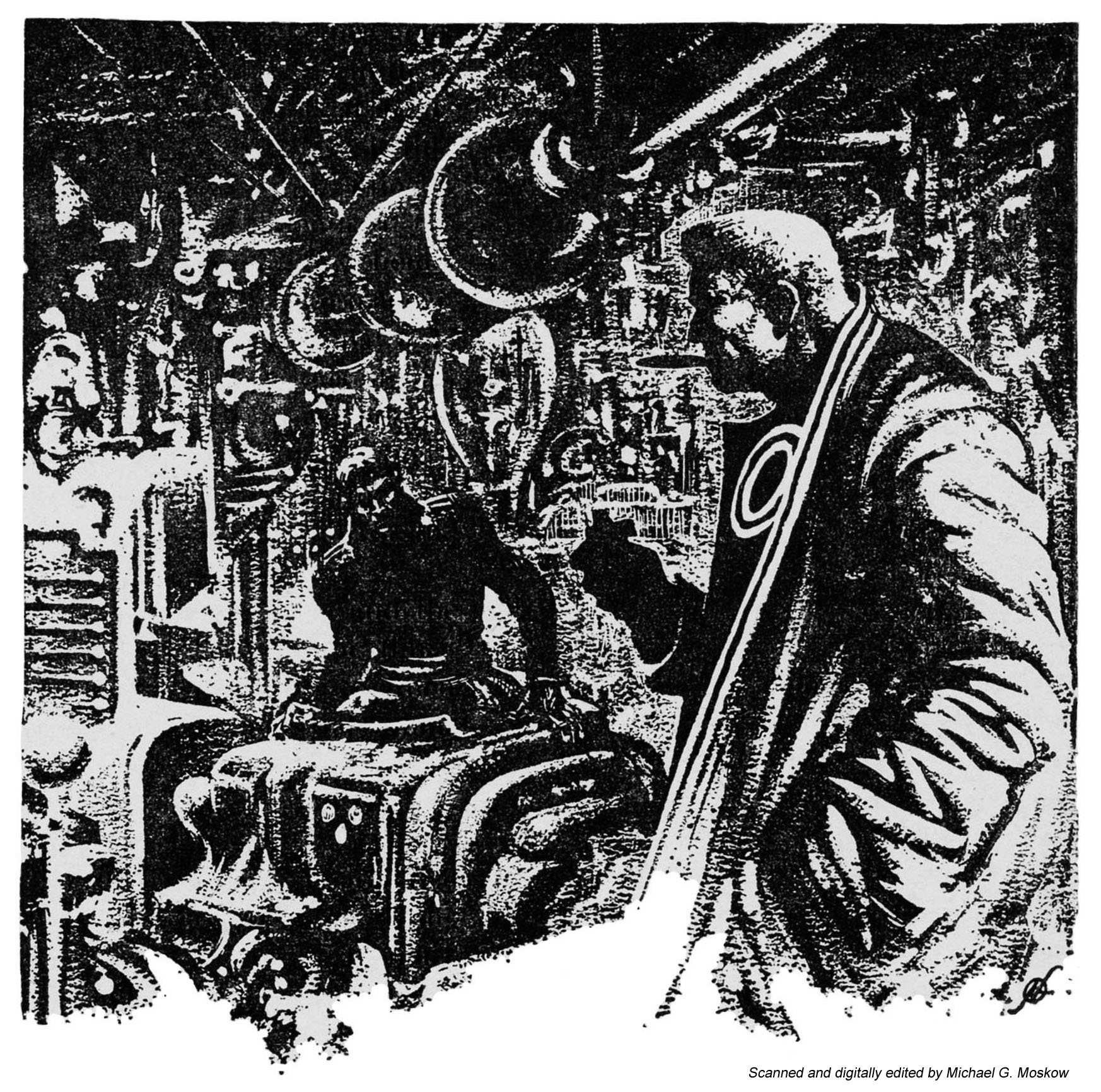 (Illustration on page 25)
_________________________
“Imagine walking under a glowing violet sky,
where great flashing clouds sweep the earth
with shadow and rain strikes beneath them.
Imagine walking on the slopes of a mountain like polished metal,
with a clean red flame exploding above you and thunder laughing in the ground.
Imagine a cool wild stream,
and low trees with dark coppery flowers,
and a waterfall, methane-fall … whatever you like … leaping off a cliff,
and the strong live wind shakes its mane full of rainbows!
Imagine a whole forest, dark and breathing,
and here and there you glimpse a pale-red wavering will-o’-the-wisp,
which is the life radiation of some fleet shy animal, and … and – ”
Anglesey croaked into silence.
He stared down at his clenched fists,
then he closed his eyes tight and tears ran out between the lids.
“Imagine being strong!” (p. 26)
_____________________
 (Illustration on page 34)
_____________________
“So.
That’s all there is?
You thought I was afraid to come down here and be Joe,
and wanted to know why?
But I told you I wasn’t!”
I should have believed – whispered Cornelius.
“Well, get out of the circuit then.”
Joe continued growling it vocally.
“And don’t ever come back in the control room, understand?
K-tubes or no, I don’t want to see you again.
And I may be a cripple, but I can still take you apart cell by cell.
Now – sign off – leave me alone.
The first ship will be landing in minutes.”
You a cripple … you, Joe Angelsey?
“What?”
The great gray being on the hill lifted his barbaric head as if so sudden trumpets.
“What do you mean?”
Don’t you understand? said the weak, dragging thought.
You know how the esprojector works.
You know I could have probed Angelsey’s mind in Angelsey’s brain
without making enough interference to be noticed.
And I could not have probed a wholly nonhuman mind at all,
now could it have been aware of me.
The filters would not have passed such a signal.
Yet you felt me in the first fractional second.
It can only mean a human mind in a nonhuman brain.
You are not he half-corpse on Jupiter V any longer.
You’re Joe – Joe Angelsey.
“Well, I’ll be damned,” said Joe. “You’re right.” (p. 37)
– Poul Anderson –
Analog – Science Fact – Fiction, December, 1960 (Featuring “The Longest Voyage” by Poul Anderson) [Frank Kelly Freas]
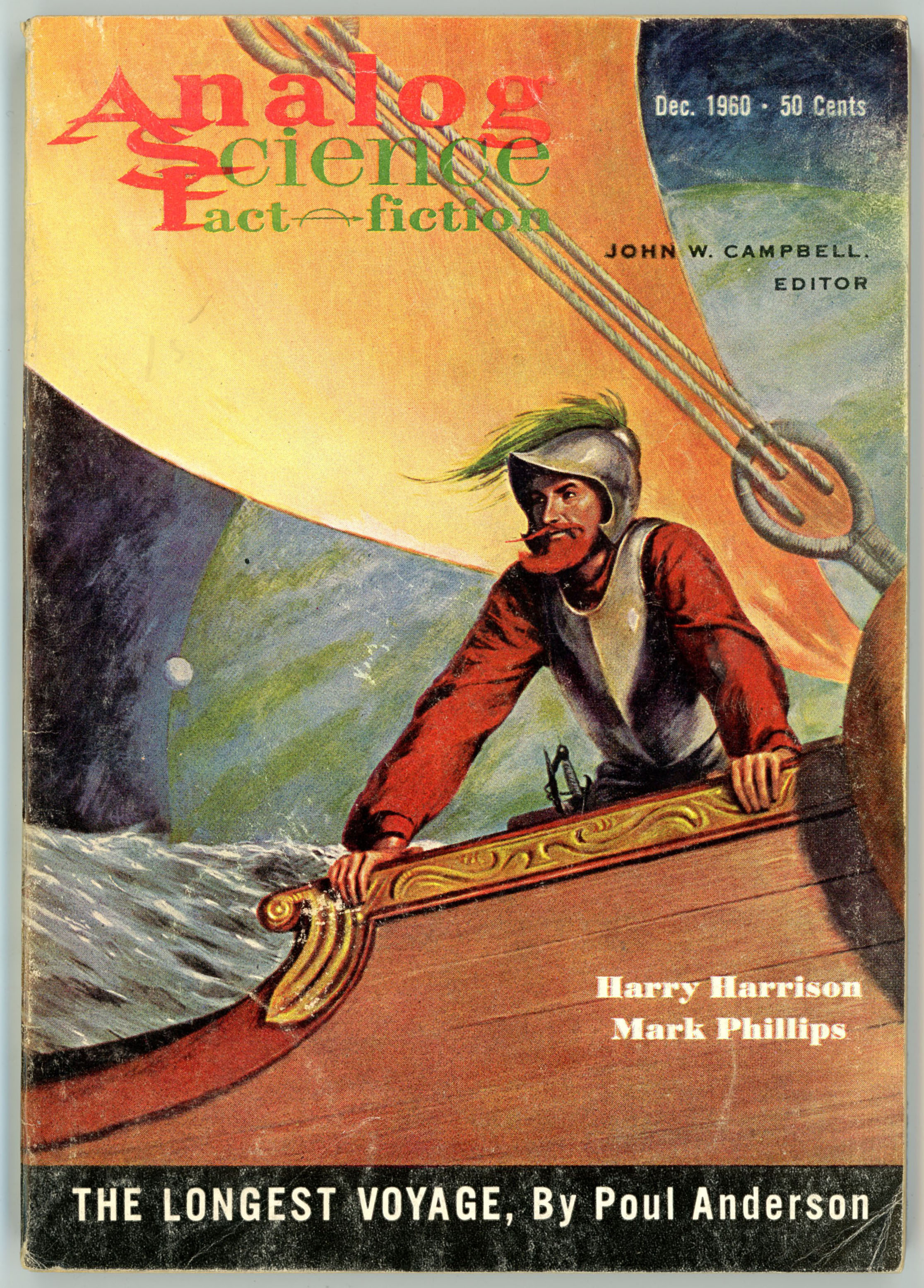 Yet when we came upon the Ship, toward evening, I forgot my weariness.
And after an amazed volley of oaths,
our mariners rested silent on their pikes.
The Hisagazi,
never talkative,
crouched low in token of awe.
Only Guzan remained erect among them.
I glimpsed his expression as he started at the marvel.
It was a look of lust.
Wild was that place.
We had gone above timberline.
The land was a green sea below us, edged with silvery ocean.
Here we stood among tumbled black boulders,
cinders and spongy tufa underfoot.
The mountains rose in steeps and scarps and ravines,
on to snows and smoke,
which rose another mile into a pale chilly sky.
And here stood the Ship.
And the Ship was beauty.
I remember.
Its length
– height, rather, since it stood on its tail
– it was about equal to our caravel,
in form not unlike a lance head,
in color a shining white,
unvarnished after forty years.
That was all.
But words are paltry, my lords.
What can they show of clean soaring curves,
of iridescence on burnished metal,
of a thing which was proud and lovely and in its very shape aquiver to be off?
How can I conjure back the glamour which hazed that Ship whose keel had cloven starlight?
– Poul Anderson
 Illustration by Frank Kelly Freas (p. 24)
The Pritcher Mass, by Gordon R. Dickson – 1972 (September, 1973) [Frank Kelly Freas and Jack Gaughan]
 ______________________________
 Story description, from rear cover…
“The only hope for mankind’s survival after the contamination of the Earth lay in the Pritcher Mass, a psychic forcefield construction out beyond the orbit of Pluto. Created by the efforts of individuals with extraordinary paranormal powers, the Mass was designed to search the universe for a new habitable planet.
Chaz Sant knew he had the kind of special ability to contribute effectively to the building of the Mass, but somehow the qualifying tests were stacked against him. Then he learned that he had become the special target of an insidious organization that fattened on the fears of the last cities of the world. His confrontation with this organization, their real motives and his unexpected reactions, were to touch off the final showdown for mankind’s last enterprise.”
______________________________
Interior illustration, facing title page…
 Frontspiece by Jack Gaughan
Astounding Science Fiction, August, 1954 (Featuring “They’d Rather Be Right,” by Mark Clifton and Frank Riley, and, “The Cold Equations,” by Tom Godwin) [Frank Kelly Freas]
 Tom Godwin’s short story “The Gulf Between” was a cautionary tale about using computer technology to supplant human decision-making, set within the overlapping contexts of the creation of the ultimate (robotic) soldier, and, mans’ first venture into space. Godwin’s “The Cold Equations” is different: The story is a stunning exploration of the classical philosophical dilemma of balancing the life of one, versus the life of many, set within the frontier of a future space-faring civilization.
Though the latter tale is far better known within and even beyond the genre of science-fiction, the cord linking the two stories being Godwin’s adept use of an imagined future as the setting for confronting and resolving – in a deeply unsettling, unflinching manner – questions of man’s uniqueness, and, the inherent spiritual value of the individual. Though the stories are (unsurprisingly) somewhat dated on technological grounds – well, they were written over a half-century ago – overall, the writing is tight, crisp, and direct, their length belying their impact and the import of their underlying themes.
“The Cold Equations” has been adapted for radio, television, and web formats, testimony to the tale’s power and literary merit. Similarly, the story has been anthologized many times, one example being in volume one of the Science Fiction Hall of Fame, published in November of 1972.
The story, scripted by George Lefferts and with the roles of pilot Barton and passenger Marilyn voiced by Court Benson and Jill Meredith, was broadcast as episode 15 of the X Minus One radio program on August 8, 1955. The play can also be downloaded from Archive.org.
The two television versions of the story comprise the Twilight Zone production of January 7, 1989 (available on YouTube), and the FilmRise / Alliance Atlantis movie of December 7, 1996, the latter receiving widely varying reviews at both IMDB and Amazon.
Oddly, the several YouTube versions of the Twilight Zone version manifest the same strange problem: About one hour long, all are comprised of three copies of the episode “spliced” together, whereas the actual episode – without commercial breaks – is only 21 minutes long.
Though appearing under a different title – “Stowaway” – the DUST YouTube channel’s version of The Cold Equations, released on April 7, 2018, is a superb rendering of Godwin’s story, the brevity (12 minutes) and pacing of the film closely paralleling the feel of the original story. The acting is excellent (the CG, too), but (?!) the names of the actor and actress are not presented.
______________________________
Though Frank Kelly Freas’ illustrations and cover art were often whimsical, humorous, and – at least in his early years – highly creative (the cover is superb!), such qualities would not have befitted art accompanying “The Cold Equations”. Thus, the images of Barton and Marilyn are aptly subdued and pensive, while the leading image – a simple depiction of a spacecraft which seems to have jettisoned an unidentified “something” as it approaches a planet in crescent phase – symbolizes the central aspect of the story. These appear below, accompanied by key passages from the story, which is available in full text at LightSpeedMagazine.
______________________________
He began to check the instrument readings,
going over them with unnecessary slowness.
She would have to accept the circumstances
and there was nothing he could do to help her into acceptance;
words of sympathy would only delay it.
It was 18:20 when she stirred from her motionlessness and spoke.
“So that’s the way it has to be with me?”
He swung around to face her.
“You understand now, don’t you?
No one would ever let it be like this if it could be changed.”
“I understand”, she said.
Some of the color had returned to her face
and the lipstick no longer stood out so vividly red.
“There isn’t enough fuel for me to stay;
when I hid on this ship I got into something I didn’t know anything about
and now I have to pay for it.”
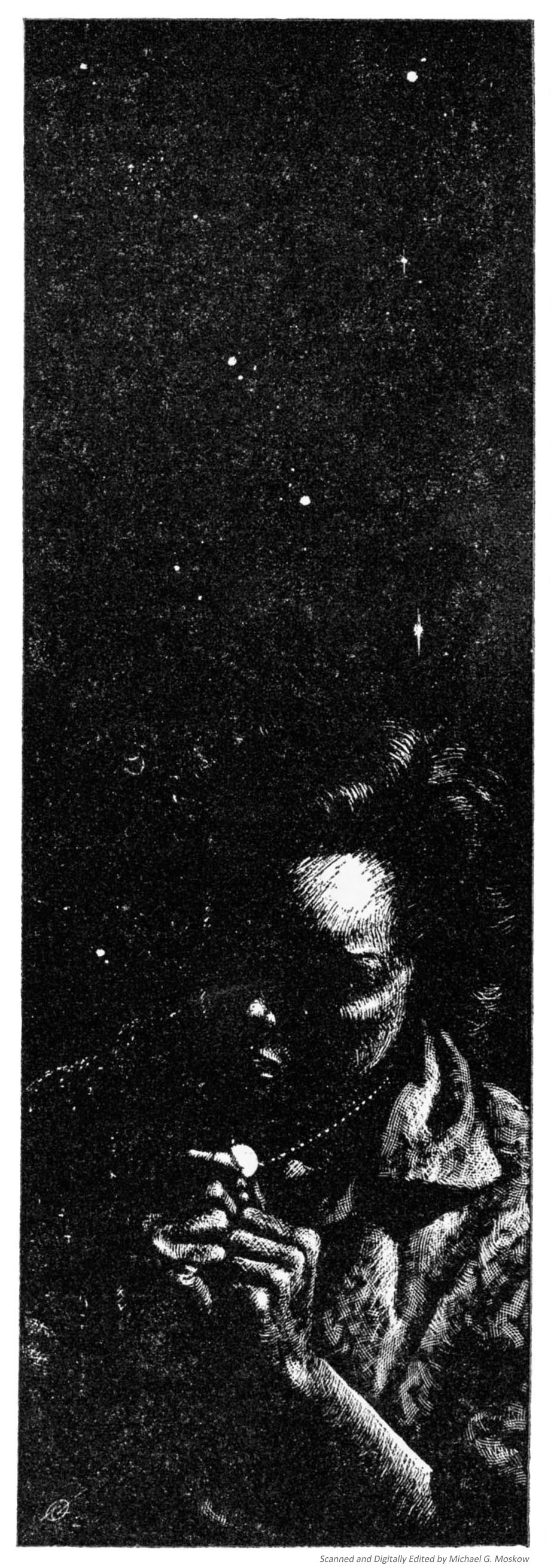 She had violated a man-made law that said KEEP OUT
but the penalty was not of man’s making or desire
and it was a penalty men could not revoke.
A physical law had decreed:
h amount of fuel will power an EDS with a mass of m safely to its destination;
and a second physical lad had been decreed:
h amount of fuel will not power an EDS with a mass of m plus x safely to its destination.
EDSs obeyed only physical laws
and no amount of human sympathy for her could alter the second law.
“But I’m afraid.
I don’t want to die – not now.
I want to live and nobody is doing anything to help me
everybody is letting me go ahead and acting just like nothing was going to happen to me.
I’m going to die and nobody cares.”
“We all do,” he said.
“I do and the commander does and the clerk in Ship’s Records;
we all care and each of us did what little he could to help you.
It wasn’t enough – it was almost nothing – but it was all we could do.”
“Not enough fuel – I can understand that,” she said,
as though she had not heard his own words.
“But to have to die for it.
Me, alone –
 How hard it must be for her to accept the fact.
She had never known danger of death;
had never known the environments where the lives of men could be as fragile
as sea foam tossed against a rocky shore.
She belonged on gentle Earth,
in that secure and peaceful society where she could be young and gay and laughing
with the others of her kind;
where life was precious and well-guarded
and there was always the assurance that tomorrow would come.
She belonged in that world of soft winds and warm suns,
music and moonlight and gracious manners
and not on the hard, bleak frontier.
— Tom Godwin —
— 1954 —

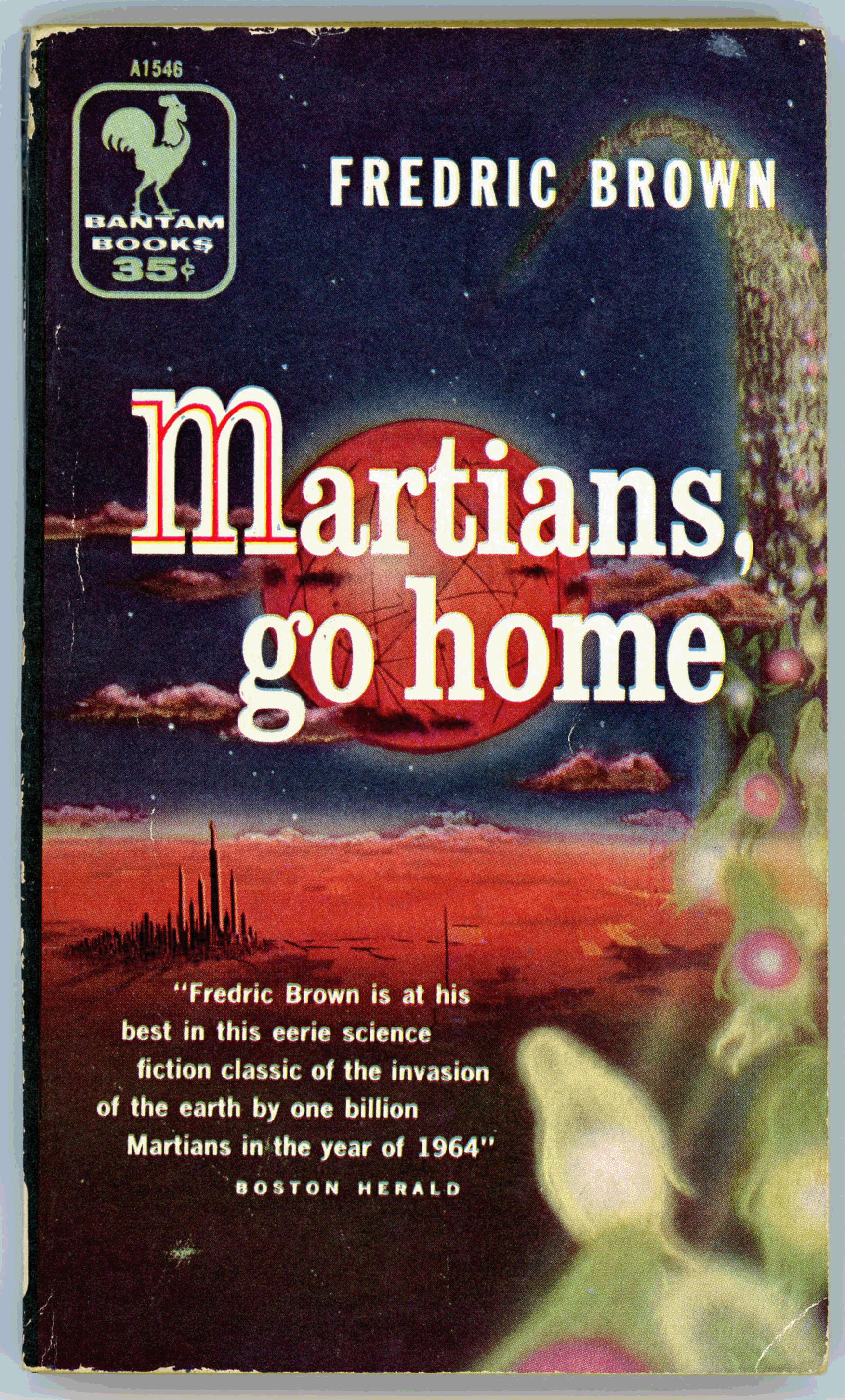
Martians, Go Home, by Fredric Brown – 1955 [Richard M. Powers]
 ______________________________
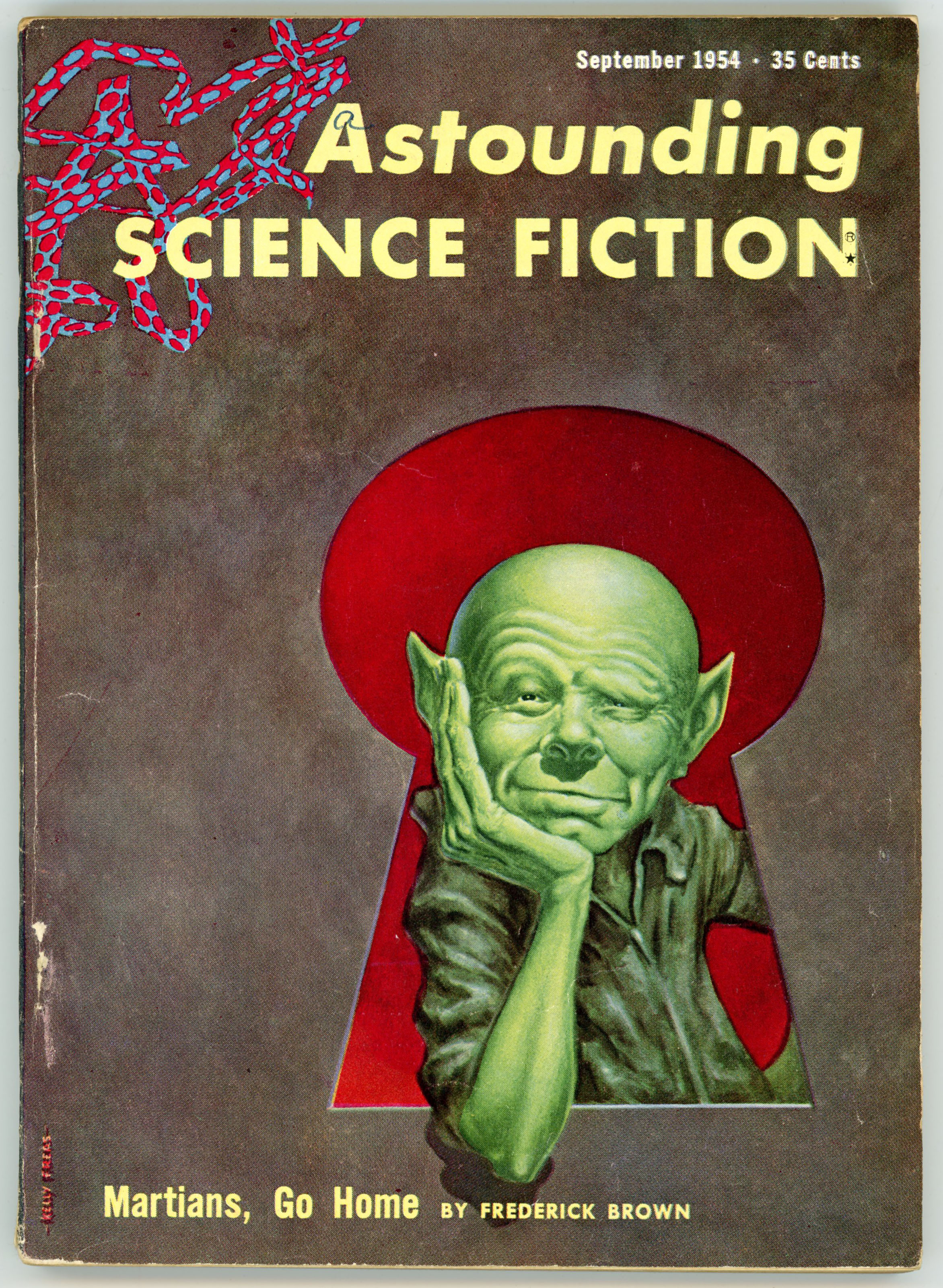
Fredric Brown’s novel – note that his name is presented as “Frederick” – originally appeared as a single installment within the September, 1954 issue of Astounding Science Fiction.
The cover of this particular issue of Astounding is representative of the magazine’s cover design for the latter part of the 1950s: The majority of issues published from February, 1954 through November, 1959 featured – always in the upper left corner – a diagram, abstract representation, or symbol of an aspect of the physical sciences (biology, chemistry, physics, and engineering / technology) with a brief explanatory “blurb” within the magazine’s table of contents.
So, for September of 1954, we have: “Optical confusion: The eye cannot simultaneously focus on pure red and pure blue.”
Well, I don’t know if it’s really that confusing. At least, it wouldn’t be for a Martian peering through the oversized keyhole!
 My personal favorite is from December of 1957, and needs little explanation…

The Magazine of Fantasy and Science Fiction – September, 1956 (Featuring “Operation Afreet”, by Poul Anderson) [Frank Kelly Freas]

Unlike the majority of science fiction (and fantasy) magazines of the 40s and 50s, The Magazine of Fantasy and Science Fiction eschewed interior art. The issue of September, 1956 was an exception to this policy, featuring two illustrations – below – by Frank Kelly Freas, which accompanied Poul Anderson’s tale “Operation Afreet”.
The third illustration is an allegorical image created by the unknown artist “H.M.”
 (Page 11)
  (Page 37)
 (Page 37)
Donald A. Wollheim Presents the 1985 Annual World’s Best SF – Donald A. Wollheim -June, 1985 [Frank Kelly Freas]
 Contents
The Picture Man, by John Dalmas, The Magazine of Fantasy and Science Fiction
Cash Crop, by Connie Willis
We Remember Babylon, by Ian Watson, from Habitats
What Makes Us Human, by Stephen R. Donaldson, from The Magazine of Fantasy and Science Fiction, for Berserker Base
Salvador, by Lucius Shepard, from The Magazine of Fantasy and Science Fiction
Press Enter, by John Varley
The Aliens Who Knew, I Mean Everything, by George Alec Effinger, from The Magazine of Fantasy and Science Fiction
Bloodchild, by Octavia E. Butler
The Coming of the Goonga, by Gary R. Shockley
Medira, by Tanith Lee
Astounding Science Fiction – June, 1955 (Featuring “Final Weapon”, by Everett B. Cole) [Frank Kelly Freas]
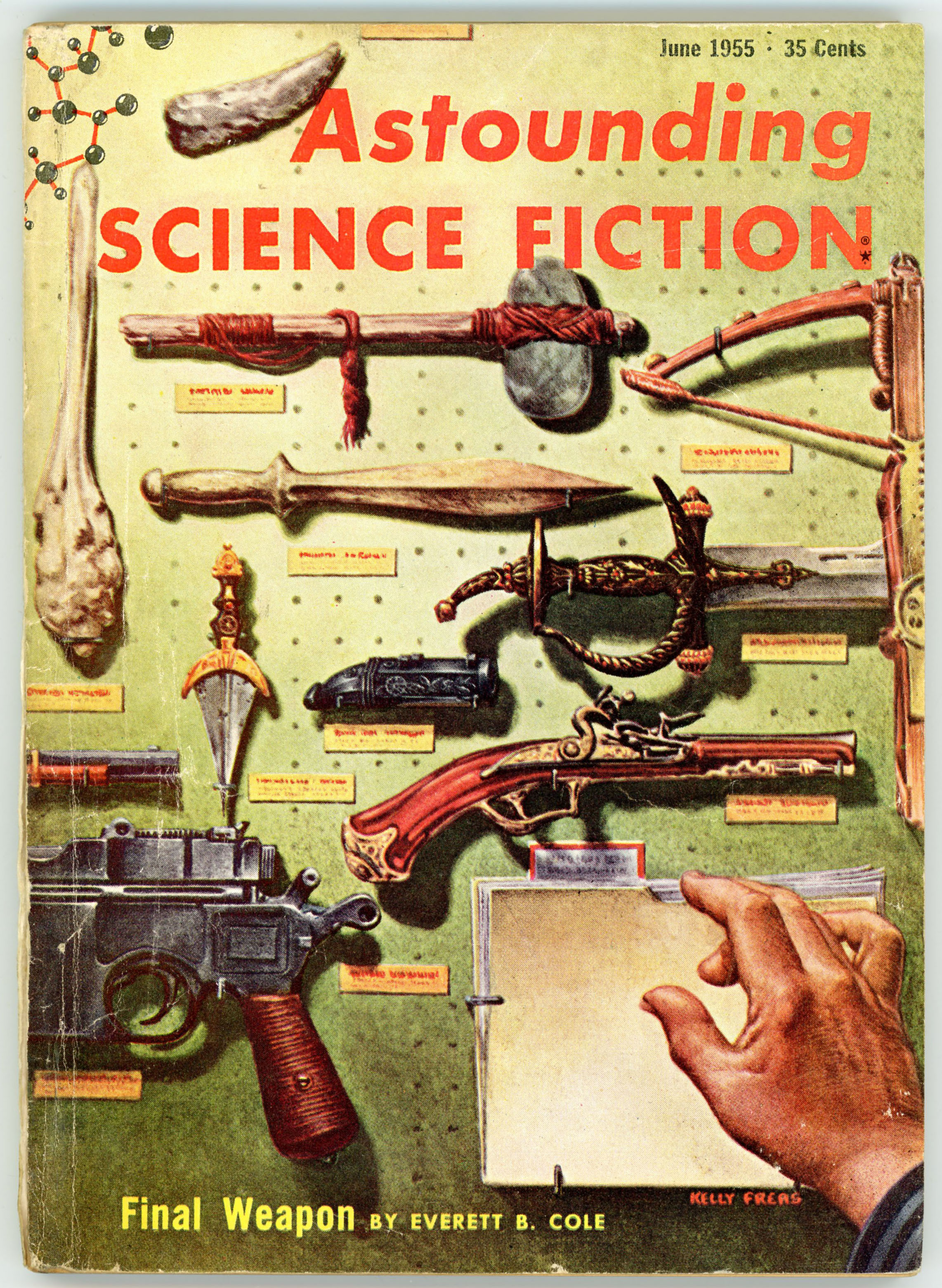
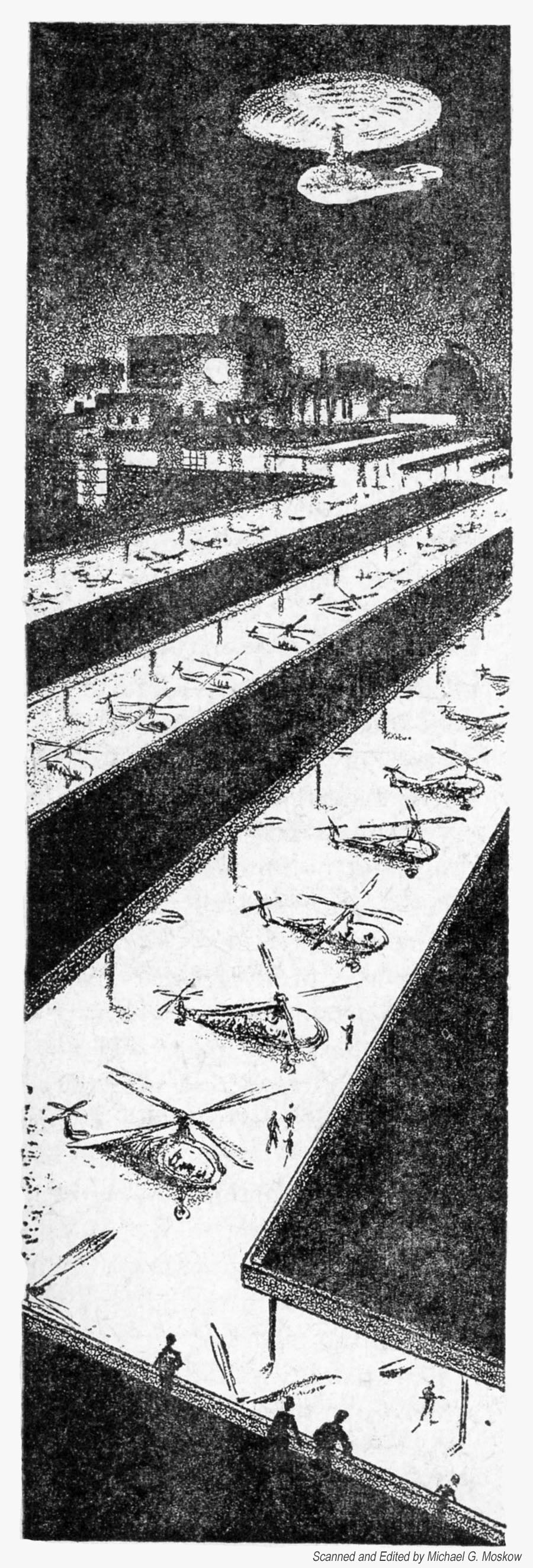 Illustration by Alexander Leydenfrost, for “Final Weapon”, by Everett B. Cole (p. 8).
 Illustration by Alexander Leydenfrost, for “Final Weapon”, by Everett B. Cole (p. 19).
 Illustration by Alexander Leydenfrost, for “Final Weapon”, by Everett B. Cole (p. 28).
 Illustration by Alexander Leydenfrost, for “Final Weapon”, by Everett B. Cole (p. 37).
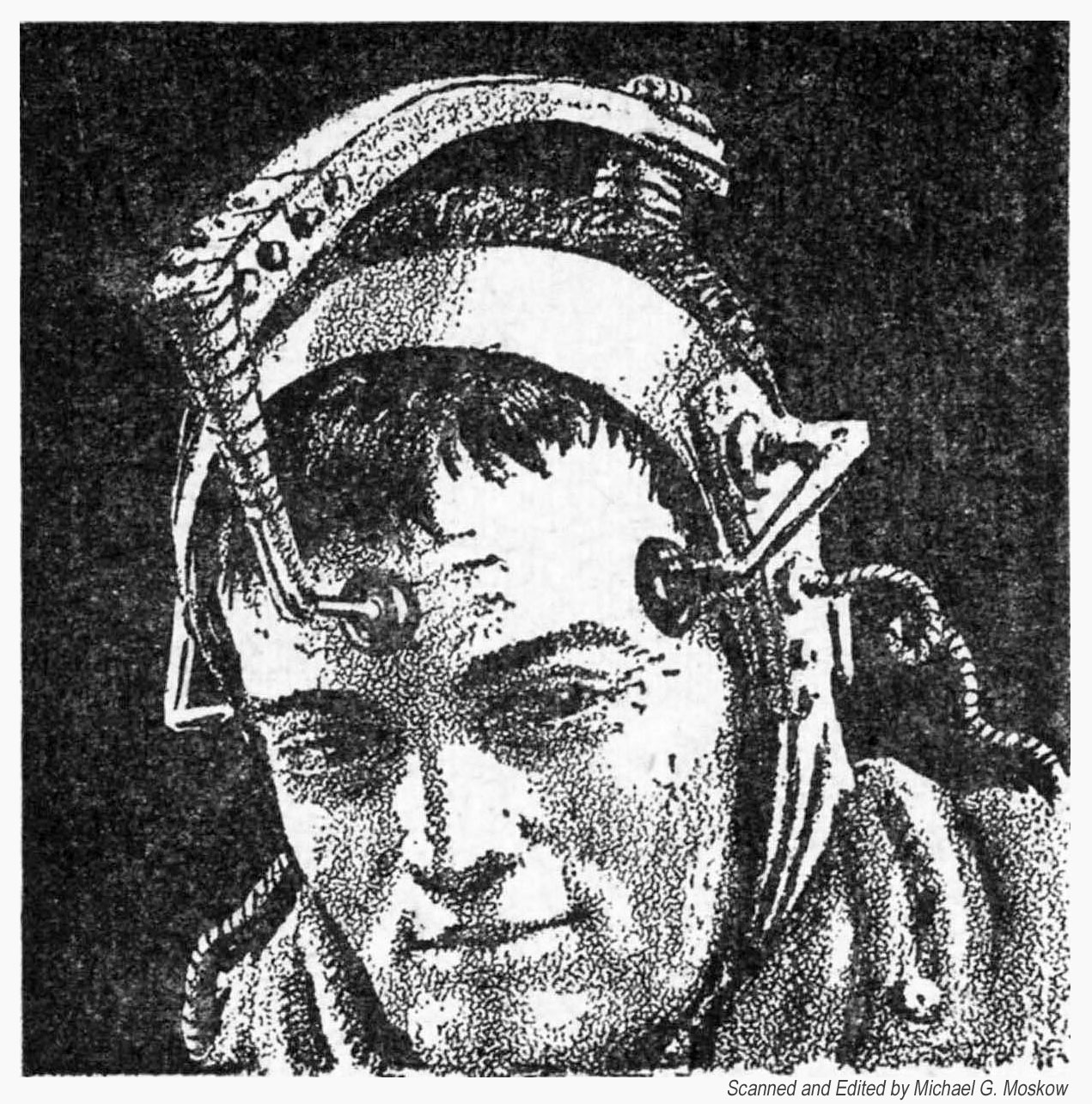 Illustration by Alexander Leydenfrost, for “Final Weapon”, by Everett B. Cole (p. 46).
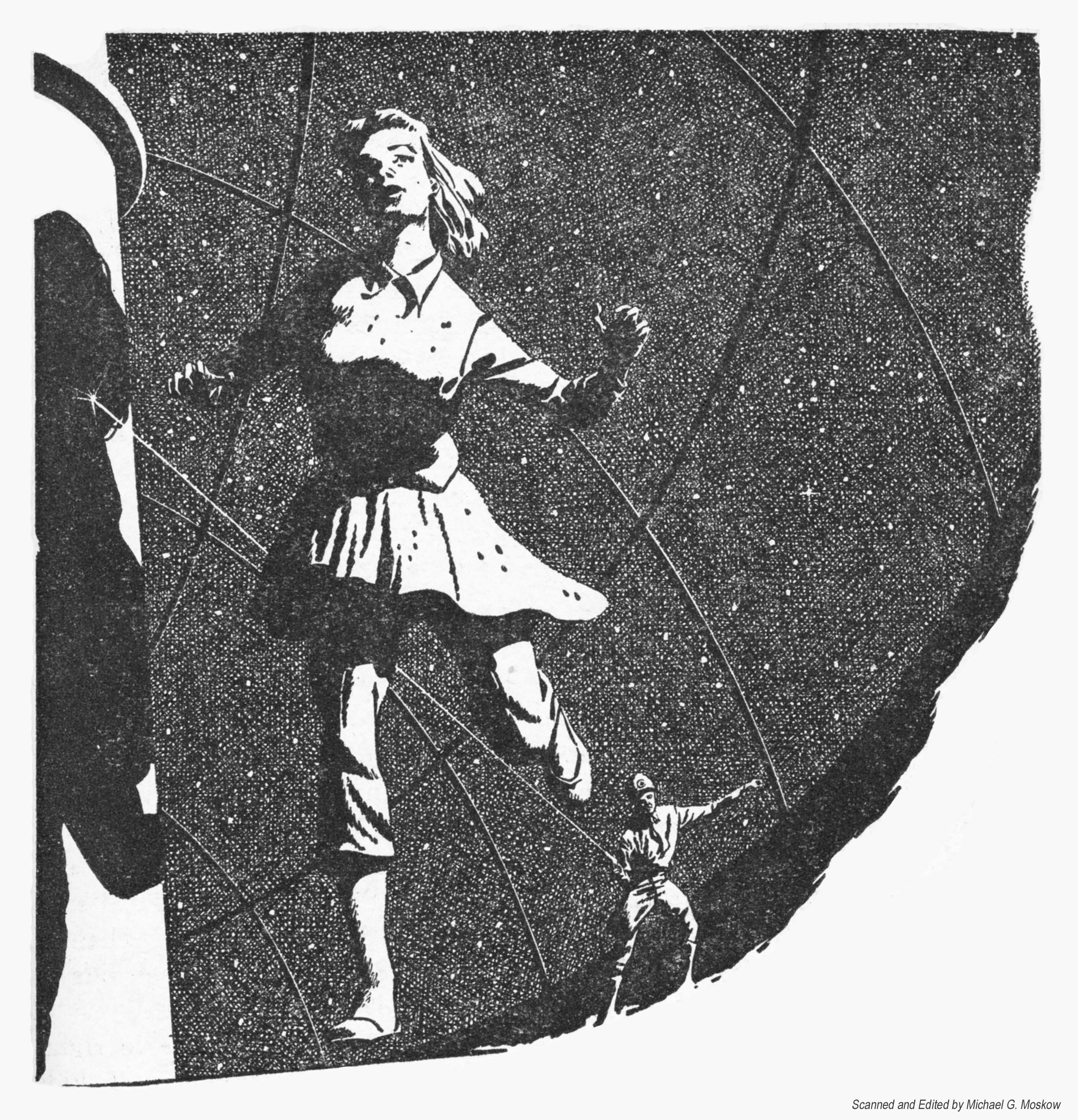 Illustration by Richard Van Dongen for “The Guardians”, by Irving Cox, Jr. (p. 53).
 Illustration by Richard Van Dongen for “Shock Absorber”, by E.G. Von Wald (p. 67).
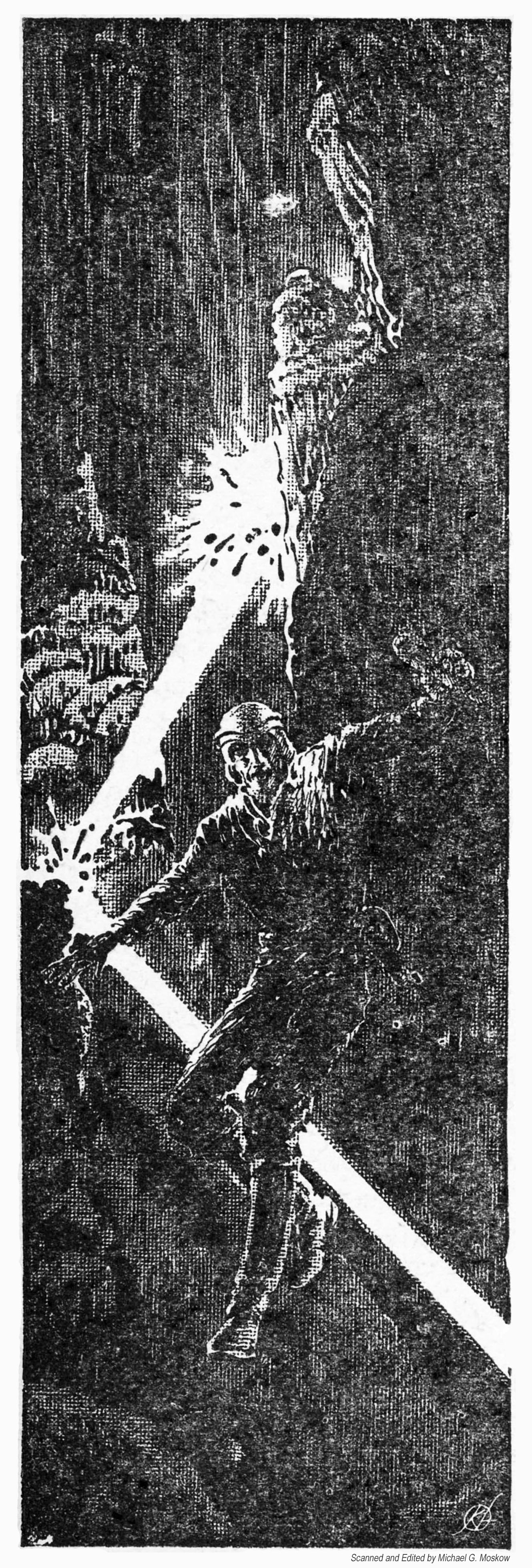 Illustration by Frank Kelly Freas for “The Long Way Home” (Part III of IV), by Poul Anderson (p. 134).
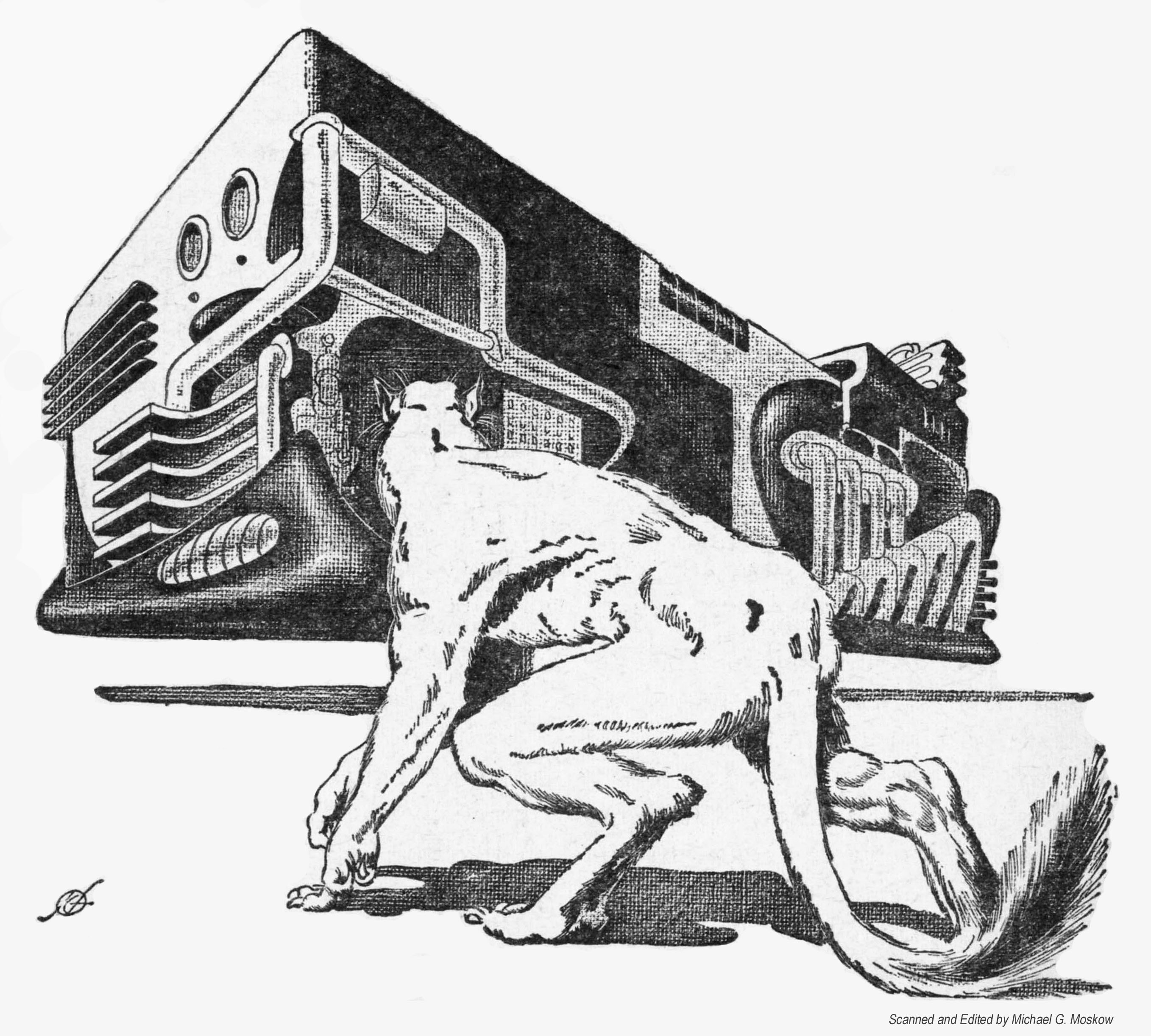 Illustration by Frank Kelly Freas for “The Long Way Home” (Part III of IV), by Poul Anderson (p. 147).