Star Science Fiction Stories No. 4, Edited by Frederik Pohl – 1958 [Richard M. Powers] [Revised Post]

Though Powers’ cover primarily appears in muted shades of gray and brown, a close-up – below – reveals a level of complexity and mystery not readily apparent upon a cursory glance: Two enigmatic figures signal one another across a barren landscape, while a bird-like tower stands in the distance, and a ragged sphere – a planet? – a moon? – rises above the horizon, on the left. 

Above all, the scene imparts an absence of visual and thematic certainty, typical of Powers’ work.

Contents

A Cross of Centuries, by Henry Kuttner

The Advent on Channel Twelve, by Cyril M. Kornbluth

Space-Time for Springers, by Fritz Leiber

Man Working, by Richard Wilson

Helping Hand, by Lester del Rey

The Long Echo, by Miriam Allen deFord

Tomorrow’s Gift, by Edmund Cooper

Idiot Stick, by Damon Knight

The Immortals, by James Gunn

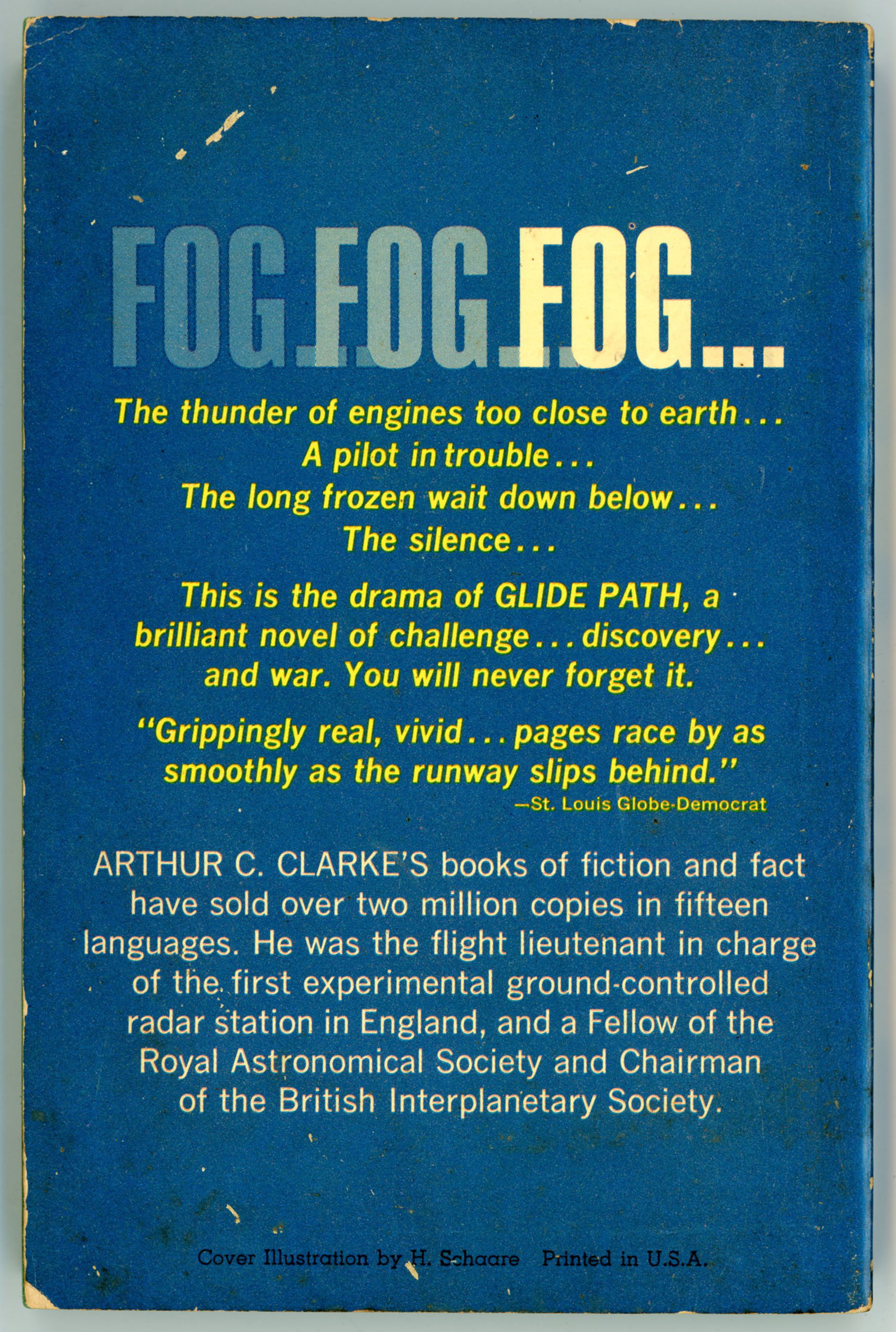
Glide Path, by Arthur C. Clarke – 1963 (1965) [Harry Schaare] [Revised post]

“It is strange how the mind can leapfrog across the years,
selecting from a million, million memories for one that is even faintly relevant,
 while rejecting all the others.”

C Charlies was like a fly crawling over this darkened clock face. 
It had been aimed at the narrow illuminated section,
but might already have missed it,
to remain lost in the blackness that covered almost all the dial.

So this, Alan told himself without really believing it,
was probably the most dangerous moment of his life. 
Introspection was not normally one of his vices;
he could worry with the best,
but did not waste time watching himself worrying. 
Yet now, as he roared across the night sky toward an unknown destiny,
he found himself facing that bleak and ultimate question which so few men can answer to their satisfaction. 
What have I done with my life, he asked himself,
that the world will be the poorer if I leave it now?

He had no sooner framed the thought than he rejected it as unfair. 
At twenty-three, no-one could be expected to have made a mark on the world,
or even to have decided what sort of mark he wished to make. 
Very well, the question could be reframed in more specific terms:
How many people will be really sorry if I’m killed now?

There was no evading this. 
It struck too close to home,
brought back too vivid a memory of the tearless gathering around his father’s grave.

______________________________

It is strange how the mind can leapfrog across the years,
selecting from a million,
million memories for one that is even faintly relevant,
 while rejecting all the others.