Vanguard Science Fiction, June, 1958 – First issue, last issue, only issue! [Edmund A. Emshwiller]

So for every author, so for every artist:  Whether in terms of the written word, or objects and images fashioned from the “stuff” of the world around us, the works of writers and illustrators (and especially illustrators!) – by the distinctiveness of their style, theme, mood, and message – readily reveal the identity of the creators:  You don’t always need a signature to know who made the brush-strokes.

In terms of science fiction art, the works of “EMSH” – Edmund A. Emshwiller – are some of the most visually distinctive.  Characterized by boldness of color (and typically, a variety of colors within a single composition), sharpness and clarity (and almost always, objects and people distinctly defined), dramatic action (and often, scenes where action has temporarily halted for a dramatic pause), technical intricacy (and inevitably, portrayals of technology of the future), you usually “know” when you’re viewing his creations.  Then again, his emblematic signature of “EMSH”, always sort-of-hidden somewhere in his paintings, simplifies things a bit, too! 

Case in point, the cover of the June, 1958, issue of Vanguard Science Fiction, the magazine’s first, last, and (alas!) only issue.  In this case the palette is limited to shades of yellow and very dark green; the background of space otherwise entirely black, with the exception of a planet in the distance.  (No, it’s not earth.)  The source of illumination – and therefore the lighter shades of color – actually arises from a very dramatic element in the painting: The flames emanating from the spacecraft’s five clustered engines.

But, the cover art tells a story, and a very (did I say “very”?) grim story at that:  A pair of astronaut-technicians are performing repairs to their ship.  Then, somehow (how?) the engines fire.  One astronaut desperately attempts to grab hold of the spacecraft.  The other is engulfed by the flames emerging from the engine cluster.  Not good.  No, not good at all.  But, in artistic terms, Ed Emshwiller’s dramatic portrayal of this scene – directly inspired by the opening of A. Bertram Chandler’s cover story, “SOS: Planet Unknown”, in which this incident is really a minor detail in the story arc – was, precisely because of its jarring and disturbing nature, riveting. 

As for Chandler’s story itself?  Well, it’s competently constructed.  The protagonists and other characters are well-drawn and distinctive, while the tale’s undertone is disturbing and somewhat graphic (verbally graphic, that it), akin to something you might have read in Venture Science Fiction.  With that, oddly, the action in “space” only comprises the first few paragraphs, which – crisply and very tightly written – go at a brisk pace, the remainder of the story occurring at a much more methodical pace on an uncharted planet, where we find that the plot revolves vastly less around the theme of space exploration than it does biology.  (Or, alien biology, to be specific.)  Not the greatest story by any means, but certainly an adequate and entertaining read. 

So, recently, after a long measure of searching, I finally had the good fortune of obtaining my own nice copy of this magazine.  Here it is…

Admittedly, I wanted to get this one for a long time.  I had my first glimpse of the cover art in James Gunn’s 1973 Alternate Worlds, where a photo of the cover occupies an entire page (specifically, page 208) in this large format (8 1/2″ x 12″) book.  Reproduced in color, the image is one of the fifty-five images of the covers of science fiction pulps found in the book, where they’re grouped into sections by era or magazine title.  Gunn’s book is equally valuable in the abundance of photographic portraits of science fiction authors that grace its pages, let alone invaluable for the very text itself.  

(As for the fate of the two hapless astronaut-technicians?  Well, you can find that here…)

Reference(s)

Gunn, James E. (with Introduction by Isaac Asimov) Alternate Worlds – The Illustrated History of Science Fiction, A&W Visual Library (by arrangement with Prentice-Hall, Inc.), Englewood Cliffs, N.J., 1973

A. Bertram Chandler at…

Fantastic Fiction

GoodReads

Simon & Schuster

Wikipedia

James Blish, at…

James Blish.com

James E. Gunn (biography), at…

Wikipedia

The Magazine of Fantasy and Science Fiction – August, 1958 (Featuring “Have Spacesuit – Will Travel”, by Robert A. Heinlein) [Edmund A. Emshwiller] [Updated post!…  February 6, 2021]

[This post, created on June 30, 2018, is very simple:  It shows the cover of the August, 1958 issue of The Magazine of Fantasy and Science Fiction, in which appeared the first installment of Robert Heinlein’s  Have Spacesuit – Will Travel.  It’s now updated to an image of Edmund Emshwiller’s (a.k.a. EMSH) original cover art.  The original composition readily conveys how the center of activity and therefore visual interest in Emshwiller’s composition, is situated to right and at bottom, leaving room for the magazine’s title and contents to left and at top.  Also, both the original painting and the cover as published are a great example of how Emshwiller would cleverly situate his logo – EMSH – within the painting in such a manner as to make it an almost natural part of the scene.] 

____________________

The cover as published…

…Edmund Emshwiller’s original art, from Heritage Auctions.  The original is described as “acrylic on board, 19.75 x 13.5 inches, framed under acrylic to 24.5 x 18.25 inches, from the Glynn and Suzanne Crain Collection“.

Reference

“Have Spacesuit-Will Travel, Fantasy and Science Fiction cover”, August 1958, at Heritage Auctions

June 30, 2018

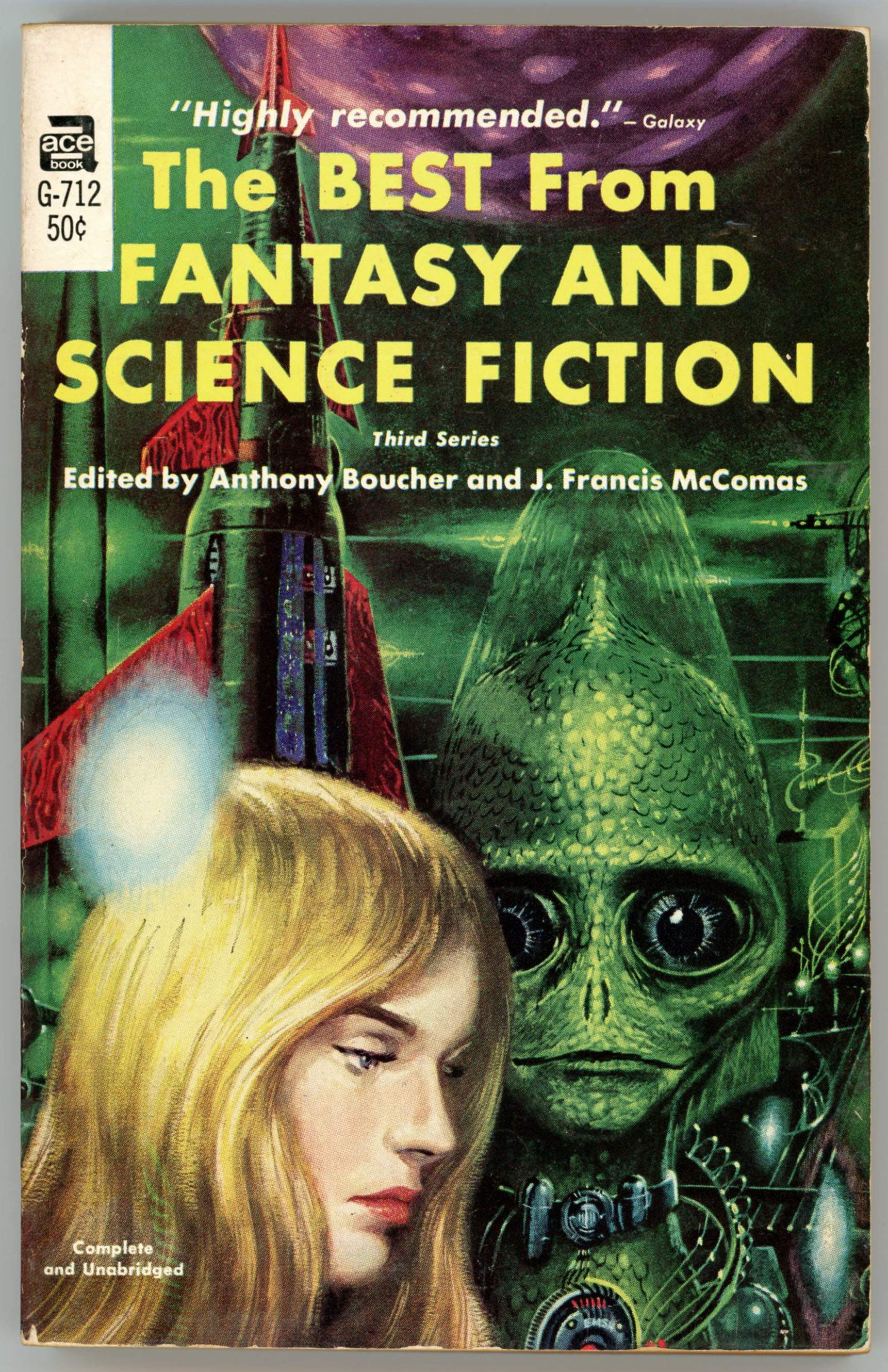
The Best From Fantasy and Science Fiction – Third Series, Edited by Anthony Boucher and J. Francis McComas- 1952 (1953, 1954) [Edmund A. Emshwiller] [Updated post…] – Ace D-422 / G-712

Dating from June of 2017 (gadzooks!), this was one the earliest posts at WordsEnvisioned: The cover of the third volume (or, third series, as it were) of stories published in The Magazine of Fantasy and Science Fiction during 1953.

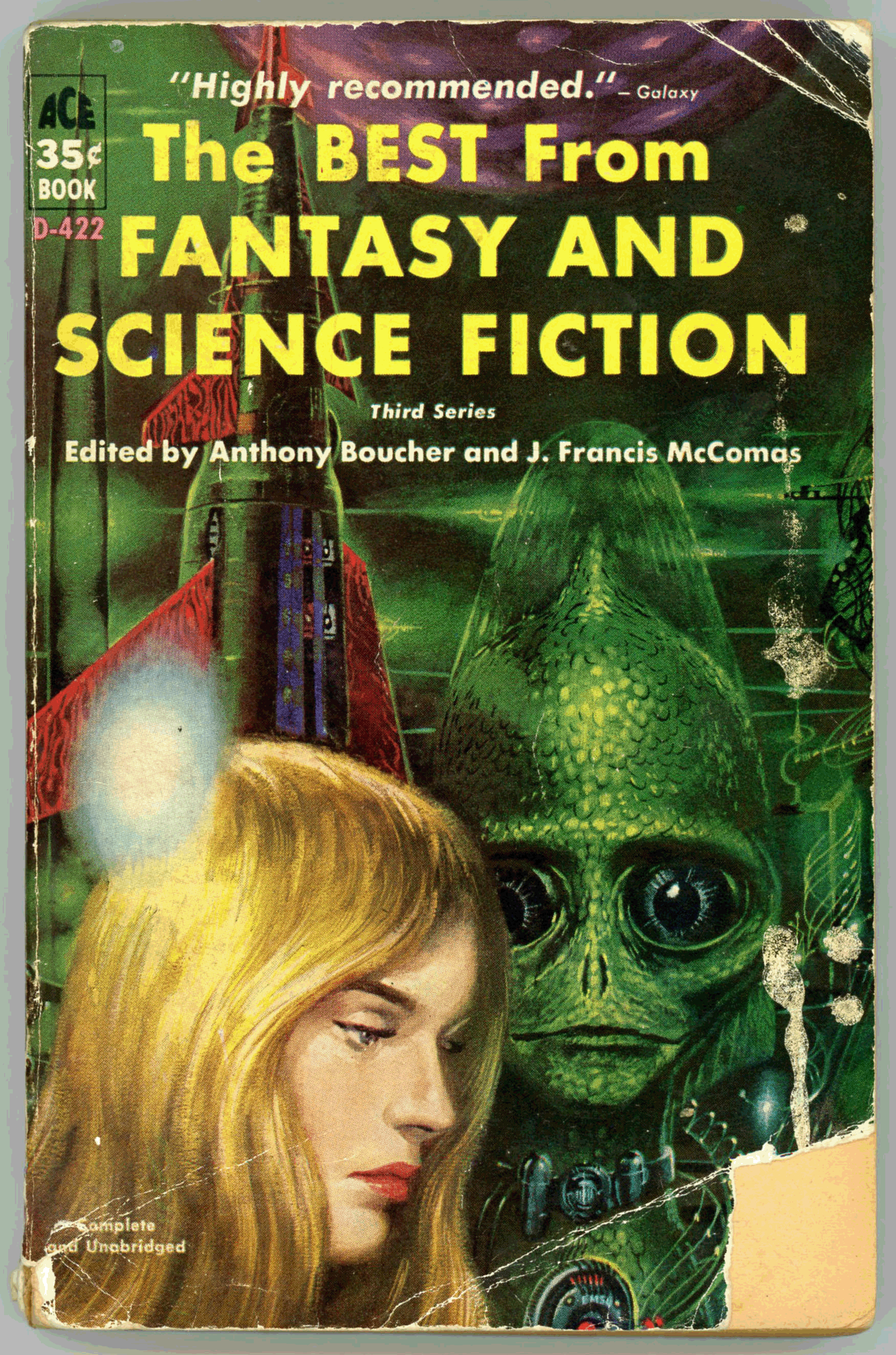
The post originally showing a rather bedraggled copy of the book, which I purchased at a flea market some decades ago.  (See image at bottom.)  It’s now been updated with a pristine copy, which presents Edmund Emshwiller’s cover art in its complete imagination and intricacy.  In this case, for Kay Rogers’ tale “Experiment”. 

This is also a great example of how “Emsh” sort of “hid” his nickname in his illustrations:  In this case, “EMSH” appears in tiny blue letters in the center of the aquatic space-alien’s chest.  Uh, assuming the space-alien has a chest…

“Attitudes”, by Philip Jose Farmer, October, 1953

“Maybe Just a Little One”, by Reginald Bretnor, February, 1953

“The Star Gypsies”, by William Lindsay Graham, July, 1953

“The Untimely Toper”, by L. Sprague de Camp and Fletcher Pratt, July, 1953

“Vandy, Vandy”, by Manly Wade Wellman, March, 1953

“Experiment, by Kay Rogers, February, 1953

“Lot”, by Ward Moore, May, 1953

“Manuscript Found in a Vacuum”, by Philip Maitland Hubbard, August, 1953

“The Maladjusted Classroom”, by Homer Czar Nearing, Jr., June, 1953

“Child by Chronos”, by Charles L. Harness, June, 1953

“New Ritual”, by Idris Seabright, January, 1953

“Devlin”, by William Bernard Ready, April, 1953

“Captive Audience”, by Anne Warren Griffith, August, 1953

“Snulbug”, by Anthony Boucher, May, 1953 (originally in Unknown Worlds, December, 1941)

“Shepherd’s Boy”, by Richard Middleton, March, 1953 (originally in The Ghost Ship & Other Stories, May, 1912)

“Star Light, Star Bright”, by Alfred Bester, July, 1953

Reference

The Best From Fantasy and Science Fiction – Third Series, at Internet Speculative Fiction Database

6/19/17

The Artful Astronaut: The Magazine of Fantasy and Science Fiction – November, 1962 [Edmund Emshwiller]

Four short months after the appearance of his cover illustration for the June, 1962, issue of The Magazine of Fantasy and Science Fiction, Edmund Emshwiller – “Emsh” – created cover art for the magazine’s November issue that was utterly different in style and mood.  Though this painting, too, depicted an astronaut, this space explorer seems to be a person quite different from “George”, the intergalactic dispenser of unknown elixers!

Taken at first (and second?) glance, the viewer might be hard-pressed to think that the two illustrations were products of the same hand.  November’s astronaut is painted in bold, rough-edged, unrefined strokes.  His spacesuit is odd:  His visor is a little confining, if it is a visor: It iincorporates a set of vertical bars.  His helmet is decorated with two cylindrical, mechanical protrusions: While they could be thrusters for maneuvering in space, they look all the world like something a little more earthbound:  Spigots.  Beer spigots, that is.  Well, there is lots of ambiguity going on here, which is reflected in the astronaut’s pensive countenance.

The sky behind provides an interesting contrast: Rather than appearing as gradations of a particular shade of color, or a series of colors gradually blending into and away from one another, the sky appears as distinctly-edged waves of green, purplish-brown, medium blue, and dark blue, with a few small stars floating just above the horizon:  The feel is vaguely reminiscent; lightly akin, to Vincent van Gogh’s The Starry Night, albeit spacecraft were not known to have existed during van Gogh’s lifetime.  At least, as far as is known.  At least, on earth.

Something else; a tiny detail:  Ed Emshwiller typically signed his art with the four-letter moniker “EMSH” tiny in capital letters, often “hiding” his diminutively-written signature somewhere within the details of his finished work, whether painting or black & white interior illustration.  For example, in the June, 1962 issue of TMFandSF, “EMSH” appears on the sole of the astronaut’s left boot.

But, November’s cover is anonymous: EMSH is nowhere to be found.  And, another similarity with June:  This, too, is a “stand-alone” illustration:  The painting pertains to none of the stories within the issue, and, is un-named in the table of contents.

Perhaps we’re supposed to supply the story?

The Artful Astronaut: The Magazine of Fantasy and Science Fiction – June, 1962 [Edmund Emshwiller]

Whimsy is an interesting thing.

Usually, we think of whimsicality in terms of the play of words and sentences. 

But, the visual arts can be whimsical as well.

Case in point, the work of Edmund Emshwiller (or, “EMSH”, for short).  An artist whose extraordinarily prolific output was only exceeded by his sense of imagination and creativity, Emsh’s oeuvre primarily comprised cover art for softcover books and pulp magazines, as well as – perhaps more abundantly – black and white interior illustrations.  His cover paintings for both literary formats are characterized by boldness and variety of color, an almost camera-like, stop-motion “capture” and portrayal of action (whether of individual men and women, machines, or both), and, an almost physicalized and detailed crispness and clarity to alien worlds and imagined future technology, the latter particularly in terms of the interiors of spacecraft, as well as spacesuits, weapons, and related equipment.

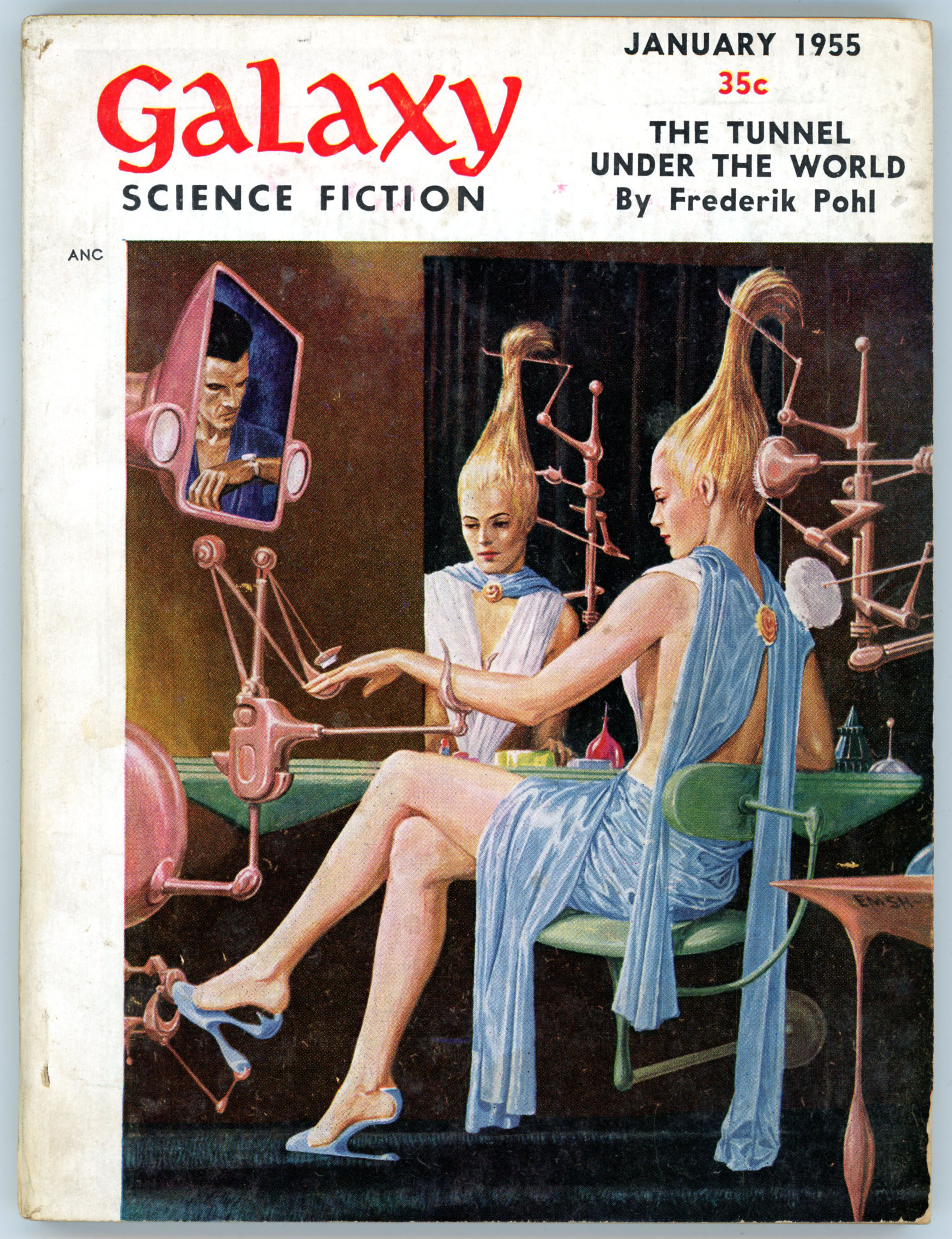
But on occasion, his art took a different (or latent?!) turn:  It could be humorously insightful, as shown on the cover of the January, 1955 issue of Galaxy Science Fiction.

Or, it could playful, as seen in cover of the June, 1962 issue of The Magazine of Fantasy and Science Fiction.  Here, while the taken-for-granted scenario of an astronaut floating in the void of intergalactic space might conventionally focus on the rather – um, er, ah – challenging (?!) aspects of this predicament most dire, Emsh – presumably inspired by illustrations of spacesuits prevalent at the time, particularly Randall F. White and George J. Scott’s 1961 design for a full pressure flight suit (below), from Patent Room.com – takes a different turn. 

Our hero George (or, is he an anti-hero!?) is equipped with an air tank decorated with the phrase “GEORGE’S ELIXIR – GUARANTEED MONEY BACK IF NOT COMPLETELY SATISFIED.”     

On his arm, where a tattoo would be: “MOTHER”

Oh his torso, where a tattoo could be: an octopus, a pair of dice, and the shield from the Great Seal of the United States. 

On his thigh, where a tattoo might be: a nude image of “ROSIE”, and, the head of a bald eagle.

On his calf, where a tattoo almost certainly is: “HOME SWEET HOME”.

Alas.  This is a stand-alone illustration:  While the table of contents lists the artist as “Ed Emsh”, no title attached to the painting, and the painting pertains to no story. 

Perhaps George’s story is ours to imagine.

The Macabre Reader, edited by Donald A. Wollheim – 1959 [Edmund Emshwiller]

Though his art is typically associated with science fiction, such as covers for The Magazine of Fantasy and Science Fiction, Galaxy Science Fiction, and (but of course…!) Ace Books, and other publications, Edmund Emshwiller’s creativity found a different outlet in Ace Books’ 1959 The Macabre Reader: horror.

Note that all the spaces in the composition that might otherwise be “blank” and “empty” are instead cleverly occupied by elements denoting horror, terror, and fear, such as a spider, a ghost, the figure of a woman-in-peril, and three menacing ghoul-like figures, all within or surrounding a sickly-green skull.  And, as per his works of science fiction, Emshwiller signed the composition with his trademark “EMSH” (visible in the lower right).

It’s notable that five of the volume’s thirteen (hmm…was it intentionally thirteen?!) works are either solely by, or by authors in collaboration with, H.P. Lovecraft. 

Contents

The Phantom-Wooer, poem from Death’s Jest Book, 1850, poem Thomas Lovell Beddoes

The Crawling Horror, from Weird Tales, November, 1936, by Thorp McClusky

The Opener of the Way, from Weird Tales, October, 1936, by Robert Bloch

Night Gaunts (variant of “Night-Gaunts”, alternative title “Fungi from Yuggoth”), poem from The Phantagraph, Spring, 1936, by H.P. Lovecraft

In Amundsen’s Tent, from Weird Tales, January, 1928, by John Martin Leahy

The Thing on the Doorstep, from Weird Tales, January, 1937, by H.P. Lovecraft

The Hollow Man, from The Evening Standard Book of Strange Stories, 1934, by Thomas Burke

It Will Grow On You, from Esquire, April, 1942, by Donald Wandrei

The Hunters from Beyond, from Strange Tales of Mystery and Terror, October, 1932, by Clark Ashton Smith

The Curse of Yig, poem by Zealia Bishop and H.P. Lovecraft (as by Zealia Brown Bishop)

The Cairn on the Headland, from Strange Tales of Mystery and Terror, January, 1933, by Robert E. Howard

The Trap, from Strange Tales of Mystery and Terror, March, 1932, by H.P. Lovecraft and Henry S. Whitehead (as Henry S. Whitehead)

The Dweller, poem from Weird Tales, March, 1940, by H.P. Lovecraft

Reference

The Macabre Reader, at The Internet Speculative Fiction Database

Galaxy Science Fiction – January, 1955 (Featuring “The Tunnel Under the World,”, by Frederik Pohl) [Edmund A. Emshwiller)]

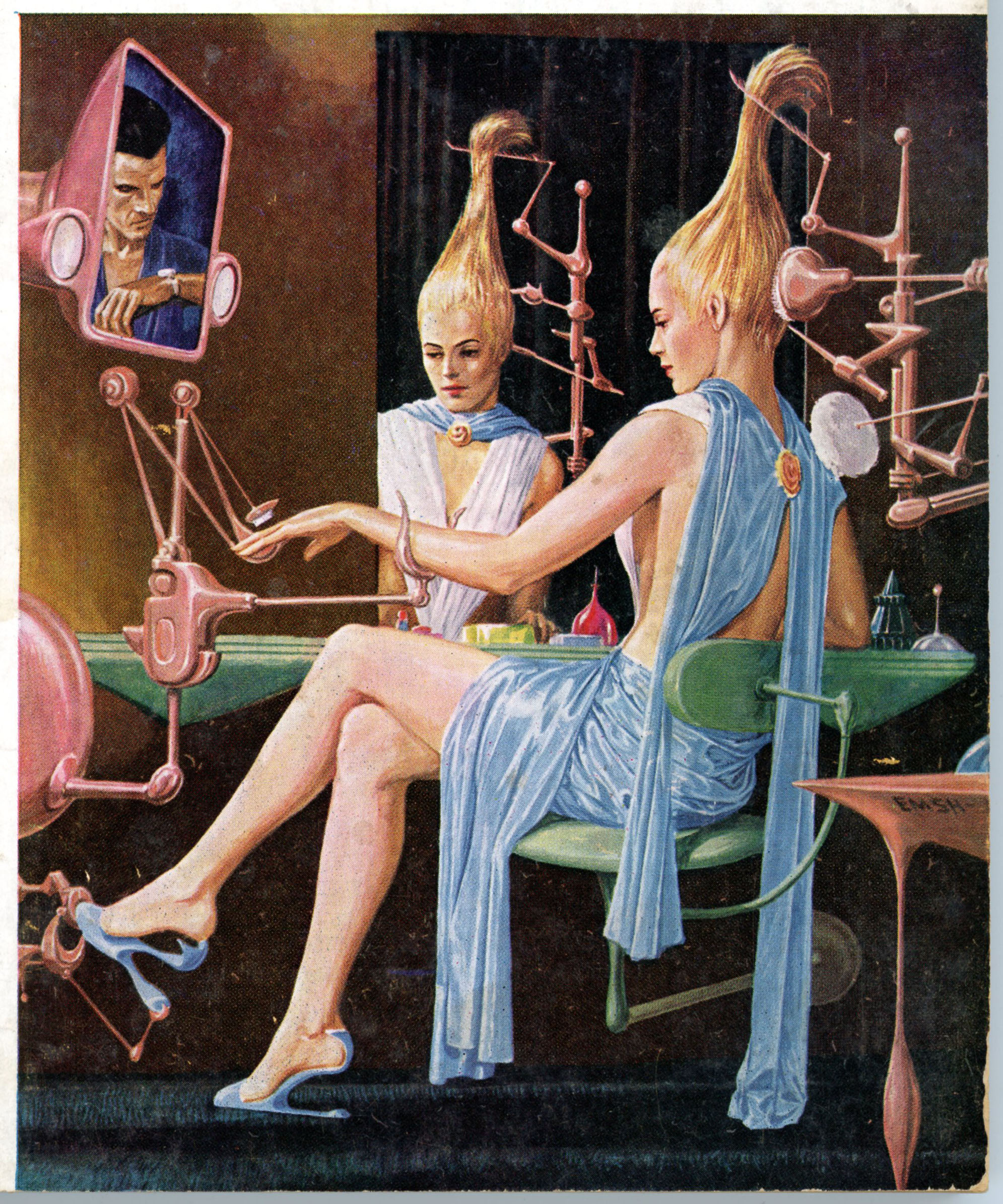
Unlike the cover art of Astounding Science Fiction, and most (but certainly not all!) of the cover art featured by its leading competitors, among them The Magazine of Fantasy & Science Fiction, if – Worlds of Science Fiction, and Amazing Science Fiction Stories, the cover illustrations of Galaxy Science Fiction, particularly from about 1955 through the early 1960s, was characterized by a sense of humor and whimsy, in the form of (obviously wordless!) visual social commentary.

Of this, the illustration below, by “Emsh” (Edmund A. Emshwiller) – entitled “Milady’s Boudoir”, is an excellent example, needing little elaboration.  (-* Ahem.*-)  Like other humorous Galaxy covers, the cover art is a “stand alone” image, entirely unrelated to the magazine’s literary content. 

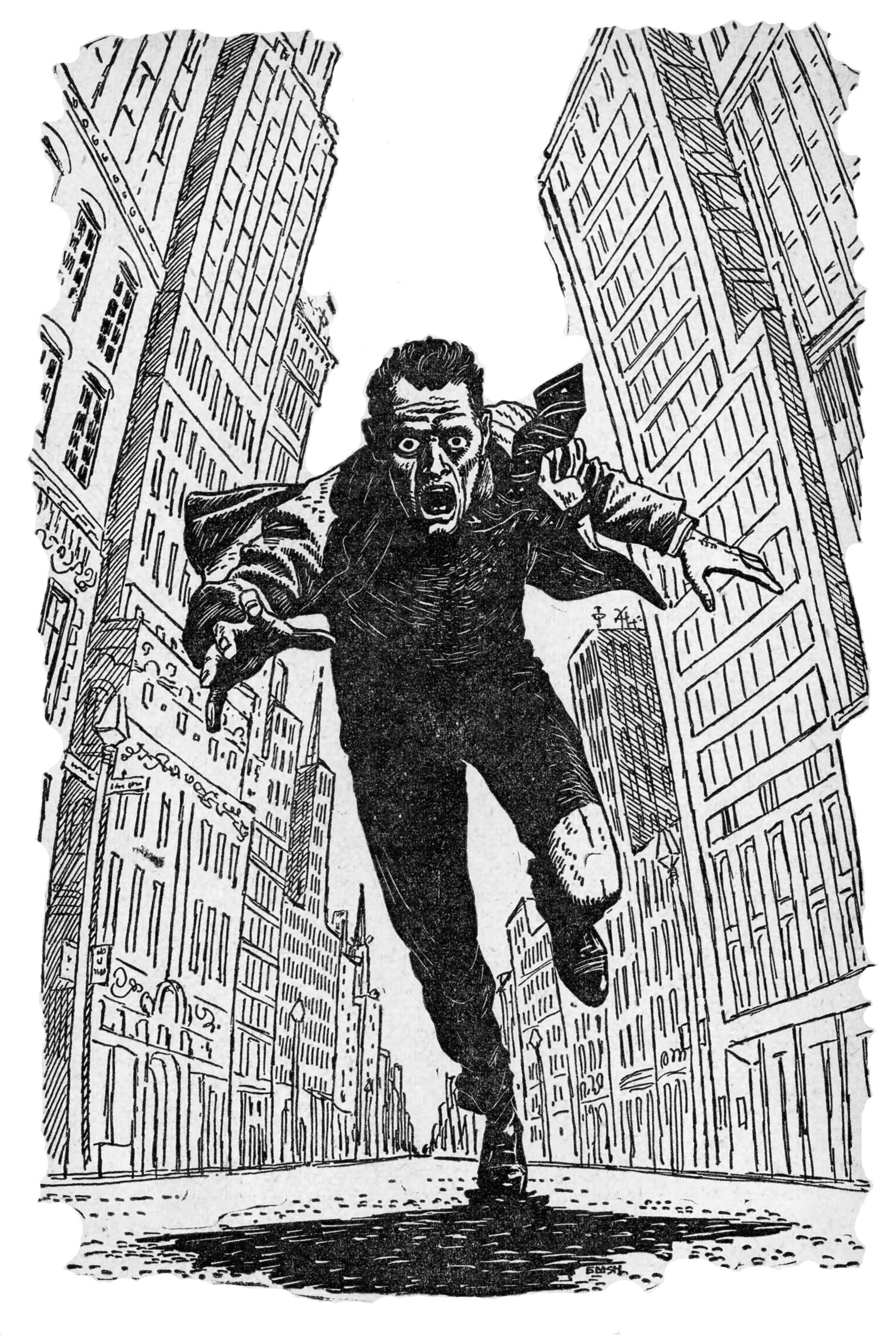
If – Worlds of Science Fiction – March, 1953 (Featuring “Deadly City”, by Ivar Jorgenson) [Kenneth S. Fagg]

This was one of my earlier posts, initially dating from May of 2017, and incorporating a cover image of if – World of Science Fiction, which was found amidst that (not necessarily so) free-floating mass of photons, otherwise known as the Internet. 

I’ve since obtained obtain a physical copy of the magazine, a scan of which now is featured in this post.  It’s got a few imperfections, but hey, that’s what makes reality so interesting.  And, so real.

See…

…below:

______________________________

Illustration by Edmund Emshwiller, for Ivar Jorgenson’s story “Deadly City” (p. 25)

______________________________

Illustration by Edward I. Valigursky, for Arthur G. Stangland’s story “The Black Tide” (p. 98)

The Humanoids, by Jack Williamson – 1954 [Edmund A. Emshwiller]

One of the forty-six Galaxy Science Fiction novels published between 1950 and 1961, The Humanoids includes and was based upon Jack Williamson’s tale “With Folded Hands…”, which appeared in the July, 1947 issue of Astounding Science Fiction, with cover art by William Timmins.