(This is the first of two posts describing the digest-format science fiction anthology Wonder Stories, published with generally similar content in 1957 and 1963, featured cover art of the same general theme by Richard M. Powers. As such, though the content of both posts is similar, major differences between the two editions are explained and made clear in each post. So, for those in a hurry (who’s not in a hurry anymore?!) you can jump to the post for the 1963 edition, “here“.)
The best way to impart a sense of literary wonder is through awe, mystery, and a sense of things unknown. Certainly that’s the case for the 1957 edition of Standard Magazines’ (otherwise known as Thrilling Publications’) anthology Wonder Stories, which is comprised of selections from early 50s editions of Startling Stories and Thrilling Wonder Stories, as well as Kurt Vonnegut, Jr.’s story “Thanasphere”, the latter was written specifically for this publication.
(You can learn more about the history of Wonder Stories, and “other reprints from the Thrilling group”, at Todd Mason’s Sweet Freedom blog.)
A sense of wonder really arises (at first!) from the anthology’s cover, which features one of the very few pulp magazine cover paintings created by Richard M. Powers, whose forte overwhelmingly resided in creating cover art for books: His few other cover illustrations appeared in early issues of Galaxy Science Fiction, and, Beyond Fantasy Fiction.
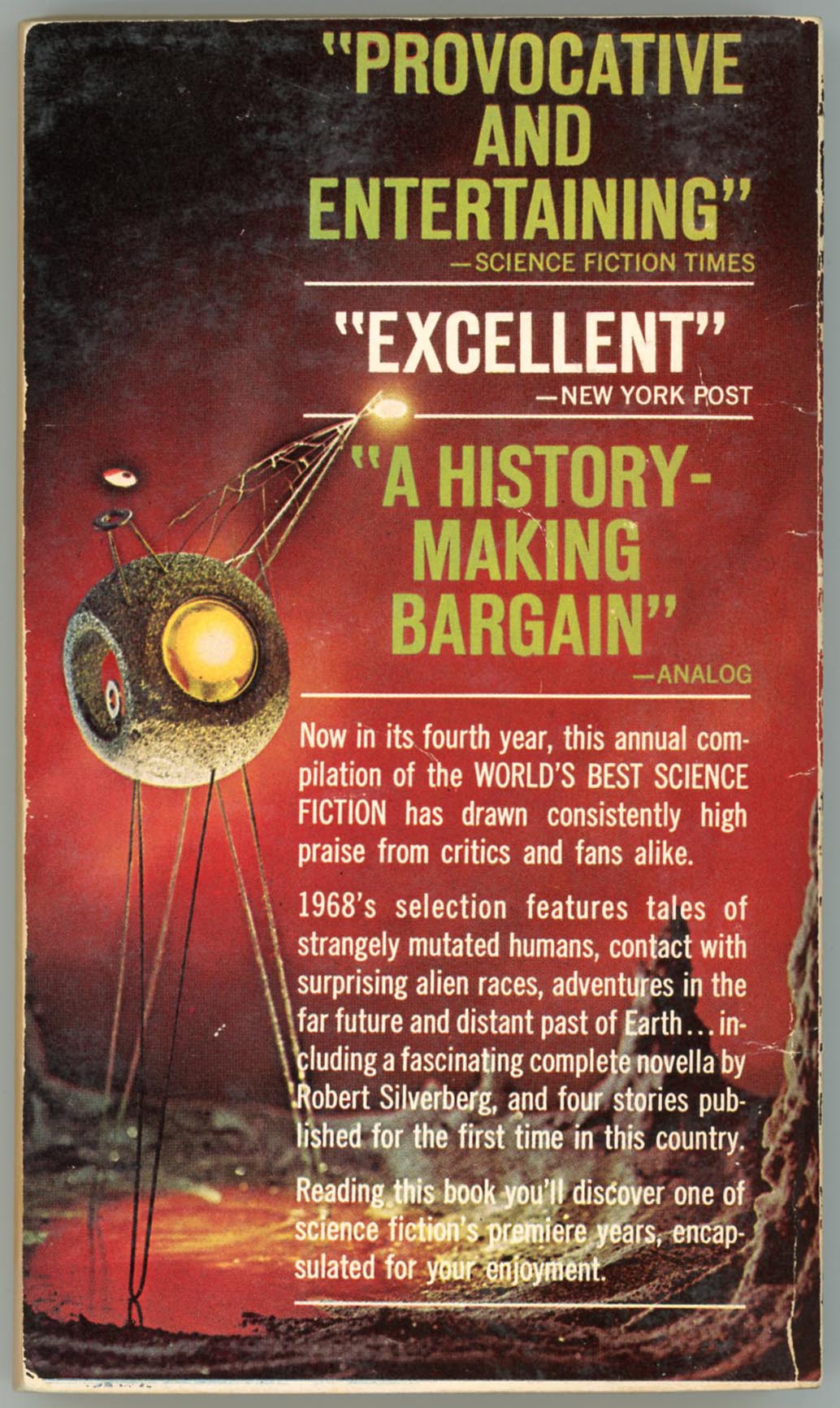
Typical of Powers’ cover art, this painting sets up a mood; a feeling; a vibe, having absolutely no relationship to or inspiration from any of the stories in the anthology. (The same thing often goes for his book covers, which are often similarly unrelated to the contents therein.) Also typical of Powers, the scene is absent of specific beings or even the merest sign of a human presence, let alone anything identifiably organic. Instead, it presents active and energetic symbols of technology and power set upon a desolate, barren alien landscape. Something’s happening, and, some thing is happening, too. But, what? (Hey, is that a city in the distance?)
In the hindsight 2025, the painting depicts a scene reminiscent of the ruins of the Ring Builders’ constructions on the planet Ilus IV, from season four of “The Expanse”: Incomprehensibly ancient structures embedded deep (how deep?) within yet extending far above the desert soil of that world, yet still functioning over two billion years after their construction, their power undiminished. Check out these images of concept art for “The Expanse” at Lee Fitzgerald’s website, to see the resemblance. The Expanse (fandom) also displays an image of the ruins on Ilus.
So, here’s Wonder Stories’ cover, “as is”…


… while here’s a close-up of the scene…


…and, here’s the cover art all “niced up”, lightly edited, and framed in white, for this post.

But, what of the anthology’s contents? Of the stories within, I’m only directly familiar with Ray Bradbury’s “A Sound of Thunder”, Arthur C. Clarke’s “All the Time in the World”, and especially and recently John D. MacDonald’s “Shadow On the Sand”, the latter of which appeared in and inspired the cover art for the October, 1950 issue of Thrilling Wonder Stories. I didn’t actually r e a d MacDonald’s story within my copy of Wonder Stories – the one you see featured in the images above – due to the fragility of my now-67-year-old copy. Instead, I created and printed the story from a PDF comprising the entire issue (accessed through the Internet Archive … you can also download it via the Luminist Archive); that, I read.
Having previously encountered very little by and knowing virtually nothing about author MacDonald, I can unreservedly say that I was deeply impressed with “Shadow on On the Sand” on a variety of levels, specifically the originality of the plot, and, characters (even minor characters) that – differentiated and not two-dimensional stock figures – changed and evolved as the story progressed. In sum, the novella is the account of an extraterrestrial totalitarian civilization’s clandestine conquest of Earth utilizing instantaneous superluminal teleportation, and, the impersonation and replacement of human beings with physically altered doppelgangers … the aliens already being (this made writing the story easier, I suppose!) on a superficial level at least … physically and superficially identical to homo sapiens. All this occurs against and within a backdrop of competition, conflict, and political murder among the aliens’ ruthlessly competitive political parties, military, and clandestine services, with the story’s protagonist going over to the side of humanity by the story’s end. More, I shall not say. As fast paced entertainment, it’s a great read. And yet… Unusually for a story penned over seven decades ago, the novella is surprisingly violent, if not genuinely grotesque, in parts (“not for the squeamish!”) … albeit violence and horror are neither the center of nor the “drivers” of the plot. The novella is quite reminiscent of the works of Jack Vance in terms of political and social complexity and ambiguity, as well as the air of intrigue that permeates the tale.
(For a much deeper exploration of MacDonald’s story, read “Shadow On the Sand” at Steve Scott’s blog, “The Trap of Solid Gold – Celebrating the works of John D MacDonald“.)
Otherwise, my reading of “Shadow On the Sand” imparted a sense of curiosity about MacDonald’s larger body of work, which led to my reading the Fawcett Gold Medal 1978 book Other Times, Other Worlds, an anthology of sixteen of his science fiction stories spanning publication between 1948 and 1968. Upon reading this collection (it deserved better cover art than a simple astronomical photograph!) I soon realized that I previously had read one of his stories: “Spectator Sport” (originally published in the February, 1950 issue of Thrilling Wonder Stories) first in Fifty Short Science Fiction Tales, and subsequently in Isaac Asimov Presents The Great SF Stories 12. Curiously, this short story features an event that prefigures a plot element in “Shadow On the Sand”. (Ironically, I didn’t like “Spectator Sport” at all!) Regardless, I was and remain deeply impressed by MacDonald’s literary skill in terms of character development and delineation, his ability to create an event, setting, scene, and “world” with a modicum of skillfully chosen language, and especially, his ability to unflaggingly maintain the pace, mood, and atmosphere of a tale from beginning to end. Only upon reading this anthology and sources elsewhere did I learn that MacDonald more than successfully (extraordinarily so) transitioned from science fiction to mainstream fiction, creating the “Travis McGee” series.
Here’s a nice image of the magazine’s cover. As revealed in the Internet Speculative Fiction Database, the cover and interior artist of this issue are unknown. Otherwise, MacDonald’s story is entirely absent of flying saucers (actually, spacecraft make no appearance whatsover) and the characters don’t go around wearing tattered, torn, Tarzan-like togas.

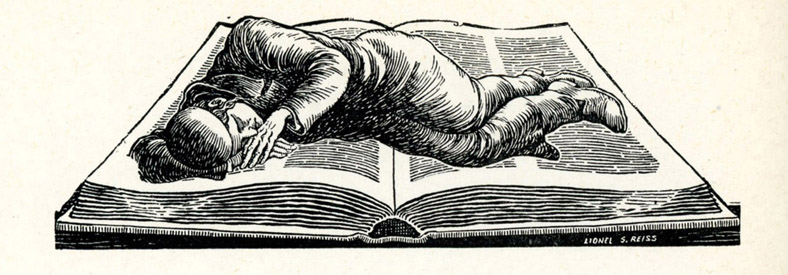
This diminutive image appears in the magazine’s table of contents (page 4), adjacent to the story title. The monolith-like slab is a symbol of the teleportation device which is a central plot element and inspiration of the title, albeit the device is essentially invisible to human observers. Rather, what is visible is a mere glimpse of a vague and fleeting rectangular shadow, which is the portal through which the aliens are transported to Earth.

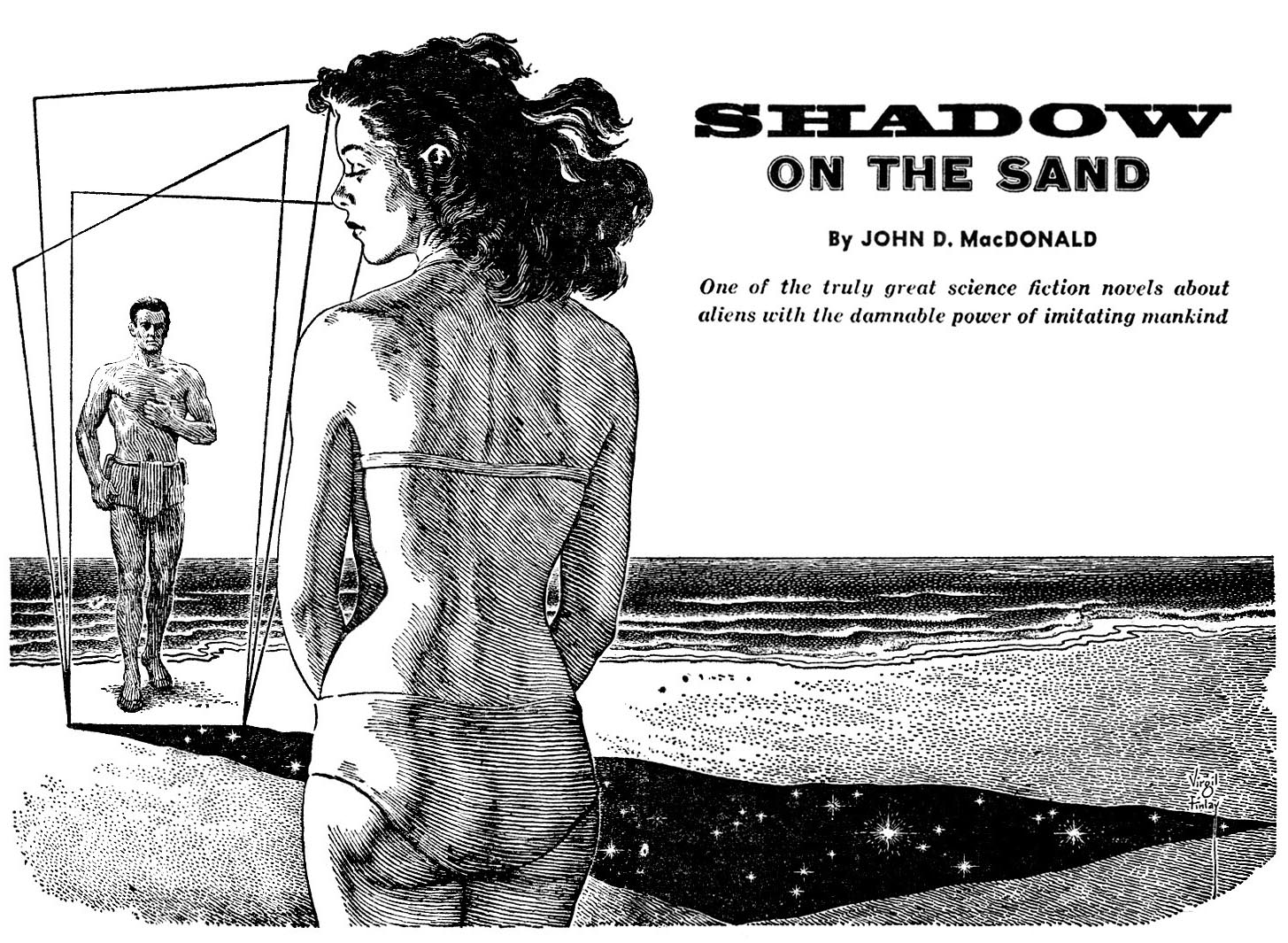
The only single-page illustration accompanying the story appears on page 15. It shows the arrival of the alien who eventually “goes over” to the side of Earth. Of course, his major inducement is the romantic relationship he unexpectedly (unexpectedly to him!) develops with a woman. MacDonald doesn’t actually describe the appearance of the portal, let alone venture an explanation of its operation. It simply shows up when needed and then disappears.

The unknown artist’s illustration of the alien civilization’s “shadow” – the teleportation portal – is absent from Wonder Stories, having been replaced by Virgil Finlay’s intricate portrayal of the scene, which is characterized by his typical attention to detail. Due to the fragility of my copy of Wonder Stories, this image – on pages 2 and 3 – was downloaded (right-clicked) from something known as the “Internet” (!) for display here, on, the, Internet. Oh, yeah, I’m already on, the, Internet. (Like, you!) In reality!… The image here is from the cover of The JDM Bibliophile, Number 17, from March, of 1972. (That’s “JDM”, as in John D. MacDonald. That’s FANAC as in “The Fanac Fan History Project.”)
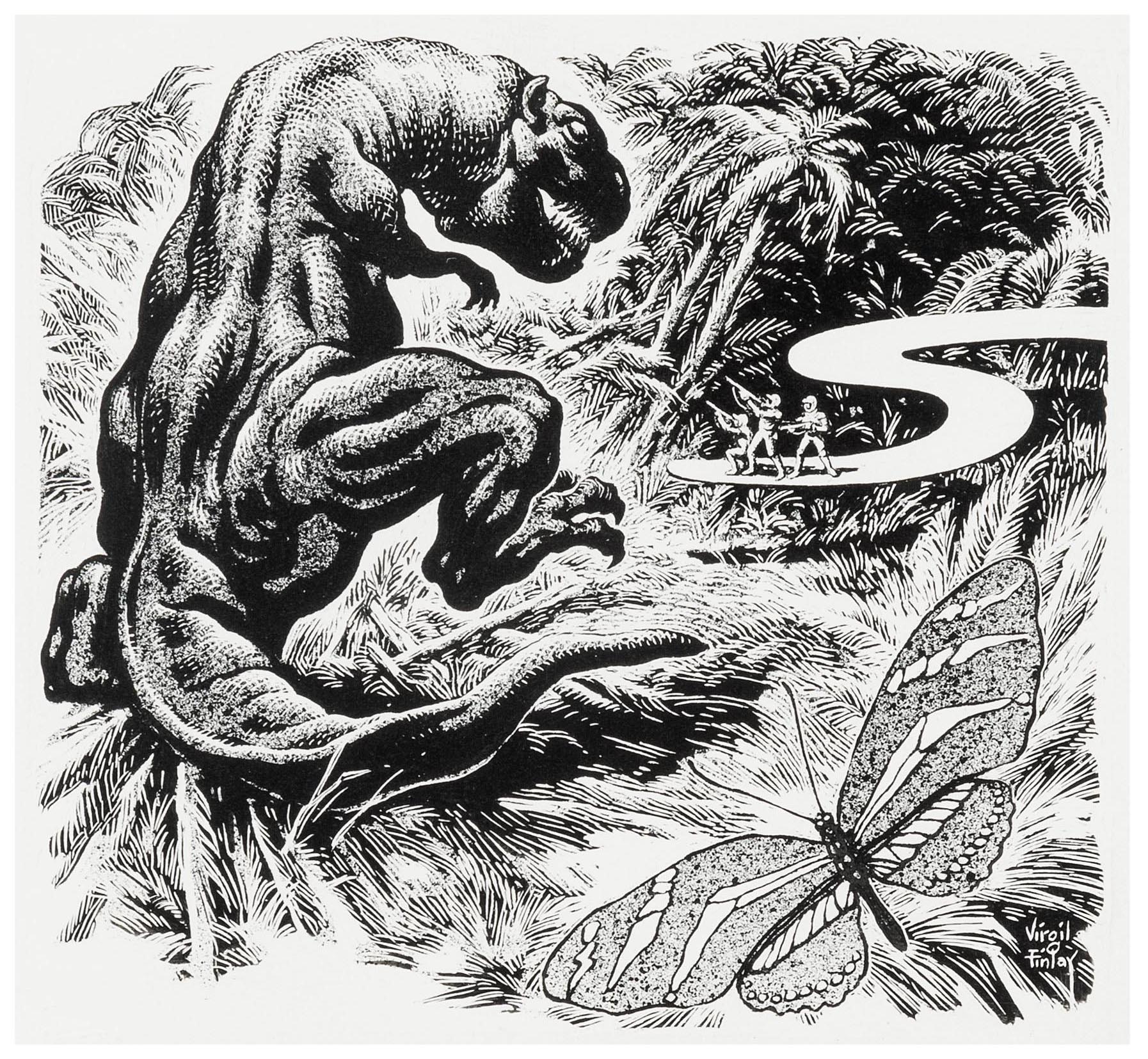
The second story in Wonder Stories is Ray Bradbury’s “A Sound of Thunder“. Though the tale appeared in Planet Stories in 1954, accompanied by a great two-page illustration by Ed Emshwiller, in Wonder Stories, it’s replaced by a Virgil Finlay composition which appears on page 30. The example below is taken from Heritage Auctions, where it was uploaded in September of 2019: “Created in ink over graphite, this small wonder is already beautifully matted and framed with an inside matting area of 4.25″ x 4.25″. Wood silver painted frame, glass front, and outside measurements of 8.5″ x 8.5″. The frame has some small nicks and blemishes but the art is in Excellent condition.”
Wonder Stories was republished in 1963, with cover art based upon Powers’ composition for this 1957 edition, and containing six of the stories from this “first” edition. You can read about the latter edition here.
~~~~~~~~~~~~~~~~~~~~~~~~~~~~~~
And, in a sort of conclusion, at this link – here, given that you read this far! – you can download the PDF version of MacDonald’s story that I created for my own reading.
~~~~~~~~~~~~~~~~~~~~~~~~~~~~~~
So, inside “Wonder Stories” you’ll find what, exactly?
“Shadow on the Sand”, by John D. MacDonald, from Thrilling Wonder Stories, October, 1950 (Reprinted in 1963 edition)
“A Sound of Thunder”, by Ray Bradbury, from Colliers, June 28, 1952; then from Planet Stories, January, 1954 (Reprinted in 1963 edition)
“All the Time in the World”, by Arthur C. Clarke, from Startling Stories, July, 1952 (Reprinted in 1963 edition)
“Man of Distinction”, by Fredric Brown, from Thrilling Wonder Stories, February, 1951 (Reprinted in 1963 edition)
“Thanasphere”, by Kurt Vonnegut, Jr., for this volume
“Spacemate”, by Walt Sheldon, from Thrilling Wonder Stories, August, 1950
“The Monitor”, by Margaret St. Clair, from Startling Stories, January, 1954 (Reprinted in 1963 edition)
“Star Bride”, by Anthony Boucher, from Thrilling Wonder Stories, December, 1951 (Reprinted in 1963 edition)
…and otherwise…
… Internet Speculative Fiction Database
John D. MacDonald, at…