The Secret is Forever Elusive
______________________________
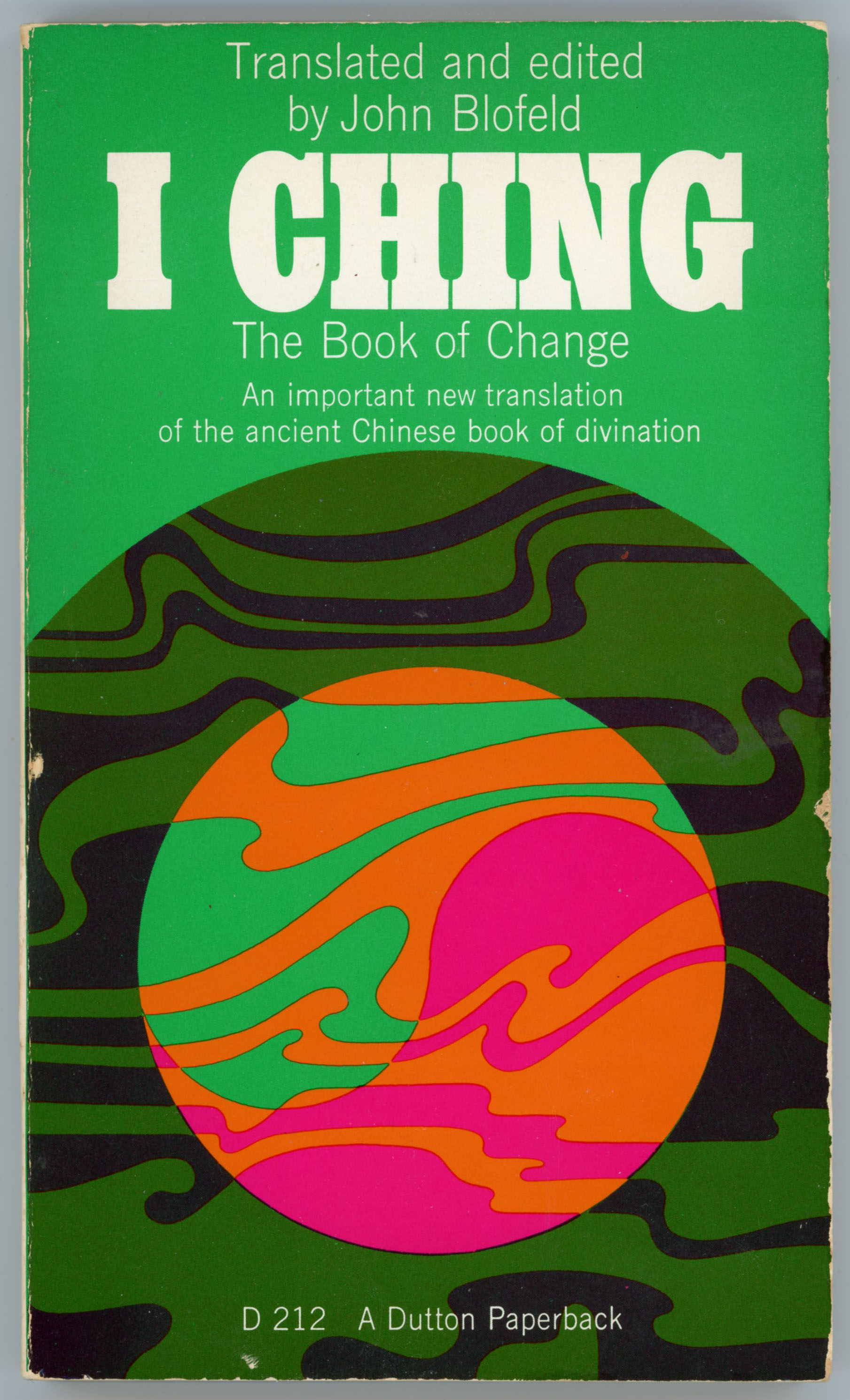
Given the centrality of the I Ching to The Man in The High Castle, I thought it’d be interesting to display the cover of this edition of the book, from 1968.
Lawrence Sutin’s extremely thorough and truly well-written biography of Dick – Divine Invasions – A Life of Philip K. Dick, which I’m currently reading – discusses the ancient text in terms of Dick’s daily consultation of the work (for lack of a better word!) during the 1960s, in terms of his daily life in general, and specifically, the creation of his famous alternate history.
Fact (fiction?)…
“He continued to consult the I Ching on a near-daily basis – more frequently if he perceived a crisis at hand, which was fairly often. Miriam Lloyd, with whom Phil commenced an enduring friendship during this period, observes, “Phil was a crisis junkie anyway – he loved a crisis.” The I Ching was a valued touchstone at such times, though Phil no longer consulted it for plot construction. It was during 1965 that Phil write the essay “Schizophrenia & The Book Of Changes,” in which he argues that the oracle can’t predict the future – fortunately, since total knowledge would immobilize us (as a schizophrenic, whose idios kosmos is overwhelmed by the koinos kosmos, is immobilized). But it can reveal the gestalt from which the future will emerge.”
Fiction (The Man in The High Castle) (fact?)…
“In a 1976 interview, Phil accused the I Ching of being a “malicious spirit” largely because it “copped out completely” as to the “unresolved ending chapter of High Castle. “It is a liar. It speaks with forked tongue.” (Notwithstanding the pronouncements, Phil consulted the I Ching regularly up to the time of his death, with peak use in the sixties and early seventies.) What frustrated Phil (as well as numerous critics who otherwise admired the novel unreservedly) was that the revelation of the truth – that the Allies prevailed in World War II – does nothing to dispel the characters’ foreboding. Juliana remains isolated; Abendsen continues to live in fear. The sense of Nazi oppression remains. Truth alone, it seems, is not enough to liberate the soul. In an August 1978 letter, Phil tries to make the High Castle ending cohere:
Juliana tells Hawthorne Abendsen that his book is true and it makes him angry. […] Simply because he knows that if this woman, this stranger, this ordinary person knows, then the Fascist Authorities must know, and his life is in danger. Abendsen feels two opposite ways about his novel; on one level he would like the truth of it to be palpable, but it scares him that he knows the truth and has publicly stated that truth: he is a Geheimnistrager [person entrusted with secret information]: a carrier (knower I mean) of a secret, and it is a secret which frightens him.
…[in 1974] he returned briefly to the idea of writing a sequel to High Castle. Back in 1964 he made a start of it (two chapters, twenty-eight pages total, survive…) but could not face further research on hideous Nazi tactics. Dictated cassette notes of 1974 describe one scene in which Abendsen would be brutally interrogated by Nazis who seek (like Juliana) the truth as to the alternate universe (“Nebenwelt”), which Abendsen cannot provide – he does not know. The secret is forever elusive.”
Something Somewhere All At Once?
Mountfort, Paul, The I Ching and Philip K. Dick’s The Man in the High Castle, Science-Fiction Studies, July, 2016, V 43, N2 (PDF)
…at Archive.org (“A Talk With Philip K. Dick” – “Starting out and doing research” – at 15:10) (audio)
…at Joe Nolan’s Insomnia (“I Ching According to Philip K. Dick”)
…at Philip K. Dick.com (“Philip K. Dick’s Final Interview”)
…at Philip K. Dick.com (“Vertex Interview with Philip K. Dick”)
…at Quora (“How exactly does the I Ching (Oracle) work in Philip K. Dick’s novel, The Man in the High Castle?”)
…at Open Culture (“Philip K. Dick Tarot Cards: A Tarot Deck Modeled After the Visionary Sci-Fi Writer’s Inner World”)
…at reddit (“Glitch in the Matrix” – “The metaphysics of GITM: The I Ching, Philip K. Dick, and The Man in the High Castle.”)

A Biography of Philip K. Dick
Sutin, Lawrence, Divine Invasions – A Life of Philip K. Dick, Harmony Books, New York, N.Y., 1989