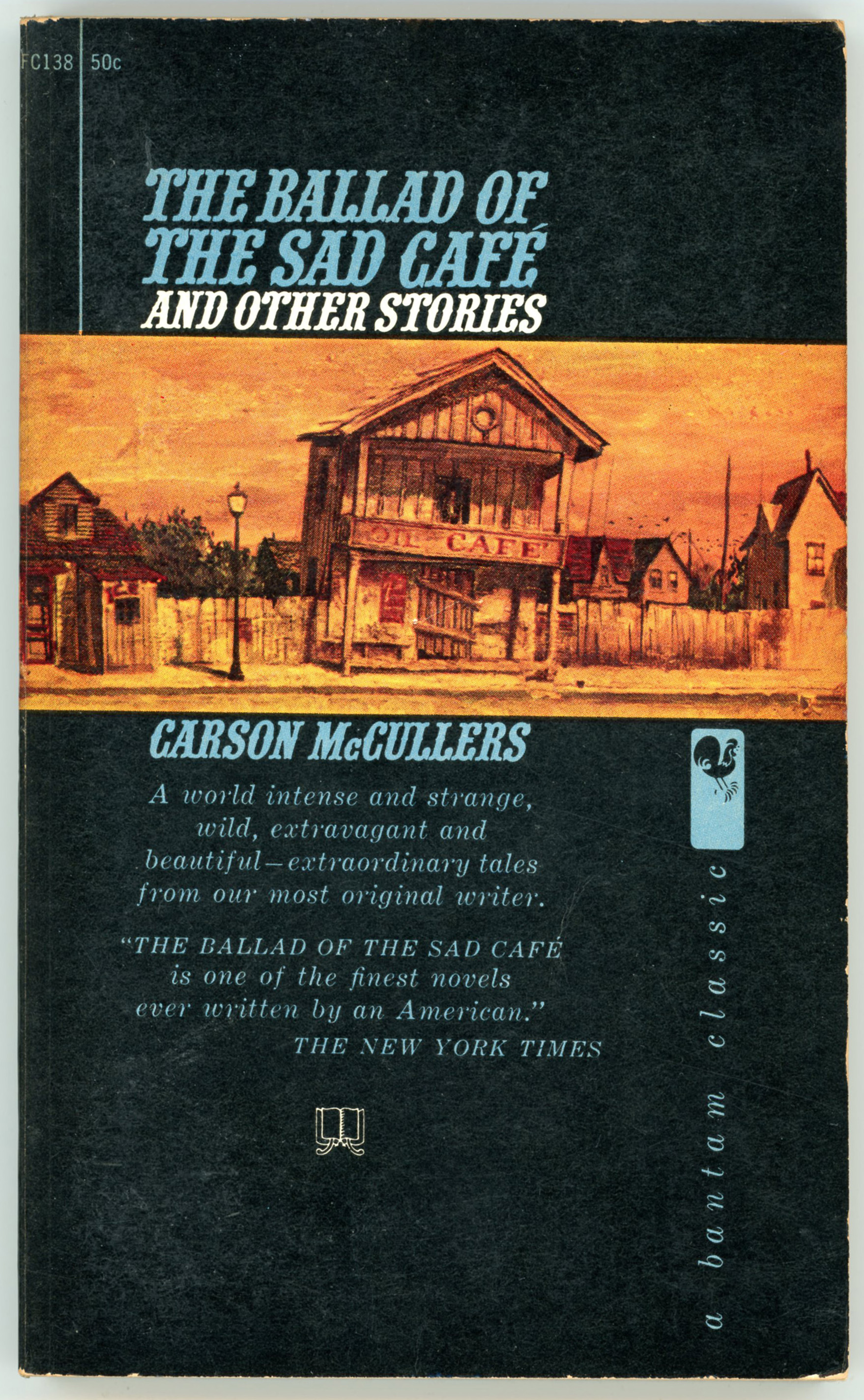
The Ballad of the Sad Café, by Carson McCullers – May, 1962 (May, 1951) [Unknown artist]

____________________

You can download the full text of McCullers’ short story from Green Mountain Writers, and, you can view the cover of the 1958 paperback edition of McCullers’ The Member of the Wedding here.

____________________

There is a type of person who has a quality about him
that sets him apart from other and more ordinary human beings. 
Such a person has an instinct which is usually found only in small children,
an instinct to establish immediate and vital contact
between himself and all things in the world. 
Certainly the hunchback was of this type. 
He had only been in the store half an hour
before an immediate contact had been established
between him and each other individual. 
It was as though he had lived in the town for years,
was a well-known character,
and had been sitting and talking there on that guano sack for countless evenings. 
This, together with the fact that it was Saturday night,
could account for the air of freedom and illicit gladness in the store. 
There was a tension, also,
partly because of the oddity of the situation
and because Miss Amelia was still closed off in her office
and had not yet made her appearance.

She came out that evening at ten o’clock. 
And those who were expecting some drama at her entrance were disappointed. 
She opened the door and walked in with her slow, gangling swagger. 
There was a streak of ink on one side of her nose,
and she had knotted the red handkerchief about her neck. 
She seemed to notice nothing unusual. 
Her gray, crossed eyes glanced over to the place where the hunchback was sitting,
and for a moment lingered there. 
The rest of the crowd in her store she regarded with only a peaceable surprise.

“Does anyone want waiting on?” she asked quietly.

There were a number of customers, because it was Saturday night,
and they all wanted liquor.
Now Miss Amelia had dug up an aged barrel only three days past
and had siphoned it into bottles back by the still.
This night she took the money from the customers
and counted it beneath the bright light.
Such was the ordinary procedure.
But after this what happened was not ordinary.
Always before, it was necessary to go around to the dark back yard,
and there she would hand out your bottle through the kitchen door.
There was no feeling of joy in the transaction.
After getting his liquor the customer walked off into the night.
Or, if his wife would not have it in the home,
he was allowed to come back around to the front porch of the store
and guzzle there or in the street.
Now, both the porch and the street before it were the property of Miss Amelia,
and no mistake about it —
but she did not regard them as her premises;
the premises began at the front door and took in the entire inside of the building.
There she had never allowed liquor to be opened or drunk by anyone but herself.
Now for the first time she broke this rule.
She went to the kitchen,
with the hunchback close at her heels,
and she brought back the bottles into the warm, bright store.
More than that she furnished some glasses and opened two boxes of crackers
so that they were there hospitably in a platter on the counter
and anyone who wished could take one free.

She spoke to no one but the hunchback,
and she only asked him in a somewhat harsh and husky voice:
“Cousin Lymon, will you have yours straight,
or warmed in a pan with water on the stove?”

“If you please, Amelia,” the hunchback said. 
(And since what time had anyone presumed to address Miss Amelia by her bare name,
without a title of respect? —
Certainly not her bridegroom and her husband of ten days. 
In fact, not since the death of her father,
who for some reason had always called her Little,
had anyone dared to address her in such a familiar way.)
“If you please, I’ll have it warmed.”

Now, this was the beginning of the café.

____________________

____________________
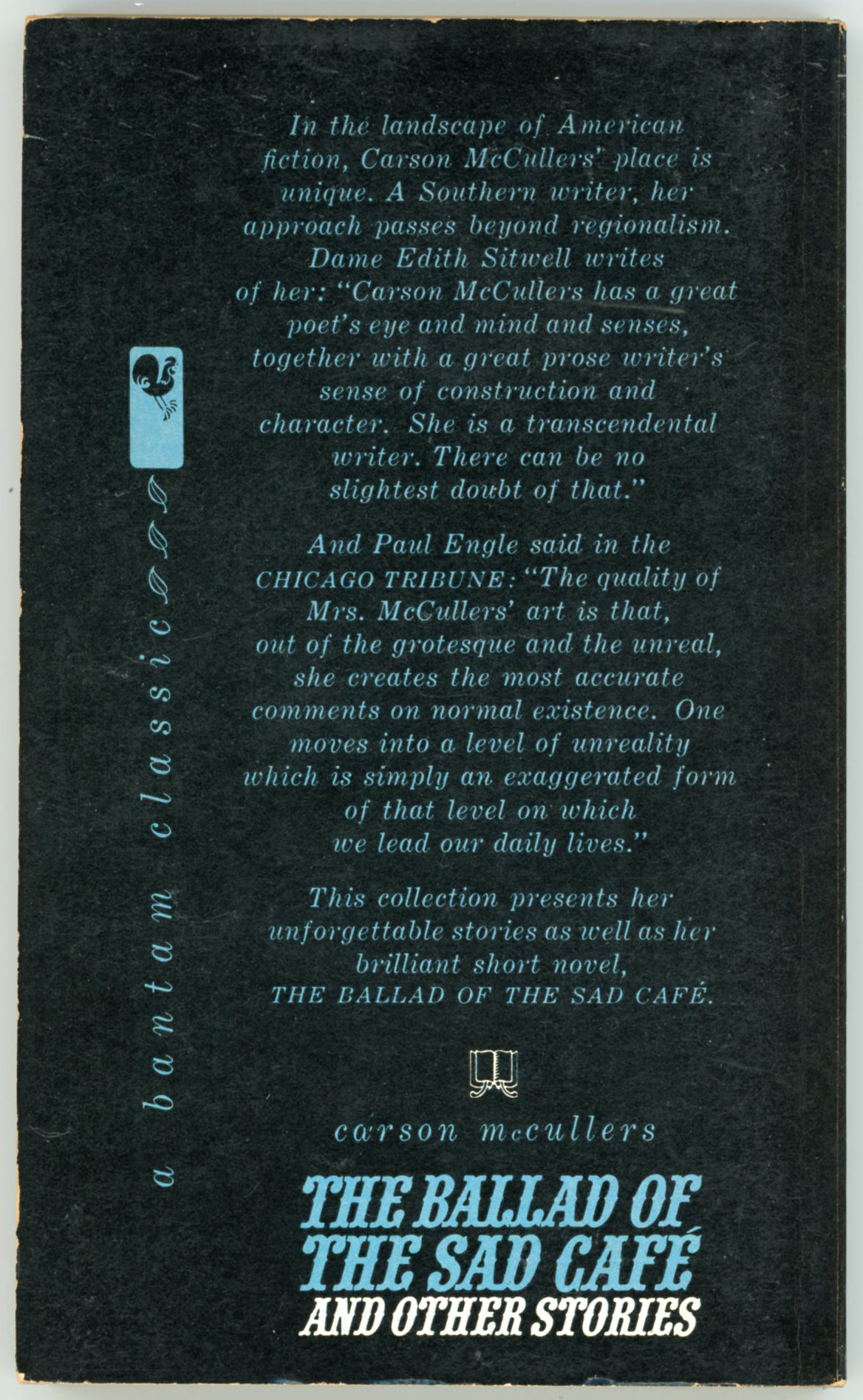
McCullers’s title story was adapted for film in 1991.  Starring Vanessa Redgrave and Keith Carradine (see more at IMDB) you can view the movie. divided into two parts, at Daily Motion.

Part 1 here

Part 2 here…

Here’s the trailer, at YouTube:


Gentlemen Prefer Blondes, by Corinne Anita Loos – 1950 (November, 1925) [Earle K. Bergey]

“…writing is different because you do not have to learn or practise…”

____________________

“Kissing your hand may make you feel very good but a diamond bracelet lasts forever.”

____________________

Bergey, Bergey, Bergey!…

Earle K. Bergey, cover illustrator of mainstream publications, pulp magazines, and paperbacks – all in a variety of genres – produced a body of work that while more conventional in terms of subject matter than that of artists like Frank Kelly Freas or Edmund Emshwiller, is eye-catchingly distinctive, and is truly emblematic of mid-twentieth-century illustration. 

His science-fiction art commenced in the late 1930s and continued until his untimely death in 1952 … see examples here, here, and here.  As described at Wikipedia, his, “…science fiction covers, sometimes described as “Bim, BEM, Bum,” usually featured a woman being menaced by a Bug-Eyed Monster, alien, or robot, with an heroic male astronaut coming to her assistance. The bikini-tops he painted often resembled coppery metal, giving rise to the phrase “the girl in the brass bra,” used in reference to this sort of art. Visionaries in TV and film have been influenced by Bergey’s work. Gene Roddenberry, for example, provided his production designer for Star Trek with examples of Bergey’s futuristic pulp covers.  The artist’s illustrations of scantily-clad women surviving in outer space served as an inspiration for Princess Leia‘s slave-girl outfit in Return of the Jediand Madonna’s conical brass brassiere.”

An example?  The Spring, 1944, issue of Thrilling Wonder Stories.

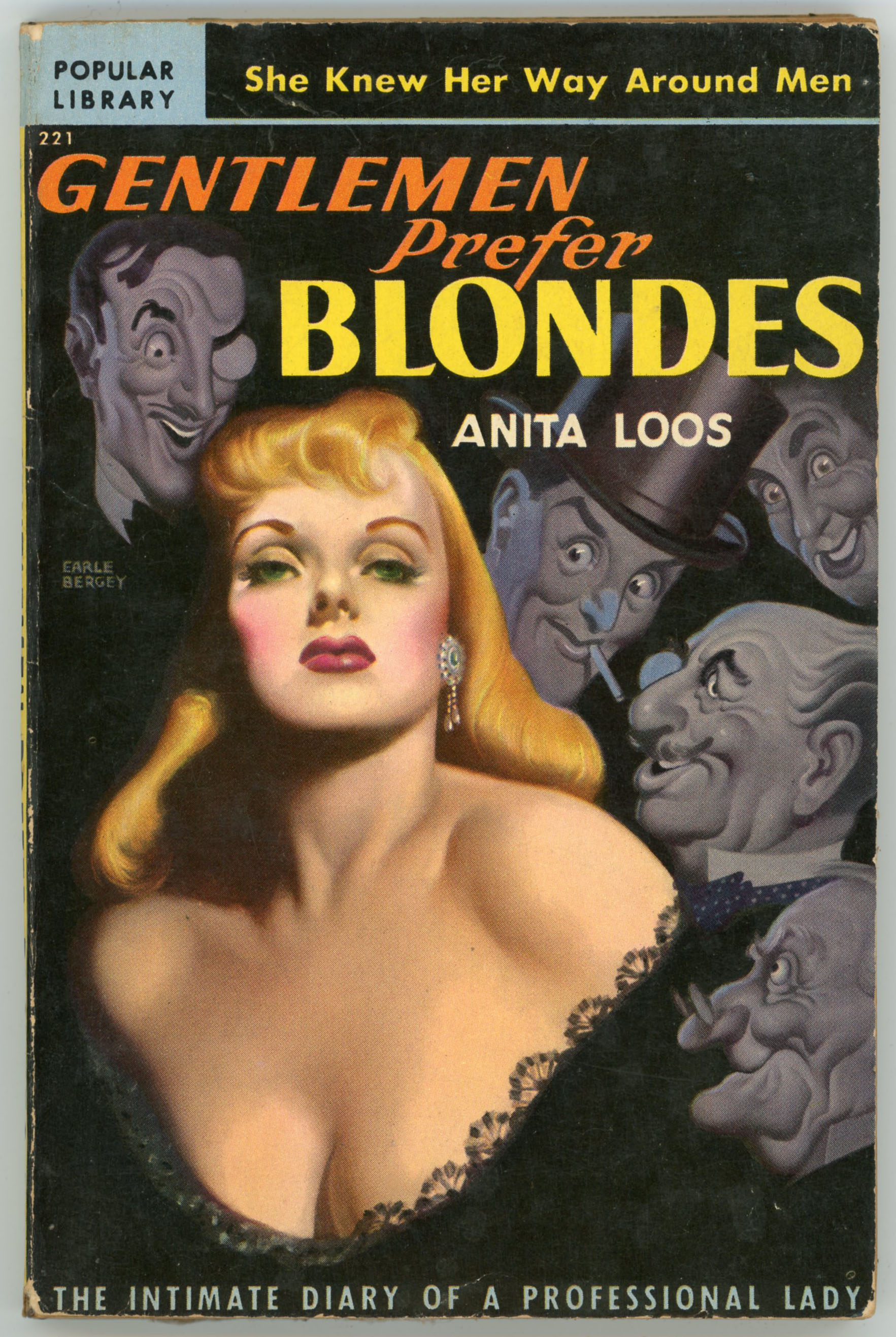
Commencing in 1948, Bergey became heavily involved in creating cover art for paperbacks.  This began with Popular Library’s 1948 edition of Anita Loos’ Gentlemen Prefer Blondes, which was first published in 1925.  Though the book is a light-hearted work of conventional fiction (perhaps lightly semi-autobiographical; perhaps loosely inspired by fact), Bergey’s cover is a sort-of…, kind-of…, maybe…, perhaps…, well…, variation on a theme of “Good Girl Art” characteristic of American fiction of the mid-twentieth-century, and likewise is a stylistic segue from Bergey’s science fiction pulp cover art.  Sans shining copper brassiere, however.

Here is it… 

From Bergey’s biographical profile at Wikipedia, here’s an image of the book’s original cover art.  The only information about the painting (does it still exist?) is that it’s “oil on board”.

A notable aspect of this painting, aside from the extraordinarily and deliberately idealized depiction … exaggeration?! … of Miss Lorelei Lee (looks like she’s being illuminated by a klieg light, doesn’t it?) is the appearance of the men around her, each of whom is each vastly more caricature than character.  Well, exaggeration can work in two directions.

____________________

She was a

GIVE AND TAKE GIRL

Lorelei Lee was a cute number with lots of sex
appeal and the ability to make it pay off.
With her curious girl friend, Dorothy,
she embarked on a tour of England and the
Continent. And none of the men who crossed
their path was ever the same again.
When one of Lorelei’s admirers sent her a
diary she decided to write about her
adventures. They began with Gus Eisman, the
Button King, who wanted to improve her “mind”
and reached a climax in her society debut
party – a three-day circus that rocked
Broadway to its foundations.
A hilarious field study of the American
chorus girl in action set down in her
own inimitable style!

____________________

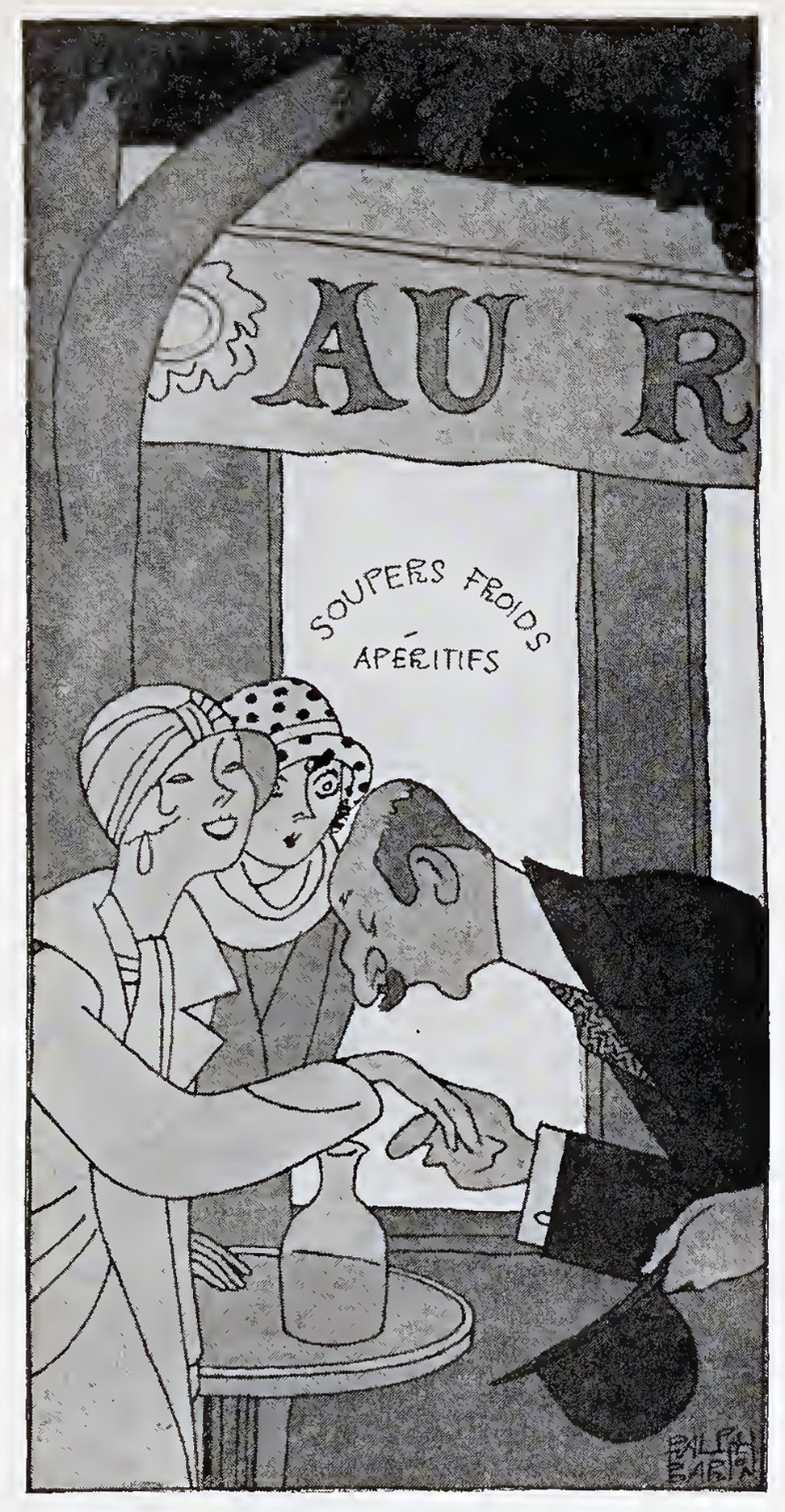
Lorelei Lee’s appearance in Ralph Barton’s cartoons in the 1925 edition of Gentlemen Prefer Blondes is – wellll, granting that they’re just cartoons; thirty-three appear in the book – vastly less exaggerated than her depiction on Bergey’s cover.  Three of his cartoons are shown below… 

____________________

It would be strange if I turn out to be an authoress. 
I mean at my home near Little Rock, Arkansas,
my family all wanted me to do something about my music. 
Because all of my friends said I had talent and they all kept after me and kept after me about practising. 
But some way I never seemed to care so much about practising. 
I mean I simply could not sit for hours at a time practising just for the sake of a career. 
So one day I got quite tempermental and threw the old mandolin clear across the room
and I have never really touched it since. 
But writing is different because you do not have to learn or practise
and it is more tempermental because practising seems to take all the temperment out of me. 
So now I really almost have to smile because I have just noticed
that I have written clear across two pages onto March 18th, so this will do for today and tomorrow. 
And it just shows how tempermental I am when I get started. (Illustration p. 13)

____________________

“Kissing your hand may make you feel very good but a diamond bracelet lasts forever.” (Illustration p. 101)

____________________

“Dr. Froyd seemed to think that I was quite a famous case.”  (Illustration p. 157)

____________________

What would be the book without the movie?  Here’s Howard Hawks’ 1953 production of Gentlemen Prefer Blondes, at Network Film’s YouTube channel. 

A qualifier:  Despite being a movie aficionado and voracious reader, I’ve not actually viewed this movie, for … despite being able to appreciate and enjoy most any genre of film … I’ve absolutely never been a fan of musicals.  (Ick.)  

What would Gentlemen Prefer Blondes be without “Diamond’s Are a Girl’s Best Friend”?  (Starts at 59:00 in the film.)  The idea of a rotating chandelier formed of women strikes me as really bizarre, if not disturbing…  Oh, well.

____________________

____________________

Some Other Things…

Anita Loos…

…at Wikipedia

…at Brittanica.com 

…at Internet Movie Database

…at Literary Ladies Guide

Gentlemen Prefer Blondes…

…at Archive.org (“Gentlemen prefer blondes” : the illuminating diary of a professional lady, Boni & Liveright, New York, N.Y., 1925)

…at Wikipedia

…at Internet Movie Database

Diamonds Are a Girl’s Best Friend…

…at Wikipedia

…at Genius.com (lyrics)

Earle K. Bergey…

…at Wikipedia

…at Internet Speculative Fiction Database