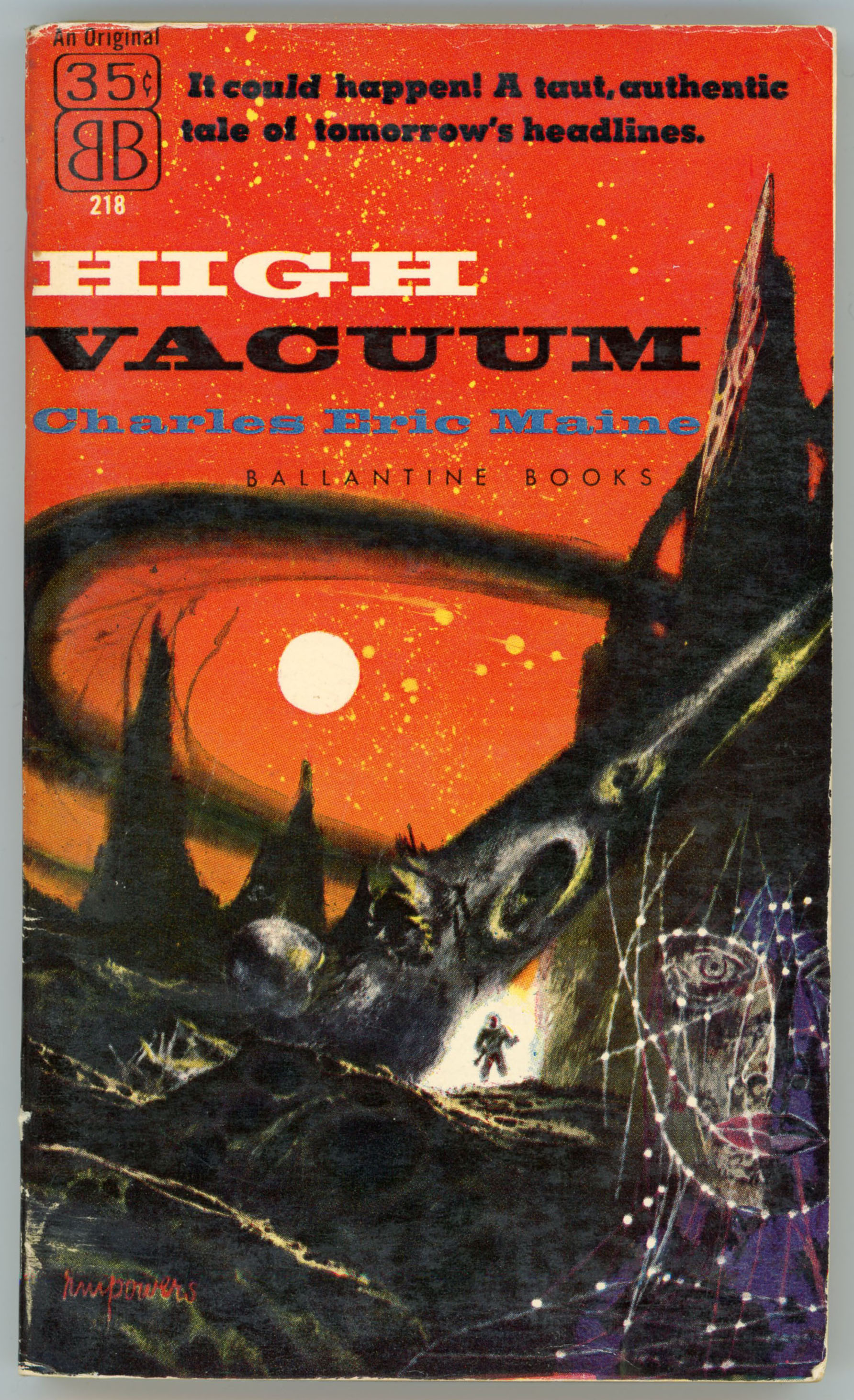
High Vacuum, by Charles Eric Maine (David McIlwain) – 1957 [Richard M. Powers]

A straightforward example of Richard Powers’ late 1950s science fiction cover art….

With colors ranging from white, to bright orange, to dark greenish gray, to black, the cover shows the surface of the moon in (highly) imaginary, (very) exaggerated, (strongly) symbolic fashion:  There are neither craters nor chain-like walls of jagged-peaked mountains, nor flat plains of dust, but spires projecting from an irregular foreground.  A woman’s face, formed from a lined pattern of dots, is at lower right.  Near the center is the only conventional element in the painting: The diminutive figure of an astronaut in a dark spacesuit, only visible because he’s backlit by a background glowing white.    

Regardless of the cover’s originality, the novel itself – having gone through nine printings since 1957, the latest having been in 2021, is fairly straightforward and conventional.  As described by Andrew Darlington [spoiler alert!], “1956 – ‘High Vacuum’ (Hodder & Stoughton, 12/6d, 192pp, Corgi, 1959, USA Ballantine), the ‘Operational Programme’ of the ‘Ministry of Astronautics’ undertakes the first lunar landing in Moonship Alpha.  Three of the four crewmen survive the initial wreck, plus the female stowaway, the second, Russian ship is sabotaged, Kenneth F Slater says ‘although there is a survivor, there is not a ‘happy ending’ to the story.  It is all the more realistic for that’ (‘Nebula’ no.25, October 1957).  Leslie Flood adds ‘the story collapses into formula melodrama’ until ‘a dream glimpse into the future of the moon-base involving the stowaway’s spaceman son – immediately belied by the child being stillborn’ (‘New Worlds’ no.66, December 1957).

So, it seems that the novel is primarily plot and character driven, rather than being founded in hard SF.
SURVIVAL…

“Vacuum is the first and last enemy of the astronaut. In space, vacuum is normal. In space, therefore, air is abnormal, and life forms depending on air for survival in space are in abnormal state. The establishment and maintenance of the abnormal is therefore the beginning and the end of interplanetary flight.”

The Handbook of the
Ministry of Astronautics

     Charles Eric Maine, author of The Timeliner and The Isotope Man, writes a tale of a grim race with time. The Alpha rocket is the first manned expedition from Earth to get to the Moon. It makes a crash-landing, and facilities for “the maintenance of the abnormal” are sharply cut. There is enough oxygen to support the four survivors for five weeks – or two for ten, or one for twenty…
     Nerve-wracking because it is so matter-of-fact, this is a high tension story of ordinary men in an extraordinary situation, of decisions quietly made that are literally of life and death importance, and, in the end, of the naked determination of the human will to survive – at any cost.

Otherwise…

High Vacuum, at…

GoodReads

Wikipedia

Internet Speculative Fiction Database

Charles Eric Maine (David McIlwain), at…

Internet Speculative Fiction Database

Wikipedia

The Encyclopedia of Science Fiction

Andrew Darlington Blogspot (Includes reviews, biography. and filmography. (Indeed, a filmography.))

The Alley God (“The Alley Man”), by Philip José Farmer – The Magazine of Fantasy and Science Fiction – June, 1959 [Edmund A. Emshwiller] / Ballantine Books – 1962 [Richard M. Powers]

Ballantine Books’ 1962 edition of Philip José Farmer’s The Alley God bears a singular example of Richard Powers’ cover art.  But, before we get to that… 

Here’s the cover of the June, 1959, issue of The Magazine of Fantasy and Science Fiction where the story first appeared, under the title “The Alley Man“.  This cover’s by EMSH – Edmund Emshwiller.  As described in Brian Ash’s The Visual Encyclopedia of Science Fiction, “…[the story] is in some ways akin to “Flowers For Algernon”, though on a more personal level.  A mental and physical throwback, who believes himself to be the last of the Neanderthals, tries to come to terms with the modern world, and, in particular, with the intellectual superiority of the girl he loves.”  

______________________________

Sidgwick and Jackson’s imprint (the only hardcover printing featuring the story), with cover art by David Hardy, appeared in 1970.  This is the only appearance of the story in English-language book format other than Ballantine’s paperback edition.  As in Ballantine’s prior imprint, the title is The Alley God.  Via the ISFDB, “Sidgwick and Jackson was originally established in 1908 and acquired by Macmillan in the 1980s.  It’s now an imprint of Pan Macmillan.”

This edition also includes “The Captain’s Daughter” and “The God Business”.  The former is a variant of “Strange Compulsion” from the October, 1953 issue of Hugo Gernsback’s Science Fiction +, which is accompanied by six (count ’em, six) illustrations by Virgil Finlay, two of which are particularly outstanding, with a level of – um – er – uh – s y m b o l i s m (yeah, that’s it, symbolism!) that’s rather direct and unambiguous.  I’ve not actually read the tale, but from what I vaguely know of it anecdotally and elsewhere – and as much as I admire Farmer’s body of work – I don’t think I’d want to. (!)  As for “The God Business”, the story originally appeared in the March, 1954 issue of Beyond Fantasy Fiction.  

______________________________

And so, we come to Ballantine Books 1962 Edition, which has content identical to that of the later Sidgwick and Jackson printing.  

______________________________

Amidst a scene of urban desolation (notice the pebbles and stones scattered across the landscape?), under a violet and ochre sky – the colors work marvelously together! – the sun fixed above, are two human-like figures.  One, kneeling, resembles the shattered remnants of a demolished building.  The figure to the left is altogether different:  Unlike anything else in the scene, it’s formed of a single, multiply folded bronze-like sheet, and props itself against the kneeling figure, to face the sun.  (With longing?  With fear?  In worship?  In wonder?)  Where did it come from?  Where is it going?  For what is it searching? 

Is it the only one of its kind? 

Alley, (lower case) god, and man.

Easily one of Powers’ best works, I’m glad Ballantine’s design department left the image “as is”, without title or publisher’s logo printed upon it.  Suitable for framing?

______________________________

There is no classifying PHILIP JOSE FARMER…

He has moved with equal ease from the rollicking adventures of “The Green Odyssey” to the weird ingenuity of “Strange Relations” to the sensitive poignancy of “The Lovers”.

Now, in the three novelets that comprise THE ALLEY GOD, he combines something of each of those qualities, using as central themes the universal concept of worship and the taboos that surround the human reproductive process.

Some people have, in the past, been shocked by the frankness of Farmer’s writing – but then, human experience is itself frequently shocking, and Farmer’s stories are of the very essence of human experience. No matter how wild the setting, nor how imaginative the circumstances, reality – human reality – is the motive power behind the foibles exposed, the shibboleths exploded, the secret dreams recalled.

______________________________

______________________________

Other Neat Places to Visit

The God of the Alley… 

…at GoodReads

… at Wikipedia (“The Alley Man”)

…at Philip José Farmer Philip José Farmer International Bibliography

…at The Hugo Awards (1960)

…at L.W. Currey, Inc. (…going for $350!…)

A Book…

Ash, Brian, The Visual Encyclopedia of Science Fiction, Harmony Books, New York, N.Y., 1977

Philip José Farmer…

…at Wikipedia

…at pjfarmer.com

…at Philip Jose Farmer

…at Internet Speculative Fiction Database