Dirty Work, by Larry Brown – 1989 [Glennray Tutor]

“I was in a rifle company. 
Joined the marines when I was eighteen. 
I had to go. 
The army was fixing to draft me. 
Back when they had that lottery system, my birthday was number one. 
And hell, I’d already had my physical. 
I was 1-A. 
So I knew I was gone. 
The lady who ran the draft board in town called my mama and told her I had about two weeks to join something if I wanted to, because after that the army would get me. 
So I joined the marines. 
I figured they were the toughest thing going. 
My old man, he … he really resisted me going. 
Both of them did. 
It was getting worse and worse all the time. 
I guess you were over there before I was. 
He was in World War II. 
He stayed in for four years. 
Walked all the way across Europe with the infantry, was wounded once. 
He knew what it was like to have to fight with a rifle. 
He taught me how to shoot. 
We’d hunt squirrels with a .22. 
Shoot em in the head.
“He was in prison for a while. 
A long time ago. 
Twice.

“I was over there within six months. 
Did it smell like something dead the whole time you were over there? 
Same here. 
I thought I’d never get out of there alive. 
I couldn’t sleep for a long time. 
I couldn’t sleep at all without a rifle next to me. 
I was usually always the biggest so I usually always kept the M60. 
Twenty-six pounds. 
I loved that damned gun. 
Kept it clean. 
I could by God shoot it, too.”

– Larry Brown –

____________________

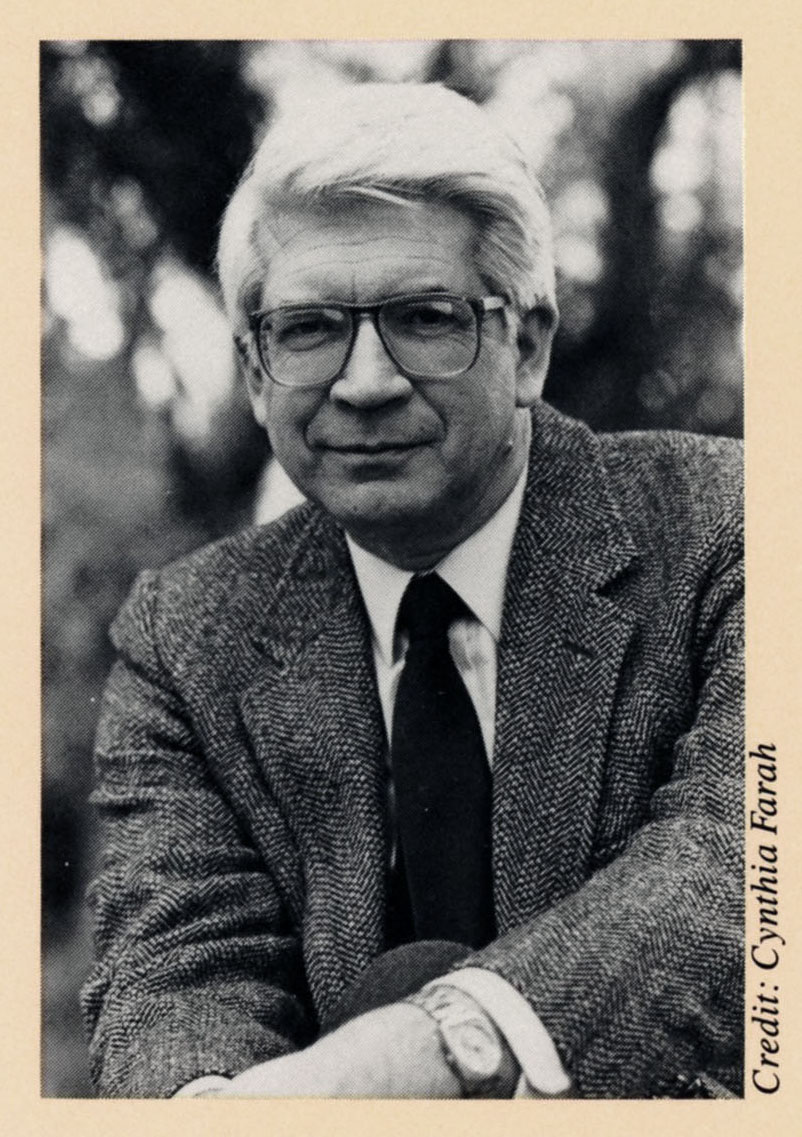
Larry Brown (Photo by Susie James)

The Victim, by Saul Bellow – 1958 (1975) [Barbra Bergman]

In a general way, anyone could see that there was great unfairness
in one man’s having all the comforts of life while another had nothing.
But between man and man, how was this to be dealt with?
Any derelict panhandler or bum might buttonhole you on the street and say,
“The world wasn’t made for you any more than it was for me, was it?”
The error in this was to forget that neither man had made the arrangements,
and so it was perfectly right to say,
“Why pick on me?
I didn’t set this up any more than you did.”
Admittedly there was a wrong, a general wrong.
Allbee, on the other hand, came along and said, “You!” and that was what was so meaningless.
For you might feel that something was owing to the panhandler,
but to be directly blamed was entirely different.

“Why?” Leventhal involuntarily repeated.  He was bewildered.
“Because you’ve got to blame me, that’s why,” said Allbee.
“You won’t assume that it isn’t entirely my fault.
It’s necessary for you to believe that I deserve what I get.
It doesn’t enter your mind, does it –
that a man might not be able to help being hammered down?
What do you say?
Maybe he can’t help himself?
No, if a man is down, a man like me, it’s his fault.
If he suffers, he’s being punished.
There’s no evil in life itself.
And do you know what?
It’s a Jewish point of view.
You’ll find it all over the Bible.
God doesn’t make mistakes.
He’s the department of weights and measures.
If you’re okay, he’s okay, too.
That’s what Job’s friends come and say to him.
But I’ll tell you something.
We do get it in the neck for nothing and suffer for nothing,
and there’s no denying that evil is as real as sunshine.
Take it from me, I know what I’m talking about.
To you the whole thing is that I must deserve what I get.
That leaves your hands clean and it’s unnecessary for you to bother yourself.
Not that I’m asking you to feel sorry for me,
but you sure can’t understand what makes a man drink.”

Mr. Benjamin shrugged his shoulders.
“We have to live today,” he said.
“If you had a son, Harkavy, you’d want him to have a college education.
Who’s going to wait for the Messiah?
They tell a story about a little town in the old country.
It was out of the way,
in a valley,
so the Jews were afraid the Messiah would come and miss them,
and they built a high tower and hired one of the town beggars to sit in it all day long.
A friend of his meets this beggar and he says, ‘How do you like your job, Baruch?’
So he says, ‘It doesn’t pay much, but I think it’s steady work.’”

– Saul Bellow –

Mister Roberts, by Thomas Heggen – 1958 [Harvey Kidder]

He read a great deal, being embarked upon an ambitious program of self-improvement. 
By education Pulver was a metallurgical engineer,
and now read books that he had widely and willingly evaded during his college days. 
He read these books because they were the books that Lieutenant Roberts read;
consciously or not, Ensign Pulver had set out to make himself over in Roberts’ image. 
With regard to most objects, people, ideas, Pulver was languidly cynical;
with a few he was languidly approving, and with almost none he was overtly enthusiastic. 
His admiration for Roberts was utterly unabashed. 
He thought that Roberts was the greatest guy he had ever known. 
He prodded him with questions on every conceivable subject,
memorized the answers,
then went back to the bunk and assiduously absorbed them into his own conversation. 
He watched the careless, easy dignity with which Roberts met the crew,
and studied the way that Roberts got the crew to work for him;
and then he tried to apply this dignity and this control to his own small authority. 
Being honest with himself,
he couldn’t notice any increased devotion in the eyes of the men;
or indeed, anything more than the usual tolerance. 
It is not very likely that Ensign Pulver would ever have read Santayana,
or the English philosophers,
or Jean Christophe,
or The Magic Mountain,
if he had not seen Roberts reading them. 
Before this self-imposed apprenticeship,
he had been content to stay within the philosophical implications of God’s Little Acre
He had read God’s Little Acre twelve times,
and there were certain passages he could recite flawlessly.

When the girls came aboard that night,
escorted by the two officers,
 the entire crew was massed along the rail and up on the bridges.
As the white-stockinged legs tripped up the gangway,
one great, composite, heart-felt whistle rose to the heavens and hung there.
Ensign Pulver’s girl, Miss Girard, had turned out to be a knockout.
At dinner in the wardroom he could scarcely keep his eyes off her,
and no more could the other officers,
who feigned eating and made self-conscious conversation.
Miss Girard had lovely soft blond hair which she wore in bangs,
wide blue innocent eyes, and the pertest nose there ever was.
The total effect was that of radiant innocence; innocence triumphant.
Only Ensign Pulver noted that when she smiled her eyes screwed up shrewdly
and her mouth curved knowingly; but then only Ensign Pulver would.

– Thomas Heggen –

Mr. Sammler’s Planet, by Saul Bellow – 1969 (1977) [Roy Ellsworth]

And since he had lasted –
survived –
with a sick headache –
he would not quibble over words –
was there an assignment implicit? 
Was he meant to do something?

______________________________

“During the war I had no belief, and I had always disliked the ways of the Orthodox.
I saw that God was not impressed by death.
Hell was his indifference.
But inability to explain is no ground for disbelief.
Not as long as the sense of God persists.
I could wish that it did not persist.
The contradictions are so painful.
No concern for justice?
Nothing of pity?
Is God only the gossip of the living?
Then we watch these living speed like birds over the surface of a water,
and one will dive or plunge but not come up again and never be seen any more.
And in our turn we will never be seen again,
once gone through that surface.
But then we have no proof that there is no depth under the surface.
We cannot even say that our knowledge of death is shallow.
There is no knowledge.
There is longing, suffering, mourning.
These come from need, affection, and love –
the needs of the living creature, because it is a living creature.
There is also strangeness, implicit.
There is also adumbration.
Other states are sensed.
All is not flatly knowable.
There would never have been any inquiry without this adumbration,
there would never have been any knowledge without it.
But I am not life’s examiner, or a connoisseur, and I have nothing to argue.
Surely a man would console, if he could.
But that is not an aim of mine.
Consolers cannot always be truthful.
But very often, and almost daily, I have strong impressions of eternity.
This may be due to my strange experiences, or to old age.
I will say that to me this does not feel elderly.
Nor would I mind if there were nothing after death.
If it is only to be as it was before birth, why should one care?
There one would receive no further information.
One’s ape restiveness would stop.
I think I would miss mainly my God adumbrations in the many daily forms.
Yes, that is what I should miss.
So then, Dr. Lai, if the moon were advantageous for us metaphysically, I would be completely for it.
As an engineering project, colonizing outer space,
except for the curiosity, the ingenuity of the thing,
is of little real interest to me.
Of course the drive, the will to organize this scientific expedition must be one of those irrational necessities that make up life –
this life we think we can understand.
So I suppose we must jump off, because it is our human fate to do so.
If it were a rational matter, then it would be rational to have justice on this planet first.
Then, when we had an earth of saints, and our hearts were set upon the moon,
we could get in our machines and rise up …”
(236-237)

Margotte had much to say.
She did not notice his silence.

By coming back, by preoccupation with the subject,
the dying, the mystery of dying, the state of death.
Also, by having been inside death.
By having been given the shovel and told to dig.
By digging beside his digging wife.
When she faltered he tried to help her.
By this digging, not speaking, he tried to convey something to her and fortify her.
But as it had turned out, he had prepared her for death without sharing it.
She was killed, not he.
She had passed the course, and he had not.
The hole deepened, the sand clay and stones of Poland, their birthplace, opened up.
He had just been blinded, he had a stunned face,
and he was unaware that blood was coming from him
till they stripped and he saw it on his clothes.
When they were as naked as children from the womb,
and the hole was supposedly deep enough, the guns began to blast,
and then came a different sound of soil.
The thick fall of soil.
A ton, two tons, thrown in.
A sound of shovel-metal, gritting.
Strangely exceptional, Mr. Sammler had come through the top of this.
It seldom occurred to him to consider it an achievement.
Where was the achievement?  He had clawed his way out.
If he had been at the bottom, he would have suffocated.
If there had been another foot of dirt.
Perhaps others had been buried alive in that ditch.
There was no special merit, there was no wizardry.
There was only suffocation escaped.
And had the war lasted a few months more, he would have died like the rest.
Not a Jew would have avoided death.
As it was, he still had his consciousness, earthliness, human actuality –
got up, breathed his earth gases in and out, drank his coffee,
consumed his share of goods, ate his roll from Zabar’s, put on certain airs –
all human beings put on certain airs – took the bus to Forty-second Street
as if he had an occupation, ran into a black pickpocket.
In short, a living man.
Or one who had been sent back again to the end of the line.
Waiting for something.
Assigned to figure out certain things, to condense, in short views,
some essence of experience, and because of this having a certain wizardry ascribed to him.
There was, in fact, unfinished business.
But how did business finish?
We entered in the middle of the thing and somehow became convinced that we must conclude it.
How? 

– Saul Bellow –

The Coming Triumph of the Free World, by Rick DeMarinis – 1988 [Anne Bascove]

Contents

The Handgun

Disneyland, from Antaeus

Culture Shock

Romance: A Prose Villanelle

Your Story

The Coming Triumph of the Free World (originally titled “Rick DeMarinis to Q”), from The Quarterly

The Swimmer in Hard Light (originally titled “The Swimmer”), from The Malahat Review

The Flowers of Boredom, from The Antioch Review

Pagans, from Harper’s Magazine

Mole, from Harper’s Magazine

Queen (originally titled “Tenderloin”) from Colorado State Review

Your Burden Is Lifted, Love Returns

Red Chair

Medicine Man, from The Atlantic

________________________________________

“What I am telling you is that there is a great dark …
consensus
that sweeps things along to their inevitable conclusion. 
There is an intelligence behind it, but, believe me, it is not human. 
It is the intelligence of soil, the thing that lifts trees and flowers out of the ground. 
I am too astonished and thrilled to be frightened by it.”

Lamar saw, even then, that Randy Voss was crazy,
but what he had said made a lasting impression.
And over the years he has come to adopt Voss’s idea as his own.
But it was something he was unable to talk about to anyone else,
not even his wife.
How could you convince anyone that in this industry no single individual,
or group of individuals,
suspects the existence of a vital sub-rosa mechanism
that produces and deploys our beautifully elegant weapons?
How could you say to someone that the process is holistic,
that a headstrong organic magic is at work,
or that a god presides?

(From “The Flowers of Boredom” (first published in Antioch Review, Winter, 1988)

Give Us This Day, by Sidney Stewart – 1958 [Harry Scharre?] [Revised post]

(This post has been updated to include the back cover of the 1958 paperback edition of Give Us This Day, as well as the front cover of the 1990 edition. (Scroll to bottom.))

Manila:
December 1941

IN THE LAND where dead dreams go lies the city of Manila,
as it was before the war.
Manila, where the white man didn’t work in the afternoon because it was too hot.
Manila, with its beauty and its poverty and its orchids at five cents apiece.

What could a soldier do with a handful of orchids
if he had no one to give them to?
I used to buy those orchids.
I’d pay my nickel for them and stand there awkwardly holding them in my hand.
I would run my finger over the satin petals and then,
embarrassed,
I would give them to the first little girl I met,
because there was something very lonely about buying orchids
when you had no one to give them to.

____________________

I began to plan the things I wanted to do when I went home.
The promises I had made to the boys about seeing their parents.
I thought of the things that home meant to me.
The things that freedom, and being home, would mean.
I thought of seeing women again, white women,
and being again where people laughed,
where laughter was good and life was good.

I wondered if ever again things would worry me. 
I thought what I would do with my life. 
I had never asked to live, but God had spared me. 
Now I knew there was an obligation within me to justify my life. 
I must do something.

My mind wandered back to the times
when Rass and John and Weldon and Hughes
sat together around the fire in the evenings. 
We talked about the things we wanted to do
when we were free and we were home again. 
Rass had wanted to go into the diplomatic service. 
John had wanted to be a professor again.

“I’m going to be a writer,” I said. 
“I’m going to write novels.”

We used to laugh about it. 
They were interested in the things I wanted to write about. 
Once, when we were very hungry, John had turned to me.

“Some day, Sid, I wish you’d put me in one of your books.”

“Yes, Stew,” Rass said. 
“I wish you’d write a book about this, about all of us. 
Will you?  
Could you do that for us one day?  
Write a book about all of us. 
Something that we could keep.”

I remembered what I had promised them.
I would write a book about them some day.
But I felt cold inside and I thought, “No, they’ll never read that book now,
 that book I’m going to write about them.
About their faith and hopes, their goodness and their beliefs.”

______________________________

Biographical blurb about Sidney Stewart, from the jacket of the book’s hardcover (1957) edition.

______________________________

1990 edition of Give Us This Day.  Artist? – unknown.

Astounding Science Fiction, August, 1954 (Featuring “They’d Rather Be Right,” by Mark Clifton and Frank Riley, and, “The Cold Equations,” by Tom Godwin) [Frank Kelly Freas]

Tom Godwin’s short story “The Gulf Between” was a cautionary tale about using computer technology to supplant human decision-making, set within the overlapping contexts of the creation of the ultimate (robotic) soldier, and, mans’ first venture into space.  Godwin’s “The Cold Equations” is different:  The story is a stunning exploration of the classical philosophical dilemma of balancing the life of one, versus the life of many, set within the frontier of a future space-faring civilization. 

Though the latter tale is far better known within and even beyond the genre of science-fiction, the cord linking the two stories being Godwin’s adept use of an imagined future as the setting for confronting and resolving – in a deeply unsettling, unflinching manner – questions of man’s uniqueness, and, the inherent spiritual value of the individual.  Though the stories are (unsurprisingly) somewhat dated on technological grounds – well, they were written over a half-century ago – overall, the writing is tight, crisp, and direct, their length belying their impact and the import of their underlying themes. 

“The Cold Equations” has been adapted for radio, television, and web formats, testimony to the tale’s power and literary merit.  Similarly, the story has been anthologized many times, one example being in volume one of the Science Fiction Hall of Fame, published in November of 1972.

The story, scripted by George Lefferts and with the roles of pilot Barton and passenger Marilyn voiced by Court Benson and Jill Meredith, was broadcast as episode 15 of the X Minus One radio program on August 8, 1955.  The play can also be downloaded from Archive.org

The two television versions of the story comprise the Twilight Zone production of January 7, 1989 (available on YouTube), and the FilmRise / Alliance Atlantis movie of December 7, 1996, the latter receiving widely varying reviews at both IMDB and Amazon. 

Oddly, the several YouTube versions of the Twilight Zone version manifest the same strange problem: About one hour long, all are comprised of three copies of the episode “spliced” together, whereas the actual episode – without commercial breaks – is only 21 minutes long. 

Though appearing under a different title – “Stowaway” – the DUST YouTube channel’s version of The Cold Equations, released on April 7, 2018, is a superb rendering of Godwin’s story, the brevity (12 minutes) and pacing of the film closely paralleling the feel of the original story.  The acting is excellent (the CG, too), but (?!) the names of the actor and actress are not presented. 

______________________________

Though Frank Kelly Freas’ illustrations and cover art were often whimsical, humorous, and – at least in his early years – highly creative (the cover is superb!), such qualities would not have befitted art accompanying “The Cold Equations”.  Thus, the images of Barton and Marilyn are aptly subdued and pensive, while the leading image – a simple depiction of a spacecraft which seems to have jettisoned an unidentified “something” as it approaches a planet in crescent phase – symbolizes the central aspect of the story.  These appear below, accompanied by key passages from the story, which is available in full text at LightSpeedMagazine

______________________________

He began to check the instrument readings,
going over them with unnecessary slowness. 
She would have to accept the circumstances
and there was nothing he could do to help her into acceptance;
words of sympathy would only delay it.

It was 18:20 when she stirred from her motionlessness and spoke.

“So that’s the way it has to be with me?”

He swung around to face her. 
“You understand now, don’t you? 
No one would ever let it be like this if it could be changed.”

“I understand”, she said.
Some of the color had returned to her face
and the lipstick no longer stood out so vividly red.
“There isn’t enough fuel for me to stay;
when I hid on this ship I got into something I didn’t know anything about
and now I have to pay for it.”
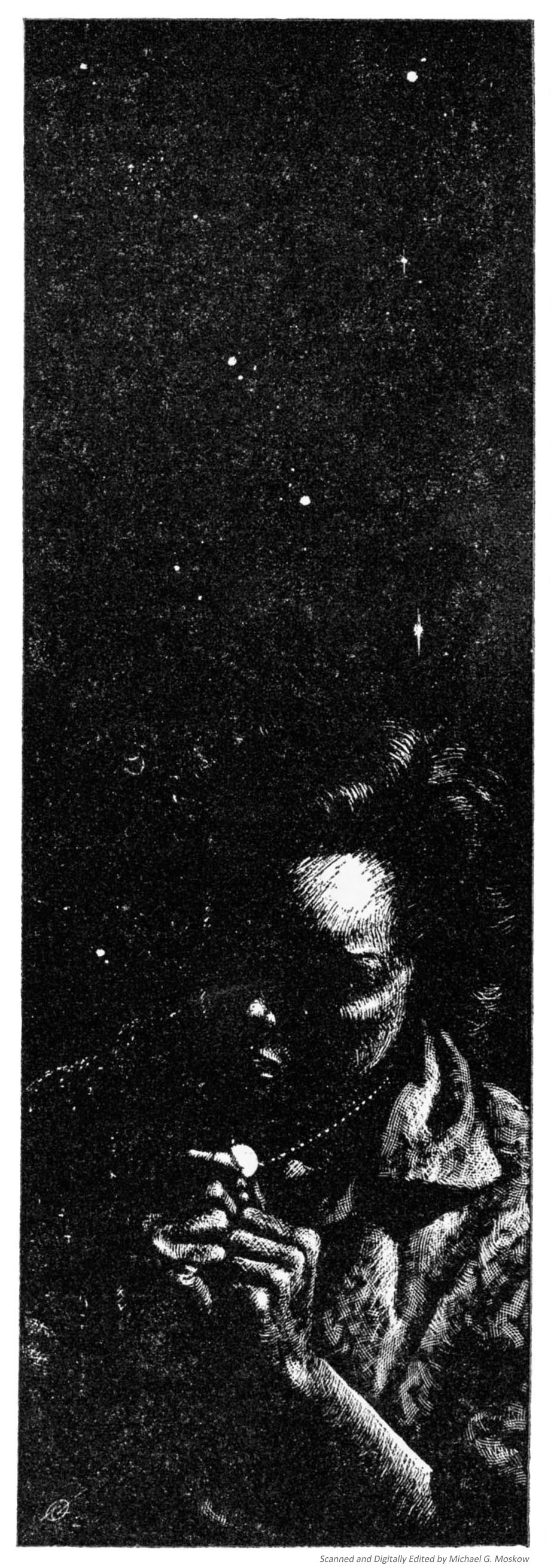
She had violated a man-made law that said KEEP OUT
but the penalty was not of man’s making or desire
and it was a penalty men could not revoke.
A physical law had decreed:
h amount of fuel will power an EDS with a mass of m safely to its destination;
and a second physical lad had been decreed:
h amount of fuel will not power an EDS  with a mass of m plus x safely to its destination.

EDSs obeyed only physical laws
and no amount of human sympathy for her could alter the second law.

“But I’m afraid.
I don’t want to die – not now.
I want to live and nobody is doing anything to help me
everybody is letting me go ahead and acting just like nothing was going to happen to me.
I’m going to die and nobody cares.”

“We all do,” he said. 
“I do and the commander does and the clerk in Ship’s Records;
we all care and each of us did what little he could to help you. 
It wasn’t enough – it was almost nothing – but it was all we could do.”

“Not enough fuel – I can understand that,” she said,
as though she had not heard his own words.
“But to have to die for it.
Me, alone –

How hard it must be for her to accept the fact.
She had never known danger of death;
had never known the environments where the lives of men could be as fragile
as sea foam tossed against a rocky shore.
She belonged on gentle Earth,
in that secure and peaceful society where she could be young and gay and laughing
with the others of her kind;
where life was precious and well-guarded
and there was always the assurance that tomorrow would come.
She belonged in that world of soft winds and warm suns,
music and moonlight and gracious manners
and not on the hard, bleak frontier. 

— Tom Godwin —
— 1954 —

The Voice of America, by Rick DeMarinis – 1991 [Anne Bascove]

“…a second chance is the sweetest blessing any of us can hope for.”

Contents

Safe Forever, from Story

Desert Place, from Epoch

Paraiso: An Elegy, from The Georgia Review

God Bless America

An Airman’s Goodbye, from The Paris Review

Aliens, from Antioch Review

Horizontal Snow, from Story

Fidelity

Infidelity

The Whitened Man, from Vox

Wilderness, from Epoc

The Voice of America, from Cutbank

Insulation, from Harper’s Magazine

Her Alabaster Skin

Rudderless Fiction: Lesson 1 (A Correspondence Course), from Harper’s Magazine

________________________________________

How people could lie to themselves,
and believe it,
was the miracle of human life as far as I was concerned. 
(from “The Voice of America”, p. 177)

He’s on a mission of wild truth-seeking. 
He thinks he can solve his life if he keeps telling it. 
(from “Rudderless Fiction: Lesson 1”, p. 208)

A story should not mean; at best it should be meant.
(from “Rudderless Fiction: Lesson 1”, p. 213)

– Rick DeMarinis –

Damon Runyon Favorites, by Damon Runyon – 1946 [Unknown Artist]

Contents

Butch Minds the Baby
Lillian
A Very Honorable Guy
Madame La Gimp
The Hottest Guy in The World
Bred for Battle
A Story Goes With It
Sense of Humor
Undertaker Song
That Ever-Living Wife of Hymie’s
The Brakeman’s Daughter
Little Miss Marker
Dancing Dan’s Christmas
Princess O’Hara
________________________________________

“Sense of Humor”

No one in the world can give a hot foot as good as Joe the Joker, because it takes a guy who can sneak up very quiet on the guy who is to get the hot foot, and Joe can sneak up so quiet many guys are willing to lay you odds that he can give a mouse a hot foot if you can find a mouse that wears shoes.  Furthermore, Joe the Joker can take plenty care of himself in case the guy who gets the got foot feels like taking the matter up, which sometimes happens, especially with guys who get their shoes made to order at forty bobs per copy and do not care to have holes burned in these shoes.

But Joe does not care what kind of shoes the guys are wearing when he feels like giving out hot foots, and furthermore, he does not care who the guys are, although many citizens think he makes a mistake the time he gives a hot foot to Frankie Ferocious.  In fact, many citizens are greatly horrified by this action, and go around saying no good will come of it.

This Frankie Ferocious comes from over in Brooklyn where he is considered a rising citizen in many respects and by no means a guy to give a hot foots to, especially as Frankie Ferocious has no sense of humor whatever.  In fact, he is always very solemn, and nobody ever sees him laugh, and he certainly does not laugh when Joe the Joker gives him a hot foot one day on Broadway when Frankie Ferocious is standing talking over a business matter with some guys from the Bronx.

He only scowls at Joe, and says something in Italian, and while I do not understand Italian, it sounds so unpleasant that I guarantee I will leave town inside of the next two hours if he says it to me.

– Damon Runyon –